

If you’re a runner, you know the feeling. That familiar, frustrating ache creeping into your lower legs can stop a great run in its tracks. When your calves hurt from running, it’s more than just a minor inconvenience—it’s a roadblock that can throw your whole training schedule off course and crush your motivation.
The thing is, most calf pain is predictable. And more importantly, it's preventable.
Your Guide to Understanding and Treating Calf Pain From Running
The primary reason your calves hurt after a run is usually straightforward: they've been pushed beyond their current capacity. Whether from overuse, muscle fatigue, or a sudden jump in training intensity, that pain is a clear signal from your body's powerhouse muscles that they need a break.
This guide is your complete roadmap to figuring out why your calves are hurting and what to do about it. We’ll walk through everything from the root causes to the practical steps you need to take to get back on your feet—and stay there.
Our goal is to give you clear, actionable solutions to help you become a smarter, more resilient runner. We'll cover:
- Why your calves are so susceptible to injury in the first place.
- Immediate, effective steps for pain relief right after your run.
- A structured approach to rehab and strengthening exercises.
- Proactive strategies to keep your calves strong and healthy for the long haul.
Quick Symptom Checker
To get started, let's try to pinpoint where your discomfort is coming from. Calf pain isn't a one-size-fits-all issue; how it feels and where it’s located can offer big clues about the underlying cause.
Think of yourself as a detective investigating your own body. Is the pain a dull, widespread ache or a sharp, localized twinge? Is it high up near your knee or down low by the Achilles? Answering these questions helps you and your healthcare provider narrow down the possibilities and get you on the right recovery path.
Use the table below as a starting point to compare your symptoms and get a better handle on what might be going on.
Quick Symptom Checker For Runner's Calf Pain
Use this table to help identify the potential cause of your calf pain based on common symptoms, location, and what the pain feels like.
| Potential Cause | Pain Location | Pain Sensation | Common Trigger |
|---|---|---|---|
| Muscle Fatigue/DOMS | General calf area | Dull, aching soreness | A longer or harder run than usual; often felt 24-48 hours later. |
| Gastrocnemius Strain | Upper, bulky part of the calf | Sharp, sudden pain or pulling | A sudden burst of speed, sprinting, or pushing off forcefully. |
| Soleus Strain | Deeper, lower part of the calf | Deep, persistent ache that can feel like shin splints | Long-distance, steady-state running; often develops gradually. |
| Dehydration/Cramps | Anywhere in the calf | Sudden, tight, and intense spasming | Long runs in heat, inadequate fluid or electrolyte intake. |
This quick check is the first step. Once you have a better idea of what you might be dealing with, you can move on to the right strategies for immediate relief and long-term prevention.
Why Your Calves Hurt After Running: A Deeper Look
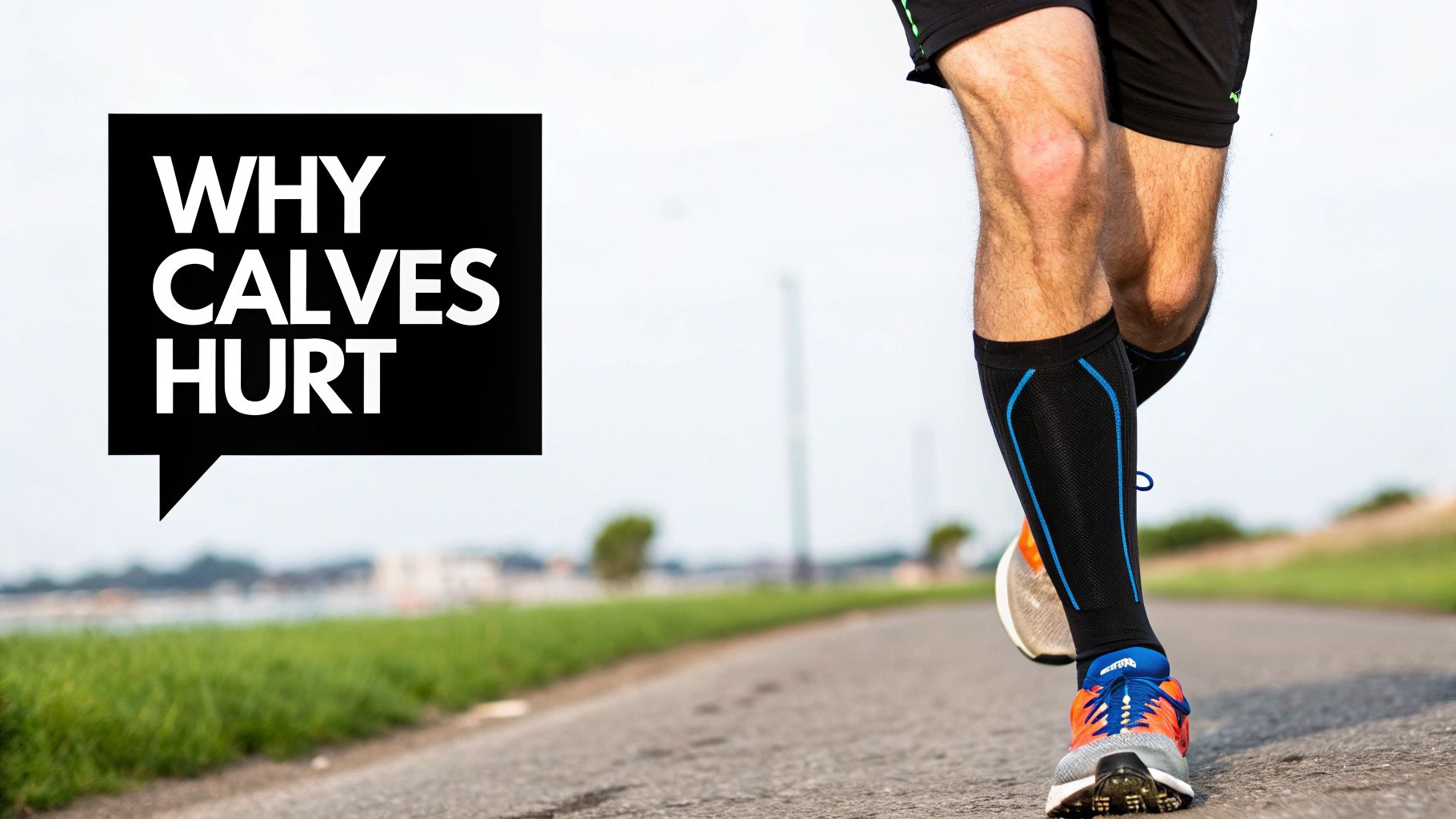
To really get why your calves are screaming after a run, you need to think of them as the high-performance engine of your lower legs. This engine has two key parts working in tandem: the gastrocnemius and the soleus. Each has a specific job, and when pain pops up, it’s usually because one part is being pushed too hard or has a mechanical issue.
The gastrocnemius is that big, visible muscle that gives your calf its classic diamond shape. This is your power muscle, the one you rely on for explosive movements like sprinting, jumping, or that final push-off in your stride. It's built for speed and force.
Tucked underneath it is the soleus, a flatter, wider muscle that stretches down your lower leg. Think of the soleus as your endurance workhorse. It’s what carries you through long-distance runs, provides critical ankle stability, and tirelessly soaks up the impact, step after punishing step.
The Most Common Reasons for Engine Failure
When this calf engine breaks down, it’s rarely out of the blue. The pain you’re feeling is a direct signal that the stress on your muscles has officially exceeded their ability to cope. Here are the usual suspects.
1. Simple Overuse and Fatigue Honestly, this is the most common culprit. You just asked your calves to do more than they were ready for. Ramping up your mileage or intensity too quickly doesn't give these muscles the time they need to adapt and get stronger, leading to that deep, nagging ache.
2. Muscle Strains (Micro-Tears) A strain is what happens when muscle fibres are stretched past their limit and actually tear. These can range from tiny micro-tears (Grade 1) all the way to a full-blown rupture (Grade 3). A sudden, sharp pain during a sprint often points to a gastrocnemius strain, while a dull, deep ache that slowly builds over time is more typical of a soleus problem.
3. Biomechanical Inefficiencies If your running form is even a little bit off, you can put a ton of uneven load on your calves. For instance, overstriding—landing with your foot way out in front of your body—forces your calf to act like a brake, absorbing a massive amount of shock. In the same way, weak glutes or a weak core can make your calves overcompensate, forcing them to do a job they were never designed for.
The Ripple Effect of Running Injuries in Canada
Calf pain isn’t just your problem; it’s a huge issue for runners all across the country. Running-related injuries are incredibly common. An Ontario-based study that followed runners for a year found that 48% sustained at least one injury.
Other studies show that the calf and Achilles tendon region accounts for up to 25% of all running injuries. So, if your calves are hurting, you are definitely not alone. Even more concerning, if you've been injured before, there's nearly a 50% risk of that injury coming back, which really drives home how important proper recovery and prevention are. You can read the full research on running injury patterns to see just how widespread these issues are.
When you ignore the small signals, your body sends bigger ones. A slight ache after one run can become a sharp strain on the next if you don't address the root cause. Listening to your body isn't about being cautious—it's about being smart.
How Training Habits Contribute to Calf Pain
What you do before, during, and after your run has a massive impact on your calf health. A few common missteps can lead directly to the pain you're feeling.
- Sudden Changes: Abruptly switching from flat roads to a hilly route forces your gastrocnemius into overdrive without any prep time.
- Improper Footwear: Worn-out shoes have lost their cushioning and support, which means more impact shock gets transferred straight to your lower legs. A sudden switch to minimalist shoes with a lower heel-to-toe drop can also dramatically increase the load on your calves and Achilles.
- Dehydration and Imbalance: Your muscles need water and electrolytes like sodium and potassium to fire correctly. When you're running low, it can lead to the dreaded calf cramp—that sudden, involuntary, and incredibly painful muscle contraction.
Understanding these factors is the first real step toward finding a solution. The pain isn't random; it's a symptom of a specific breakdown in your body's system. By figuring out the 'why,' you can finally move on to the 'how' of getting real relief and preventing it from happening again.
Finding Immediate Relief for Sore Calves After a Run
When your calves are screaming after a run, the last thing you want is a complicated recovery plan. You need simple, effective steps that bring relief right now. The first 24 to 48 hours are crucial for calming down those angry muscles, knocking back inflammation, and setting the stage for a quick return to the road.
Think of this as your first-aid toolkit for immediate action. The foundation is the classic R.I.C.E. protocol—Rest, Ice, Compression, and Elevation. It might sound basic, but each part plays a powerful and specific role in managing that initial pain and swelling. You’re essentially hitting the emergency brake on the inflammatory process before it gets out of control.
This initial response is what prevents a minor ache from blowing up into a significant strain that could sideline you for weeks.
Your First-Aid Action Plan
Your first priority is to get those initial symptoms under control and give your body what it needs to start healing.
-
Rest: This is completely non-negotiable. Trying to push through the pain is a surefire recipe for a more severe injury. Rest means no running and steering clear of any other high-impact activities that put stress on your calves.
-
Ice: Applying a cold pack for 15-20 minutes every few hours helps constrict blood vessels. This is the key to reducing inflammation and numbing those sharp pain signals. Just remember to never put ice directly on your skin—wrap it in a thin towel first.
-
Compression: Using a compression sleeve or an elastic bandage helps keep swelling in check by preventing fluid from pooling in the muscle tissue. It should feel snug, but not so tight that it’s cutting off your circulation.
-
Elevation: Prop your leg up on a few pillows so it’s above the level of your heart. This simple trick uses gravity to help drain excess fluid away from the injured area, which helps bring down the swelling even more.
The Power of Targeted Topical Relief
While R.I.C.E. is fantastic for handling the swelling, you also need a direct way to manage the pain itself. This is where a topical analgesic becomes an invaluable tool in your recovery kit. Instead of waiting for a pill to make its way through your system, a topical product goes right to the source of the discomfort.
A product like MEDISTIK's Extra Strength Spray or Dual Action Stick is built for exactly this situation. The cooling ingredients, like menthol, create a sensation that helps override the pain signals being sent to your brain. It’s immediate, targeted relief that helps you manage the discomfort effectively. For a deeper dive, you can learn more about the benefits of topical versus oral pain relievers in our detailed guide.
When your calves hurt from running, topical analgesics act like a local anesthetic for your muscles. They calm the nerve endings right where you apply them, offering fast-acting relief without the systemic effects of oral medication.
Heat, Cold, or Both? What to Use and When
Knowing when to reach for ice versus heat is a game-changer for effective self-care. It’s a common point of confusion, but the rule of thumb is pretty simple.
-
Cold Therapy (Ice): Use ice during the first 48-72 hours after the pain pops up. Cold is your best friend for acute inflammation and swelling. It constricts blood vessels, which limits internal bleeding and calms that initial inflammatory response.
-
Warmth Therapy (Heat): Once that initial fiery phase has passed (usually after 72 hours), gentle warmth can be incredibly helpful. A warm compress or, for some all-over muscle relaxation, a warm bath with an Epsom salt recovery bath soak can increase blood flow to the area. This helps deliver fresh oxygen and nutrients to support healing and ease any lingering muscle tightness.
By combining the timeless R.I.C.E. method with the modern effectiveness of a high-quality topical analgesic, you’ve got a powerful one-two punch against immediate calf pain. This proactive approach not only makes you more comfortable but also lays the groundwork for the important rehab and strengthening to come.
How to Rehabilitate and Strengthen Your Calves for Running
Getting immediate relief is just the first step. The real prize is building powerful, resilient calves that can take the pounding of a run without giving out. This takes a smart, step-by-step rehab plan that eases you from recovery back to running at full strength.
One of the biggest mistakes I see runners make is rushing this process, which almost always leads to the same injury popping up again and again.
Think of it like rebuilding a bridge. You wouldn't just lay the foundation and immediately let traffic flood over it. First, you make sure the structure is stable (that's your mobility work). Then, you add the heavy-duty support beams (that’s strength training). Only then do you slowly, gradually let traffic back on (that's load management). Your calves need that same patient, structured approach.
And this isn’t just about your lower legs. Your calves are part of a connected system—what we call the kinetic chain. If your glutes or core are weak, your calves are forced to pick up the slack, leading to overload and pain. A solid rehab plan strengthens the whole support crew, not just the one player that got hurt.
Phase 1: Gentle Mobility and Activation
After that initial, sharp pain has settled down, the first thing you need to do is gently restore movement and wake the muscles back up. The focus here is on achieving a pain-free range of motion, not aggressive, painful stretching. All we want to do is encourage blood flow and stop the muscle from getting stiff and short as it heals.
A few effective movements to start with are:
- Ankle Circles: Gently rotate your ankle clockwise, then counter-clockwise. This improves mobility without putting any real stress on the calf muscle itself.
- Alphabet Writing: While sitting, use your big toe to trace the letters of the alphabet in the air. This encourages your ankle to move in every direction.
- Foam Rolling: Use a foam roller to gently massage the calf muscle. This can help release some of that tightness and break up minor knots. Just be sure to avoid rolling directly over any spots that are still acutely painful.
This simple framework shows you how to handle the initial response to calf pain, which is what you do before you even think about starting rehab.
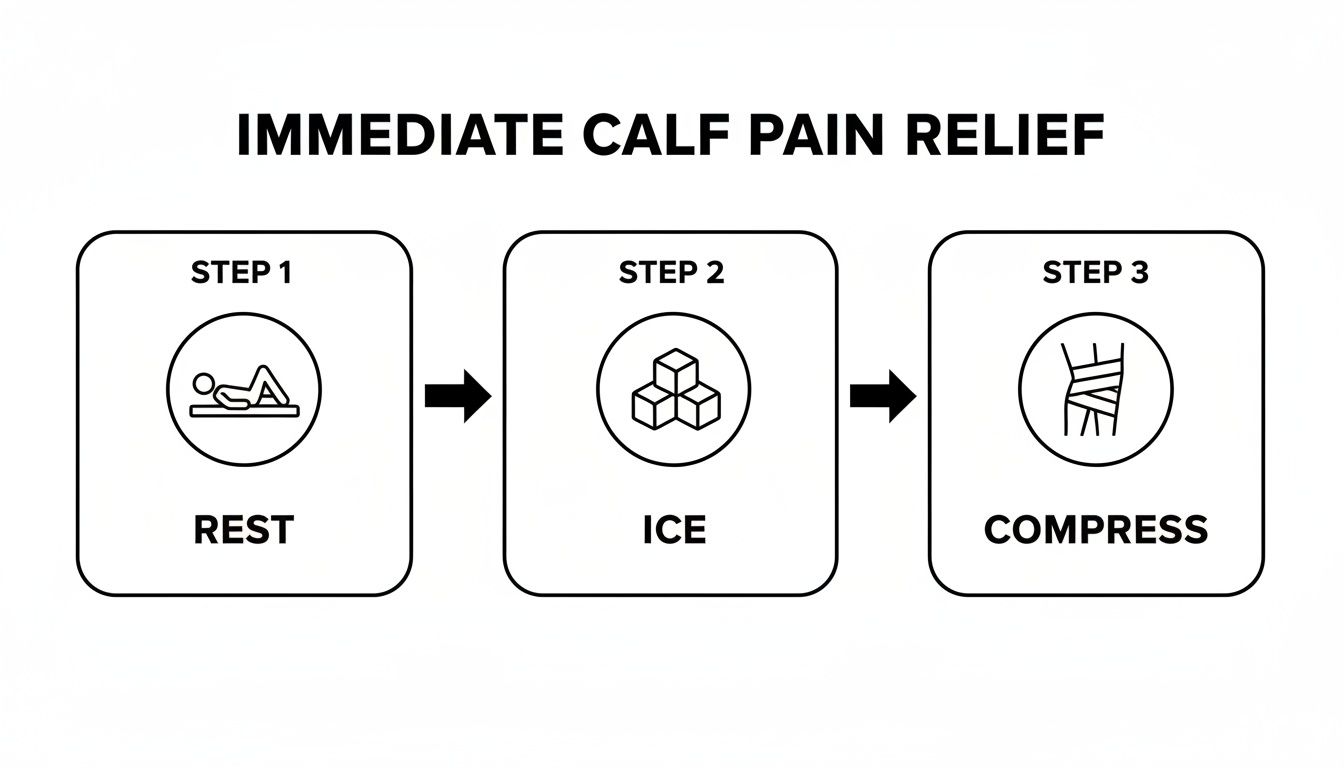
Those first steps—rest, ice, and compression—are absolutely crucial for getting inflammation under control before you begin any active rehab work.
Phase 2: Building Foundational Strength
Once you can move your ankle without pain, it’s time to start adding some strength back into the equation. This is hands-down the most critical phase for preventing this from happening again.
Calf muscle strains are incredibly common in running, and they have a frustratingly high recurrence rate of around 16%. That's why building robust strength is completely non-negotiable. For a deeper dive, you can check out our detailed guide on how to heal a calf strain quickly for a complete recovery plan.
Your calf is actually made of two main muscles, and you need to strengthen both:
- Straight-Knee Calf Raises: Stand on a flat surface and slowly raise your heels off the ground. Pause at the top, then slowly lower back down. This one primarily targets the big, powerful gastrocnemius muscle. Aim for 3 sets of 15-20 repetitions.
- Bent-Knee Calf Raises: Do the exact same movement, but this time with your knees slightly bent. This simple tweak shifts the focus to the deeper soleus muscle—your endurance workhorse. This muscle is so often neglected, yet it's absolutely crucial for long-distance runners.
Key Takeaway: Ignoring the soleus is a classic runner's mistake. It’s responsible for absorbing so much impact during long runs, so a weak soleus is a primary cause of that deep, aching calf pain that seems to build and build over time.
For pain that is particularly severe or just won't go away, getting professional help is key. Options like physiotherapy at home can give you a tailored rehab program to guide your recovery and strengthening.
Phase 3: Gradual Load Management
With your strength coming back, the final phase is all about reintroducing the stress of running in a controlled, gradual way. This is what we call load management.
Think of your calf's capacity as a bucket. If you pour too much "stress" (running volume and intensity) into it too quickly, it's going to overflow, and you'll end up re-injured. The goal is to slowly make that bucket bigger over time.
Start with a walk/run program. For example, you might begin with 5 rounds of walking for 4 minutes and running for just 1 minute. If that feels good, you can slowly increase the running bits and decrease the walking bits in your next few sessions. This approach lets your calves adapt to the impact of running without getting overwhelmed. The Ontario running cohort study even pinpointed rapid increases in training volume as a major risk factor, which just shows why this gradual approach is so important.
By moving through these phases patiently, you're doing more than just healing an injury. You’re building stronger, more resilient calves that are ready to tackle your running goals for years to come.
Smart Prevention Strategies to Keep Your Calves Healthy
The best way to deal with calf pain? Make sure it never happens in the first place. Shifting your mindset from reactive recovery to proactive prevention is the secret to logging consistent, uninterrupted miles. It all comes down to building smarter habits around your training, from how you prep for a run to the shoes on your feet.
Think of it as routine maintenance for your body. You wouldn't skip an oil change and expect your car to run forever, right? These strategies are your checklist to keep your calf muscles firing smoothly and efficiently, run after run.
A few smart, consistent habits can be the difference between constantly fighting soreness and enjoying pain-free mileage.
Setting the Stage for Success Before and After Your Run
How you start and finish every run has a massive impact on your muscle health. Honestly, skipping these crucial steps is one of the fastest ways runners find themselves sidelined with injuries that were totally preventable.
The Non-Negotiable Warm-Up Hitting the pavement with cold, stiff muscles is like trying to stretch a cold rubber band—you’re just asking for something to snap. A solid warm-up is all about gradually increasing blood flow, raising your muscle temperature, and getting your brain and muscles talking to each other for the work ahead.
- Dynamic Stretches: Before you run, focus on movements that take your muscles through their full range of motion. We’re talking leg swings, walking lunges, and high knees. These actively switch on the exact muscles you’re about to use.
- Pre-Run Priming: Especially in those colder Canadian climates, applying a warming topical analgesic like MEDISTIK before you head out can give your muscles a head start. The warming sensation helps increase localized blood flow, getting your calves ready to go from the very first stride.
The Essential Cool-Down Slamming on the brakes after a hard run leaves all sorts of metabolic junk lingering in your muscles. A proper cool-down helps your body ease back to its resting state, flushing out the waste and kick-starting recovery.
- Static Stretches: Now is the time for those classic, hold-it-right-there stretches. Gently stretch your gastrocnemius (the big calf muscle) with a straight-leg calf stretch and your soleus (the one underneath) with a bent-knee version. Make sure to hold each for at least 30 seconds.
Smart Training Principles to Avoid Overload
So many runners get hurt not because they’re weak, but because they do too much, too soon. Smart training is a game of consistency and patience.
The "10% Rule" is a trusted guideline for a very good reason: you shouldn't increase your weekly running mileage by more than 10%. This simple rule gives your muscles, tendons, and bones the time they need to adapt to the new stress without breaking down. This is especially vital in Canada, where running-related injuries are all too common.
Survey data from Canadian runners paints a clear picture: over two-thirds have been sidelined by a running injury. The knee and the Achilles/calf area are the biggest culprits, accounting for 27% and 25% of injuries. For runners who’ve been injured before, the risk of it happening again actually doubles. This stat alone shows why smart, gradual progression is so critical to staying healthy. You can find more insights on how these Canadian running injury stats should change your training.
On top of progressing gradually, mixing in some cross-training is an absolute game-changer. Activities like swimming, cycling, or hitting the weights build your cardio fitness and strengthen supporting muscles without the constant pounding of running. It gives your calves a well-deserved break while still making you a stronger, more resilient runner.
When to See a Professional for Your Calf Pain
While self-care is a fantastic tool for managing the typical aches and soreness that come with running, it’s absolutely critical to know when to call in an expert. Trying to "tough out" a serious injury can turn a fixable problem into a long-term setback, keeping you sidelined for months.
Think of it this way: your self-care routine is perfect for dealing with muscle fatigue and minor strains. But when you suspect something might be structurally damaged, that’s when you need a professional. A physiotherapist or sports medicine doctor has the tools and expertise to figure out exactly what’s going on, making sure you get on the right recovery track from day one.
Red Flags You Should Never Ignore
If you experience any of the symptoms below, it’s time to stop the guesswork and book an appointment with a healthcare professional right away. These aren't just aches; they're warning signs of a more severe injury like a significant muscle tear (Grade 2 or 3 strain), deep vein thrombosis, or even compartment syndrome.
- A sudden, sharp pain that feels like you've been hit, often with a "popping" or snapping sound. This is a classic signal of a major muscle or tendon rupture.
- Significant swelling, warmth, or noticeable bruising that shows up quickly after the incident.
- You can't walk normally or put your full weight on the injured leg without intense pain.
- The pain is constant, seems to be getting worse over time, or is so severe it wakes you up at night.
- Any numbness, tingling, or a pale or bluish colour appearing in your foot or lower leg.
Your body is incredibly good at telling you when something is seriously wrong. Sharp, sudden pain and dramatic visual changes like major swelling aren’t things to push through. Consider them your body's emergency alerts—it's time to seek expert help.
Knowing when to worry about leg pain is a crucial part of being a smart runner. It’s about understanding the difference between a sore muscle and a real injury, and recognizing when a professional diagnosis is the only safe path forward for your long-term health. While topical analgesics are great for soothing muscular discomfort, they are no substitute for a proper medical evaluation when a serious injury is on the line.
Frequently Asked Questions About Runner's Calf Pain
Even with a solid recovery plan, you probably still have some questions. Let's tackle some of the most common ones runners ask when their calves are giving them trouble.
Are Compression Socks Actually Effective?
Yes, they can be a really helpful part of your recovery toolkit. Compression socks apply gentle, graduated pressure to your lower legs, which helps improve blood flow. During a run, this can reduce muscle vibration, meaning less fatigue and soreness.
After a run, that improved circulation can also help clear out metabolic waste and reduce swelling, which might speed up your recovery. But remember, they’re a supportive tool, not a magic fix. They won’t correct underlying problems like weak muscles or poor form—you still need to do the strengthening and technique work.
Should I Change the Surface I Run On?
Switching up your running surface can absolutely make a difference. Hard surfaces like concrete and pavement don't offer much shock absorption, which means more impact force travels right up your legs into your calves. Softer surfaces like trails, grass, or a running track are much more forgiving.
That said, softer surfaces can be uneven, forcing your lower leg muscles to work harder to keep you stable. The best strategy? Variety. If you only ever run on pavement, try mixing in some runs on softer surfaces to give your calves a break. A treadmill is also a great option, as it provides a cushioned, predictable surface that’s perfect for recovery runs.
Key Insight: A sudden, drastic change in your running surface is a classic recipe for calf pain. If you're used to flat roads, don't suddenly jump into a week of intense hill training on trails. Introduce any new terrain gradually to give your calf muscles time to adapt.
How Do I Know if My Running Form Is the Problem?
Poor running form is one of the biggest reasons for nagging, recurrent calf pain. The most common culprit is overstriding—landing with your foot way out in front of your body. This essentially turns your calf muscle into a brake, forcing it to absorb a huge amount of impact with every single step.
A simple way to check for this is to think about your cadence, which is just the number of steps you take per minute. If your cadence is slow (usually below 170 steps per minute), you’re likely overstriding. The fix is to focus on taking quicker, lighter steps, trying to land your foot more directly underneath your body’s centre of gravity.
Can Dehydration Really Cause Calf Pain?
Without a doubt. To contract and relax properly, your muscles need a very specific balance of fluids and electrolytes like sodium and potassium. When you get dehydrated, that balance gets thrown off, making your muscles much more likely to cramp.
A calf cramp is that sudden, intense, and very painful involuntary muscle contraction. It's especially common during long runs or in hot, humid weather when you're losing more fluids through sweat.
For reliable, on-the-go relief that fits perfectly into your recovery toolkit, trust MEDISTIK. Our powerful topical analgesics are designed to target muscle pain right at the source, helping you manage discomfort and get back to your training. Explore our full range of Canadian-made pain relief solutions at MEDISTIK.


