

You reach for a mug in the high cupboard, but your elbow stops short. There's a deep ache inside it, and the arm still won't straighten comfortably after sleep. Before you buy a brace or push through stretches, it helps to work out whether the pain comes from the joint itself, a nearby tendon, or an irritated nerve.
What Arthritis Pain in the Elbow Feels Like
Elbow arthritis involves changes inside the joint, such as damaged cartilage or an inflamed joint lining. That's different from a sore tendon attached to the bony bump on the outside of the elbow, even though both can make lifting the kettle uncomfortable.
Cartilage covers the ends of the bones where they meet. The joint lining helps maintain the environment in which those surfaces move. When either becomes affected by arthritis, you may notice aching, stiffness, swelling, or a smaller comfortable range of movement.
The cupboard reach offers a useful clue. Does the elbow gradually loosen as you move, or does it meet a firm stop? Does turning your palm hurt, or is the main difficulty bending and straightening? Those distinctions matter more than calling every elbow symptom wear and tear.
Notice the movement you're losing
Joint pain can feel deep and difficult to pinpoint. You might manage light typing but struggle to push yourself out of a chair, carry shopping, or hold a tool away from your body. The task that hurts helps identify which movement needs assessment.
These are useful features to record:
- After rest: Whether the elbow feels stiff on waking or after sitting.
- During loading: Whether carrying, pushing, gripping, or throwing brings on the ache.
- At the movement limit: Whether discomfort appears near full bend or full straighten.
- Around the joint: Whether you can see swelling or feel unusual warmth.
The main symptom pattern is easier to recognise when movement and joint changes are considered together.

Arthritis is common in Canada, although national figures don't identify which joints hurt. In 2007–2008, more than 4.2 million Canadians aged 15 and older, approximately 16% of that population, reported arthritis, according to the Public Health Agency of Canada's arthritis report.
At the elbow, useful distinctions include outer-joint radiocapitellar changes, main-hinge ulnohumeral changes, and changes following an old injury. Naming a likely pattern helps guide assessment, but it doesn't establish a diagnosis. Bracing, topical relief, and exercise should follow that distinction rather than replace it.
Three Elbow Patterns Behind Arthritis Pain
Think of the elbow as a door hinge with a rotating doorknob. The ulnohumeral joint provides much of the bend-and-straighten movement. The radial head participates in forearm rotation while contacting the capitellum on the outer side of the elbow.
These parts work together, so pain rarely follows a perfect diagram. Nevertheless, the movement that provokes symptoms can help a clinician decide where to examine and what an X-ray needs to clarify.
Elbow arthritis patterns and how they show up
| Pattern | Where it hurts | Tasks that provoke it | What an X-ray may show |
|---|---|---|---|
| Radiocapitellar | Outer elbow near the radial head | Turning the palm, gripping a jar, throwing | Joint-space loss or osteophytes at the radiocapitellar joint |
| Ulnohumeral | Deep in the bend or back of the elbow | Pushing up from a chair, forcing full bend or straighten | Anterior or posterior osteophytes or loose bodies that may accompany a smaller bending-and-straightening range |
| Post-traumatic | Around a previous fracture, dislocation, or operation | Loading the previously injured arm; episodes of locking or giving way | Malunion, surgical hardware, loose bodies, or uneven joint surfaces |
| Primary osteoarthritis | Either side of an elbow with a history of heavy work or throwing | End-range loading; stiffness that may ease with gentle movement | Osteophytes, with joint space sometimes preserved early |
Radiocapitellar symptoms deserve attention when palm rotation and loaded gripping reproduce outer-elbow pain. Opening a resistant jar combines both actions, so it can be uncomfortable even when an unloaded elbow bend feels manageable. The location overlaps with tennis elbow, which is why tenderness alone isn't enough to distinguish them.
Ulnohumeral symptoms are more suggestive when the main difficulty is reaching the end of a bend or straighten. A person may avoid pushing up from a chair because that action loads the elbow as it approaches extension. A firm block shouldn't be treated as a tight muscle that needs a harder stretch.
Injury history changes the interpretation
Post-traumatic arthritis describes a cause rather than a separate joint compartment. A previous radial-head fracture, for example, can leave changes around the radiocapitellar joint. A dislocation or another fracture can affect different surfaces, alignment, or stability.
Tell the clinician about old injuries even if you returned to sport and stopped thinking about them. Mention any operation, retained hardware, catching, or episodes when the joint gets stuck. Those details can be more useful than a general pain score.
Primary osteoarthritis, by contrast, doesn't require a major preceding injury. A history of repetitive heavy loading or throwing may be relevant, but occupation and age don't diagnose it. Broader guidance on arthritis and joint pain can help you organise symptoms without assuming every ache has the same cause.
Use the table to identify the task that best matches your experience. Treat that match as a question for examination, not permission to self-diagnose.
How to Tell Arthritis From Tendon or Nerve Pain
Elbow pain isn't automatically elbow arthritis. Tendons, the bursa over the elbow tip, and the ulnar nerve can produce symptoms close to the joint, sometimes alongside arthritis.
Elbow pain patterns that mimic or indicate arthritis
| Symptom pattern | More likely cause | Why not assume arthritis | Next check |
|---|---|---|---|
| Outer pain on grip, tender tendon, full motion | Lateral epicondylitis, often called tennis elbow | The tendon attachment may be the painful structure | Reduce aggravating grip and arrange assessment if symptoms persist; consider X-ray assessment if motion is lost |
| Inner pain with wrist flexion or grip | Medial epicondylitis | Pain follows the flexor tendon origin | Review gripping load and ask about accompanying nerve symptoms |
| Tingling in ring and little fingers, often at night | Ulnar nerve irritation | Tingling suggests nerve involvement, not cartilage wear alone | Clinician nerve examination if it persists, particularly with hand weakness |
| Swollen elbow tip after leaning | Olecranon bursitis | The swelling may involve the bursa over the bone rather than the joint | Check for redness, warmth, broken skin, and fever |
| Locking or a shrinking ability to straighten | Osteoarthritis or post-traumatic change with an osteophyte or loose body | An internal mechanical block needs consideration | Clinical assessment and possible X-ray, promptly if motion loss is progressive |
Imaging follows the examination, not just the word arthritis. The Elbow Disorders Guideline generally advises against imaging during the first four weeks without red flags, while supporting X-rays for persistent, moderate-to-severe, or movement-restricting symptoms.
That isn't an instruction to wait when something concerning happens. New trauma, marked swelling, redness, fever, or progressively diminishing movement changes the decision. A visibly swollen elbow tip also needs a different examination from a deep ache with restricted rotation.
Check sensation as well as tenderness
Tendon pain often follows a particular loaded action. For example, gripping a racquet or extending the wrist against resistance may reproduce outer-elbow tenderness while unloaded elbow movement remains comfortable. SunnyBay's gentle approaches to tennis elbow relief offers additional reading when a tendon pattern fits, but it isn't a substitute for examining a stiff or locking joint.
Nerve symptoms need different questions. Note whether tingling appears when you sleep with the elbow bent, lean on a desk, or hold a phone. Report dropping objects, reduced finger control, or weakness rather than describing everything as soreness.
Practical rule: Pain location suggests where to look. Movement, sensation, swelling, and injury history help determine what needs checking.
Prolonged morning stiffness, persistent warmth, and symptoms in several joints raise concern about inflammatory arthritis. Antibody testing isn't a universal elbow-pain screen; a clinician selects it when the history and examination suggest an inflammatory rheumatic disorder. Inflammatory markers may help when inflammation or infection is suspected.
If you're unsure how to describe the problem, distinguishing joint pain from muscle pain can improve the history you bring to an appointment. Temporary relief doesn't confirm the diagnosis, and a comfortable exercise session doesn't rule out a joint problem.
Home and Clinic Care That Keeps the Elbow Moving
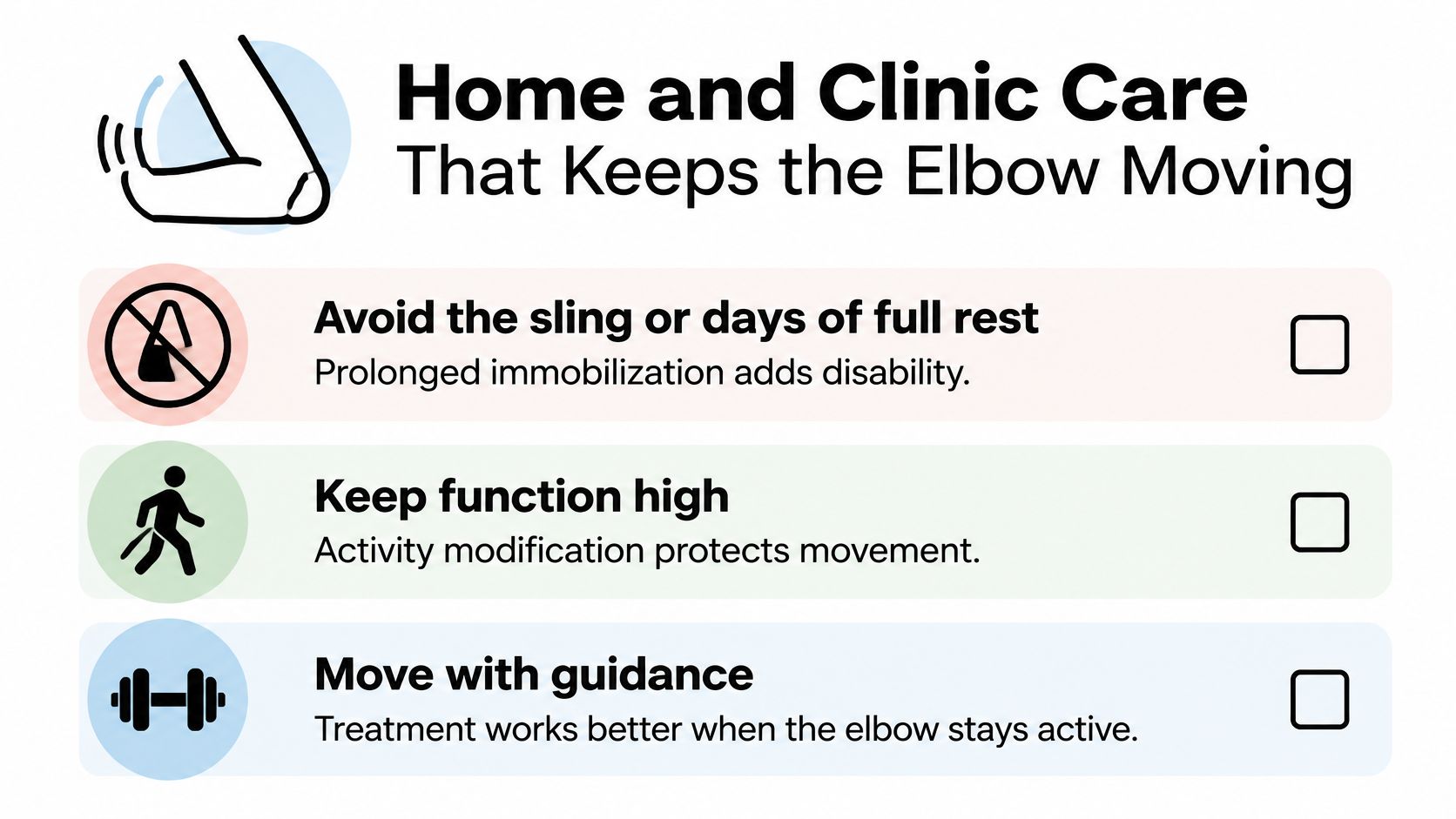
Putting the arm in a sling or avoiding it for days may feel protective, but prolonged immobilisation can make recovery harder. Unless an injury or procedure requires protection, the aim is to preserve useful movement while reducing the load that provokes symptoms.
The evidence-based elbow guidance favours maintaining function and modifying activity rather than prolonged rest or immobilisation, which can add disability and prolong treatment. It also includes conservative analgesic management for elbow osteoarthrosis.
Change how you do the task
Slide the mug closer before lifting it. Use both hands for a saucepan, keep a heavy carry near your body, and move frequently used objects onto a lower shelf. A stable step stool can reduce an awkward high reach, provided you can use it safely.
The distinction is less aggravating load, not no arm use. This checklist keeps the main priorities visible.
Home and clinic treatments at a glance
| Treatment | Job in the plan | Use when | Caution |
|---|---|---|---|
| Activity modification | Reduces joint stress while retaining function | A task repeatedly provokes pain | Change the load rather than abandoning movement |
| Counterforce strap | May offload an irritated tendon attachment | Assessed outer-elbow tendon pain | Doesn't treat a locked joint |
| Hinged elbow brace | Controls movement or end-range stress | Clinician-assessed instability or a flare needing protection | Wear schedule should be prescribed, not assumed |
| Physiotherapy or occupational therapy | Builds movement, strength, and workable task adaptations | Pain limits everyday function | Programme should match the diagnosis |
| Acetaminophen | Provides oral pain relief | An appropriate option, including when NSAIDs are unsuitable | Check liver conditions, other medicines, and combination products |
| NSAIDs | Provide pain relief and reduce inflammation | Appropriate for the individual | Review stomach, kidney, heart, and blood-thinner history |
| Topical analgesic | Offers temporary symptom relief | Suitable product and intact skin | Check ingredients, allergies, warnings, and application instructions |
| Ice or heat | Cooling may soothe a warm flare; warmth may ease quiet stiffness | Match the approach to the symptom | Protect skin; avoid heat on a hot, swollen joint |
A brace needs a defined job. A clinician may recommend temporary support, but routine all-day restriction isn't a substitute for rebuilding comfortable movement. Physiotherapy can address strength and range, while occupational therapy can help with tool handles, workstations, and demanding household tasks.
Topicals also have different ingredients and warnings. A listing such as Supplemynts Inc.’s 2.5 oz muscle rub is useful for reviewing a specific formulation, not evidence that it suits every painful elbow. When comparing topical pain relief for arthritis, distinguish temporary soothing from treatment of the underlying disease.
If structural changes are suspected, a clinician can request radiographs to look for narrowing, bone spurs, loose bodies, or injury-related changes. A hot swollen joint, significant trauma, or worsening movement needs assessment rather than another layer of home treatment.
A Graded Stretch and Strength Plan
Start with comfortable motion before adding resistance. A joint that feels stiff doesn't necessarily need forceful stretching, especially when there's a firm stop or a history of locking.
The following sequence is a starting framework to discuss with a physiotherapist, not a fixed prescription. The right amount depends on your examination, previous injuries, work demands, and response afterwards.
Build the session around symptoms
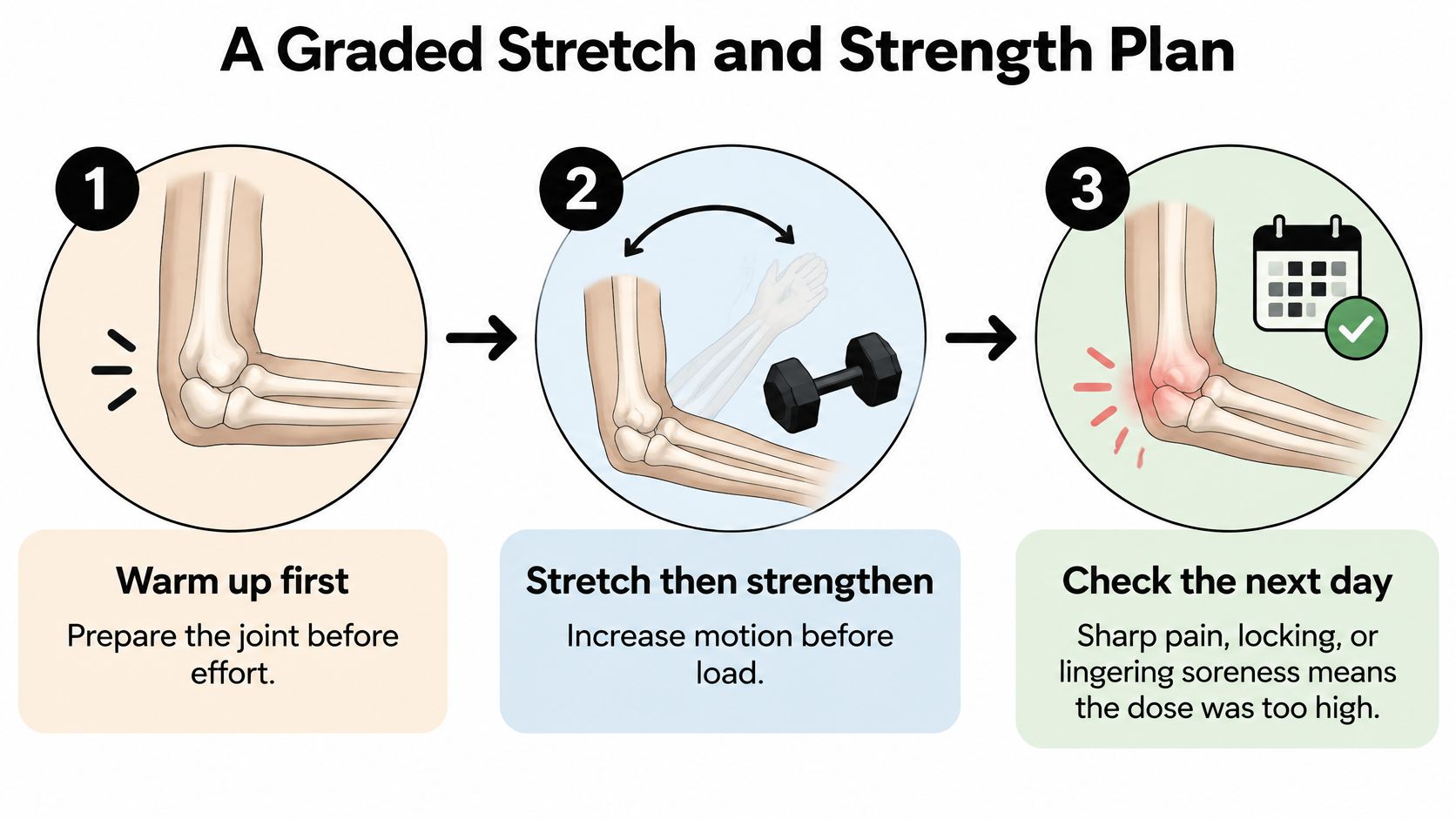
- Prepare the elbow. Begin with easy arm movement or a warm shower when stiffness is the main problem. Skip added heat if the elbow is hot or swollen, and don't start exercise through an unexplained flare.
- Bend and straighten gently. Support the arm if needed and move through the comfortable range. Use a small, easy batch of repetitions rather than chasing maximum movement; stop before sharp pain or a hard block.
- Turn the palm. Keep the elbow close to your side and slowly rotate the palm upwards and downwards. Shorten the movement if outer-joint pain appears, and stop if rotation catches.
- Introduce a gentle static contraction. With the opposite hand providing light resistance, try to bend the elbow without allowing it to move. Then gently resist straightening, keeping the shoulder relaxed; skip either direction if it reproduces joint pain.
- Add light resistance only when ordinary tasks are easier. A light exercise band can introduce controlled bending or straightening. Choose resistance that doesn't make you brace your body, hold your breath, or force the elbow towards its painful limit.
- Treat grip work as optional. A soft ball can provide light resistance if squeezing is comfortable. Leave it out when gripping reliably aggravates outer-joint pain or produces tingling.
- Review the response afterwards. Compare your next morning's stiffness, reach, and carrying comfort with your usual baseline. Reduce the session if you're worse, and stop for sharp pain, locking, new swelling, or neurological symptoms.
The sequence is simple, but the response matters more than completing every step.
Motion that settles by the next day is a useful dosing guide, not permission to push through sharp pain or locking.
Count work and training as part of the load
Your elbow programme doesn't happen separately from the rest of your day. Carrying equipment, using a drill, gardening, and racquet practice all add demands that should influence how much strengthening you do afterwards.
According to the Arthritis Society Canada's osteoarthritis guidance, as many as four in five Canadians with osteoarthritis report pain in at least two joint sites, and more than 40% report pain in four or more sites. An elbow-only plan can therefore miss the practical problem of also having a sore wrist, shoulder, hip, or knee.
Avoid solving elbow discomfort by overloading another painful area. Separate demanding upper-limb training from heavy manual work when possible, and use quieter days for gentle rehabilitation rather than trying to recover missed sessions. Broader strategies for relieving joint pain can help you organise activity across the whole week.
Three Days When the Elbow Plan Changes
These hypothetical situations show why the painful task, injury history, and other joints matter more than choosing a generic elbow routine. The same description, sore elbow, can lead to very different decisions.
Elbow symptoms can interrupt work and home tasks in different ways.

The carpenter who loses his straighten
A carpenter notices a deep ache when pushing himself up from the floor. After a demanding shift, he can't straighten the elbow as far as usual. That pattern raises the possibility of ulnohumeral changes, but an examination is still needed.
His wrong assumption would be that working harder through the final part of the movement will loosen it. Instead, he changes material handling, avoids loaded end-range presses, and arranges assessment because movement is already restricted. The meaningful change is load management, not stronger stretching.
The tennis player with an old fracture
A recreational tennis player had a radial-head fracture years ago. Serving now causes outer-elbow pain, and the joint occasionally locks. Calling it tennis elbow would overlook both the old injury and the mechanical symptom.
She pauses the provoking serve and asks a clinician whether post-traumatic changes or a loose body need investigation. A counterforce strap can't remove an internal obstruction, and grip exercises aren't the priority. The deciding feature is locking, not just where the pain sits.
If you use video demonstrations alongside a prescribed programme, keep the movement within your own assessed limits.
The office worker with more than elbow pain
An office worker has outer-elbow tenderness and assumes the computer mouse is responsible. During the history, however, they also describe prolonged morning stiffness in both hands and their knees.
Adjusting the workstation may improve comfort, but it doesn't address the possibility of inflammatory arthritis. They book a medical assessment rather than continuing an isolated wrist-stretching routine. The important change is recognising the multi-joint pattern.
None of these situations automatically calls for complete rest. Each calls for a different next decision, and none justifies using pain relief to push through fever, redness, or an elbow that increasingly gets stuck.
Decide on Home Care or a Clinic Visit
Seek urgent assessment for fever with a red, hot elbow, significant new trauma, or severe swelling. Arrange prompt assessment for locking, clearly shrinking movement, persistent warmth, prolonged morning stiffness, or pain in several joints.
Inflammatory arthritis requires more than local symptom control. Approximately 374,000 Canadian adults aged 16 and older, or 1.2% of that population, have diagnosed rheumatoid arthritis, according to the Public Health Agency of Canada's rheumatoid arthritis factsheet.
Make a practical decision this week
- Choose a home-care trial when symptoms are mild, movement remains usable, and no warning signs are present. Modify the aggravating task and introduce comfortable movement.
- Book an appointment when lifting, gripping, or reaching remains limited, symptoms worsen, or the cause is uncertain. Bring notes about location, provoking movements, other joints, and previous injuries.
- Use relief as support rather than a reason to increase the load or delay assessment. Our elbow pain treatment guidance can help you organise those options.
Our Power Stick provides temporary soothing relief for sore muscles and joints associated with arthritic or rheumatic pain. We apply MEDISTIK before activity to reduce pain, but product suitability and label directions still matter: do not use Power Spray if you're allergic to salicylates or taking anticoagulant medications.
Relief is useful when it helps you move within a sensible plan. It isn't a reason to ignore a changing symptom pattern.
We offer topical options for temporary relief of sore muscles and joints, including arthritic pain, as part of a movement-focused routine. Visit MEDISTIK to compare formats and review product directions before choosing support for the elbow tasks that trouble you.


