

You're halfway through a workday, or perhaps still in the driver's seat after a long commute, when a sharp ache appears under your left shoulder blade. You shift position, roll your shoulder, and wonder whether you've pulled a muscle, irritated a rib, or somehow developed a problem with an internal organ. The location feels specific, but the cause isn't always obvious.
Left middle back pain deserves a clear, organised approach. First, identify the anatomical zone. Then notice how the pain behaves with movement, posture, touch, and breathing. Finally, screen for symptoms that don't fit a straightforward muscle or joint problem.
What Left Middle Back Pain Actually Means
The word “middle” can be misleading. It usually means the area between the lower neck and the bottom of the rib cage, not the waist and not the space directly behind the heart. Anatomically, left middle back pain is usually thoracic pain, involving the region from T1 to T12, the twelve vertebrae between the neck and lower back. Canadian clinical guidance on thoracic and chest-wall pain uses this region as the basis for assessing mid-back symptoms.

Start with two landmarks:
- The lower edge of the shoulder blade, which helps you identify the upper part of the mid-back.
- The bottom of the rib cage, which marks the lower boundary of the thoracic area.
The thoracic spine is different from the lower back because the ribs attach to it. Those ribs form a flexible cage around the chest, so a strained muscle, irritated joint, or sensitive rib connection can create pain that feels deep, broad, or difficult to pinpoint. A discomfort that wraps slightly toward the side or front of the chest can still come from the thoracic region.
True thoracic pain and referred pain
Pain felt on the left side doesn't always originate exactly where you feel it. The neck can refer discomfort toward the shoulder blade. The shoulder can produce pain near the upper back. A rib joint can send a sharp sensation around the chest wall. In other cases, the pain may be referred from a structure outside the musculoskeletal system.
That's why the location is only the first clue. Your next questions should be: Does movement change it? Does pressing the area reproduce it? Does breathing affect it? Are there symptoms elsewhere? A helpful overview of the muscles that support this region is available in this guide to mid-back muscles.
Practical rule: A precise spot that changes with posture or movement often points toward a mechanical source, but it doesn't prove one. Red flags and unusual associated symptoms still matter.
The Most Common Causes and How They Differ
Three broad families help make sense of left middle back pain. Mechanical causes include muscle strain, irritated thoracic joints, rib dysfunction, and disc-related pain. They often produce a local ache or sharp catch that changes when you twist, reach, lift, cough, or press the area.
Postural causes develop when the same position is repeated for too long. A rounded upper back, a laptop placed too low, a phone held to one side, or a steering wheel position that keeps one shoulder forward can load the left side repeatedly. The pain may build gradually and ease after walking, changing position, or gently moving the thoracic spine.
Internal or referred causes behave differently. Kidney, lung, or pleural irritation can feel deeper and may occur alongside fever, breathing difficulty, urinary changes, or feeling generally unwell. Shingles can begin with burning or hypersensitivity before a rash appears. Cardiac symptoms can sometimes refer toward the back, particularly when chest pressure, sweating, nausea, or shortness of breath is also present.
| Cause Family | Typical Pain Pattern | What Makes It Worse | Distinguishing Clue |
|---|---|---|---|
| Mechanical | Local ache, tightness, sharp catch, or pain around a rib | Twisting, reaching, lifting, coughing, or pressing the area | You can reproduce or change the pain with movement or touch |
| Postural | Gradual fatigue, burning, or soreness near the shoulder blade | Prolonged sitting, driving, screen use, or uneven shoulder loading | It improves when you stand, walk, or reset your position |
| Internal or referred | Deeper, less predictable, or spreading discomfort | Breathing, illness, exertion, meals, or no clear movement trigger | Fever, urinary symptoms, breathing changes, rash, chest symptoms, or feeling unwell |
These families can overlap. Arthritis or reduced joint mobility may make the thoracic area less adaptable, while weak postural endurance can make a small irritation more noticeable. Readers managing stiffness alongside back symptoms may find a general resource on managing arthritis mobility useful, but persistent or unusual pain still needs individual assessment. A broader explanation of muscle pain causes can also help you compare strain with other possible sources.
The useful question isn't “Which diagnosis do I have?” after a quick internet search. Ask instead, Which pattern does my pain behave like, and what would make that pattern unsafe to manage at home?
Why This Area of the Back Gets Overloaded
The thoracic spine balances two competing jobs. It needs enough mobility for rotation and breathing, while the ribs and surrounding muscles provide stability for the trunk and shoulders. That arrangement works well when you move regularly, but sustained sitting, driving, laptop work, and repeated reaching can keep one side working without a proper reset.
The ribs behave like a connected set of levers. If your left shoulder stays slightly higher, your screen sits off-centre, or you habitually lean into one armrest, the muscles around the shoulder blade and rib cage may keep making small corrections. One awkward position rarely explains every episode of pain. Repetition can.
California occupational data show that this is a measurable musculoskeletal burden, not a symptom people imagine. Private-sector employers reported 39,760 work-related musculoskeletal-disorder cases involving days away from work in 2014, compared with 39,240 in 2019. Cases specifically involving the back declined from 14,330 to 13,910 over those years, while the incidence rate fell from 137 to 119 cases per 100,000 full-time workers. The figures come from the California Department of Public Health occupational-health report, and they describe reported workplace injuries, not every episode of pain.
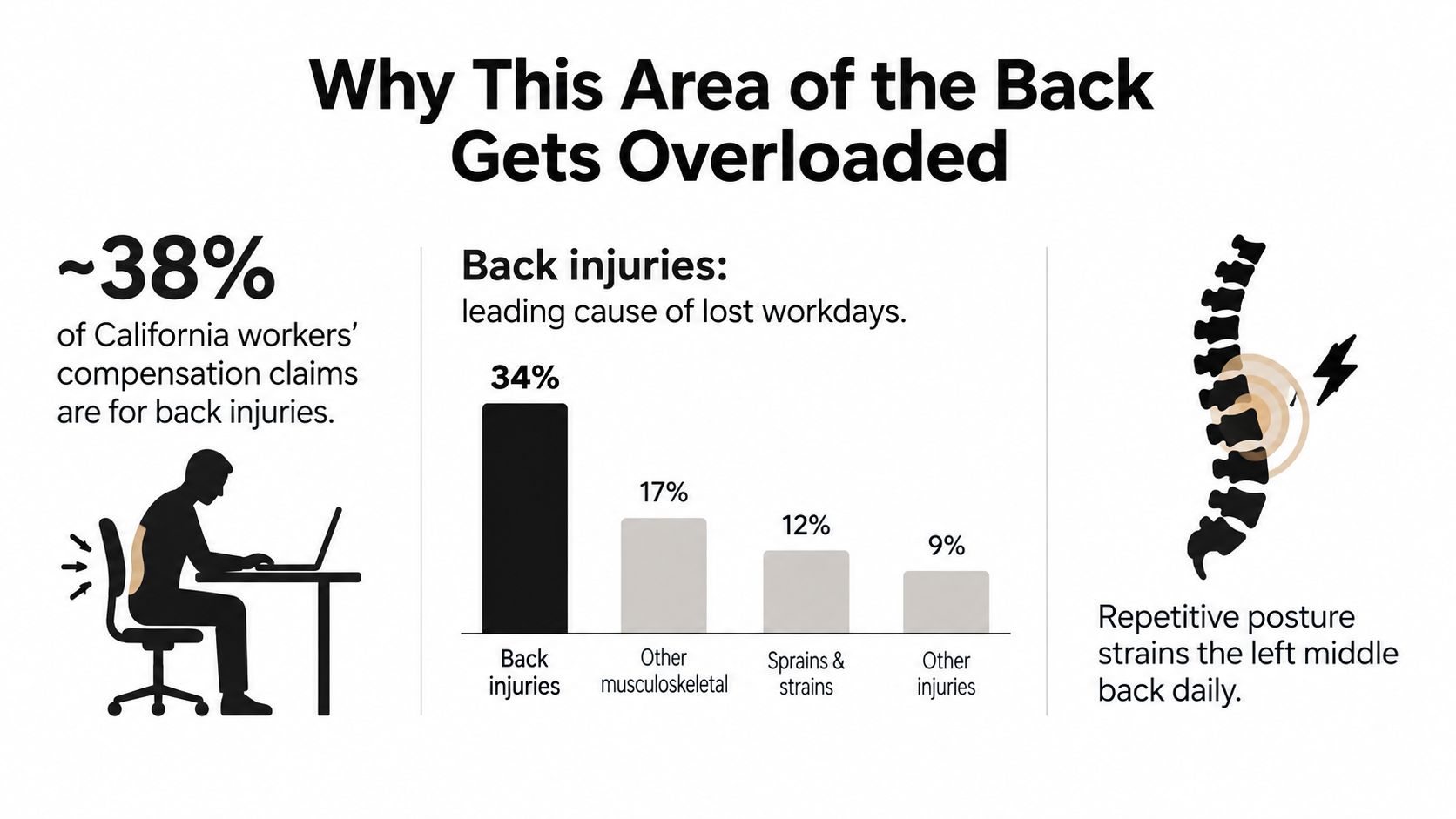
The same pattern appears when the anatomy is separated. California recorded 20,250 severe occupational back injuries in 2020, including 1,090 thoracic-region injuries, or 5.4% of severe back injuries. Lumbar injuries accounted for 11,920 cases, or 58.9%, while 6,130 cases, or 30.3%, were classified as unspecified back injuries, according to the CDC and NIOSH compilation of Bureau of Labor Statistics data.
Those numbers don't identify left-sided symptoms or ordinary soreness. They do show why thoracic complaints can receive less attention than low-back complaints while still reflecting a real occupational load. A practical way to reduce that load is to pair posture changes with trunk control and regular movement, such as the drills described in this guide to core stability exercises.
A Simple Self-Check to Narrow Down the Source
Use this screen only for mild or moderate symptoms that aren't accompanied by warning signs. Stop if a movement creates sudden, severe, spreading, or unfamiliar pain. The purpose isn't to diagnose yourself. It's to notice which inputs change the symptom.
Step one maps the location
Sit or stand comfortably and use one finger to identify the most specific point. Is it close to the spine, under the lower edge of the shoulder blade, along the ribs, or lower toward the waist? Then compare the painful side with the right side.
A small, touch-sensitive area near the shoulder blade may fit muscle or joint irritation. A band that travels around the ribs may involve the chest wall. Pain that feels deep and difficult to locate deserves more caution, especially if it doesn't respond to changes in position.
Step two compares movement
Sit with your feet supported. Cross your arms gently and rotate your chest to the right, then to the left, moving only within a comfortable range. Next, place your hands on your knees and gently lengthen your upper back, without forcing a deep bend.
Notice three things:
- Direction: Does one rotation provoke the left side?
- Reproduction: Does the movement create the same pain you feel during the day?
- Response: Does gentle movement reduce stiffness or make the symptom sharper?
Pain that changes predictably with thoracic movement is more suggestive of a mechanical contribution. It still isn't a diagnosis.
Step three observes breathing
Place one hand over the upper chest and the other over the lower ribs. Breathe slowly without trying to take the biggest breath possible. Notice whether the lower ribs expand, whether you brace your abdominal muscles, and whether inhaling reproduces the back pain.
Breathing-related pain, shortness of breath, chest pressure, fever, or a sense of illness shouldn't be sorted out with home exercises. Seek medical advice instead. If the screen points toward a mild mechanical pattern, use gentle movement and monitor the response rather than repeatedly testing the painful motion.
Red Flags You Should Not Ignore
Most mild thoracic pain can be watched briefly when it behaves like a strain and improves with comfortable movement. The mistake is treating every left-sided symptom as a pulled muscle. Use this triage approach.
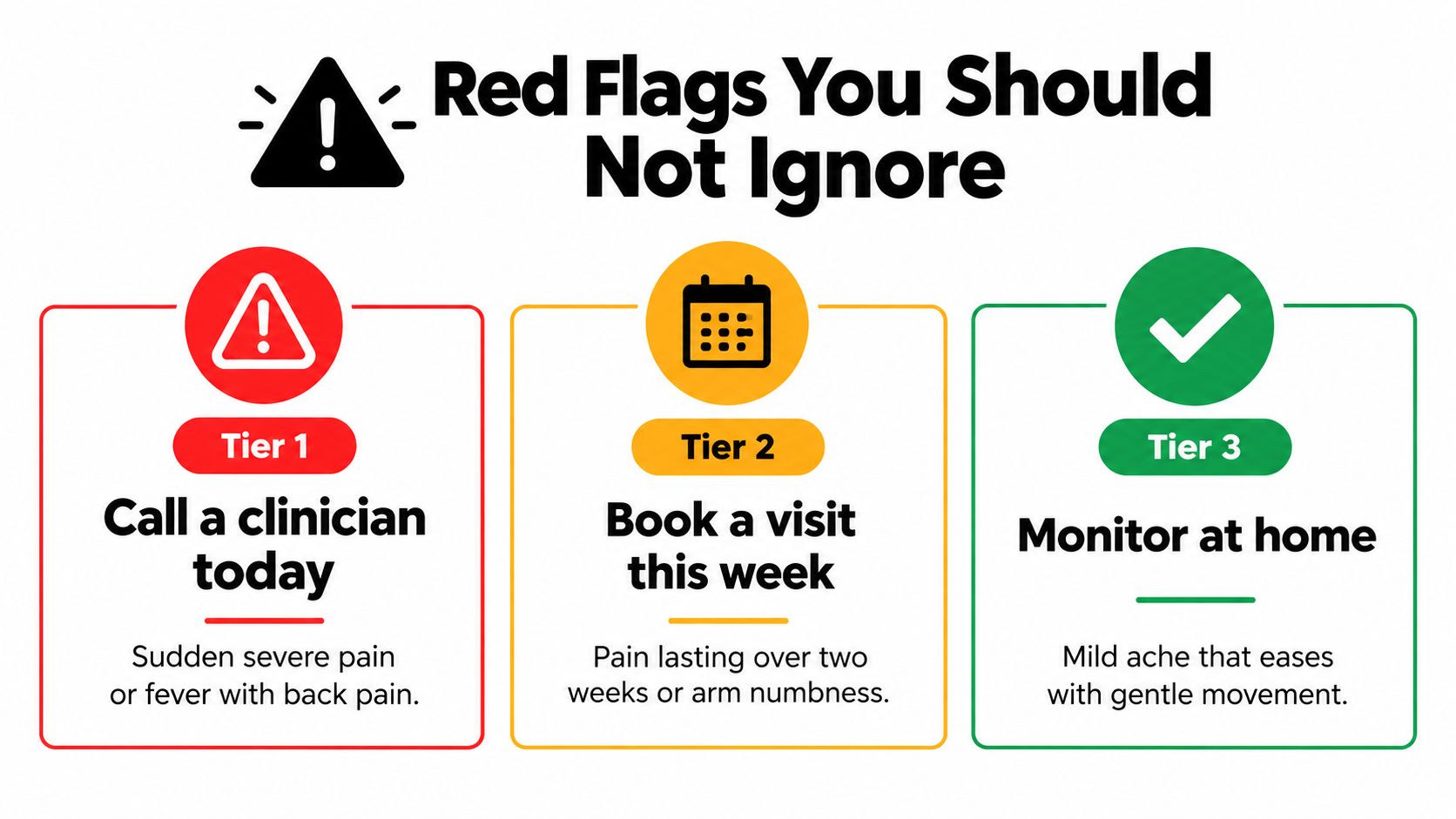
Call a clinician today
Get prompt medical advice for sudden severe pain, pain after a significant fall or direct blow, or pain accompanied by fever, chills, marked illness, or unexplained weight loss. Left-sided back pain with urinary changes, abdominal symptoms, or deep flank pain may need assessment for a kidney or another internal source.
Seek urgent care for new weakness, numbness or tingling spreading into the legs or trunk, difficulty walking, or changes in bladder or bowel control. New chest pressure, fainting, severe shortness of breath, or pain associated with exertion also requires urgent attention.
Book a visit this week
Arrange an assessment if the pain keeps returning, interferes with sleep or work, worsens at rest, or doesn't begin to settle with sensible activity modification. Make an appointment sooner if you have a history of cancer, osteoporosis, immune suppression, or a recent infection.
Pain that travels around the chest, persists without a movement trigger, or appears with a rash should also be evaluated. A clinician can decide whether you need examination, treatment, or further investigation.
Monitor at home
Home care is more reasonable when the ache is mild, movement-related, and gradually easing. Keep moving within comfort, avoid repeatedly provoking the area, and record what makes it better or worse.
This video can provide general visual context for recognising when back symptoms deserve attention, but it doesn't replace an individual clinical assessment.
Stretches, Strengthening, and Posture Fixes That Help
A useful routine should fit between meetings, errands, or training sessions. It shouldn't turn a sensitive mid-back into a test of endurance. Keep every movement smooth, breathe normally, and stop when pain becomes sharp, spreads, or feels different from the original ache.
Start with two minutes of mobility. Sit tall and rotate gently to each side with your arms crossed. Then, if you have a foam roller, place it across the mid-back and lean back over it lightly, supporting your head with your hands. Move the roller slightly up or down rather than forcing one stiff spot.
Follow with a doorway chest opener. Place your forearms on the frame, step forward until you feel a mild stretch across the chest, and keep your ribs from flaring. This counters the rounded-shoulder position that often accompanies laptop work, but the stretch shouldn't create pain around the ribs.
For the left flank and side of the trunk, try a comfortable side-lying lengthening position. Lie on your right side with the left arm overhead and the left leg reaching away, then breathe into the lower left ribs. Keep the stretch gentle. If it causes a sharp side or abdominal sensation, stop.
Add breathing and control
Lie on your back with your knees bent. Place your hands around the lower ribs and inhale softly so the ribs widen into your hands. Exhale without gripping the shoulders or forcing the abdomen flat. This helps you notice whether you're holding tension through the trunk during rest.
Finish with simple strength cues:
- Chin tucks: Draw the head straight back without looking down.
- Scapular squeezes: Bring the shoulder blades gently toward each other, without shrugging.
- Wall angels: Stand with your back near a wall and slide the arms only as far as you can while keeping the movement controlled.
Perform the strengthening sequence once in the morning and once later in the day if it remains comfortable. Raise the monitor so you aren't constantly looking down, keep the keyboard close, and change your hand position when using a phone. A broader set of exercises to help with back pain can help you choose variations that match your ability.
Topical Analgesics and Other Treatment Options
Think in layers rather than searching for one perfect product. During an irritated, guarded phase, heat may relax a tight muscle, while a brief cold application may feel better after a recent strain. Use a cloth barrier, protect the skin, and avoid falling asleep with a heat source in place. Light walking and temporary activity modification are usually more useful than complete bed rest for uncomplicated mechanical pain.
Topical analgesics can provide temporary symptom relief while you keep moving. Menthol and methyl salicylate products create cooling or warming sensations that can distract from a sore area. Lidocaine is used in some products when the discomfort feels more nerve-like, while capsaicin may be used for persistent muscular or nerve-related tenderness. Follow the product label, apply only to intact skin, wash your hands afterwards, and stop if you develop burning, blistering, or a rash.
People with medication allergies, sensitive skin, pregnancy, chronic medical conditions, or several prescription medicines should ask a pharmacist or clinician before choosing an analgesic. Don't combine multiple topical products over the same area unless a healthcare professional says it's appropriate.
For symptoms that limit sleep, work, or normal movement, a clinician may consider targeted manual therapy, taping, physiotherapy, or prescription medication. The choice depends on the examination and the suspected tissue, not just the pain score. You can also review a practical explanation of topical pain relief for back pain.
Treat claims about specialised treatments carefully. If you're researching whether HBOT helps back pain, discuss the evidence and your specific diagnosis with a qualified clinician before treating it as a substitute for standard assessment.
Your One-Week Plan to Move With Less Pain
Use the week to collect useful information, not to force a rapid cure. Each day, note the pain location, the position that triggers it, how long you can sit comfortably, and whether a deep breath feels easier or harder. Those observations make a later clinical appointment more productive.
Monday and Tuesday identify the trigger
Begin with seated rotation, gentle thoracic extension, and lower-rib breathing. At work, raise the screen, bring the mouse and keyboard closer, and place both feet on the floor. In the car, adjust the seat so you aren't reaching forward or leaning into one side.
During each work block, take two brief movement breaks. Stand, walk, and let your arms move freely rather than stretching aggressively. If heat or a topical analgesic helps before a predictable task, use it according to the label and record whether the task becomes easier.
Wednesday and Thursday build capacity
Keep the morning mobility flow, then add chin tucks, scapular squeezes, and wall angels. Use a smaller range if the left side feels guarded. During lifting, keep the object close, turn with your feet instead of twisting under load, and avoid testing the painful side with repeated heavy movements.
Continue the breathing drill in the evening. Track whether you can inhale comfortably into the lower ribs and whether sitting or driving feels less demanding.
Friday and Saturday apply the changes
Repeat the routine and return gradually to ordinary tasks. Alternate positions instead of trying to maintain one “perfect” posture all day. A good posture is one you can change easily, not a rigid pose you must hold.
On Saturday, take a comfortable walk and use gentle stretching afterwards. If movement consistently eases the ache, that supports continuing a graded approach. If activity repeatedly causes sharper pain, spreading symptoms, or a new breathing problem, stop and seek advice.
Sunday reviews the decision
Compare your starting notes with the end of the week. Look for longer pain-free sitting, easier deep breathing, fewer sharp catches, and better tolerance for ordinary reaching. If the symptom is worsening, remains disruptive, behaves unpredictably, or includes any red flag, book a clinical assessment rather than extending the experiment.
If left middle back pain is limiting work, sport, or everyday movement, MEDISTIK offers topical sticks, sprays, and roll-ons intended for temporary relief of sore muscles and backaches. Review the product directions and speak with a healthcare professional when symptoms are persistent, severe, or accompanied by warning signs.


