

You're halfway through a meeting when your leg starts to ache. It may feel heavy, stiff or tingly, even though it felt fine when you sat down. Often, changing position and moving helps. But new one-sided pain with swelling or warmth isn't something to stretch away.
The useful question is not only where your leg hurts, but what the pain does when you stand, walk or change position. A practical plan starts with safe immediate relief, then adjusts your setup and sitting habits while keeping warning signs in view.
Immediate Relief Steps When Your Leg Starts Aching
Try this routine over the next few minutes, but check for warning signs before you start. If one leg is newly swollen, warm or red, or you have chest pain or sudden breathlessness, stop and seek medical care rather than testing stretches.
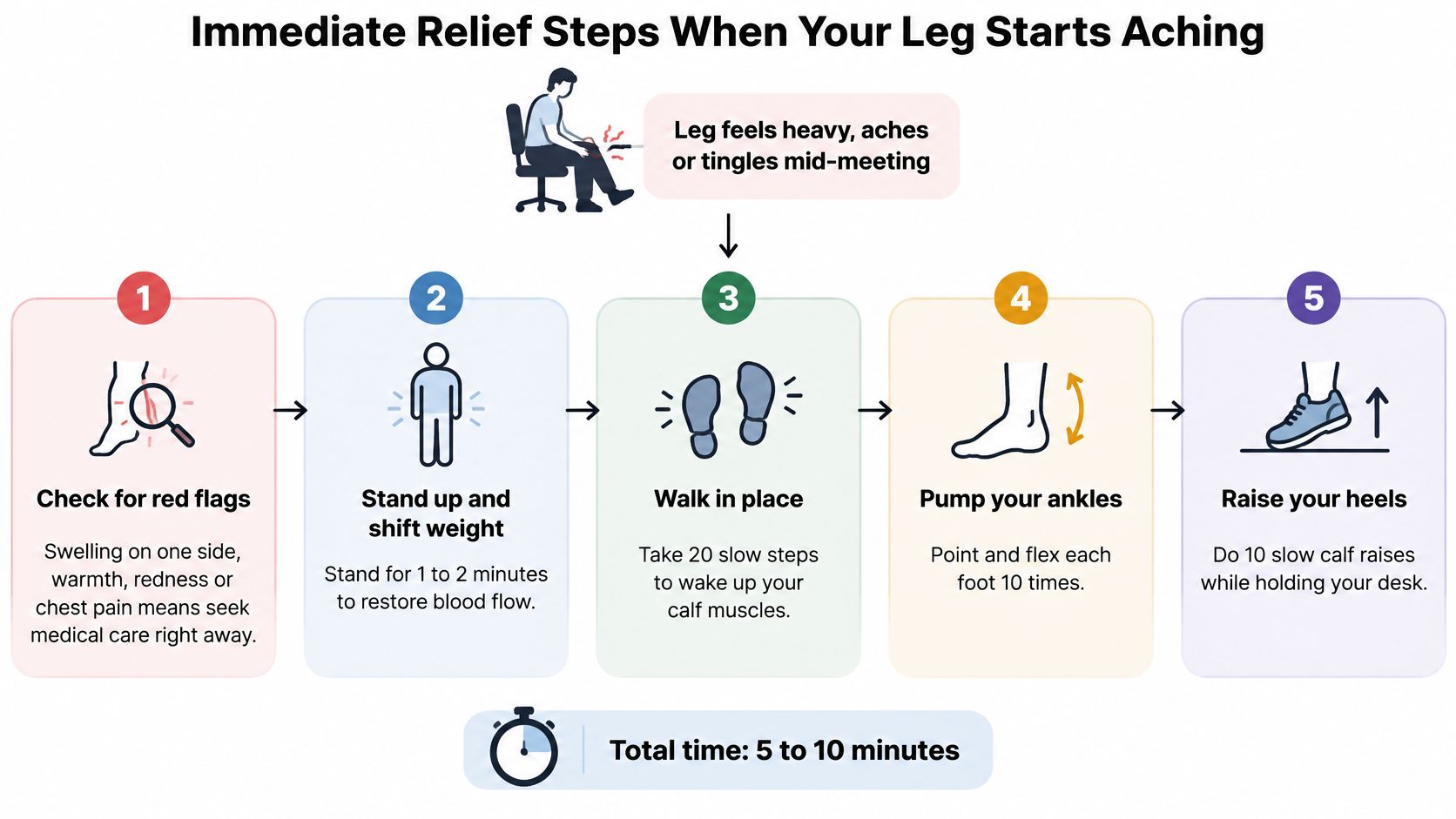
- Stand and walk for 2 to 3 minutes. An easy walk wakes up the calf muscles and lets your hips move through a different position. If walking makes the pain sharper or sends it farther down your leg, stop.
- Do 20 slow ankle pumps and 10 heel raises. Point and flex both feet, then rise onto your toes while holding the desk for balance. These movements work the lower-leg muscles without requiring a long stretch.
- Reset how you're sitting. Uncross your legs. If you need to sit again, place both feet on the floor or a low footrest and move back from the chair edge so it isn't pressing into the backs of your thighs.
- Choose warmth or cold based on how it feels. A wrapped cold pack may help a tender or mildly swollen muscle; a warm pack may feel better for stiffness. Keep ice off bare skin, and stop if either temperature makes symptoms worse.
- Recheck the symptoms. After moving and resting briefly, record your pain from 0 to 10 and note whether it eased, stayed in the same place, or spread. An ordinary positional ache should start settling with movement. If you need gentle options for radiating discomfort, see this guide to immediate relief for sciatica pain at home.
Many positional aches ease after a short period of movement. Pain that doesn't settle, keeps returning with each sitting session, or changes in character deserves a closer look. The next decision should depend on the symptoms, not on how long you can tolerate them.
Red Flags That Need a Doctor, Not a Stretch
Take new pain in one leg seriously when it comes with swelling, warmth or redness. Pain or tenderness in one calf, thigh or groin can be a sign of deep-vein thrombosis (DVT), a clot that needs medical assessment rather than home treatment. Recent surgery or hospitalisation, prolonged immobility, long-haul travel, pregnancy, estrogen exposure and a previous clot all increase concern.
| Symptom pattern | What it may mean | What to do |
|---|---|---|
| Both legs stiff, easing within minutes of moving | Ordinary positional stiffness | Use the steps in this guide |
| One calf, thigh or groin painful, with swelling, warmth or redness | Possible deep-vein thrombosis (DVT) | Get same-day medical assessment; don't treat at home |
| Pain worse on standing or walking, not settling with rest | A circulation or nerve problem needs consideration | Arrange medical assessment within a few days |
| Numbness, weakness or foot drop in one leg | Possible nerve involvement | Seek urgent medical evaluation |
| Saddle numbness, or bladder or bowel changes | Possible cauda equina compression, a spinal emergency | Go to an emergency department now |
| Chest pain, sudden shortness of breath, coughing blood or fainting | Possible pulmonary embolism | Call emergency services immediately |
| Pain unchanged after 4–6 weeks of self-care | Persistent or complex pain | Book a provider review |
The table separates symptoms into two directions, and the DVT row deserves the most caution in both. Many people assessed for a suspected clot turn out not to have one, yet a missed clot can travel to the lungs, so symptoms alone cannot confirm or rule it out. A clinician can examine the pattern and decide whether testing is needed, and if an initial scan is clear while suspicion remains high they may arrange repeat imaging. One-sided swelling earns an appointment, not a wait-and-see week.
Chest pain, unexplained shortness of breath, coughing blood, fainting or rapidly increasing swelling calls for emergency assessment, full stop. For anything less acute, arrive prepared. Tell the clinician when the pain began, which leg is affected, your pain score from 0 to 10, and whether standing or walking makes it worse. Mention recent travel, surgery or long stretches of immobility, since those details shape how urgently the workup happens. A clear history helps the clinician judge what to examine first. For a straightforward walkthrough of which symptoms justify attention, read about when to worry about leg pain.
Why Sitting Triggers Leg Pain
When you sit still, your calf muscles do less of their usual work helping move blood and fluid back up the legs. Pressure from a chair edge can also press under the thighs, while bent hips and knees hold the legs in one position. Together, these factors can leave the legs feeling heavy, achy or tingly. The feeling may ease when you stand and move, but it doesn't identify the cause by itself.
A slumped position can add another source of symptoms. Staying rounded through the lower back may irritate a lumbar nerve, with discomfort travelling into the buttock or back of the thigh. Meanwhile, the hip flexors stay shortened and the glutes do less work. If the discomfort centres on the front of the hip, this guide to hip flexor pain offers more on that pattern.

The population evidence shows why it's better to assess the whole pattern than to label every ache as a sitting problem. In a study of 7,757 workers from the 1998 Quebec Health and Social Survey, 6.4% reported lower-leg or calf pain that interfered with usual activities over the previous year. The rate was 8.0% among women and 5.1% among men. Among respondents whose work involved sitting, 6.1% reported knee pain and 4.8% ankle or foot pain, according to the Quebec worker study.
That study didn't prove that prolonged sitting directly causes leg pain. It found that work posture and demands matter alongside other factors, including age, sex and psychological distress. Constrained standing was associated with pain, while the freedom to sit when needed appeared protective. The practical takeaway is simple: leg pain after sitting is a pattern to assess, not a diagnosis.
Ergonomic Setup Targets for Leg Comfort
Start with a quick check at your desk. Sit fully back, place both feet flat, and slide a hand between the front edge of the seat and the back of your knee. Then look at the top of your screen. These simple checks can show whether your chair is forcing pressure under your thighs or encouraging you to lean forward.
| Setting | Target | Why it matters |
|---|---|---|
| Seat height | Feet flat on the floor, knees about level with or slightly below hips | Keeps your thighs from bearing weight against the seat edge |
| Seat depth | Two to four finger widths between the seat edge and the back of your knee | Limits pressure under the thighs |
| Hip and knee angle | Keep both comfortably open, near a right angle or slightly wider | Avoids a fixed, cramped posture |
| Footrest | Use one whenever your feet don't rest flat | Supports your feet without pressing under your thighs |
| Backrest | Support the lower back against the chair, with a slight recline | Reduces slumping that can irritate the lower back and hips |
| Screen | Top of screen at or just below eye level, about an arm's length away | Helps limit a forward-head position and the tension it can add to the lower back and hips |
Adjust the seat height first. If it's too high, your feet may dangle and the chair edge can press into your thighs. If it's too low, your knees may rise and your hips can feel cramped. Adjust seat depth next; if the chair doesn't move, a small cushion behind your back can bring you forward without making you perch on the edge.
A footrest is a practical fix when you can't lower the chair without bringing the desk too close to your knees. It should support your feet, not push up into the underside of your thighs. For more guidance on reducing slouching at your desk, consider how your backrest, screen and sitting position work together, rather than chasing a single “perfect” posture.
Drivers, remote workers and older adults can use the same targets. You may not need a new chair: adjusting the seat, adding a lumbar roll or using a footrest can address the main pressure points. A setup that makes it easy to shift position is more useful than an expensive chair that keeps you fixed in one pose. For habits that reduce repetitive strain at work, see this guide to preventing repetitive strain injury.
Stretches and Mobility Drills for Sitting Breaks
Choose movements that fit around a meeting or phone call. Start with the ankle and calf, then add hip mobility if it feels comfortable. Move smoothly rather than bouncing, and stop at the first comfortable pull during a stretch. A stretch should not produce sharp pain or send symptoms farther down the leg.
| Drill | How to do it | Dose |
|---|---|---|
| Ankle pumps | Point your toes away, then pull them towards your shin; add slow ankle circles | 20 reps every 30 minutes |
| Heel raises | Rise onto your toes, hold for 2 seconds, then lower slowly while holding the desk for balance | 10 reps |
| Seated knee extensions | Straighten one knee, hold for 3 seconds, then switch legs | 10 reps per leg |
| Standing calf stretch | Place your hands on a wall, keep the back leg straight and press its heel down | 30 seconds per side, two rounds |
| Half-kneeling hip flexor stretch | Tuck your pelvis and shift forward until you feel a stretch at the front of your hip | 30 seconds per side, once a day |
| Figure-four stretch | Place one ankle on the opposite knee and hinge forward from your hips | 30 seconds per side, once a day |
Ankle pumps are the easiest drill to repeat during the day. They keep your feet moving even when you can't leave your seat. Heel raises add a little more work for the calf muscles; hold a stable surface and don't rush the lowering phase.
Save the longer holds for a suitable break or the end of the day. If a drill causes numbness, spreading tingling or sharp pain, stop. Don't push into a stretch that worsens radiating leg pain. When you're short on time, do ankle pumps and a few heel raises rather than forcing a full routine. For additional options focused on the hips, browse these hip flexor stretches.
How Often to Break Up Long Sitting
Start with a simple rhythm: a short movement break roughly every 40 to 50 minutes of sitting, with a few minutes on your feet each time. A brisk walk to the end of the corridor and back counts. Frequency beats duration here.
The amount Canadians sit makes those interruptions worth planning. From 2022 to 2024, Canadian adults averaged 9.3 hours of accelerometer-measured sedentary time per day, and 42% met the Canadian recommendation of no more than 9 hours, according to Statistics Canada. Separately, a 2023 federal survey found that 61% of Canadian respondents reported sitting for more than 5 hours per day, according to the Government of Canada's HABIT survey.
| Sitting situation | Break to take | Minimum movement |
|---|---|---|
| Standard desk day | Stand and do ankle pumps every 20 to 30 minutes | 30 seconds to 1 minute |
| Standard desk day | Walk the hallway or stairs every 40 to 50 minutes | 5 minutes |
| Remote workday | Set a timer and pair a break with each meeting end | At least 8 breaks in a 9-hour day |
| Long drive or flight | Stop every 1 to 2 hours to walk and do calf work | 5 minutes |
| Pain already present | Use shorter sitting blocks, with a full drill set each hour | 3 minutes of drills per hour |
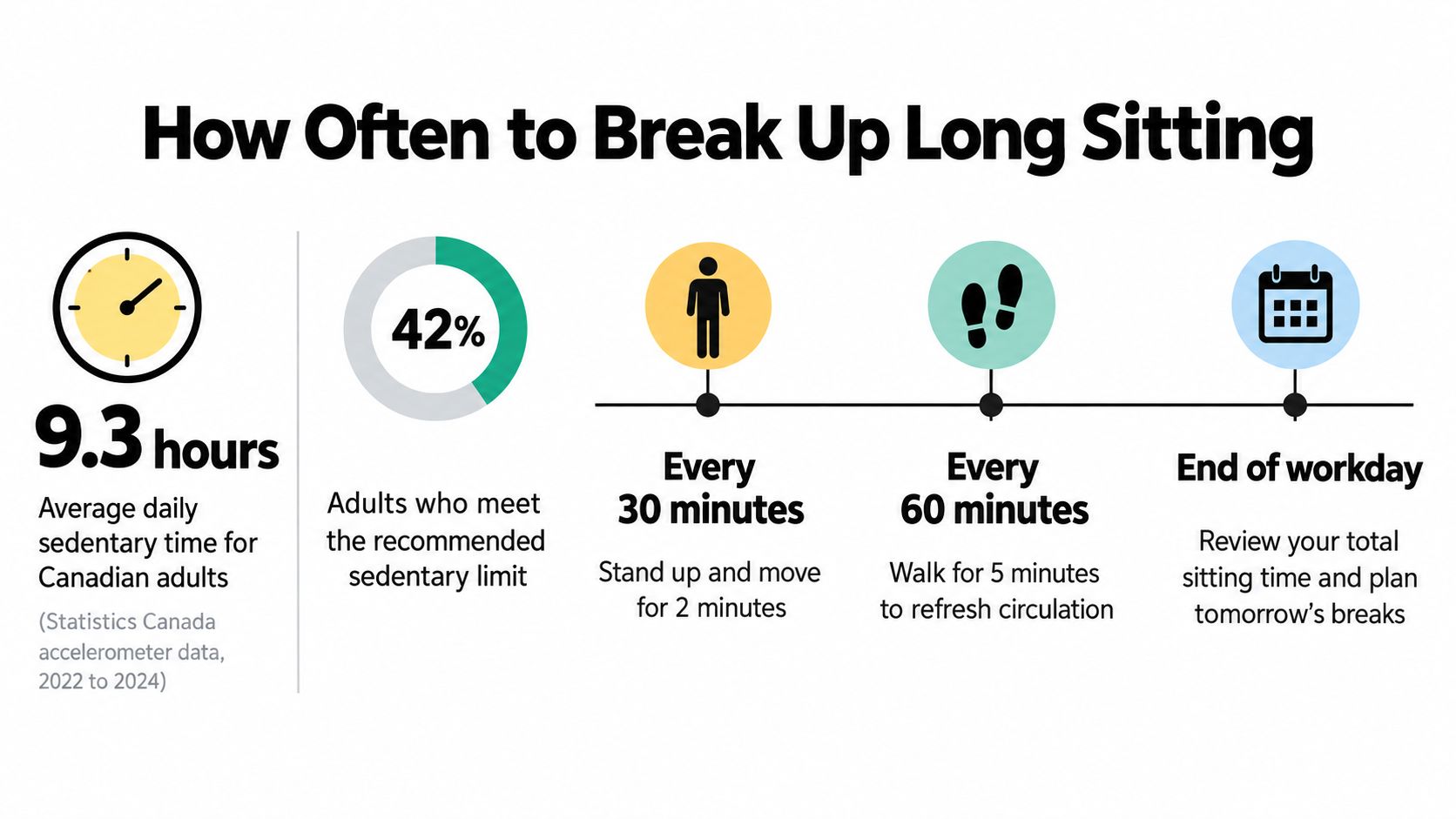
Treat these as working targets, not a universal sitting limit for every person. Your symptoms, mobility, medical history and job constraints may call for more frequent changes or a different kind of break. Ordinary positional stiffness that eases once you stand and walk usually responds well to a schedule like this. Pain that stays put, travels further down the leg or comes with one-sided calf swelling is a different problem, and more breaks alone won't settle it.
For the content of each pause, use the ankle pumps, heel raises and stretches from the drills above. On a long drive or flight, walk whenever it's safe and practical rather than waiting for a fixed interval.
Make the schedule easier to keep by attaching it to something already in your day. Refill the kettle, stand when a call ends or walk after sending a report. A small cue you follow consistently does more than an ambitious timer routine you abandon by Wednesday.
Pick Your Next Step for Leg Pain
You have adjusted your position, broken up long sitting and tried topical relief, yet the ache keeps returning. Now the job is to separate short-term comfort from the steps that find and address the cause.
If symptoms persist beyond 7 days while using a topical product, stop and consult a physician. Stop use and get medical help right away if pain, swelling or blistering develops. A topical analgesic gives temporary soothing relief for sore muscles and joints, but it will not correct nerve compression, a clot or a poorly suited workstation. The MEDISTIK Power Stick is one option for temporary relief of sore muscles and joints associated with strains and sprains, backaches, tendon or ligament pain, and arthritic or rheumatic pain. Use it as the label directs, alongside position changes and movement, while you arrange an assessment if the problem keeps coming back.
Track symptoms and function
Write down your pain on a 0 to 10 scale and one practical measure, such as how long you can sit before symptoms begin. Note whether standing or a short walk eases the pain, whether it travels farther down the leg, and whether numbness or weakness appears. An Alberta Health Services clinical pathway for low-back care recommends avoiding prolonged sitting, building short walks and standing breaks into recovery, and it cautions against treating an uncomplicated first episode as an automatic reason for imaging.
Pain that reliably worsens with sitting or bending and eases with standing or a brief walk makes a mechanical back or nerve source more plausible. Symptoms alone still do not confirm a diagnosis. A clinician can weigh your history and movement before recommending a treatment that fits.
Reassess if the problem persists
If you are not improving after 4 to 6 weeks, arrange a formal review. Systematic reviews of sciatica treatment have found only small long-term pain benefits from physiotherapy compared with minimal treatment, with evidence too limited for firm recommendations. Physiotherapy and movement still have a place; repeating the identical approach without reassessment is the part that fails.
New or progressive weakness, saddle numbness, or bladder or bowel changes needs urgent medical evaluation. Self-directed exercise and topical treatment are not enough there. Use this checklist:
- Mild and improving: Keep up the movement breaks and setup changes.
- One-sided, worsening or accompanied by warning signs: Get assessed now.
- Unchanged after 4 to 6 weeks: Book a provider review.
MEDISTIK offers topical options in stick, spray and roll-on formats for temporary relief of sore muscles and joints while you work on movement, workstation changes and appropriate assessment. If a portable topical option would support your routine, visit MEDISTIK to explore its products.


