

You woke with a stiff neck, the kind that makes turning toward the kettle feel like a negotiation. Work starts soon, the clinic is a long drive or a full shift away, and a new pillow is not arriving tonight. Ordinary muscle stiffness can ease at home. Alarming symptoms cannot, and the split between those two has to come before any stretch.
Neck pain relief at home is a short sequence, not a single trick. Sort the symptoms, ease the area with heat or cold for a set number of minutes, move only inside a comfortable range, then change the one habit that keeps loading the neck. I would start with the cheapest fix you already own, a towel and a timer, and buy nothing until that routine has had a fair trial.
Check Red Flags Before Starting
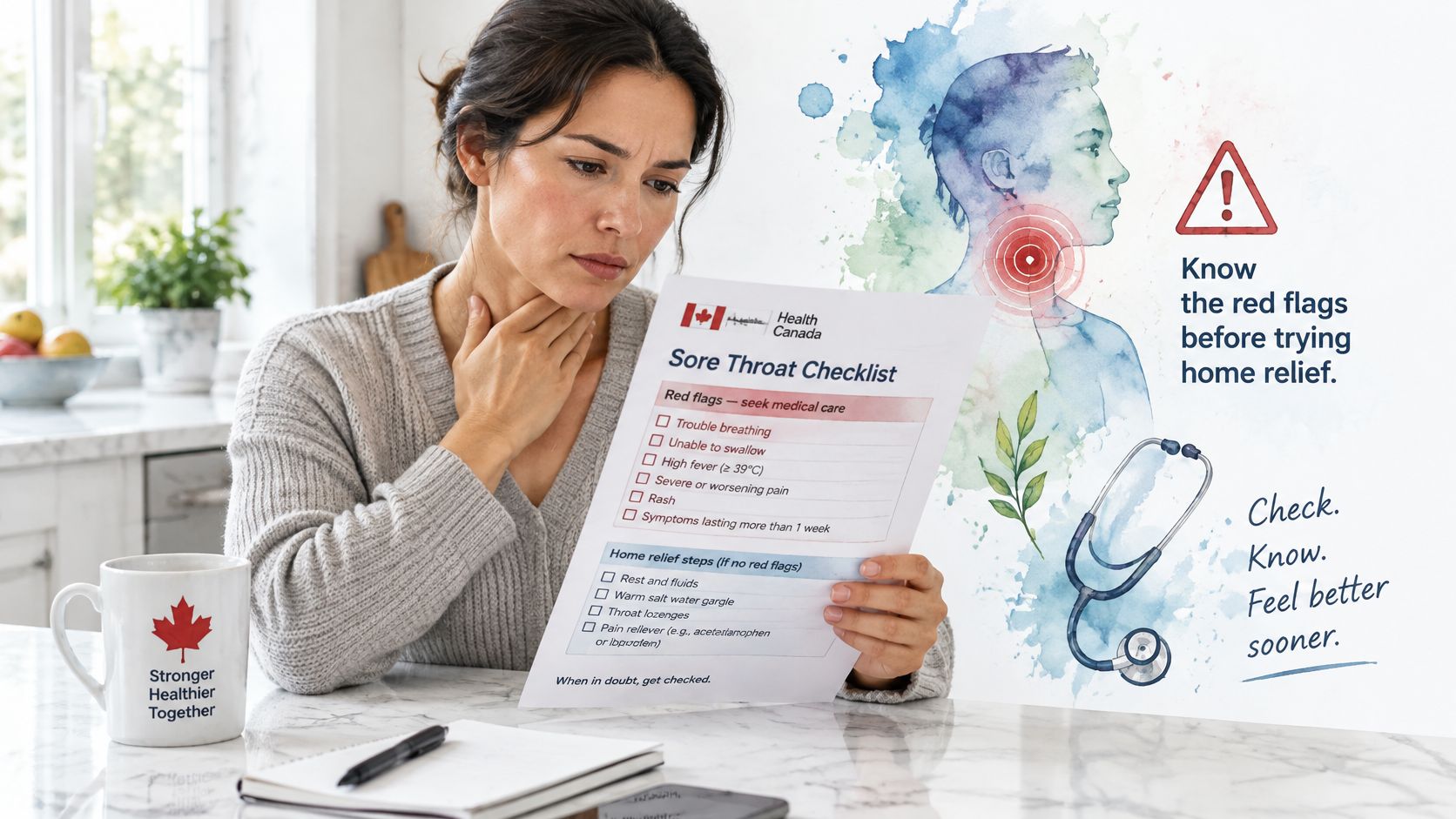
A stiff neck is usually a minor crick you can work through. That assumption fails when pain is already limiting life. In Saskatchewan's 1995 Health and Back Pain Survey, the six-month prevalence of neck pain was 54.2%, and 4.6% of adults reported disabling neck pain during the preceding six months, as set out in the Institute for Work & Health summary of the Neck Pain Task Force. The same research program linked neck pain with poorer self-rated general health and with a previous neck injury in a motor-vehicle collision.
Home steps are a first response for an ordinary ache. When function is dropping, the story includes trauma, or nerve symptoms appear, assessment comes before anything else in this routine. Read the table top to bottom before you heat, stretch, or rub anything on.
Neck pain warning signs and the action to take
| Warning sign | Action |
|---|---|
| Severe headache, vision change, trouble swallowing, or neck stiffness with fever | Emergency care now |
| Pain after a fall, car crash or blow to the head | Get assessed the same day |
| Numbness, tingling or weakness in an arm or hand | Get assessed within days; go urgently if it spreads quickly |
| Unexplained weight loss or night pain that does not ease with position | See a doctor soon |
| Pain not improving after 2-3 weeks of home care, or limiting work and sleep | Book a doctor or physiotherapist |
Ache that sits higher along the neck or between the shoulder blades is a different pattern from a simple muscle crick. The upper spine pain relief guide walks through that distinction so you are not treating the wrong area.
Decision rule: If the pain is ordinary stiffness without the signs above, continue. If any red flag appears, stop the routine and get assessed.
Two details matter as much as the list. Timing first: same-day care means today, not after the weekend, and trauma that still feels walkable counts the same. Location second: pain spreading into an arm or hand is a nerve pattern, not a muscle one, and stretching will not settle it. If a clinic or physiotherapist sits a long drive or a full shift away, a phone or virtual assessment can still separate the urgent cases from the ones safe to manage at home.
Choosing Heat or Ice for Neck Pain
Heat suits stiff, achy neck muscles without swelling, and a cold pack suits a fresh flare-up with sharp pain or visible swelling.
A home routine is worth having because neck pain is common, not because a pack cures it. A population-based Saskatchewan study surveyed 1,100 randomly selected adults, beginning in September 1995, and found an age- and sex-standardised annual incidence of neck pain of 14.6%, roughly one in seven adults in a typical year, in the Institute for Work & Health cohort report. Among people who already had neck pain at the start, 37.3% had persistent problems over follow-up. That is why a simple heat or cold habit helps episodic stiffness, and why pain that will not settle needs a clinician. These figures do not prove that any one pack or cream causes recovery.
Heat and ice options for neck pain at home
| Option | Best for | How long and how often | Watch for |
|---|---|---|---|
| Moist or dry heat | Stiff, achy muscles without swelling | 10-20 minutes, 2-3 times daily | Skip if skin is numb or the area is hot or swollen |
| Ice pack wrapped in a towel | Fresh flare-up with sharp pain or swelling | 10-15 minutes, every 2-3 hours while flaring | Never on bare skin; stop if skin turns white or numb |
| Heat, then gentle movement | Morning stiffness | Heat for 15 minutes, then 5 minutes of mobility | Stop if pain spreads into the arm |
Wrap ice in a thin towel. Keep each session inside the minutes above. Never sleep on a heating pad. After every session, check the skin for redness that does not fade, numbness, or blistering.
For morning stiffness, heat first, then five minutes of easy movement while the area is warm. A closer comparison sits in this stiff neck heat or ice note if you are still unsure which sensation you want.
Pick one option, use it for two sessions, and reassess after 48 hours. If the pain is not easing, or it spreads into the arm, stop and sort the warning signs before you continue.
Stretches and Self-Massage Done in Order
Set aside about ten minutes. The order matters: warm tissue, then small neck moves, then the shoulders, then pressure. Forcing the end range is the mistake that turns a useful session into a worse evening.
The flow below is the short version you can glance at while you move.
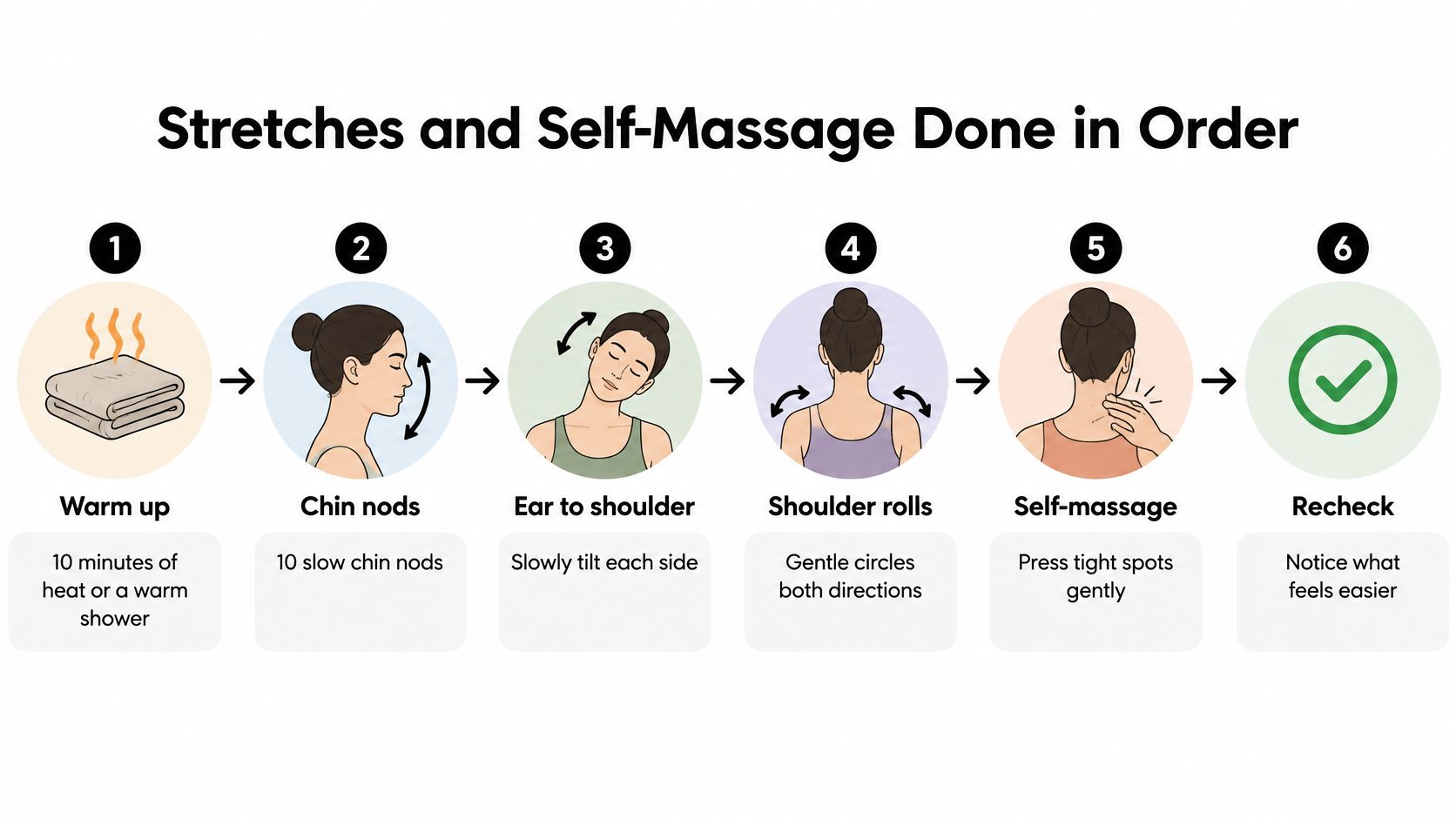
- Warm the area for 10 minutes with heat or a warm shower. Cold muscle guards when you ask it to lengthen, so skipping this step is why the first nod feels sharp.
- Do 10 slow chin nods. Draw the head straight back, as if a finger were nudging the chin inward, without tipping the nose up. Tipping shifts the load onto the upper neck, which is the slip people commonly make.
- Turn the head slowly to each side. Hold the end of the comfortable range for 5 seconds, 5 times each way. Stop at the first sharp catch. Extra degrees past that point do not speed recovery.
- Tilt the ear toward the shoulder and hold 20 to 30 seconds a side. Keep the shoulder down. Lifting the shoulder to meet the ear shortens the very muscle you are trying to ease.
- Stretch the upper trapezius by reaching the same-side hand toward the floor and gently tilting the head away, again for 20 to 30 seconds. These trapezius muscle pain relief exercises show the same idea if the shoulder stays the sore spot after the neck settles.
- Roll the shoulders backward 10 times, then squeeze the shoulder blades together for 5 seconds, 10 reps. The neck often hurts because the shoulder girdle has been parked forward all day.
- Self-massage the upper trapezius and the base of the skull with the pads of two fingers. Use moderate pressure for 30 to 60 seconds a side. Stay off the spine, off bruises, and off any spot that tingles or sends pain into the arm.
- Repeat the set once daily, or twice on stiff days. A second round on a good day is optional. A second round that clearly worsens symptoms is not.
What a useful session feels like
Less tightness, smoother turning, and no pain travelling into the arm. Soreness that fades within an hour is acceptable. Pain that climbs, spreads, or leaves the hand clumsy means you stop and get assessed.
If one tight spot keeps returning no matter how carefully you press, neuromusculoskeletal insights from Restore Osteopathic Medicine explain how clinicians connect joint and muscle findings. That context helps you decide when home pressure has done its job.
Pressure should feel firm and dull, never electric, and never strong enough that you hold your breath.
Four-Week Progression for Neck Exercises
Four-week neck exercise progression
| Week | Focus | Exercises | How often |
|---|---|---|---|
| Week 1 | Gentle mobility | Chin nods, pain-limited rotations | Daily, 5-10 reps each |
| Week 2 | Stretch and tolerate | Ear-to-shoulder stretch, upper trapezius stretch | 3-5 times weekly, 20-30 seconds each side |
| Week 3 | Shoulder and shoulder blade | Shoulder rolls, scapular squeezes | Daily, 10 reps each |
| Week 4 | Low-load endurance | Isometric holds (no rubber band if onset was recent), wall angels | 3 times weekly, 5-10 holds of 5-10 seconds |
Treat this table as a starting dose, not a prescription. For uncomplicated, non-traumatic neck pain, the Canadian Chiropractic Guideline Initiative neck pain guidance supports home exercise with advice for acute pain, and for chronic cases stretching 3 to 5 times weekly plus strengthening or endurance work from daily to three times weekly, adjusted to how symptoms respond. If you live far from a clinic or a physiotherapist, that adjustment matters more than the schedule itself: your log of morning stiffness and daily pain is what tells you when to move up a week.
Why the weeks sit in this order
Week 1 stays at pain-limited rotations and flexion because recent-onset pain does not need load. Hold off on rubber-band isometrics until movement feels comfortable, and skip them entirely if the ache only started recently.
Week 2 adds the longer holds only after nodding and turning are tolerated. Stretching a neck that still spikes on a simple turn just teaches the muscles to guard.
Week 3 shifts work to the shoulder blades. The neck often calms once the scapulae can sit back without a shrug. Daily rolls and squeezes are enough. Heavier rows can wait.
Week 4 is low-load endurance: gentle isometric holds and wall angels, a few seconds at a time. Introduce them only when the earlier stages are tolerated. Stop or reduce the work if symptoms clearly worsen, pain radiates into the arm, or strength or feeling changes. Those are the signs that home care has reached its limit and an assessment, whether in person or by telehealth, comes first.
Exercise on its own usually produces only small effects, so the gain comes from doing the right dose on ordinary days rather than a heroic session once a week. Keep a three-line log: morning stiffness, a pain score out of 10, and which activities were limited. Ten minutes after work counts the same as ten minutes in a gym.
Step back one week if pain rises by more than 2 points and is still higher the next morning. For a recent onset, stay at week 1 until movement feels easy.
Posture Fixes for Desks, Phones and Sleep
You do not need a new chair to unload the neck. A rolled towel, a stack of books under a laptop, and a phone timer cover most setups.
Distance, shift work, and transport barriers are real. A 2024 community health survey among Indigenous people in Pimicikamak, Northern Manitoba, found that 77.9% reported activity limitation from neck pain, while preferred future care included self-management for 88.5%, compared with 22.3% for a nurse or medical doctor, in this community spine-symptom survey. Self-management here means brief breaks and pacing fitted to the shift, not "exercise harder," and it still pairs with local health workers, telehealth, allied providers, or traditional care when assessment is needed.
Desk
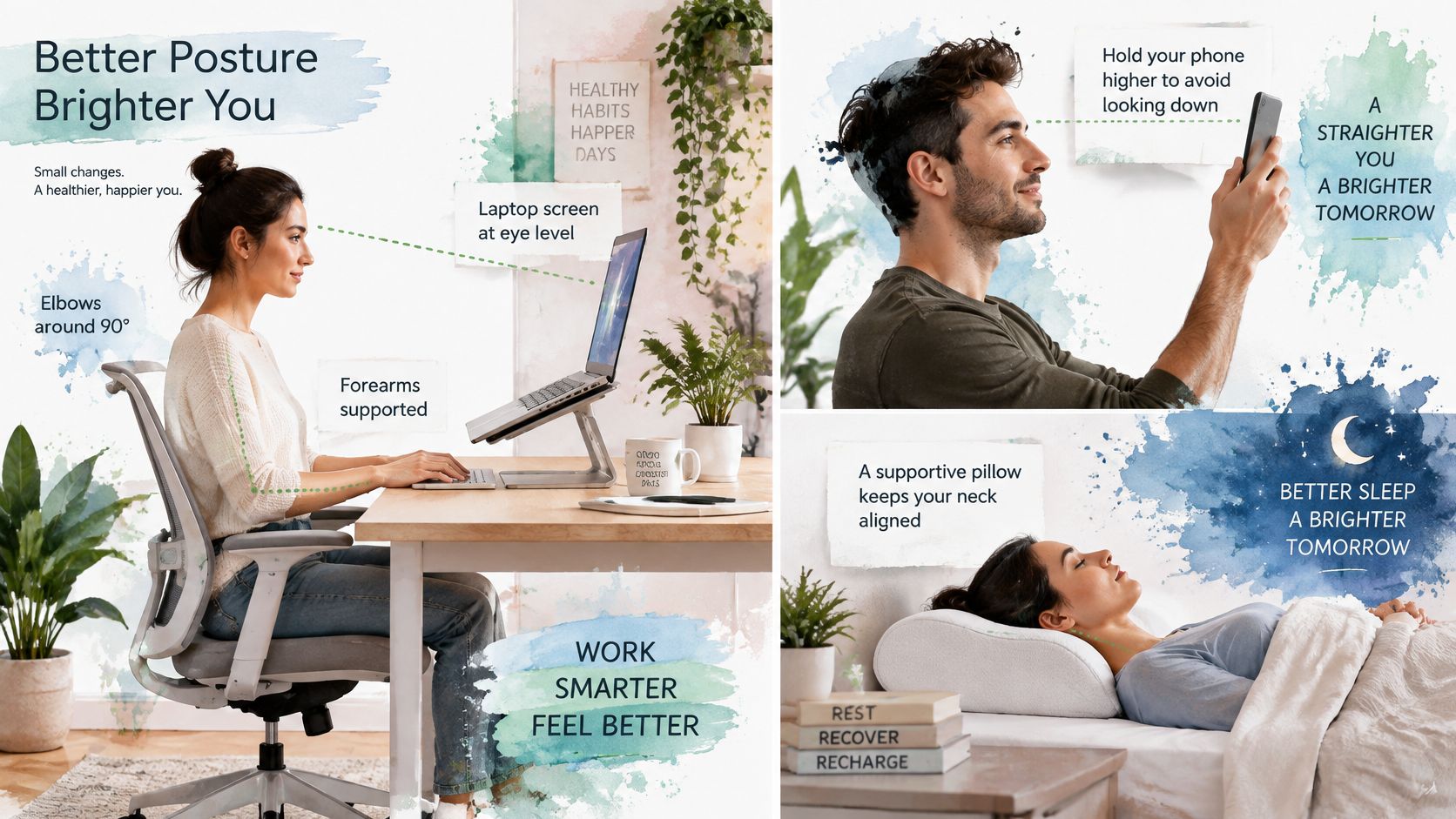
- Screen height: Put the top of the screen at or just below eye level, about an arm's length away, so the chin is not parked forward.
- Arms: Keep elbows near 90 degrees, forearms supported, shoulders dropped. Shrugged shoulders load the upper trapezius all shift.
- Seat: Support the lower back with the chair or a folded towel, and keep both feet flat.
- Break: Every 30 minutes, do one chin nod and one shoulder roll. Set the timer before you sit down.
Long hours on a screen also show up as jaw and shoulder tension. A medical acupuncture guide for screen users is a useful read if posture changes alone are not enough and you want to know what a clinic visit would add.
Phone and sleep
- Phone: Lift it toward eye level for anything longer than a quick glance. Looking down for long stretches is the habit that undoes the desk setup.
- Side sleeping: Use a higher pillow so the head stays level with the spine, not dropped toward the mattress.
- Back sleeping: Use a thinner pillow plus a small towel roll under the neck. Stomach sleeping holds the neck in rotation for hours, so turn onto your side if you can.
The same repetition that irritates the neck also irritates wrists and shoulders. This note on how to prevent repetitive strain injury covers the wider pattern if more than the neck is complaining.
A short demo of screen and pillow alignment makes the positions easier to copy.
Change the single habit that hurts most, then add the rest. Fixing five things on day one usually means none of them stick.
Topical and OTC Options and What to Check
Creams, sticks, and sprays that use menthol, camphor, or methyl salicylate create a warming or cooling sensation on the skin. That sensation can turn down surface discomfort. It does not repair the muscle or the joint, so pair any product with the movement you can already tolerate.
Before you put anything on
- Skin: Apply only to clean, intact skin. Skip cuts, rashes, and freshly shaved areas that sting.
- Label: Follow the labelled amount and the wait time before a second coat. Wash your hands afterward.
- Eyes and mouth: Keep the product away from eyes, nostrils, and any mucous membrane.
- Salicylates: Do not stack several salicylate products, and do not cover a treated patch with a heating pad. Heat plus a rub can burn.
- Pills: For acetaminophen or ibuprofen, stay at the labelled dose. Speak with a pharmacist first if you take blood thinners, have kidney, stomach, or liver conditions, or are pregnant.
A product that does not reduce pain within a few days is a signal to reassess, not a reason to use more. Oral pain relievers have the same limit: if the labelled dose is not helping, more is not the next step.
The practical differences among common non-prescription choices are laid out in this over-the-counter pain relief overview, including when a tablet and a rub should not be combined.
If dizziness, rash, stomach pain, or ringing in the ears shows up after a dose, stop and get advice the same day.
Start One Routine Tonight
Do four things, in this order, before you decide the week is a write-off. Choose heat or ice from the comparison above and use it once. Run the stretch and self-massage set a single time. Change one posture habit, either the screen height or the pillow. Start the log: morning stiffness, a pain score out of 10, and the activities you had to limit.
Set a review at two weeks. If pain is lower and turning is easier, move to the next week of the progression. If nothing has shifted, or any warning sign appears, stop and book a doctor or physiotherapist.
If you want a rub as well, read the label and use the pharmacist checks above before the first application. MEDISTIK is a non-prescription topical pain relief system designed to deliver fast, targeted relief directly where pain occurs, without pills, injections, or greasy creams. Depending on the product, it uses clinically recognized topical pain-relief ingredients such as methyl salicylate, menthol, and camphor. A product that does not ease pain within a few days means you reassess, not that you increase the amount.
Home care eases symptoms and keeps you moving. It does not replace assessment when pain persists or turns alarming. Tonight, do the first set once.
MEDISTIK offers non-prescription topical formats you can use at home for temporary relief of sore neck and shoulder muscles, so the movement routine is easier to start. The sticks, sprays, and roll-ons are made for targeted use during work, recovery, and everyday stiffness, without a clinic visit for every flare. Visit MEDISTIK to choose a format that fits the spot you are treating tonight.


