

You're back at your desk, rubbing the ache between your shoulder blades. You've stretched it every day for weeks, but it still returns before the afternoon's finished. Upper spine pain relief needs more than another stretch. It needs a way to identify what you can safely load, adjust the dose, and recognise when self-care isn't enough.
Match Your Upper Spine Pain to the Right First Step
In 2022, 16.7% of Canadians aged 15 and older, approximately 4.9 million people, had a pain-related disability, according to Statistics Canada's pain-related disability report. That figure covers pain-related disability generally, not upper-spine pain specifically.
Before choosing an exercise, ask yourself: Did this start after a specific event? Does it travel past the shoulder into the arm, or up into the head? Those answers matter more than how tight the area feels.
Upper spine pain patterns and first steps
These are possible patterns, not diagnoses. Use the table to choose a safe starting point, not to rule out an injury yourself.
| Pattern | Likely source | First step | Escalate if |
|---|---|---|---|
| Stiffness and ache between shoulder blades after long sitting | Sustained posture and low mobility | Change position and try comfortable movement | There's no clear improvement despite modifying activity |
| Sharp pain after lifting, reaching or a sudden twist | Possible muscle strain or joint irritation | Reduce the provoking load and keep movement gentle | Pain worsens at night or spreads into the arm |
| Pain, numbness or tingling down one arm | Possible nerve irritation | Avoid strengthening until assessed | Weakness, loss of grip, or bladder or bowel change develops |
| Neck pain with headache from the base of the skull | Possible cervicogenic headache pattern | Arrange assessment and track headache triggers | Headaches become daily or vision changes |
| Pain after a fall or car collision | Possible injury | Get assessed before starting exercises | New trauma hasn't been evaluated |
| Tightness from repeated lifting or heavy shifts | Possible workload strain | Modify lifting and introduce graded strengthening | Pain interrupts sleep or work |
New weakness or bladder or bowel changes need emergency assessment. Don't use the exercise plan to test whether they settle.
Recent symptoms and persistent symptoms also need different starting points. Mild, recent stiffness may suit gentle home movement. Persistent symptoms deserve a closer look at strength, function, workload and recovery, rather than just adding more stretches.
If lifting triggered the pain, the guide to heat or cold for muscle strain provides additional context for symptom management. Temperature-based care comes later in this plan; screening comes first.
Find your closest matching row and note its escalation sign. If your symptoms fit the self-care pathway, start by changing the demands of your desk.
Desk and Phone Posture Changes That Reduce Load
Posture is a load to change, not a position to hold. You don't need to sit rigidly upright all day. You need a setup that lets you work without constantly reaching, craning or bracing.
Treat these targets as adjustable starting points. A comfortable setup should make position changes easier, not force you into a supposedly perfect shape.
Desk and phone setup targets
| Setup check | Target | Common mistake |
|---|---|---|
| Monitor top edge | At or just below eye level | A low laptop screen that requires sustained downward looking |
| Screen distance | Roughly an arm's length, with text enlarged as needed | Moving closer to read small text |
| Elbow position | Comfortable bend with forearms supported | Shoulders lifted to reach a high desk |
| Chair back | Low-back support with feet supported | Perching on the seat's front edge |
| Keyboard and mouse | Close enough to keep shoulders relaxed | Reaching forward to the mouse |
| Phone use | Raised towards eye level, with arms supported where possible | Long sessions with the neck bent |
| Movement breaks | Brief, regular changes between sitting, standing and walking | Staying still through meetings and focused work |
A laptop on the couch creates a practical compromise: the keyboard and screen can't both move independently. In a hypothetical setup change, you could raise the laptop on stable books and use an external keyboard and mouse. That's an experiment to test, not a promise that your ache will disappear.
The same applies to phone height. Holding it higher isn't helpful if you replace neck strain with unsupported, tired shoulders. Support your elbows, shorten the session, or switch tasks.
Run a desk audit today
- Photograph your setup from the side. Use your normal working position, not the posture you adopt for the photo.
- Check whether you can read the screen without leaning towards it.
- Use your arm to judge whether the screen feels unnecessarily close or far away.
- Check forearm support. Notice whether you shrug or reach while typing.
- Find where you use your phone most often, including the couch and bed.
- Change the most obvious problem first, then compare how the same task feels.
For a broader look at repeated work demands, use our guide to preventing repetitive strain injury.
Practical rule: Change the setup before increasing exercise volume. Otherwise, you may keep rehearsing the same aggravating task between exercise sessions.
Your starting dose is one setup change plus brief movement breaks. Progress by changing another item only after you can judge the first. If symptoms spread, become neurological, or worsen despite easier working conditions, stop treating the desk as the whole explanation.
Mobility and Strengthening Exercises in the Right Order
Start with baseline assessment, then mobility, strengthening and endurance. Check your response at each stage. More exercise isn't automatically better if you can't tell which movement helps and which aggravates symptoms.
Canadian neck-pain guidance supports home range-of-motion exercise or multimodal care for recent mild neck pain, and supervised strengthening or group exercise for persistent symptoms. It also reports that deep-cervical-flexor training wasn't superior to other active exercise approaches for pain reduction.
Use this sequence to keep reassessment part of the routine.
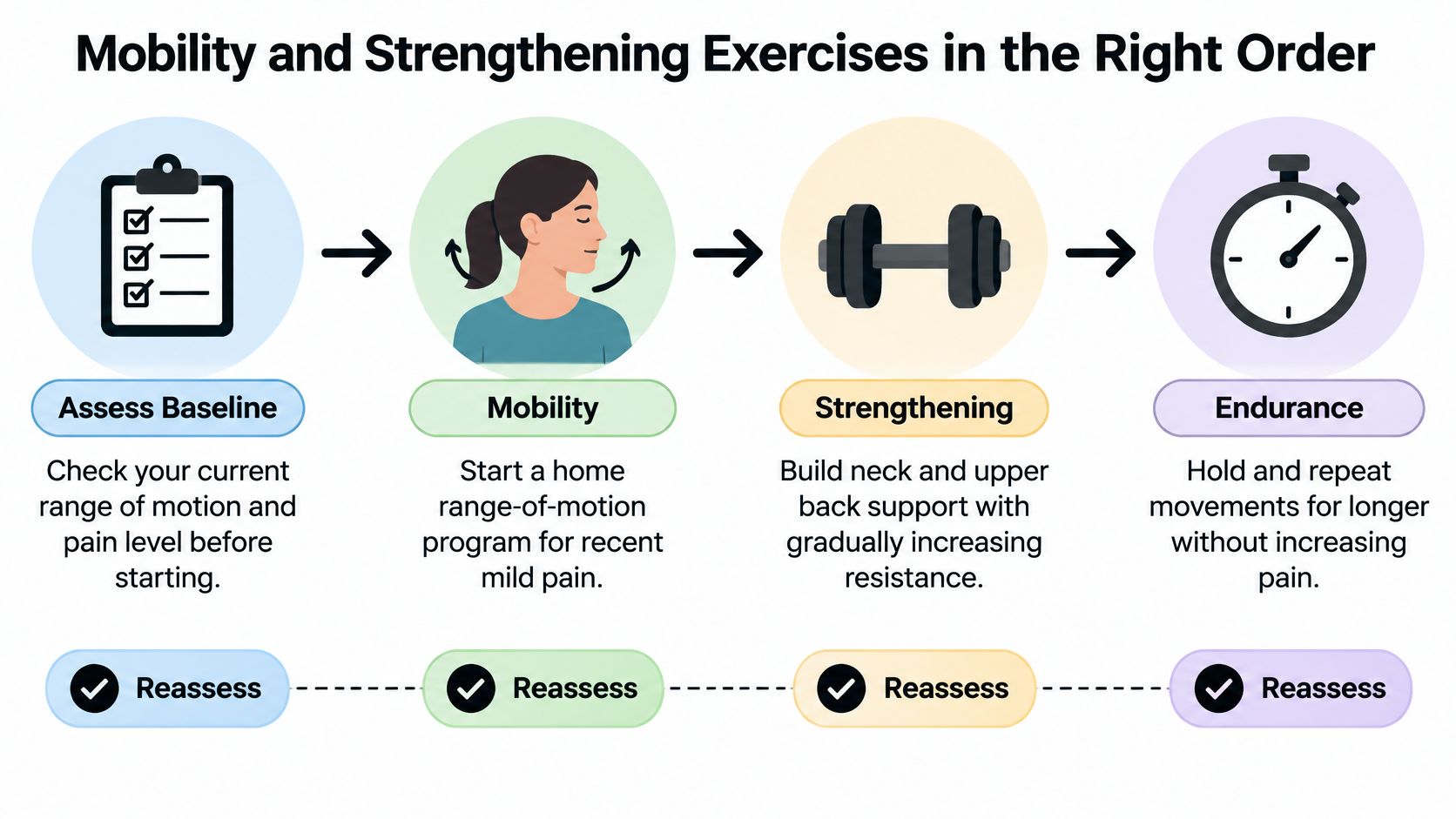
Establish your starting point
Before exercising, note your resting discomfort and try a comfortable head turn and overhead reach. Record whether dressing, typing or looking over your shoulder feels restricted. Don't force the movement to establish a maximum.
The doses below are suggested trial doses, not universal prescriptions or research-tested doses for your particular condition. Start with the relevant basics rather than completing the whole table immediately.
Upper spine exercises with dose and progression
| Exercise | Starting dose | Progress when |
|---|---|---|
| Chin tuck, lying or seated | 8 to 10 slow reps, twice daily if tolerated | Comfortable for a week without added neck pain |
| Seated thoracic extension over chair back | 5 to 8 reps, starting with one session | Movement stays in the upper back without low-back pinching |
| Doorway pectoral stretch | Two gentle 30-second holds | The stretch stays comfortable without shoulder or arm symptoms |
| Wall angels | 8 to 10 reps through a comfortable range | Arms slide without arching the low back |
| Band scapular rows | 2 sets of 10, using light resistance | You can build towards 3 sets of 15 without increased symptoms |
| Prone Y and T raises | Up to 2 sets of 8, without weights | Each lift remains controlled without shrugging |
| Open-book thoracic rotation | 5 reps per side | Rotation increases without shoulder pinching |
A chin tuck is a small backward glide, not a forceful downward nod. For chair extension, support your head and lean your upper back over a comfortable chair edge. Don't throw your head backwards.
During rows, draw your elbows back without squeezing your shoulder blades as hard as possible. For open books, lie on your side with knees supported together, then rotate your upper arm and chest only as far as comfortable.
Chin tucks are optional, not the centrepiece of recovery. If they irritate your neck, a clinician can help choose another active approach.
Use the demonstration as a movement reference, not permission to push through symptoms.
Progress the load, not the discomfort
For this trial plan, progress only after a comfortable week and when any post-exercise discomfort returns to your usual baseline by the next morning. Increase range, repetitions or resistance separately so you can identify what changed.
Stop and seek assessment if exercise produces spreading arm pain, tingling, weakness or a new headache. If ordinary soreness accumulates instead of settling, reduce the dose and reassess.
Once the basics are comfortable, build endurance through controlled repetitions rather than rigid posture holds. Our guide to exercise for core stability offers related movement-control ideas.
The common mistake is stretching indefinitely without building tolerance for work. Mobility helps you explore movement; strengthening gives you a way to practise handling load.
Flare-Up Care and Topical Adjuncts Without Full Rest
Once serious problems have been excluded, a flare-up usually calls for adjusted activity, not complete immobilisation. The Ontario OPTIMa clinical practice guideline supports maintaining activity and movement for acute cervicothoracic pain and cautions that nonspecific stretching may not help.
That doesn't mean carrying on unchanged. Reduce the task that clearly provokes symptoms while preserving movements you can tolerate.
Walking can be a useful activity to test when heavier tasks feel uncomfortable.

Match care to symptom behaviour
| What happens | Adjust the plan | Escalation point |
|---|---|---|
| Local stiffness eases with gentle movement | Continue comfortable mobility and lighter activity | Movement repeatedly leaves you worse afterwards |
| Heavy work brings the ache back | Shorten work bouts and reduce the heaviest load | You can't complete ordinary tasks despite modification |
| Symptoms radiate into the arm | Stop the provoking exercise and arrange assessment | Weakness or other neurological changes develop |
| Symptoms settle, then return after doing everything at once | Resume tasks gradually | Each return produces a stronger or longer flare |
Heat and cold are optional comfort measures. You can trial warmth for stiffness or aching, or a cool pack for a sharp, recent flare. Neither response confirms the diagnosis, and neither is compulsory.
Protect your skin with a cloth barrier and follow the pack's instructions. Stop if your skin becomes painful, unusually numb or irritated. Don't apply external heat over a topical pain reliever unless its label explicitly permits it.
Use a flare-day routine
The timings here are practical trial doses, not a requirement to complete activity regardless of symptoms.
- Reduce the heaviest task temporarily. Break demanding work into manageable blocks rather than pushing through the whole job. Keep lighter daily activity where tolerated.
- Try a 10-minute walk at a conversational pace. Shorten it if symptoms build, and repeat later only if the first walk settles comfortably.
- If stiffness prevents you starting, trial heat or cold before gentle mobility. Use the product instructions to set exposure time, rather than assuming a hotter pack or longer application works better.
- Keep the exercise range easy. Try the chin tuck and chair extension only if they remain suitable for your symptom pattern. Skip loaded rows during a flare if they clearly aggravate it.
- A topical can be an optional pre-activity adjunct. MEDISTIK is a non-prescription topical pain relief system designed for fast, targeted relief without pills, injections or greasy creams, and is applied before activity to reduce pain. Follow the label, avoid broken skin, and ask a pharmacist about suitability if you take blood thinners or use other topical medicines; our guide to topical pain medications explains the category.
- Record the evening response and sleep. Resume your usual workload gradually once symptoms return to baseline. If your baseline keeps worsening, arrange assessment rather than repeatedly restarting the routine.
For sleep, test side-lying with enough pillow support to keep your neck comfortable, or back-lying with a comfortable pillow height. Don't force a thin pillow or a prescribed position if it makes symptoms worse. If stomach sleeping keeps your neck turned and aggravates pain, try another position.
Relief is useful when it helps you move comfortably. It isn't proof that the underlying problem has resolved.
Massage and manual therapy can also be adjuncts. Canadian neck-pain treatment guidance supports exercise-based care and appropriate combinations of treatments, while the evidence for manual approaches isn't uniformly positive.
Judge an adjunct by whether you can do more comfortably afterwards. If you only get brief relief while your function keeps declining, the treatment plan needs reassessment.
Start Your Two-Week Relief Plan and Know When to Escalate
Use the next two weeks as a structured self-care trial, not a deadline for recovery. Put a review date in your calendar today. The aim is to identify a tolerable routine and a useful direction of change.
Start with a record you can repeat
- On your starting day: Use the triage table, audit your desk, and record your pain in your own words or on a consistent personal scale. Note sleep and a task that currently bothers you.
- During the trial: Use the exercise doses above as ceilings, not targets you must reach. Begin with comfortable mobility and introduce rows only if strengthening fits your symptom pattern.
- As tolerance improves: Add wall angels or open-book rotation separately. Keep the desk changes that help.
- At your review: Repeat the same task and compare pain, movement, sleep and confidence. Progress if function is improving, hold the dose if progress is uneven, and arrange assessment if you're worsening.
Persistent symptoms may need a broader plan than this initial trial. Our guide to managing chronic pain provides additional self-management context.
Don't wait for the review date
Seek prompt assessment for pain or numbness travelling down an arm, pain after trauma, unrelenting night pain, fever or unexplained weight loss. New weakness, loss of grip, bladder or bowel changes, or a sudden severe headache need urgent medical attention. Don't wait for the routine to work.
Headache beginning at the skull base also deserves assessment, especially after a collision. A 2025 Canadian clinical study on whiplash and cervicogenic headache states that more than 350,000 people experience whiplash annually in Canada, and approximately 27% develop cervicogenic headache. Those figures concern whiplash, not all desk-related neck headaches.
If the trial produces no clear improvement, book a physiotherapy or medical assessment rather than extending it indefinitely. Bring your symptom record and exercise response. That gives the clinician something more useful than a list of stretches you've tried.
MEDISTIK offers non-prescription topical relief for sore muscles and joints that can complement a graded upper spine pain relief plan. Visit MEDISTIK to explore application formats for use before activity, while keeping movement, load management and appropriate assessment at the centre of your care.


