

Rub something anti-inflammatory on it and give it a day. That's the common advice about a swollen joint, and it's the advice often followed.
It's also why so many tubes sit half-used in bathroom cabinets. The product usually isn't the problem; the match is. Whether an anti-inflammatory ointment helps depends far less on which body part the label names than on how deep the swelling sits and what caused it. In 2017, 19.3% of Canadians aged 15 and older, roughly 5.7 million people, reported a diagnosed arthritis, according to the Public Health Agency of Canada's arthritis overview. Plenty of that swelling is not a job for a topical product.
What follows is how I'd sort it across a pharmacy counter: which swelling suits an ointment, what's inside the tube, how to apply it without irritating skin, and the signs that mean put it down and get seen.
Which Swelling an Anti-Inflammatory Ointment Can Help
An anti-inflammatory ointment earns its place when the swelling is localized, superficial and caused by a known musculoskeletal problem, on skin that's intact. A rolled ankle, a strained calf, an osteoarthritis flare in a knee or hand. Everything else needs a different first step, so sort your situation below before you open a tube.
| Swelling pattern | Likely source | Ointment suitable? |
|---|---|---|
| Localized swelling after a sprain or strain | Soft tissue injury | Often suitable for short-term use on intact skin |
| Superficial knee or hand swelling from osteoarthritis | Superficial joint inflammation | Suitable first step; strongest topical evidence |
| Deep hip or spine swelling or pain | Deeper joint or spinal source | Not supported by Canadian evidence; see a clinician |
| Swelling after a cut, abrasion or insect bite | Damaged skin | No; avoid broken skin and ask a pharmacist |
| Swelling from gout or a new, unexplained lump | Metabolic or unknown cause | No; clinical assessment first |
| Swelling that keeps returning with no clear trigger | Unknown or systemic cause | No; see a clinician for a diagnosis |
The logic behind those rows is depth. Canadian guidance supports topical NSAIDs such as diclofenac mainly for superficial osteoarthritis of the knee or hand, and evidence and formulary guidance don't establish comparable benefit for deep joints such as the hip or spine, as Arthritis Society Canada's NSAID reference guide sets out. A gel reaches tissue a few millimetres under the skin. It can't reach a hip joint through the muscle and fat layered over it, no matter how strong it feels.
Osteoarthritis is the common case where this matters. About 3.9 million Canadians aged 20 and older live with it, 13.6% of that age group, according to Public Health Agency of Canada figures. Cause matters as much as depth. Consumer material treats "swelling" as one condition, but inflammation from a strain, an infected joint, a gout flare, a venous or lymphatic problem and a possible clot can all produce a puffy limb, and only the first belongs near the top of that table.
The contrarian part: a colder, stronger or more expensive ointment is not the better choice when the swelling is deep or isn't inflammatory. Match beats strength every time.
Two ankles, two answers. Say a runner finishes a long training run with a sore, slightly bruised ankle that puffs up over the evening. Cause known, tissue superficial, skin intact: a topical anti-inflammatory with rest, compression and elevation is a reasonable short-term plan. If you're still weighing whether heat or ice suits that kind of swelling, settle it first, then apply to clean, dry skin.
Now say an older adult catches a toe and lands hard, and a few hours later the knee is puffy, warm and painful. Same visible swelling, entirely different meaning. That knee could involve a fracture, a ligament tear or bleeding into the joint. No anti-inflammatory ointment for swelling should go on it before an assessment.
Find your swelling in the table. If it lands in a not-suitable row, book the appointment first and treat the ointment as something you might use afterwards.
What Is in an Anti-Inflammatory Ointment and How It Works
Think of these products as a dimmer switch for one small patch of skin. They don't switch inflammation off across your body. They turn down the chemical signals in the tissue directly beneath where you rub, and the rest of you carries on unchanged.
The ingredients split into two groups, and only one of them does anything about swelling. The percentages and rankings below follow British Columbia's clinical guidance on managing pain.
| Ingredient | Class | Effect on swelling and pain |
|---|---|---|
| Diclofenac (about 1% to 4%) | NSAID | Lowers local prostaglandins; strongest topical evidence for knee and hand osteoarthritis |
| Ketoprofen | NSAID | Reduces local pain; weaker topical evidence than diclofenac |
| Menthol | Counterirritant | Cooling sensation that distracts from pain; does not reduce inflammation |
| Camphor | Counterirritant | Warming or cooling sensation; does not reduce inflammation |
| Methyl salicylate | Salicylate counterirritant | Local warming and pain relief; weaker, less established effect on swelling |
| Capsaicin | Counterirritant | Pain relief through nerve desensitization; no direct effect on swelling |
NSAIDs work by blocking cyclooxygenase, the enzyme that ramps up prostaglandin production in inflamed tissue. Fewer prostaglandins means less pain signalling and less of the chemical push that keeps tissue swollen. It's a local version of what an oral ibuprofen does, and the evidence is strongest for diclofenac at roughly 1% to 4%, which that guidance ranks above other commonly used topical formulations for knee and hand osteoarthritis. If you want the longer comparison, this explanation of topical NSAIDs and how they differ from oral anti-inflammatories covers the trade-offs.
Topical doesn't mean none of it reaches your bloodstream. The same guidance estimates absorption at roughly 6% to 23% of what an oral formulation of the same drug would deliver, and notes that systemic side effects can still occur. Low is not zero.
Menthol and camphor sit in a different category entirely. They trigger cold or warm receptors in the skin, which is why a roll-on can feel like it's working within seconds. That sensation competes with pain signals travelling up the nerve, and for plenty of people that's useful. It doesn't touch prostaglandins and it doesn't take swelling down. Methyl salicylate and capsaicin work on similar nerve-level principles, with the same ceiling.
A practical rule: read the active ingredient, not the brand name and not how cold the product feels. Two tubes that feel completely different might be doing the same job, or entirely unrelated ones.
Go and read the active ingredient list on whatever is in your cupboard, then find its row in that table. If the ingredient is menthol or camphor and the problem is a swollen joint, you're holding a comfort product, not an anti-inflammatory one.
How to Apply an Anti-Inflammatory Ointment Safely
Most avoidable problems come from a handful of habits: product on broken skin, product sealed under a bandage, or product reapplied five times a day because it seemed slow. The sequence below puts the reason beside each step.
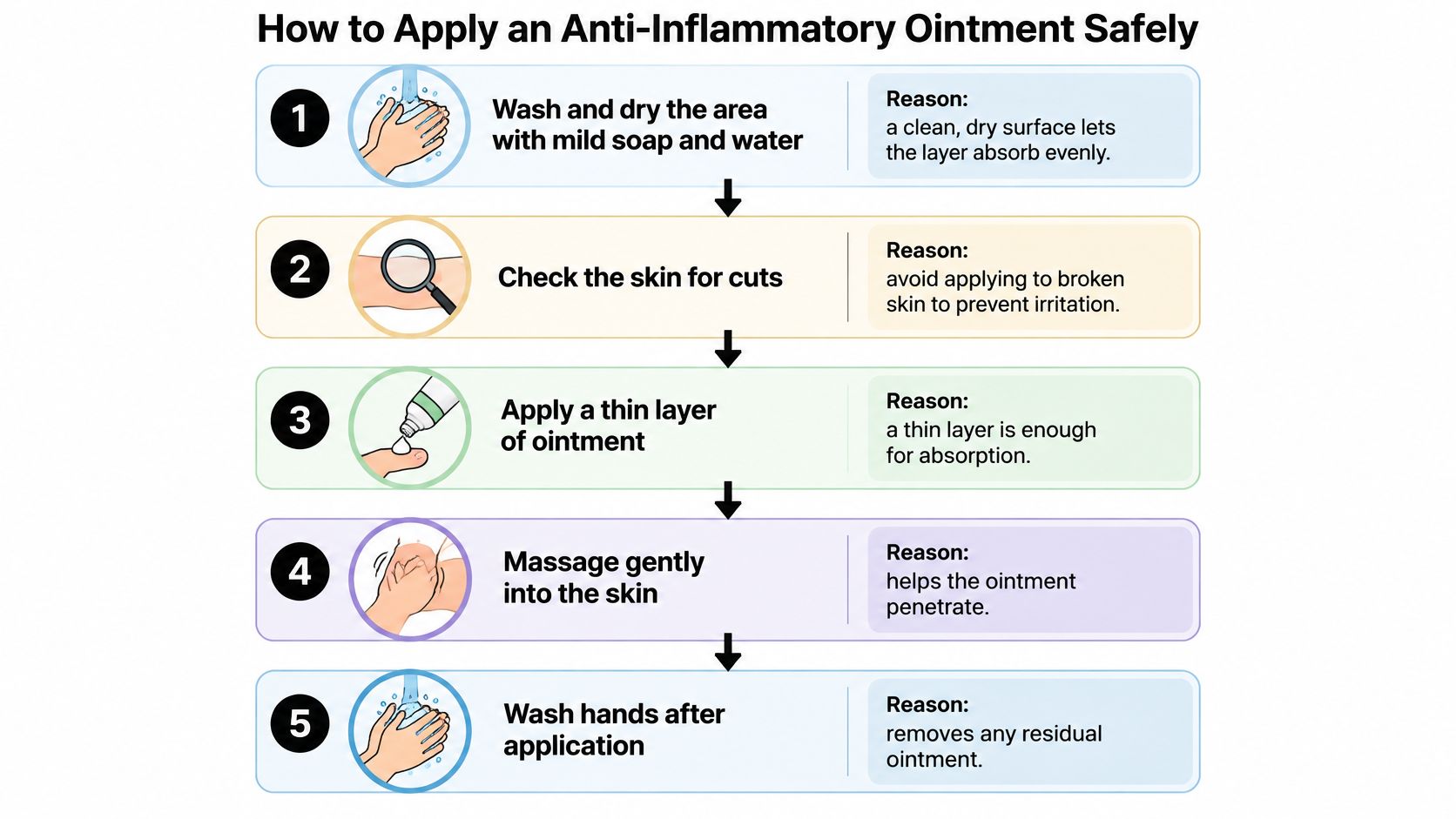
- Wash and dry the area with mild soap and water. A clean, dry surface lets the layer absorb evenly and removes sweat or oil that can make the product sit unevenly and sting.
- Check the skin before you apply. Look for cuts, grazes, blisters, a rash, or a patch that's hot and weepy. Health Canada product monograph information specifies avoiding wounds, abrasions, infected skin, the eyes, mucous membranes and oral ingestion. Damaged skin absorbs more and reacts more.
- Squeeze out what the label says, not what feels generous. Usually that's a thin layer over the painful area. A thicker coat doesn't speed relief; it increases irritation and burns through the tube.
- Rub it in gently until it disappears. A minute or two is normal. Gels and sticks make an even layer easier on a knee or the base of a thumb, so matching the topical analgesic format to the area is worth two minutes of thought before you buy.
- Wash your hands afterwards unless your hands are the treated area. Product transferred to an eye or the mouth burns far worse than it does on a knee. When your hands are the target, leave the product on for the interval your pharmacist advises before washing.
- Don't cover the area with plastic wrap, a tight bandage or a heat pad unless the label allows it. Occlusion drives more drug through the skin and raises the risk of local irritation. A loose sleeve is fine; a wrapped compress isn't.
- Note the date, the area and the time. Two lines in a notes app. You'll want that record when you decide whether the product is working, or when a clinician asks.
What a normal first application looks like
Nothing dramatic. The skin feels comfortable rather than numb, no burning lingers beyond a minute or two, and no spreading redness appears. Over the following hours the joint or muscle moves a little more easily, or the tenderness when you press it eases.
If that first application burns for more than a few minutes, itches, or leaves a raised red patch, stop there. Repeated use of a topical NSAID can produce dermatitis and other skin reactions, which is a reason to stop at the first sign rather than push through a tube.
Judge the product on a proper trial rather than a single evening. A Canadian Medical Association Journal review cited in the same Health Canada monograph material reports a number needed to treat of about 5 for topical diclofenac reaching at least 50% pain reduction within six weeks in chronic hand and knee osteoarthritis, against about 7 for topical ketoprofen. Some diclofenac products also carry their own shorter duration limits, and a product-specific limit overrides any general timeline.
Dosing, Duration and Common Mistakes to Avoid
The label sets the dose, not your routine
Every product carries its own frequency and maximum daily amount, and those numbers aren't interchangeable between a diclofenac gel and a methyl salicylate rub. Follow the one printed on the tube in your hand, even if a friend, a website or an old prescription says otherwise. If the label says three times a day, a fourth application isn't more effective, it's more exposure.
Before the first application, run a short screening conversation with a pharmacist if any of these apply:
- You've reacted badly to an NSAID before. Including an asthma flare after aspirin, or a previous rash from a topical gel.
- You take a blood thinner. Anticoagulant use changes the risk calculation even with lower topical absorption.
- You have kidney disease, heart failure, or a history of stomach ulcer or bleeding. These are the reasons a topical route gets chosen in the first place, and they're also reasons to confirm it's appropriate.
- You're pregnant or breastfeeding. Ask before you start rather than after.
- You already take oral ibuprofen or naproxen. Topical and oral NSAIDs aren't stacked without advice, because the effects add up.
That's the two-minute conversation at the counter that saves a week of guesswork.
How long before you judge it
Give it one to two weeks of consistent use before deciding. What you're watching for is modest: the puffiness looks smaller, the joint bends a bit further before it complains, or pressing the spot hurts less than it did.
Effectiveness is judged over a longer stretch than a weekend. If you're still buying tubes and still unsure after several weeks, that's the moment to book a review rather than restock. Continuing indefinitely without checking response isn't a treatment plan, it's a habit.
Four mistakes that waste the tube
- Buying the fiercest-feeling product for deep or unexplained swelling. The chill of menthol tells you a nerve is being distracted, not that a hip joint is being treated. Fix: settle the cause first, then choose an ingredient that matches it.
- Layering a menthol or camphor spray over a diclofenac gel on the same spot. Two sensations at once means you can't tell which product helped, or which one irritated your skin. Fix: one anti-inflammatory per area, and give it its own trial.
- Treating a knee or ankle injury with ointment alone. Skipping rest, support or an assessment for a fracture or ligament tear turns a short recovery into a long one. Fix: pair the ointment with a support plan, and get the injury looked at if you can't bear weight or the joint feels unstable.
- Using someone else's tube, or one past its expiry date. You don't know what's in it, how it's been stored, or whether the formula suits you. Fix: your own labelled, in-date product, stored below 25°C and out of a hot car.
One product per area: if you can't tell which tube is helping, you've made the test impossible to read.
Stop and call if any of these appear
A rash, persistent burning, spreading redness, or no change after several weeks of correct use. Any one of those is a reason to stop the product and speak to a clinician, not a reason to switch brands and try again with something stronger.
Keep a short log while you use it: date, area treated, a rough size for the swelling, and a pain score out of 10. Four columns, one line a day. That record turns "I think it helped a bit" into something a clinician can work with, and it protects both your comfort and the chance of a correct diagnosis.
Swelling That Needs Medical Attention Right Away
Some swelling isn't a self-treatment problem. Read the first list fast.
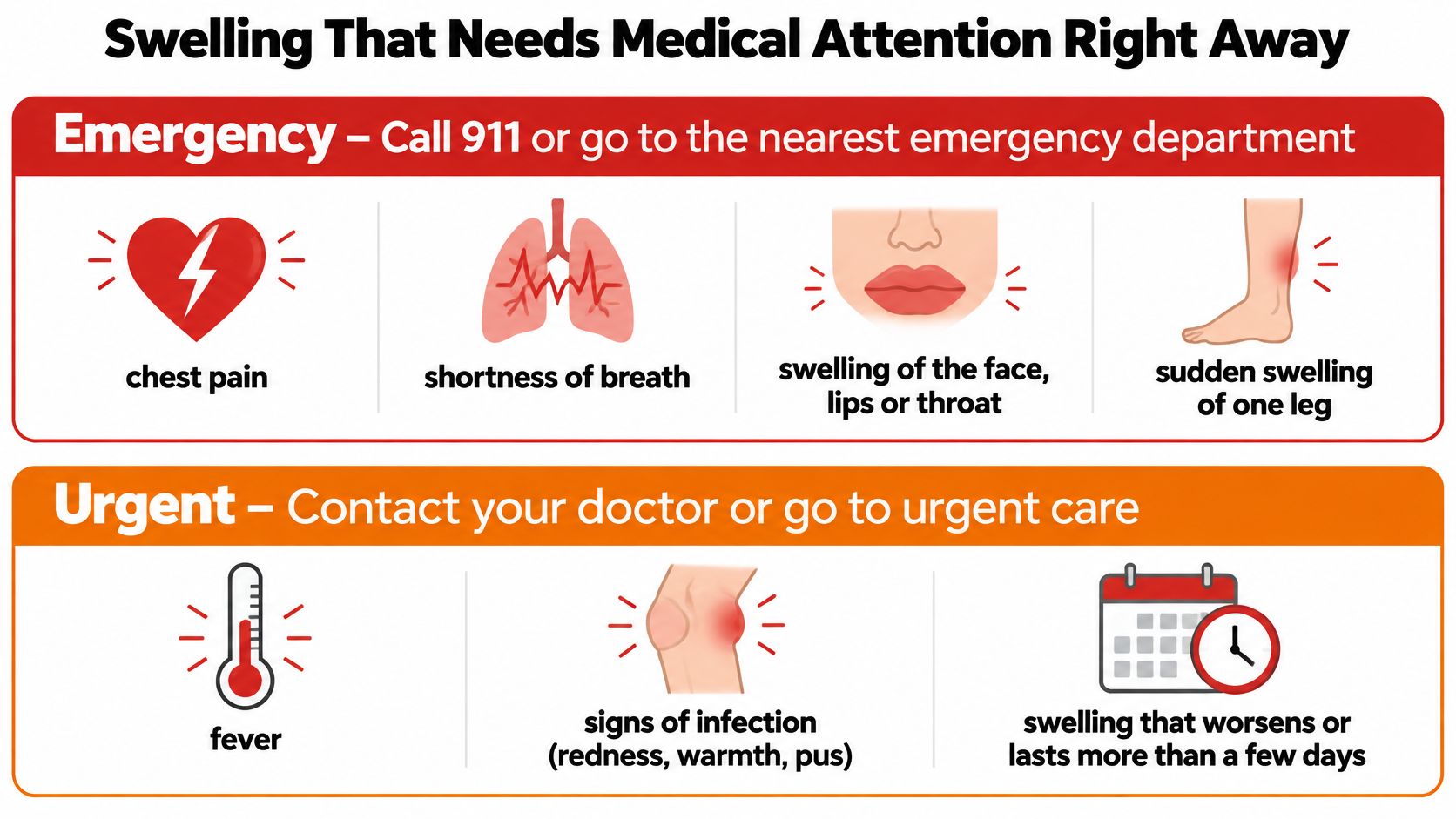
Call 911 or go to the nearest emergency department
- Chest pain, or chest tightness with swelling anywhere. Treat it as cardiac until proven otherwise.
- Shortness of breath. Especially if it arrived with the swelling.
- Swelling of the face, lips or throat. This is an airway problem, not a joint problem.
- Sudden swelling of one leg with pain or warmth. A possible blood clot, and not something to rub.
- A hot, red, swollen joint with fever. Possible joint infection. Hours matter here.
- A joint injury with visible deformity, or a joint you can't put weight on. Needs imaging, not ointment.
Book a clinician within a few days
Swelling that lasts more than two weeks without an obvious cause, swelling that spreads or keeps growing, a new lump, swelling alongside unexplained weight loss or night sweats, and swelling that keeps returning after each course of treatment. A knee that refills every few weeks is a pattern, and persistent knee joint pain and swelling has more than one possible driver.
An ointment can mask pain, and masked pain changes decisions. You keep training, keep working, keep waiting, and the diagnosis that belonged in week one arrives in week six. Infections worry me most, because the early signs look like an ordinary flare and the window is short. The same principle plays out elsewhere in the body: Paul L. Gregory, DDS guidance on dental abscess symptoms shows how quickly an untreated infection spreads before the visible swelling catches up with it.
If you'd rather hear the red flags explained than read them, this walkthrough covers when swelling needs a clinician rather than a tube.
If any item on either list applies to you, stop self-treatment and get assessed before you use an ointment again.
Confirm the Product Fits Before You Buy
Choice comes down to a short sequence. Pick a format that suits the skin and the area, then confirm the choice with a pharmacist, especially if any screening condition from the dosing list applies to you.
Sticks, sprays and roll-ons are topical formats too, and the format doesn't decide what the product does. The active ingredient on the label decides. A roll-on with menthol cools and distracts; a gel with diclofenac lowers local prostaglandins. Both are legitimate, and they aren't substitutes for each other when the swelling is inflammatory. MEDISTIK's lineup, for example, runs across a long-lasting extra-strength stick, a fast-acting spray for larger or hard-to-reach areas, and a rapid cooling roll-on for everyday maintenance, and that cooling roll-on works on pain sensation rather than on deep or unexplained swelling.
If you want to know which products carry Canadian authorization before you spend, this overview of Health Canada approved products explains what the approvals cover.
Then set the reassessment date in your calendar on the day you start, a few weeks out, and bring the log with you. If your swelling sits in a not-suitable row of the sorting table, or any red flag applies, book the clinician first and shop afterwards.
MEDISTIK makes a non-prescription topical pain relief system for people who want targeted relief without pills, injections or greasy creams, with formats built for a stiff shoulder before training, a sore knee after a shift, or a joint that flares with arthritis. If this breakdown helped you work out whether an ointment suits your swelling, start with the format that matches the area you're treating and read the active ingredients on the label. Explore the range at MEDISTIK and keep that reassessment date you set.


