

Can a cream applied to the skin ease joint pain, or does it only create a cooling or warming sensation? The answer depends on the active ingredient: a topical NSAID is an anti-inflammatory medicine applied over a painful area, not just a rub that distracts you from discomfort.
Topical NSAIDs can be a useful option when pain is localised, especially around the hands or knees. But “applied to the skin” doesn't mean “no medicine enters the bloodstream,” and evidence for one painful joint doesn't automatically apply to every kind of pain. Knowing what these products do, and how Canadian evidence and labelling guide their use, can help you decide when they may fit.
What Topical NSAIDs Are and Why They Matter
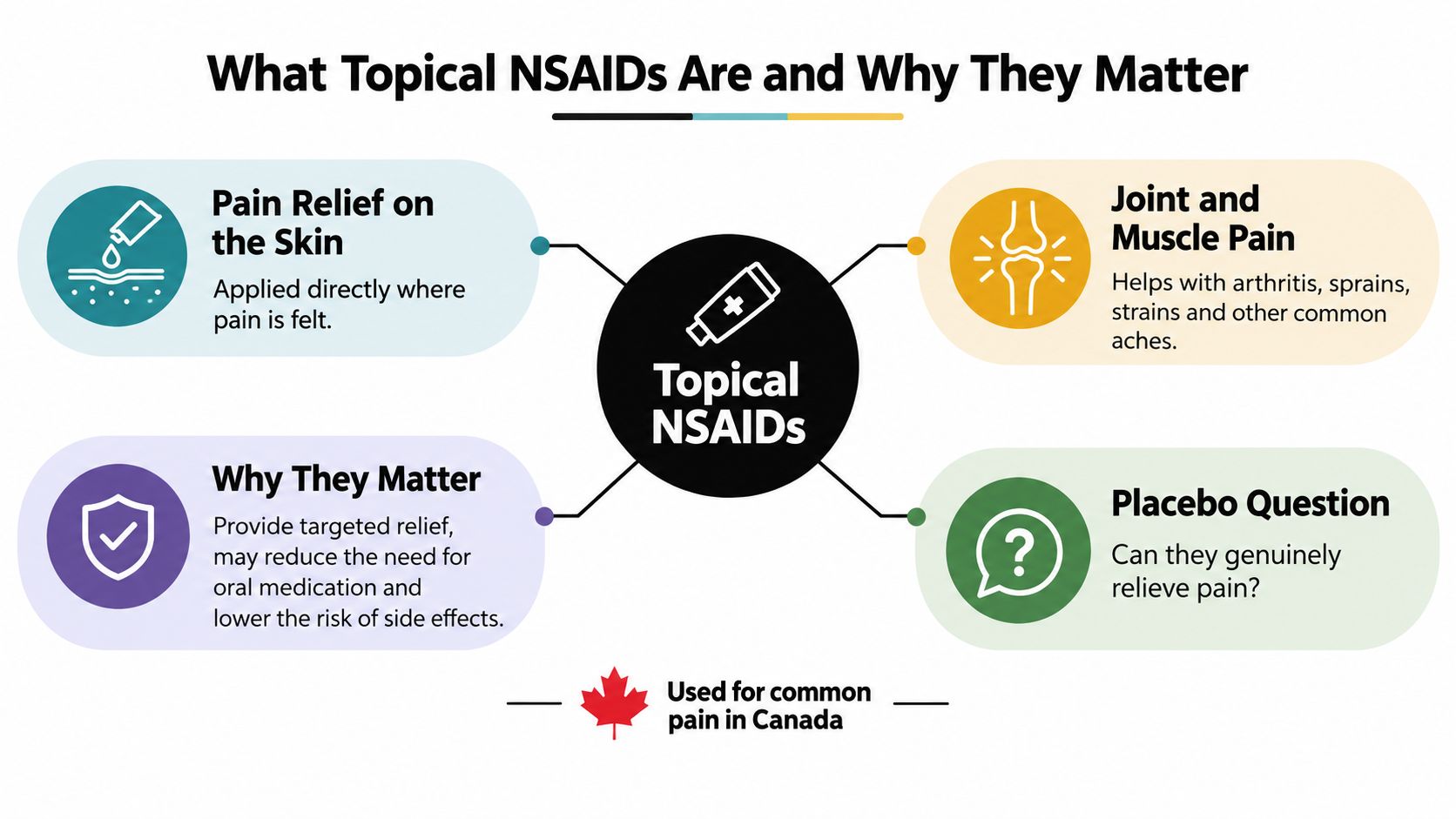
Topical NSAIDs are non-steroidal anti-inflammatory drugs made to be applied to the skin as products such as gels, creams, and solutions. You use them over the painful joint or muscle, rather than swallowing a tablet.
That distinction matters because not every product in the pain-relief aisle works the same way. Menthol rubs and similar counterirritants create a cooling or warming sensation that can temporarily distract from discomfort. A topical NSAID, such as diclofenac, is an anti-inflammatory medicine. The sensation on your skin isn't what defines its action.
Local treatment, not zero exposure
A topical NSAID is intended to act around the area where you apply it. Less of the medicine reaches the bloodstream than with oral dosing, but some absorption can still happen. That's the central trade-off: targeted application may mean lower overall exposure, but it doesn't eliminate the need to follow the label or consider other medicines and health conditions.
The practical distinction: A topical product aims the medicine at a local problem. It doesn't make the medicine risk-free, and it isn't a substitute for checking whether the product is right for you.
The evidence is strongest for localised hand and knee osteoarthritis, and Canadian clinical reviews also support topical NSAIDs for acute musculoskeletal pain. Those findings don't establish the same benefit for pain that is widespread, unexplained, or coming from a deeper area that's difficult to reach from the skin.
That's why a useful first question isn't “Does a pain cream work?” It's “Which active ingredient is in it, where is the pain, and does the evidence fit that situation?” The answers help set reasonable expectations before you choose a product or apply a dose.
How Topical NSAIDs Work in the Body
A topical NSAID has to cross the skin to reach tissues beneath it. At the local site, it inhibits cyclooxygenase enzymes, which contribute to the production of prostaglandins involved in inflammation and pain. It's a targeted route, but the medicine doesn't remain entirely at the application site.
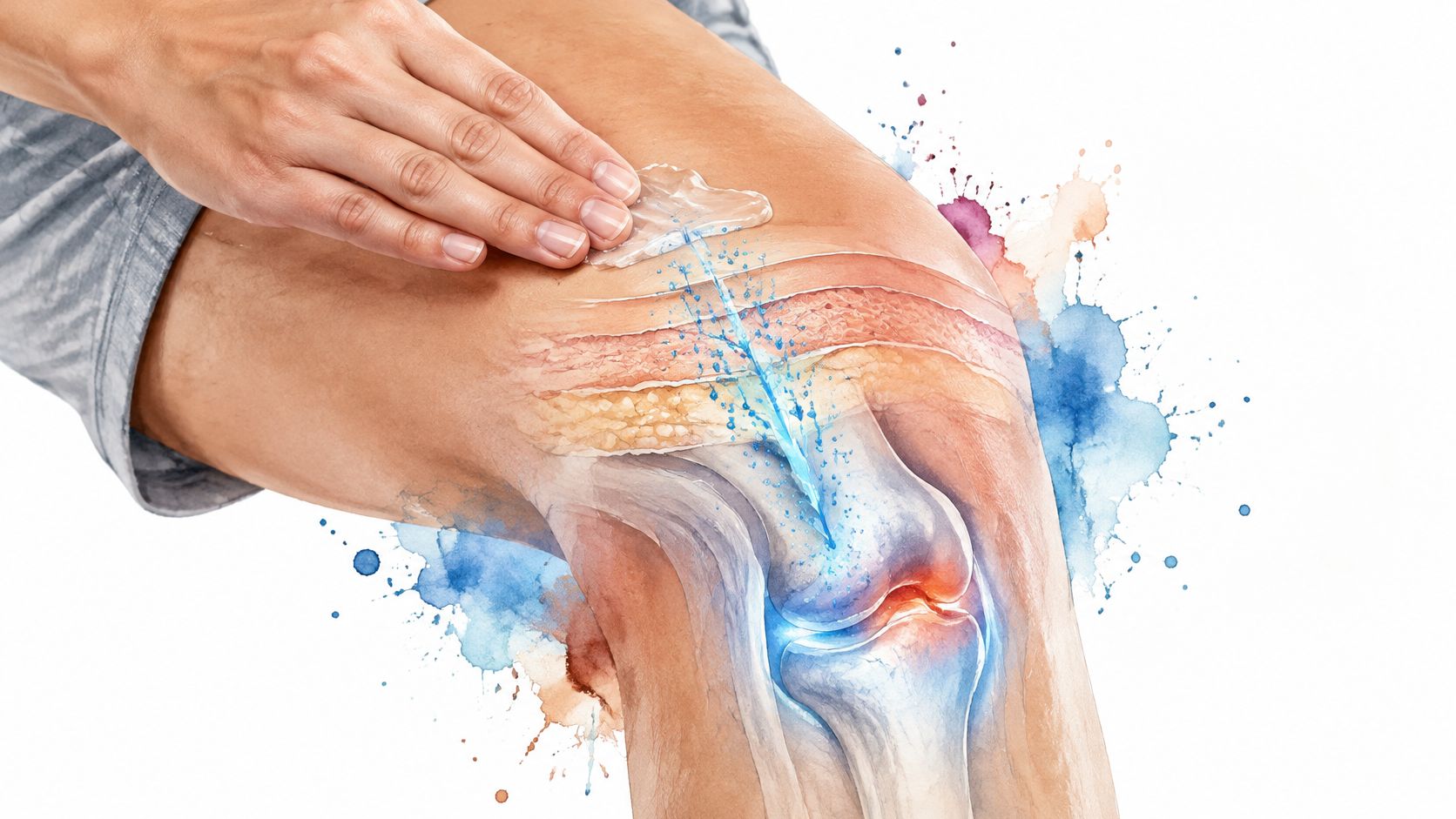
For a 2.32% diclofenac diethylamine gel, Canadian monograph data report systemic absorption of about 6% of the administered dose. Peak plasma concentrations were approximately 50 times lower than with repeated oral dosing and 100 times lower than with a single oral dose, according to Health Canada's topical NSAID policy.
Why lower exposure still needs care
Think of treating one knee directly rather than sending a dose through the whole body in the hope that enough reaches that knee. The comparison helps explain why a topical option can reduce systemic exposure. It doesn't mean the medicine has no systemic effects or that combining it with other treatments is automatically safe.
A topical NSAID may still matter if you already take another NSAID, use a blood thinner, or have health concerns that affect your medicine choices. The product, strength, amount, application area, and frequency all influence how you should use it. Follow the specific Canadian label, and ask a pharmacist or clinician if you're unsure whether it can be used alongside your other medicines.
The key point is simple: lower absorption is not zero absorption. Use the formulation as directed, and don't treat a topical product as a free pass to apply more, cover the area, or combine medicines without checking.
What the Evidence Says About Effectiveness
How well does a topical NSAID work? The honest answer is a number. The most useful one is the number needed to treat, or NNT: how many people must use a medicine for one additional person to reach a defined benefit compared with a control.
An NNT never predicts one person's outcome. It describes an average across a trial group.
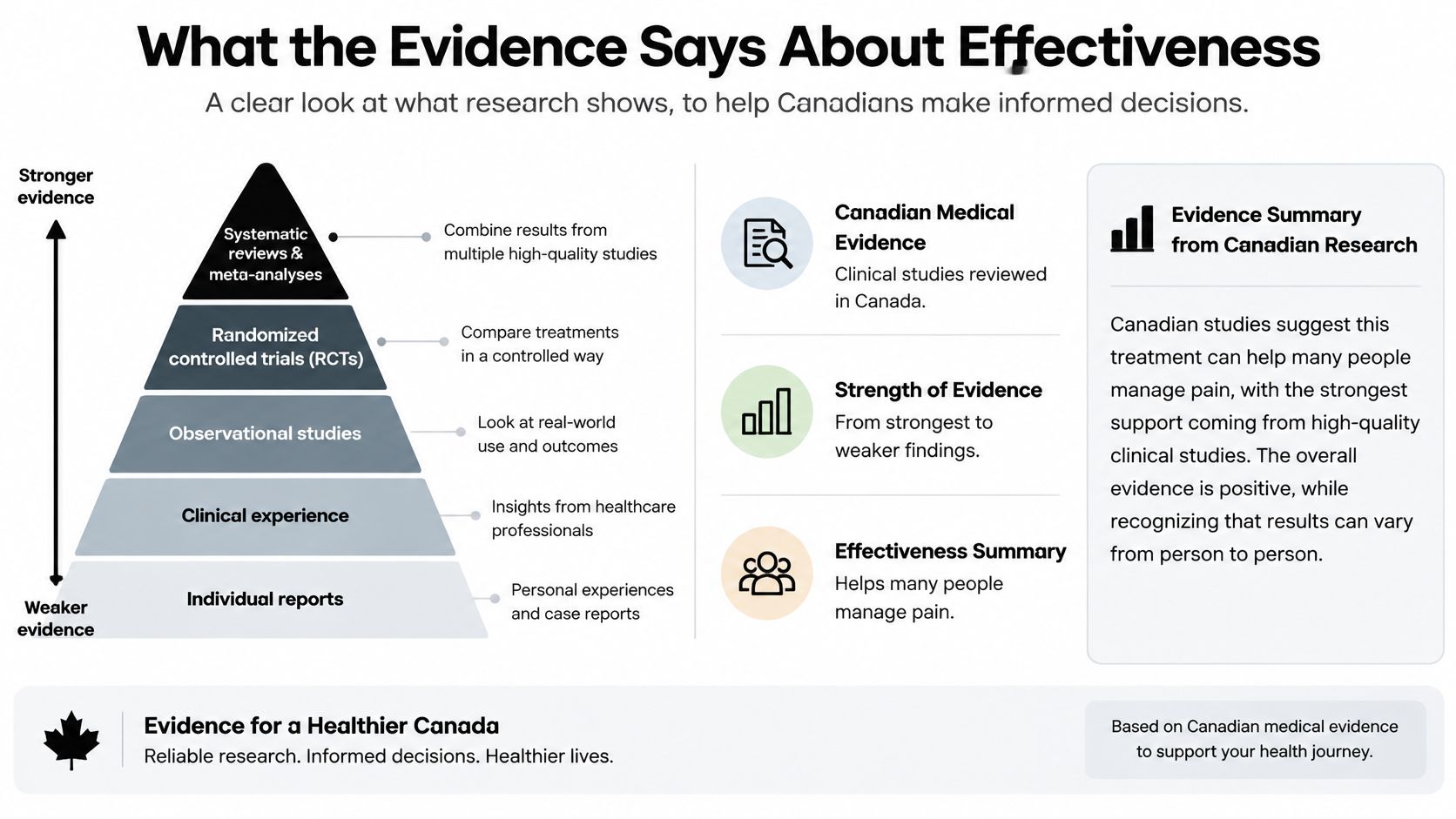
According to the Canadian Medical Association Journal review of topical NSAIDs, topical diclofenac achieved at least 50% pain improvement within six weeks, with an NNT of 5, while topical ketoprofen's reported NNT was 7. In plain terms, for every five people using diclofenac in those trials, one extra person reached meaningful relief who would not have on control.
A clinician's reading of NNT 5: treat five people and, on average, one more reaches the target than would have without the medicine. The other four may still need a different approach, which is why NNTs guide expectations rather than settle them.
What pooled trials add to the picture
Single trials can mislead, so the review leans on meta-analyses. Those analyses found pain relief from topical NSAIDs comparable to oral NSAIDs for chronic osteoarthritis and acute musculoskeletal pain. Comparable pain relief does not mean identical risk, and it says nothing about pain spread across the whole body.
The same evidence summary captures the PEER simplified chronic pain guideline, which pooled 6 to 43 randomised controlled trials involving 706 to 28,699 patients. For osteoarthritis, topical NSAIDs outperformed control with a relative benefit of 1.27 and a 95% confidence interval of 1.16 to 1.38, a range narrow enough to suggest a real, if modest, average effect.
The review also reports a shift in gastrointestinal adverse events from 26% with oral NSAIDs to 17% with topical formulations. That difference helps explain why clinicians often reach for a topical option first when the pain sits in one joint and the patient has reason to avoid systemic exposure.
Evidence boundary: These findings speak most directly to localised hand and knee osteoarthritis. They do not settle questions about widespread pain, back pain, or aches without a clear cause.
When comparing products for arthritis, the active ingredient and the joint involved tell you more than the phrase "pain relief" on the box. This guide to topical pain relief for arthritis walks through those distinctions in more detail.
How to Apply Topical NSAIDs Correctly
The skin matters as much as the dose. Apply a topical NSAID only to intact skin. Canadian monograph directions for diclofenac say to avoid open, abraded, or infected skin and to skip occlusive dressings. Broken or tightly covered skin changes how much medicine your body absorbs, so these instructions protect you rather than pad out the label.
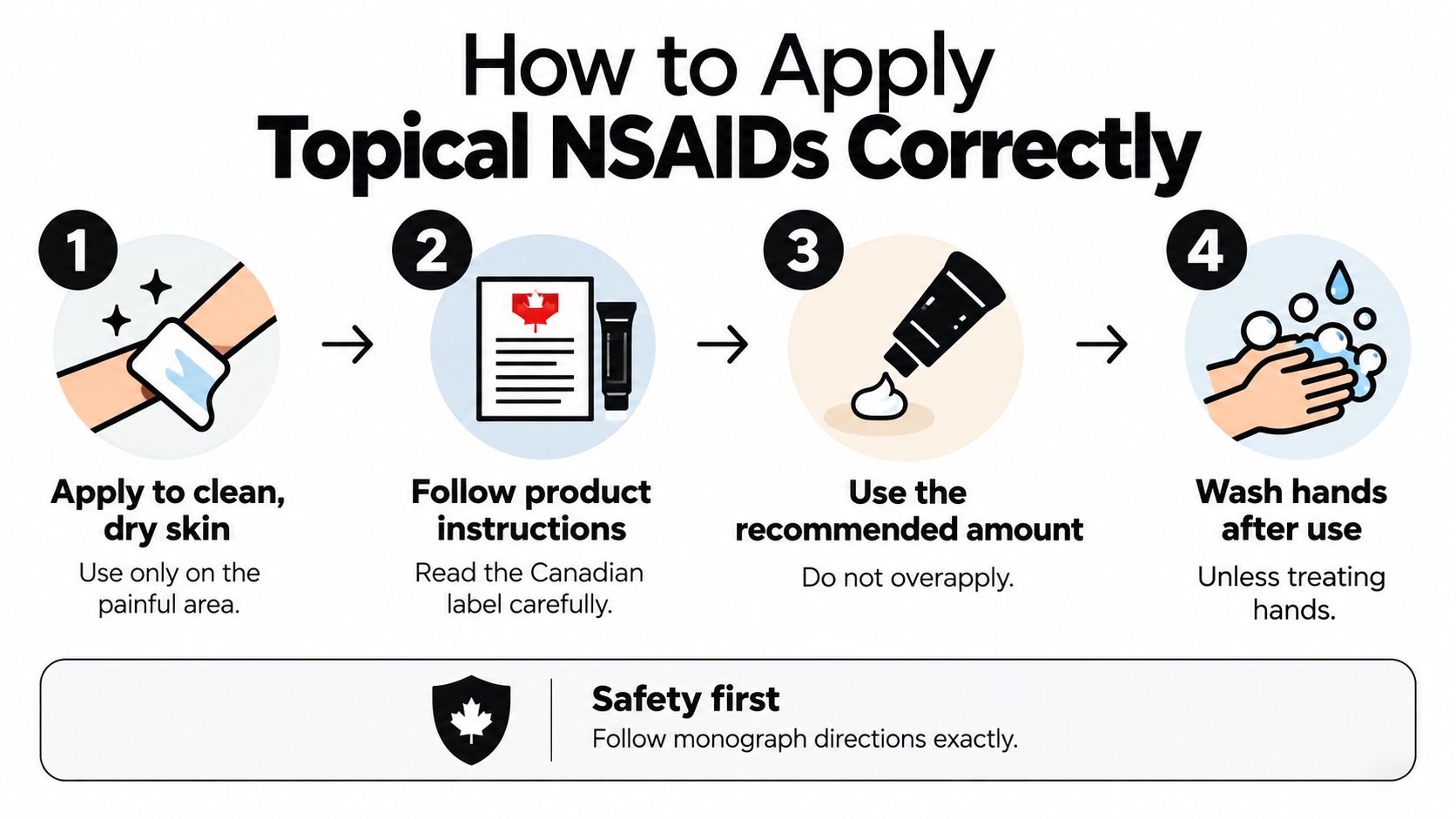
Intact skin works like a gatekeeper. It lets a predictable amount of medicine through to the tissue below. A scrape, a rash, or an airtight bandage removes that control, and the amount you squeezed onto your finger may no longer match the amount your body takes in.
Follow the Canadian product directions
Canadian rules depend on the product and its intended use. Health Canada's revised classification allows single-ingredient topical diclofenac at concentrations equivalent to 2% or less to be sold without a prescription when used for no more than seven days. The Health Canada diclofenac regulatory record also describes a 1.5% diclofenac sodium topical solution indicated for knee osteoarthritis in regimens lasting no longer than three months. That duration applies to that formulation alone, not to every topical NSAID on the shelf.
Key principle: The label is the dose. The amount, frequency, and duration printed on your specific product define the treatment. Extra gel on the skin raises exposure without a guarantee of extra relief.
A few habits separate using a topical NSAID from using it well:
- Check the skin first: Skip broken, scraped, or infected areas.
- Measure what the label says: Follow the instructions for that exact formulation instead of estimating or borrowing directions from a different product.
- Leave the area uncovered: Avoid tight or occlusive dressings unless a clinician has specifically advised one.
- Wash your hands afterward: This applies unless your hands are the treatment site. Keep the product away from your eyes and other sensitive areas.
- Ask before layering: Check with a pharmacist before adding heat, ice, or a second topical product if the label doesn't address it.
If you miss an application, follow the package directions instead of doubling the next one. Sprays and other formats have their own handling steps, and this guide on how to use a pain-relief spray walks through them.
Topical NSAIDs Compared with Oral NSAIDs and Other Analgesics
Is a topical NSAID automatically the safer choice? The honest answer is that the routes solve different problems, so the better question is which one fits the pain, the person, and the goal of treatment.
Topical NSAIDs deliver medicine to a defined area with lower exposure to the rest of the body. Oral NSAIDs act systemically, which can suit widespread symptoms but brings different concerns. Non-NSAID rubs, such as menthol products, are a third category: they create a cooling or warming sensation rather than reducing inflammation.
In Canada, that difference in exposure shows up in regulation. Health Canada permits 2% diclofenac gel without a prescription for muscle and joint pain, with labelled use capped at seven days, while stronger topical formulations remain prescription products.
The useful comparison is: where is the pain, what else does this person take, and what does the evidence show for each route?
| Option | Systemic exposure | GI risk | Onset | Best-fit use case |
|---|---|---|---|---|
| Topical NSAID | Lower than oral dosing, but not zero | Expected to be lower than oral NSAIDs; a study in a Canadian review found severe GI events dropped when patients switched to the topical route | Depends on the product and use; follow its label | Localised joint or musculoskeletal pain where the product is indicated |
| Oral NSAID | Taken by mouth and acts systemically | Expected to be higher than the topical route; individual risk varies with dose, duration, and health history | Varies by medicine and person | Situations where a clinician considers systemic treatment appropriate |
| Non-NSAID topical analgesic | Depends on the ingredient and product | Does not carry NSAID-related GI concerns; check its own warnings | A cooling or warming sensation can feel immediate | Temporary local comfort when a counterirritant suits the situation |
The 26%-to-17% shift deserves context. The Canadian review reports that substituting topical NSAIDs for oral NSAIDs reduced severe gastrointestinal adverse events from 26% to 17% in the study it cites. That is a population-level result rather than a prediction for any one person. It supports trying the topical route when pain is localised, without ruling out systemic treatment where it is more reasonable.
Effectiveness matters alongside safety. Researchers often express it as the number needed to treat: how many people must use a product for one to gain meaningful relief. Topical NSAIDs performed well on that measure for localised joint pain in the evidence reviewed.
A counterirritant can feel soothing without acting on inflammation, and an oral NSAID may suit symptoms too widespread for any one application site. A pharmacist or clinician can weigh those differences against other medicines you take. For a closer look at the trade-offs, see this comparison of topical pain relievers and oral pain relievers.
The same principle, treating a specific site to spare the rest of the body, appears elsewhere in medicine. This guide to awake surgery in Beverly Hills describes how local anaesthesia applies that idea on a very different scale.
Choosing the Right Option for Your Pain
Choosing well here is mostly a matching exercise. A topical NSAID delivers an anti-inflammatory ingredient to one specific address, so the first question is whether your pain has one. A single knee, a sore shoulder, or a defined muscle group fits that pattern. Widespread, unexplained, or steadily worsening pain does not, and a cream will not reveal why the pain is happening.
The second question is whether anything else changes the safety picture. Tell a pharmacist or clinician if you already take an oral NSAID or a blood thinner, have reacted to an NSAID before, or have kidney or cardiovascular concerns. Even the smaller amount absorbed through skin adds to what you already swallow.
Then check what Canadian rules let you buy, and for how long. Under Health Canada's framework, topical NSAIDs at strengths up to 2% are sold without a prescription, while stronger formulations go through a prescriber. Non-prescription labels also set a seven-day limit on self-treatment. That limit works like a built-in checkpoint: if the pain still needs the product after a week, the right move is a conversation, not a larger amount.
The right choice is the product whose ingredient, strength, and directions match your pain, your skin, and the rest of your medicines. Format and sensation come second.
Match the product to the situation
- A stiff knee with osteoarthritis: Topical diclofenac has Canadian clinical evidence in osteoarthritis, particularly in localised joints such as the knee. Confirm the formulation and directions fit your situation.
- A sore shoulder after training: Consider whether the pain is confined to one area and the skin is unbroken. Local discomfort can suit a topical product; pain that persists or worsens deserves assessment.
- An aching lower back after a long shift: A broad or deep area is harder to treat locally. Spreading more product over a larger area does not solve that mismatch.
- Post-activity muscle soreness: A topical product can be a convenient way to treat a defined spot. Match it to its intended use, and separate anti-inflammatory medicines from products that mainly create a cooling or warming sensation.
Format affects convenience, not evidence. MEDISTIK sells an extra-strength stick, an extra-strength spray, and a natural ice roll-on, aimed at targeted application, broader or hard-to-reach areas, and cooling respectively. Its products contain methyl salicylate, so read the ingredient list and label rather than assuming they behave like diclofenac.
Older adults comparing pain-relief options can use this guide to pain relief for seniors to prepare questions for a health professional. Easier application helps, but the active ingredient and its directions still decide whether a product suits you.
Safety, Side Effects, and Who Should Avoid Topical NSAIDs
Topical NSAIDs can irritate the skin where they are applied. Dryness, itching, and irritation are among the most commonly reported reactions. A Canadian review reported a number needed to harm (NNH) of 7 for local skin reactions. In plain terms, for every seven people treated, one additional person experienced a reaction compared with the control group. Stop using the product and seek advice if a reaction worsens or spreads.
Skin sensitivity can also develop after repeated exposure. In an assessment of a topical NSAID submission in the late 1980s, 1% to 2% of 200 patients became sensitised to the active arylpropionic-acid derivative. Health Canada's policy calls for assessing sensitisation, including systemic-contact and photocontact hypersensitivity, and recommends patch testing. A clinician can advise whether testing applies to your situation.
Before applying, check the medicine, the skin, and any other treatments that could affect your risk.
Ask a pharmacist or clinician before use if you have an NSAID allergy, take medicines that may interact, or are considering applying the product over a large area. Do not use it on damaged or infected skin. Follow the label's directions for dressings and duration.
Check these points first:
- Ingredient: Is the product an NSAID? Have you reacted to it or a related medicine before?
- Skin: Is the area intact and free of infection?
- Other treatments: Are you using an oral NSAID, a blood thinner, or another topical product?
- Directions: Do you know how much to apply, how often, and for how long?
Pregnancy calls for individual advice. A topical medicine is not automatically suitable because it is applied to the skin. The Axelrad Clinic's guidance on natural relief for pregnancy aches may help you prepare questions for a qualified health professional. You can also check information about Health Canada-approved products, then confirm the specific product's label and directions.
Your Next Steps for Trying Topical NSAIDs
Choose one local area and follow the Canadian product label. Health Canada limits non-prescription topical NSAIDs to products with no more than 2% concentration and a maximum seven-day course. Check the specific product's label, since directions can vary.
Set a practical measure of benefit, such as whether walking or climbing stairs becomes easier. Check the skin for dryness, itching, or irritation, too. Relief during an activity is more useful to track than the immediate sensation after applying a product.
If pain persists beyond the labelled period, ask a pharmacist or clinician what to do next. Seek advice as well if pain spreads beyond one area, a skin reaction worsens, or you are unsure how a topical product fits with other treatments. A topical NSAID may ease symptoms, but it cannot identify their cause.
MEDISTIK offers topical pain-relief products in stick, spray, and roll-on formats. Some contain methyl salicylate for temporary relief of sore muscles and joints. Check each product's ingredients and directions, and ask a health professional whether it suits your needs.


