

Muscle pain usually comes from strain, overuse, or tension in soft tissue and often eases with rest, heat or ice, and gentle movement, while joint pain points to the joint itself, including cartilage, ligaments, or inflammation, and is more likely to need assessment. That need rises if joint pain lasts beyond six weeks or comes with swelling, locking, or redness.
That distinction sounds simple until your knee aches on stairs, your shoulder hurts reaching for a mug, and your back is tight by noon. Is it the muscle doing the work, the joint allowing the movement, or both feeding each other. Getting that first call right changes what you do next, how much you rest, how much you load, and when you stop guessing and book care.
Why Muscle and Joint Pain Affects So Many Canadians
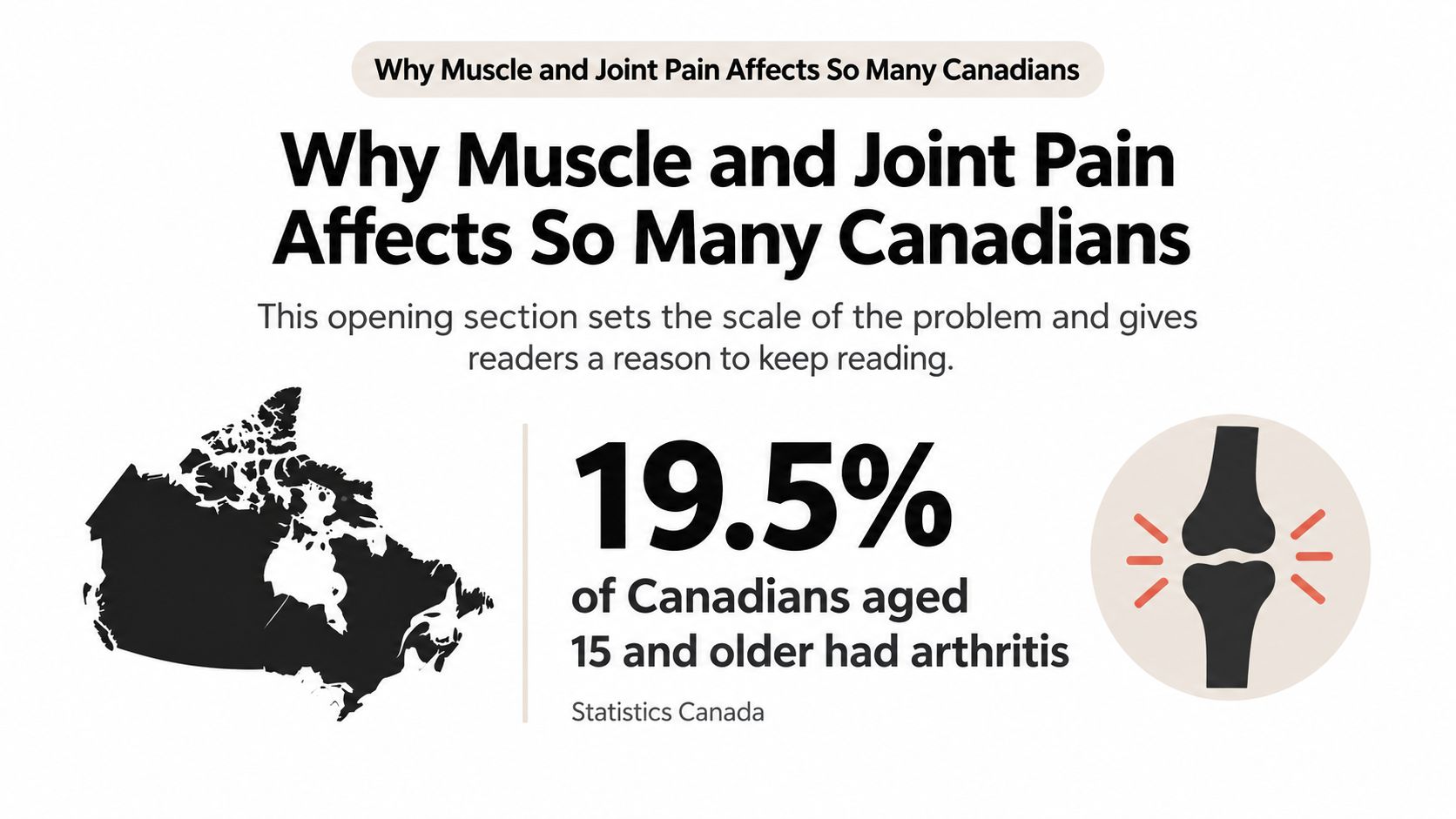
Arthritis affects nearly one in five Canadians aged 15 and older. Statistics Canada reported a prevalence of 19.5% in 2021, as shown in a map of Canada and a bone icon illustrating that 19.5 percent of Canadians have arthritis.. Arthritis can limit walking, exercise, work, and routine tasks. The figure describes how common arthritis is, not how many Canadians experience every kind of muscle or joint pain.
Age Raises Risk But It Does Not Explain Everything
Statistics Canada's 2021 figures show a clear age pattern: arthritis affected 2.7% of Canadians aged 18 to 34, 9.2% of those aged 35 to 49, 27.0% of adults aged 50 to 64, and 46.6% of people aged 65 and older. The figures rise with age, but arthritis is not only an older adult's concern. Symptoms that begin during working years can affect daily routines, sport, and family life over time.
The pattern is like a map, not a forecast for one person. Age gives context, but it does not explain every ache or confirm a diagnosis. A younger adult's persistent pain still deserves attention, just as an older adult's pain should not automatically be dismissed as age-related.
Nearly one in five Canadians aged 15 and older had arthritis in 2021, making its effects on movement and daily function a population-level concern.
A useful guide connects the structures that hurt with decisions about relief and care. Muscles, tendons, and joints work together, so pain in one area can affect how another moves or carries load. While waiting for a diagnosis, physiotherapy, or surgery, the aim is to manage symptoms safely without mistaking temporary relief for treatment of the underlying cause.
Knowing what to monitor can help you explain symptoms clearly and choose sensible next steps. It can also help you recognise when pain calls for assessment rather than more self-management. The goal is not to diagnose yourself, but to avoid ignoring symptoms for months or pushing through pain that needs a different plan.
Muscle Pain Versus Joint Pain and How to Tell Them Apart
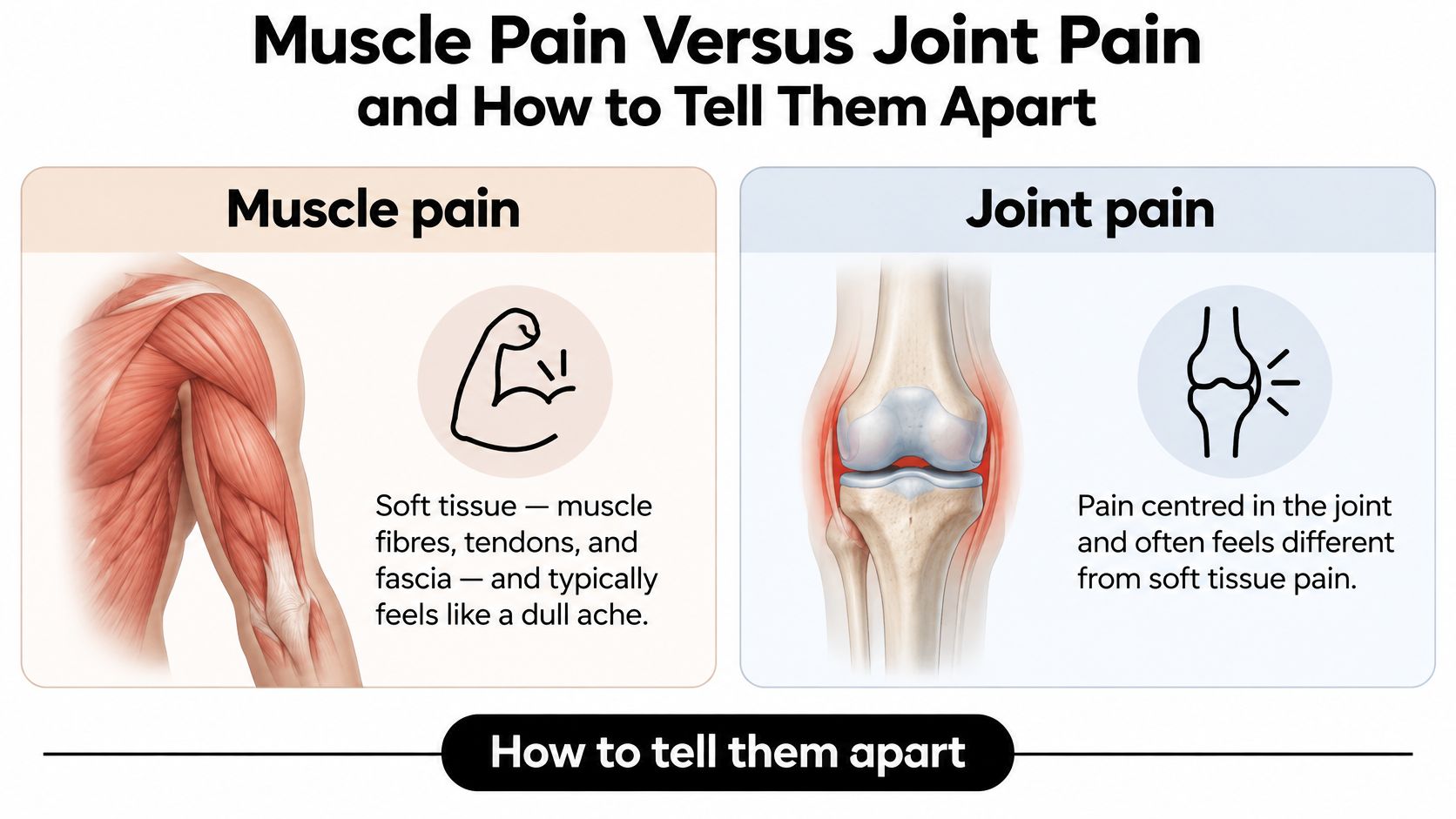
Start with anatomy in plain terms. Muscle pain comes from soft tissue, meaning muscle fibres, tendons, and fascia, and it typically feels like a dull ache, tightness, cramping, or soreness spread along a muscle. Joint pain originates in the joint itself, including cartilage, ligaments, the joint capsule, or inflammation within the joint space, and it tends to feel deeper and more pinpoint.
This visual comparison puts the two patterns side by side before you test your own symptoms.
Ropes and Hinges
Use a door analogy. Muscles are the ropes that pull the door open and closed, and joints are the hinges that let it swing.
A frayed rope hurts when you pull it, so muscle pain often worsens when you contract or stretch that muscle and eases with rest, warmth, or gentle movement. A rusty hinge hurts when the door moves through its range, so joint pain often shows up with weight bearing, twisting, stairs, kneeling, or standing after sitting, and it may bring stiffness, swelling, grinding, catching, or locking.
The hinge test: if pain feels deep inside the joint and limits movement in a specific direction, think hinge first, rope second.
A Short Self Check You Can Run Today
This isn't a diagnosis, it's triage you can bring to a clinician. Work through it slowly and note the answers.
- Where exactly is it: can you point to one deep spot on a joint line, or does soreness spread along a muscle belly.
- What provokes it: does tightening the muscle against resistance hurt most, or does moving the joint through its range without much load hurt most.
- What travels with it: is there swelling, warmth, redness, bruising, numbness, weakness, or a feeling that the joint gives way.
- How does rest change it: does it settle quickly at rest, stiffen after sitting, or persist at night.
The short video below reinforces how clinicians listen for those patterns, rather than relying on pain intensity alone.
Plenty of people have both problems at once. A sore knee joint makes you guard, your thigh and calf tighten to protect it, and soon you can't tell which tissue started the conversation, which is why specific conditions matter next.
Common Conditions Behind Muscle and Joint Discomfort
A similar ache can come from different tissues, and the cause shapes what may help. A muscle strain, tendon irritation, and joint disease can all make movement uncomfortable, but they do not call for the same response.
Muscle Side Problems
A strain occurs when muscle fibres face more force or speed than they can manage, often during awkward lifting or a quick return to sport. Tendinitis usually develops more gradually: repeated loading makes the tendon that transfers force from muscle to bone sensitive and less tolerant.
Myofascial trigger points may feel like tender knots or tight bands in the neck, shoulders, low back, glutes, or calves. Pressing one spot can reproduce an ache nearby. Delayed onset muscle soreness after unfamiliar activity is more spread out and tends to settle with recovery and a sensible return to that activity.
Joint Side Problems
Osteoarthritis is a common joint condition. In Canada, diagnosed osteoarthritis affects approximately 3.9 million adults aged 20 years and older, or 13.6% of this population. The Public Health Agency of Canada osteoarthritis surveillance also reports 219,000 new diagnoses recorded in 2016 to 2017, equivalent to 8.7 new cases per 1,000 people annually. Prevalence was higher among females than males, at 16.1% versus 11.1%.
Other joint conditions can have different clues. Rheumatoid and other inflammatory arthritis may cause swelling in several joints, prolonged morning stiffness, warmth, and fatigue that do not track closely with activity. Bursitis irritates small, fluid-filled sacs that reduce friction near a joint. Ligament injuries, by contrast, often follow a blow, twist, or movement that pushes a joint beyond its usual control. This overview of arthritis and joint pain patterns and care options explains how arthritis symptoms can differ from simple overuse.
These patterns guide what to do while waiting for an assessment. A gradual, activity-related ache may call for adjusted loading, while warmth and swelling across several joints are reasons to seek clinical advice. Relief measures may reduce discomfort, but they do not establish or treat the underlying cause.
Overlap is common. Knee osteoarthritis can coexist with a calf trigger point, and tendon irritation can sit beside an irritated joint. Treating only the most painful spot may leave another source of symptoms unaddressed. Notice which movements provoke pain, how it changes with rest, and whether swelling or other symptoms appear. That information can help a clinician distinguish conditions and guide the next step.
How Soft Tissue and Joints Affect Each Other
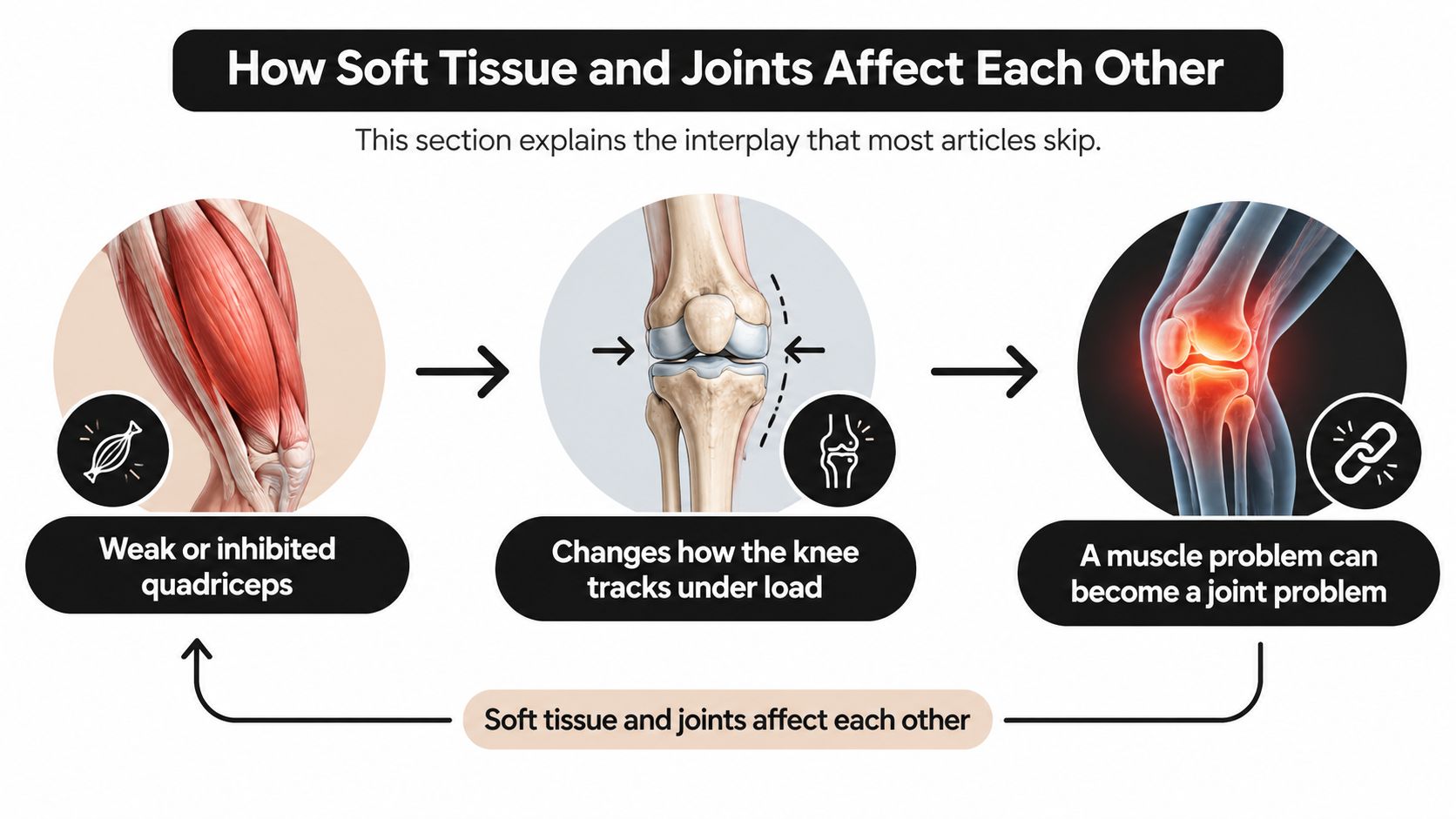
Your knee doesn't work alone. When your quadriceps at the front of your thigh is weak or inhibited by pain, it controls knee tracking and shock absorption less well under load. Stairs, squats, and getting up from a low chair then place more stress through the joint itself.
This diagram shows that chain from muscle weakness to altered joint loading.
The Cycle That Traps People
Follow one common story. Your knee hurts, so you walk less, avoid stairs, and sit more, which feels protective in the moment.
Within weeks your quadriceps weakens, your balance gets shakier, and the same chair rise now demands more from a joint with less muscular support. Pain rises, confidence falls, and activity drops again. The joint problem created a muscle problem, and the muscle problem now feeds the joint problem.
Pain leads to avoidance, avoidance leads to weakness, and weakness leads to more joint stress with everyday tasks.
The back works the same way in reverse. A strained back muscle makes you move stiffly and shift load to your hips and spinal joints, while an irritated spinal joint makes surrounding muscles brace constantly until they ache from overwork.
Why Strengthening Counts As Joint Treatment
Canada's guidance recommends that adults aged 18 to 64 complete at least 150 minutes of moderate to vigorous activity weekly and perform muscle strengthening activities involving major muscle groups at least twice per week, with balance training added for adults aged 65 and older, as set out in Canadian physical activity guidance for health professionals. That's a general health target, not a prescription for a painful joint on day one, but the principle holds, stronger muscles support joints better.
Prolonged inactivity does the opposite, accelerating deconditioning and reducing joint support capacity. For a related lower leg example, this explanation of how calf function relates to knee pain shows why clinicians rarely treat one tissue in isolation.
Core Treatment Principles for Muscle and Joint Pain
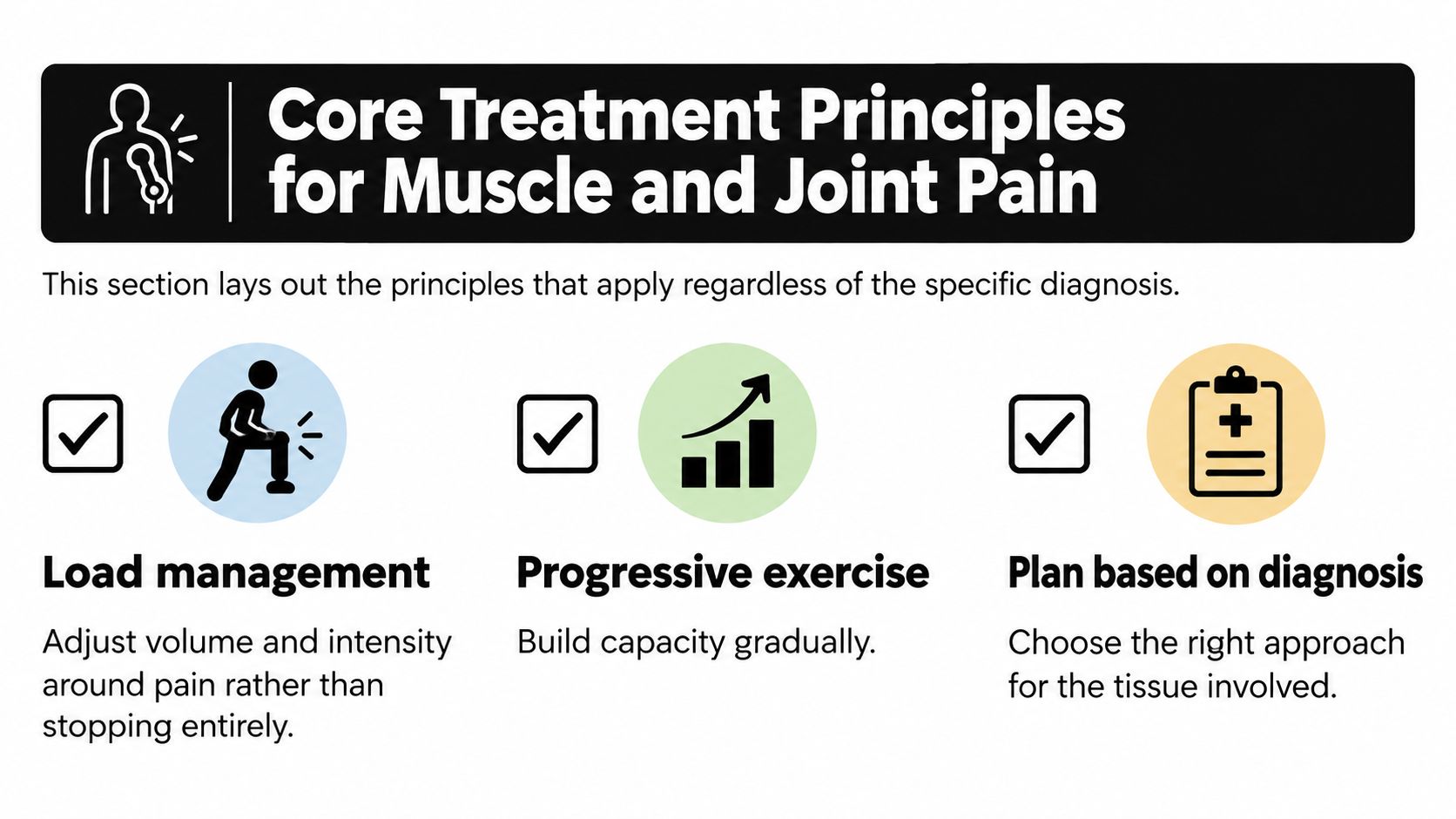
Principles beat random tips. Whatever your diagnosis, most good plans for muscle and joint pain adjust load, rebuild strength gradually, calm symptoms enough to keep moving, and protect sleep and recovery.
This checklist summarises those principles before you apply them to your own routine.
Load Management Comes First
Load management means adjusting volume, intensity, range, or frequency around pain, rather than stopping entirely or pushing through at full volume. Shorten the walk, lighten the load, split the job into smaller blocks, or swap running for cycling or pool work while tissue settles.
Then rebuild progressively. Add a little range, resistance, or time, watch the response over the next day, and progress only when symptoms stay manageable.
Heat Ice and Symptom Relief
Heat usually suits muscle tightness and stiffness, helping tissue relax before gentle movement. Ice usually suits acute swelling or a hot, irritated joint after activity or injury.
Topical and oral non prescription options can reduce symptoms enough to make movement tolerable. This explanation of gate control theory and how pain signals are modulated helps clarify why rubbing, warmth, cooling, and topical sensations can change how strongly you feel pain. Relief matters, but be precise about what it does, it eases symptoms temporarily, it doesn't reverse cartilage loss, heal a ligament tear, or cure arthritis.
- Progressive strengthening: target the muscles that support the painful joint, plus major muscle groups for overall capacity.
- Aerobic movement: choose tolerable options you will repeat, from walking and cycling to learning how to get more exercise from paddleboarding if balance and access suit you.
- Pacing and sleep: spread demanding tasks across the day and protect sleep, because poor recovery lowers your tolerance the next day.
Practical rule: mild soreness that settles within a day or two is usually acceptable, pain that escalates during activity or lingers for days means reduce the dose and reassess.
That rule won't replace clinical advice. It will stop the boom and bust cycle where you overdo it on a good day, flare for three days, rest completely, weaken further, and start again from a lower baseline.
Choosing Relief Options That Fit Your Day
The best format on paper fails if you won't use it at work, on a trail, or before a shift. Compare onset, duration, portability, and where each option fits around activity, then choose for your actual day.
Relief Options Compared
| Option | Typical Onset | Duration | Portability | Best For |
|---|---|---|---|---|
| Topical analgesic | Fast on the skin | Short to longer depending on format | High | Targeted sore muscles and joints at work or training |
| Oral non prescription option | Slower systemic effect | Longer systemic window | High | More widespread ache when appropriate for you |
| Heat | Fast while applied | Mostly during and shortly after use | Low to moderate | Muscle tightness and stiffness before movement |
| Ice or cooling | Fast while applied | Short | Low to moderate | Acute swelling or an irritated joint after activity |
| Manual therapy | During session | Variable | Low, appointment based | Guarding, stiffness, and movement retraining support |
For a direct format comparison, this guide to topical versus oral pain relievers and when each fits walks through trade offs in localisation, convenience, and whole body exposure. Supportive gear plays a narrower role, for example riders sometimes review knee sleeves for mountain biking for warmth and proprioceptive feedback during rides, but a sleeve doesn't strengthen the quadriceps or treat joint disease.
Where a Topical System Fits
One option in the topical category is MEDISTIK, a Canadian made range approved by the FDA and Health Canada, designed around prime, perform, and restore use. The portfolio described by the company includes a long lasting extra strength stick for targeted coverage before a shift or training session, a fast acting extra strength spray for larger or hard to reach areas, and a rapid cooling natural ice roll on for cooling relief after activity.
The company states it's trusted by over one million customers and more than 10,000 health care clinics, plus professional athletes and Canadian Military Health Services, with a 100% satisfaction guarantee and free standard shipping in North America. Treat those formats like tools for temporary relief within the principles above, useful if they help you warm up, complete rehab exercises, or recover after work, not as substitutes for assessment or progressive strengthening.
Pick by scenario, not loyalty. A tradesperson may favour a stick in a kit bag, a runner may prefer a spray after training, and someone with a hot knee after gardening may reach for cooling first, then adjust tomorrow's load.
When to See a Clinician and What to Do While You Wait
Waiting is part of care in Canada, and pretending otherwise doesn't help you. Arthritis Society Canada reports that about 25,000 people annually wait beyond medically appropriate timeframes for joint replacement surgery, while nearly 6 million Canadians lack access to a regular healthcare provider, in its Arthritis Action Now report on access to arthritis care.
Red Flags That Should Not Wait
Book prompt assessment, or urgent care depending on severity, if any of these apply.
- Duration: pain persists beyond six weeks despite sensible load changes, or keeps returning in the same pattern.
- Joint signs: swelling, redness, warmth, locking, catching, or the joint giving way.
- Night and systemic signs: pain that wakes you and doesn't ease with position change, fever with a hot swollen joint, or sudden severe pain after trauma.
- Nerve signs: numbness, tingling that travels, or weakness in an arm or leg.
This guide on when leg pain warrants prompt medical worry gives a useful limb specific version of that triage. Don't use temporary relief to mask a red flag for weeks, relief that lets you move gently is helpful, relief used to ignore swelling or weakness is risky.
A Waiting Period Plan That Protects Function
Staying active while you wait doesn't mean forcing painful activity. Reduce load, shorten sessions, keep the joint moving through a comfortable range, and switch to non weight bearing options such as cycling or pool work when walking flares symptoms.
You can also explore low-intensity recovery methods to structure easier days between stronger sessions, rather than alternating between full effort and complete rest. Combine non drug strategies, such as heat, ice, pacing, and graded exercise, with non prescription options as needed, while remembering that symptom control isn't disease treatment.
Prepare for the appointment you are waiting for. Track when pain occurs, what makes it better or worse, how long morning stiffness lasts, any swelling or locking, medicines and topicals you use, and which daily tasks, sleep, or work duties it limits. That record turns a short appointment into a useful assessment.
Your Next Step Toward Moving With Confidence
Keep the core distinction in front of you. Muscle pain usually comes from soft tissue and often responds to load management, gradual strengthening, and temporary symptom relief, while joint pain points to the joint itself and deserves assessment when it persists or arrives with swelling, locking, or redness.
They're linked, so don't choose between relief and rehabilitation. Use relief to make movement tolerable, use movement to rebuild support around the joint, and monitor how you respond over the next day rather than chasing a pain free promise in one session.
Today, pick one relief format that fits your day, do one tolerable block of movement within a comfortable range, and write down any red flags that apply to you. If a red flag is present, book assessment and treat your notes as part of your care, not as homework.
If temporary topical relief would help you warm up, get through work or training, and recover while you build strength, explore the Canadian made stick, spray, and roll on options from MEDISTIK and choose the format that fits your routine. Use it to support movement, keep tracking your symptoms, and follow up promptly if pain persists or any red flag develops.


