

More than 1 million Canadian workers developed chronic back problems between 1994/1995 and 1996/1997, according to Statistics Canada's historical analysis. That's an older finding, not a current prevalence estimate, but it reframes the question: useful relief must help people function, not just make their back feel better while they're resting.
So, what is best for back pain relief? Start with safety screening, then choose the least costly effective approach you can sustain. For uncomplicated low-back pain, that usually means an achievable movement plan, with symptom-relief tools used to support it rather than replace it.
Which Back Pain Relief Works Best First
For most uncomplicated low-back pain, staying active and following an appropriate exercise program come first; heat and selected pain-relief products can help when discomfort makes movement difficult.
The low-back-pain clinical guideline supports an active-care package that combines activity, education and clinician-directed exercise, rather than passive treatment alone. It also places options such as superficial heat, massage and manual therapy alongside physical activity, not in place of it.
Back pain relief options compared at a glance
| Option | Best use | Evidence strength | Main caution |
|---|---|---|---|
| Exercise and staying active | Foundation for acute and persistent uncomplicated low-back pain | Strongest foundation among these approaches | Progress gradually; avoid prolonged bed rest |
| Heat | Temporary comfort when stiffness limits movement | Supported as an adjunct to activity | Prevent burns; don't sleep on a heating pad |
| Ice | A comfort trial during a flare | Comparative benefit isn't established by the cited guidance | Use a cloth barrier; stop if skin becomes painful or numb |
| Topical analgesics | Localized symptom relief around activity | Adjunctive role; no product-specific comparative evidence established here | Not a substitute for rehabilitation or diagnosis |
| Oral over-the-counter pain relievers | Selected short-term pain control | Medicine-specific; not interchangeable | Check dose limits, contraindications and interactions |
| Prescription medicines | Selected symptoms under clinician direction | Drug- and diagnosis-specific | Prescriber review and side-effect monitoring |
| Injections | Selected persistent radiating pain or a defined diagnosis | Targeted, not a general first-line solution | Specialist assessment; benefit may be temporary |
| Manual therapy or massage | Helping someone participate in movement | Uncertain as stand-alone care | Judge by function, not comfort alone |
How to use the comparison
This ranks starting approaches, not guaranteed winners. Someone with a recent uncomplicated flare needs a different decision from someone whose pain travels down the leg or repeatedly interrupts work.
The distinction between a foundation and an adjunct matters financially, too. Paying repeatedly for temporary relief makes little sense if you still can't walk farther, manage household tasks or rebuild strength.
Practical rule: Keep a relief tool when it helps you do something useful. Reassess it when the benefit ends before you can move.
Don't interpret a stronger sensation, higher price or more intensive procedure as evidence of a better treatment. The useful question is whether the option improves your ability to participate safely in daily life.
Warning Signs That Need Urgent or Professional Care
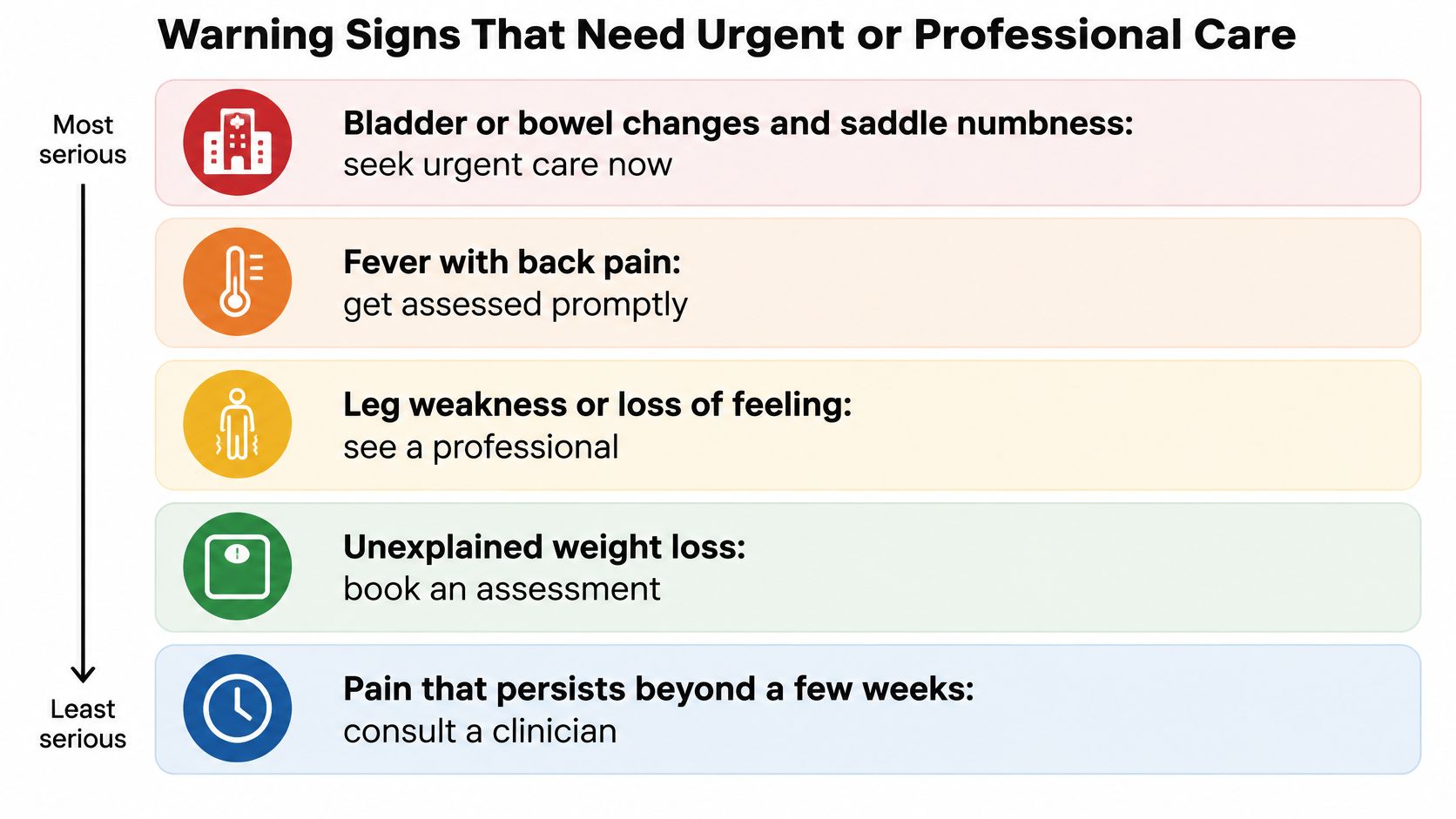
New bladder or bowel changes, especially with numbness around the groin or saddle area, need emergency assessment. Don't try another stretch, spray or painkiller first.
Safety triage comes before any relief decision, because the cheapest effective step is only worth taking once serious causes are ruled out. The Ontario Health patient guide supports that order: screen for serious causes first, and avoid routine imaging when warning signs aren't present. A checklist can sort where to seek care. It cannot diagnose the cause.
Back pain warning signs and the action to take
| Warning sign | Possible concern | Action |
|---|---|---|
| Bladder or bowel changes, saddle numbness | Cauda equina syndrome | Emergency assessment now |
| Major trauma or a significant fall | Fracture | Emergency assessment |
| Fever with back pain | Infection | Same-day medical assessment |
| Progressive leg weakness or numbness | Nerve compression | Urgent clinician review |
| Unexplained weight loss or cancer history | Serious underlying disease | Prompt clinician review |
| Pain that isn't improving despite a reasonable self-care trial | Persistent or complex cause | Scheduled clinician assessment |
| Uncomplicated pain without red flags | Often nonspecific or mechanical | Self-care and active treatment, with monitoring |
Match each symptom to the speed of response it needs, from emergency assessment down to monitored self-care at home.
More testing isn't automatically better
A substantial share of Ontario patients still receive spinal imaging within months of a first visit for low back pain, even though the patient guide recommends against routine scans when warning signs are absent. Imaging rates describe how often scans get ordered. They say nothing about how many were necessary or helpful.
An MRI, CT scan or X-ray should answer a clinical question. Without signs suggesting serious disease, routine imaging isn't the starting point recommended by the patient guide.
Unnecessary testing can encourage fear and lead to avoidable downstream care. Skipping routine scans is not the same as ignoring deterioration: new weakness, systemic illness or loss of bladder control changes the decision immediately.
Absence of red flags isn't a guarantee. Arrange assessment sooner if pain becomes unmanageable, walking becomes difficult or your symptoms change substantially. You don't need to wait for an arbitrary deadline before asking for help.
Why the Right Relief Depends on Your Pain Pattern
In the 2007/2008 Canadian Community Health Survey, more than 2 million Canadians aged 12–44 reported back problems, and approximately one-third of them also reported chronic pain, according to Statistics Canada. That overlap shows why back discomfort shouldn't always be treated as an isolated, short-lived event.
The practical distinction is between a recent episode, an ongoing limitation and symptoms suggesting nerve involvement. Our guide to acute versus chronic pain provides additional context, but the label alone doesn't choose the treatment.
Recognize the pattern without diagnosing yourself
- Recent, localized pain: Notice whether changing position or reducing a demanding task makes movement manageable. An uncomplicated episode often permits a conservative activity-based approach.
- Persistent pain without leg symptoms: Look beyond immediate soothing. A repeatable strengthening and mobility program provides a framework for rebuilding everyday capacity.
- Pain spreading into the leg: Record where it travels and whether there's tingling, altered sensation or weakness. These symptoms warrant clinical assessment, particularly when they're new or progressing.
Keep a useful symptom record
Note what happens when you walk, sit, bend, get out of bed and change position. Include whether symptoms settle after activity or leave you less capable later.
For example, stiffness that eases during a comfortable walk calls for a different adjustment from leg pain that spreads farther with each attempt. That observation doesn't establish a diagnosis, but it gives a clinician something more useful than a pain score alone.
Track function alongside discomfort. Being able to dress, carry groceries or complete a work task more comfortably is meaningful progress. Persistent restriction, even without an emergency warning sign, deserves a reviewed plan rather than an expanding collection of relief products.
Exercise and Activity as the Strongest Evidence-Based Relief
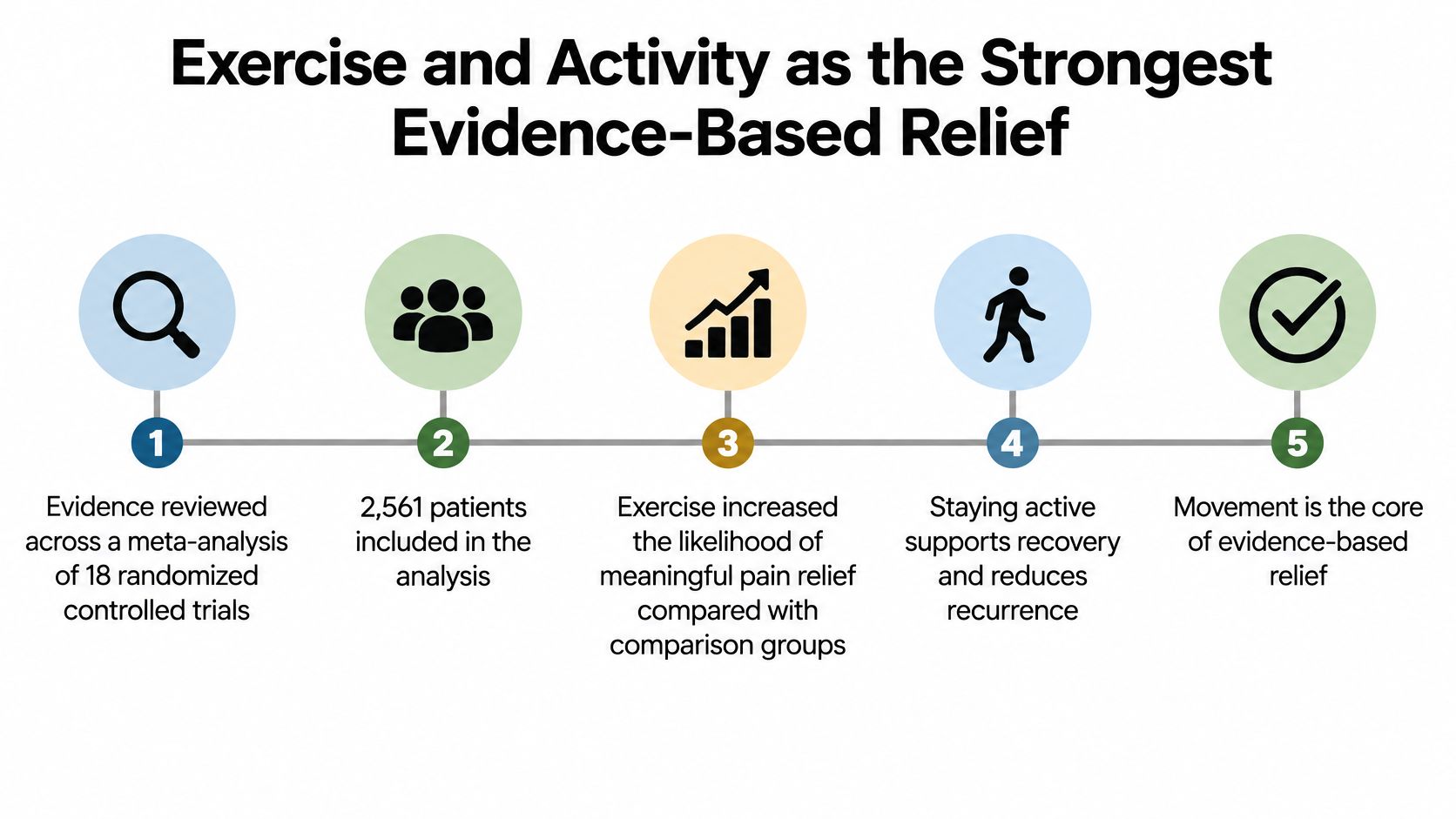
Exercise should be individualized and progressed, not prescribed as a test of willpower. The clinical guideline on managing low-back pain in adults describes gradual progression towards at least 30 minutes on 5 days per week, adding about 10 minutes every 3–4 weeks when tolerated; it also reports a meta-analysis of 18 randomized controlled trials involving 2,561 patients, in which exercise increased the likelihood of meaningful pain relief versus control, with a relative risk of 1.71 and a 95% confidence interval of 1.37–2.15.
That relative risk isn't a promise that your pain will fall by a corresponding percentage. It describes the likelihood of achieving the study-defined meaningful relief compared with the control groups.
The main findings support movement as the foundation, while leaving room to adapt the activity to the person.
Build capacity in a manageable sequence
Start with walking at a comfortable pace. Choose a route you can shorten easily, and finish before fatigue makes your movement markedly less controlled.
Add gentle mobility next. Small pelvic tilts or comfortable hip movements can help you explore a tolerable range without forcing a stretch.
Then introduce strength and control work:
- Chair sit-to-stands: Use a stable chair and stand smoothly, using your hands for assistance if needed.
- Small bridges: Lift through a comfortable range without forcing your lower back into an arch.
- Supported hip hinges: Practise bending at the hips with your hands resting on a counter.
- Modified bird-dogs: Begin with a single limb movement rather than immediately reaching an opposite arm and leg.
These are starting examples, not a universal prescription. Our guide to exercises to help with back pain can help you organize a routine. Walking, aerobic activity, aquatic exercise, mobility, strengthening, motor-control work and mindful movement offer different ways to build consistency.
Progress towards your actual activity
Progressive trunk and hip loading can improve conditioning, movement control and confidence while reducing fear-driven avoidance. You're practising tolerating the tasks you want to resume, not trying to hold your spine rigid all day.
For runners, Swift Running's strength drills to run pain-free offer sport-specific examples to discuss when planning a return. The title isn't a guarantee, and running drills shouldn't replace assessment of new leg symptoms.
Progression check: Increase what you can repeat reliably, not what you can endure once.
A small, temporary increase in soreness can be compatible with graded activity. Sharp, spreading or progressively worsening pain calls for stopping that exercise and reassessing, especially if sensation or strength changes.
Heat, Ice and Topical Products for Relief During Movement
Heat, ice and topical products are best treated as comfort tools, not tests of whether your back has healed. Choose one for a clear purpose, such as making a walk or home exercise session more manageable.
A cold pack is one option to trial when a flare feels irritated.

Choose comfort without irritating your skin
Heat may be more comfortable when stiffness is the main barrier to starting movement. Wrap the heat source, keep it comfortably warm rather than hot, check your skin and never sleep on a heating pad.
Ice may feel preferable during a sudden flare. Put fabric between the pack and your skin, check regularly and remove it if you develop burning, marked numbness or skin changes.
There isn't a universal winner between them. Our heat-or-ice guide for backache offers a practical comparison; avoid either tool over skin with impaired sensation unless a clinician has advised you.
Match a topical format to the area
Depending on the product, MEDISTIK uses methyl salicylate, menthol and camphor, clinically recognized topical pain-relief ingredients. Our products are applied before activity to reduce pain, with use governed by the individual label.
The Power Stick is designed for long-lasting, localized relief. The Power Spray suits fast relief over larger or hard-to-reach areas, while the Daily Defence Roll-On provides cooling relief and everyday maintenance.
- Apply carefully: Use only on intact skin and follow the product's directions for quantity and frequency.
- Check compatibility: Review allergy warnings and ask a pharmacist about salicylate-containing products if you take interacting medicines.
- Keep tools separate: Don't apply external heat over a topical analgesic or cover it tightly unless its label expressly permits this.
This video provides additional context for considering topical relief around activity.
Wash your hands after application unless the label directs otherwise for hand treatment. Temporary relief doesn't replace rehabilitation, diagnosis or treatment of a serious cause.
Benefits and Limits
Oral medicines should have a defined purpose and stopping point, rather than becoming an automatic response to every flare. A pharmacist can check whether a particular product fits your medical history and current medicines.
Ibuprofen and naproxen are non-steroidal anti-inflammatory drugs, or NSAIDs. Acetaminophen is another analgesic, but being an alternative to an NSAID doesn't establish that it will effectively relieve low-back pain for you.
Oral medicines and injections: typical use and key limits
| Category | Typical use | Key limit |
|---|---|---|
| Non-steroidal anti-inflammatory drugs, including ibuprofen and naproxen | Selected short-term pain that limits activity | Stomach, kidney and cardiovascular risks; check blood-thinner interactions |
| Acetaminophen | An option considered when anti-inflammatories are unsuitable | Benefit for low-back pain is uncertain; observe the label maximum and avoid duplicate ingredients |
| Prescription muscle relaxants | Selected short-term muscle spasm | Drowsiness; avoid driving when impaired; not a routine long-term strategy |
| Prescription neuropathic pain medicines | Selected diagnosed nerve-pain conditions | Not a routine answer to all radiating back pain; clinician review is essential |
| Epidural steroid injections | Selected persistent radiating pain with an appropriate cause | Specialist assessment; targeted, potentially temporary benefit |
Avoid treating medicines as interchangeable
A higher dose isn't necessarily a better next step. Don't combine different NSAIDs without medical advice, and check cold, flu and combination pain products for acetaminophen before taking another dose.
Prescription anti-inflammatories still require the same attention to medical history and interactions. Muscle relaxants can impair alertness, while medicines used for neuropathic pain can cause dizziness and other adverse effects.
Our guide to over-the-counter back-pain medication can help you prepare questions. It shouldn't replace a pharmacist's review when you have kidney disease, ulcer history, cardiovascular disease, pregnancy or a complex medicine list.
Match escalation to a defined cause
An injection needs a clinical target, not merely a high pain score. Similarly, surgery for a specific contributing condition is a separate decision from treating nonspecific low-back pain.
For someone exploring symptomatic breast enlargement as a contributor, OC Breast Surgery's discussion of evidence on reduction and pain relief provides condition-specific context. It doesn't establish that surgery is appropriate for an individual reader.
If you repeatedly need medicine to complete ordinary tasks, seek a review rather than extending use or increasing the dose yourself.
Building a Low-Cost Stepped Plan for Rural and Budget Access
Access changes what a workable recommendation looks like. Canadian Family Physician's discussion of low-back-pain care identifies exercise as a primary treatment and describes barriers including out-of-pocket costs, travel, limited services and wait times.
A home plan can reduce dependence on repeated appointments, but it shouldn't become a reason to delay necessary assessment. Ask about public clinics, community exercise programs and remote consultations where available; eligibility and local provision need checking.
Spend on the barrier, not the whole treatment menu
Begin by modifying demanding activities without shutting down movement. Add home mobility and strength when your baseline activity is manageable, then consider a comfort tool only if discomfort is blocking participation.
Oral medicine is an optional, safety-checked step, not a compulsory phase. Escalate to assessment when function deteriorates, symptoms change or a consistent trial isn't producing improvement.
The schedule below is an illustrative four-week planning template, not a required recovery timetable or a research-tested protocol. Start below these example targets if necessary, and don't advance because the calendar changes.
Four-week stepped back pain relief plan
| Week | Focus | Activity target | Relief tool |
|---|---|---|---|
| Week 1 | Establish a manageable baseline | Example: short walks of up to 10 minutes, repeated only as tolerated | Heat or ice if helpful; suitable topical before walks |
| Week 2 | Add comfortable mobility | Example: a 15-minute walk and 5 minutes of gentle mobility, only if baseline activity is comfortable | Optional topical; oral medicine only if appropriate |
| Week 3 | Introduce graded strength | Repeat tolerable walks; add chair sit-to-stands or modified bridges | Use comfort tools selectively |
| Week 4 | Review function and consistency | Continue a sustainable routine; don't force a duration target | Reduce unnecessary tools; arrange review if not improving |
Compare purchases with useful care
Our physiotherapy guide for back-pain relief explains how assessment can support a home program. If you can afford limited appointments, ask for a clear exercise progression and criteria for returning.
For readers already choosing a topical bundle, our Chronic Pain Rx costs $56.14 at 25% off, with two Power Sticks and one Rx Spray. Shipping is free on orders of $50 or more.
A bundle is only economical if you'll use it. Don't let an optional purchase displace an assessment you need.
Choose Your Back Pain Relief Starting Today
Make the next decision based on your symptoms and the task you want to regain, not on how many treatments you've already tried. You don't need a fully equipped home gym or an assortment of products to begin a sensible plan.
Choosing between self-management and professional help starts with an honest look at what's limiting you.
Answer these questions before choosing a product
- Are there warning signs? Arrange the appropriate assessment before attempting self-treatment.
- Is this a recent, uncomplicated episode? Choose a manageable activity and avoid turning a temporary flare into complete inactivity.
- Is pain persistently limiting work or daily life? Make structured rehabilitation and a reviewed plan the priority, rather than accumulating symptom-relief options.
Then choose an activity, an optional relief tool and a review date. You might put a comfortable walk in your calendar, decide whether warmth makes starting easier and record how you feel during ordinary tasks afterwards.
Decide what success would look like
Use a concrete measure: dressing without stopping, finishing a grocery trip or getting through a work task with fewer interruptions. Write down what would justify continuing the plan and what would prompt an appointment.
If you choose a topical product, keep its purpose specific. Our Power Spray's recommended use includes temporary soothing relief of sore muscles and joints associated with backaches and lumbago, along with other listed muscle and joint conditions.
That's symptom relief, not a diagnosis or a claim to rebuild strength. When symptoms worsen or your capabilities keep shrinking, book an assessment rather than adding another product.
The best relief is the approach that safely helps you regain activity and that you can keep up with. A modest plan you can repeat is more useful than an ambitious routine you can't tolerate.
MEDISTIK offers non-prescription topical pain relief designed for fast, targeted relief where pain occurs, without pills, injections or greasy creams. Visit MEDISTIK to compare sticks, sprays and roll-ons for temporary backache relief, and choose an optional support for your movement plan rather than a replacement for care.


