

By mid-afternoon, you're lifting your shoulders towards your ears and turning your whole body to look away from the screen. Your neck feels stiff, and you're tempted to pull it hard until something releases. Neck pain relief stretches should feel much gentler than that, with controlled movement rather than a tug, crack or forced position.
Neck Stretches at a Glance and How Often to Do Them
A stretch works like a dose of medicine: the amount matters as much as the movement itself. Before you try anything, scan this table. It lists the four stretches in this routine and the hold each one uses.
Neck stretch holds and reps
| Stretch | Hold and reps |
|---|---|
| Chin glide | Gentle, pain-free range, no timed hold |
| Cervical extensor stretch, chin towards sternum | Up to 30 seconds, 3 repeats if comfortable |
| Lateral flexion, ear towards shoulder | Up to 30 seconds, 3 repeats if comfortable |
| Rotation, look over shoulder | Up to 30 seconds, 3 repeats if comfortable |
How often you stretch is a separate decision, and no single schedule suits every neck. For chronic neck pain, practitioner guidance commonly places home stretching at three to five sessions across the week, as part of an individualised exercise programme. A neck that has only recently become painful often does better with a quieter start: a few gentle repetitions on the days it feels settled, adjusted with a physiotherapist's input. Your frequency depends on how irritable your symptoms are, which movements are restricted and what other exercises you are doing, so it is chosen individually rather than copied from a chart.
There's also a naming distinction worth keeping straight: bringing your chin towards your sternum is cervical flexion, which stretches the muscles along the back of your neck. Cervical extension means looking upwards. You'll use the chin-down movement in this routine, not a backward head tilt.
Choose a starting dose, not a quota
Stretching manages stiffness and discomfort; it does not cure an underlying problem, and a bigger dose does not speed it up. A physiotherapist can help set your frequency by weighing irritability, movement restrictions and the rest of your programme.
Practical rule: More stretching isn't automatically better. A schedule is useful only if your neck tolerates it.
With a chin glide, there's no need to count out a hold. Slide back gently, then release. If pain starts, ease out rather than trying to reach further.
Choose a pair of comfortable movements for your first week. Each evening, check whether ordinary tasks like reversing the car or reaching a high shelf feel easier, unchanged or worse. That check is part of the dose: it tells you whether the schedule is working before you add another stretch.
How to Do Each Neck Stretch Step by Step
Use a firm chair that lets you place your feet flat on the floor. Keep your jaw relaxed, and take off anything that restricts your movement, such as a heavy bag hanging from your shoulder.
The written cues below describe what each movement should feel like. The range you reach matters less than whether you can control it.
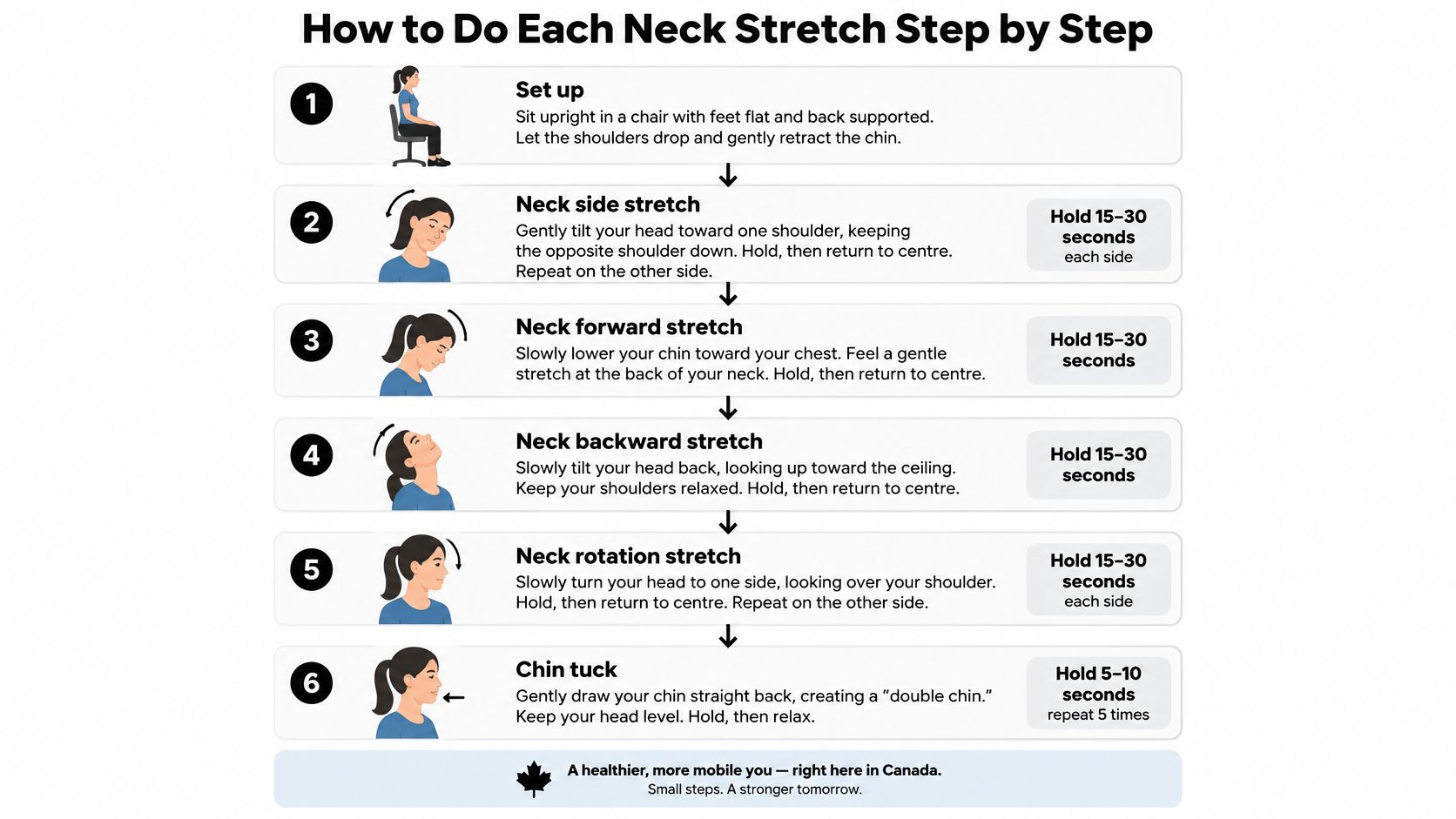
Perform the movements slowly
- Set up your sitting position. Sit upright with your back supported and shoulders relaxed. Gently draw your chin backwards, as though making a small double chin, without clenching your teeth. This gives you a controlled starting position rather than beginning with your head jutting forwards.
- Practise the chin glide. Keeping your gaze level, slide your head straight backwards over your trunk, then return slowly. Don't point your nose down or tip it upwards. The horizontal movement helps you distinguish retraction from bending your neck.
- Stretch the cervical extensors. From neutral, let your chin move towards your sternum until you feel a comfortable pull along the back of your neck. A hand may rest lightly on your head as a guide; the stretch should come from the movement itself. The Canadian neck-pain practitioner guidance describes a 30-second hold for this movement, with the number of daily repetitions matched to your stage of symptoms as set out in the table above.
- Move into lateral flexion. Return to centre, then tilt your left ear towards your left shoulder while keeping your nose facing forwards. Rest your right hand lightly on your right shoulder to notice whether it rises, rather than pressing it down forcefully. Keeping that shoulder quiet lets you control the stretch without creating movement elsewhere.
- Try a separate rotation stretch. Return to neutral before turning your chin towards your shoulder. Keep your chest facing forwards and look only as far around as you comfortably can, then repeat towards the other side. Separating rotation from side-bending makes the movement easier to monitor.
- Repeat only while the quality stays steady. For held movements, use the comfortable hold and repeat pattern in the table, releasing fully between attempts. Breathe normally with a relaxed exhale rather than bracing your abdomen. Returning to neutral between holds helps you notice whether each repetition feels better or more irritated.
- Finish in neutral and check your response. Let your hands rest in your lap and notice how easily you can turn your head. Don't immediately test your maximum range. A quiet finish makes it easier to judge the effect of the session without adding another strong movement.
Don't rigidly hold a double chin throughout every stretch. Start gently retracted, then allow the natural movement needed for bending or turning.
Every hold produces feedback. Read the sensation against the actions below before deciding whether to continue.
| Sensation during the hold | Action |
|---|---|
| A comfortable pull along the muscle | Stay in the hold and breathe normally |
| The pull eases as you settle | Remain where you are, or ease slightly further |
| Your shoulder creeps up towards your ear | Return to centre, let it settle, then restart |
| A sharp or catching pain | Ease out of the movement fully |
| Arm symptoms, numbness, weakness or dizziness | Stop the session |
| Symptoms above your usual level the next day | Use a smaller dose next time |
Session gate: Continue only with comfortable movement. Stop for arm symptoms, numbness, weakness or dizziness, and don't progress unless symptoms have returned to your usual baseline by the following day.
Keep the routine part of broader care
Stretching works alongside shoulder and arm mobility, motor-control practice, endurance and strengthening. If discomfort centres around the top of your shoulder, these trapezius muscle pain relief exercises offer a more focused starting point.
If jaw discomfort accompanies your neck symptoms, the All Stars Dental TMJ care guide provides context for discussing jaw symptoms with a dental professional. Neck stretching on its own does not address a jaw problem.
For an additional movement demonstration, watch without trying to copy a range that feels uncomfortable.
Mistakes That Undo a Neck Stretch and How to Adjust
Stretching every day while your neck still feels stuck can make you think you need a stronger pull. Often, the more useful adjustment is less force and better control.
The Alberta neck-exercise guidance advises starting slowly and easing off when pain begins. Treat discomfort as information, not a barrier you need to push through.
Fix the movement you can feel
- Shoulder hiking: If your shoulder rises to meet your ear, return to centre and let it settle. Think of moving the head while the shoulder stays heavy, rather than bringing them together.
- Turning your torso: Place a hand over your breastbone while rotating your head. If that hand turns with you, reduce the movement until your chest remains forward.
- Bouncing at the end: Stop just before the point where you want to pulse or tug. Stay still in an easier position instead of repeatedly testing the boundary.
- Holding your breath: Loosen your jaw and breathe out gently. If you can't breathe comfortably, ease the position rather than concentrating harder on the hold.
- Pulling with your hand: Remove the hand briefly. If your head springs back because you were hauling it into position, restart with active movement and use only light contact.
Use the corrections below as a reminder of what to change, not as a target for deeper stretching.
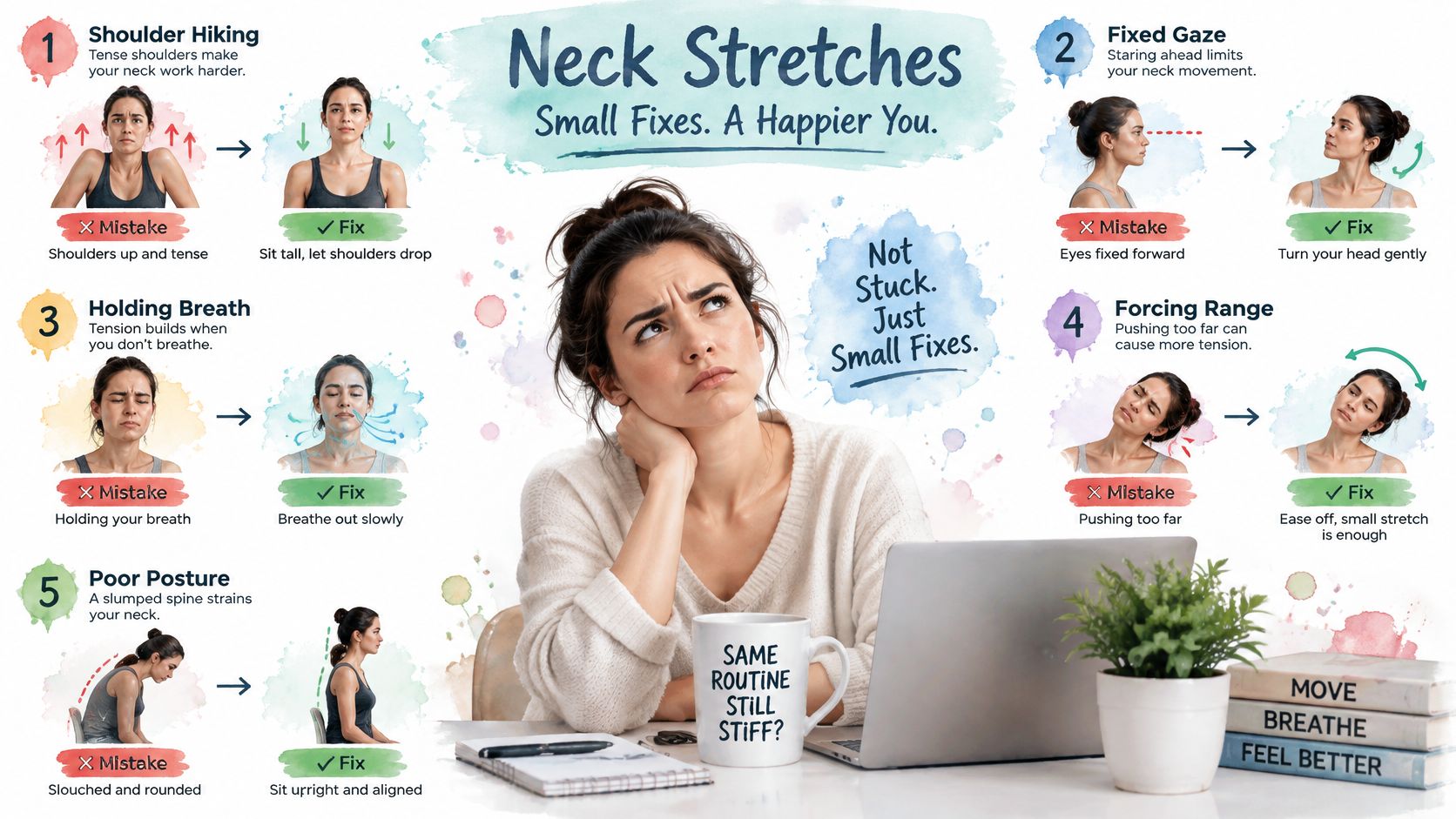
Make a sensitive neck easier to move
Reduce the range first. If the position still feels demanding, shorten the hold or sit with your upper back supported against a wall. Don't press the back of your head into the wall while trying to turn it.
A specialised deep-neck-flexor exercise isn't automatically the best option for everyone. Choose active exercises you can perform safely and consistently, ideally with guidance when symptoms recur.
If you're considering an additional support, this guide to tape for neck pain explains that option. Support shouldn't become a reason to force an uncomfortable movement.
When improvement stalls, compare your comfort, available movement and daily function. Looking over your shoulder while walking or sitting through a meal may tell you more than whether you can stretch farther.
Before each session, check:
- Shoulders down.
- Head turns, torso stays still.
- No bouncing.
- Breathe out comfortably.
- Hand stays light.
Stop Rules and Red Flags for Every Stretch
A mild pull, a sharp catch and tingling down your arm don't mean the same thing. The sensation determines your next action, and a table can help you make that decision before trying another repetition.
What a sensation during a stretch means
| Sensation during a stretch | What it usually means | What to do |
|---|---|---|
| Mild pull that eases within the hold | A tolerable stretching sensation | Continue within that range if it remains comfortable |
| Sharp catch or pain that rises with the hold | The movement or load isn't tolerated | Release it; only retry in a smaller, pain-free range |
| Pain or tingling travelling into the arm | Possible nerve involvement | Stop and seek clinical assessment |
| Numbness, weakness or unsteadiness | Possible neurological sign | Stop and seek urgent assessment, especially if new or worsening |
| Dizziness or visual change | A symptom that needs assessment, not further stretching | Stop and seek urgent assessment |
| Soreness still present the next morning | You may not have tolerated the session | Don't progress; reduce the dose and reassess, seeking advice if it persists |
This table guides action, not diagnosis. For example, next-morning soreness could reflect stretching, work demands or another cause. Compare it with how you felt before the session rather than assuming every symptom came from the exercise.
Pass the red-flag gate before starting
The QualExam physiotherapy red-flag review describes warning patterns that can require referral for possible serious conditions. Seek urgent medical care for sudden, unusually severe neck or head pain, particularly when it occurs with neurological symptoms.
Other urgent warning signs include:
- Vision or speech changes: Double vision, slurred speech or new difficulty swallowing.
- Altered sensation: Facial numbness or new, unexplained sensory changes.
- Loss of control or strength: Worsening weakness, unsteadiness or unexpectedly dropping objects.
Don't drive yourself if dizziness, visual disturbance or unsteadiness makes driving unsafe. Severe, sudden or rapidly progressing symptoms warrant emergency help rather than an exercise appointment.
Brief relief from a stretch doesn't rule out a serious cause.
If jaw pain or headache accompanies the neck symptoms, Inspire Dental Group's explanation of when jaw pain needs urgent care can help you recognise additional reasons to seek care. Don't delay urgent assessment to explore self-care options.
Know when to book a routine assessment
Arrange a clinical appointment if pain persists, repeatedly returns or worsens despite gentle movement. Older adults, physically demanding workers, military personnel and athletes may need an assessment that considers injury history and occupational or training loads.
Pain after a fall or collision needs assessment before stretching. It isn't automatically non-urgent, especially when there was significant impact, severe pain or any neurological change.
Some tumour-related warning signs have uncertain diagnostic accuracy and come largely from case reports. That uncertainty is a reason for clinical judgement, not for diagnosing yourself from an isolated symptom.
Avoid aggressive stretching or neck manipulation while warning signs remain unexplained. For discomfort centred lower down, the upper spine pain relief guide may help you describe the location, but it doesn't replace examination.
Where Neck Stretches Fit in Your Warm-Up and Recovery
Use your routine where it fits naturally, rather than saving all your movement for bedtime. Before work or exercise, the aim is to explore comfortable motion, not to make your neck feel loose at any cost.
Before desk work or exercise
- Start with gentle chin glides. Move slowly enough to keep your gaze level.
- Try a comfortable side-bend in each direction, returning to centre between sides.
- Finish with easy head turns, without chasing the farthest possible position.
Keep this preparation brief and below your symptom threshold. For exercise, continue into activity-specific preparation using these warm-up exercises before a workout, rather than treating neck stretching as a complete warm-up.
After prolonged static posture
Use this recovery order if every movement is comfortable:
- Chin glide to bring the head back over the trunk.
- Chin towards the sternum for the cervical extensor stretch.
- Side-bending, left and right.
- Rotation, left and right.
- An easy chin glide to finish in neutral.
Spread an individually prescribed routine across your day instead of compressing missed sessions into one long stretch. Don't add a full recovery routine on top of an existing dose without considering how your neck responds.
For grapplers, the Locals Jiu Jitsu Alexandria guide to cooling down after grappling provides sport-specific context. Neck pain after a throw, impact or forceful hold deserves a different decision from ordinary post-desk stiffness.
Stretching doesn't replace shoulder and upper-back strengthening or changes to prolonged work positions. Skip the routine entirely when a red-flag symptom is present.
Build Your Seven-Day Neck Routine
Tomorrow, choose a pair of movements you can perform comfortably and write them in a notebook or phone note. Use a clinician-selected frequency if you have one, rather than adopting the highest daily schedule.
Keep a useful session record
- During the session: Record the movement, sensation and whether you reduced the range.
- The following morning: Note whether you're back to your usual symptom level.
- During everyday tasks: Check whether turning, reading or working feels easier, unchanged or harder.
Only consider adding another movement after your sessions remain comfortable and your next-morning response is settled. Progress can mean easier daily movement, not just a deeper stretch.
If you're also considering temperature-based comfort measures, use the stiff neck heat or ice guide to help organise that decision without changing several things at once.
Set a reassessment date several weeks ahead. At that point, review pain, movement and daily function rather than judging success from one good afternoon. Stretching supports symptom management and movement restoration; it isn't a guaranteed cure.
Start your seven-day plan tomorrow. Book an assessment if symptoms remain unresolved at your reassessment date, and seek urgent care immediately for urgent warning signs.
Our non-prescription topical pain relief system is designed to deliver fast, targeted relief where pain occurs, without pills, injections or greasy creams. MEDISTIK is applied before activity to reduce pain, but relief isn't permission to force a neck stretch or ignore warning signs. Visit MEDISTIK to explore topical options for supporting your movement routine.


