

6,281,200 Canadians aged 12 and older reported arthritis in 2022, according to Statistics Canada's Canadian Community Health Survey. That's a substantial population, but it doesn't mean every aching lower back is arthritic. Having arthritis and knowing what's causing your back pain are different questions.
When you're looking for relief from arthritis pain in the lower back, the most useful starting point is your pain pattern: when it appears, which movements change it, and whether other symptoms come with it. Those observations help a clinician distinguish joint-related pain from muscle, disc, nerve or inflammatory problems, often before a scan becomes necessary.
Which Cause Fits Your Lower Back Pain
In 2023, 20.6% of Canadian adults reported having arthritis, according to Statistics Canada's 2024 Health of Canadians report. You're far from alone, but arthritis is only one possible explanation for lower-back symptoms.
Use the patterns below to organise what you're noticing, not to choose your own diagnosis.
Lower back pain pattern, likely cause and next step
| Likely cause | Typical pattern | Clue that points there | Next step |
|---|---|---|---|
| Spinal osteoarthritis, involving facet or sacroiliac joints | Stiffness after rest; discomfort with prolonged standing or certain back movements | Previous back injury; local ache when leaning backwards | Clinical assessment and physiotherapy |
| Inflammatory spondyloarthritis | Persistent night or early-morning pain that eases with activity | Psoriasis, uveitis, inflammatory bowel disease or family history | Family doctor, with rheumatology referral when appropriate |
| Mechanical pain involving discs or muscles | Worse with lifting, bending or sitting; changes with position | Recent strain or unfamiliar lifting; relief in a comfortable position | Individualised movement plan and activity changes |
| Referred pain from the hip, sacroiliac joint or pelvis | Buttock or groin pain; spinal movement may not reproduce it consistently | Painful hip rotation or difficulty rising from a chair | Hip and pelvis assessment by a clinician |
Look for a combination of clues, rather than one matching symptom. Morning stiffness can occur with several conditions, and feeling better after movement doesn't prove inflammatory disease. Likewise, pain during bending doesn't establish that a disc is responsible.
Say your back aches after gardening but settles when you change position. That history gives your clinician a different starting point from pain that repeatedly wakes you and accompanies psoriasis, even if both feel like a deep ache.
If you're unsure whether discomfort seems muscular or joint-related, our guide to joint pain versus muscle pain can help you describe it more clearly. Bring the pattern to a clinician rather than treating the table as a verdict, especially if symptoms persist or your usual activities become harder.
How Arthritis Makes the Lower Back Hurt
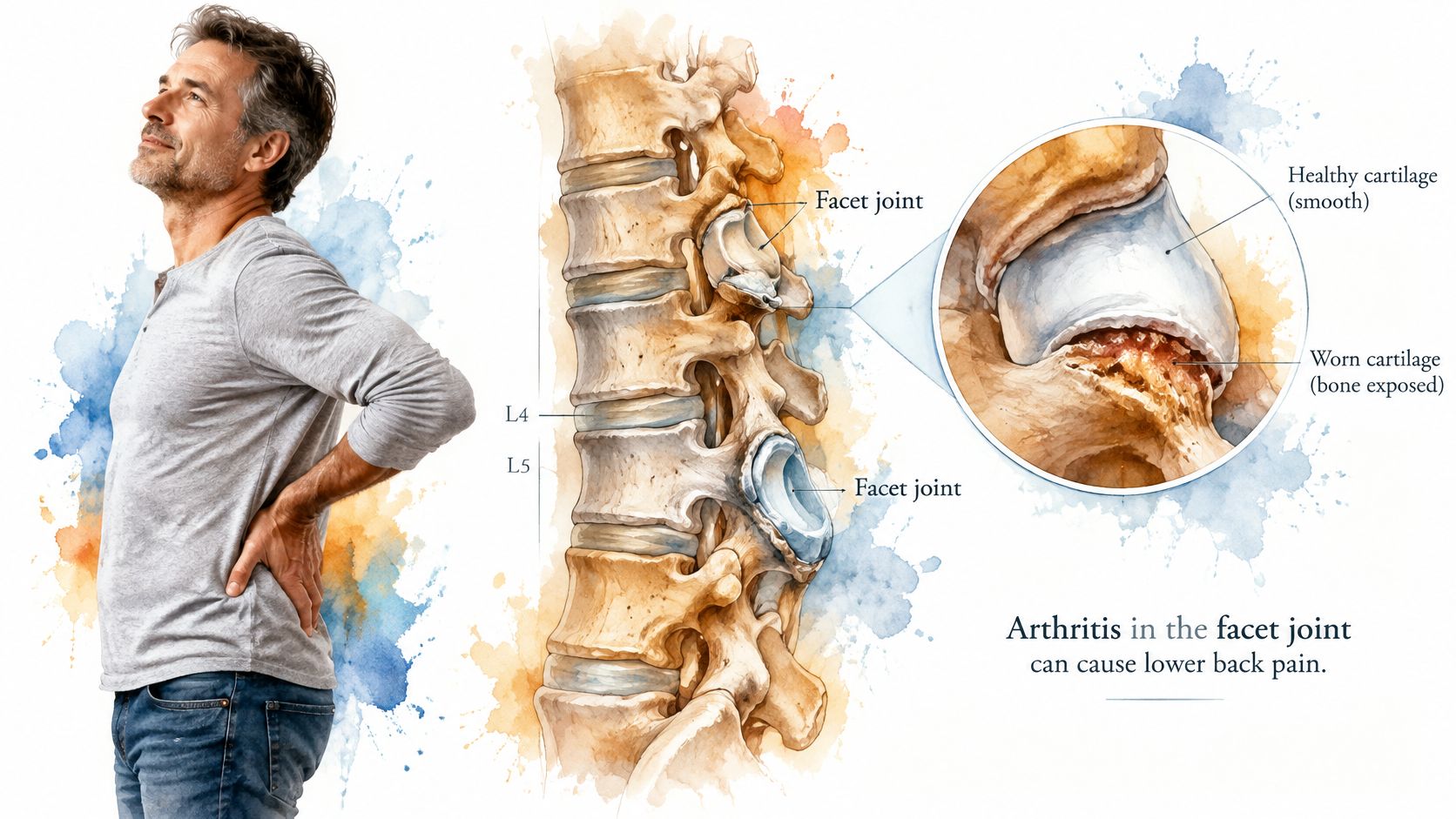
Suppose you stand up after a long car journey and your lower back feels reluctant to straighten. Small joints behind the vertebrae, called facet joints, help guide that movement. They work somewhat like hinges, allowing controlled motion while helping the spine share load.
This diagram shows where those joints sit.
A changing joint isn't simply a worn-out hinge
Healthy cartilage provides a smooth joint surface. With osteoarthritis, cartilage and surrounding joint tissues change, and the joint lining can become irritated. The hinge analogy helps explain stiffness, but a living joint isn't a piece of hardware that wears out.
Age, previous injury and repeated loading can contribute to those changes. Pain may come from sensitive tissues around the joint, inflammation and protective muscle tension, not just bones rubbing together. Your capacity for movement can improve even when structural changes remain.
Inflammatory arthritis follows a different process. Immune-driven inflammation can affect joints and the places where tendons or ligaments attach to bone, including around the sacroiliac joints and spine. Exercise remains useful, but controlling the disease may also require medication prescribed through specialist care.
For another visual explanation, the following video offers additional context.
Why the painful spot may not identify the source
Nerve signals from the hip, pelvis and lower back travel through overlapping pathways. Your nervous system may therefore register pain near the lower back even when the main problem is elsewhere. That's referred pain, and it explains why a physiotherapist may examine your hips even when you point to your waist.
The distinction matters: in a representative British Columbia adult sample reported in the Annals of the Rheumatic Diseases, 48.8% reported lower-back pain or discomfort, while 8.5% reported health-professional-diagnosed lower-back osteoarthritis. Those figures describe that sample, not every Canadian, but they illustrate why symptoms alone can't confirm arthritis.
Practical distinction: The place you feel pain and the tissue producing it aren't always the same.
Our explanation of arthritis and joint pain provides broader context. The useful question is which process needs attention: joint sensitivity and reduced capacity, active inflammatory disease, or pain referred from another area.
What to Track Before You See a Clinician
Keep a brief daily log while you're waiting for your appointment, provided you don't have urgent warning signs. Record what happens rather than testing painful movements repeatedly to find an answer.
A simple checklist can make those observations easier to organise.
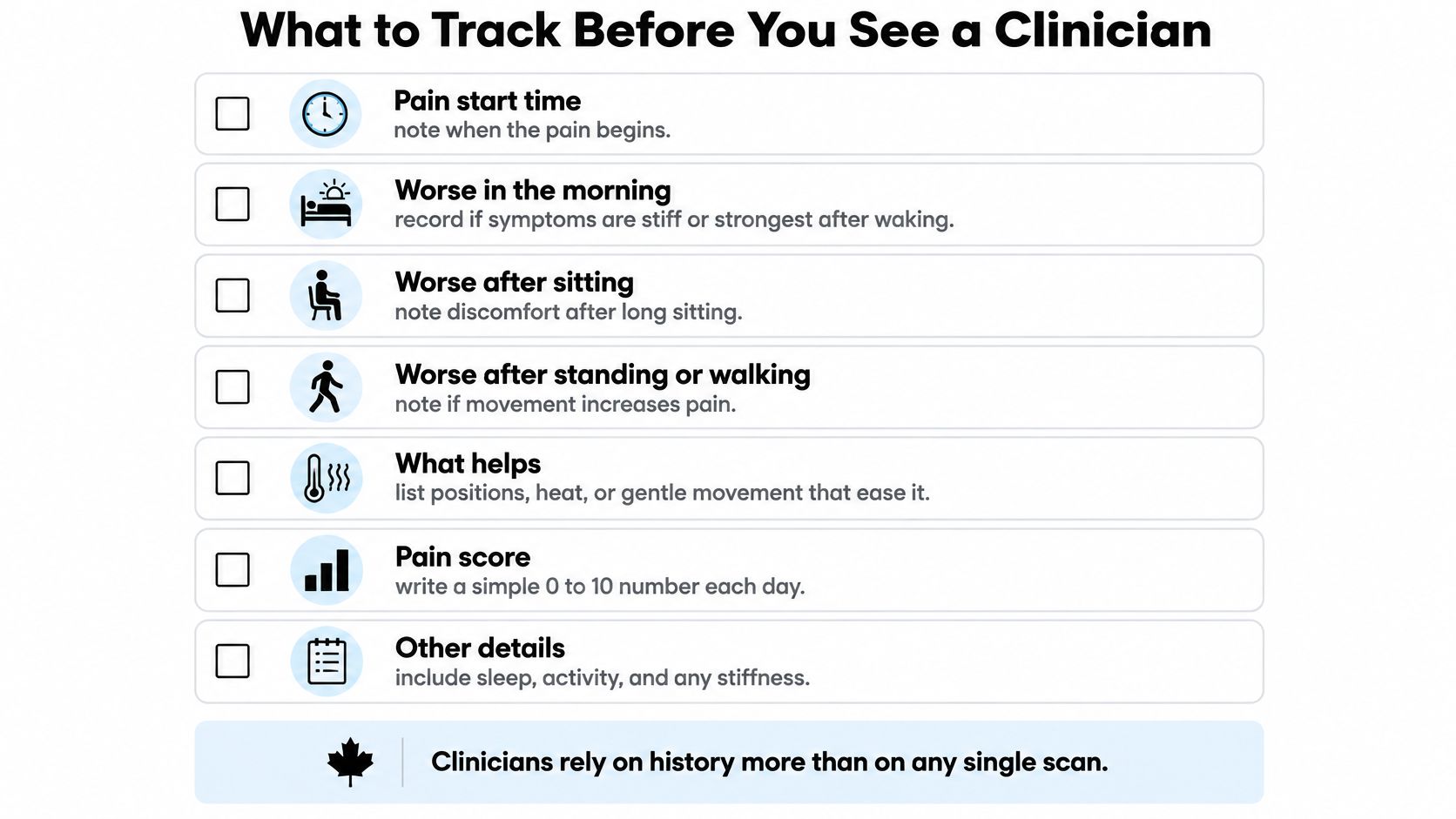
Keep the same details each day
- When pain starts and stiffness occurs. Note whether symptoms appear on waking or after rest, and time the stiffness, because the relationship between rest and movement helps distinguish possible causes.
- Positions that help or worsen it. Record your response to sitting, standing, bending and side-lying, because positional changes help a clinician select useful examination movements.
- Pain intensity. Use the same simple rating scale each morning, midday and evening, because a consistent measure makes changes easier to interpret.
- Where pain travels. Mark the buttock, groin or leg and how far symptoms extend, because spreading pain, tingling or numbness may warrant a nerve assessment.
- Flare triggers and duration. Write down the activity before a flare and how long recovery takes, because this helps match your activity load to your current tolerance.
- Medications and topical products. List the name, amount used and effect, because your clinician needs to assess benefit, side effects and possible duplication.
- Sleep and mood changes. Note disrupted nights, worry or low mood, because these affect function and deserve attention alongside physical symptoms.
Bring the log, your medication list, previous imaging reports and any family history of psoriasis or spondyloarthritis. You don't need a perfectly completed diary for the appointment to be worthwhile.
What the assessment adds
Your clinician combines your history with an examination of the spine, hips and pelvis, adding strength, sensation or reflex checks when indicated. The Veterans Affairs Canada guidance on lumbar spine conditions explains why imaging changes must be interpreted alongside symptoms: abnormalities become more common with age and don't necessarily correlate with pain.
A scan report isn't a pain measurement. Imaging may be appropriate when serious disease or severe or progressive neurological problems are suspected, but it isn't automatically the next step for an aching back.
Ask these questions before leaving:
- Cause: Which explanation best fits my history and examination?
- Imaging: Would a scan change my treatment, and why?
- Referral: Would physiotherapy, rheumatology or another assessment help?
For help organising the wider effects of persistent symptoms, our guide to managing chronic pain offers additional planning support.
Red Flags That Need Urgent Medical Care
| Symptom | Urgency | Who to see |
|---|---|---|
| New loss of bladder or bowel control, or numbness in the groin or inner thighs | Emergency now | Emergency department |
| Progressive leg weakness or foot drop | Same-day assessment | Emergency department or urgent care |
| Fever with back pain, unexplained weight loss, or cancer history with new back pain | Urgent assessment; seek immediate advice if fever or illness is present | Family doctor or urgent assessment |
| Significant trauma with back pain | Same-day assessment | Urgent care or emergency department |
| Persistent pain beginning at a younger age, with prolonged morning stiffness, night pain or associated inflammatory conditions | Book a medical appointment soon | Family doctor, with rheumatology referral when appropriate |
| Back pain that isn't improving, or repeatedly worsens despite an adjusted exercise plan | Arrange a clinical review | Family doctor or physiotherapist |
Don't wait to complete a symptom log if an emergency symptom appears. New bladder or bowel changes with back pain can indicate serious nerve compression. Groin numbness or worsening leg weakness also needs prompt assessment, even if your back pain itself isn't severe.
Fever with back pain deserves particular caution if you feel generally unwell. A history of cancer or unexplained weight loss doesn't establish a serious diagnosis, but it changes what your clinician needs to investigate. Tell the person arranging your appointment about those features rather than booking a routine exercise consultation.
Inflammatory clues need a different pathway
Persistent pain that starts before age 45, particularly night or early-morning pain that improves with activity, warrants consideration of an inflammatory cause according to Arthritis Society Canada's Arthritis Action Now report; the report also notes that more than 80% of Canadians with arthritis have at least one additional chronic condition.
Tell your doctor about psoriasis, inflammatory bowel disease, previous uveitis or a family history of spondyloarthritis. These details can influence whether rheumatology assessment is appropriate. They're not reasons to diagnose yourself, and they're not usually emergencies on their own.
Seeking assessment for a warning sign isn't overreacting. It gives the clinician a chance to rule out conditions that shouldn't be managed with exercise alone.
Why the whole person matters
A safe plan accounts for more than the sore joint. Kidney or cardiovascular disease can affect medication choices, while anxiety, poor sleep and demanding work can make day-to-day management harder.
Tell your clinician what you're struggling to do, such as dressing, driving, sleeping or completing a shift. That information helps set meaningful treatment goals. Imaging and other tests should answer a clinical question, rather than substitute for this broader assessment.
Daily Movement Routine for Lower Back Arthritis
Gentle, regular loading is usually more useful than prolonged rest once urgent causes have been excluded. Start with movements you can control comfortably, and choose an amount that doesn't leave you substantially worse afterwards. This is a starting framework, not a prescription for every back condition.
The aim is to restore confidence and capacity, not force stiffness out of the spine.
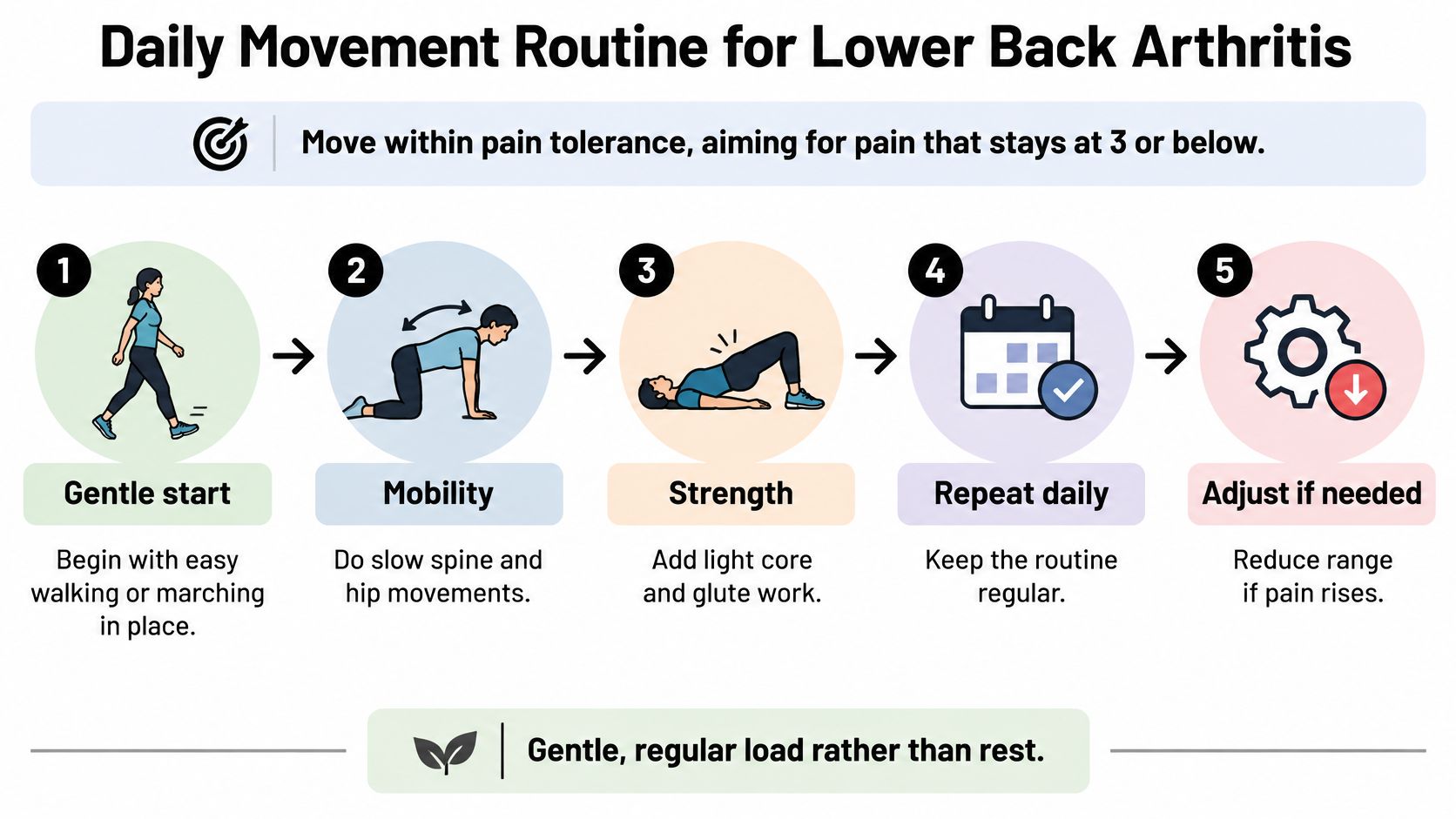
A manageable sequence
- Warm up with easy walking or stationary cycling until movement feels less guarded, giving your body time to adjust before strengthening.
- Lying on your back with knees bent, gently tighten the lower abdomen and rock the pelvis so your back moves towards the surface, using pelvic tilts to explore a comfortable range.
- On hands and knees, slowly round and ease the back through a small cat-cow movement, avoiding the end of the range if it pinches.
- Try a glute bridge, lifting your hips only as far as you can without arching or holding your breath, to practise sharing effort through the hips.
- Walk at a comfortable pace on a manageable route, stopping before fatigue noticeably changes your stride so you can repeat the activity consistently.
- Finish with a gentle supported hip-flexor stretch and relaxed breathing, helping you settle rather than ending with a strenuous stretch.
If floor exercises are difficult, ask a physiotherapist for standing or chair-supported alternatives. A countertop-supported movement or a shorter walk can be a better starting point than struggling to get onto a mat. Our guide to exercises to help with back pain offers further movement ideas to discuss.
Progress by your response, not the calendar
The exercise evidence supports consistency: a synthesis cited in the PEER chronic pain guideline found that exercise increased the likelihood of meaningful pain relief in low-back-pain patients compared with control, with a relative risk of 1.71 and benefits persisting beyond 12 weeks. That finding concerns low-back pain generally, not confirmed spinal osteoarthritis alone.
Progression rule: Add a little only when your current routine feels manageable and your symptoms return towards their usual level afterwards.
Mild, familiar discomfort can be compatible with exercise. Sharp pain, spreading leg symptoms or a substantial next-day setback calls for reducing the range, duration or effort, not pushing harder.
Change one part of the routine at a time so you can identify what your back tolerates. If setbacks keep recurring despite those adjustments, seek a personalized assessment; new weakness, numbness or bladder and bowel symptoms shouldn't be managed by changing repetitions.
Topical and Over-the-Counter Relief Compared
| Option | Best for | How to use | Cautions |
|---|---|---|---|
| Heat, such as a warm pack | Stiffness and muscle guarding | Apply comfortable warmth before gentle movement, with a protective layer | Avoid irritated skin or areas with reduced sensation; don't sleep on a heating pad |
| Ice, such as a cold pack | A local flare that feels more comfortable with cooling | Wrap in a cloth and use briefly, checking the skin | Avoid numb skin or areas with circulation problems |
| Topical analgesic in a stick, spray or roll-on | Localised joint or muscle ache | Apply only to labelled areas, using the amount and frequency directed | Don't use on broken skin; check restrictions on heat and other products |
| Acetaminophen, taken orally | A possible option when NSAIDs are unsuitable | Follow the product label and pharmacist's advice | Check liver health and other medicines containing acetaminophen |
| Ibuprofen or other oral NSAIDs | Selected short-term pain flares | Use the lowest effective labelled dose for the shortest necessary time | Ask a pharmacist first with kidney disease, ulcers, blood thinners or heart disease |
| Prescription anti-inflammatory treatment or biologics | Confirmed inflammatory spondyloarthritis | Treatment selected and monitored by a clinician | Requires review of suitability, interactions and monitoring |
Choose relief for a specific task
A useful relief option should help you do something worthwhile, such as take a comfortable walk, get dressed or settle for sleep. It shouldn't become a reason to ignore worsening symptoms or repeatedly overload a painful movement.
Heat and ice are comfort measures, not tests of what's wrong. If warmth helps you loosen up, use it cautiously before movement. If cooling feels better during a flare, choose that instead, while protecting and checking your skin.
Topical analgesics provide temporary symptom relief. They don't rebuild cartilage, confirm that arthritis is present or control an underlying inflammatory disease. Don't combine a medicated topical with a heating pad, tight covering or another topical unless the product directions specifically allow it.
Oral medicines need a suitability check
Acetaminophen isn't automatically effective when an NSAID is unsuitable. A pharmacist can help you decide whether a trial makes sense and check for accidental duplication in cold, flu or combination pain products.
NSAIDs also aren't interchangeable with every pain reliever. Taking them with food may reduce stomach upset, but it doesn't remove risks involving bleeding, kidneys or cardiovascular health. Our guide to over-the-counter back pain medication can help you prepare questions for that conversation.
Sleep comfort deserves a separate check. Before purchasing a mattress, consider whether your current surface makes turning difficult or leaves pressure around the hips; Guynn Furniture & Mattress's guide to find joint relief with memory foam offers shopping context, not a treatment recommendation or proof that a mattress treats arthritis.
The best comparison is practical: does the option improve a meaningful activity without causing adverse effects? If you need increasingly frequent relief just to manage ordinary tasks, arrange a review rather than continually adding products.
Book Your Next Step for Lower Back Arthritis Pain
The next decision isn't whether you can confidently label your pain as arthritis. It's which level of care fits your symptoms, and what you can safely do while waiting.
Use this plan:
- Act on urgent warning signs. Stop routine self-care and seek the level of assessment indicated by your symptoms; emergency neurological changes shouldn't wait for an ordinary appointment.
- Book an assessment for persistent or limiting pain. Choose a family doctor or physiotherapist, bring your symptom log and medication list, and explain which daily activity you most want to regain.
- Request review for an inflammatory pattern. Tell your family doctor about night symptoms, prolonged stiffness and associated conditions, and ask whether a rheumatology referral is appropriate.
A topical option such as our MEDISTIK Power Stick, used according to its label, provides temporary soothing relief of sore muscles and joints associated with backaches and arthritic or rheumatic pain, and can sit alongside this clinical plan rather than replace assessment.
Make the appointment useful
Choose a concrete goal before you go. You might want to stand comfortably while cooking, return to a walking route or finish a work shift with fewer interruptions. A goal like that helps your clinician judge progress beyond whether pain is completely absent.
Ask what you should continue, what you should temporarily modify and what would mean the plan needs review. If an exercise is prescribed, practise it during the appointment so the clinician can check your technique and help you recognise an appropriate effort level.
While you're waiting, use a manageable amount of movement and one suitable relief approach rather than changing everything at once. Keep track of whether you can do more comfortably, not just whether a product briefly changes the sensation.
A helpful plan combines movement, appropriate relief and professional review. You don't need to prove the diagnosis before asking for help, and you don't need a scan before your symptoms deserve attention. Your next step is a clinician-reviewed plan that accounts for your pain pattern, health and everyday priorities.
MEDISTIK offers topical options for temporary relief of sore muscles and joints, including discomfort associated with backaches and arthritis. Visit MEDISTIK to review the available formats and labelled directions, and choose an option that complements your movement and clinician-guided care plan.


