

If your legs hurt when you finally stop moving, does that automatically mean your arthritis is getting worse? Not necessarily. Arthritis pain in legs at night can reflect joint irritation, an uncomfortable position, and disrupted sleep, but circulation problems and nerve pain can produce symptoms that need a different response.
The useful starting point isn't choosing a stronger pain reliever. It's identifying where the pain starts, what it feels like, and what changes it. That helps you decide whether to try a gentle bedtime routine or arrange an assessment first.
Night Leg Pain Causes Compared at a Glance
| Cause | Night pattern | What usually helps | Get checked if |
|---|---|---|---|
| Osteoarthritis of the knee or hip | Aching after a day of loading, with brief stiffness after rest | Comfortable positioning, warmth, paced activity, and an appropriate topical anti-inflammatory | The joint is hot, markedly swollen, or suddenly locked |
| Inflammatory arthritis, such as rheumatoid arthritis | Pain at rest, prolonged morning stiffness, sometimes affecting both sides | Clinician-directed treatment of the underlying disease | Joint swelling accompanies fatigue, fever, or persistent stiffness |
| Vascular claudication | Calf or thigh cramping during walking that settles with rest; more severe circulation problems may cause foot or toe pain when lying flat | Vascular assessment and a clinician-directed walking programme when appropriate | A foot is cold, pale, or blue, or a sore won't heal |
| Restless legs syndrome | An urge to move with crawling or itching sensations, especially at rest in the evening | Review of iron status, medicines, caffeine, and sleep habits | Symptoms repeatedly disrupt sleep |
| Nerve root pain, including sciatica | Burning, shooting, or electric pain travelling down the leg, sometimes affected by sitting or lying position | Gentle movement, physiotherapy, and clinician-advised medicine | There's new weakness, groin numbness, or a change in bladder or bowel control |
Match the pattern, not just the location
A sore calf doesn't automatically mean the calf muscle is the problem. Pain can travel from the back, while hip pain may be felt around the thigh or knee. Our guide to arthritis and joint pain offers more context for recognising joint-related discomfort.
Notice the difference between pain that makes you want to move and an urge to move that temporarily eases unpleasant sensations. The latter fits restless legs more closely, although an assessment is still needed to establish the cause.
Circulation symptoms need particular care. Walking-related cramping and foot pain at rest aren't interchangeable signs of routine arthritis. Don't start a walking programme for unexplained night-time foot pain before a clinician checks the circulation.
Use observations without diagnosing yourself
For several nights, note where symptoms begin, whether movement helps, and whether the leg looks different. Include tingling, swelling, skin colour changes, and whether symptoms affect one side or both.
Practical rule: Use the table to choose your next action, not to give yourself a diagnosis.
If the pattern resembles established osteoarthritis and no warning signs appear, gentle bedtime adjustments are reasonable. If it doesn't fit, or the symptoms are new, book a review before changing treatment.
Why Arthritis Pain in Legs Peaks at Night
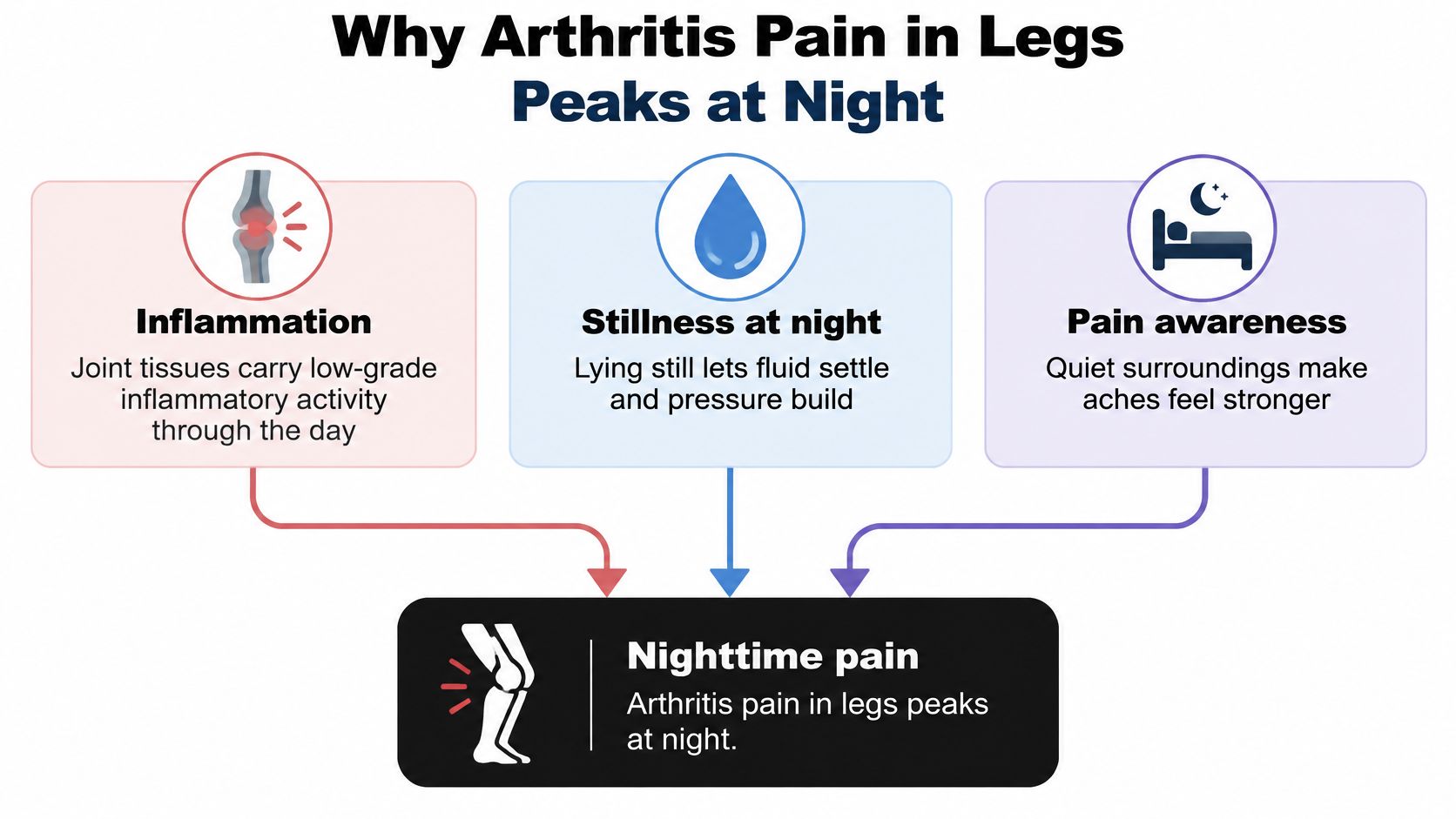
Say your knee feels manageable while you're doing errands, then aches once you're in bed. That doesn't necessarily mean something changed inside the joint after you switched off the light. Your day's activity, sleeping position, and sleep quality can all influence what you feel.
Nearly 64% of Canadians with osteoarthritis report difficulty obtaining a good night's sleep, according to Arthritis Society Canada's osteoarthritis report summary. Night pain and sleep disruption deserve attention together, rather than treating sleep as an unrelated problem.
From daytime loading to overnight stillness
A sensitive joint may tolerate ordinary activity but become sore after more walking, stairs, or standing than it's currently accustomed to. Osteoarthritis can also involve inflammation of joint tissues, not only cartilage changes.
When you stop moving, stiffness can become more noticeable. Think of a stiff hinge that moves more easily after gentle use, although a living joint is more complex and shouldn't be forced through pain.
Position adds another layer. Lying directly on a painful hip or keeping a knee tightly bent can maintain pressure on sensitive tissues. Unloading the leg doesn't guarantee comfort if the position itself is irritating.
The illustration brings these overlapping influences together.
Why sleep belongs in pain care
In a quiet bedroom, you may notice discomfort that was less prominent while you were occupied. Daily rhythms in pain processing may contribute, too, but the time pain occurs can't identify its cause.
Poor sleep can increase pain sensitivity and fatigue. You may then avoid activity because you're exhausted, leaving you less prepared for normal walking and household tasks. That doesn't mean the pain is imaginary, or that sleeping better alone will treat the arthritis.
Night pain isn't a reliable measure of joint damage. Its meaning depends on the overall pattern, including swelling, stiffness, mobility, and changes in function.
Activity-related aching with brief stiffness can fit osteoarthritis. Persistent pain at rest, especially with warmth or swelling, needs assessment rather than an assumption that you've just overdone it.
How to Position Your Legs and Settle for Sleep
Build a routine around comfort, not a rigid sleeping posture. If you've had joint surgery or have positioning restrictions, follow your rehabilitation team's instructions instead.
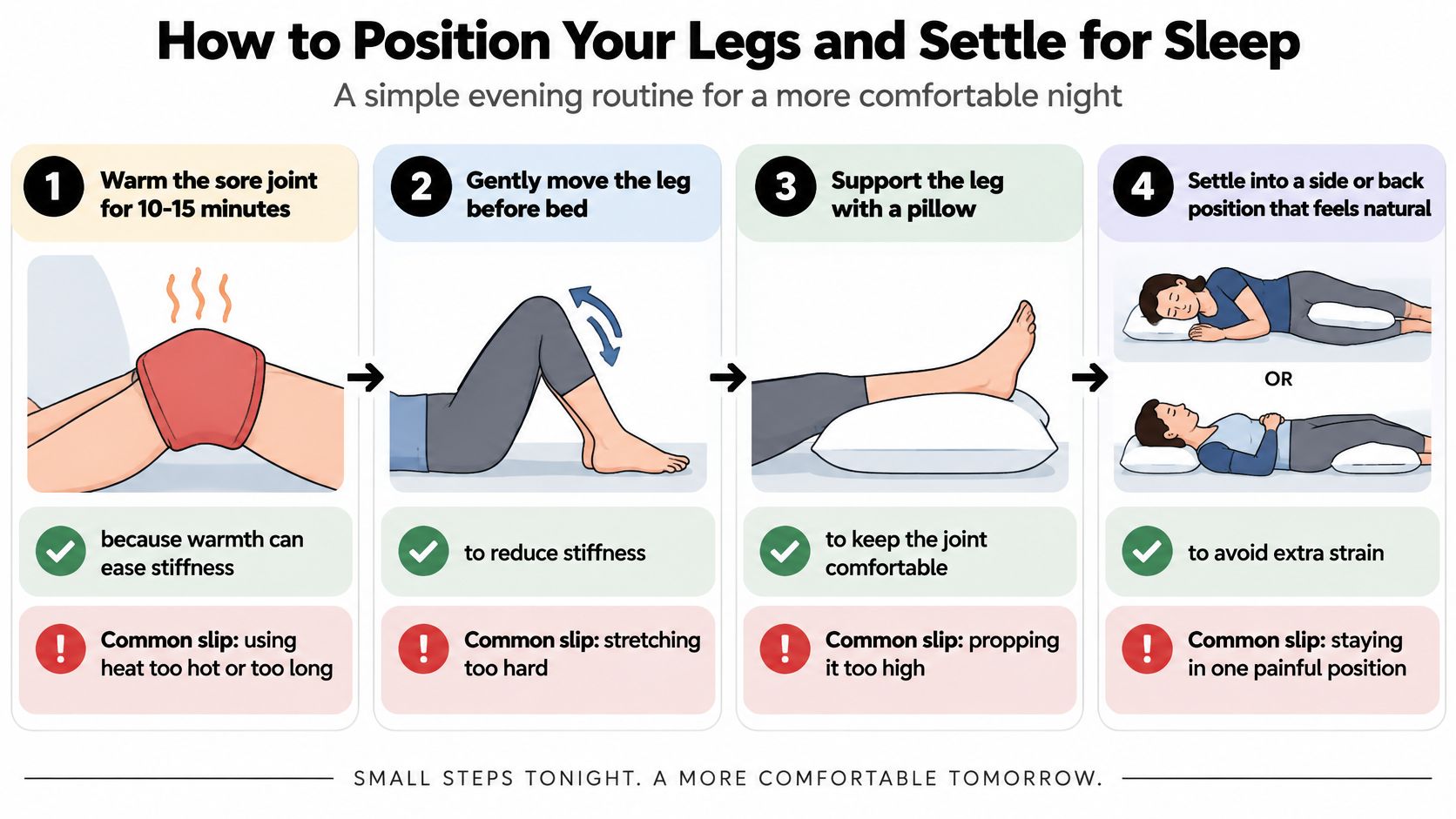
These positioning ideas provide a starting point, not a requirement to sleep in a particular way.
A gentle evening routine
- Warm a stiff joint if warmth feels soothing. Try a comfortably warm shower or a wrapped heat pack, checking your skin regularly. A common mistake is using excessive heat or falling asleep on the pack; avoid heat over numb skin or an acutely hot, swollen joint.
- Move through a comfortable range before bed. Try slow heel slides, easy knee bends, or ankle movements without forcing the end position. The slip to avoid is turning a settling routine into a strenuous stretching session.
- If you sleep on your side, support the upper leg. Lie on the less painful side and place a pillow between your knees, extending support towards the ankles if that feels better. A pillow that's too thin may leave the upper knee dropping across your body.
- On your back, try a small support beneath the knees. Use only enough height to reduce discomfort, rather than folding the knees too much. Don't assume more cushioning is better if it creates pressure elsewhere.
- Keep covers loose around sensitive feet. Tuck bedding so you can move without pulling against tight fabric. Don't use heavy covers to hold a painful leg in place.
- If pain wakes you, change something gently. Adjust the pillow, straighten or bend the knee comfortably, or get up for a brief walk if you're steady. Avoid standing abruptly when sleepy or after taking sedating medicine.
- Avoid sustained compression. Sitting in bed with your knees tightly drawn up may feel cosy initially but become uncomfortable. Change the position instead of trying to stretch aggressively after holding it.
For more help identifying position-related patterns, see our guide to leg pain when lying down.
Judge comfort by your own response
A useful improvement is easier settling, less time awake, or a more comfortable start to the morning. There's no universal pillow arrangement or guaranteed timetable.
This video provides an additional visual resource to consider alongside your clinician's advice.
Medication and Topical Timing Before Bed
| Option | When to use before bed | Watch for |
|---|---|---|
| Acetaminophen, also called paracetamol | Follow the product's dosing interval and daily maximum; ask a pharmacist how it fits your evening schedule | Hidden doses in combination cold, flu, or prescription products |
| Oral anti-inflammatory, such as ibuprofen or naproxen | Use only if suitable for you, following the label and food instructions | Stomach bleeding, kidney problems, raised blood pressure, and interactions with blood thinners |
| Topical anti-inflammatory gel, such as diclofenac | Apply only to sites and at intervals permitted by the product label | Skin irritation; handwashing instructions; overlap with oral anti-inflammatories |
| Topical menthol or capsaicin cream | Follow the specific product's application schedule rather than assuming immediate bedtime relief | Burning or irritation; avoid broken skin and contact with eyes |
| Non-prescription topical stick or roll-on | Use at the labelled interval, allowing for any earlier applications | Active ingredients, maximum frequency, and duplication with other topical products |
Plan around the product, not a generic countdown
The aim is to have an appropriate treatment available when symptoms usually interfere with sleep, without taking doses too close together. There's no single bedtime interval that suits every formulation, medicine, or person.
Acetaminophen doesn't treat joint inflammation, and it isn't suitable for everyone. Check every product you take for overlapping ingredients, particularly if you're also treating a cold or using a prescription combination pain medicine.
Oral anti-inflammatories require a different safety check. Taking them with food may reduce stomach discomfort, but it doesn't remove the risk of bleeding or kidney complications. Don't combine ibuprofen and naproxen unless a prescriber explicitly directs you to.
Topical doesn't mean risk-free
A topical anti-inflammatory isn't the same as a cooling counterirritant. Menthol changes local sensation, while diclofenac is an anti-inflammatory medicine; capsaicin has its own application instructions and shouldn't be treated as an interchangeable cooling cream.
For practical distinctions between formats and ingredients, use our guide to topical pain relief for arthritis. Avoid layering products on the same area unless a pharmacist confirms it's appropriate, and don't put a heating pad over a medicated topical.
A soothing sensation tells you how a product feels. It doesn't confirm that the underlying cause has been treated.
Ask a pharmacist before selecting or combining treatments if you take blood thinners or blood pressure medicine, have kidney disease or a history of stomach ulcers, or are pregnant. Bring the actual packages or clear photographs of their ingredient panels.
If you're considering supplements too, NexiHerb's review of joint supplement evidence, from NexiHerb LLC, can help frame questions about evidence and expectations. Supplements aren't a substitute for assessing unexplained night pain, and symptom relief doesn't replace disease-directed treatment for inflammatory arthritis.
Red Flags That Need Prompt Medical Review
Don't wait to complete a home trial when symptoms suggest a circulation, infection, or neurological problem. The level of urgency depends on the symptoms accompanying the pain, not on how intense the ache feels.
Arthritis Research Canada describes how pain, fatigue, and restricted function can affect activity and sleep in people with arthritis. Clinically, prolonged stiffness, visible swelling, and pain prominent at rest warrant a different assessment from straightforward activity-related soreness.
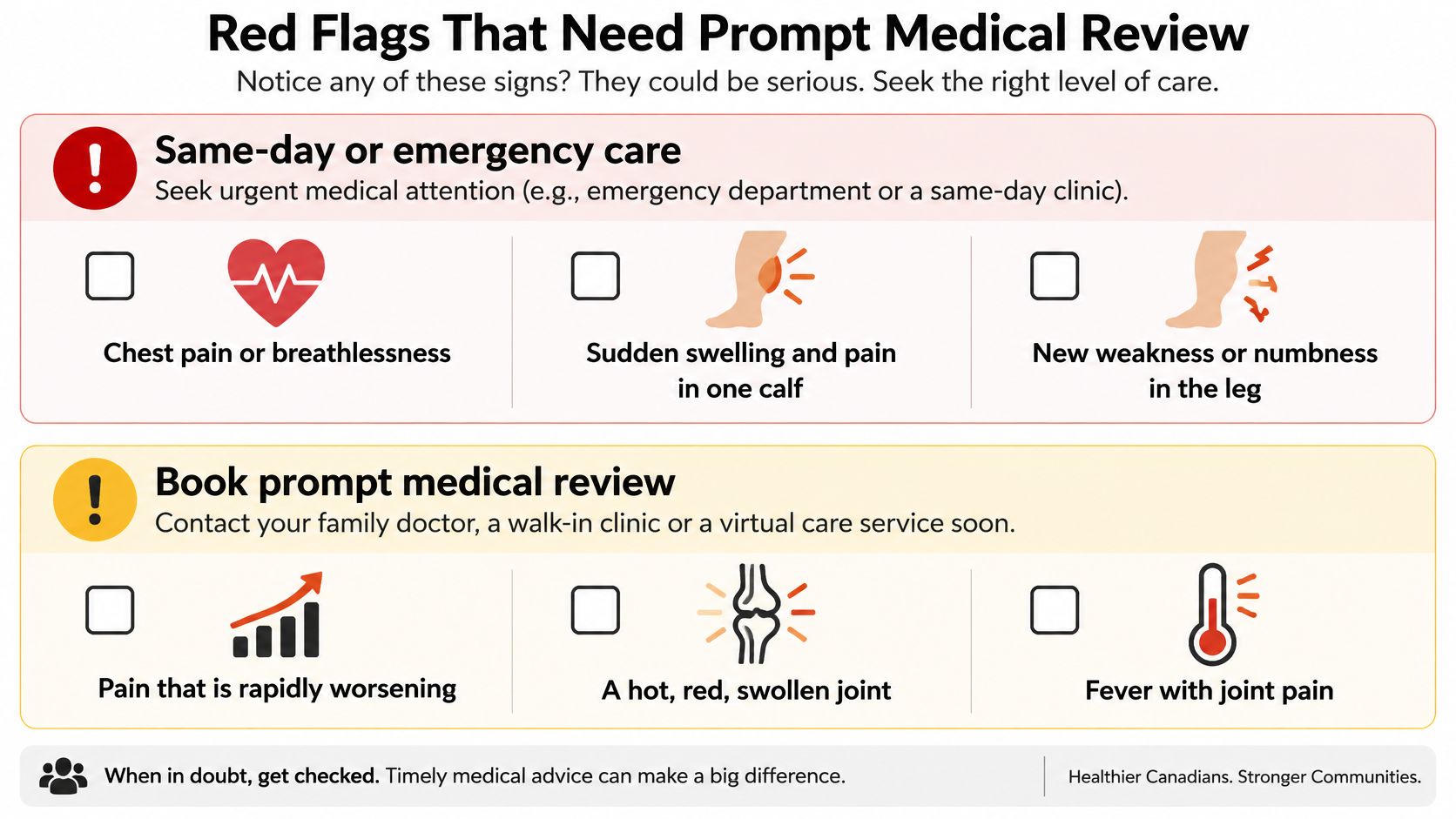
Use this checklist to recognise symptoms that shouldn't be managed with bedtime remedies alone.
Get emergency or same-day care
- Chest pain or breathlessness: Call emergency services, particularly if these occur alongside leg swelling.
- A suddenly cold, pale, or blue foot: Seek emergency assessment for a possible interruption of blood supply.
- Sudden weakness, groin numbness, or bladder or bowel changes: Seek emergency care rather than waiting for physiotherapy.
- New swelling and pain in one calf: Arrange urgent same-day assessment. Don't massage the calf or assume you've strained it.
- A hot, markedly swollen joint, especially with fever: Obtain urgent same-day care because joint infection must be excluded.
These features aren't typical of uncomplicated osteoarthritis. A cream, pain tablet, or temporary improvement doesn't safely rule out a serious cause.
Arrange a medical appointment for a changing pattern
Book a GP or nurse practitioner appointment when pain is increasingly prominent at rest, morning stiffness is prolonged, or joints on both sides become swollen. Repeated sleep disruption, declining walking ability, and unexplained worsening also deserve review.
Bring details rather than only a pain rating. Explain whether the symptoms began suddenly, where they started, and what you can no longer do comfortably. Mention any recent illness, injury, surgery, or medicine change.
Our guide to when to worry about leg pain provides additional context for deciding when to seek help. A pharmacist can review medicines and interactions, but can't replace the physical examination needed to assess circulation, nerve function, or a swollen joint.
Track Night Pain and Choose Your Next Step
A useful diary measures whether you're sleeping and functioning better, not just whether a product felt soothing when applied. Keep it simple enough to complete when you're tired.
Try a brief record over consecutive nights, using the same descriptions each time. You don't need an elaborate app; a notebook beside the bed works.
Record the details that change decisions
| Diary column | What to record |
|---|---|
| Bedtime and settling | When you went to bed and approximately how long you stayed awake |
| Awakenings | How often pain woke you and how long you were awake |
| Pain before sleep and on waking | Use a consistent personal scale or descriptions such as mild, moderate, and severe |
| Morning stiffness | How long it took to move comfortably |
| Treatment and timing | Medicine name, dose, topical product, and application time |
| Daytime loading | Unusual walking, stairs, prolonged standing, or exercise |
| Next-day function | Whether your usual walk, stairs, or household tasks felt easier |
| Associated symptoms | Swelling, warmth, tingling, or a change in pain location |
Don't set an alarm to collect information. Estimate overnight timings in the morning, and avoid repeatedly checking the clock if that makes you more alert.
Look for a useful trend
Compare ordinary nights rather than judging the whole approach from a single difficult evening. Say you settle more comfortably and spend less time awake, but your morning walking remains unchanged. That's a partial improvement worth recording, not proof that every aspect of the problem has resolved.
Conversely, a lower bedtime pain rating isn't enough if you're waking more often or becoming less mobile. Sleep, stiffness, and daily function should guide the decision together.
Measure what matters: The best result is a more manageable night followed by a more capable day, not simply a stronger cooling or warming sensation.
Change one manageable part of the routine at a time when possible. Keep prescribed medicines consistent unless your clinician advises otherwise, so the diary remains interpretable.
If comfort improves and the pattern fits diagnosed osteoarthritis, ask a physiotherapist about graded strengthening and activity progression. If symptoms persist, change character, or resemble nerve or circulation symptoms, arrange an assessment rather than repeatedly adding remedies.
Bring the record to your appointment
Seeking care for arthritis is routine: 6.24% of Canadians aged 20 and older used health services for arthritis in 2023–2024, according to the Public Health Agency of Canada's Canadian Chronic Disease Surveillance System.
Bring your diary, medicine list, and a description of where the pain begins. Our guide to managing chronic pain can also help you organise everyday strategies while you work with your care team.
Our Power Stick, Power Spray, and Roll-On offer non-prescription topical options for temporary relief of sore muscles and joints, including arthritis-related discomfort. Visit MEDISTIK to compare formats and review their directions with your pharmacist as part of a considered night-time pain plan.


