

That throbbing, persistent ache that seems to set up camp in your legs the moment you lie down? It’s not just in your head. For so many people, the pain that was just a minor nuisance during the day suddenly takes centre stage at night.
The reason is actually pretty straightforward. When you're still, changes in your body position, blood flow, and nerve pressure can really highlight underlying problems that your daytime movements were masking.
Why Leg Pain Often Feels Worse at Night
If you've ever found yourself wondering why your legs felt perfectly fine during a hectic day only to start aching, cramping, or throbbing the second you get into bed, you're definitely not alone. It's a common puzzle, and the answer lies in some basic physiology.
Think of your circulatory system as a busy highway. During the day, every step you take—walking, standing, even just shifting your weight—acts like a pump. These muscle contractions help push blood from your legs back up to your heart, working against gravity.
But when you lie down for the night, that all changes.
The Impact of Lying Down
Without the help of gravity and constant muscle movement to keep things flowing, your circulation naturally slows down. For anyone with an underlying issue like venous insufficiency (where the valves in your leg veins are weak), this slowdown lets blood start to pool. This pooling action cranks up the pressure inside the veins, leading to that all-too-familiar heavy, aching, or throbbing feeling.
On top of that, your sleeping position can put direct pressure on nerves, like the sciatic nerve. A slight twist in your hips or a mattress that isn’t giving you the right support can be enough to pinch a nerve that was only mildly irritated during the day. Suddenly, that minor annoyance flares up into a sharp, radiating pain that makes sleep impossible.
Lying flat can unmask or worsen symptoms that your body's daytime activities kept in check. The stillness of the night removes distractions, making you more aware of the discomfort and disrupting your ability to get restorative sleep.
This is an incredibly common problem. In Canada, chronic pain affects one in five people, and nighttime leg pain is often tied to conditions that seriously mess with sleep. A 2019 report found that an estimated 19% of the population lives with chronic pain, and more than half of them describe it as moderate to severe.
Your Brain's Perception of Pain
There's another piece to this puzzle: how your brain interprets pain. During the day, your brain is a multitasking marvel, juggling sights, sounds, conversations, and a million other things. All that activity can effectively distract you from low-level pain.
But at night, when the world goes quiet, your brain has nothing else to focus on. Those pain signals from your legs suddenly have a direct line, with no distractions to get in the way, making the pain feel much more intense. It’s a fascinating process, and if you’re curious, you can learn more about the gate control theory of pain and how your brain acts as a gatekeeper for these signals.
Exploring the Common Culprits Behind Nightly Leg Pain
We've talked about why pain can feel so much worse at night, but what's actually causing it? Let's dive into some of the most common reasons your legs might be acting up when you're trying to sleep.
Often, these issues are just your body's way of telling you something is a little off-balance—think overuse or a minor imbalance rather than a serious disease. Getting to the root cause is the first real step toward finding relief and getting back to peaceful nights.
Nocturnal Leg Cramps
This is probably the one you know best. That sudden, vice-like grip on your calf muscle that jolts you awake? That's a nocturnal leg cramp, sometimes called a "charley horse." It’s a harsh, involuntary muscle spasm that can leave you with a tender, sore muscle for hours or even days.
Imagine your muscle fibres are like tiny elastic bands. To work properly, they need a perfect mix of fluids and minerals. When that balance is off, the bands can suddenly seize up into a painful knot.
So, what throws things out of whack?
- Dehydration: Not drinking enough water is a huge trigger. Your muscles are thirsty and can't function properly without enough fluid.
- Mineral Imbalance: A shortage of key electrolytes like magnesium, potassium, and calcium is a classic recipe for cramping.
- Muscle Overuse: If you pushed it hard at the gym or spent the whole day on your feet, your muscles are fatigued and much more likely to cramp once they finally try to relax.
- Prolonged Sitting: On the flip side, sitting all day can cause problems too. It can shorten your muscle fibres, making them prone to spasms later on.
If this sounds familiar, you're not alone. Research shows nocturnal leg cramps hit up to 60% of Canadian adults, and the numbers get even higher for those over 50. It’s a very common complaint.
Restless Legs Syndrome
This one is different from a cramp. Restless Legs Syndrome (RLS) is a neurological condition that gives you an almost maddening urge to move your legs. It’s less about sharp pain and more about a strange, deep sensation people describe as "creepy-crawly," "pulling," or "electric."
These feelings typically act up when you’re resting, especially in the evening as you lie down. The tell-tale sign of RLS is that moving your legs—walking, stretching, shaking them out—makes it feel better for a moment. But as soon as you stop, the feeling often creeps right back.
Restless Legs Syndrome isn't about a muscle locking up in pain. It's about an unstoppable sensation that compels you to move for relief. A cramp is a forceful contraction you can't stop; RLS is an urge you can't ignore.
While the exact cause can be a mystery, RLS is often tied to an imbalance of dopamine, a brain chemical that helps manage muscle movement. Iron deficiency, pregnancy, and certain medications can also play a role.
Delayed Onset Muscle Soreness
Ever start a new workout and feel fine, only to wake up the next day feeling like you’ve been hit by a truck? That's Delayed Onset Muscle Soreness, or DOMS. It's the deep muscle ache and stiffness that kicks in 24 to 48 hours after you've done an intense or unfamiliar exercise.
This isn't the immediate burn you feel during a workout; DOMS is sneaky. The exercise creates tiny, microscopic tears in your muscle fibres, and the soreness you feel is the inflammation that comes with your body's repair process. This ache can easily peak right when you’re trying to sleep, making it impossible to get comfortable.
Sometimes, what feels like leg pain can actually be radiating from somewhere else. If your discomfort seems to start higher up, it’s worth learning about what causes hip pain when sleeping to see if that's the real source of the problem.
The good news? DOMS is just a sign your muscles are getting stronger. With a bit of gentle stretching and proper rest, it'll pass.
When Your Leg Pain Signals Something More Serious
While plenty of aches and pains at night are nothing to lose sleep over, sometimes that persistent leg pain is your body's way of sending up a flare. It's a signal that something more serious is going on. This isn't about causing alarm; it's about helping you listen to your body and know when it’s time to call a professional.
Think of it like this: you need to know the difference between a minor speed bump and a major roadblock in your body’s internal highway system. Let’s break down some of the more serious conditions that could be behind your nighttime leg pain.
Peripheral Artery Disease: The Traffic Jam in Your Arteries
Imagine your arteries as major highways that deliver oxygen-rich blood to your leg muscles. With Peripheral Artery Disease (PAD), plaque builds up and narrows these highways, creating a slow-motion traffic jam that seriously restricts blood flow.
During the day, you might not notice it much. But when you lie down for the night, you lose the help of gravity, and the already weak circulation can drop even lower. This is when the cramping pain, known as claudication, can really kick in, waking you up from a sound sleep.
A classic sign of PAD is pain that gets worse when you prop your legs up on a pillow but feels better when you dangle them over the side of the bed. Why? Gravity is giving your circulation a much-needed boost, pulling blood down into your feet.
Sciatica: When a Pinched Nerve Creates Chaos
Sciatica isn't a condition on its own, but rather a tell-tale symptom of another problem, like a herniated disc or spinal stenosis that’s pinching the sciatic nerve. This major nerve runs all the way from your lower back, through your hips and buttocks, and down each leg.
Your sleeping position can be the trigger. Lying down on a mattress that’s too soft or twisting your body can put just enough extra pressure on that already angry nerve. The result is often a sharp, shooting, or burning pain that radiates down your leg, making it feel impossible to get comfortable. This is why sciatica is a common culprit behind severe pains in leg when lying down.
Varicose Veins and Venous Insufficiency
Those bulging varicose veins can be more than just a cosmetic issue. They're often a clear sign of chronic venous insufficiency, a condition where the tiny one-way valves inside your leg veins have become weak or damaged. This allows blood to flow backward and pool in your lower legs.
All day long, that pressure builds. When you finally lie down at night, the accumulated fluid and pressure don’t just vanish. Instead, you're left with a dull, heavy, throbbing ache that can make your legs feel incredibly tired and sore.
This is a widespread issue in Canada. The Canadian Pain Task Force found that chronic pain affects about 19% of the population, with direct healthcare costs hitting $7.2 billion each year. If your legs ache most after a long day on your feet, venous problems could be the reason. You can learn more about chronic pain rates in Canada from Statistics Canada.
This infographic breaks down some of the most common sensations associated with nightly leg pain.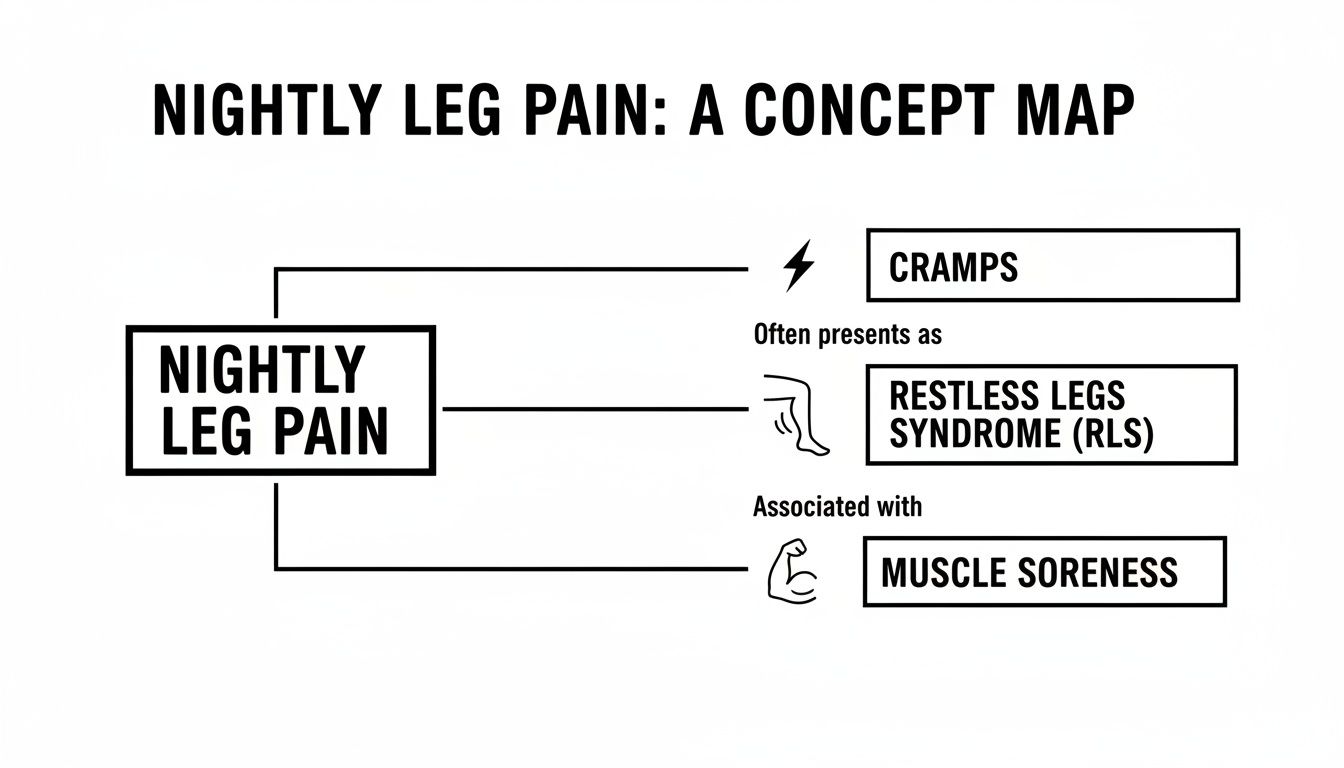
It helps you see the difference between the sudden jolt of a cramp, the constant need to move from RLS, and the general ache of sore muscles.
Deep Vein Thrombosis: A Critical Red Flag
This is the one you absolutely cannot ignore. A Deep Vein Thrombosis (DVT) is a blood clot that forms in a deep vein, usually in the leg. It's a medical emergency because a piece of that clot can break off, travel to the lungs, and cause a life-threatening pulmonary embolism.
Unlike the other conditions, DVT symptoms tend to come on suddenly and usually only affect one leg. If you're feeling uneasy about your symptoms, it helps to understand when to worry about leg pain and which signs mean you need to see a doctor right away.
Be on the lookout for these critical warning signs:
- Swelling in one leg (it’s rare for both to be affected)
- Pain or tenderness that might feel like a severe cramp or soreness
- A feeling of warmth in the painful area
- Red or discoloured skin on the leg
If you experience any of these symptoms—especially after a long flight, surgery, or any period of being immobile—seek emergency medical care immediately.
Practical At-Home Strategies for Immediate Relief

When a sudden cramp or a deep, throbbing ache strikes in the middle of the night, you need solutions that work—fast. Having a few go-to strategies can make all the difference, helping you calm the pain and get back to the restorative sleep your body desperately needs. The goal here is to break that pain cycle with simple, immediate actions.
These techniques are all about improving your circulation, easing muscle tension, and taking pressure off sensitive nerves. It might take a little trial and error to figure out what works best for you, but these are a fantastic starting point for anyone dealing with leg pain when lying down.
Master Your Sleeping Position
Believe it or not, how you lie in bed can either soothe your leg pain or make it flare up. The right posture can take a surprising amount of pressure off your lower back and legs, while the wrong one can make things a whole lot worse.
Try sleeping on your side instead of your back or stomach. Tucking a pillow between your knees helps keep your hips, pelvis, and spine in a much better alignment. This simple trick stops your top leg from pulling your spine out of place, which can ease the strain on your sciatic nerve.
Key Takeaway: Proper alignment is everything. That small pillow between your knees isn't just about comfort; it actively maintains a neutral spine, preventing nerve compression and muscle strain while you sleep.
For even more support, it's worth learning how adjustable bases can help alleviate various health concerns. Being able to elevate your legs or head can do wonders for circulation and pain reduction.
Use Elevation to Your Advantage
Gravity can be a powerful ally against nighttime leg pain, especially if it’s tied to poor circulation or varicose veins. By elevating your legs, you help blood flow back toward your heart instead of pooling in your lower limbs.
You don't need any fancy equipment for this. Just prop one or two firm pillows under your calves and ankles, raising your legs just slightly above your heart. This can bring immediate relief from swelling, pressure, and that heavy, aching feeling.
Gentle Stretches You Can Do in Bed
When a muscle cramp hits, the natural instinct is to tense up. But a gentle, targeted stretch is a far more effective way to release the spasm and ease that sharp, intense pain.
Here are a couple of simple stretches to try right in bed:
- Calf Stretch: Sit up and straighten the leg that's cramping. Loop a towel or belt around the ball of your foot and gently pull it toward you, keeping your knee as straight as you can. You'll feel a nice, relieving stretch along your calf muscle.
- Hamstring Stretch: Lying on your back, lift one leg straight toward the ceiling until you feel a gentle stretch in the back of your thigh. Hold it there for 20-30 seconds.
If you're dealing with stubborn calf issues, knowing the right way to recover is crucial. We have more detailed advice on how to heal a calf strain quickly in our dedicated guide.
Harness the Power of Temperature and Topicals
Applying warmth is incredibly soothing for tight, aching muscles. Taking a warm bath with Epsom salts before bed can relax your whole lower body and might even stop cramps before they start. If pain wakes you up, try a heating pad or warm compress on the sore spot for 15-20 minutes to boost blood flow and ease the ache.
For more direct relief, a topical analgesic can be a game-changer. Products like MEDISTIK, a Canadian-made topical, deliver pain-relieving ingredients right where you need them. Applying a spray, stick, or roll-on can provide rapid relief from muscle soreness and joint pain, helping you get back to sleep without reaching for oral medications.
Building Long-Term Resilience Against Leg Pain
Moving beyond just immediate fixes is where the real magic happens for lasting comfort. If you want to stop the pain in your legs from returning night after night, you need to build a strong, flexible foundation for your lower body. This is all about being proactive and creating resilience through simple, consistent habits that support your muscles, nerves, and circulation.
Think of your leg muscles as the support cables holding up a bridge. If they're weak or constantly tight, the whole structure becomes unstable and prone to problems. A good mix of strengthening and flexibility work ensures these "cables" can handle the stress of your day without spasming the second you lie down to rest.
This isn't about signing up for gruelling gym sessions. It’s about weaving in small, targeted movements that make a genuine difference over time.
Strengthening and Flexibility for Pain-Free Nights
A few simple exercises can really fortify your lower body, making it far less susceptible to the fatigue and strain that often trigger nighttime pain. The goal is to focus on movements that build up stability and improve your range of motion.
- Calf Raises: Stand flat on the floor, then slowly lift your heels until you’re on your tiptoes. Hold for a moment before slowly lowering back down. This is a fantastic strengthener for your calf muscles—a common culprit behind those awful nocturnal cramps.
- Glute Bridges: Lie on your back with your knees bent and feet flat on the floor. Squeeze your glutes and lift your hips up toward the ceiling, then gently lower them back down. Strong glutes provide crucial support for your lower back and pelvis, which can help reduce nerve irritation down your legs.
- Ankle Circles: Whether you're sitting or lying down, slowly rotate your ankles in circles. Do about 10-15 circles in one direction, then switch to the other. It's a simple move that does wonders for flexibility and circulation in your lower legs and feet.
Consistent stretching is just as crucial. Tight muscles are unhappy muscles, plain and simple. Gentle, regular stretching helps lengthen those muscle fibres, making them much less likely to seize up into a painful cramp when you least expect it.
Building resilience is a long game, not an overnight fix. Every small, consistent action—a daily stretch, an extra glass of water—adds up. You're creating a body that is less reactive to pain triggers.
Stretching is a powerful preventative tool. By dedicating just a few minutes each day to lengthening key muscle groups, you can significantly reduce the tension that contributes to nocturnal leg pain. The table below outlines a few essential stretches to get you started.
Preventative Stretches for Nightly Leg Pain
| Stretch Name | Target Muscle Group | How to Perform Safely | Recommended Frequency |
|---|---|---|---|
| Standing Calf Stretch | Gastrocnemius and Soleus (Calf Muscles) | Stand facing a wall, one foot forward and one back. Keeping your back leg straight and heel on the floor, gently lean forward until you feel a stretch in your calf. Hold for 20-30 seconds. | Daily, especially before bed or after long periods of standing. |
| Hamstring Stretch (Seated) | Hamstrings (Back of Thigh) | Sit on the floor with one leg straight out and the other bent, foot against your inner thigh. Gently lean forward from your hips toward the straight leg's foot. Stop when you feel a gentle pull. Hold for 20-30 seconds per side. | Daily. Tight hamstrings can pull on the lower back and affect leg alignment. |
| Quadriceps Stretch (Standing) | Quadriceps (Front of Thigh) | Stand, holding onto a wall or chair for balance. Grab your ankle and gently pull your heel up and back toward your glute. Keep your knees close together. Hold for 20-30 seconds per side. | Daily, particularly if you sit for long hours. |
| Piriformis Stretch (Figure-Four) | Piriformis (Deep Glute Muscle) | Lie on your back with knees bent. Cross one ankle over the opposite knee. Gently pull the bottom thigh toward your chest until you feel a stretch in the glute of the crossed leg. Hold for 20-30 seconds per side. | Daily. This can help relieve sciatic-like pain. |
Remember to breathe deeply during each stretch and never push into sharp pain. Consistency is more important than intensity.
The Critical Role of Hydration and Nutrition
Did you know your muscles are made of roughly 75% water? When you're dehydrated, your muscles simply can't function as they should, which makes them far more prone to cramping and soreness. Making sure you drink enough water throughout the day is one of the easiest and most effective things you can do.
Beyond water, certain minerals called electrolytes are absolutely vital for proper muscle contraction and relaxation. If you're running low on these, it can be a direct cause of nighttime leg pain.
- Magnesium: Think of this mineral as a natural muscle relaxant. A lack of magnesium is often linked to the kind of involuntary muscle spasms that jolt you awake with a cramp.
- Potassium: Essential for both nerve signals and muscle contractions, potassium helps manage the fluid balance inside your cells.
- Calcium: While famous for bone health, calcium also plays a huge part in how your muscles contract in the first place.
You don't necessarily need supplements. Try incorporating foods rich in these minerals—like leafy greens, bananas, nuts, and dairy—to help keep your muscles calm and happy through the night.
Lifestyle Choices That Build a Stronger Foundation
It's amazing how much your daily habits can impact your leg health. Seemingly small choices can either set you up for nighttime pain or help you build a solid defence against it. Think about your footwear—are your shoes supporting your feet and legs, or are they causing muscle strain that you only feel hours later when you're trying to sleep?
Bringing low-impact activities like swimming or cycling into your routine can also work wonders. These exercises are fantastic for strengthening your leg muscles and boosting circulation without the pounding stress of activities like running. By making more conscious choices to support your body during the day, you pave the way for peaceful, pain-free nights.
Knowing When to See a Healthcare Professional
While at-home strategies and lifestyle tweaks are fantastic first steps, it's critical to know when your leg pain is sending a message that requires a professional. Think of certain symptoms as your body’s alarm bells—they’re telling you it’s time to move beyond self-care and get a doctor involved.
Ignoring these signals can mean delaying the diagnosis and treatment of a more serious underlying condition. Being able to tell the difference between a manageable ache and a medical red flag is one of the most important things you can do for your health. Pain that is severe, sudden, or consistently wrecking your sleep shouldn't just be brushed off as a simple cramp.
Identifying Red Flag Symptoms
Some symptoms that can show up alongside your pains in leg when lying down need immediate attention. Don't hesitate to seek medical advice if you experience any of the following, as they could point to a serious issue like a deep vein thrombosis (DVT) or significant nerve compression.
Use this simple checklist to assess your situation:
- Swelling in One Leg: Is one of your legs noticeably puffier or larger than the other? This is a classic sign of a potential blood clot.
- Skin Changes: Take a look at the painful area. Do you see any redness, feel unusual warmth when you touch it, or notice any strange discolouration?
- Fever or Chills: Systemic symptoms like a fever suggest your body might be fighting off an infection or dealing with major inflammation.
- Severe, Unrelenting Pain: Is the pain just so intense that nothing—not elevation, stretching, or over-the-counter remedies—seems to touch it?
- Numbness or Weakness: A sudden loss of feeling or finding you can’t move your foot or leg properly is a crucial sign that nerves could be involved.
What to Expect During a Medical Visit
Walking into your appointment prepared can make a world of difference. Your doctor will likely kick things off with a thorough chat about your medical history and then do a physical examination of your legs, checking your pulses, skin, and reflexes.
A medical evaluation is a team effort. Your detailed description of when the pain started, what it feels like, and what makes it better or worse provides crucial clues that help your doctor figure out what’s going on.
Based on what they find initially, your doctor might suggest a few diagnostic tests to get a clearer picture. These could include a duplex ultrasound to check your blood flow and look for clots, or maybe an ankle-brachial index (ABI) test to screen for Peripheral Artery Disease. Knowing what these steps are can help you feel more confident and in control of your health journey.
Frequently Asked Questions About Leg Pain at Night
Even with a better understanding of what causes leg pain at night, you might still have a few questions. Let's tackle some of the most common ones that come up.
Can Certain Foods Trigger Leg Cramps at Night?
Yes, what you eat (or don't eat) can definitely play a role. While we all know dehydration is a big no-no, an imbalance of key electrolytes like potassium, magnesium, and calcium is another major trigger for those jolting muscle cramps.
If your diet is low in these essential minerals, you're setting the stage for painful nighttime spasms. The good news is you can fight back with your grocery list. Think bananas, avocados, sweet potatoes, nuts, seeds, and leafy greens—they're all packed with the good stuff your muscles need.
Does My Job Affect My Leg Pain When Lying Down?
Absolutely. What you do for 8+ hours a day has a massive impact on how your legs feel when you finally put them up.
- Jobs requiring prolonged standing: If you're a nurse, retail worker, or hairstylist, you're putting constant pressure on your leg muscles and veins. This often leads to fluid pooling and muscle fatigue, which shows up as a deep ache or heaviness as soon as you lie down.
- Sedentary desk jobs: Sitting all day might seem restful, but it can cause your hamstrings and hip flexors to become incredibly tight and short. That stiffness can easily lead to nerve irritation and imbalances that flare up once you're off your feet.
Whether you stand all day or sit all day, the common thread is a lack of varied movement. Incorporating regular stretch breaks and short walks can counteract the strain of a static work posture.
Is It Better to Use Heat or Cold for Leg Pain at Night?
This really depends on what’s causing the pain. For general muscle soreness, tightness, or cramps, heat is usually your best friend. A warm bath or a heating pad can work wonders by helping tense muscles relax and boosting blood flow to the area.
But if you’re dealing with swelling and inflammation from a recent injury, cold therapy is the way to go to help bring that swelling down. For targeted, on-the-spot muscle aches, a topical analgesic that provides either a warming or cooling sensation can offer direct relief exactly where you need it most.
For seriously strong, non-prescription relief from muscle and joint pain, trust MEDISTIK. Our Canadian-made topical analgesics are designed to help you prime, perform, and restore, so you can get back to pain-free nights and active days. Explore our products today.


