

No quality trial crowns one anti-inflammatory cream for plantar fasciitis, so there's no clinically proven best jar on the shelf. A topical NSAID such as diclofenac is the most evidence-aligned class for a label-directed trial of 1 to 3 weeks, while a counterirritant stick or roll-on is for temporary comfort before activity, not for repairing tissue.
Search for the best anti inflammatory cream for plantar fasciitis and you'll get tubes sorted by strength claims, star ratings and price per gram. That ordering is invented. Nothing in the clinical literature compares commercial heel creams against each other, so any page that crowns a winner is ranking packaging.
What you can do instead is narrower and more useful. Match the formulation to your stomach, your kidneys, your other medicines and your goal, then run a short trial beside the things that change tissue: plantar fascia stretching, calf work, supportive shoes and less time standing on a hard floor.
Which Cream Type Fits Heel Pain First
Diclofenac gel sits at the front of the queue because a guidelines body names the class, not because it survives a bracket. California's workers' compensation guideline, the American College of Occupational and Environmental Medicine Ankle and Foot Disorders guideline, recommends topical NSAIDs for acute, subacute or chronic plantar-fascial pain syndromes, including mild, moderate and severe cases, and including situations where oral treatment is unsuitable.
That same document is unusually honest about the limits of its own advice. It reports no evidence that one topical NSAID is superior to another, and it notes there are no quality trials directly evaluating topical NSAIDs for plantar heel pain at all. The recommendation covers an ingredient family. It doesn't rank brands, concentrations or textures.
The guideline also sets the practical frame: use the product generally according to the manufacturer's directions, and note that published use has commonly lasted 1 to 3 weeks.
| Option | Active idea | Realistic job | Trial window | Best fit |
|---|---|---|---|---|
| Topical NSAID gel or solution | Diclofenac or a similar NSAID | Localized analgesia with less body-wide exposure than pills | Label directions, commonly 1-3 weeks | Heel pain when an anti-inflammatory drug is appropriate, especially if oral NSAIDs are a poor fit |
| Counterirritant stick, spray or roll-on | Menthol, camphor or methyl salicylate | Temporary soothing and a cooling or warming sensation | As labelled, often before activity | Intact skin when the goal is comfort for walking, work or exercise |
| Clinic phonophoresis | Ketoprofen gel driven in with ultrasound | Adjunct pain reduction, not a cure | As the clinician prescribes | Rehab plans where a physiotherapist adds it |
| Oral NSAID | Ibuprofen, naproxen or similar | Systemic anti-inflammatory effect | Only if a clinician says it is safe | When topical care is not enough and stomach, kidney and drug risks have been checked |
The two front rows do different jobs
A topical NSAID is a drug that crosses skin in small amounts. It damps local pain signalling, and because less of it reaches the bloodstream than a swallowed tablet, it's a reasonable route for someone whose stomach or kidneys won't accept pills. It's still an NSAID. Every label rule about broken skin, pregnancy, blood thinners and stacking it with an oral NSAID applies unchanged.
A counterirritant works on sensation instead. Menthol makes the skin feel cool, camphor and methyl salicylate bring warmth, and the heel feels less loud for a while. That's real relief in the ten minutes before a shift starts. It isn't an anti-inflammatory claim, and you shouldn't let a label imply otherwise.
Practical rule: if the goal is calming a genuinely inflamed joint, look at the NSAID column. If the goal is getting through the first block of standing, either column can help, and the counterirritant carries fewer drug interactions.
An oral NSAID isn't a stronger version of a cream. It's a whole-body drug with whole-body checks, and the guideline treats it as a separate decision rather than an escalation you make alone at the pharmacy shelf.
One number keeps the whole exercise in proportion. The same guideline states that more than 90% of patients resolve over 6 to 12 months with nonsurgical management, which makes the cream's job comfort that lets you keep rehabbing, not a cure you shop for. For a plain tour of the formats sold in Canada, this breakdown of topical pain relief products covers what each one is built to do.
Why Heel Pain Is Often Not Inflammation
The plantar fascia is a tough band under the arch that takes your body weight with every step. Load it repeatedly, month after month, and the tissue responds the way a rope does when it's been asked to hold too much for too long. The fibres fray, and repair tissue lays down in a messy, disorganised pattern. What you feel under the heel is that overloaded band, not a pocket of inflammatory fluid like a freshly sprained ankle.
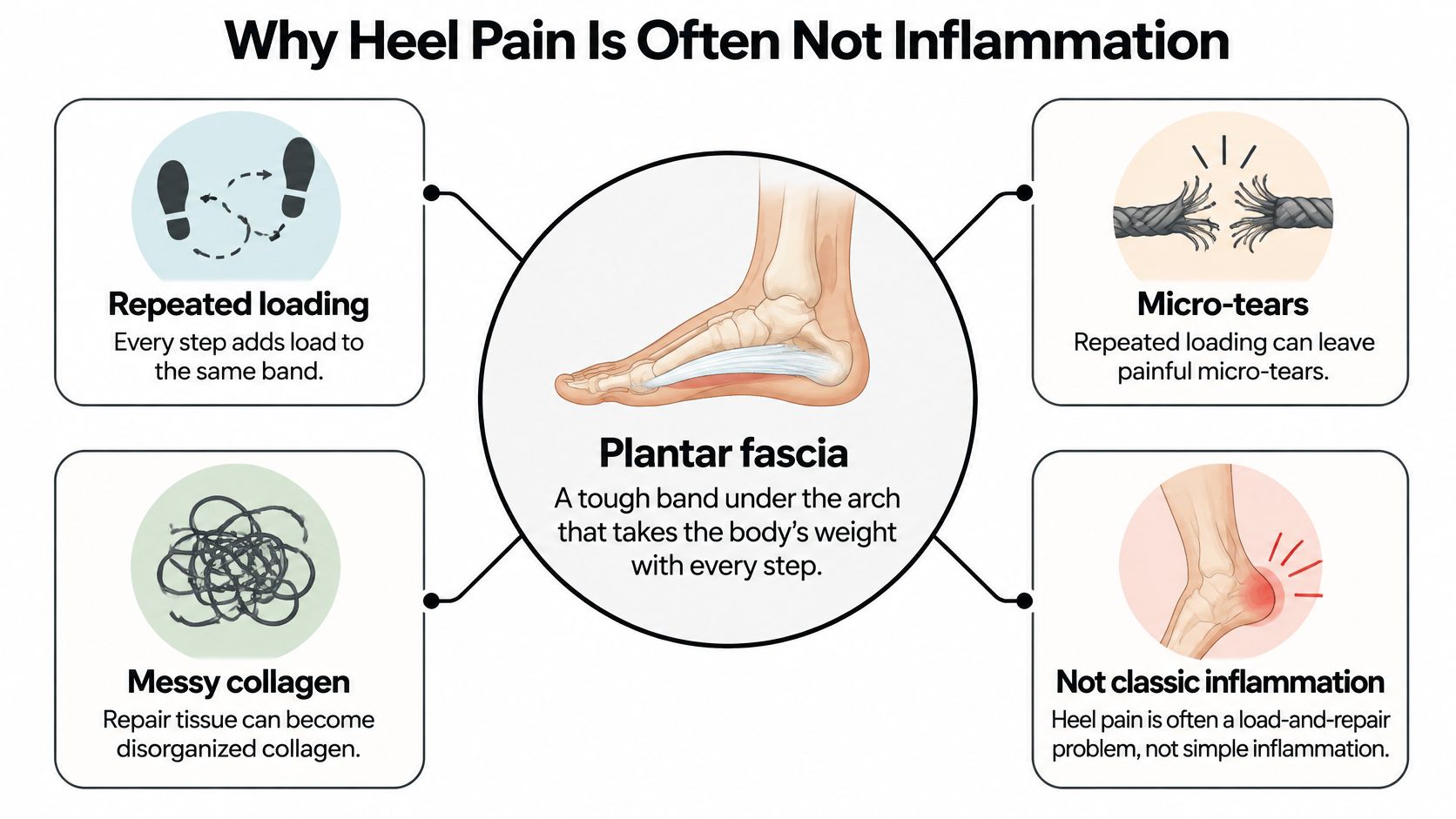
The naming has followed the tissue. Chronic cases are increasingly described as plantar fasciopathy rather than plantar fasciitis, because a clinical review of plantar heel pain characterizes the condition by repetitive loading, collagen disorganization and degenerative change rather than purely prostaglandin-mediated inflammation. That review also reports limited efficacy for NSAIDs and notes that placebo-controlled evidence has not shown clear superiority for NSAIDs over placebo, although they may provide short-term relief when combined with stretching and other conservative measures.
What a cream can reach and what it can't
An anti-inflammatory drug quiets the sensitisation around damaged tissue. It doesn't reorganise collagen. That's why a topical NSAID belongs in the temporary pain relief that enables rehabilitation, not in the stand-alone tissue-healing category.
Ketoprofen gel phonophoresis appears in the 2023 heel-pain guidance as an option clinicians may use to reduce pain, and it's worth reading that precisely. A clinician drives the gel in with ultrasound in a treatment room. The listing is evidence for an adjunctive delivery technique, not evidence that rubbing a cream into your arch repairs the band.
Judge a product by two markers
Ask two questions during the trial. How bad is the first-step pain getting out of bed, and how does the heel feel partway through a walk or a shift? If both ease over a week or two, the product is doing its job. If neither moves, the tube was never the problem.
Check before you start: an NSAID allergy, blood thinners, pregnancy, kidney disease, a history of stomach ulcers, or an oral NSAID already in your daily routine. Any one of those means a pharmacist or clinician reviews the choice first.
Keep the product on intact skin, stop for rash or irritation, and follow the Canadian product monograph rather than a friend's advice. Persistent symptoms, neurological signs such as numbness or tingling, marked swelling, or an inability to bear weight warrant diagnostic reassessment, not a stronger tube. If the pain is worst in those first minutes and eases as you move, this explanation of why your feet hurt when you wake up describes the pattern to compare against.
How to Match a Topical to Your Risks
Your constraints choose the product, not the other way round. Two label families cover almost everything sold for heels: an NSAID such as diclofenac, which is a drug absorbed in smaller amounts than a tablet, and a counterirritant such as menthol, camphor or methyl salicylate, which mainly creates a local sensation.
The evidence for the drug family is real but thinner than the marketing suggests. A systematic review of topical NSAIDs for heel pain found topical diclofenac and ketoprofen performed better than placebo, yet the effect sizes were fragile. Approximately 50% of placebo-group participants reported clinically meaningful pain relief, and only about 10% more NSAID users achieved that improvement.
Read the gap rather than the headline. Half the people rubbing in a placebo got meaningful relief, so applying something to a sore heel already does part of the work. The drug added roughly ten points on top of that. That's a reason for a short, honest trial. It's no reason to stack two products and hope for double.
| Your situation | Lean toward | Pause and ask first |
|---|---|---|
| Oral NSAIDs upset the stomach or are contraindicated | A labelled topical NSAID for a short trial | Using an oral NSAID at the same time |
| Need comfort before standing, walking or sport | A counterirritant on intact skin, as labelled | Broken, blistered or recently injected skin |
| Pregnancy, kidney disease, ulcer history, allergy or blood thinners | Pharmacist or clinician review before any NSAID | Starting a diclofenac gel on your own |
| No change in first-step or walking pain after the trial | Stretching, footwear and a clinical review | A stronger cream and more months of waiting |
| Rash, burning or irritation | Stop that product | Covering the skin and applying it again |
Formulations built on counterirritants sit in a different column from the start. Depending on the product, MEDISTIK uses clinically recognized topical pain-relief ingredients such as methyl salicylate, menthol, and camphor, which places our line in the comfort role rather than the NSAID role. That isn't a downgrade. It's a different job with a different set of interactions to worry about.
Three label rules do most of the safety work. Never apply either family to broken, blistered or recently injected skin, because absorption changes and irritation is likelier. Keep one NSAID in play at a time, counting any gel, patch or tablet together. Wash your hands after application, and don't wrap the foot tightly or add a heating pad over a salicylate product. If you're weighing formats and Canadian availability, this overview of topical pain relief in Canada lays out the options without the ranking fiction.
What a Diclofenac Heel Study Actually Found
The closest published look at a topical NSAID in heel pain is a small randomized, open-label study that included people with plantar fasciitis. It used diclofenac topical solution twice daily, increasing to three times daily if needed.
After four weeks, 45% to 50% of participants achieved at least a 30% pain reduction, and 35% to 40% achieved at least a 50% reduction, according to the heel-pain study summarized in California's MTUS ankle and foot disorders document. 82.5% were satisfied or very satisfied, and reported adverse events were mild.
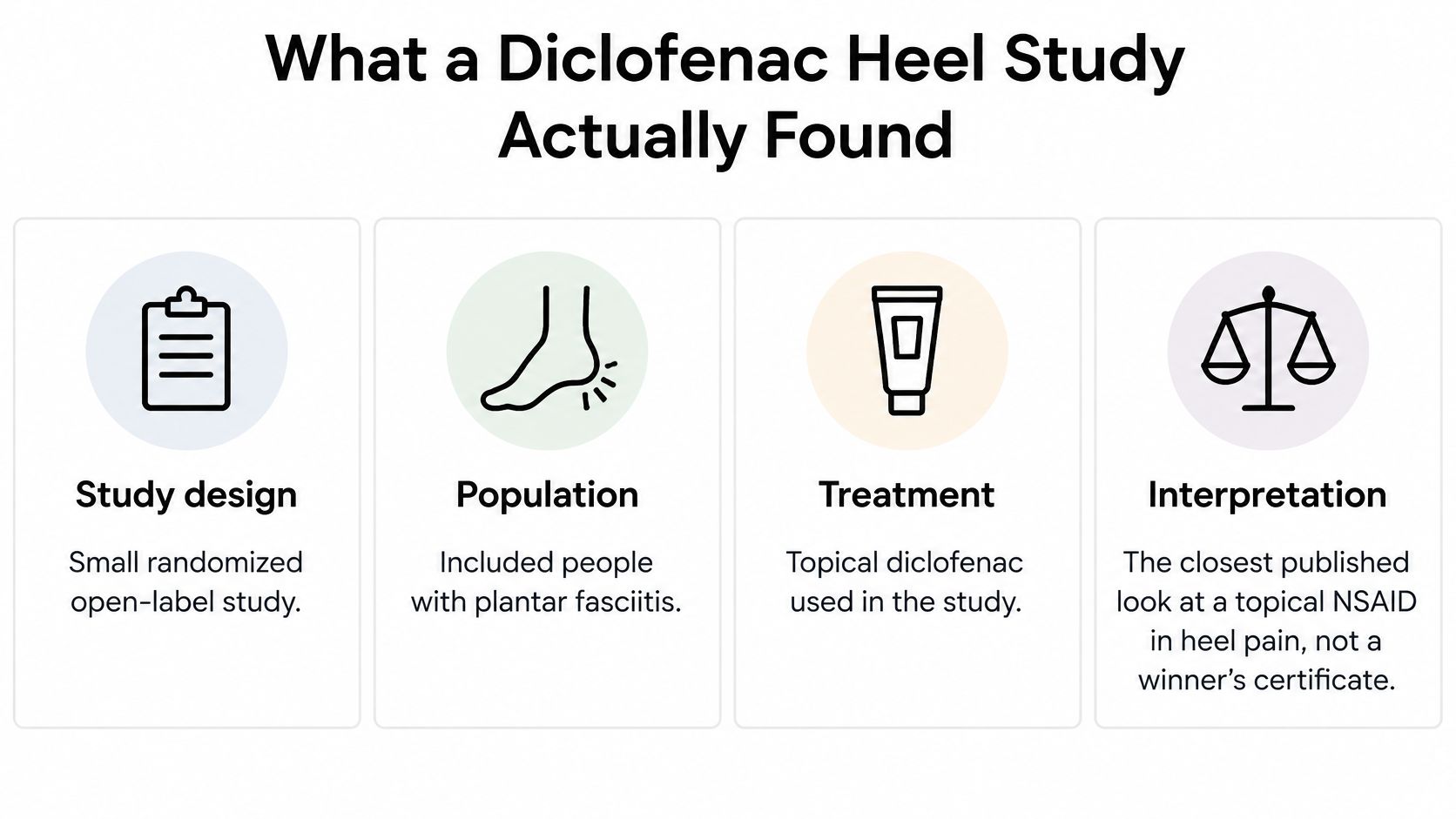
Translate those bands into expectations you can use. A meaningful dent in pain is realistic for about half the people who try it. A large drop is a minority experience. Four in five were satisfied, which says as much about what they expected as about what the gel did.
| Outcome | Result | Limit |
|---|---|---|
| At least a 30 percent pain cut at 4 weeks | 45% to 50% | A meaningful dent for some people, not a guarantee |
| At least a 50 percent pain cut at 4 weeks | 35% to 40% | A large drop is less common |
| Satisfied or very satisfied | 82.5% | Small group, no placebo arm, and not a Canadian trial |
| Reported side effects | Mild | Does not prove a drugstore brand is best or that four weeks heals the fascia |
The limits belong in the same breath as the numbers. The study was small, had no placebo arm, and wasn't Canadian. It cannot tell you that any particular drugstore formulation beats another, and it cannot tell you that four weeks of gel heals a degenerative band. Anyone quoting these percentages as a winner's certificate is overselling the file.
The usable lesson is narrow. If a clinician or pharmacist agrees a topical NSAID suits you, apply it to intact skin exactly as the label says, then look again at first-step pain and walking pain. If those two markers haven't shifted, don't escalate the cream. Pair the numbers with the longer recovery window, where a partial response still counts as a reason to keep stretching, changing footwear and shortening your standing blocks. For the label and drug details behind the class, this guide to topical NSAIDs is a sensible primer.
How to Trial Relief Before the First Steps
The first steps out of bed feel like a bruise under the heel, and by mid-morning the sharpness has faded into a dull ache you can ignore until tomorrow. That morning pattern is the most useful thing you have to measure against.

Stretching does more for the tissue than any cream does. A randomized trial found plantar-fascia stretching produced the greatest improvement among the compared approaches, exceeding analgesics, heat with heel pads, and calf stretching in the study population, as summarized in Veterans Affairs Canada's clinical information on plantar fasciitis. That's the hierarchy to hold in your head while you shop.
Here's the routine worth running for a couple of weeks.
- Wash and dry the heel and arch first. Clean, dry skin absorbs predictably, and you get a clear look at whether the skin is intact. Skip the product entirely if you find a cut or blister.
- Apply the labelled amount and let it dry. A localized counterirritant such as the MEDISTIK Power Stick provides temporary soothing relief of sore muscles and joints associated with strains and sprains, backaches, lumbago, pain of tendons and/or ligaments, and arthritic or rheumatic pain. It's designed to go on before activity. Don't wrap the foot tightly unless the monograph tells you to.
- Stretch before those first steps, not after. Sit and draw the toes toward the shin until the arch tightens, hold it, then add a gentle calf stretch against a wall. Hold only to a tolerable pull, never to a wince. Two minutes here changes how the morning walk feels.
- Put on supportive shoes instead of walking barefoot on a hard floor. House slippers with a thin, flat sole do nothing for an overloaded arch. If your job means hours on your feet, shorten the first standing block of the day and break the rest into seated intervals where you can.
- Score two things and reassess in a week or two. Write down first-step pain and walking pain on a scale you'll use consistently, like 0 to 10. Improving numbers mean keep the stretches and ease off the product. Flat numbers mean change the plan with a clinician rather than extending the same tube for months.
Notice what the routine doesn't include. There's no instruction to apply more product when the pain is louder, and no suggestion that the cream substitutes for the stretching or the shoe change. The cream has one job: make the next hour tolerable enough that you keep doing the rest. For the wider picture on managing heel pain day to day, this guide to heel pain relief covers the habits that carry the load.
When to Stop the Cream and Who to See
A cream is a short-term comfort tool, not a test that confirms plantar fasciitis. Heel pain can come from other causes, so stop self-treating and get assessed if symptoms begin suddenly after a fall or overload, the heel or ankle is markedly swollen, red or warm, or you cannot bear weight or walk across a room. Numbness, tingling, pain travelling into the toes or up the calf, fever, unexplained weight loss, or pain in other joints also call for medical advice.
Work can contribute to heel strain as well as running. Prolonged standing, walking, lifting and repetitive loading place repeated demands on the foot. A Canadian occupational-health fact sheet on plantar fasciitis reports that plantar fasciitis accounts for almost 15% of all foot-related complaints, that middle-aged adults around 40 to 50 are commonly affected, and that about 65% of affected people are overweight.
If first-step pain returns or remains troublesome after a labelled trial, stretching and shoe changes, book an assessment rather than extending the same treatment or switching to a stronger cream. That response is useful information: it suggests the plan needs review.
Choose a professional based on the question you need answered. A pharmacist can check whether a topical NSAID fits your medicines and health history, including pregnancy, kidney function, ulcer history and allergies. A physiotherapist can guide fascia and calf loading and adjust activity. A podiatrist can assess footwear and orthotics, while a physician can investigate other possible causes.
Cream prices vary by product and retailer. A Familiprix joint and muscle pain listing included an 85 g topical pain-relief cream priced at CAD $16.99. Use cost as one consideration, not as a reason to delay assessment when symptoms persist or warning signs appear.
For intact skin, a counterirritant may offer temporary comfort before a shift or walk. A pharmacist can help determine whether a labelled topical NSAID is suitable instead. MEDISTIK offers a Power Stick for long-lasting, localized pain relief, a Power Spray for fast relief over larger or hard-to-reach areas, and a Daily Defence Roll-On for cooling relief and everyday maintenance. These formats are applied before activity. They do not replace a change in loading or other care when heel pain continues. For practical habits that can support comfort, see this guide to day-to-day heel pain relief.


