

In 2022, 16.7% of Canadians aged 15 and older, approximately 4.9 million people, had a pain-related disability, according to Statistics Canada's Canadian Survey on Disability. That need doesn't establish whether Pain Relief Now spray works: the available evidence doesn't include its label, ingredient list, or DIN or NPN, so its effectiveness and safety can't be rated without verifying the packaging.
Pain Relief Now Spray at a Glance and Why Reviews Mislead
The defensible verdict is “not enough product-specific evidence,” not “recommended” or “ineffective.” Pain Relief Now spray reviews can help identify questions to investigate, but they can't replace a confirmed product identity and readable directions.
The national disability estimate concerns disability associated with pain, not occasional soreness. It establishes the importance of useful pain-management options, but it doesn't establish demand for this particular spray or show that any topical product will improve an individual's condition.
A favourable review describes someone's experience under circumstances that may be missing from the account. Without knowing the formulation, application amount, condition being treated, or other treatments used, you can't confidently attribute the reported improvement to the spray.
Reviewing rule: Treat a testimonial as an observation to investigate, not a result you should expect.
What a buyer should be able to establish
A useful assessment separates the questions that advertising often blends together:
- Label fit: Does the product's authorized indication cover the pain you want to manage?
- Personal suitability: Do its precautions allow use in your circumstances?
- Reported performance: Does independent feedback describe relief and ordinary activities, rather than just an intense sensation?
These questions require different evidence. The packaging establishes ingredients and directions; a pharmacist can help interpret suitability; customer accounts describe perceived performance without establishing causation.
The practical alternative to star ratings is a label-verifiable assessment covering authorization, medicinal ingredients, application design, duration, and tolerability. You don't need to turn that assessment into a clinical trial. You do need to distinguish a missing detail from a confirmed positive finding.
That distinction matters most when a listing looks persuasive. An attractive product page with incomplete labelling remains incomplete evidence.
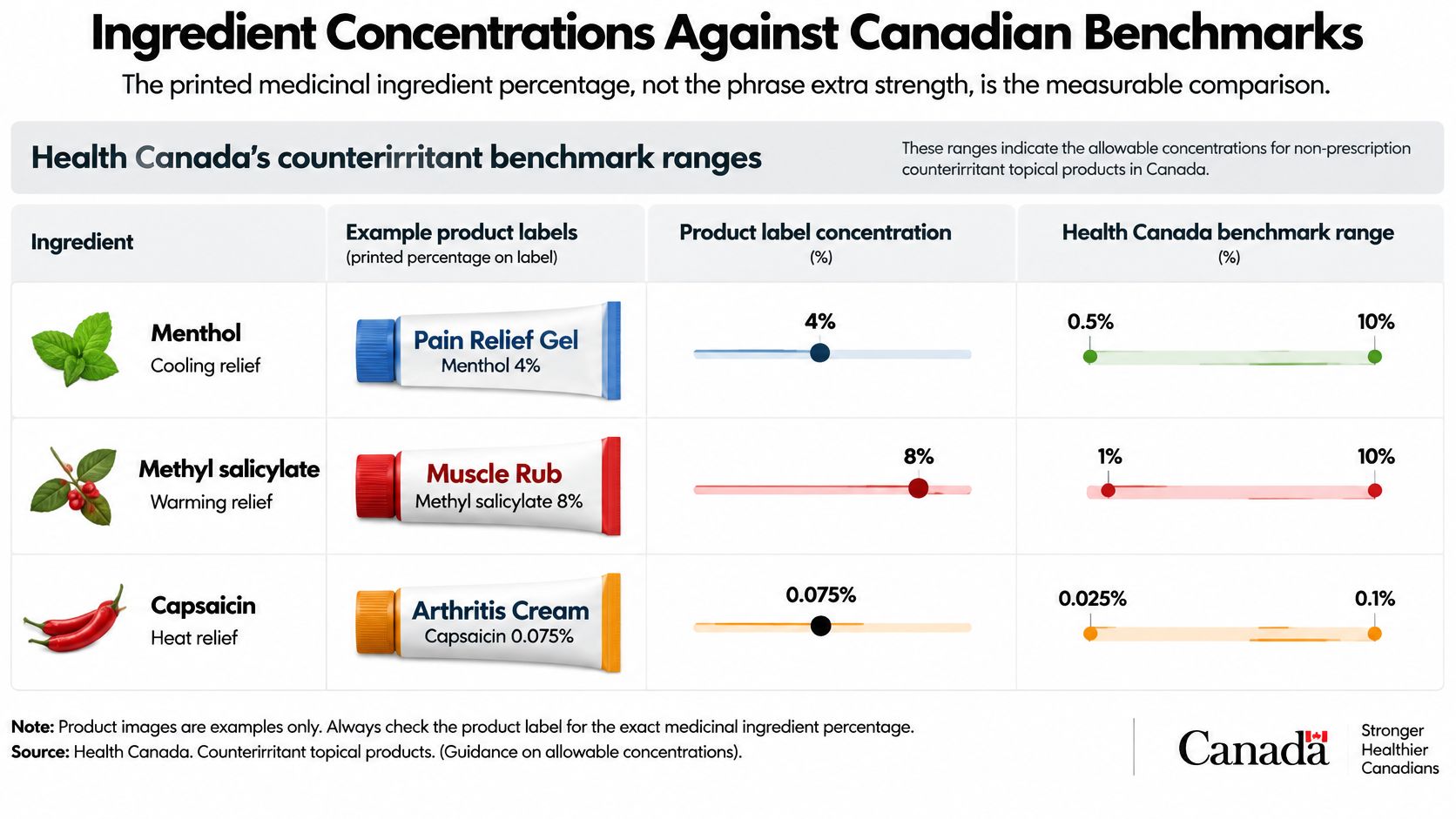
Ingredient Concentrations Against Canadian Benchmarks
Canadian benchmark ranges and reference concentrations
The benchmark column below uses the counterirritant ranges in Health Canada's topical analgesic labelling standard: menthol 1.25–16%, methyl salicylate 10–30%, camphor 3–11%, and capsaicin 0.025–0.25%.
| Active ingredient | Canadian benchmark range | MEDISTIK Power Spray (reference) | Check on the Pain Relief Now label |
|---|---|---|---|
| Menthol | 1.25–16% | 10% | Record the printed percentage |
| Methyl salicylate | 10–30% | 12% | Note whether it's alone or combined with menthol |
| Camphor | 3–11% | Not listed as a medicinal ingredient | Record the printed percentage if present |
| Capsaicin | 0.025–0.25% | Not listed as a medicinal ingredient | Record the printed percentage if present |
| Pain Relief Now spray | Compare each active with its applicable range | Not a reference-product measurement | Record each printed percentage and compare with the ranges |
Our Power Spray contains 12% methyl salicylate and 10% menthol as medicinal ingredients. Both sit within their respective benchmark ranges, but that comparison alone isn't a head-to-head effectiveness result.
The visual below illustrates the comparison approach. Use the cited table's ranges for decisions, rather than any different ranges displayed in the graphic.
Read the medicinal ingredients panel first
The printed percentage is measurable. A description such as extra strength isn't enough to compare formulations because it doesn't identify the active ingredient, its concentration, or the product's authorized use.
Copy the medicinal ingredient names exactly, including their percentages. Compare each ingredient separately with its corresponding benchmark, then record the product's authorization number alongside those findings.
Being inside a benchmark range doesn't prove effectiveness for your pain. Conversely, a percentage outside a listed range warrants clarification about the product's authorization and applicable standard; it isn't, by itself, proof that the product is dangerous or unlawfully sold.
Health Canada's standard recognizes spray formats, including non-pressurized, bag-on-valve, and non-CFC aerosol products, subject to the appropriate authorization. The delivery format therefore belongs in the assessment, but the word spray isn't a regulatory endorsement of a particular bottle.
Keep non-medicinal ingredients separate
Record the non-medicinal panel too, without treating every listed substance as an authorized pain-relieving active. Our Power Spray's non-medicinal ingredients include isopropyl alcohol, water, MSM, Boswellia serrata extract, Ilex paraguariensis leaf extract, glucosamine, and chondroitin.
Those names help identify the formulation and support a discussion about ingredient sensitivities. They don't justify transferring the medicinal ingredient claims to the entire ingredient list.
For combination products, check every active separately. Don't add their percentages together and compare the total with a single ingredient's benchmark. A formulation containing menthol and methyl salicylate must be assessed as that combination, not as though either ingredient describes the whole product.
A Review Scorecard for Application and Labelling
| Criterion | What to verify | Strong review reports | Red flag |
|---|---|---|---|
| Identity | DIN or NPN number | Product name matched to authorization number | Name only, no authorization number |
| Active ingredients | Names and percentages | Each ingredient with its concentration | Vague strength claims |
| Spray mechanism | Pump, aerosol, or bag-on-valve | Direction, droplet control, and ventilation | Instructions to inhale or spray near the face |
| Onset | Time to first perceived relief | Elapsed time across separate permitted applications | Only a cold or hot sensation described |
| Duration | Time until relief fades or reapplication | Experience compared with the label interval | Reapplication beyond the label maximum |
| Tolerability | Burning, redness, swelling, blistering | Any irritation and whether use stopped | Irritation omitted from the account |
Use this as an evidence-completeness scorecard, not a clinical effectiveness score. Mark each field documented, unclear, or missing. Don't award points for stronger sensations or higher concentrations.
A spray with complete documentation may still be unsuitable for an individual. A poorly documented review may describe a genuine benefit, but it leaves you unable to assess what happened.
Build a record you can interpret
Follow this sequence when reviewing the packaging and any use that's otherwise appropriate:
- Confirm identity. Copy the DIN or NPN and exact product name, because similar names don't establish identical formulations.
- Transcribe the actives. Record names and percentages rather than paraphrasing the front label.
- Describe delivery. Note the mechanism, application direction, and control of overspray, since practical usability isn't captured by ingredient concentration.
- Separate onset from sensation. Record when pain first seems reduced across separate label-permitted applications, without applying extra product to complete a log.
- Record persistence and skin response. Note when relief fades, whether reapplication is permitted, and whether irritation occurs.
Our explanation of Health Canada product authorization provides context for the identity check. Authorization should be matched to the actual product rather than inferred from a brand's other products.
A complete review says what was applied, how it was applied, what changed, and what went wrong.
Also record other topical products used on the same occasion. Applying our spray first for fast relief and then the stick for longer-lasting support is a common customer approach, but that practice isn't a recommendation to combine products indiscriminately.
If a reviewer uses both, their account doesn't isolate the spray's contribution. Label compatibility and professional advice take priority over copying another customer's routine. A documented account with those limits is more useful than an unexplained star rating.
Safety Signals to Check Before Every Application
Health Canada's safety review of menthol, methyl salicylate, and capsaicin products identified 29 unique Canadian reports of serious skin burns, including 28 involving use as directed. These reports don't measure the probability of harm, but they show that following directions doesn't eliminate all risk.
The safety-history account describes a later Health Canada communication reporting reactions sometimes appearing 24 to 48 hours after the first application. An uneventful first few minutes therefore isn't a complete tolerability assessment.
The visual summarizes precautions; the cited review concerns capsaicin, not camphor.
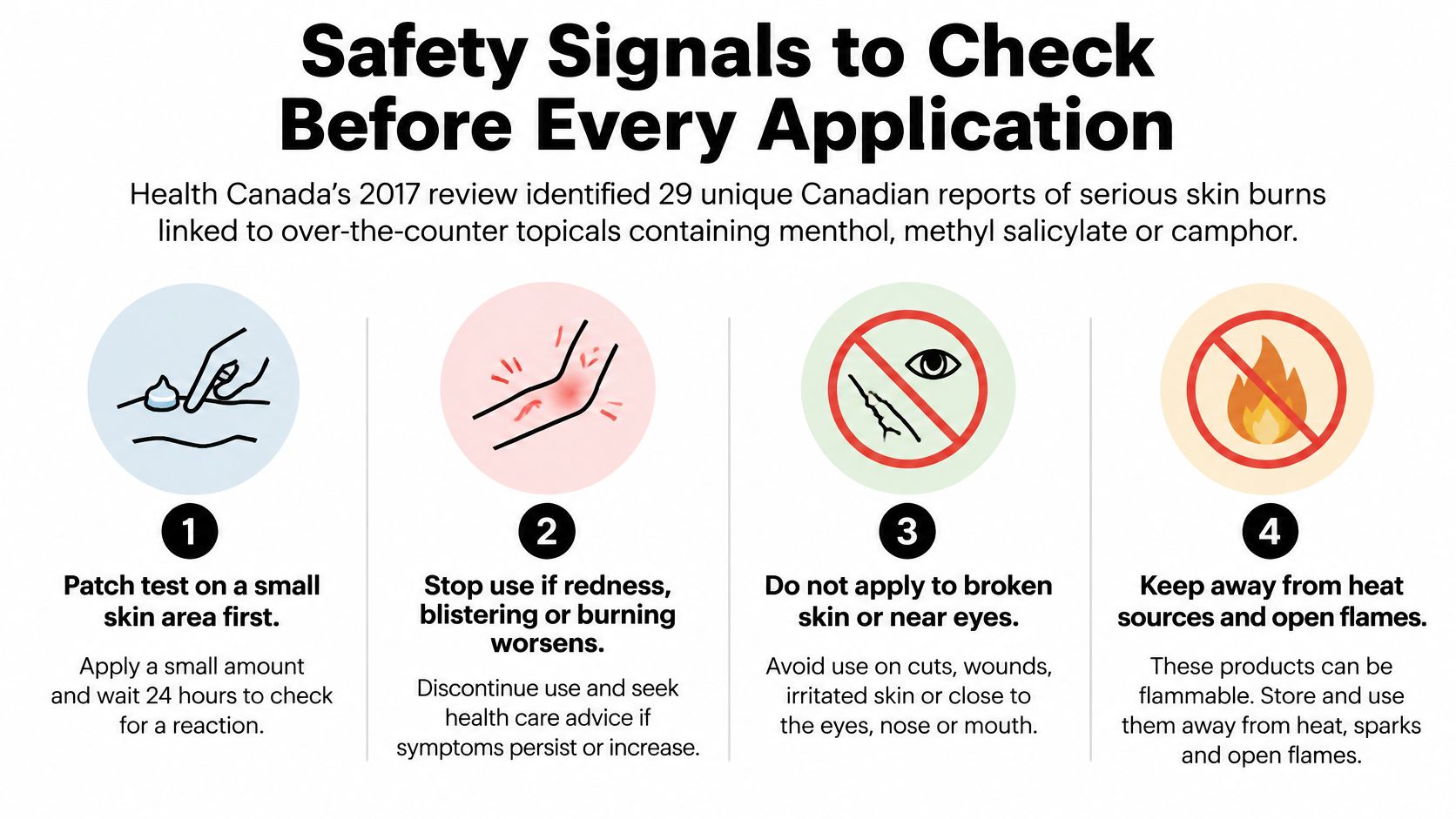
- Use intact skin only. Avoid damaged skin, and don't apply to recently shaved skin while it's irritated.
- Avoid added heat and tight covering unless the label permits them.
- Don't inhale pump spray. Control direction and keep it away from the face.
- Check initial tolerance cautiously. A small-area application, if consistent with the label, cannot rule out a later reaction.
- Stop and seek medical help for severe pain, swelling, or blistering.
Our spray application guide adds practical context. Power Spray directions specify thin, even application, up to a maximum of four times daily as required, including for chronic conditions; don't transfer that frequency to another product.
What Customer Feedback Can and Cannot Prove
Brand-published testimonials are selected accounts, not a representative comparison group. They can illustrate what customers value, but they don't establish how often other purchasers obtain the same result.
Consider these customer statements about our products.
Everyday usefulness versus measured improvement
“This is great, I use it regularly on bad hips and shoulders. With the spray I can live with a little less pain.”
Mayferd
This describes perceived usefulness during everyday life. It doesn't identify a measured change in walking, sleep, activity tolerance, or medication use, and it doesn't establish the cause of the hip or shoulder pain.
“A little less pain” may matter to that person. The analytical limit is that another buyer can't predict their own outcome from the statement.
Speed versus persistence
“Gives almost instant relief”
Barbara C.
This identifies perceived speed as a valued feature. It doesn't tell you how long relief lasted, what amount was applied, or whether the initial experience was mainly cooling.
An onset claim without duration is incomplete for someone choosing a product for a work shift or rehabilitation exercise. It's also not evidence that the underlying problem improved.
Multiple formats versus an isolated spray effect
“I have used each of the stick, roll on and spray at different times and places for arthritis, aching joints and inflammation with immediate and quite long lasting relief.”
James
This account covers several formats and circumstances. It doesn't separate the spray's effect from the stick, roll-on, rest, other treatments, or changes in symptoms.
Our overview of topical pain medications offers context for comparing product types, but no testimonial establishes a diagnosis, long-term benefit, or suitability for every skin type.
When assessing independent Pain Relief Now spray reviews, include accounts from people who discontinued use, not just enthusiastic purchasers. Tally which scorecard fields each account documents, and keep missing information separate from negative findings. Repeated descriptions of practical benefits are worth investigating, but even consistent anecdotes don't establish causation or a reliable response rate.
Which Situations a Spray Suits and Which Need a Clinician
Cooling or warming is a sensory effect. Meaningful pain relief involves a useful change, such as walking more comfortably or completing a necessary task with less pain. Neither sensation nor temporary improvement establishes healing.
Ordinary activities provide more useful review context than temperature descriptions alone.

Use situations and when to get advice first
| Situation | Spray may suit, if label permits | Get advice first when |
|---|---|---|
| Short soreness after training | Yes, on intact skin | Pain persists rather than settling |
| Sprains and strains | Yes, as labelled | Significant swelling or inability to bear weight |
| Chronic joint or back pain | Temporary easing only | Symptoms repeatedly return |
| Burns, blisters, or broken skin | No | A skin reaction develops |
| New or unexplained pain | Not until assessed | Symptoms are new or worsening |
Our Power Spray's recommended use is temporary soothing relief of sore muscles and joints associated with strains and sprains, backaches, lumbago, tendon or ligament pain, and arthritic or rheumatic pain. That indication is a reference for our product, not an indication that can be assigned to Pain Relief Now without its label.
Track function without testing your limits
Say your knee feels cooler after application but stairs remain just as difficult. That's a sensory change without a demonstrated functional benefit. If walking becomes more comfortable, record that specific task, while avoiding the assumption that the joint is ready for harder training.
The muscle pain spray guidance distinguishes temporary relief from treatment of an underlying cause and advises consulting a health professional when symptoms worsen or recur within a few days. Keeping a short activity diary can make that conversation more useful, but it shouldn't delay assessment.
The distinction between acute and chronic pain also matters when interpreting reviews. A person describing post-training soreness isn't necessarily a useful comparison for someone managing recurring arthritis symptoms.
The accompanying video provides additional context, but it doesn't replace the product's directions or an individual assessment.
Match the problem to the appropriate care
A muscle-and-joint spray shouldn't become a general answer to pain anywhere in the body. For a different example of why identifying the cause matters, Eric Wiitala DDS explains when toothache pain needs a dentist. That resource concerns dental assessment, not an additional use for topical muscle products.
For recurring back, neck, knee, or joint symptoms, focus on what you can do comfortably and whether that improvement persists. If symptoms worsen or return within a few days, stop self-treating and consult a health professional, rather than escalating application because the sensation has become less noticeable.
Buy-or-Skip Conditions Before First Use
Consider buying only when the product is identifiable, its formulation is disclosed, and its directions are usable. Independent feedback should add practical detail, not compensate for a missing label.
Make the decision in this order:
- Match the authorization. Search the DIN in Health Canada's Drug Product Database, or the NPN in its Licensed Natural Health Products Database, and check that the entry matches the product.
- Resolve formulation questions. Compare the printed medicinal ingredients with the applicable benchmarks. Ask a pharmacist about unexplained differences rather than declaring a product safe or unsafe from concentration alone.
- Check usable directions. The application method, permitted frequency, and precautions should be readable before purchase.
- Evaluate the remaining uncertainty. Decide whether the independent accounts describe the intended use clearly enough to inform, rather than determine, your choice.
If the percentages are missing or the authorization can't be matched, pause the purchase. You can't make a defensible comparison from a product name and enthusiastic reviews alone.
Format is a separate consideration. Our Power Stick is intended for long-lasting, localized relief; Power Spray for fast relief over larger or hard-to-reach areas; and Daily Defence Roll-On for cooling relief and everyday maintenance. None of those format descriptions establishes suitability for every user.
For broader treatment choices, our discussion of topical versus oral pain relievers can help frame questions for a pharmacist. Choose on identifiable evidence and personal suitability, not the strongest sensation.
MEDISTIK offers spray, stick, and roll-on formats for temporary muscle and joint pain relief. Visit MEDISTIK to compare the available formats, then assess the product you're considering against its ingredients, directions, and your own care needs before buying.


