

Post workout recovery meaning comes down to this: recovery is the set of processes and behaviours that restore your body after exercise so it can adapt, repair and perform again, and it isn't the same thing as feeling sore. The working parts are sleep of seven to nine hours, fluids and carbohydrate after a sweaty session, protein of roughly 0.25 g per kilogram of body weight spread across meals, and enough easy time before the next hard session on the same muscles.
The most popular recovery advice gets that backwards. Fitness feeds treat soreness as the receipt that proves a workout worked, and they reduce recovery to a purchase: a massage gun, an ice bath, a powder. Neither idea survives contact with how the body repairs itself. Soreness is a symptom, not a scoreboard.
That ordering matters most to people without a sports scientist on staff. If you train three times a week around a job, or you're restarting after months away, you need to know what to do first when you have ten minutes and a mediocre night behind you. This guide walks through what recovery covers, what your body is doing hour by hour, the reference numbers for sleep and nutrition, how to read soreness without panicking, and how three very different people would plan a week.
What Post-Workout Recovery Really Means
Recovery has three jobs and they run in parallel. The first is refuelling and rehydrating, replacing the fluid and carbohydrate a session spent. The second is repair and rebuild, the work your muscles and nervous system do to come back at least as capable as before. The third is readiness, keeping enough in reserve that the next session is a training session rather than a survival exercise.
Think of a pit crew. The lap is the workout; the crew work between laps is what lets the car run the next one at the same speed instead of limping in. Nobody judges a race team by how dramatic the pit stop looked. They judge it by whether the car got out in front again.
The Public Health Agency of Canada guidance frames recovery the same way: restoring the body so it can adapt, repair and safely perform again, rather than eliminating soreness. Its activity targets make recovery foundational rather than optional: at least 150 minutes of moderate-to-vigorous activity each week for adults aged 18 to 64, plus muscle- and bone-strengthening work at least twice weekly. Only 46% of Canadian adults met that recommended level of at least 150 minutes per week in 2022 to 2024, Statistics Canada reported in 2025, which suggests Canadians are fitting training into a crowded week rather than living like professionals.
What it looks like across a normal week
Say you lift Monday and Thursday. A sensible week alternates muscle groups so Thursday isn't asking Monday's muscles to repeat identical work. It slots an easy walk or a mobility session into the gap. It protects bedtime on Sunday and Wednesday so both sessions start from a full tank.
The boundary to hold onto: recovery is never permission to train through sharp, worsening or persistent pain. That kind of pain isn't a recovery problem, it's a signal to get a clinical assessment before your next session.
What Happens in Your Body After Training
Recovery isn't a single event that happens after training. It's a sequence, and each stage responds to a different action. Miss the early stage and the later ones cost you more.
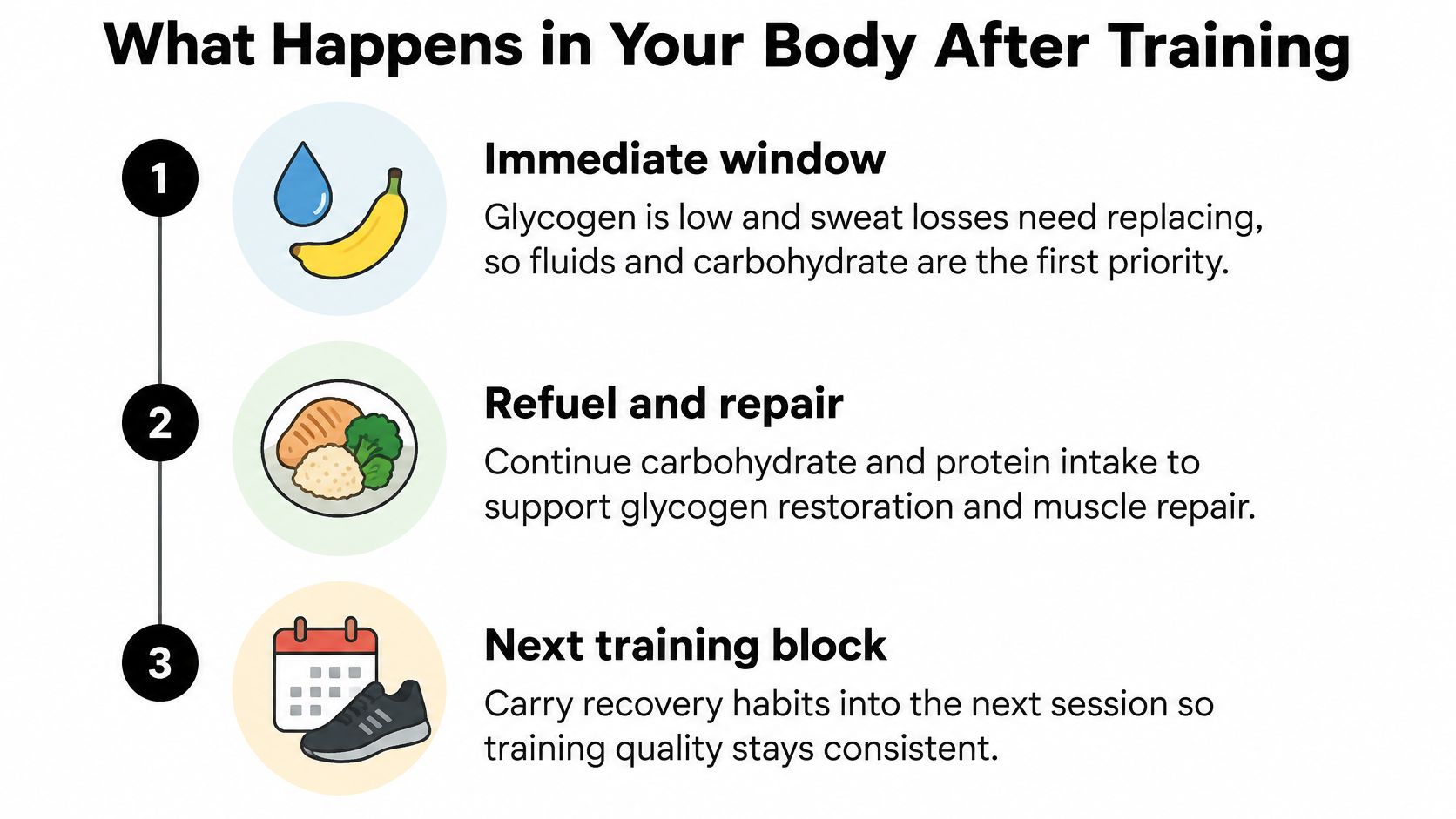
Here's the sequence laid out in order, from the minute you stop to the days that follow.
The first hour
Glycogen, the stored carbohydrate your muscles burn during hard work, sits low when you finish, and sweat has taken fluid with it. The first job is boring and effective: drink, and eat something carbohydrate-rich. Water and a banana, a sports drink, or a bowl of cereal all do the same thing.
The next eight hours
When another demanding session is close, what you eat now matters more than anything you eat tomorrow. Carbohydrate supplies the raw material for glycogen resynthesis, and protein switches on muscle-protein synthesis. That's why the pair travel together in every credible recovery recommendation. Wait until dinner and you've spent half the window doing nothing.
Overnight
Sleep carries most of the nervous-system and tissue recovery. Tissue repair and the consolidation of the coordination you just practised happen while you're unconscious. A five-hour night undoes a surprising amount of what the afternoon paid for.
The next one to three days
Repair keeps going. Strength and range of motion return gradually, and feeling better isn't the same as being rebuilt. This is the stretch where people stack a second hard session too early because the ache faded. That ache has its own clock, separate from the repair itself, which is why delayed onset muscle soreness is worth understanding on its own terms.
Think of charging a phone overnight. The charge starts the moment you plug it in, but you don't unplug it after ten minutes and expect a full battery. If you'd rather watch the sequence explained, this short walkthrough covers it.
Use the timeline rather than memorising it. Find where your next session falls, pick the matching row, and do that one thing.
| Phase | Timing | What the body is doing | What helps |
|---|---|---|---|
| Immediately after | Minutes to about 2 hours | Glycogen is low and sweat losses need replacing | Fluids and a carbohydrate-rich snack |
| Early recovery | Within 8 hours | Glycogen refilling and muscle repair start when fuel is available | Carbohydrate and protein meal if the next session is close |
| Overnight | 7 to 9 hours of sleep | Nervous-system and tissue recovery carry on while you sleep | Consistent bedtime and a dark, cool room |
| Next 1 to 3 days | 24 to 72 hours | Repair continues and strength returns gradually | Gentle movement, lower intensity and steady protein intake |
Sleep, Fluids and Nutrition Targets
Recovery means having the capacity to train again, not chasing soreness away. When time is short, prioritize sleep first, then match food and fluids to the demands of your next session. The table gives useful reference points, not targets everyone needs to hit every day.
| Pillar | Reference value | When it applies | Basis |
|---|---|---|---|
| Sleep | 7 to 9 hours per night (the American College of Sports Medicine advises at least 8) | Every night, and more after heavy training weeks | Federal guidance for adults and ACSM |
| Carbohydrate | About 1.2 g per kg right after exercise, repeated over 4 to 6 hours | Two or more hard sessions in one day, or competition | Canadian Sport Institute Pacific |
| Protein | About 0.25 g per kg in frequent meals over 8 to 24 hours | Daily training and muscle-building goals | Recovery nutrition evidence reviewed on PubMed |
| Fluids | About 1.5 litres of fluid for each kilogram of body weight lost during the session | Any session with notable sweating | Canadian Sport Institute Pacific |
| Meal timing | Within 30 to 90 minutes after exercise | When the next session is within about 8 hours | Canadian Sport Institute Pacific |
Sleep is the first priority because tiredness can make the rest of your routine harder to sustain. Adults should aim for seven to nine hours; training demands may affect how much rest you need. Carbohydrate targets become more specific when another hard session is coming soon. The recovery nutrition evidence reviewed on PubMed supports taking in carbohydrate and protein soon after exercise to begin replenishing glycogen and supporting muscle-protein synthesis.
Run the numbers once for your own body
For a 75 kg athlete with another demanding session later that day, roughly 1.2 g per kg of carbohydrate works out to about 90 g in the first recovery feeding. Protein at 0.25 g per kg is roughly 19 g alongside it. These figures are useful benchmarks for a compressed schedule, not daily quotas.
On a day without another session, overall food intake and a complete meal matter more than hitting an exact post-workout window. Timing matters most when the next session is close. For a practical approach to pair lifestyle changes with blood testing, consider how hydration, nutrition and sleep fit together rather than treating each as a separate fix.
Fluids depend on how much you sweat. If you weigh yourself before and after a sweaty session, replace roughly 1.5 litres for every kilogram lost. For everyday hydration, urine colour can be a simple check: pale straw generally suggests you are hydrated, while dark amber is a cue to drink.
Supplements come after the basics. First consider what your usual meals already provide, then use this guide to judging an athlete recovery supplement to assess whether a product addresses a genuine gap. Recovery is about restoring your ability to train, not proving that you feel no soreness.
Tracking Recovery Trends and Adjusting Load
One bad night tells you very little. A week of them tells you a lot. The Canadian Sport for Life review of sleep and recovery reported that athletes in a medical-review sample slept between 4.5 and 10.5 hours per night, averaging 7.8 hours, and it links cumulative sleep debt with poorer mood, concentration, motivation, endurance and recovery, which raises the risk of under-recovery.
That spread is the point. A fixed prescription doesn't fit everyone, and sleep need shifts with training load, perceived need and how you respond. What doesn't shift is the value of writing things down.
The five-line log
Keep it short enough that you'll keep it.
- Sleep duration and quality: hours slept, plus a one-to-five rating for how rested you feel.
- Next-day soreness: rate the sorest area out of ten, in the same way each morning.
- Effort at a standard workload: how hard the usual session felt, not how hard you pushed.
- Motivation: whether you wanted to train, before you talked yourself into or out of it.
- One repeated performance task: the same lift, the same set distance, the same number of stairs.
When three or more of those move the wrong way in the same week, cut intensity or volume for several days instead of pushing through the dip.
Why the cluster matters more than any single reading
Shorter or broken sleep, higher effort at a load that used to feel routine, falling output and soreness that lingers: together, that cluster signals incomplete recovery and supports backing off. Separately, each one is noise. A coach, a clinic or a workplace wellness lead can read the same log and reach the same conclusion.
One caution sits on top of all of it. A topical product that makes a joint or muscle feel comfortable, or a warm bath that loosens it, doesn't prove the tissue underneath has regained its capacity. Judge readiness by function and load tolerance: can you do the movement, at the load, with the same control as last week? Comfort is not the same measurement.
Reading Soreness and Warning Signs
Soreness is the least reliable measure of recovery people use most often. It arrives late, it varies with how novel the session was, and it can be completely absent after a hard effort. The Cleveland Clinic's explanation of delayed-onset muscle soreness puts the timeline plainly: it commonly begins 12 to 24 hours after unfamiliar or intense exercise, peaks around 24 to 72 hours, and usually resolves within 3 to 5 days.
Here's the part that surprises people. The American College of Sports Medicine notes that soreness is not essential for an effective recovery routine. You can recover adequately without becoming sore. A session that leaves you walking normally the next morning wasn't wasted, and a session that leaves you unable to sit down wasn't automatically superior.
The functional test beats the pain rating
Before you decide how hard to train, check function rather than sensation. If balance, technique, strength or range of motion is still impaired, reduce intensity or train a different body region. That's a more honest answer than deciding to push through because the ache is "only a six out of ten".
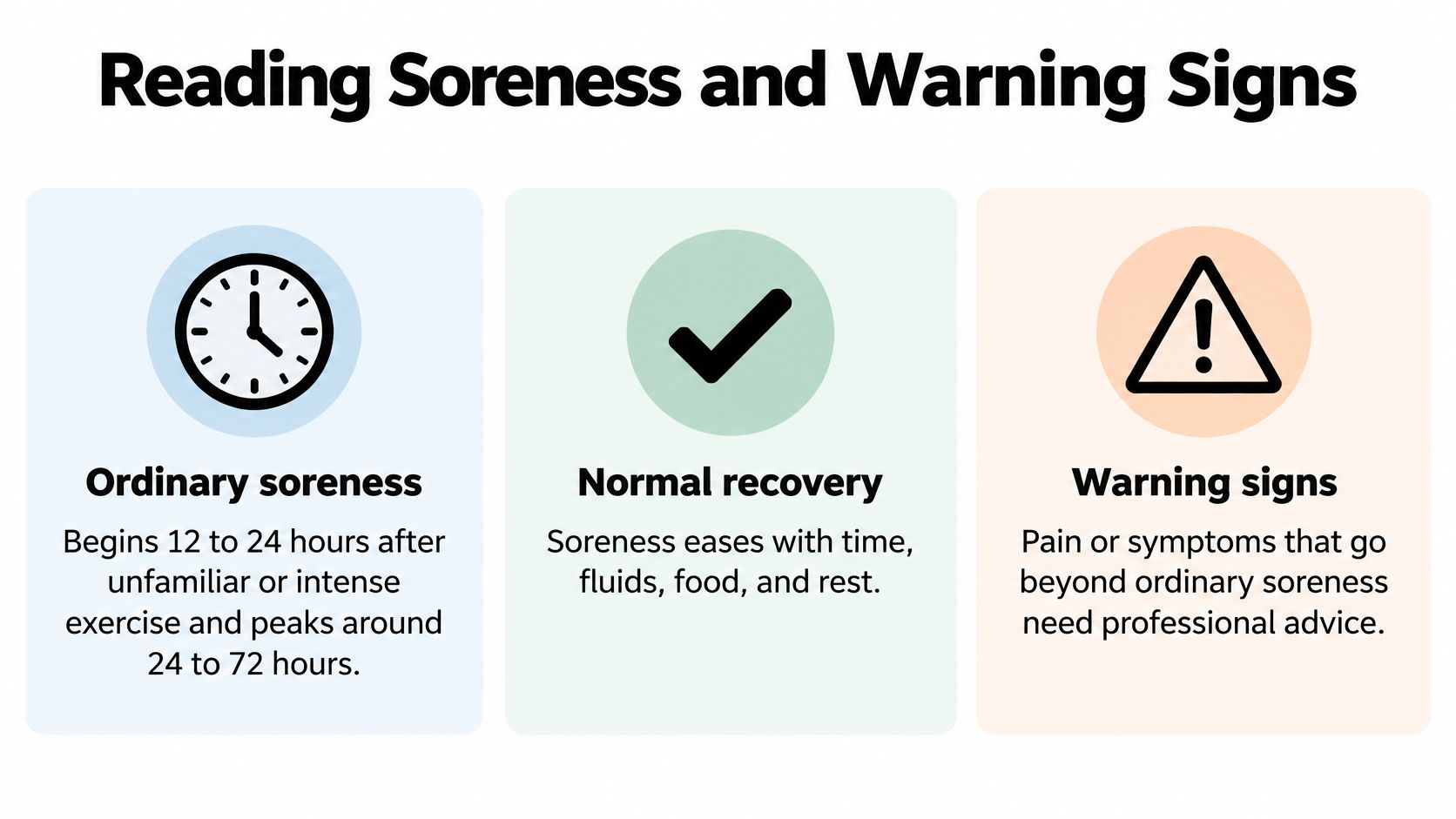
Use this as a lookup when something feels off.
| Signal | Usually means | What to do |
|---|---|---|
| Dull, widespread ache starting 12 to 24 hours after a new or hard session | Ordinary delayed-onset soreness | Keep moving gently, lower intensity and sleep well |
| Sharp, stabbing or joint-specific pain | Possible injury | Stop loading the area and get it assessed |
| Bruising, swelling or a visible deformity | Possible tissue damage | Get a medical assessment before training the area |
| Soreness lasting longer than 7 days | Incomplete recovery or injury | Book a clinical review before returning to full load |
| Lost strength, balance or range of motion | Recovery is incomplete | Reduce intensity or train a different body region |
What actually helps ordinary soreness
Gentle movement, a lower-intensity session, and a solid night's sleep do most of the work. Cooling or massage can make you more comfortable if you like them, and there's no harm in that. Just don't mistake temporary comfort for rebuilt tissue.
Sharp pain that worsens rather than settles, or soreness that drags past a week, is your cue to stop guessing. If you're unsure whether you're dealing with a strain or something worse, the difference between a torn muscle and a pulled muscle is worth ten minutes before you decide to train on it.
Practical rule: sharp, worsening or persistent pain gets a clinical assessment before the next session, not after it.
Recovery Plans for Three Real Situations
The principles don't change with the person. The order of operations does. Here's how three different weeks would run.

The athlete with two hard sessions in one day. The first move is a carbohydrate-rich drink and a full meal within the hour, not a stretching routine and not an ice bath. They keep topping up carbohydrate through the afternoon instead of waiting for dinner, and they treat bedtime as part of the programme rather than the reward for finishing it. What they skip is the search for a single recovery gadget that promises to replace the food and the sleep.
The office worker restarting after six months away. Sleep of seven to nine hours becomes the first priority, because it's the lever with the largest effect and the one most damaged by a busy month. The day after a session they do fifteen easy minutes rather than another hard one, and they rotate muscle groups so nothing gets loaded twice in a row. Soreness arrives the next morning and eases as they keep moving. They write it down, which is how they notice that the week they slept badly was the week everything felt heavy.
The warehouse worker on night shifts. Five or six hours of broken daytime sleep and a physical job is a genuine recovery problem, not a discipline problem. The plan protects one uninterrupted daytime sleep block, keeps water going through the shift, and downgrades a planned heavy session to a moderate one until the trend improves. What they skip is adding more training to fix feeling flat.
All three do the same three things in the same order: put fluid and food back, protect sleep, adjust load. Everything else is a supporting act.
Build Your Recovery Routine This Week
Recovery means restoring your capacity to train again, not erasing every ache. When time, equipment or sleep is limited, prioritize fluids and food first, sleep second, training load third, and tools last. Cooling, massage and topical products may ease discomfort, but they do not replace the basics.
The American College of Sports Medicine's guidance on recovery points to two useful anchors: at least eight hours of sleep nightly and at least 48 hours between higher-intensity sessions that work the same muscle groups. A practical routine turns those anchors into repeatable habits:
- Log two things each morning for seven days: hours slept and next-day soreness out of ten. The trend is more useful than any single rating.
- Set a post-session default: have water and a carbohydrate-and-protein snack within the first hour, rather than waiting until dinner.
- Space hard sessions for the same muscles. Choose a lighter day between them, and leave at least 48 hours between higher-intensity work on the same groups.
- Review the pattern after seven days. If warning signs appear, reduce training load instead of adding another recovery product.
Active recovery can help clear lactate, but research does not show that it clearly outperforms stretching, massage or extra sleep for restoring performance. Gentle movement is a reasonable option if it feels comfortable and helps you stay consistent. It is not a shortcut around sleep, food or sensible spacing between hard sessions.
Keep tracking for a month before judging whether the routine is working. Soreness alone does not tell you whether you are ready to train; sharp or persistent pain is a reason to get checked, not to push harder. For practical ways to reduce post-workout soreness, see how to prevent muscle soreness after a workout.
Post-workout recovery has two distinct aims: restoring capacity and managing discomfort. MEDISTIK's non-prescription topical pain relief system is designed to deliver targeted relief where pain occurs, without pills, injections or greasy creams. That places it among the symptom-relief tools, not ahead of sleep, nutrition or load management. The Prep & Recover Roll-On contains menthol and camphor. Use a topical product for temporary comfort, while keeping the habits that support recovery in place. You can compare MEDISTIK's stick, spray and roll-on formats at MEDISTIK.


