

150 minutes of moderate-to-vigorous activity weekly is the eventual target in Arthritis Canada's osteoarthritis guidance, reached gradually rather than all at once. That reframes natural knee pain relief: the foundation isn't a supplement or a stronger cooling sensation. It's building a manageable movement routine that helps you do more with less discomfort.
That doesn't mean pushing through every painful step. Most evidence concerns knee osteoarthritis, not every possible cause of knee pain, and even well-supported treatment usually produces modest average improvements. A useful plan separates long-term rehabilitation from temporary comfort, gives each option a fair trial, and sets clear reasons to get assessed.
Natural Knee Pain Options Ranked by Evidence
| Option | Evidence strength | Expected benefit | Best suited for |
|---|---|---|---|
| Exercise and strengthening | Strong | Small to moderate gains in pain and function | Most adults with knee osteoarthritis |
| Weight management | Strong when excess weight is present | Lower mechanical load on the knee | Adults with excess body weight |
| Heat or cold | Limited to moderate for comfort, not disease modification | Short-term comfort during flares | Stiffness and acute swelling |
| Manual therapy | Mixed | Temporary pain relief for some people | Those who respond to hands-on care |
| Topical products | Limited to moderate, depending on the ingredient and condition | Short-term relief of sore muscles and joints | Localised soreness |
| Supplements | Weak | Little or no reliable symptom relief for knee osteoarthritis | Few cases, if any |
| Activity changes | Practical, not heavily studied as a standalone treatment | Fewer flare triggers | Anyone with recurring flares |
Read this as a priority guide, not a set of equal alternatives. Exercise develops capacity; weight management can reduce load when relevant. Comfort measures may make daily life easier, but they don't replace either.
The table's evidence labels are broad summaries, not formal grades for every product or technique. In particular, a category such as topical products contains different ingredients with different effects. A cooling feeling alone doesn't establish that a treatment improves knee osteoarthritis.
Put function ahead of the natural label
Natural doesn't automatically mean safe, effective, or curative. A topical analgesic still contains active ingredients, and an herbal supplement can still interact with medication. None of these options should be presented as rebuilding a damaged joint.
Population surveillance helps explain why function matters. The CDC's state-level arthritis surveillance report documents arthritis-related activity limitations and quality-of-life burdens, including in California; it doesn't establish that a particular home remedy works.
Choose a practical outcome before starting treatment: getting out of a chair, walking to the shops, or climbing your home stairs. A remedy that feels pleasant but doesn't help your chosen task may not deserve continued time or expense.
Give comfort measures a stop rule
Use comfort treatments to support movement, not to conceal worsening symptoms.
- Heat for stiffness: Try gentle warmth through a cloth barrier before comfortable movement. Stop if the skin becomes irritated or the knee feels more swollen; don't apply heat to an already hot joint.
- Cold for a flare: Wrap the pack rather than placing it directly on skin. Check the skin frequently and remove it if you develop burning, marked numbness, or colour changes.
- Hands-on care: Judge massage or mobilisation by whether you move more comfortably afterwards. If the benefit never carries over into daily activity or exercise, reconsider repeated appointments.
- Activity adjustments: Change a recognisable trigger, such as repeated deep bending, then reassess that task. Avoid changing everything at once, which makes it hard to identify what helped.
Don't sleep with a heating pad or cold pack in place. If you have reduced sensation or circulation problems, get individual advice before using either.
For a broader discussion of supportive habits, our guide to reducing inflammation naturally can help you distinguish everyday self-management from treatment claims.
Keep topicals and supplements in perspective
Trial a topical against a specific task, using the label's application instructions and treatment limits. Stop for skin irritation or lack of useful benefit, and don't combine it with heating pads, tight coverings, or other products on the same area unless the label permits this.
Our MEDISTIK non-prescription topical pain relief system is designed to deliver fast, targeted relief where pain occurs, without pills, injections, or greasy creams. Depending on the product, we use clinically recognized topical pain-relief ingredients such as methyl salicylate, menthol, and camphor. That's symptom support, not a replacement for diagnosis or strengthening.
Alberta's patient guidance on osteoarthritis describes uncertain benefit from glucosamine and chondroitin, notes that turmeric is still being studied, and explains that massage or acupuncture may help some people but may be no better than placebo. Supplements therefore belong last, not at the centre of the plan. Before trying one, ask a pharmacist about interactions, especially if you take blood thinners.
How to Build an Exercise Routine for Knee Pain
Exercise has some of the strongest support among non-drug options, but the expected improvement needs honest framing. A Cochrane review summarised by American Family Physician found that, across 30 trials comparing exercise with attention control or placebo, pain improved by 8.7 points and function by 11.3 points.
Those are average changes on study outcome scales, not a promise that your pain will fall by a particular percentage. The practical question is whether a routine makes meaningful activities easier without causing progressively worse symptoms.
Before starting, use this boundary:
Practical rule: Mild, temporary soreness can be compatible with exercise. New swelling, locking, giving way, or progressively worsening pain calls for a change of plan, not greater effort.
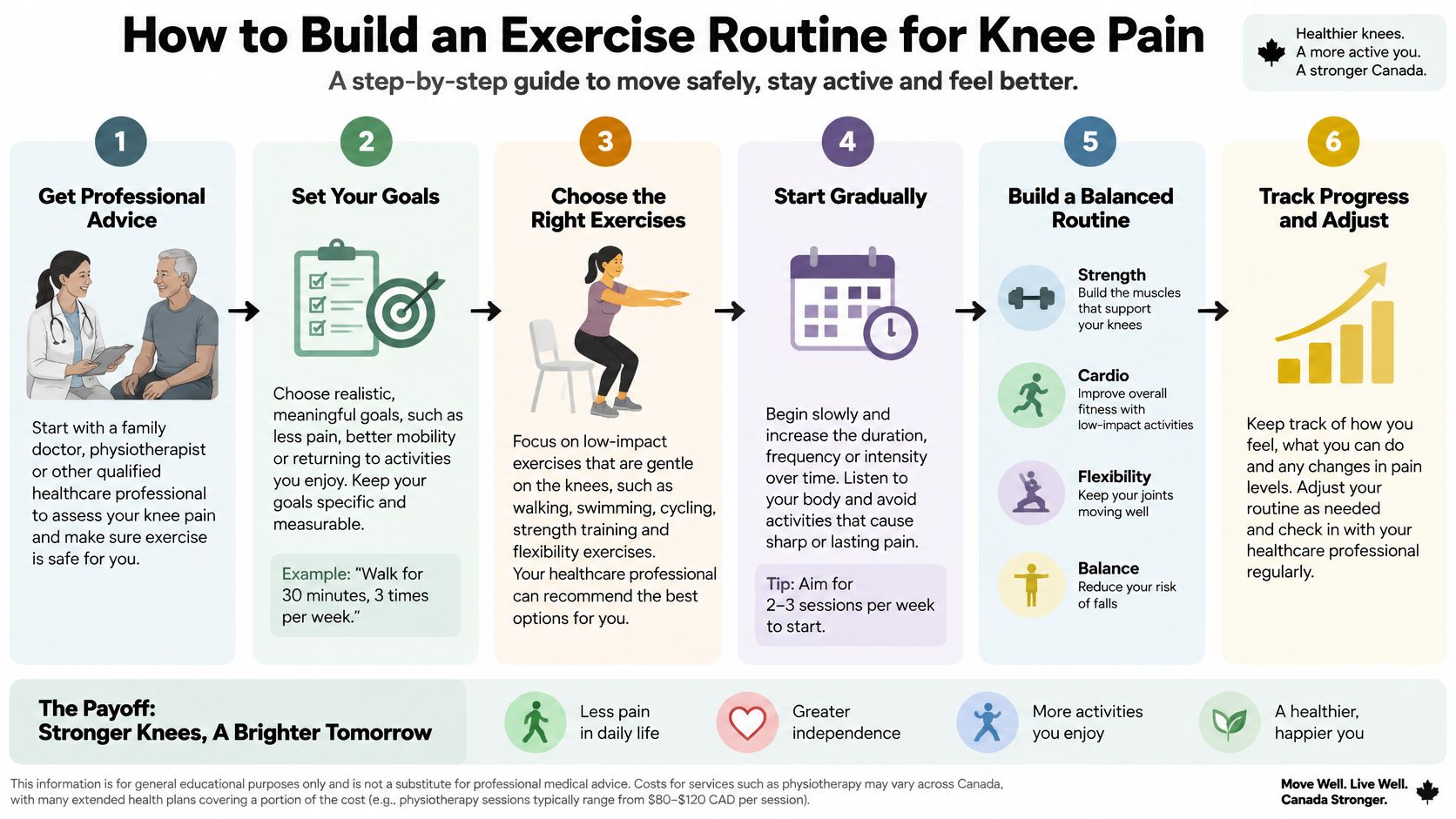
The visual guide outlines the main decisions in a gradual routine.
Build a routine you can repeat
- Begin with comfortable movement. Sitting or lying down, gently bend and straighten your knee without forcing the end position. The common mistake is treating range-of-motion work as a contest to achieve a deeper bend.
- Choose manageable aerobic activity. Try level walking, stationary cycling, or an elliptical if it feels comfortable. Finish while your movement is still controlled rather than continuing until you limp.
- Strengthen the supporting muscles. Sit-to-stand from a firm chair, shallow supported squats, band knee extensions, and standing hamstring curls are possible starting exercises. Choose movements you can perform smoothly, and have a physiotherapist tailor resistance and frequency rather than copying someone else's programme.
- Use water when land exercise is difficult. Aquatic exercise offers another way to practise movement and conditioning. It's an alternative route, not a sign that rehabilitation has failed.
- Progress gradually. Add duration, resistance, or difficulty separately so you can judge the response. Increasing all of them together makes a flare harder to explain and the next session harder to plan.
- Check the response afterwards. Notice whether walking, swelling, sleep, and your usual tasks are better, unchanged, or worse. If the knee remains more irritable at the next planned session, reduce the challenge and seek advice if this keeps happening.
Make technique serve the goal
For sit-to-stand, use a chair that lets you rise without dropping heavily back into the seat. Move your feet to a comfortable position, lean forward slightly, and use your hands for support if needed.
With cycling, start with light resistance and a seat position that avoids an uncomfortable deep bend. A harder setting isn't automatically a better knee exercise.
Our guide to exercises for knee arthritis offers movement options to discuss with your physiotherapist. Choose a small, repeatable selection rather than collecting exercises you can't consistently complete.
Use the demonstration below as a movement reference, not a substitute for individual assessment.
How Body Weight and Daily Load Change Knee Pain
Carrying groceries upstairs increases the work your knees do: they support your body and the bags as you climb. Lighter loads, a handrail, or fewer trips can make the same task easier without changing your body weight.
Body weight is one part of the mechanical picture, not a complete explanation for knee pain. Weight reduction may help some people, but it does not guarantee symptom relief. A sustainable approach to weight management can complement activity and strengthening when excess weight is present. Avoid crash dieting or delaying rehabilitation until you reach a target weight.
Separate body weight from activity load
Everyday activity can be adjusted independently of body weight. The ACOEM knee-disorders guideline includes conservative care options such as temporary use of cold. Cold may ease discomfort, but it does not replace rehabilitation or assessment of persistent swelling and mechanical symptoms.
For another perspective, read about clinical evidence on weight and joints. Use general information to support a conversation with your clinician, not as an individual weight-loss prescription.
Change the demands of everyday tasks
Small adjustments can make routine activities more manageable:
- Break up walking: Choose shorter, comfortable routes and pause before fatigue changes your stride.
- Adapt stairs: Use the handrail and take one step at a time if that feels steadier.
- Raise the seat: A firm, higher chair may make standing easier than a low sofa.
- Reduce carrying demands: Divide shopping into lighter loads and keep a hand free for balance when needed.
- Modify running conditions: Choose even ground when symptoms are irritable and reduce aggravating hills or uneven terrain.
If a long shopping trip leaves you limping, try a shorter visit with lighter bags. This tests whether the amount or context of activity is driving symptoms, rather than treating all walking as harmful.
Runners can use this guide to runner's knee recovery to organise questions about training demands and returning to activity.
Reduce the task enough to keep movement controlled. Temporary pain relief should not be a reason to repeat a load your knee is not tolerating.
Mild soreness may call for adjusting the task. A hot or substantially swollen joint calls for stopping the provoking activity and seeking clinical assessment.
Flare-Ups, Warning Signs and When to See a Clinician
Expected exercise soreness and a warning sign aren't the same thing. Mild discomfort that settles and leaves your everyday movement intact is different from a knee that becomes increasingly swollen, unstable, or difficult to straighten.
Ontario Health's osteoarthritis quality standard supports individualised care based on goals, preferences, other health conditions, access, and progress. It also makes an important distinction: weight is not a prerequisite for exercise or other care.
Decide how urgently you need help
Don't wait for a planned review if you develop concerning symptoms.
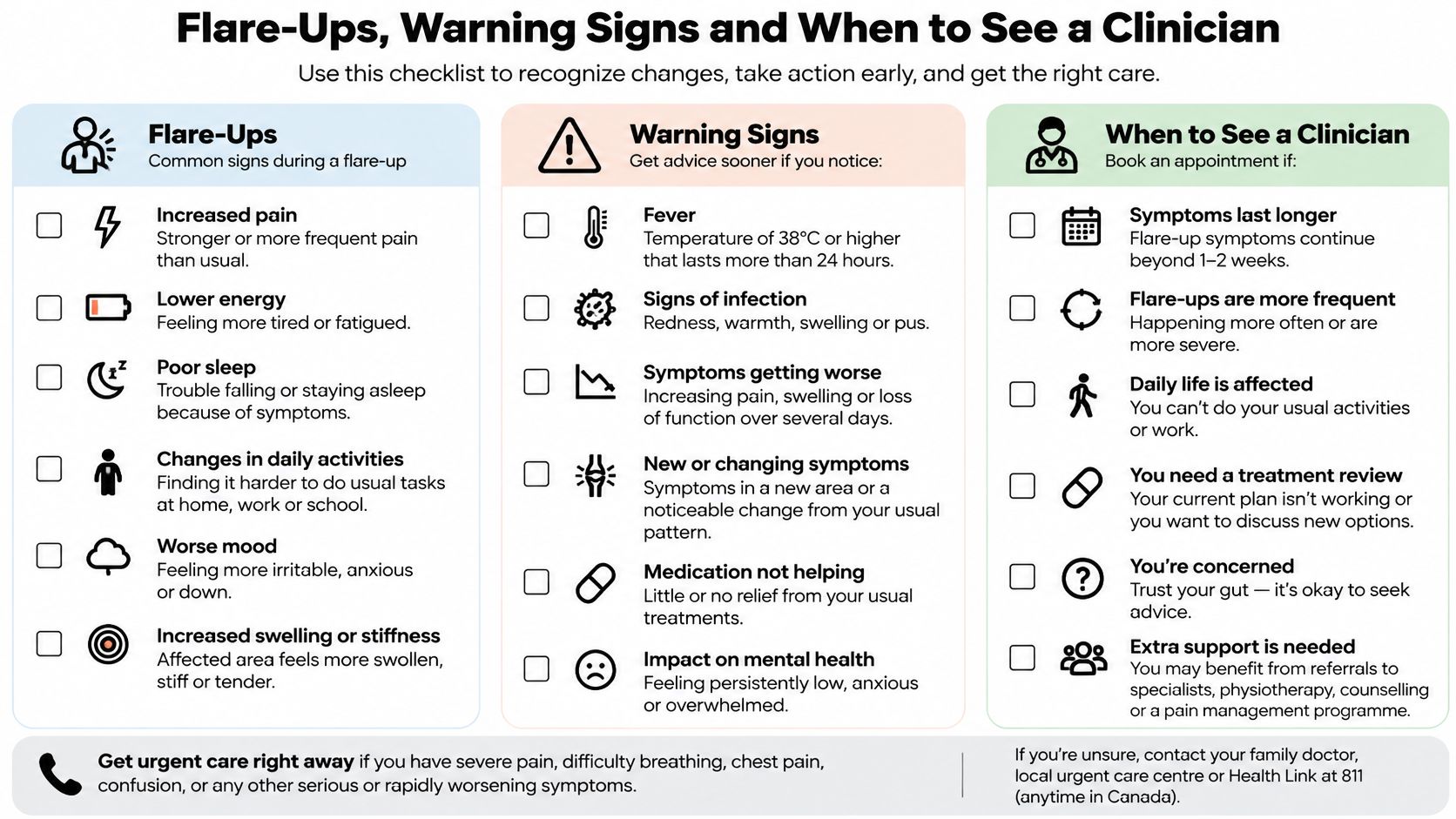
- Seek urgent assessment: A hot, red, swollen knee with fever or feeling unwell, a new deformity, or inability to bear weight needs prompt medical attention.
- Arrange prompt review: Repeated giving way, persistent catching or locking, or substantial new swelling needs an examination. A knee that is physically stuck is different from a painless click.
- Book an earlier appointment: Pain that repeatedly wakes you, steadily declining walking tolerance, or worsening symptoms despite reducing the provoking activity should interrupt the self-care trial.
- Reassess the routine: If each session leaves you less able to manage normal tasks, the current exercise dose or diagnosis needs review.
These are decision prompts, not diagnoses. For example, warmth alone doesn't tell you whether the cause is an arthritis flare, an injury, or something requiring urgent treatment.
Use the checklist as a reminder when symptoms change.
Put an actual review date in your calendar
A self-care plan needs an endpoint for judging progress. Choose a six-week review as a personal planning checkpoint, not a medical waiting rule, and write the date in your calendar when you start. Your clinician may recommend an earlier review based on your symptoms.
At that checkpoint, compare the same daily activities rather than relying only on whether today happens to be a good day. If there's no useful improvement, book a clinical review instead of indefinitely adding remedies.
During a flare, substitute a shallower chair-rise for a deep squat, easier level movement for repeated stairs, or tolerable cycling for running. Keep comfortable movement where possible, but stop testing an activity that produces sharp pain or instability.
Stop point: A calendar deadline never overrides a new warning sign.
A clinician can examine the joint, review medications and supplements, and decide whether imaging or referral would change management. Bring a description of what changed and which activities now provoke symptoms.
Our guide to knee joint pain and swelling can help you organise those observations, but it shouldn't delay urgent care.
Questions to Ask Your Clinician
Arrive with your main goal, a medication and supplement list, and a short description of the symptom pattern. Include any injury, visible swelling, sleep disturbance, and tasks you've stopped doing.
A useful appointment should leave you with more than an exercise handout. You need a working explanation, a manageable starting dose, and clear instructions for what to do if the knee reacts badly.
Bring questions that lead to decisions
- Is this mainly osteoarthritis, or could something else explain the pain? Ask whether exercise is appropriate now and what findings support the working diagnosis.
- Which exercises should I begin with, and how often? A useful answer names the movement, resistance, frequency, and a simpler substitute if it hurts.
- Could my medicines or supplements interact with a topical or turmeric? Bring the actual containers or ingredient lists so the clinician or pharmacist can check specific products.
- Would imaging or a specialist referral change treatment? Ask what question the test would answer and which symptoms would make further investigation necessary.
- Is hands-on treatment worth a trial for my goal? Agree on what improvement would justify continuing, such as easier walking rather than feeling relaxed after treatment.
- Would weight management help my health and knee symptoms? If relevant, ask for a realistic, supported approach that preserves strength and doesn't delay other care.
- How will we judge progress? Choose repeatable measures such as a familiar walking route, chair-rise comfort, or stair tolerance, alongside pain.
Leave with a plan you can explain
Before leaving, describe the plan back in your own words. You should know which activity to practise, what response is acceptable, what to modify during a flare, and when to contact the clinic.
Ask the clinician to demonstrate an unfamiliar exercise and watch you try it. Small adjustments to chair height, support, or resistance may make the movement more manageable.
If you're comparing conservative options, our overview of arthritis knee pain treatment can help you prepare. Use it to start a focused discussion, not to choose treatment before the joint has been assessed.
Your First Week and the Six-Week Review
Your first week should establish what you can repeat comfortably, not prove how much pain you can tolerate. If the cause is unclear, symptoms followed an injury, or you have warning signs, arrange assessment before beginning a new exercise programme.
Start a simple note on your phone or a paper calendar. Record your chosen activity, the knee's response, and whether an ordinary task felt easier or harder afterwards.
Make the first week manageable
- Choose a baseline task: Use something relevant, such as walking to the bus stop or rising from your usual chair.
- Practise comfortable mobility: Gently bend and straighten the knee without forcing a painful range.
- Add tolerable conditioning: Choose walking, cycling, or water-based activity according to access and symptoms.
- Practise a strengthening movement: Use a controlled chair-rise or a clinician-selected alternative, stopping before technique deteriorates.
- Select comfort support deliberately: Match warmth to stiffness or wrapped cold to a flare, and judge whether it helps you function.
- Keep the plan readable: Record what you did, not an ambitious programme you couldn't follow.
Avoid starting several new supplements, exercises, and topical products together. If symptoms change, you'll have little idea which change mattered.
Make a decision at the review
At your calendar checkpoint, compare your baseline task under similar conditions. Look for easier movement, better tolerance, or more confidence, not necessarily complete freedom from pain.
| Decision | What it looks like | Next action |
|---|---|---|
| Continue | Daily tasks are becoming easier | Keep the routine and progress gradually |
| Adjust | Some benefit, but particular tasks provoke flares | Modify those demands and review technique |
| Get assessed | No useful improvement, worsening function, or warning signs | Arrange the appropriate clinical review |
Don't renew an unsuccessful self-care trial automatically. Decide this week whether you're ready to continue, need a practical adjustment, or should book an assessment.
We offer non-prescription topical pain relief for temporary relief of sore muscles and joints, including arthritis-related discomfort. Visit MEDISTIK to explore our topical options and check their directions as a comfort measure alongside an appropriate movement and rehabilitation plan.


