

Stretching harder isn't always the right response to soreness at the back of your thigh. A local muscle strain, pain referred from your back or hip, and an irritated nerve can feel surprisingly similar. Before reaching for a stretch or topical relief, notice what started the pain, where it travels, and whether your strength, sensation or walking has changed.
Why the Back of the Thigh Gets Sore
Soreness behind the thigh is a location, not a diagnosis. The hamstrings occupy this area, but they aren't the only possible source of pain. Nearby tendons, the hip, the lower back and nerves can all contribute to discomfort along the same corridor.
Say you feel a sudden grab while accelerating during recreational hockey. That's a different starting point from an ache that appears during long meetings, or discomfort that travels into your calf with tingling. Calling all of these a tight hamstring can lead you towards the wrong treatment.
Local pain and pain from elsewhere
The hamstrings help bend your knee and move your thigh backwards. Sprinting, kicking, lunging and changing direction place demands on this muscle group. Our guide to quads versus hamstrings explains how these opposing muscle groups contribute to movement.
A local strain can be more than ordinary post-exercise soreness. In a prospective study of Canada West university football, researchers recorded 1,811 injuries across five varsity programs during the 1993–1997 seasons, with hamstring strain the second-most frequent specific diagnosis at 88 cases. The study counted injuries that caused a complete or partial missed participation session, so these weren't every ache reported after practice.
Those historical football findings don't estimate your personal risk. They do illustrate why a painful push-off that interrupts activity deserves more attention than a general tired feeling.
Start with the pattern: A muscle that hurts when it works needs a different assessment from a leg that tingles or becomes swollen.
Pain referred from the hip or lower back may be felt in the thigh even though the main problem is elsewhere. Nerve irritation can also travel through the buttock and down the leg, sometimes beyond the knee into the foot.
A deep, one-sided ache accompanied by swelling raises a separate safety concern. Don't assume it belongs in a muscle-recovery routine just because you feel it near the hamstrings.
A Pattern Chart for Posterior Thigh Pain
Posterior thigh patterns and the first move
| Pattern | Usual source | Clues | First move |
|---|---|---|---|
| Pain after a sprint, kick or lunge | Hamstring muscle or tendon | Local tenderness; worse when the hamstring contracts | Relative rest, then gradual loading |
| Worst when sitting, eased by standing | High hamstring tendon or referred hip pain | Sit-bone or deep buttock ache; stretching often aggravates | Shorten sitting; skip aggressive stretches |
| Pain travels with tingling or numbness | Sciatica or nerve irritation | Back link, weakness or altered sensation | Stop provocative nerve stretches; get assessed |
| Both thighs sore after unfamiliar work | Delayed-onset muscle soreness | Symmetric discomfort that improves with easy movement | Keep light activity if no warning signs are present |
| Deep one-sided ache plus swelling or warmth | Possible deep-vein thrombosis | Redness, recent immobility, cancer or prior clot | Urgent assessment, not exercise |
Start with what the pain does, rather than the product or stretch you'd like to use. These patterns help sort possibilities, but none confirms a diagnosis on its own. The distinction between muscle, referred and nerve-related symptoms is also discussed in our guide to back-of-thigh pain when sitting.
Reading the muscle and sitting patterns
The first row fits a straightforward local injury best when there's a clear movement trigger and a tender area you can identify. Bending the knee against resistance may reproduce the discomfort because you're asking the hamstring to contract. Don't repeatedly test it hard to prove that it hurts.
The sitting pattern is less straightforward. Pressure around the sit bone may irritate the upper hamstring tendon, but discomfort in this region can also come from the hip or back. Standing up and feeling better tells you that position matters, not which structure is responsible.
For either pattern, forcing your leg into a deeper stretch isn't a useful diagnostic test. It can aggravate the sore area without answering the underlying question.
Reading travelling pain and general soreness
Travelling discomfort deserves attention to sensation and strength, not just flexibility. Tingling, numbness or weakness makes a nerve-related explanation more important to assess. Our guide to immediate relief for sciatica pain at home offers additional context, but home measures shouldn't delay assessment when neurological symptoms are developing.
By contrast, general soreness after unfamiliar exercise is more compatible with delayed-onset muscle soreness when both thighs feel similarly affected and gentle movement helps. That reassurance only applies when swelling, unusual weakness, altered sensation and other warning signs are absent.
- Local and improving: Modify the provoking activity and monitor ordinary movement.
- Travelling or function-changing: Arrange an assessment rather than adding stronger stretches.
- Deep, swollen or warm: Seek urgent medical assessment.
The chart narrows the possibilities. It doesn't replace an examination when your walking, strength or sensation is changing.
How Each Cause Feels in Real Life
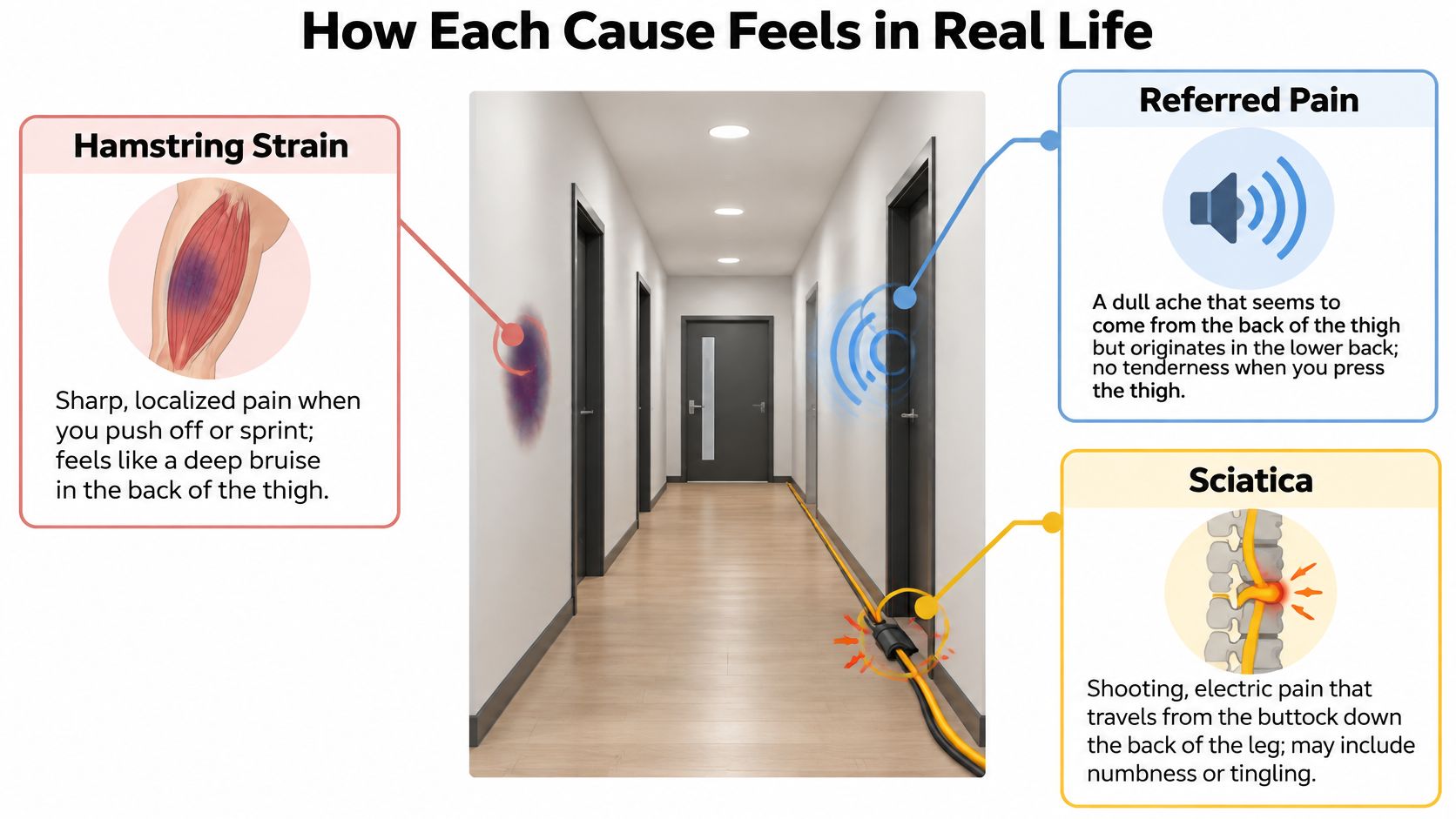
Think of the back of the thigh as a hallway. A bruise on the hallway wall represents a local hamstring strain, an echo from another room represents referred pain, and an irritated cable running along the hallway represents nerve pain. The discomfort occupies the same space, but its origin differs.
This illustration compares those experiences.
A hockey player who can't push off
A recreational hockey player accelerates towards the puck and feels a grab in one thigh. On the next shift, pushing off feels painful, and shortening the stride seems necessary. Later, the player can identify a sore patch rather than a vague ache throughout the leg.
That scene is compatible with a local hamstring injury. The useful detail isn't that hockey preceded the pain. It's the close connection between a particular effort, a particular spot and a loss of function.
Continuing to skate because the muscle feels warmer would make it harder to judge the injury. The better immediate choice is to stop the demanding movement and assess whether ordinary walking remains comfortable.
An office worker with a meeting-related ache
An office worker develops a deep ache during long meetings without any recent sprint or awkward lunge. Pressing the middle of the thigh doesn't reproduce the familiar discomfort. Changing the chair position or moving the lower back changes how the thigh feels.
That pattern makes referral from the hip or back worth considering. Upper hamstring tendon irritation remains another possibility, especially when sitting pressure is prominent. A clinician needs to examine more than the sore location to distinguish them.
Buying a stronger topical product wouldn't settle that question. Neither would repeatedly stretching until the area feels numb or temporarily looser.
An older adult with thigh pain and foot tingling
An older adult stands from a chair and notices discomfort extending through the thigh towards the foot. There's tingling as well as pain, and the leg doesn't feel quite normal. This calls for assessment of nerve function rather than an assumption that ageing muscles need more stretching.
A change in sensation is useful information. Don't dismiss it because the thigh also feels tight.
These scenes are examples, not diagnoses. A previous injury can leave someone with overlapping muscle, tendon and back-related symptoms. When the pattern doesn't settle, an examination is more useful than trying to make every symptom fit a pulled hamstring.
Red Flags That Should Skip Home Treatment
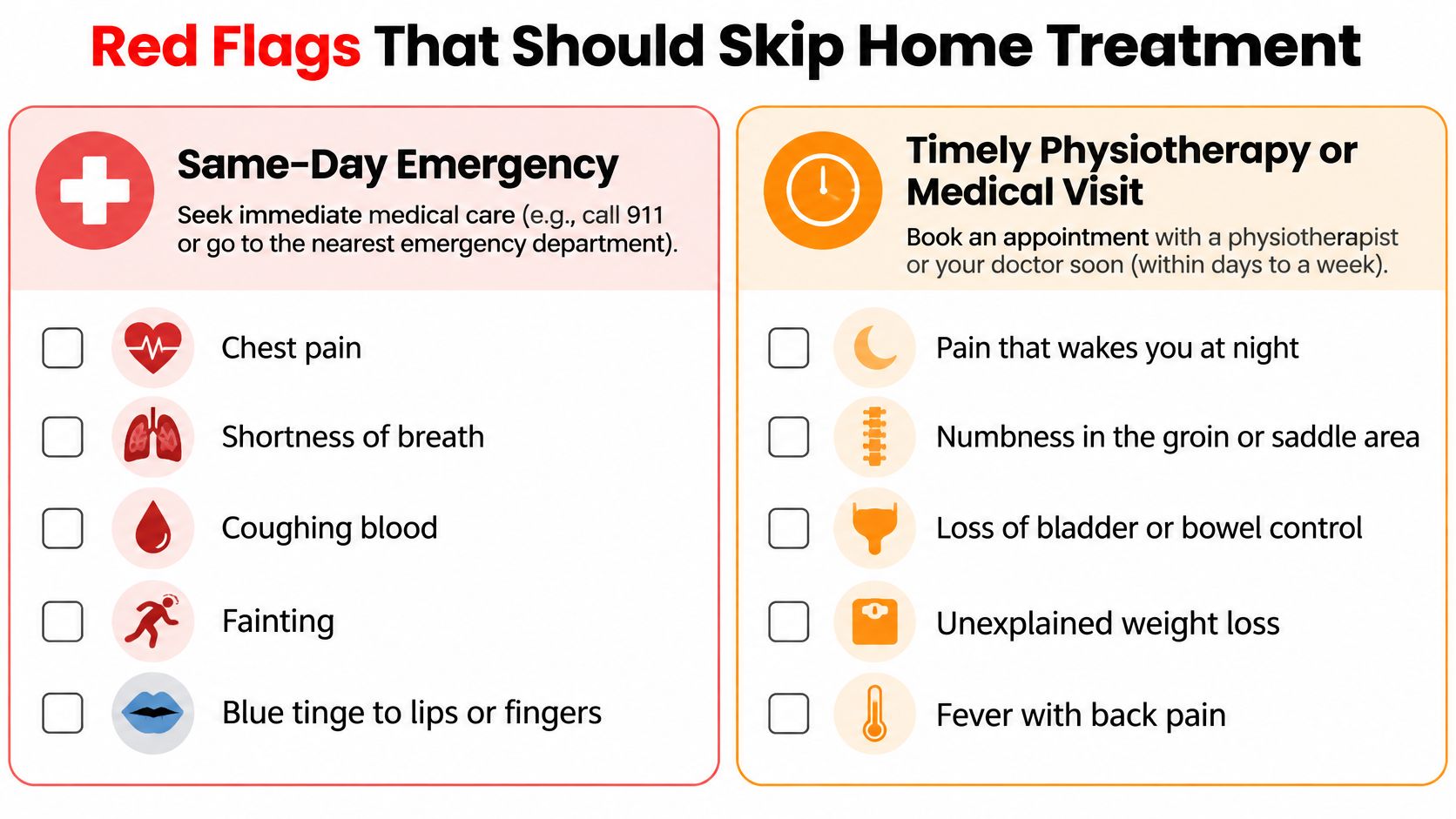
Chest pain, shortness of breath, coughing blood, fainting or a blue tinge require emergency care. With leg symptoms, these can indicate a pulmonary embolism or serious venous obstruction. New loss of bladder or bowel control, numbness around the groin or saddle area, or rapidly worsening leg weakness also requires emergency assessment.
Use this visual as a reminder, with an important correction: saddle numbness and new bladder or bowel-control changes belong in the emergency category, not a routine appointment.
When a clot needs to be excluded
A deep ache in one thigh accompanied by swelling, warmth, redness or diffuse leg discomfort needs urgent medical assessment. According to the British Columbia venous thromboembolism guideline, clinicians assess clinical probability using tools such as the Wells score, then select objective testing, including compression ultrasound when indicated.
Symptoms alone can't confirm or exclude deep-vein thrombosis. Feeling better after rubbing the area or walking around doesn't safely rule it out.
Tell the clinician about relevant history:
- Recent surgery or immobility: Include time spent recovering in bed or with restricted movement.
- Cancer or a previous clot: These change the clinical assessment.
- Long travel: Mention prolonged periods spent sitting.
- New leg changes: Describe when swelling, warmth or redness began.
Exercise-based rehabilitation is the wrong path until a meaningful clot concern has been assessed.
When to arrange a timely appointment
Persistent pain that limits walking, repeated grabs during a return to sport, unexplained night pain, or symptoms clearly affected by the back or hip deserve professional review. A physiotherapist or medical clinician can assess strength, sensation, joint movement and tendon loading, then decide whether imaging would add useful information.
Our guide to when to worry about leg pain can help you describe your concerns, but it isn't a substitute for urgent care.
For additional educational context, the following video may be useful. Don't delay medical assessment to watch it if warning signs are present.
If you have no warning signs and the discomfort behaves like mild local soreness, cautious home care is reasonable. If symptoms are changing or you're unsure which pattern fits, get assessed before loading the leg harder.
Conservative Care That Matches the Cause
Home care is most appropriate for ordinary exercise soreness or a mild local strain, when walking remains possible and there's no spreading numbness, significant weakness or vascular warning sign. The aim is to keep comfortable movement while reducing the demand that irritated the tissue.
Protect movement without stopping everything
Stop the exact action that caused the grab. That may mean holding running intervals, deep lunges or forceful hockey strides while keeping easy walking and gentle hip and knee movement. Relative rest means adjusting the load, not automatically staying in bed.
For a sensitive spot, a wrapped cold pack may offer comfort. Protect your skin and stop if it becomes numb, painful or discoloured. Warmth may suit stiffness better, but neither heat nor cold repairs a tear or establishes the cause; our guide to heat or cold for a muscle strain explains the practical trade-offs.
Recovery after an operation needs a different level of individualisation. If surgery is part of your situation, Longevity Medical Institute's resource on post-surgery recovery in Los Cabos provides a rehabilitation context, but your surgical team's restrictions take priority over a general soreness plan.
Use comfort measures without losing the warning signal
A topical analgesic can temporarily ease discomfort around a known sore muscle. Apply only to intact skin, follow the product's directions and test a small area first if your skin is sensitive. Don't combine a topical with external heat unless its directions explicitly allow that combination.
Some formulas can produce a stinging or burning sensation during the first few minutes as they start working. That doesn't mean you should tolerate a painful skin reaction.
- Pain, swelling or blistering after application: Stop use and get medical help right away.
- Worsening symptoms, rash or irritation: Stop use and consult a physician.
- Symptoms persisting for more than 7 days: Stop use and consult a physician rather than continuing to cover them up.
A quieter pain signal isn't proof that the tissue can tolerate more force. Judge the activity by your movement quality as well as your comfort.
Choose mobility rather than a forced stretch
A fresh strain, an irritated upper hamstring tendon and a sensitive nerve can all respond poorly to aggressive lengthening. Skip the deep toe-touch or long hamstring hold if it reproduces sharp pain, buttock pain or tingling down the leg.
Instead, move the hip and knee gently within a comfortable range. There's no need to chase a strong pulling sensation to make the movement worthwhile.
Comfort is support, not clearance: Don't use pain relief to push through a limp.
When easy walking is comfortable and you're no worse the next morning, consider a gradual increase in activity. That's a readiness signal for controlled loading, not permission to test an all-out sprint.
Rebuild Load for Work and Sport
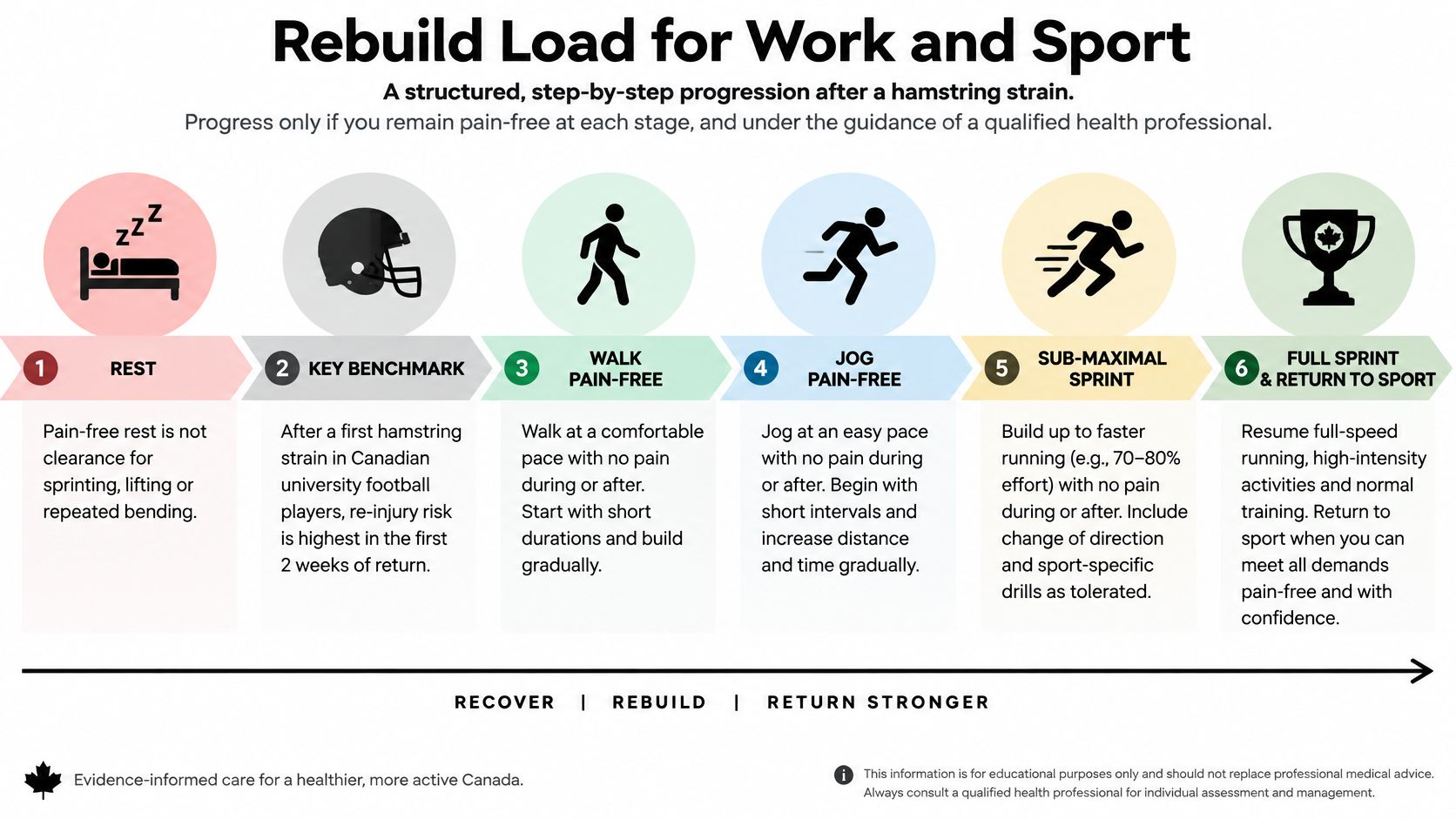
In Canadian university football players with a first hamstring strain, early return to sport averaged 28.84 ± 8.62 days, while athletes requiring more than 40 days averaged 51.93 ± 10.54 days. Early differences between sides in straight-leg raise or active knee extension were associated with a higher probability of delayed return.
Those are field-sport benchmarks, not deadlines for workers, older adults or people with nontraumatic soreness. Pain-free rest isn't clearance for sprinting, lifting or repeated bending. Readiness depends on what the leg can repeatedly do.
Progress from controlled tasks to original demands
- Remove the provoking demand. Hold running, jumping or the exact work task that reproduced the pain. Tolerated cycling or pool activity may help you stay active without repeating the same stress.
- Restore comfortable hip and knee movement. A clinician can compare sides and distinguish protective stiffness from a limitation that needs targeted rehabilitation. Don't force the sore side to match by stretching through pain.
- Introduce slow strength work. Bridges and gentle hamstring curls are examples, provided they don't reproduce posterior-thigh pain. Control the movement before increasing resistance.
- Rebuild walking, stairs and manageable job tasks. The Group23 hamstring-strain physiotherapy handout describes a progression of about 10% per week when symptoms don't worsen, but that's a symptom-gated guide, not an obligation to increase.
- Reintroduce the original demand last. Sprinting, forceful skating, caregiving lifts and carrying heavy loads require more than comfortable daily movement. Practise a reduced version before returning to the full task.
The visual below illustrates increasing demands. Its embedded reinjury-timing claim shouldn't be treated as an individual risk estimate or a clearance rule.
Track function instead of chasing a date
Keep separate notes on discomfort during walking, stairs, sitting, resisted knee bending and the next morning. Improvement in one task doesn't automatically mean another is ready. For example, comfortable cycling doesn't establish readiness for repeated lifting from the floor.
If increased activity brings lingering pain, a limp or disrupted sleep, reduce the demand and reassess. Recurrent setbacks warrant a clinician's review rather than repeated attempts at the same workload.
Our guide to muscle-strain recovery time offers context for planning around recovery. For households balancing practices and matches, Villarreal Houston Academy's season-long health guide for Houston families adds a family-sport planning resource, rather than an individual clearance test.
A worker may need a temporary change in lifting duties. A runner may need to separate easy distance from speed work. The useful plan is the one that matches the actual demands you're returning to.
Choose One Next Step This Week
Choose the path that matches your symptoms, rather than collecting every treatment tip. If you fit more than one category, take the more cautious route.
Mild muscle soreness without warning signs
Keep comfortable walking, hold demanding speed work and use comfort measures only on intact skin. MEDISTIK may fit that routine: our non-prescription topical pain relief system is designed for fast, targeted relief without pills, injections or greasy creams.
Our Power Stick provides temporary soothing relief of sore muscles and joints associated with strains and sprains, backaches, lumbago, tendon or ligament pain, and arthritic or rheumatic pain. Applied before a tolerated activity, it can help reduce pain, but it shouldn't be used to ignore a limp or increase the planned workload.
Sitting, tingling or back symptoms dominate
Book a physiotherapy or medical assessment and skip long, provocative hamstring stretches. Bring a brief description of what changes the pain, where it travels and whether you've noticed weakness or altered sensation. That information is more useful than reporting a tight thigh.
Swelling or major neurological changes appear
Seek urgent assessment for a newly swollen, warm or red leg. Chest symptoms, new bladder or bowel-control problems, saddle numbness or rapidly worsening weakness require emergency care now.
Judge progress by easier walking, more normal movement and a better next-morning response, not by how completely a product suppresses discomfort. The right next step should improve safety and function, not just make the sore spot quieter.
MEDISTIK offers non-prescription topical relief for sore muscles and joints, including discomfort associated with a straightforward hamstring strain. Once warning signs have been addressed, visit MEDISTIK to explore targeted relief options that can support comfortable movement while you rebuild activity gradually.


