

You're standing in a pharmacy aisle with a sore knee, a tight calf, or an aching shoulder, trying to decide between a cooling stick, an anti-inflammatory gel, a spray, or a familiar pain tablet. The packaging may promise relief, but it doesn't always explain what the active ingredient does, how much reaches the painful area, or whether the product is suitable for your health situation.
A topical analgesic can be useful when pain is concentrated in a muscle, joint, or superficial tissue. It can also be easy to misuse, especially when people treat every cream, roll-on, patch, and compounded mixture as interchangeable. The right choice depends on the ingredient, the formulation, the application site, and whether you're preparing to move, managing pain during activity, or recovering afterward.
What a Topical Analgesic Actually Is
A runner may slide a menthol stick across a tight calf before heading out. In a physiotherapy clinic, a patient with knee osteoarthritis may receive advice about applying diclofenac gel over the affected joint. Both products belong to the broad category of topical analgesics, but they don't work in exactly the same way.
A topical analgesic is a product applied to the skin over a painful area to provide temporary relief. Unlike an oral medication, it doesn't need to pass through the digestive system before reaching the bloodstream. Depending on its ingredients, it may create a cooling or warming sensation, reduce local inflammation, or temporarily quiet pain signals in superficial tissues.
The phrase covers several distinct product types:
- Counterirritants use sensations such as cooling, tingling, or warmth to alter how the nervous system experiences pain.
- Topical NSAIDs such as diclofenac or ibuprofen are intended to reduce local inflammation.
- Local anaesthetics such as lidocaine temporarily reduce nerve signalling near the application site.
- Natural cooling products may rely on ingredients such as peppermint oil or arnica, although the clinical evidence varies considerably between formulations.
A plain moisturising cream, massage oil, or cosmetic balm isn't automatically a topical analgesic. The product needs an ingredient intended to relieve pain or discomfort, and its label should explain the approved use, directions, warnings, and active ingredients. In Canada, Health Canada's labelling standards distinguish regulated topical anaesthetic and analgesic ingredients from informal or custom mixtures. You can read more about how topical pain medications differ before comparing products.
Practical rule: Judge a topical product by its active ingredient and intended use, not by the sensation alone.
Topical analgesics sit between self-care and clinical therapy. You may buy some without a prescription, yet the choice still matters if you have arthritis, nerve pain, skin sensitivity, kidney disease, heart failure, or medicines that affect bleeding. The sections ahead focus on four questions: how different ingredients work, when topical treatment makes more sense than an oral option, how to apply it safely, and how to match a format to warm-up, performance, or recovery.
How the Different Types Work on Your Skin
The sensation you feel isn't always the same as the therapeutic action underneath it. A product that feels cold may be changing sensory input without treating inflammation, while an anti-inflammatory gel may work without producing a dramatic hot or cold feeling.
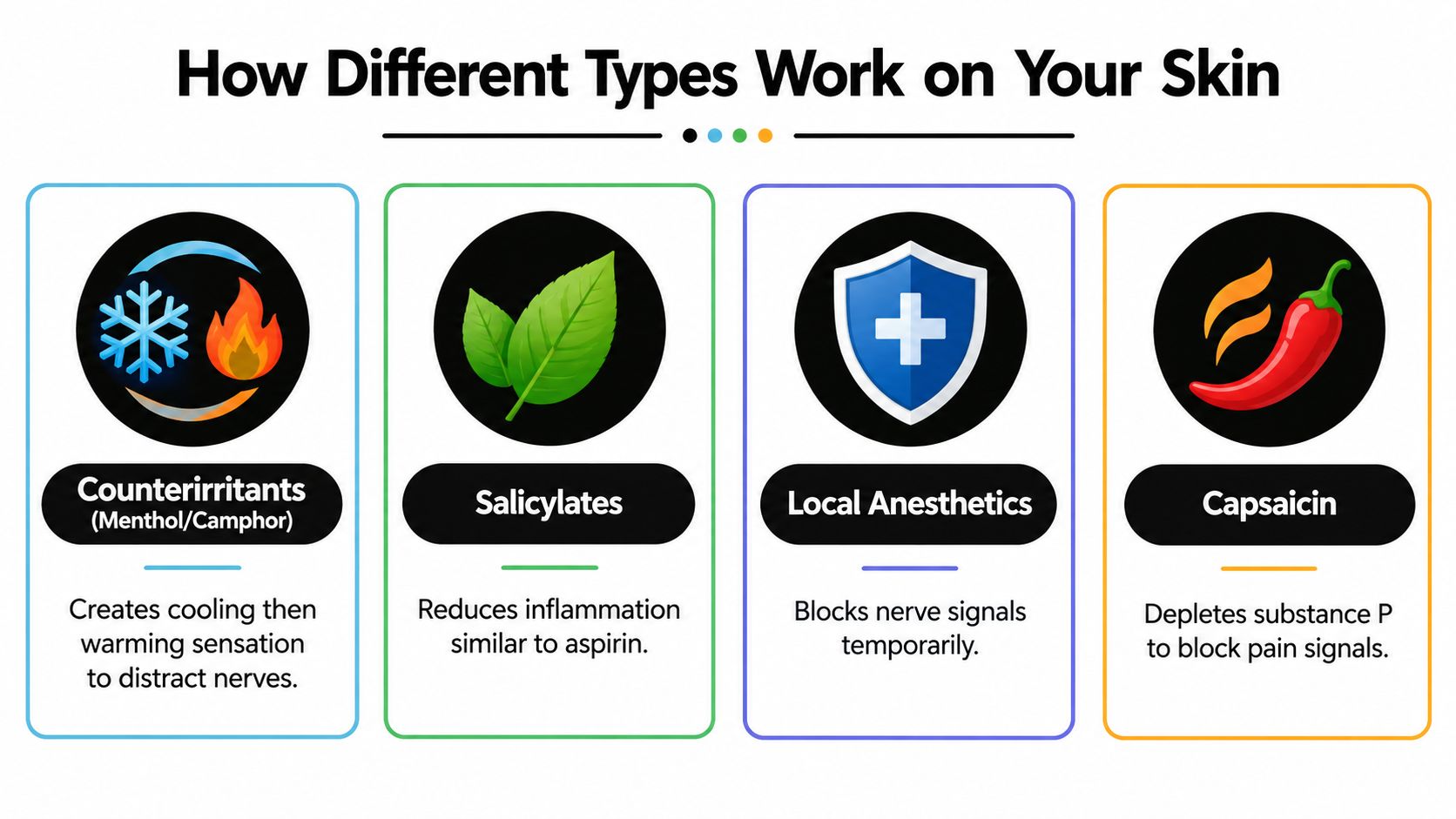
Counterirritants create a competing sensation
Menthol, camphor, and methyl salicylate are common counterirritants. They stimulate sensory receptors in the skin, producing cooling, warming, tingling, or a sequence of sensations. That input can draw attention away from deeper discomfort, which is why a menthol product may feel helpful even when it isn't directly repairing a strained muscle or joint.
Capsaicin works differently within the same broad sensory category. Repeated use can reduce the responsiveness of pain-sensing nerve endings, but it may initially create noticeable burning or warmth. These products require careful adherence to the label because a strong sensation isn't proof that the treatment is working better.
Topical NSAIDs target local inflammation
Diclofenac, ibuprofen, and ketoprofen are topical NSAIDs. They're absorbed through the skin and can act near an inflamed joint, tendon, or soft-tissue area. British Columbia guidance identifies topical diclofenac at 1–4%, ibuprofen at 5–10%, and ketoprofen at 1–5% as best-evidence topical formulations for selected acute injuries and some osteoarthritis conditions. The same guidance estimates systemic absorption at about 6–23% of oral therapy, so topical treatment can reduce, but not eliminate, exposure beyond the application area. The British Columbia pain-management guideline recommends reassessing treatment and continuing it only when the person responds.
Local anaesthetics quiet nearby nerve signalling
Lidocaine is a local anaesthetic. Rather than creating a cooling or warming distraction, it temporarily interferes with nerve conduction in the skin and nearby superficial tissues. That can be useful when pain is sharply localised, although numbness can also reduce awareness of irritation or an injury that needs attention.
Natural products such as arnica and peppermint oil usually produce a milder sensory effect. Their evidence depends on the exact preparation, dose, and condition being treated, so it's sensible to separate a pleasant cooling experience from a well-established anti-inflammatory effect. Some newer products combine sensory ingredients with other actives, but combining mechanisms doesn't make every formulation equally well supported.
For a practical explanation of the cooling pathway, see how menthol relieves pain.
Topical vs Oral Pain Relief and When Each Wins
Topical and oral pain medicines solve different problems. A topical analgesic makes the most sense when discomfort is localised, such as pain over a knee, elbow, wrist, calf, or shoulder. An oral medicine travels throughout the body, which can be more appropriate when pain is widespread, deep, or linked to a broader inflammatory process.
Counterirritants may create a noticeable sensory change relatively quickly, while topical NSAIDs need time to penetrate the tissues and work on inflammation. Oral ibuprofen or naproxen can reach areas that a topical product cannot, but they also expose the digestive system and other organs to the medicine.
The lower systemic exposure associated with topical NSAIDs can be attractive for older adults and people who have previously experienced problems with oral NSAIDs. However, the evidence doesn't answer every safety question for people with heart failure, anticoagulant use, or renal failure. A Canadian review in the CMAJ discussion of topical NSAIDs notes that these products can help with acute sprains, strains, hand osteoarthritis, and knee osteoarthritis, while also highlighting the absence of recommendations for patients with common NSAID contraindications.
| Factor | Topical Analgesic | Oral Pain Medication |
|---|---|---|
| Main reach | Focused on the area where it's applied | Distributed throughout the body |
| Useful for | Local muscle, joint, and superficial tissue discomfort | Widespread, deep, or systemic pain |
| Systemic exposure | Often lower for topical NSAIDs, but not absent | Broader exposure through the bloodstream |
| Common concern | Skin irritation, incorrect application, or using too much | Digestive, renal, cardiovascular, or other medicine-related risks |
| Best decision point | Match the ingredient to the local problem | Consider the whole-body cause and health profile |
A layered plan can sometimes be reasonable. For example, a clinician may use an oral treatment for a broader condition and a topical product for a specific flare over a joint. That combination shouldn't be improvised, particularly when both products contain NSAID ingredients. The comparison between topical and oral pain relievers can help frame the discussion, but your pharmacist or prescriber should individualise it.
How to Apply a Topical Analgesic the Right Way
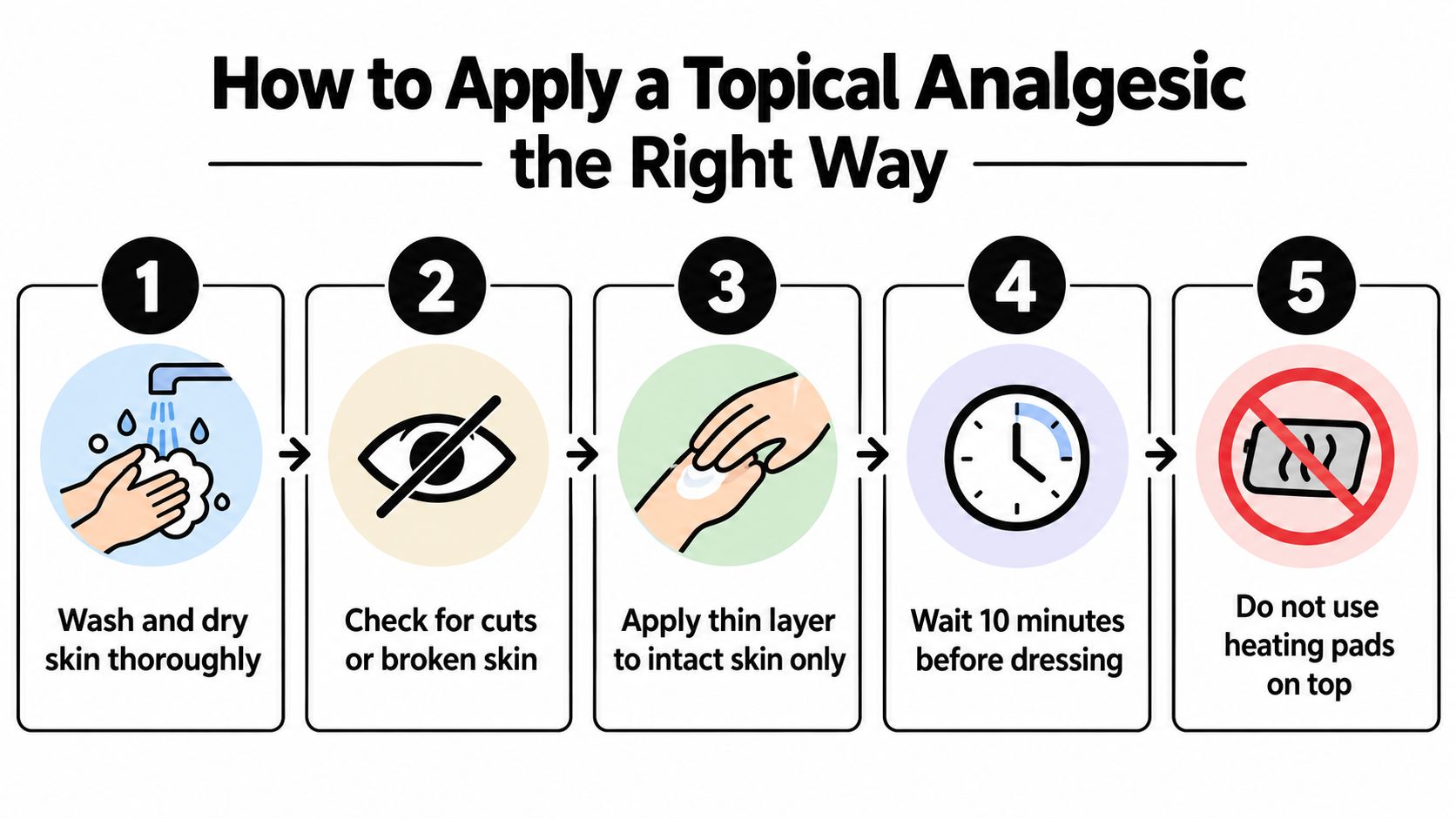
Application affects both comfort and safety. Start with clean, dry, intact skin. Remove sweat, oils, and other products so the active ingredient can contact the skin evenly. Don't apply over cuts, rashes, abrasions, surgical incisions, or areas where the skin is already irritated.
Let the formulation do its job
Use the amount directed on the label. A cream or gel usually needs a thin, even layer. A stick or roll-on is designed for controlled strokes rather than a thick smear. More product doesn't necessarily mean more relief, and a heavy layer can increase transfer to clothing, hands, exercise equipment, or the eyes.
Timing depends on your purpose. Before activity, apply early enough for the product to settle and for you to assess the sensation before moving vigorously. During recovery, applying after you've cooled down can fit naturally into stretching, showering, or changing clothes. A cooling product may feel soothing, while an anti-inflammatory product is being used for a different reason and may not produce an immediate dramatic sensation.
Application check: If the skin feels intensely hot, painful, blistered, or unusually numb, remove the product and seek medical advice rather than adding another layer.
Avoid heating pads, hot baths, tightly sealed coverings, and compression that traps the product against the skin unless a healthcare professional has specifically instructed you to combine them. Don't stack several warming ingredients over the same area, and wash your hands after application unless the product is intended for hand pain.
This short demonstration shows how to use a spray without coating nearby surfaces: how to use a pain-relief spray.
Safety, Side Effects, and What the Evidence Actually Supports
Begin with simple precautions. Test a small area if the label permits, keep the product away from your eyes and mucous membranes, don't use it on damaged skin, and wash your hands after application. Stop if you develop severe burning, swelling, blistering, hives, or breathing difficulty.
Health Canada's safety review provides important context. In 2017, Health Canada reported over 400 over-the-counter topical pain relievers available for sale in Canada and 29 unique Canadian reports of serious skin burns associated with products containing menthol, methyl salicylate, or capsaicin. The review covered creams, gels, liquids, and patches, showing why consumers need to treat a topical analgesic as a medicine rather than as an ordinary cosmetic. Health Canada's safety review also reinforces the importance of following product directions and avoiding heat or misuse.
Read the formulation, not just the front label
Canadian standards set defined ingredient ranges. Health Canada's counterirritant monograph allows menthol at 1.25–16%, methyl salicylate at 10–30%, capsaicin at 0.025–0.25%, and camphor at 3–11%. A separate topical anaesthetic and analgesic standard lists camphorated metacresol formulations with camphor at 3–10.8% and metacresol at 1–3.6%. These ranges don't mean every product is suitable for every person, but they show why “strong” is too vague a way to compare products.
Compounded mixtures require particular caution. The WSIB position on compounded topical analgesics states that compounded topical analgesics aren't Health Canada-approved for topical pain treatment in compounded form and that evidence for exact mixtures is absent or very poor. A custom cream containing several familiar ingredients shouldn't automatically be treated as equivalent to an authorised commercial product.
| Format | Evidence Strength | Key Safety Considerations |
|---|---|---|
| Regulated single-ingredient counterirritant | Supports temporary sensory relief when used as labelled | Burns and irritation can occur, especially with excess product or heat |
| Topical diclofenac and selected topical NSAIDs | Stronger support for certain sprains, strains, and osteoarthritis | Absorption is lower than oral therapy but isn't zero |
| Local anaesthetic formats | Useful for selected superficial or localised pain | Numbness can hide irritation or injury |
| Multi-drug compounded cream | Evidence varies and may be weak for the exact mixture | Ingredient interactions, uncertain dosing, and unclear effectiveness |
| Essential-oil or cosmetic cooling blend | Often limited clinical evidence | Natural ingredients can still irritate or trigger allergy |
Talk with a clinician or pharmacist before use if you're pregnant, have renal or liver disease, take anticoagulants, have significant cardiovascular risk, or are treating pain after surgery. Competitive athletes should also check ingredients against their sport's anti-doping rules.
Using Topical Analgesics for Warm-Up, Performance, and Recovery
A topical analgesic can serve different purposes across a physically demanding day. The important distinction is whether you want a sensory cue before movement, a portable option during activity, or local support after the work is done.

Before movement
A person with recurring lower-back tightness might apply a counterirritant stick before mobility work. The cooling or warming sensation can make the area feel more comfortable while the person performs a proper warm-up. It shouldn't be used to push through sharp pain, weakness, altered sensation, or a suspected injury.
The goal is not to make the back feel invulnerable. The goal is to support controlled movement while the person pays attention to range, coordination, and symptoms. A topical product belongs alongside mobility work, strength training, and an assessment of why the tightness keeps returning.
During activity
A competitive athlete may prefer a fast-drying spray between events when rubbing in a cream would leave residue on the hands or equipment. The format matters here. A spray can reach some areas without requiring the athlete to massage the product thoroughly, although the label should still specify the intended application site and precautions.
For athletes planning recovery around training, this sports pain-relief spray guide offers a format-specific reference. Recovery also includes sleep, hydration, sensible loading, and an appropriate return-to-activity plan. For readers comparing broader recovery methods, Swift Running's guide to how long to sit in an ice bath is a useful resource for understanding why cold exposure should be considered separately from topical pain relief.
After work or training
A tradesperson with sore forearms and shoulders may choose a roll-on after a shift because it allows targeted application without putting a large amount on the hands. The expected outcome is temporary local comfort, not proof that the underlying tissue has healed. Persistent pain, night pain, swelling, loss of function, or repeated reliance on a product calls for an assessment rather than another application.
Where MEDISTIK Fits Across Its Three Formats
Format affects whether a topical analgesic fits your routine. A stick is practical when you want mess-free, hands-free application over an accessible muscle or joint, including before a training session or while preparing for a clinic appointment. A spray may suit a hard-to-reach shoulder blade or mid-back area, especially when you need a quick-drying application during a workday.
A roll-on provides a controlled path across a smaller region. That can be useful after training when you want to limit accidental transfer to your eyes, hands, clothing, or equipment. None of these formats is universally superior. The right choice depends on the body region, the timing, how much contact you want with the product, and whether you need portability.
Canadian regulation gives consumers a useful comparison habit. Instead of relying on terms such as “extra strength” or “rapid,” check the active ingredient, concentration, directions, and warnings. Health Canada's authorised ranges for ingredients such as menthol, camphor, methyl salicylate, and capsaicin help put a product label into context. Texture and absorption time still vary by formulation, so follow the product directions rather than assuming that a stick, spray, and roll-on behave identically.
| Format | Best Moment | Best Body Region | Application Style | Key Trade-off |
|---|---|---|---|---|
| Stick | Before movement or when hands-free use matters | Calves, thighs, knees, and other accessible areas | Direct strokes over the target area | Convenient and low-mess, but less suitable for broad or hard-to-reach areas |
| Spray | During a shift, between activities, or for difficult access | Mid-back, shoulder blade, and larger areas | Mist applied according to label directions | Fast and portable, but requires care around the face and nearby surfaces |
| Roll-on | Post-training or controlled local recovery | Forearms, shoulders, neck, and focused muscle areas | Narrow, measured application | Precise and easy to carry, but may take longer over a broad region |
Compounded pharmacy products are a separate category, not a direct substitute for regulated nonprescription formats. As the WSIB position explains, evidence and approval can differ substantially when ingredients are combined in a custom preparation. Your shelf may reasonably contain more than one format, but no single product covers every situation.
Building Your Own Topical Analgesic System
A useful topical analgesic system starts with three decisions, not a brand name.
First, match the format to the location and the moment. A gel may spread well over a joint, a patch may suit a steady local application when authorised for that use, and a stick, spray, or roll-on may be more practical for movement, work, or travel. Second, identify the active ingredient and compare its concentration with the relevant Health Canada standard. Third, decide whether the product fits a specific routine, such as pre-activity preparation, an acute flare, or post-shift recovery, rather than becoming a substitute for assessment.
Counterirritants and topical NSAIDs answer different questions. One may change the sensory experience of pain, while the other is intended to address local inflammation. A one-product shelf rarely solves a routine that includes arthritis, muscle soreness, nerve irritation, and repeated sports loading.
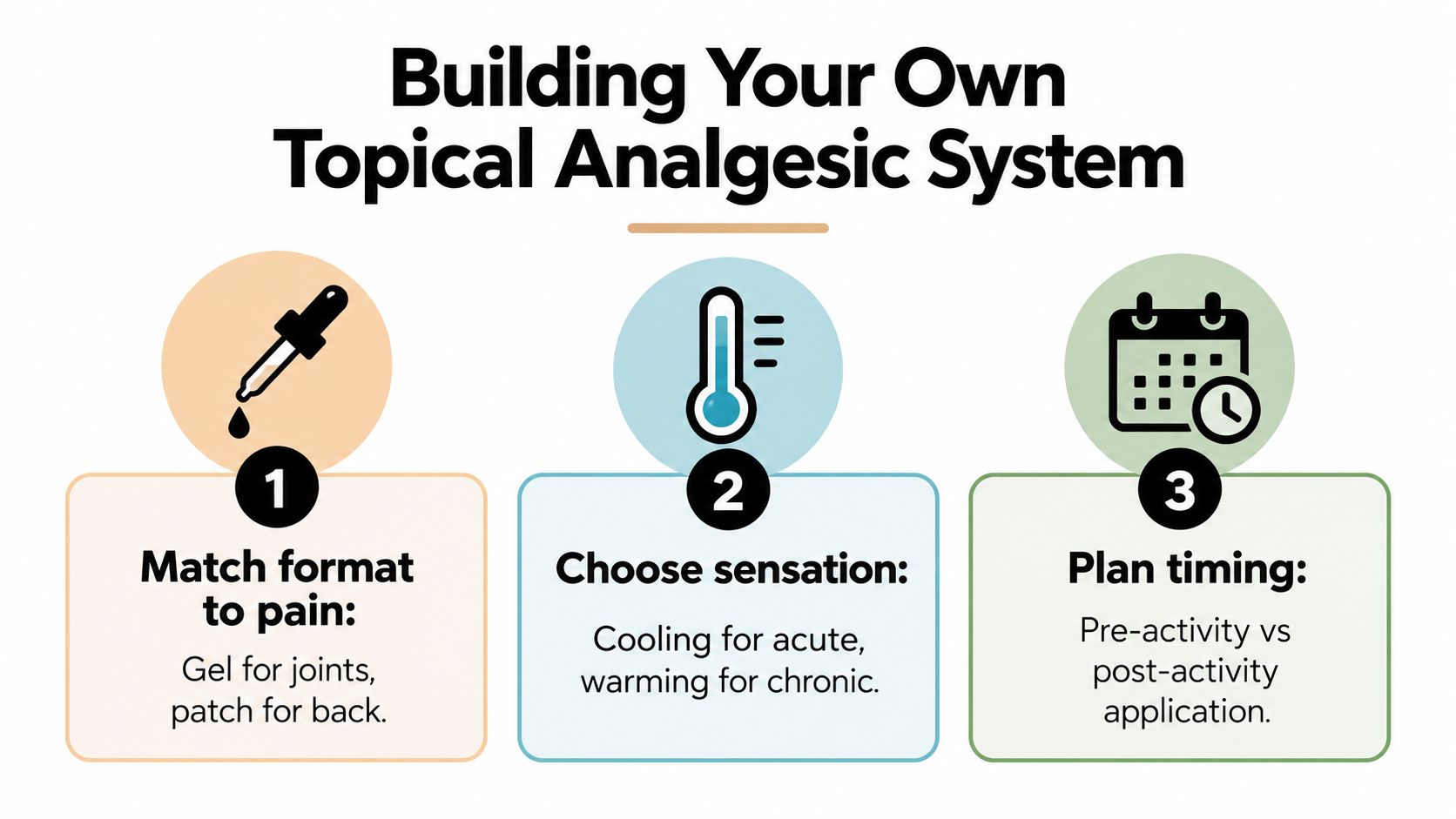
Track what happens after application. Record the location, activity, product, sensation, functional change, and any skin reaction over a short period. A cooling or warming feeling can mask the fact that the underlying pain is unchanged, so judge success by movement and daily function as well as comfort.
Seek clinical advice when pain keeps returning, is getting worse, follows a significant injury, or comes with swelling, weakness, numbness, fever, or reduced function. If you have complex medical conditions or take medicines that affect bleeding, the most valuable next step may be a pharmacist or clinician conversation rather than another topical product.
MEDISTIK offers a stick, spray, and roll-on format for targeted temporary relief of sore muscles and joints, allowing you to choose an application style for warm-up, activity, or recovery. Visit MEDISTIK to compare the formats, review product directions, and choose an option that fits your movement or work routine.


