

You step off a curb, the ankle rolls, and the next few minutes turn into a negotiation. Can I walk on it? Is this just a tweak? Should I keep moving or stay completely off it? In clinic, that's the moment where people still reach for the old script: ice it, rest it, wait.
That script is incomplete.
Real pain relief for the ankle depends on what's irritated. The most common patterns I see are lateral ligament sprains, Achilles tendon irritation, posterior tibial tendon overload, and the stiff, sore ankle that shows up after a boot, a long car ride, or too much sitting after an injury. Those don't all respond to the same plan, and they definitely don't all get better from doing nothing.
In Canada, ankle pain isn't a niche complaint. A Statistics Canada analysis reported that ankle or foot pain or injury affected 942,000 Canadians, with a prevalence of 22.8%, including 20.5% in males and 25.8% in females in that analysis, and a British Columbia survey found foot or ankle discomfort was the third most commonly reported joint-pain site at 30.8% in that regional sample (Statistics Canada report on joint pain and ankle or foot pain).
The practical takeaway is simple. Good ankle pain relief usually means brief protection, early controlled loading, swelling management, and a graded return to function. Rest still has a role. It just isn't the whole plan, and it shouldn't drag on longer than necessary.
When Ankle Pain Hits and What Relief Really Looks Like
You step off a curb, the ankle folds, and the next 30 seconds decide a lot. If you test it carefully and support it early, recovery usually moves faster. If you park on the couch for a week and wait for it to sort itself out, the joint often gets stiffer, weaker, and less trustworthy.
That is the part many people miss. Pain relief is not only about calming pain. It is about keeping the ankle usable while the irritated tissue settles.
The four patterns that show up most
Lateral ankle sprain is the classic rolled ankle. Pain sits on the outside, swelling can come on quickly, and side-to-side movement feels uncertain.
Achilles tendon irritation usually hurts at the back of the heel or 2 to 6 cm above it. The first few steps in the morning are often the worst, and push-off, hills, or faster walking tend to aggravate it.
Posterior tibial tendon overload shows up along the inside of the ankle or arch. I see it after a jump in walking volume, longer standing days, or repeated hill work.
Post-immobility stiffness is its own problem. After a boot, a long drive, a flight, or too much protective rest, the ankle can feel blocked, tight, and weak even when the original injury has started to settle.
What relief should actually look like
Good ankle pain relief usually shows up in stages. First, pain becomes more manageable with standing and walking. Then swelling and stiffness start to ease. After that, the ankle tolerates more load, and confidence returns on stairs, uneven ground, and faster direction changes.
Canadian guidance has shifted away from passive rest as the main treatment for a simple ankle sprain. CADTH's review of clinical guidance for acute lateral ankle sprain found that recommendations favoured functional support such as bracing and exercise therapy, rather than rest, ice, compression, and elevation as a stand-alone treatment (CADTH review of diagnosis and treatment for acute lateral ankle sprain).
That matches what works in clinic. Short-term protection helps. Complete shutdown for too long does not.
Topical relief still has a place, but it is a support tool, not the whole plan. In the first phase, a topical analgesic can make walking, bracing, and gentle movement more tolerable. A few days later, it can help you do mobility work and light calf or balance drills with less guarding. The ankle still needs load, range, and progression if you want it to feel stable again.
Clinical reality: The ankle usually responds best to brief protection, early loading, external support, and progressive rehab. Rest is part of that plan, but only for as long as it helps.
Immediate First Aid for an Acute Ankle Injury
The first question after a fresh ankle injury isn't “How do I get back to sport tomorrow?” It's “How do I stop this from getting worse while giving it the best chance to recover well?”
Start with protection, not panic.
What to do in the first 72 hours
Many know RICE. The problem is that RICE alone isn't enough. Canadian guidance has moved toward functional support and exercise-based rehab, not passive care by itself. CADTH reported that guidance for acute lateral ankle sprain did not recommend rest, ice, compression, and elevation as a stand-alone treatment, and favoured functional support such as an ankle brace plus exercise therapy over rigid immobilisation.
Use this kitchen-counter version instead:
- Protect it Use a brace, taping, or a firm elastic wrap so the ankle feels supported when you stand.
- Load it gently Walk as tolerated. If you can take careful steps with a limp that improves as you move, that's often better than total avoidance.
- Ice for symptom control Use ice wrapped in a thin towel for short bouts in the early phase. It helps with pain and swelling, but it isn't the treatment by itself.
- Elevate properly Get the ankle above the hip when possible, not just on a low footstool.
- Start easy motion Gentle ankle circles and ankle alphabet work can begin early if they stay within mild pain.
For a patient-friendly overview of ice pack strategies for ankle recovery, that resource is useful because it helps people avoid overdoing cold exposure and forgetting the mobility piece.
What current rehab guidance says
HealthLink BC advises starting rehab exercises within the first 72 hours and using symptoms as the limiter, with 8 to 12 repetitions once or twice daily for the prescribed movements (HealthLink BC ankle rehabilitation exercises).
A practical external reference on treatment for sprains in New Jersey is also worth reviewing if you want a broader medical overview of what sprain care can involve beyond home management.
Here's a good visual walkthrough before you start moving it again:
Don't put heat on a fresh swollen ankle, don't deep-massage a new sprain, and don't confuse “resting” with “healing.”
Home Remedies and Topical Relief That Fit Each Phase
You roll the ankle on a curb, limp through the next few hours, then start wondering whether to ice it, heat it, rub something on it, or just stay off it. The answer depends on what the ankle is doing today, not what it was doing on day one.
That matters because current Canadian guidance has shifted away from passive rest as the main plan. Early protection, compression, bracing, and gradual loading usually move recovery along better than days of doing nothing. Home remedies still help, but they work best when they support that progression instead of replacing it.
Match the remedy to the ankle you have
In the first couple of days, the ankle is usually warm, swollen, and reactive. Cold can settle symptoms after activity. Compression helps limit extra swelling. A brace often does more for day-to-day function than repeated icing, because it lets you walk with less irritation while the ligaments calm down.
Later, the pattern changes. Swelling drops off, but stiffness and soreness with first steps often show up instead. That is when warmth tends to be more useful than more ice, especially before home exercises or a walk. Heat too early often leaves the ankle feeling more congested.
Epsom salt soaks fit in that later stage as well. They can make the ankle feel better. They do not repair ligament tissue, and I tell patients to treat them as comfort care.
Where topical products actually fit
Topicals are useful for ankle pain because the painful area is easy to reach and easy to monitor. The right product depends on the phase and on the kind of pain.
- Menthol or methyl salicylate products work best for short-term symptom relief, especially if the ankle feels achy before a walk or after light rehab work.
- Topical diclofenac gels make more sense when the ankle is locally inflamed and tender, such as a fresh sprain or strain.
- Lidocaine products can help when the skin and soft tissue feel irritable or overly sensitive to touch.
- Capsaicin creams are usually a poor first choice for a sore ankle because many people find the burning sensation hard to tolerate in shoes or socks.
If you want a practical breakdown of topical pain relief products for different pain patterns, that guide helps sort out which category fits best.
Health Canada approved topical diclofenac products for local pain relief in acute strains and sprains, including ankle sprains. Use the product exactly as labeled, and stay within the listed daily dose and application frequency on the product monograph or package instructions.
Home remedies matched to recovery phase
| Remedy | Best Phase | How to Use | Cautions |
|---|---|---|---|
| Ice | Early reactive phase | Use short sessions after walking or rehab if swelling or throbbing picks up | Helpful for symptoms, but it does not replace loading and rehab |
| Elastic compression wrap | Early reactive phase | Wear during the day with even pressure from foot to lower calf | Loosen it if toes become numb, pale, cold, or tingly |
| Elevation plus calf pumping | Early swollen phase | Raise the leg and add easy ankle pumping to help fluid move | Stop if pain spikes or the ankle feels less stable |
| Warm bath or moist heat | Later stiff phase | Use before mobility work or first activity of the day | Skip it if the ankle is still visibly puffy or hot |
| Epsom salt soak | Later stiff or achy phase | Use in warm water for comfort at the end of the day | Good for symptom relief, not tissue healing |
| Topical menthol gel or roll-on | Early soreness or pre-activity stiffness | Apply to the sore area for temporary relief | Keep it off broken skin and wash hands after use |
| Topical diclofenac | Acute local sprain or strain pain | Apply exactly as directed on the label | Check with a pharmacist or clinician if you have GI, kidney, blood thinner, or NSAID-related concerns |
| Compression sleeve | Later support phase | Use for comfort during the day once major swelling settles | Useful support, but it does not rebuild strength or balance |
Mobility and Strengthening Drills You Can Do at Home
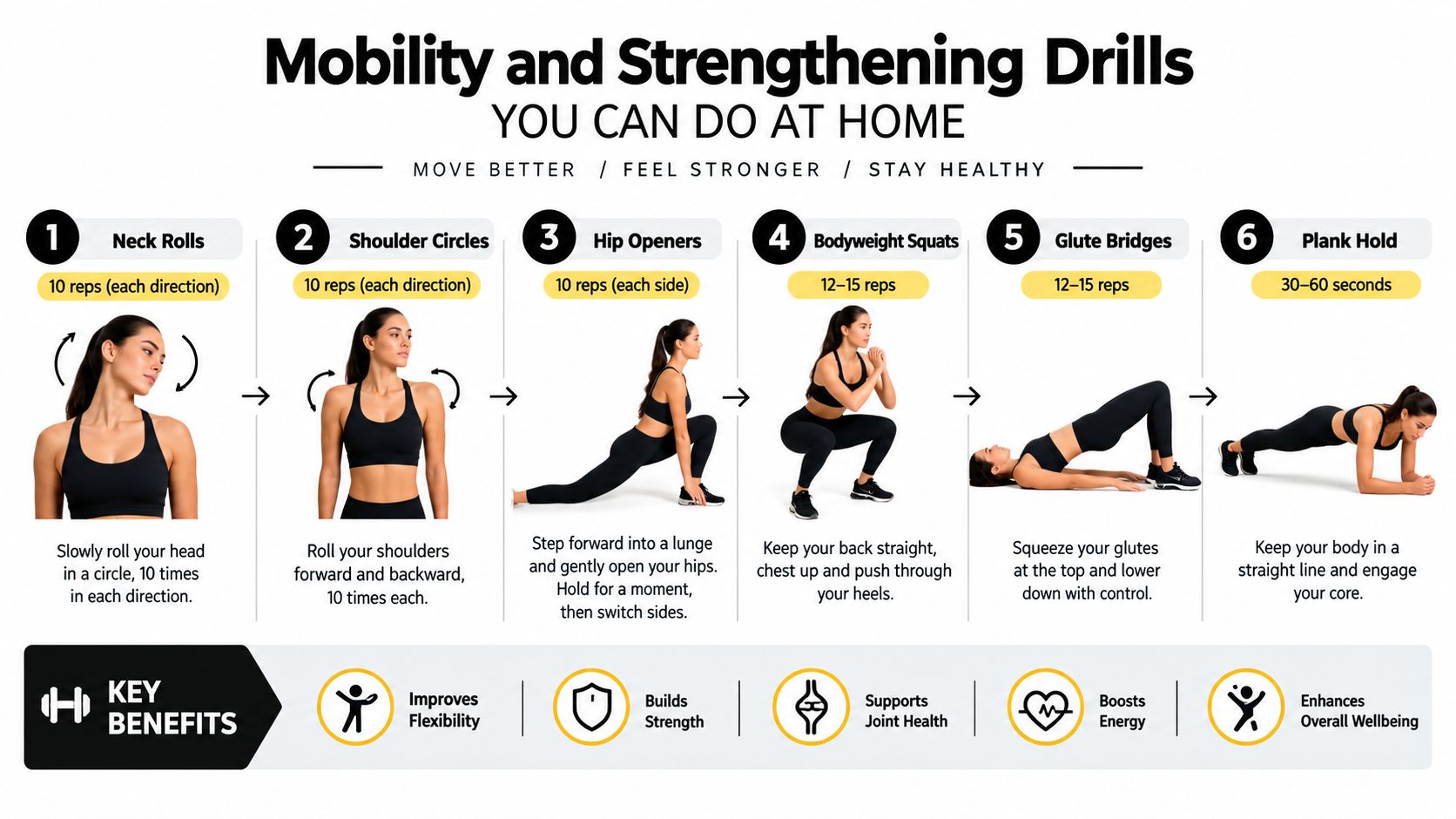
The ankle recovers when you restore three things in order. Motion, strength, and balance. Miss one and the ankle usually reminds you later on stairs, trails, or quick direction changes.
Week-by-week home progression
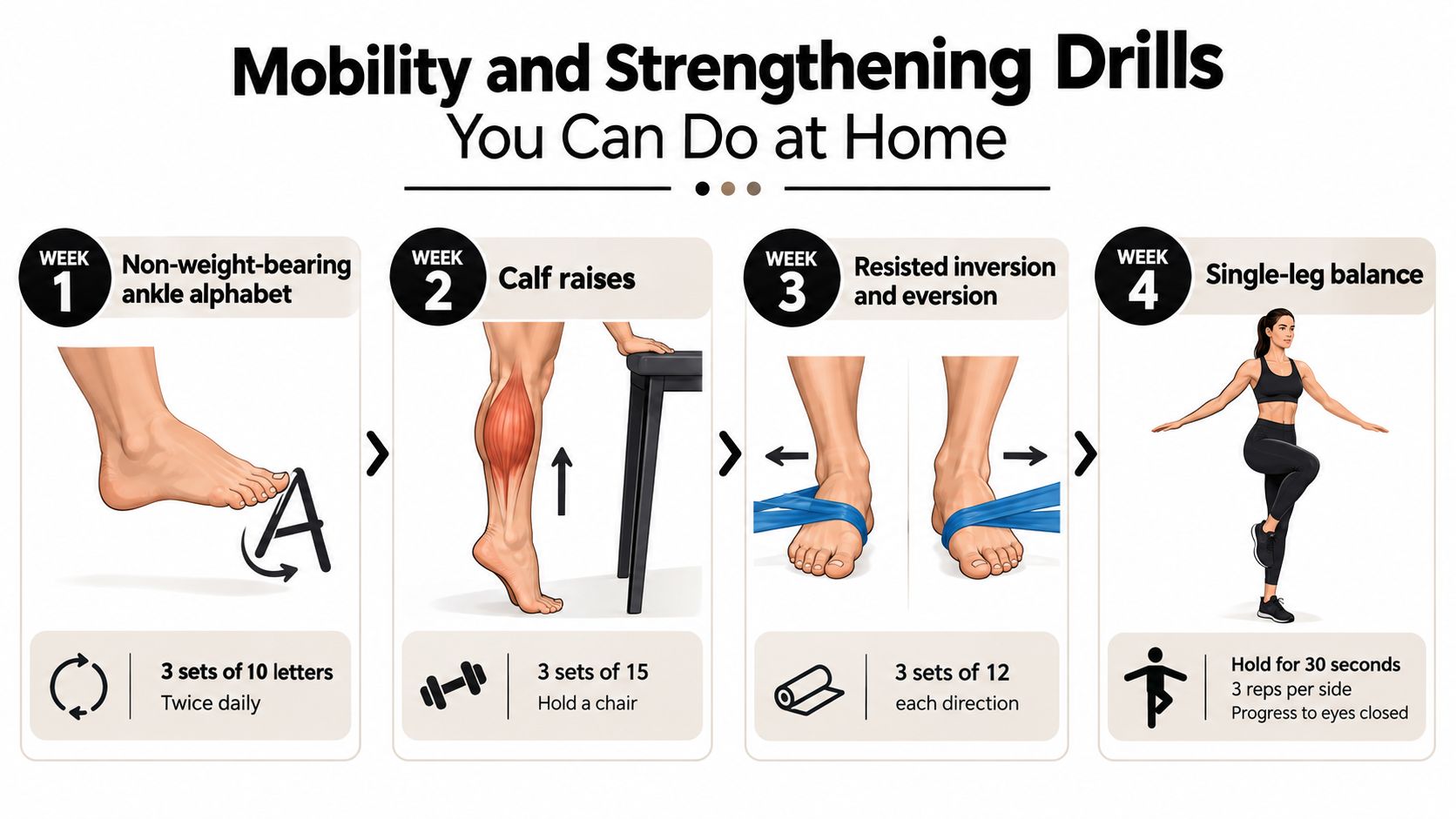
Week 1 Use ankle alphabets in non-weight-bearing. Trace the letters slowly with your foot. Do 3 sets of 10 letters, twice daily. This restores motion without asking the ligaments to handle full load yet.
Week 2 Add calf raises, holding a chair or counter. Start with both feet and move smoothly. Do 3 sets of 15. These begin to restore push-off strength for walking and stairs.
Week 3 Bring in resisted inversion and eversion with a resistance band. Do 3 sets of 12 in each direction. The ankle starts getting its side-to-side control back.
Week 4 Use single-leg balance holds for 30 seconds, 3 reps per side. Progress by reducing hand support, then by closing the eyes if that's well tolerated.
If your ankle pain showed up after sport, this guide on ankle pain after running helps connect the drills to training errors and return-to-run decisions.
How to decide when to progress
Use symptoms, not impatience.
- Advance when the ankle feels looser during the day, swelling doesn't rise after exercise, and walking looks close to normal.
- Hold steady when the exercise feels challenging but settles quickly after.
- Regress if you wake up more swollen, more limpy, or newly sore in a sharp way.
Canadian guidance leans hard toward early, symptom-guided mobility. HealthLink BC advises starting range-of-motion work early and continuing stretching, strength, and balance work over the following weeks and months. The emphasis is progression based on tolerance, not sitting still and hoping for the best.
The right amount of loading makes the ankle more reliable. Too little loading leaves it stiff and hesitant.
Taping and Bracing for Confident Movement
Bracing helps people because it does two jobs at once. It limits the slop that aggravates healing tissue, and it gives the brain better awareness of where the foot is in space.
When a wrap is enough and when it isn't
A simple elastic compression wrap is enough when the ankle is mildly swollen, walking is mostly normal, and you just need daytime comfort.
A lace-up brace earns its keep when you're still unstable on turns, uneven ground, or stairs. A semi-rigid stirrup brace is often the better option when side-to-side motion still feels unreliable after a more significant lateral sprain.
Canadian rehabilitation guidance supports this practical approach. It emphasises early mobility and bracing, and notes that a brace or lace-up support is reasonable in the early period for symptom management, with progression based on gait, swelling, and pain-free exercise completion rather than the calendar.
A simple taping approach
Kinesiology tape won't replace strength, but it can provide useful feedback.
- Anchor with no stretch above the heel.
- Run one strip under the arch and up the inside or outside depending on the support goal.
- Use light to moderate tension through the middle only.
- Finish with no stretch at the ends.
The common mistake is pulling the whole strip too tight, especially around the front of the ankle. If the toes change colour, tingle, or feel cold, it's too tight and needs to come off.
For readers dealing more with tendon pain than ligament sprain, this overview of K tape for Achilles tendonitis can help you understand where taping is useful and where it isn't.
Using OTC Pain Medication and Topical Analgesics Safely
A lot of people treat ankle pain like a race to the medicine cabinet. That usually means grabbing ibuprofen first and asking questions later.
That isn't always the best first move.
Why local treatment often makes more sense
For a sore, swollen, localised ankle, I usually think local first. Topical products target the painful area directly and avoid turning a small joint problem into a whole-body medication decision.
That's one reason topical diclofenac makes sense for many sprains and strains. In Canada, the treatment pathway is already recognised in regulated labelling for acute local joint injuries, including ankle sprains, as noted earlier in the article.
A non-prescription topical option such as MEDISTIK Pain Relief Spray may also fit when the goal is temporary relief for sore muscles and joints associated with strains and sprains. That's a symptom-relief tool, not a substitute for loading, bracing, and rehab.
OTC Analgesic Options for Ankle Pain Compared
| Product Type | Active Ingredient | Onset & Duration | Best Used For | Safety Note |
|---|---|---|---|---|
| Topical anti-inflammatory gel | Diclofenac | Local relief pattern varies by product and use | Acute local sprain or strain pain | Follow label directions and check with a clinician if you have medication restrictions |
| Cooling or warming topical | Menthol or methyl salicylate | Often felt quickly on the skin | Temporary symptom relief before or after activity | Avoid eyes, mucosa, and broken skin |
| Numbing topical | Lidocaine | Useful for touch-sensitive pain | Irritable areas where friction from shoes or braces is bothersome | Don't use excessively or on damaged skin unless directed |
| Oral NSAID | Ibuprofen or naproxen | Systemic effect rather than local only | Broader inflammatory pain when appropriate | Not ideal for everyone, especially with stomach, kidney, or blood-thinner issues |
| Topical capsaicin | Capsaicin | Builds with repeated use | Persistent pain states more than fresh sprains | Can sting significantly at first |
Who should slow down before using OTC pain medication
Self-care is reasonable for many ankle injuries, but some people should get advice before taking oral or topical pain medication.
That includes people with:
- Blood thinner use
- Kidney disease
- History of stomach ulcers or GI bleeding
- Diabetes-related foot problems
- Pregnancy or complex medication regimens
- Unclear diagnosis, especially if the pain may not be a simple sprain
Oral NSAIDs can be useful, but they're not casual meds for everyone. If the ankle is the only problem area, a topical often gives a cleaner risk-benefit profile.
Some readers also look at broader joint-support strategies during recovery. For that angle, VitzAi.com expert vitamin recommendations offer a nutrition-focused perspective, though vitamins don't replace mechanical rehab for an injured ankle.
If you're comparing ankle pain medicine options, the practical question is less “Which one is strongest?” and more “Which one fits this tissue, this stage, and this person safely?”
When self-care should stop
HealthLink BC's ankle sprain guidance points to red-flag thresholds for imaging and reassessment, including inability to bear weight and malleolar tenderness along Ottawa Ankle Rule pathways, which helps separate routine self-care from injuries that need clinical evaluation (HealthLink BC ankle sprain guidance).
Here are the big stop signs:
- You can't take four steps, both right after the injury and again when reassessed.
- You have bony tenderness at the posterior edge or tip of the medial malleolus.
- You have bony tenderness at the posterior edge or tip of the lateral malleolus.
- You have tenderness at the navicular.
- You have tenderness at the base of the fifth metatarsal.
Soft-tissue red flags matter too:
- Visible deformity
- Open wound
- Sudden severe swelling within minutes
- A pop followed by immediate collapse
- Calf pain or swelling
- Numb or pale toes
- Fever with hot joint pain
- Pain that isn't improving after a structured stretch of guided loading
If a red flag shows up, stop running, cutting, jumping, and “testing it.” Get it assessed.
Bring three things to the appointment. The mechanism of injury, the swelling timeline, and a short list of what you've already tried.
Preventing the Next Ankle Episode
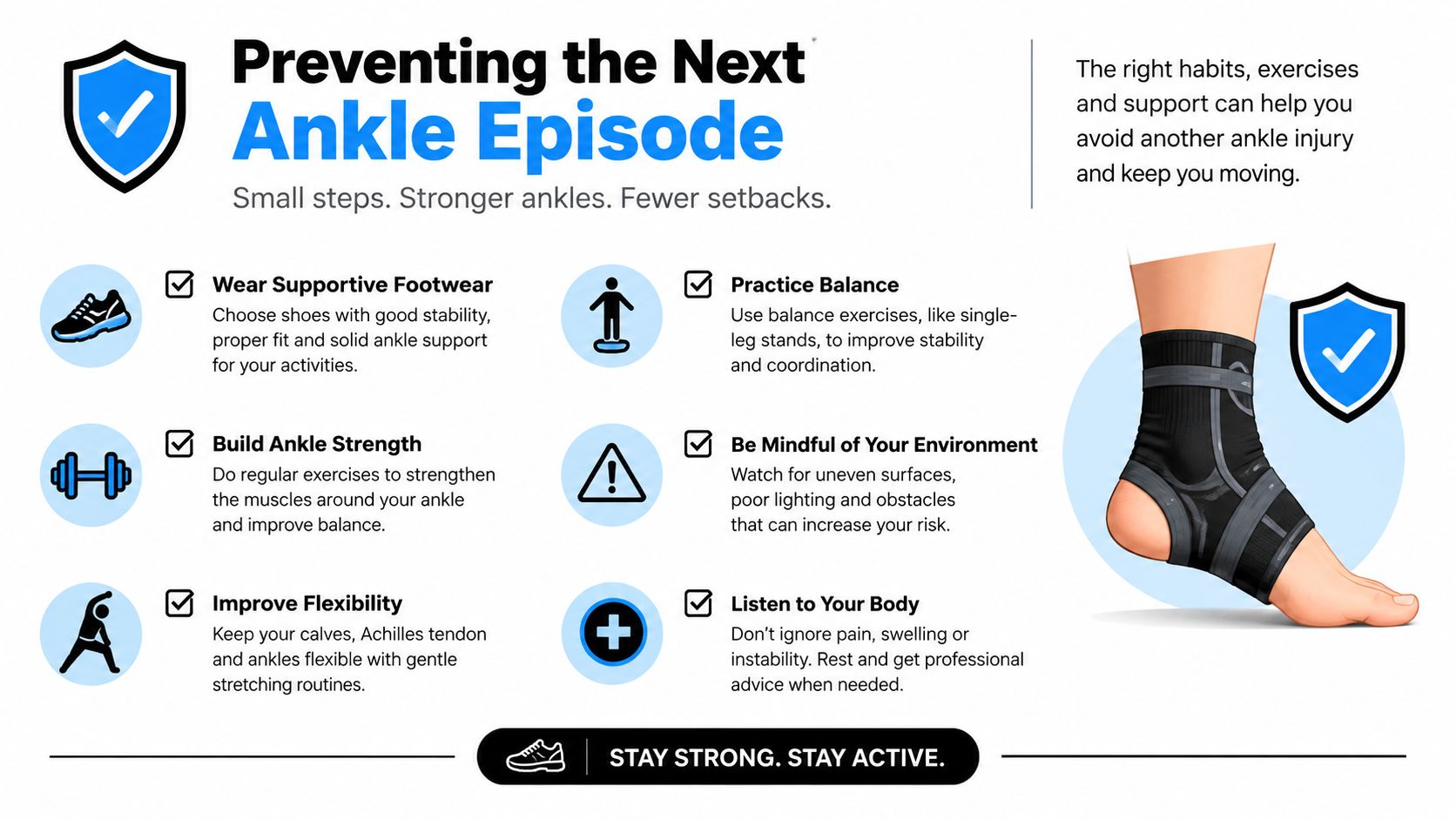
The strongest prevention plan is boring in the best way. It lives in routines, not heroic stretches done once after a scare.
Build a short warm-up that actually prepares the ankle
Before running, court sport, or field sessions, use a short neuromuscular warm-up:
- Ankle circles to free up the joint
- Banded dorsiflexion to help the shin move forward over the foot
- Lateral shuffles to wake up side-to-side control
- Single-leg holds to prime foot and ankle balance
This doesn't need to be long. It needs to be regular.
Train the tissues that usually fail first
The ankles that keep relapsing are often missing side-chain strength and balance, not just flexibility.
Focus on:
- Peroneal strength with banded eversion
- Calf capacity with heel raises and controlled lowering
- Posterior tibial support with arch control and resisted inversion
- Balance retraining with firm-floor single-leg stance, then unstable surfaces, then hop-and-stick patterns
Do that work twice weekly and it pays off better than random stretching after pain has already started.
Make footwear decisions based on surface and task
Flat stable pavement, trails, court sport, and long work shifts don't place the same demand on the ankle.
Use simpler shoes on predictable surfaces if your ankle handles them well. Use more supportive or trail-specific shoes on uneven terrain or when fatigue tends to expose instability. Break in new footwear gradually. If a shoe changes your ankle mechanics in the wrong direction, you'll often feel it within a few sessions.
Use simple return-to-sport rules
Don't use “it feels okay” as the only test.
A more sensible screen includes:
- Full pain-free range of motion
- Confident single-leg balance
- Strong calf raise performance
- Comfort with cutting, landing, or descending stairs, depending on your sport
Morning stiffness is also useful feedback. If the ankle is grumpy first thing, that's often a sign to add mobility and reduce intensity for the day rather than trying to blast through it.
The main prevention habit is this. Treat small losses of mobility, balance, or confidence early. Ankle pain rarely appears out of nowhere. Several quiet warnings often appear first.
If ankle pain is slowing down your training, workday, or recovery, MEDISTIK offers Canadian-made topical pain relief options designed for sore muscles and joints, including strains and sprains, in formats that are easy to use at home or on the go. To explore products and practical education on managing movement-related pain, visit MEDISTIK.


