

Canada counted 25,294 physiotherapists in 2019, a 2.6% increase over 2018, and the profession's steady growth is why the Introduction to the Health Workforce in Canada chapter on physiotherapy describes rehabilitation as an organised service rather than a hospital side function. Equipment is the physical form a clinic's capacity takes. Buy badly and you spend clinician minutes you don't have.
Most supply lists are written as if price and spec sheet were the only variables. They aren't. A cheaper table that needs two people to raise costs more per patient than an electric plinth, because the therapist stops treating to adjust furniture. A $40 band set that snaps in a month costs more than the $90 set that lasts two years. The number that matters is what it costs to complete one treatment episode, not what the invoice says.
Every category in this guide is scored on two tests. First, does the item safely extend a stretched clinician's reach, meaning can an assistant, student or caregiver run it without a regulated judgement call. Second, what does it cost per completed episode once consumables, cleaning time and replacement intervals are counted. Regulated devices get a third gate before purchase, which is the licence check.
Physiotherapy Supplies Category Map
Physiotherapy supplies are everything a practice needs to assess a patient, treat them, document the visit and turn the room over safely. These include treatment tables and electrotherapy units that stay in place for a decade, bands, balls and putty that pass through dozens of hands a week, gel, couch roll and wipes that disappear by the case, and topical products kept within reach at the bench.
The spend is larger than most therapists assume. Canada's physiotherapy-equipment market was estimated at approximately USD 201.8 million in 2024 and is projected to reach USD 270.7 million by 2029, a compound annual growth rate of 6.1%, according to MarketsandMarkets' Canada physiotherapy equipment market data. Physiotherapy and rehabilitation centres were the largest identified end-user segment at about USD 96.0 million in 2024, forecast to reach USD 126.0 million by 2029 at 5.7% annual growth. Home-care settings were estimated at USD 25.8 million and projected to reach USD 33.4 million over the same period.
Those three segments buy differently. A rehabilitation centre spends on plinths and multi-channel modalities. A hospital physiotherapy department restocks electrodes, gel and paper. A home-care program buys only what a therapist can carry through a doorway and disinfect between visits.
The four families this guide uses
- Exercise and rehabilitation equipment. Bands, tubing, therapy balls, cuff weights, balance pads, putty, parallel bars, stairs and wedges.
- Modality and electrotherapy devices. TENS, NMES and FES units, interferential and combo machines, ultrasound, laser, traction, and hot and cold systems.
- Disposables and infection-control consumables. Self-adhesive electrodes, gel, couch roll, face paper, gloves, wipes, linen.
- Clinic furnishings and assessment tools. Tables, plinths, stools, trolleys, storage, goniometers, inclinometers, dynamometers.
Every clinic buys from all four families. What separates a two-room practice from a twelve-therapist rehabilitation centre is depth in each row, not which rows it uses. The map below keeps the working categories straight, including the documentation and turnover supplies that never appear on a glossy equipment page.
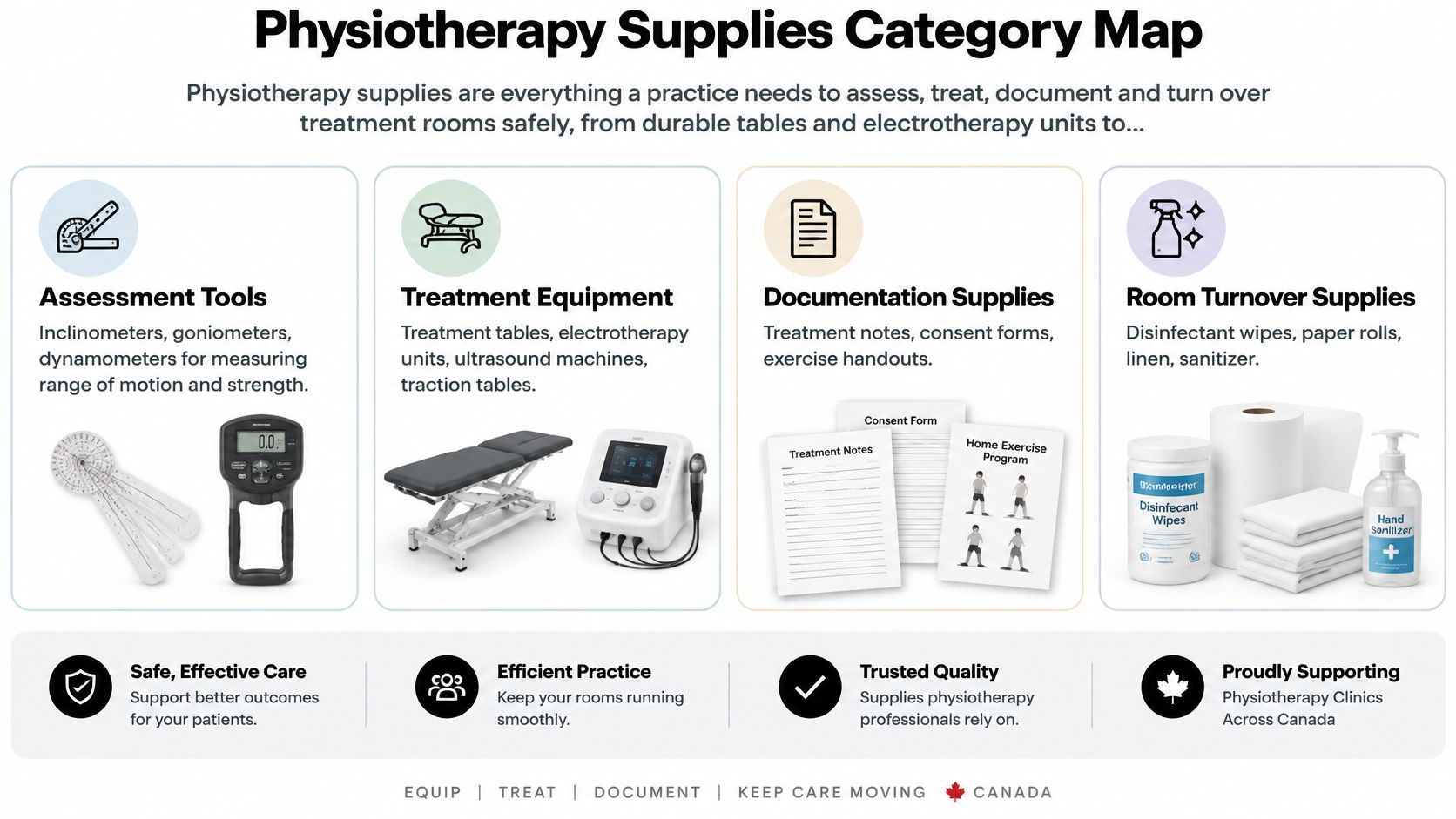
The map on the stockroom wall
| Category | Core items | Typical specs to compare | Primary users |
|---|---|---|---|
| Exercise and rehabilitation | Resistance bands and tubing, therapy balls, dumbbells, cuff weights, balance boards, foam rollers, putty, parallel bars | Resistance levels from light to extra-heavy, tubing length of 1.2 to 2.5 m, latex-free options, ball diameter from 45 to 85 cm | Outpatient clinics, home programs, seniors and sports rehab |
| Electrotherapy and modalities | TENS, NMES and FES units, IFC machines, combo units, therapeutic ultrasound, laser, traction systems | Channel count, waveform and frequency range, 1 vs 3 MHz heads, device licence class | Rehab centres, sports-medicine and neuro clinics |
| Thermal and hydro agents | Hydrocollator packs, paraffin baths, contrast units, cold-compression systems | Tank temperature, pack sizes, heat-up time, treatment timers | Clinics offering hands-on passive treatment |
| Disposables and consumables | Self-adhesive electrodes, ultrasound gel, couch roll, face paper, gloves, wipes, topical analgesics | Adhesive life of 10-15 sessions, gel type, single-use vs reusable | Every treatment room, all settings |
| Assessment and measurement tools | Goniometers, tape measures, inclinometers, dynamometers, reflex hammers, posture grids | Scale range and increments, calibration, durability | Assessment bays, mobile and rural practitioners |
| Clinic furnishings | Treatment tables, plinths, stools, trolleys, storage, privacy screens | Height range, lift mechanism, weight rating, upholstery cleanability | All clinic and rehab settings |
| Safety and mobility aids | Gait belts, transfer boards, walking aids, guard rails, floor mats | User weight limits, height adjustability, non-slip surfaces | Falls prevention, geriatric and neuro rehab |
New clinics start by buying at least one item from every row. Established clinics mostly re-buy the disposables row on a four-week cycle and upgrade a single modality row once a year, when caseload justifies it.
A starter map for a three-room clinic
Three treatment rooms need three height-adjustable tables, one electric or hydraulic if the budget stretches to it, a two-channel combo unit with ultrasound and electrical stimulation, a wall rack of colour-coded bands with two balls per room, a set of cuff weights, and one month of consumables held as buffer stock. Add assessment tools, a trolley per room and lockable storage for records. If you're fitting out a stock cupboard or a shared rehab gym, storage planning for hospital labs is a practical reference for shelving heights, cart layouts and lockable cabinets.
Treat every range above as a shopping comparison, not a rule. Regulated devices still need a licence check before they enter service, and that check is covered in the modality section.
Exercise and Rehabilitation Equipment in Detail
Exercise equipment is the cheapest family on the list and the one most often bought badly. A wall of bands isn't a system. A system means knowing which resistance maps to which patient, what gets replaced and when, and where the rack sits so a therapist can grab a level without walking away from the plinth.
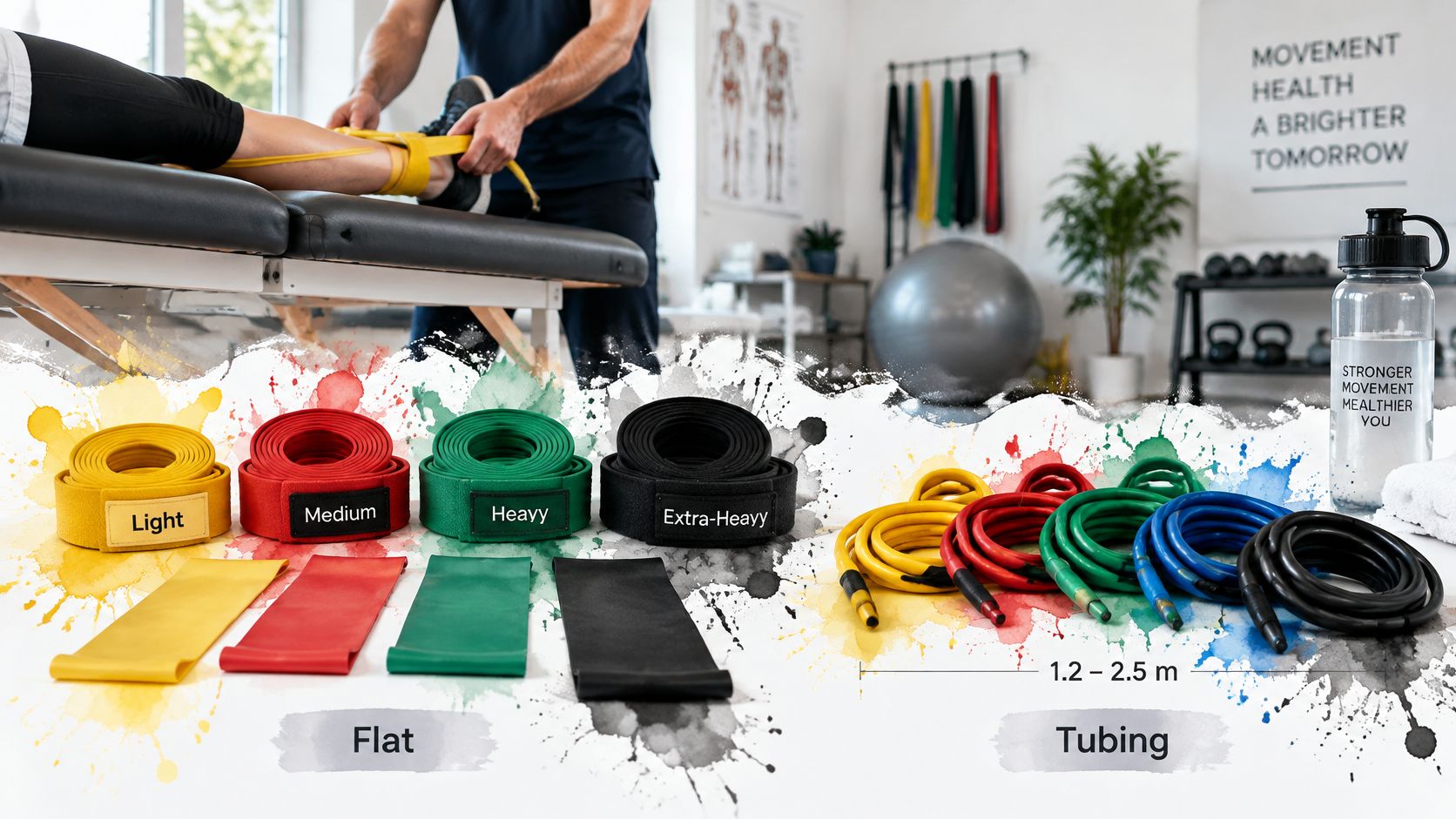
Bands and tubing
Colour coding is standard across most manufacturers, light through extra-heavy, but the colour does not carry a universal resistance value. Pick one brand and stay with it so a progression note means the same thing in every room. Flat bands suit sustained holds and shoulder work; tubing with handles suits rows, presses and any movement where a grip matters. Lengths between 1.2 and 2.5 m cover most clinic use, and door anchors turn any treatment room into a pulley station.
Latex-free TPE versions cost a little more and solve a real problem for patients and staff with latex sensitivity, which belongs in your allergy policy rather than in a conversation at the bench. Retire a band the moment you see nicks, clouding or a colour change along the fold line. A band that snaps mid-extension puts a patient's face and shoulder at risk.
Balls, weights and balance work
Therapy ball diameter should track patient height, not room aesthetics. Roughly 45 cm under 155 cm, 55 cm for 155 to 170 cm, 65 cm for 170 to 185 cm, 75 cm for 185 to 200 cm. Buy burst-resistant ratings for anything used under load, and keep a pump on the accessory order because a soft ball trains nothing.
Free weights run from 0.5 to 10 kg in neoprene, with adjustable ankle and wrist cuffs for the patients who can't grip a handle. Balance and proprioception kit is where clinics under-buy: wobble boards, balance pads, foam rollers in 30 to 90 cm lengths and a mini trampoline all earn their shelf space with post-operative and neurological caseloads.
Practical rule: Buy putty in individual tins per patient, or cut single-use portions. A shared tin picks up whatever was on the last set of hands, and it's the one hand-therapy item nobody thinks to clean.
Hand therapy rounds out the family with putty in five resistances, finger ladders and graded hand exercisers. Gait and functional equipment runs to parallel bars, fixed or folding, with height and width adjustment and 3 to 4 m runs for a usable stride, plus stairs, wedges, peddlers, agility ladders, cones and suspension trainers. If you're setting up a gait lane for the first time, this short walkthrough is worth ten minutes before you bolt anything to the floor.
One progression, start to finish
Take a post-operative knee. Weeks one to three, the patient works seated with putty for grip and circulation, then light flat band for terminal knee extension and gentle hip work. Weeks four to eight, tubing with a door anchor adds resisted stepping, and cuff weights load the quadriceps in short arcs. Weeks eight onward, balance pad work and light trampoline plyometrics rebuild proprioception before a return to running. Same wall of equipment, sequenced properly, and every item on it costs less than one billed treatment session.
Core work runs alongside that progression, and a handout library helps patients keep the thread between visits. The core stability exercise guide is the kind of reference worth printing once and laminating.
Selection notes. Check the latex-free share of your band inventory against your patient list. Confirm every surface wipes clean, because foam and fabric-covered items fail infection control faster than they wear out. Wall-mount the racks and check the fixing weight rating against the load, and keep one spare of every resistance level so a snapped band never ends a session.
Modality Equipment From TENS to Traction
Powered devices are where a clinic's capital budget concentrates and where a purchasing mistake is hardest to unwind. Each family solves a different clinical problem, and each carries its own specification traps and its own licensing obligation. Compare them on the parameters that change how they're used, not on the badge count on the front panel.
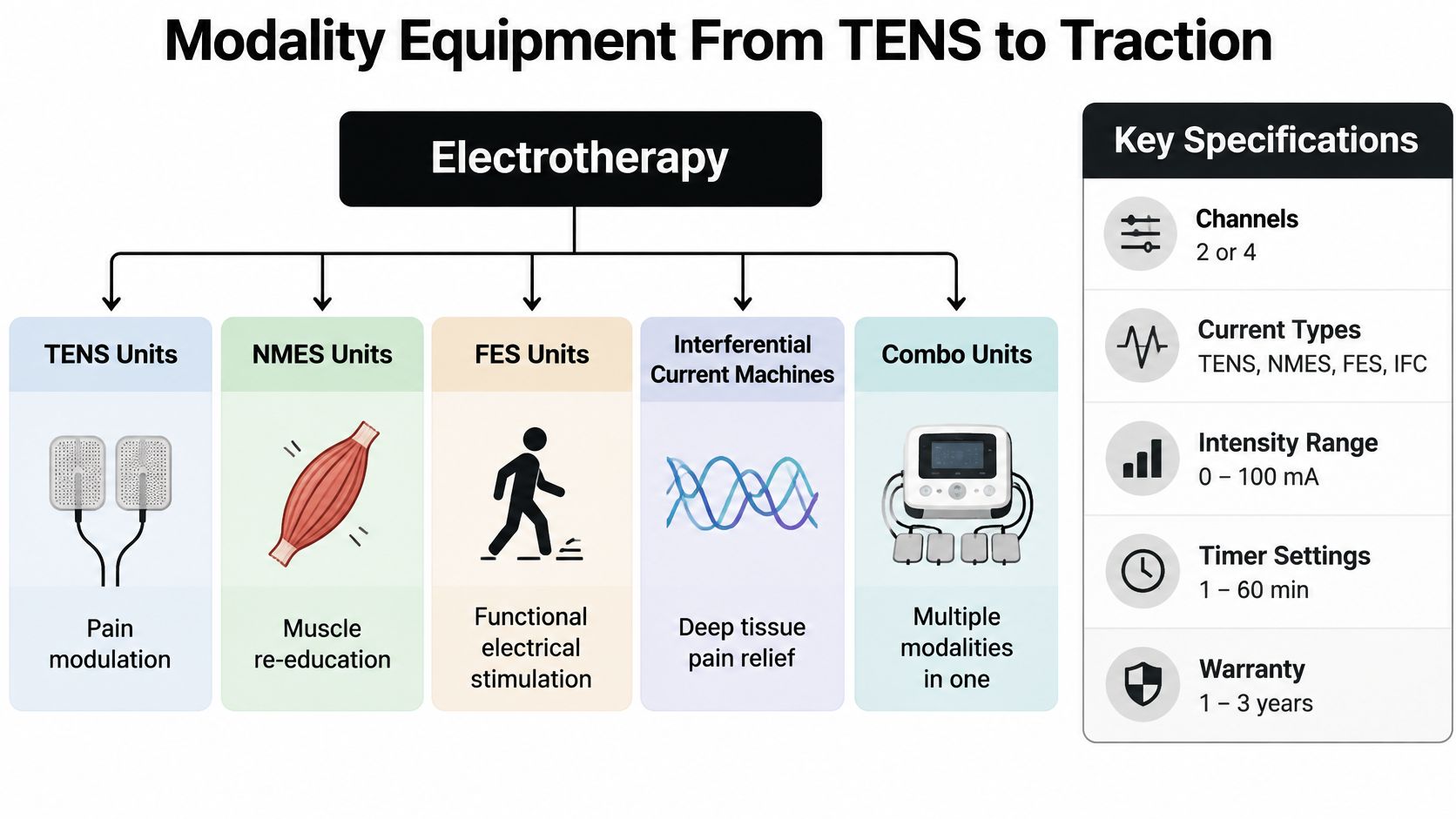
Specs that change the buying decision
Electrotherapy. TENS handles pain modulation, NMES and FES handle muscle re-education and functional work, and interferential machines reach deeper tissue with medium-frequency currents. Compare channel count from one to four, the waveform menu, pulse duration and frequency ranges, and whether the unit runs on mains or battery. Data export matters more than most buyers expect, because a device that logs settings and session time makes charting faster and defensible.
Therapeutic ultrasound. A 1 MHz head treats deeper tissue, a 3 MHz head works superficially, and serious buyers look at continuous versus pulsed duty cycles, 1 cm² and 5 cm² applicators, and the beam non-uniformity ratio. Photobiomodulation splits into class 3B and class 4 lasers with corresponding eye-protection requirements, which is a training and signage cost as well as a device cost.
Traction and thermal. Cervical and lumbar traction systems differ on static versus intermittent pull and on force range, so match the unit to the caseload rather than to the brochure. Hydrocollator tanks run around 70 to 77 °C and need a thermometer, a timer and a log sheet beside them. Paraffin baths, contrast units and cold-compression systems complete the passive-treatment shelf.
Cold remains the cheapest modality in the building and the one most often improvised, so it pays to standardise it. Guidance on ice pack use for back pain covers the timing and skin-check discipline worth building into every room's routine.
The licence check that comes before any purchase
Health Canada distinguishes Medical Device Licences (MDLs) for Class II, III and IV devices from Medical Device Establishment Licences (MDELs), which apply to Class I manufacturers and to establishments importing or distributing devices. Class II to IV devices cannot be sold or imported in Canada without a valid MDL, and importers and distributors generally need an active MDEL, as set out in Health Canada's medical devices overview. The same guidance advises facilities to verify licensing before purchasing and to use Health Canada's active licence listing.
Turn that into a five-step check any clinic manager can run. Identify the device class. Request the manufacturer's Canadian licence number. Confirm the listing is active. Match the label and intended use to what you'll do with it. File the purchasing record so the device is traceable years later. Powered rehabilitation equipment, electrical stimulation and ultrasound systems and traction devices all fall inside this gate. Ordinary exercise items usually don't.
A worked choice
Say your three-room clinic has $1,200 for modalities. One two-channel combo unit with ultrasound and stimulation, mounted on a trolley and shared across rooms, buys more clinical range than three single-purpose TENS units and keeps one purchase record to maintain. A home-care program is the opposite case: single-purpose, battery-powered TENS units that a patient can operate at home win, because the clinical value sits in continuity rather than channel count.
The licence check isn't paperwork for its own sake. A device without an active listing is one you can't defend if something goes wrong, and no discount covers that.
Disposables, Consumables and Reprocessing Routines
Consumables behave like payroll. They recur, they rarely surprise you if you track them, and they stop the clinic dead if they run out. Budget them per session rather than per year: a pair of self-adhesive electrodes, a gel application and a length of couch roll, multiplied by every patient you see, is the recurring spend that hides inside a supply cupboard.
What gets consumed
Electrodes typically hold adhesion for 10 to 15 sessions before the gel dries and contact drops off. Store them gel-side down on the film, reseal the pouch, and retire them when edges lift or the patient reports stinging. Ultrasound gel comes in 5 L jugs for treatment rooms and single-dose packets for home-care kits. Couch roll and face paper get torn fresh per patient, never smoothed over. Nitrile gloves, disinfectant wipes, linen and laundry are pure volume items, and a par level set two to four weeks deep keeps a busy Friday from turning into a rescheduling exercise.
Topical adjuncts belong on the same ordering list. A menthol and camphor rub, a spray for larger areas and a roll-on for cooling maintenance sit at the bench and get used before manual work, which means they deplete on a predictable rhythm.
What gets reprocessed
The College of Physiotherapists of Alberta's infection-prevention guidance treats reprocessing instructions as a purchasing specification, not an afterthought. Health Canada-approved devices and equipment must include manufacturer instructions for appropriate use and reprocessing that address intended use and infection risk, per the College of Physiotherapists of Alberta infection prevention and control guide. In practice, buy tables, reusable electrodes, ultrasound heads and exercise accessories only when the supplier gives you a defined cleaning method, a compatible chemical list, contact time, dilution requirements and limits on immersion or heat.
| Item | Between patients | Routine care | Replace when |
|---|---|---|---|
| Treatment table or plinth | Wipe all contact surfaces with clinic-grade disinfectant and respect the wet contact time | Daily deep clean of frame, seams and headrest | Upholstery cracks or foam loses shape |
| Ultrasound transducer head | Disinfect the head after every use | Inspect cable, housing and couplant seal weekly | Cracked head, loose cable or failed seal |
| Self-adhesive electrodes | Single-patient use only; store gel-side on film | Refresh per manufacturer guidance; never share between patients | Gel dries out or adhesion fails, typically after 10-15 sessions |
| Hydrocollator packs | Use a fresh towelling cover for each patient | Check seams and cover weekly; log tank temperature daily | Pack hardens, leaks or no longer holds heat |
| Exercise mats | Disinfect both sides between users | Inspect for tears weekly | Surface tears, cracking or porous wear |
| Therapy balls and bands | Wipe down after each contact | Check inflation and elasticity weekly | Snapping, cracking or permanent stretch |
| Couch roll and face paper | Tear off a fresh sheet for every patient | Restock each treatment room daily | Single-use, replace by depletion |
For disinfectants used against viruses, the Alberta guidance recommends confirming a Canadian Drug Identification Number (DIN) and verifying effectiveness through Health Canada's database. Keep the device instructions, the disinfectant label, lot information and staff training records together as part of your quality system.
The disqualifier. Porous, cracked or non-cleanable surfaces can't be reliably reprocessed between patients, so exclude them from high-turnover rooms entirely. That single rule retires more worn equipment than any inspection schedule.
Reading a disinfectant label properly is a skill that transfers. If you're comparing actives, dwell times and residue, pet-safe disinfecting for Dallas homes explains how to read contact time and surface compatibility before you commit to a case. Sharps and filament work belongs on the same schedule, and the handling notes in this guide to dry needling cover what to stock alongside it.
Clinic Furnishings and Assessment Tools
The largest line in any room budget is the table, and it's the purchase therapists regret fastest. A fixed-height plinth at 75 cm is fine for a tall therapist treating tall patients and miserable for everyone else, which is why height-adjustable models dominate. Typical electric and hydraulic ranges run from about 45 to 95 cm, weight ratings sit between 160 and 200 kg with bariatric models above that, and widths of 60 to 80 cm cover most body types without turning the room into a corridor problem.
Tables, lifts and therapist backs
Manual crank tables cost less and suit low-turnover rooms. Electric plinths cost more and pay for themselves in any clinic with geriatric, post-operative or bariatric caseloads, because the therapist adjusts with a foot switch instead of lifting a patient's body weight with their own shoulders. Buy the electric lift before the second ultrasound unit. Back injuries among therapists are the expensive kind of false economy.
Look for a headrest with a face hole for prone work, side rails where neurological patients transfer, and upholstery you can wipe without bleaching the colour out of it. Seam construction matters as much as fabric: stitched seams split and trap moisture, while heat-sealed covers survive daily disinfection.
Stools, storage and room layout
Five-caster gas-lift stools with roughly 45 to 65 cm of travel let a therapist sit at the right height for a mat, a plinth or a desk without changing furniture. Beyond stools, the room needs a treatment trolley per bay, a band and ball rack on the wall, and a lockable cabinet for records and anything controlled.
Layout decisions outlast equipment decisions. Leave wheelchair-transfer clearance on at least one side of every table. Route modality cables overhead or along the wall so nobody kicks a lead loose mid-treatment. Specify non-slip flooring in wet zones, and place screens so privacy holds when a door opens.
A room that takes ninety seconds longer to reset between patients costs you more across a year than the difference between a mid-range and a premium trolley.
Handheld assessment tools
Measurement tools are cheap and quietly decisive. A 30 cm and a 45 cm goniometer cover most joints; 180° and 360° scales both work, so standardise on one. Add tape measures, a digital inclinometer, a handheld dynamometer, a reflex hammer and a posture grid. A stopwatch and a set of cones turn any corridor into a timed up-and-go or six-minute walk test, which gives you objective numbers for charting and discharge decisions.
The furnishing decision comes down to caseload. Manual tables suit budget builds and lower turnover. Electric plinths win wherever patients arrive with limited mobility, and the difference shows up in how many patients a therapist can treat in a day without paying for it that night.
Choosing Supplies and Budgeting for Total Cost
Unit price is the least useful number on a quote. Canada's workforce picture explains why. More than 91% of physiotherapists practise in urban areas, leaving rural and remote communities with far fewer providers, and the projected gap runs to approximately 1,590 positions under one workforce scenario and 1,197 under another, according to the Canadian Physiotherapy Association report on expanding physiotherapy education seats. When clinicians are the scarce input, supplies that assume a fully staffed urban clinic with permanent treatment space stop making sense.
| Criterion | What to check | Red flag |
|---|---|---|
| Regulatory status | Device class, valid Medical Device Licence for Class II-IV, active MDEL for the importer or distributor | Supplier cannot produce a licence number or active listing |
| Reprocessing support | Written cleaning method, compatible chemicals, contact time and dilution from the manufacturer | No instructions, or porous and cracked contact surfaces |
| Workflow fit | Setup time, cleaning time, supervision demands and delegability to assistants | Routine tasks that require specialist-only handling |
| Portability and access | Weight, battery life, storage volume and shipping to rural or remote addresses | Clinic-only design for a home-care or travelling caseload |
| Durability and support | Warranty terms, spare parts availability and complaint-handling process | No post-market contact, parts or documented complaints path |
| Total cost per episode | Purchase price plus consumables, cleaning time and replacement interval | Lowest unit price with high consumable lock-in |
The budget method
- List per-room essentials from the category map, room by room, before you look at a single quote.
- Split one-time from recurring. Equipment is capital; electrodes, gel and paper are monthly.
- Run the cost-per-use math. Say a combo unit costs $900 and treats 20 sessions a week for five years. That's 5,000 sessions, or about 18 cents per session. The electrode pairs that recur every few weeks cost more in a year than the device did.
- Hold a replacement reserve of roughly 10 to 15% of equipment value annually, so a failed ultrasound head isn't a budget crisis.
- Phase modality purchases behind proven caseload, never ahead of it.
Worked hypotheticals like that one are how you compare a $300 TENS unit against a $900 combo unit. The cheap device looks efficient until you count the second purchase, the lost clinical options and the extra cleaning time. That logic isn't unique to rehabilitation equipment; buyers comparing large capital items across healthcare make the same calculation, and the cost breakdown for a hyperbaric chamber follows the same shape of purchase price plus installation, consumables and service.
Score every candidate on cost per completed treatment episode, and ask whether it improves access for the patients who can't travel regularly. If it doesn't do either, it's a want.
Vendors can help you test products without a full commitment, and a sample request is worth writing into your evaluation step. Healthcare professionals in Canada can request product samples before committing a room to a new topical format.
Supplies for Remote, Home and Stretched Care
Say a therapist covers a circuit of three towns, a long-term care home and a handful of virtual follow-ups. The kit that works in that car is not a smaller version of a clinic room. It's a different list, chosen for what survives a trunk in February, cleans up in a bathroom sink and needs no instructions beyond a printed sheet.
Rural, home-based and hybrid programs need supplies that travel. Run every candidate past the same checklist before it goes in the bag.
- Shipping and storage. Can it reach a remote address intact, and does it fit in the space you have?
- Power. Battery life, charging time and whether it works without an outlet.
- Cleaning between users. A wipe-down surface beats anything with seams, foam or fabric.
- Replacement intervals. A consumable that dies every six weeks is a logistics problem in a remote region.
- Weather durability. Heat, cold and condensation kill electronics left in a vehicle overnight.
- Instruction design. Written progressions must work without broadband or frequent clinician contact.
Delegation is the design brief
Which items can a physiotherapist assistant, a student or a caregiver run safely, and which need regulated-professional judgment? Bands with printed progression cards, balance pads, putty, a lightweight goniometer, a digital inclinometer and a handheld dynamometer all sit comfortably in delegated hands once the plan is set. Dry needling, sharp handling, modality dosing decisions and reassessment stay with the regulated clinician.
The practical test is the handover. If you can't explain an item's use, contraindications, cleaning and progression in one page, it isn't a home-care product. Documentation should travel with the equipment, and so should infection-control guidance, because the person cleaning it between users may not be a therapist at all.
Buying the lowest unit-price supply can cost more in the field than in the clinic. Frequent replacement, specialist training and clinic-only design all land on the clinician's time, which is exactly the resource that's short. Score each candidate on total cost per completed treatment episode and on whether it gets care to someone who can't travel. For patients managing recurring back pain between visits, the home program notes in this guide to physiotherapy for back pain relief are a useful handout.
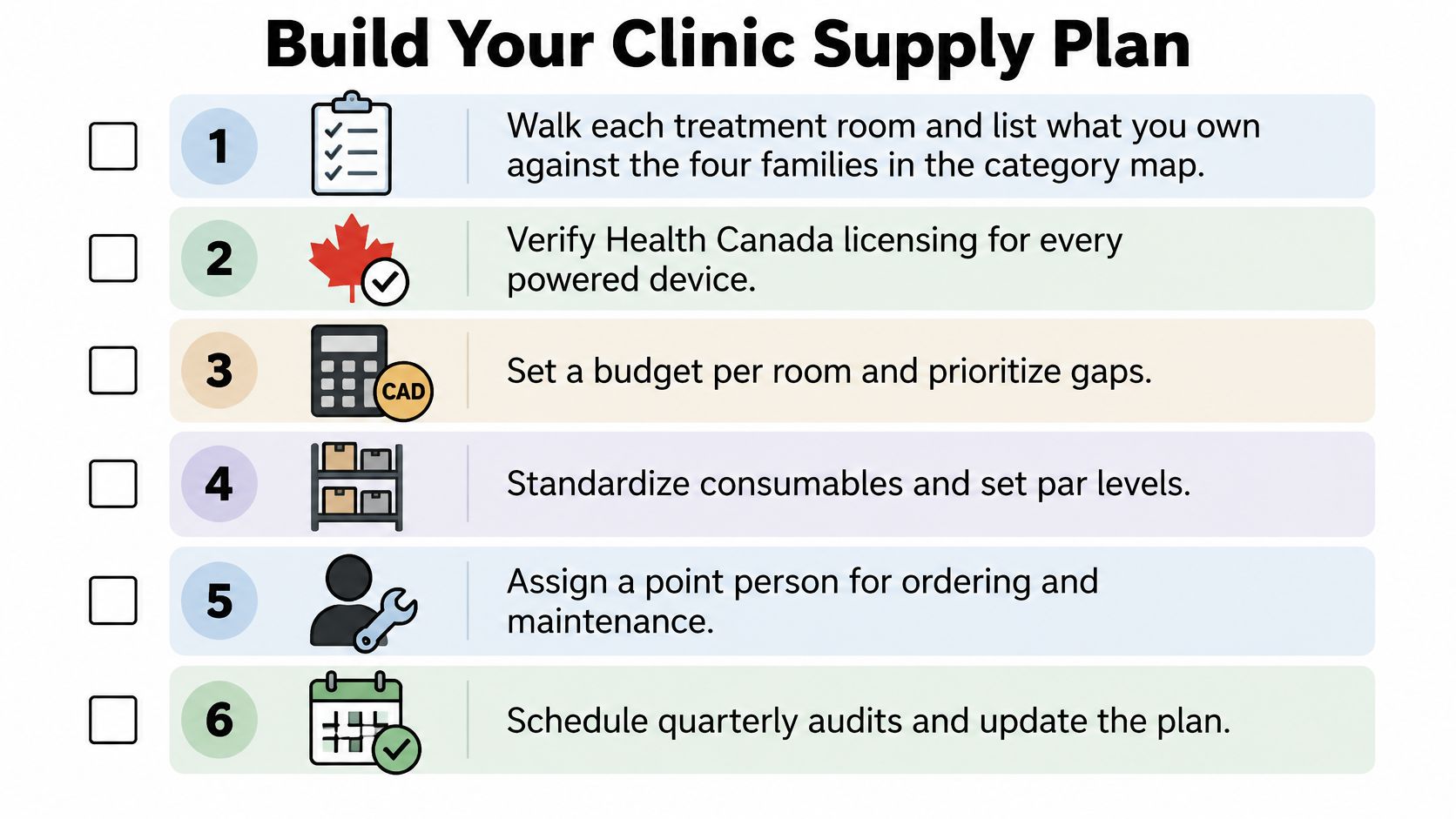
Build Your Clinic Supply Plan
Health Canada's 2025 workforce study estimates a current shortfall of approximately 2,600 physiotherapists, about 10% of required supply, with the gap expected to persist before additional capacity emerges around 2032, according to the federal workforce, education, training and distribution study. A clinic operating inside that shortage should value supplies by how much clinician time they protect, not by how advanced the specification looks.
- Audit each room against the four families. Write down what you own, what's broken and what's missing.
- Verify Health Canada licensing for every powered device before it enters service, and keep the record.
- Attach written reprocessing instructions to every reusable item, and pair each with a DIN-checked disinfectant.
- Set two-to-four-week par levels on consumables so no treatment stops for stock.
- Favour portable and delegable supplies where staffing is tight, using the remote-care checklist above.
- Budget with cost-per-episode math and hold a replacement reserve.
- Re-audit quarterly. Retire anything with cracked or non-cleanable surfaces without debate.
One line item that earns its bench space is a topical analgesic in a format that doesn't slow the therapist down. We make the Power Stick for long-lasting, localized relief, the Power Spray for fast coverage over larger or hard-to-reach areas, and the Daily Defence Roll-On for cooling relief and everyday maintenance. Our products are sold in over 4,500 professional health clinics, pharmacies and retail stores around the world, which means your patients can keep the same format at home.
Print the category map and audit one treatment room before the week is out. You'll find at least one item you can't clean properly and one you've been replacing too often.
Topical pain relief belongs in the supply plan, not in a drawer. MEDISTIK makes a long-lasting extra-strength stick, a fast-acting extra-strength spray and a rapid cooling roll-on, all Canadian-made and formulated to relieve sore muscles and joints before and after treatment. Keep one within arm's reach of every plinth so a patient can settle before manual work begins. Visit MEDISTIK to compare formats and stock the version that suits your rooms.


