

That satisfying ache you feel a day or two after a tough workout? That’s your body’s way of telling you it’s adapting and getting stronger.
This feeling is called Delayed Onset Muscle Soreness (DOMS), and it’s a completely normal—and even productive—part of your fitness journey. It’s the main reason you feel sore after exercise and a clear sign your muscles are busy repairing and rebuilding themselves.
Why Your Muscles Ache After a Good Workout
If you’ve ever felt that signature stiffness walking down the stairs after a heavy leg day, you’ve met DOMS. But what’s really going on inside your muscles to cause that feeling?
For years, people blamed a buildup of lactic acid. We now know that’s not the case. Lactic acid is actually cleared from your muscles pretty quickly after you stop exercising, so it can’t be responsible for the soreness that shows up 24 to 48 hours later.
The real cause is far more interesting. When you challenge your muscles with new or intense exercises—especially movements that lengthen the muscle under tension, like lowering a dumbbell or running downhill—you create tiny, microscopic tears in the muscle fibres.
Think of it like a carefully managed renovation project for your body. To build a stronger, more resilient structure, you first have to create some controlled “damage.” This kicks off your body’s natural repair and inflammatory response.
The Science of Muscle Repair
Once those micro-tears happen, your body gets to work on a sophisticated healing process. This response is what leads to the classic symptoms of DOMS:
- Inflammation: Your immune system sends fluid and repair cells to the area to start cleaning up and rebuilding the damaged tissue. This influx causes a bit of swelling and pressure, which contributes to the ache.
- Increased Sensitivity: The nerves in the area become more sensitive, which is why even a light touch on a sore muscle can feel tender. It's fascinating how these pain signals work—you can dive deeper into the science with our guide on the gate control theory of pain.
- Stiffness: The combination of inflammation and muscle repair can temporarily reduce your range of motion. This is why movement often feels stiff and restricted for a day or two.
This repair cycle is precisely how your muscles get stronger. Your body doesn’t just patch up the micro-tears; it reinforces them, making the muscle fibres thicker and better equipped to handle similar stress in the future.
Ultimately, post-workout soreness is a temporary inconvenience that paves the way for long-term gains in strength and endurance. It’s a good sign that you’ve pushed your body just enough to trigger adaptation. Once you understand the process, you can stop fearing the ache and start seeing it as confirmation of your hard work.
The Soreness Timeline: What to Expect Day by Day
One of the strangest things about that post-workout ache is how it sneaks up on you. You finish a great session, feel fantastic, and then wake up the next morning feeling like you’ve been run over. That classic experience is the calling card of Delayed Onset Muscle Soreness (DOMS), and it follows a surprisingly predictable path.
Knowing this timeline helps you tell the difference between normal muscle adaptation and a potential injury. It gives you the confidence to plan your week without worrying that every ache is a red flag. It’s all just part of your body’s incredible process of getting stronger.
The journey from workout stress to full recovery involves several key stages, where your body breaks down and then rebuilds muscle fibres stronger than before.
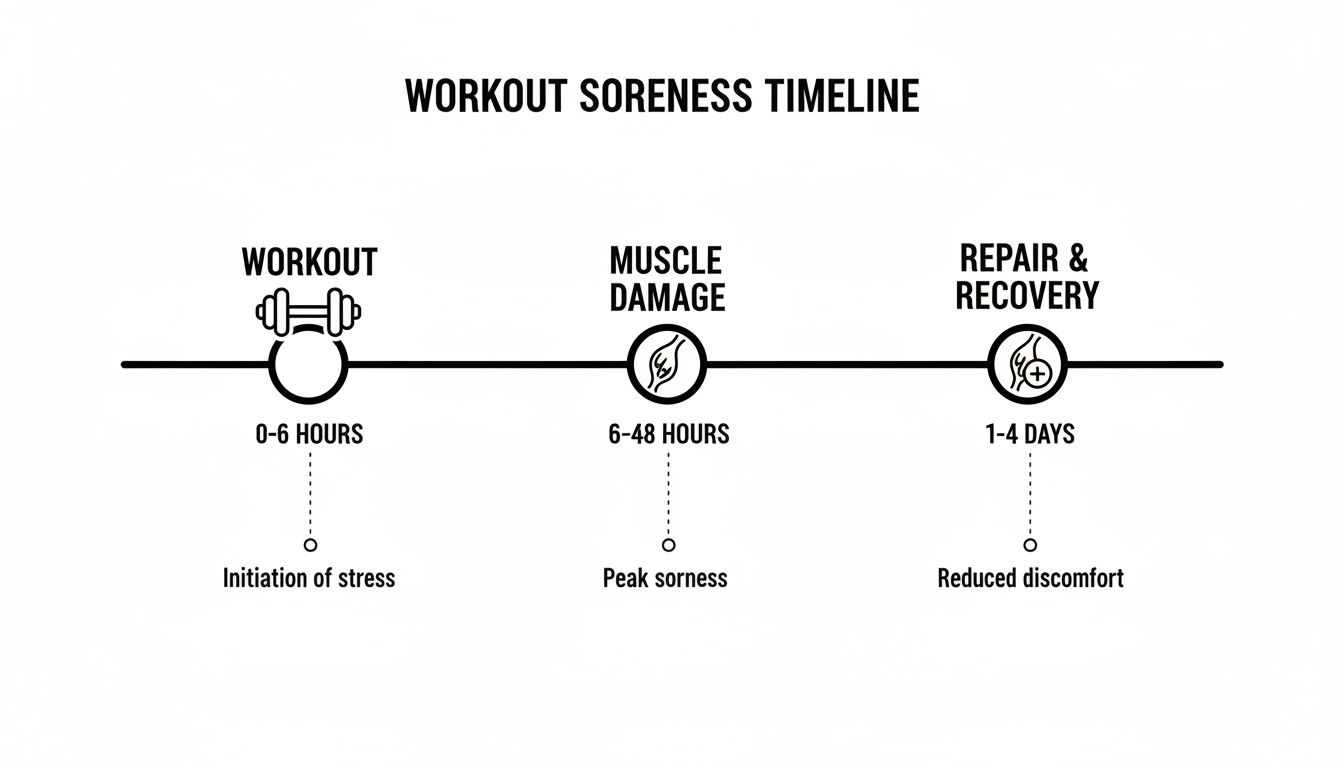
This process starts with microscopic damage during your workout, which kicks off a repair phase that ultimately makes your muscles more resilient. Let's break down what that feels like day by day.
To help you anticipate what's coming, we've outlined the typical progression of DOMS. This timeline can help you manage your expectations and plan your recovery activities accordingly.
The Typical Timeline for Soreness After a Workout (DOMS)
| Time After Exercise | Expected Sensation | Recommended Action |
|---|---|---|
| 0-8 Hours | Minimal soreness; you might feel fatigued but not achy yet. | Rehydrate, have a protein-rich meal, and get a good night's sleep. |
| 8-24 Hours | Mild tightness and tenderness begin to set in. | Gentle movement, like walking or light stretching, can help ease stiffness. |
| 24-48 Hours | Peak soreness. Stiffness, tenderness to the touch, and noticeable discomfort. | Focus on active recovery, stay hydrated, and use topical analgesics if needed. |
| 48-72 Hours | Soreness begins to fade. The sharp ache turns into a dull, manageable sensation. | Continue with light activity. You can gradually reintroduce more intense exercise. |
| Day 4-7 | Most, if not all, of the soreness has resolved. You feel stronger and recovered. | You’re ready to train the same muscle group again. Listen to your body! |
This table provides a general guide, but remember that individual experiences can vary based on your fitness level, the workout's intensity, and your recovery habits.
Day 1: The Calm Before the Storm (The First 24 Hours)
Right after your workout, you probably feel tired but not necessarily sore. The real soreness after a workout usually starts to creep in much later.
This delay is perfectly normal. The inflammatory and repair processes that cause that familiar ache need time to get going. The initial micro-tears are just the beginning of a much larger biological response.
According to the experts at Cambridge Physiotherapy & Rehab Centre in Ontario, DOMS usually starts to make its presence known 6 to 8 hours after a new or intense workout. This first phase often feels like a mild tightness or a growing awareness of the muscles you just trained.
Day 2: The Peak (The 48-Hour Mark)
Welcome to the main event. For most people, muscle soreness hits its peak somewhere between 24 to 48 hours after the workout. This is when inflammation is at its highest, leading to the most noticeable discomfort, stiffness, and sometimes even a temporary drop in strength.
If you hit a heavy squat session on a Monday, Wednesday morning is probably when you'll really feel it. Getting out of a chair might suddenly feel like a Herculean task, and the muscles you worked will likely be tender to the touch.
This peak soreness isn't a sign that you did something wrong; it's a clear signal that your body is in the thick of its repair and rebuilding cycle. It’s a temporary state that paves the way for stronger, more resilient muscles.
This is a critical time for recovery. Trying to push through another intense workout on the same muscle group right now is counterproductive and can get in the way of proper healing.
Day 3 and Beyond: The Road to Recovery
After hitting its peak, the soreness should finally start to fade. From day three onward, you should notice a steady improvement. The sharp ache mellows out into a duller, more manageable feeling, and your range of motion will begin to return to normal.
How long this final stage takes can depend on a few things:
- Workout Intensity: A tougher or brand-new workout will naturally require a longer recovery time.
- Your Fitness Level: Seasoned athletes tend to bounce back quicker than beginners whose bodies are still adapting.
- Recovery Habits: How well you sleep, eat, and hydrate makes a massive difference in how quickly your body can repair itself.
In most cases, DOMS fully resolves within 3 to 7 days. By the end of the week, you should feel pretty much back to normal—and your muscles will be stronger for it. Managing this period well is a key part of any smart training plan. Our guide to muscle recovery after a workout has more strategies to help you bounce back even faster.
Is It Soreness or an Injury? How to Tell the Difference
After a really tough workout, a bit of discomfort is almost a badge of honour. But as the aches and pains start to creep in, that nagging question pops into your head: is this just normal soreness after a workout, or did I actually injure myself?
Learning to tell the difference is a critical skill for anyone who's active. It's what helps you decide whether you just need a rest day or if it's time to seek professional medical advice. The good news is, your body sends pretty clear signals—you just have to know how to read them.
Decoding Your Body’s Signals
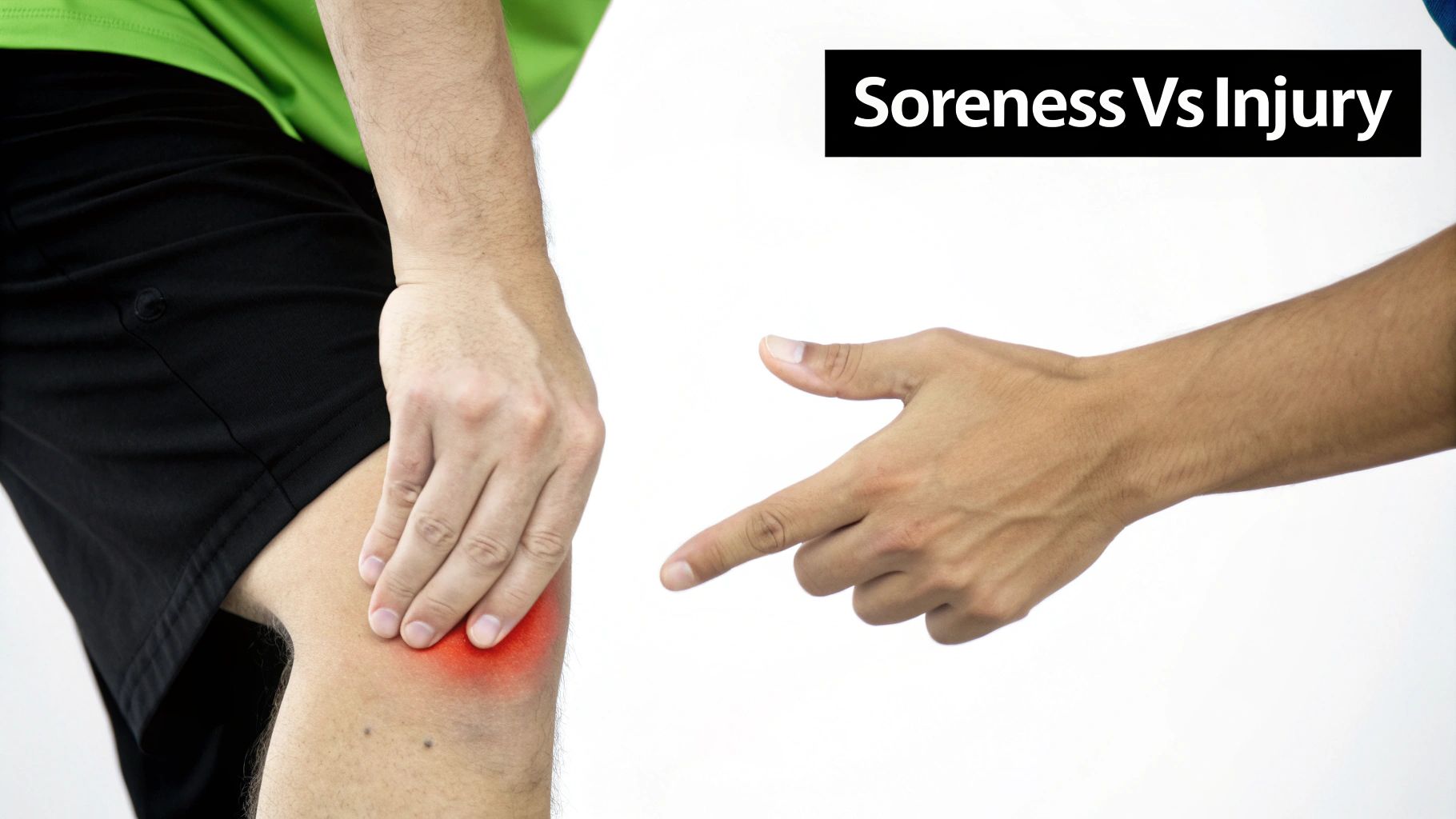
The biggest giveaway is the type of pain you're feeling. DOMS is almost always a dull, generalized ache that spreads across the whole muscle you just hammered. If you crushed a leg day, you’ll feel it through your entire quads, glutes, and hamstrings—not just one tiny spot.
An injury, on the other hand, usually screams at you with a sharp, stabbing, or shooting pain. It’s typically very localized, meaning you can often point to the exact spot with one finger. Think of that sudden, sharp twinge in your hamstring during a sprint or a specific pinch in your shoulder during an overhead press. That’s your body’s alarm bell, and it’s telling you something is wrong.
Timing is the other huge clue. As we've covered, DOMS is delayed. It doesn’t even start to show up for several hours and usually hits its peak around the 48-hour mark. In stark contrast, the pain from an acute injury like a muscle strain or ligament sprain is almost always immediate. It happens in a split second, right in the middle of a movement.
If you can pinpoint the exact moment the pain began during your workout, it is much more likely to be an injury. Normal workout soreness doesn't have a specific "start time"; it gradually appears long after you've left the gym.
To make things even clearer, let's look at the symptoms side-by-side.
DOMS vs. Acute Injury: A Quick Comparison Guide
This chart is a handy tool for quickly figuring out if what you're feeling is normal post-workout soreness or something that might need a closer look.
| Symptom | Delayed Onset Muscle Soreness (DOMS) | Acute Injury (e.g., Strain or Sprain) |
|---|---|---|
| Pain Type | A general, dull ache or tenderness. | A sharp, shooting, or stabbing pain. |
| Pain Location | Diffuse pain felt across a large area of the muscle. | Localized pain you can often point to with one finger. |
| Onset | Gradual, appearing 12-48 hours after exercise. | Immediate, occurring suddenly during a specific movement. |
| Effect on Function | Causes stiffness but movement is still possible. | May cause swelling, bruising, or inability to bear weight. |
| Symmetry | Usually felt on both sides of the body (e.g., both legs). | Typically occurs on one side of the body. |
| Progression | Pain improves steadily after peaking around 48 hours. | Pain may worsen over time or feel unstable. |
At the end of the day, listening to your body is everything. If the pain is sharp, localized, and comes with swelling or a major loss of movement, it’s wise to stop what you're doing and check in with a healthcare professional.
But if it's that familiar, widespread ache that showed up a day later? That's likely just the sign of a workout well done and your muscles getting stronger.
Smart Training Habits to Minimize Severe Soreness
While a bit of muscle ache can be a good sign you’re making progress, that debilitating soreness after a workout that has you wincing for days isn’t the goal. Real fitness gains are built on consistency, and it's impossible to be consistent when you’re too sore to move properly. The trick is to learn how to work with your body, not against it.
This means switching your mindset from just pushing through the pain to managing it proactively. By building a few smart habits into your routine, you can keep post-workout soreness at a level that’s manageable. This allows your muscles to adapt and get stronger without feeling completely overwhelmed. It’s all about finding that sweet spot where you're challenging yourself enough to spark change but not so much that you sideline yourself for the next session.
Three key pillars will help you find this balance: a solid warm-up, smart workout programming, and making rest a priority. Each one plays a crucial role in getting your body ready for stress and helping it bounce back efficiently.
Prepare Your Muscles with a Dynamic Warm-Up
Jumping straight into heavy lifts or an intense workout without any prep is like asking your muscles to go from zero to one hundred in an instant. A proper warm-up isn't optional; it's the crucial transition that tells your body it's time to work.
Forget about old-school static stretching where you hold a pose for 30 seconds. Before you train, you need a dynamic warm-up. This means using active movements that look a lot like the exercises you’re about to do. This gets your blood flowing, warms up your muscles, and switches on the exact muscle groups you plan to target.
A great dynamic warm-up could include things like:
- Leg Swings: To get the hips and hamstrings moving freely.
- Arm Circles: To prepare the delicate shoulder joints for pressing or pulling.
- Bodyweight Squats: To wake up the glutes, quads, and core before you hit the squat rack.
- Walking Lunges: To engage your whole lower body and work on your balance.
This simple prep work helps your muscles contract more efficiently and can seriously reduce the microscopic damage that leads to that intense, next-day soreness.
Embrace the Principle of Progressive Overload
The number one reason people get painfully sore is doing way too much, way too soon. Your muscles are designed to adapt, but they respond best to gradual changes. This is the core idea behind progressive overload, and it's the bedrock of any smart training plan.
Instead of making huge jumps in your weights or workout volume from one week to the next, focus on making small, steady improvements. This gives your muscle fibres, tendons, and ligaments the time they need to adapt and strengthen, which minimizes the shock to your system.
Progressive overload is all about playing the long game. It makes sure you’re consistently challenging your body enough to grow, without causing so much damage that you need days to recover.
Let's say you're working on your squats:
- Week 1: Start with 3 sets of 10 reps using just your body weight.
- Week 2: Do the same 3 sets of 10, but this time hold a light dumbbell.
- Week 3: Increase the dumbbell weight slightly, or add 2 more reps to each set (3 sets of 12).
This methodical approach is far more sustainable and effective than grabbing a heavy barbell on day one and hoping for the best.
Prioritize Rest and Intelligent Programming
Finally, how you structure your training week is one of the most powerful tools you have for managing soreness. Your muscles don't get stronger while you're working out—they rebuild and get stronger during the rest periods in between. If you skip rest, you’re just accumulating fatigue and making soreness worse.
According to the Canadian fitness publication Impact Magazine, DOMS often peaks 24-48 hours after a workout, especially after eccentric movements (like the controlled lowering phase of a lift). This soreness is directly linked to your training volume and intensity. Without enough recovery, you can end up with nagging fatigue and see your performance drop. You can read more about the connection between recovery and performance on their site.
A well-designed program builds rest right into the schedule to prevent this. A simple rule is to avoid training the same muscle group on back-to-back days. For example, if you have a tough leg day on Monday, give those muscles at least 48 hours to recover. You could train your upper body on Tuesday, giving your legs the downtime they need to repair and come back stronger.
Proven Recovery Methods for Faster Relief
When that intense soreness after a workout hits, your first thought is probably how to get rid of it—fast. While there isn't a magic button to instantly erase DOMS, a smart recovery plan can seriously speed things up and dial down the discomfort. The goal is to work with your body's natural repair cycle, not against it.
This isn't just about what you do right after you finish your last rep. Real recovery is a mix of immediate relief tactics and solid, long-term habits. By focusing on both, you can ease the ache, help your muscles repair, and get back to your next session feeling stronger and more resilient.
Let's break down the proven methods that belong in every solid recovery toolkit.
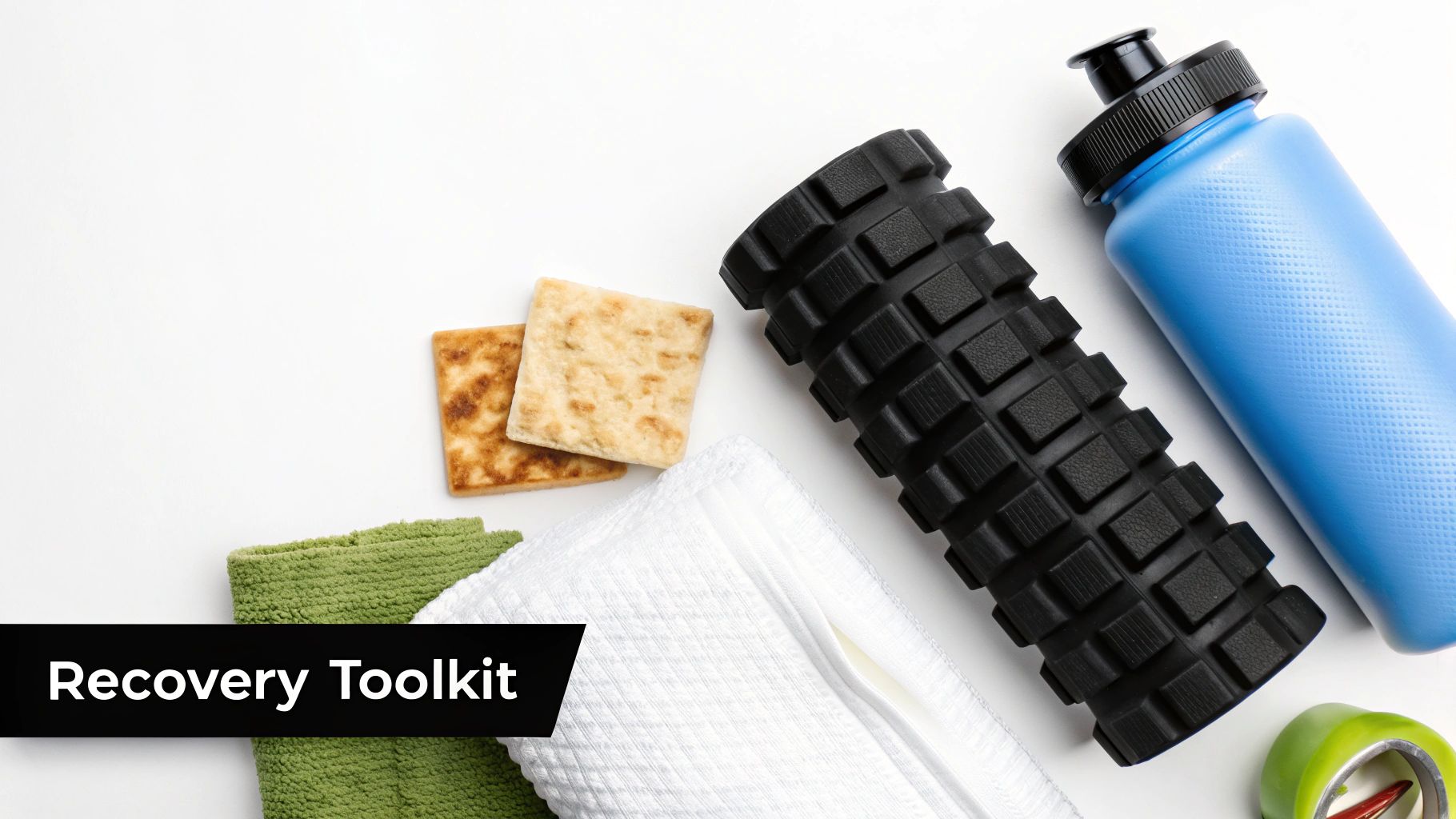
Embrace Active Recovery
I know, moving is probably the last thing on your mind when your muscles are screaming. But gentle activity is one of the best things you can do. It's called active recovery, and it’s all about low-intensity movement that gets your blood flowing without adding more stress to your muscles.
Think of it this way: your sore muscles are filled with metabolic waste and fluids from the repair process. Active recovery acts like a gentle pump, circulating fresh, oxygen-rich blood into the area while flushing out all that gunk. The result? Less stiffness and soreness.
Some great active recovery options include:
- A light walk or a slow spin on a stationary bike
- Gentle swimming or water aerobics
- Dynamic stretching, like leg swings and torso twists
- A light yoga or mobility session
Even just 15-20 minutes of this kind of movement the day after a tough workout can make a huge difference. It stops you from feeling completely seized up and helps kick-start the healing process.
Fuel Your Body for Repair
You can’t out-train a bad diet, and you definitely can't out-recover one. What you eat is one of the most critical pieces of the recovery puzzle. Your body needs the right building blocks to mend those microscopic tears and rebuild your muscles even stronger.
Protein is the star of the show here. It provides the essential amino acids your body needs to patch up damaged muscle fibres. Try to get a quality protein source in within a few hours of your workout to give your body the raw materials it needs right away.
But it’s not just about protein. Carbohydrates are just as important for refilling the glycogen stores you burned through during your workout, which gives you the energy for your next one. To prime your body for healing and cut down on discomfort, figuring out what foods help muscle recovery is a must.
Hydration is another non-negotiable. Being dehydrated can make muscle soreness feel even worse and slows down the whole repair process. A good rule of thumb is to drink at least 8 ounces (240 ml) of water for every 15-30 minutes of intense exercise.
Prioritize Quality Sleep
Sleep is when the real magic happens. While you're in a deep sleep, your body releases human growth hormone (HGH), which is a powerhouse for tissue repair and muscle growth. Skimping on sleep is like asking a construction crew to rebuild a house with half their tools missing—the job will be slow and sloppy.
Most adults need 7-9 hours of quality sleep a night for optimal recovery. If you're training hard, your body might need even more. Making a consistent sleep schedule and creating a restful environment can be one of the most powerful recovery tools you have.
Use Topical Analgesics for Targeted Relief
Sometimes, you just need direct relief to get through the day. Topical analgesics, like MEDISTIK's line of pain relief products, are a great way to manage soreness right at the source.
These products work by creating sensations like cooling or warming, which help to override the pain signals your brain is receiving. This lets you move more comfortably while your body gets on with its internal repair work. If you're wondering whether to go hot or cold, our guide on using heat or cold for muscle strains can give you some extra clarity.
When you combine these strategies—gentle movement, smart nutrition, deep sleep, and targeted topical relief—you create a powerful system for managing soreness and bouncing back faster.
When to See a Professional About Muscle Soreness
Knowing the difference between the good ache of your muscles getting stronger and a real injury is one of the most important skills you can develop. While most soreness after a workout is a positive sign of adaptation, there are certain red flags you absolutely shouldn't ignore. Think of it this way: your body is constantly sending you signals. Learning to read them correctly is key to staying safe and making long-term progress.
The main difference comes down to the severity, timing, and type of pain you’re feeling. Normal DOMS is predictable—it ramps up, peaks around 48 hours, and then gradually fades away. Pain that sticks around longer, gets worse, or feels sharp and sudden is your body’s way of saying, "Hey, something isn't right here."
Red Flags That Warrant Medical Attention
If you experience any of the symptoms below, it’s time to stop guessing and book an appointment with a doctor or physiotherapist. Pushing through these kinds of pain can turn a small setback into a major, long-lasting problem.
You should pay close attention if your pain is:
- Progressively Worsening: If your soreness is getting worse after that initial 48-hour window instead of better, that's a clear warning sign.
- Sharp and Localized: The dull, widespread ache of DOMS is one thing. A stabbing, shooting pain that you can point to with a single finger is much more likely to be an injury.
- Accompanied by Significant Swelling: Mild inflammation is part of the muscle-building process. But if you see obvious swelling, especially if it's just on one side of your body, it could signal a tear or sprain.
- Causing Numbness or Tingling: Sensations like pins and needles or a radiating nerve-like pain have nothing to do with DOMS. These could point to nerve compression or another serious issue that needs a proper diagnosis.
Trust your gut. If a pain feels completely different from any post-workout soreness you've had before, or if it’s so bad you can’t do simple daily activities for more than a few days, get it checked out.
For instance, if you can’t fully straighten or bend your arm or leg without a sharp jolt of pain several days after a workout, you might be dealing with an injury that needs professional care. The same goes for any area that feels hot to the touch or shows unusual bruising. Seeking medical advice is always the smartest move—it's what will get you back to your training safely and without delay.
Your Top Questions About Workout Soreness, Answered
Let's tackle some of the most common questions that pop up when you're dealing with post-workout aches. Getting straight answers will help you feel more in control of your recovery game.
Should I Work Out When I’m Sore?
The best advice is always to listen to your body. If you're dealing with a mild to moderate muscle ache but can still move around comfortably, some light activity is actually a great idea. We call this active recovery.
Gentle movement, like a walk, an easy bike ride, or some dynamic stretching, helps get the blood flowing to those sore muscles. This can flush out waste products and kickstart the repair process, often leaving you feeling better than if you did nothing at all.
But if the soreness is severe—we're talking sharp pain or it’s seriously limiting your range of motion—it’s time for a proper rest day. You could also choose to work on a completely different muscle group. Pushing through intense pain won't do you any favours; it can hinder muscle repair and even lead to injury.
What Should I Eat to Help with Soreness?
Never underestimate the power of nutrition in managing muscle soreness. Your body is trying to repair those microscopic tears in your muscle fibres, and it needs the right fuel to do the job. You'll want to focus on two key things:
- Protein: This is non-negotiable for muscle repair. Try to get a quality protein source—think chicken, fish, eggs, or legumes—within a few hours after your workout.
- Hydration: Being dehydrated can make muscle soreness feel even worse and definitely slows down your recovery. Keep sipping water all day, especially after a tough session. A good target is to drink 240 ml for every 15-30 minutes of intense exercise.
Adding some anti-inflammatory foods into the mix, like berries, leafy greens, and fatty fish, can give your body an extra recovery boost.
It all comes down to this: you need fuel to recover. Good nutrition and plenty of water give your body the raw materials it needs to rebuild tissue, calm inflammation, and cut down how long you feel sore after a workout.
Is It Bad if I Never Get Sore After Workouts?
Not at all! While soreness is a pretty common sign that you’ve challenged your muscles, not feeling sore doesn’t mean your workout was a waste of time. As your body adapts to a routine, it gets much more efficient at handling that stress, which naturally leads to less soreness.
Think of it as a sign that your fitness and resilience are improving. If you're training consistently and using progressive overload—gradually upping the weight, reps, or intensity—you are definitely still making progress. A lack of soreness can simply mean you've dialled in your recovery and your muscles are adapting just like they're supposed to.
Feeling the burn from a great workout? Don't let soreness sideline you. MEDISTIK offers powerful, targeted pain relief to help you recover faster and get back to doing what you love. Explore our Canadian-made recovery solutions today.


