

You reach back for your seatbelt and feel a knife-like jab beneath your right shoulder blade. Or you're sitting when a deep breath catches in the same spot. Before stretching it, notice what came with it: trouble breathing, faintness, sweating, chest discomfort or sudden weakness changes what you should do next.
Why a Jab Under the Right Shoulder Blade Misleads
The shoulder blade, or scapula, sits over the ribs and connects with muscles that move your arm, neck and upper back. Pain beneath it can come from those tissues, but the location alone doesn't tell you which structure needs attention. A sore muscle, an irritated rib joint and pain referred from an internal organ can feel surprisingly similar.
Say the jab began while you were pulling a heavy bag across the car seat. Reaching reproduces it, relaxing your arm eases it, and you otherwise feel well. That pattern provides a different starting point from pain that arrives without movement and comes with nausea or breathlessness.
Use movement as a clue, not a clearance test
Once emergency symptoms have been excluded, gently compare comfortable movements. Does lifting your arm, shrugging or turning your trunk clearly change the familiar pain? A consistent change makes a mechanical source, such as muscle or joint irritation, more plausible.
If shoulder movement is full and easy but the jab stays unchanged, pay closer attention to breathing, meals, skin sensitivity and how you feel overall. Don't repeatedly provoke a sharp pain to prove a theory.
Practical rule: Movement can help sort the possibilities. It cannot rule out a heart, lung or abdominal problem.
Pain deserves attention without assuming the worst. According to Statistics Canada's 2024 publication, 16.7% of Canadians aged 15 and older, or 4.9 million people, had a pain-related disability in 2022. That describes pain-related disability broadly, not the likelihood that a shoulder-blade jab is dangerous.
Why the feeling doesn't name the cause
Sharp doesn't automatically mean damaged bone, just as tenderness doesn't prove that muscle is the only source. Your nervous system interprets signals from several tissues; how pain is processed by the brain helps explain why the place you feel pain isn't always its origin.
The useful question isn't whether stabbing pain under the right shoulder blade sounds muscular. It's whether the complete pattern supports home care, clinical assessment or emergency help. Emergency features take priority over every movement clue.
When to Call 911 Instead of Treating It at Home
Sudden or severe pain plus trouble breathing, faintness, sweating, neurologic change or coughing blood is an emergency, not a shoulder workout problem. Call 911 now. Neurologic change includes new weakness, difficulty speaking or a sudden loss of sensation.
Don't wait for dramatic chest pain. MyHealth Alberta's emergency guidance identifies discomfort spreading to the back, shoulders, neck, jaw or arms, particularly with sweating, breathlessness, nausea or light-headedness, as a reason for emergency action.
Use these combinations to recognise when home treatment isn't appropriate.
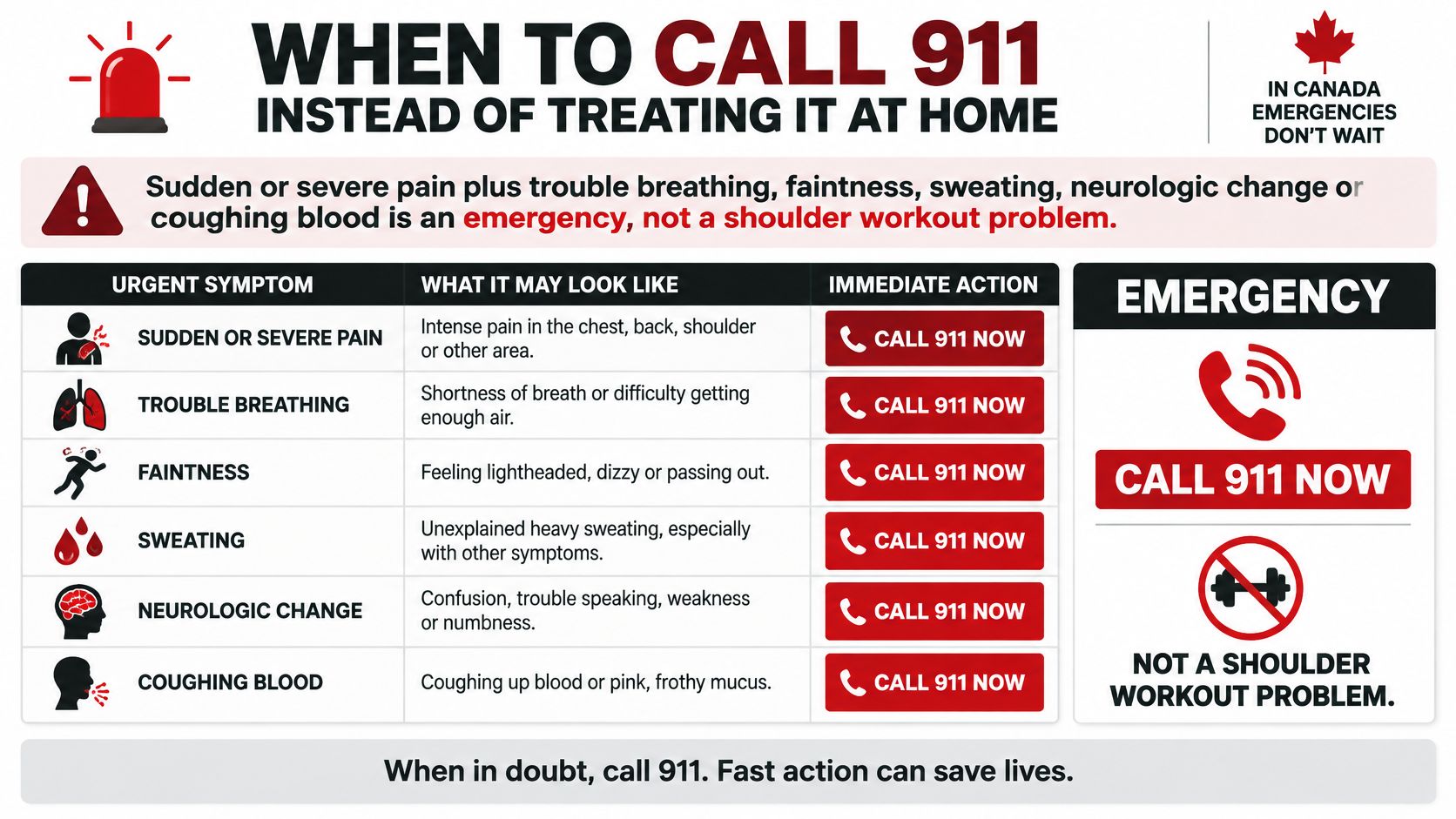
Emergency patterns with pain under the shoulder blade
| Pattern | Why it cannot wait | Action |
|---|---|---|
| Pain with breathlessness, sweating, nausea, faintness, chest pressure or pain on exertion | Upper-back discomfort can be an anginal equivalent, meaning a symptom of reduced blood flow to the heart, even with little chest pressure | Call 911 |
| Pleuritic pain, coughing blood, rapid breathing or heart rate, or fainting, particularly with recent immobility, cancer, pregnancy or hormone use | Possible pulmonary embolism or another severe lung problem | Call 911 |
| Pain maximal at onset with shock, unequal pulses or a new neurologic deficit | Possible vascular emergency | Call 911 |
Pleuritic pain means pain that worsens when you breathe in. When it starts suddenly with unexplained breathlessness, it needs emergency assessment rather than a stretch to loosen the ribs. Recent surgery, prolonged immobility, a previous blood clot, active cancer, pregnancy, the postpartum period and hormone use increase concern.
Pain that is at its worst immediately is another important pattern. If it accompanies collapse, new weakness or signs of shock, such as pale, clammy skin and severe faintness, don't spend time checking your own pulses or trying to identify the cause.
What to do while help is coming
Stop the activity and call for assistance. Don't drive yourself if you're faint, breathless or potentially having a cardiac or vascular emergency; follow the dispatcher's instructions.
Skip exercise, massage, heat and topical pain-relief trials while these warning features are present. Temporary improvement after rubbing the area wouldn't establish that the cause was harmless.
Athletes and people doing physical work can understandably connect pain with their latest effort. Older adults may also attribute unfamiliar discomfort to an existing shoulder problem. Neither fitness nor a history of muscle pain clears a new emergency pattern.
These features are prompts for emergency assessment, not home diagnoses. An isolated, brief twinge isn't the same as pain accompanied by collapse or breathing difficulty. The purpose is to act on concerning combinations, not to label every jab a heart attack.
Clues That Separate Muscle Pain From Referred Pain
| Clue | More likely source | Next step |
|---|---|---|
| Pain changes with reach, shrug or posture | Rhomboid, trapezius or other scapular muscle trigger point or strain | Short-term muscle care only if no emergency features; arrange a clinic visit if it lingers |
| Catch on a deep breath, cough, twist or lying on that side | Rib dysfunction or intercostal strain is possible, but lung causes must also be considered | Ease the provoking movement; seek assessment for unexplained breathing-related pain, worsening breathing or persistent symptoms |
| Full, easy shoulder motion plus nausea, right-upper belly pain or a link to meals | Referred visceral pain, including gallbladder patterns | Medical assessment rather than repeated stretching |
| One-sided burning or stabbing with sensitive skin, with or without a later rash | Possible shingles rather than a simple strain | Prompt clinical care; topicals don't treat the virus |
| Breathlessness, sweating, nausea, faintness, chest pressure or pain on exertion | Possible cardiopulmonary emergency | Call 911 now; don't trial heat, massage or topicals first |
Compare the familiar pain during easy movement
Only use this comparison when no emergency pattern applies. Slowly raise the arm within a comfortable range, relax it, then gently shrug and turn your upper body. Notice whether the same familiar jab changes, rather than whether you can create any discomfort by pushing farther.
A repeatable relationship with reaching or posture supports a mechanical explanation. For example, pain that appears when you reach across a desk and eases when you bring the keyboard closer suggests that loading matters. It doesn't identify a specific muscle or exclude another condition.
Comfortable shoulder motion is useful for a different reason: it makes a primary shoulder-muscle problem less convincing when other symptoms are present. Neck or thoracic nerve irritation can also refer pain here, so the alternative isn't always an internal organ.
Read the clues that movement misses
A catch during a cough or twist may involve the rib cage. But deep breathing also moves the lining around the lungs, which is why breathing-related pain shouldn't automatically be called a rib problem. Fever, a new cough or breathlessness changes the priority from loosening the area to medical assessment.
Alberta Health's shoulder guidance identifies gallstones, pancreatitis, pneumonia and other lung conditions as possible referred sources; lung-related pain can appear around the shoulder blade on the same side. Nausea, upper abdominal discomfort or a recurring relationship with meals therefore deserves attention even when the back feels like the main problem.
A burning strip of sensitive skin is different again. If clothing brushing the area feels unusually painful, inspect the skin rather than assuming there's a knot underneath it. Blisters may appear after the pain starts.
Don't force every symptom into the first explanation that seems to fit. A tender back and an unrelated medical problem can occur together.
For readers trying to describe the sensation, this guide to bone versus muscle pain offers useful vocabulary. Neither a deep ache nor a sharp jab reliably names the tissue.
The strongest clue is the combination: what changes the pain, what accompanies it and how it began. The location under the right scapula does not identify the injured tissue.
How Muscle, Ribs, Organs and Shingles Share This Spot
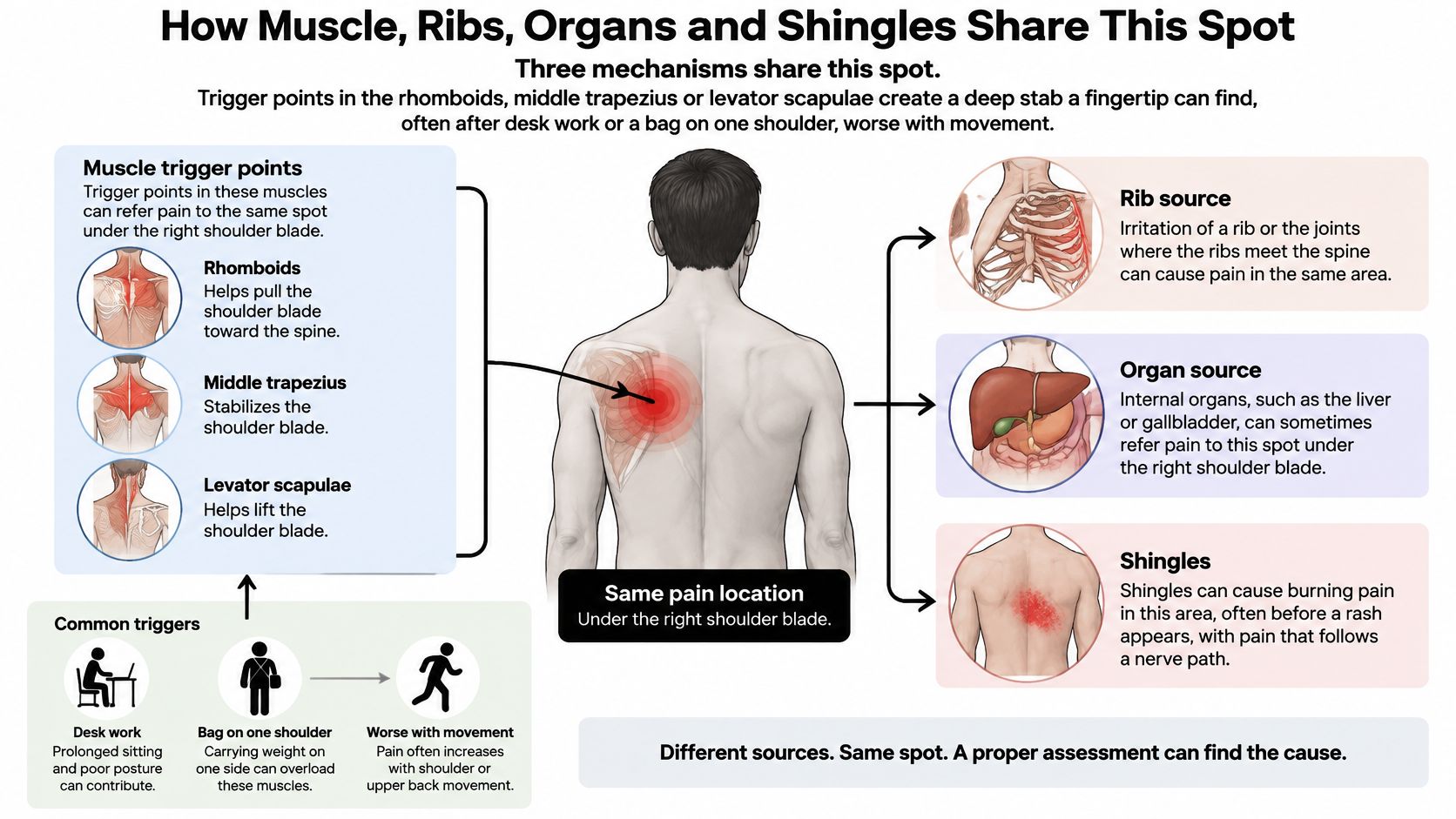
Muscle, rib and organ-related pain can overlap beneath the scapula, while shingles can add a skin-and-nerve pattern in the same area. The distinction comes from how each source behaves, not from pointing more precisely at the painful spot.
This illustration places those possibilities alongside one another.
Muscle loading and a local rib catch
The rhomboids and middle trapezius help control the shoulder blade; the levator scapulae links its upper region with the neck. Prolonged reaching, unfamiliar lifting or carrying a bag on one shoulder can leave these tissues sore. A tender area sometimes described as a trigger point may produce a deep, local stab when pressed or loaded.
Say you spent the weekend leaning over a laptop. The discomfort changes when you move your arm, and bringing the screen closer makes sitting easier. That supports investigating muscle load and work position rather than searching for a permanently perfect posture.
Work exposure can matter: a 2025 Canadian cohort study published in Annals of Work Exposures and Health included 1,885 welders and electrical workers and found that cumulative work at or above shoulder height increased welders' shoulder-pain risk by a hazard ratio of 1.07 per logarithmic increase in exposure hours. That finding concerns occupational shoulder pain, not a diagnosis for an individual scapular jab.
The ribs connect with the thoracic spine and move during breathing. Irritation around these joints or strain in the intercostal muscles between the ribs can hurt during coughing, rotation or side-lying. A catch after a hard cough doesn't mean a rib is out of place, and it isn't a reason to force it back.
An overview of the mid-back muscles can help you locate the surrounding structures. For pain much lower down near the floating ribs, VirusFAQ.com's resource on understanding 12th rib syndrome symptoms addresses a different anatomical area; it shouldn't be used to label upper scapular pain.
Organ signals and sensitive skin
Referred pain is like an alarm pointing to the wrong street. Nerve signals from an organ and the body wall can converge, so the brain may locate the discomfort away from its origin. A jab after a rich meal with right-upper abdominal discomfort raises different questions from a sore spot after lifting.
This video provides additional visual context for pain in the shoulder-blade region; it isn't a diagnostic test.
Shingles involves reactivation of the virus that causes chickenpox. Before a rash appears, a person may notice tingling, burning, stabbing pain or unusual sensitivity in a one-sided band.
The BC Centre for Disease Control estimates that 15%–28% of people develop shingles during their lifetime, and approximately 10%–15% of people with shingles develop postherpetic neuralgia, with pain continuing after the rash resolves. These figures explain why a new sensitive band shouldn't be dismissed as ordinary muscle soreness.
Seek prompt care for suspected shingles, particularly with blisters, fever or a weakened immune system. Topical analgesics may ease symptoms temporarily, but they don't treat the underlying viral infection.
Short-Term Relief for a Mechanical Jab
Limit this routine to discomfort that clearly changes with posture or movement, has a plausible mechanical trigger and comes with none of the emergency features. Unexplained pain with breathing, abdominal symptoms, fever or a sensitive rash needs assessment instead.
The aim is to reduce aggravation while keeping comfortable movement available, not to force the pain away.
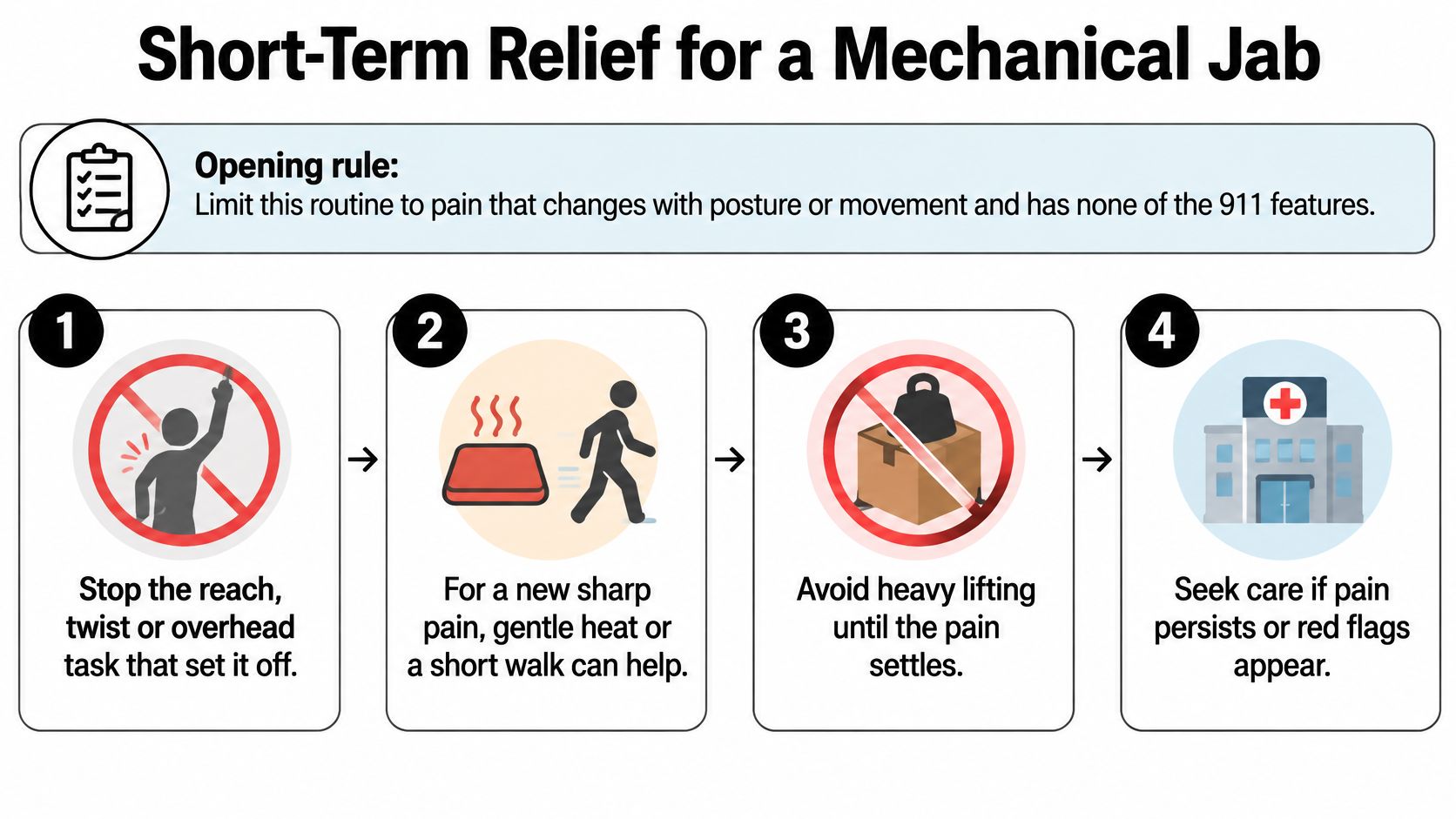
Settle irritation without immobilising yourself
- Stop the task that provokes the jab. Put down the overhead load, stop the repeated twist or bring the object closer before reaching. This is relative rest, not a requirement to keep your shoulder completely still.
- For a newly irritated, sore area, try a wrapped cold pack briefly if it feels soothing. For stiffness or a fingertip-tender muscle, gentle warmth may be more comfortable. Keep a cloth barrier between your skin and the pack, check the skin, and stop if discomfort or numbness develops. The guide to heat or cold for a muscle strain explains how to choose between them.
- Try easy scapular movement rather than a hard stretch. Rest your forearms on a table, let your shoulders soften, then gently draw the shoulder blades towards a comfortable neutral position. Don't clamp them together or pull them forcibly down. Keep breathing normally and stop if the familiar stab intensifies.
- Take a short, comfortable walk and vary your position during the day. Avoid aggressive trunk twists, doorway hangs, heavy lifting and deep massage into a sharp rib-area catch. Being able to tolerate gentle activity is more useful than repeatedly testing the most painful movement.
Use symptom relief with clear limits
- Consider a non-prescription topical only for sore muscle or joint pain on intact skin. Follow the product's application directions, avoid broken or irritated skin, and wash your hands after applying it to your back. Don't place a heating pad over a medicated area or cover it with a tight bandage. If you experience pain, swelling or blistering, stop use and get medical help right away.
- Sleep off the sore side if pressure aggravates it. Support the affected arm on a pillow so it isn't hanging forward, and reassess how comfortably you can move after resting. Don't keep extending home treatment if the pain is worsening, recurring or no longer behaving like a straightforward strain.
Safety stop: Relief isn't proof of a diagnosis. A comfortable response to warmth, rest or a topical doesn't establish that the cause is muscular.
Ice, heat and topical pain relief don't treat gallbladder disease, a blood clot or a heart problem. Leave the home-care routine if new breathing difficulty, meal-related abdominal pain, fever, skin changes or whole-body symptoms appear.
Book a Practitioner When the Jab Does Not Sort Cleanly
Choose care based on the symptom pattern rather than how accurately you can point to the pain. A physiotherapy appointment is useful for a mechanical problem, but it isn't the right first destination for a possible emergency or unexplained systemic illness.
Choose the appropriate care lane
- Emergency care: Call 911 for pain accompanied by the cardiac, breathing or vascular warning patterns described in the emergency table. Don't wait for a routine appointment.
- Same-day clinical advice: Seek prompt assessment for fever, chills, a sensitive one-sided band or blisters, marked weakness, new numbness, deformity, swelling or inability to move. Unexplained weight loss, a cancer history or persistent rest pain also warrant prompt contact with a clinician to determine urgency.
- A booked assessment: Arrange a family-doctor visit for unexplained or recurrent symptoms, particularly without a clear movement-related trigger. A physiotherapist, or a chiropractor when appropriate, can assess a clearly mechanical pattern that isn't settling or repeatedly interferes with work and sport.
The ACOEM Shoulder Disorders Guideline identifies systemic symptoms, significant weakness, sensory or motor deficits, deformity, swelling, rest pain and inability to move as reasons for investigation. These are flags for clinical reasoning, not proof of a particular disease.
Bring a useful history
Write down how the pain started, whether there was an injury and what reliably changes it. Include breathing, coughing, meals, skin changes, tingling, weakness and any symptoms elsewhere in the body. Describe the work or sporting task involved rather than saying that you overdid it.
A clinician can compare shoulder, neck and thoracic movement, examine strength and sensation, and determine whether resisted shoulder-blade movement reproduces the pain. Once medical concerns are excluded, physiotherapy for back-pain relief may include graded loading, task changes and exercises matched to the examination.
For an established muscle or joint problem, our MEDISTIK non-prescription topical system is designed for fast, targeted relief without pills, injections or greasy creams. The Power Stick provides temporary soothing relief of sore muscles and joints associated with strains, sprains, backaches, lumbago, tendon or ligament pain, and arthritic or rheumatic pain; our pain-management concept is called 3X PRIME | PERFORM | RESTORE. Symptom relief supports care, but never replaces assessment when warning signs are present.
MEDISTIK offers targeted topical options for temporary relief when shoulder-blade discomfort has been identified as sore muscle or joint pain. Visit MEDISTIK to explore our pain-relief formats and educational resources, while keeping unexplained or changing symptoms on a clinical assessment pathway.


