

The Public Health Agency of Canada osteoarthritis fact sheet reports that about 3.9 million Canadians aged 20 and older, or 13.6%, were living with diagnosed osteoarthritis. In 2016–2017, 219,000 new diagnoses were recorded, equal to 8.7 per 1,000 people per year. Prevalence was 16.1% among females and 11.1% among males. Knee pain is a common concern for people with osteoarthritis, but the right product depends on what is limiting you and your personal risks. A stronger label is not automatically a better match.
Knee Pain Relief Products Sorted by Problem
Start with the problem in front of you, not a brand name. Knee pain relief products sit in a few practical rows: a medicine on the skin, a cooling or warming stick, a pill, a brace, a clinic injection, or a short session of ice, heat, or electrical stimulation. Pick one row that matches today's main limit, whether that is walking, sleep, or training. Leave the other rows alone until you have tested that choice.
| Product type | Best for | Typical onset | Main trade-off | Skip or pause if |
|---|---|---|---|---|
| Topical NSAID gel | Localized osteoarthritic knee ache | Days, judged over about 6 weeks | Some systemic NSAID exposure remains | Broken skin, stacked oral NSAIDs, unclear diagnosis |
| Counterirritant stick, spray or roll-on | Activity soreness and stiff joints | Minutes for cooling or warmth | Sensation is not the same as inflammation control | Blistering, severe burning or damaged skin |
| Oral NSAID or acetaminophen | Wider pain or pain that wakes you | About 30 to 60 minutes | Stomach, kidney, heart or liver risk | Ulcer history, kidney disease, or heavy alcohol with acetaminophen |
| Knee brace or sleeve | Sense of instability or load while walking | Immediate mechanical support | All-day wear without strengthening | Numbness, poor fit or skin breakdown |
| Corticosteroid injection | Inflamed flare limiting function | Days, after a clinic visit | Temporary, with limits on repeats | Possible infection or a diabetes plan to discuss first |
| Hyaluronic acid injection | Osteoarthritis beyond self-care | Weeks, often a series of visits | Cost and mixed benefit | Active joint infection or relevant allergy history |
| Ice, heat or TENS | Fresh strain or stiffness between activities | During or just after the session | Short effect if used alone | Numb skin, open wounds, or a pacemaker concern with TENS |
What each row is actually for
A topical NSAID gel suits a localized osteoarthritic ache when you want fewer pills. You judge it over weeks, by stairs or a walk, not by the first minute on the skin. A counterirritant stick, spray, or roll-on suits soreness around work or sport because cooling or warmth can show up in minutes. That feeling is not proof that inflammation has dropped.
An oral NSAID or acetaminophen can cover wider pain or pain that wakes you, often within about 30 to 60 minutes. The trade-off is stomach, kidney, heart, or liver risk, so an ulcer history, kidney disease, or heavy alcohol with acetaminophen is a reason to pause and ask a clinician. A brace or sleeve changes load at once. It does not change joint chemistry. Numbness, a poor fit, or skin breakdown means take it off.
Rows that are not shelf products
Corticosteroid and hyaluronic acid injections are prescribed procedures. One is aimed at a flare that blocks function. The other is a series when self-care has not been enough, with cost and mixed benefit as real filters. Ice after a fresh strain, heat for morning stiffness, and TENS during a session are short adjuncts. They do not replace the row you already chose.
Food pattern still sits beside any of these choices. A clear look at dietary considerations for osteoarthritis helps you see how weight and everyday eating sit with joint load, which no tube can fix on its own. If morning stiffness is the limit you picked, a heating pad for knee pain is the heat row, used before a walk, not as all-day treatment.
Practical rule: Choose the single row that matches today's main limit, test it, and do not add a second class until that test has a result.
How Medicines Reach Pain Inside the Knee
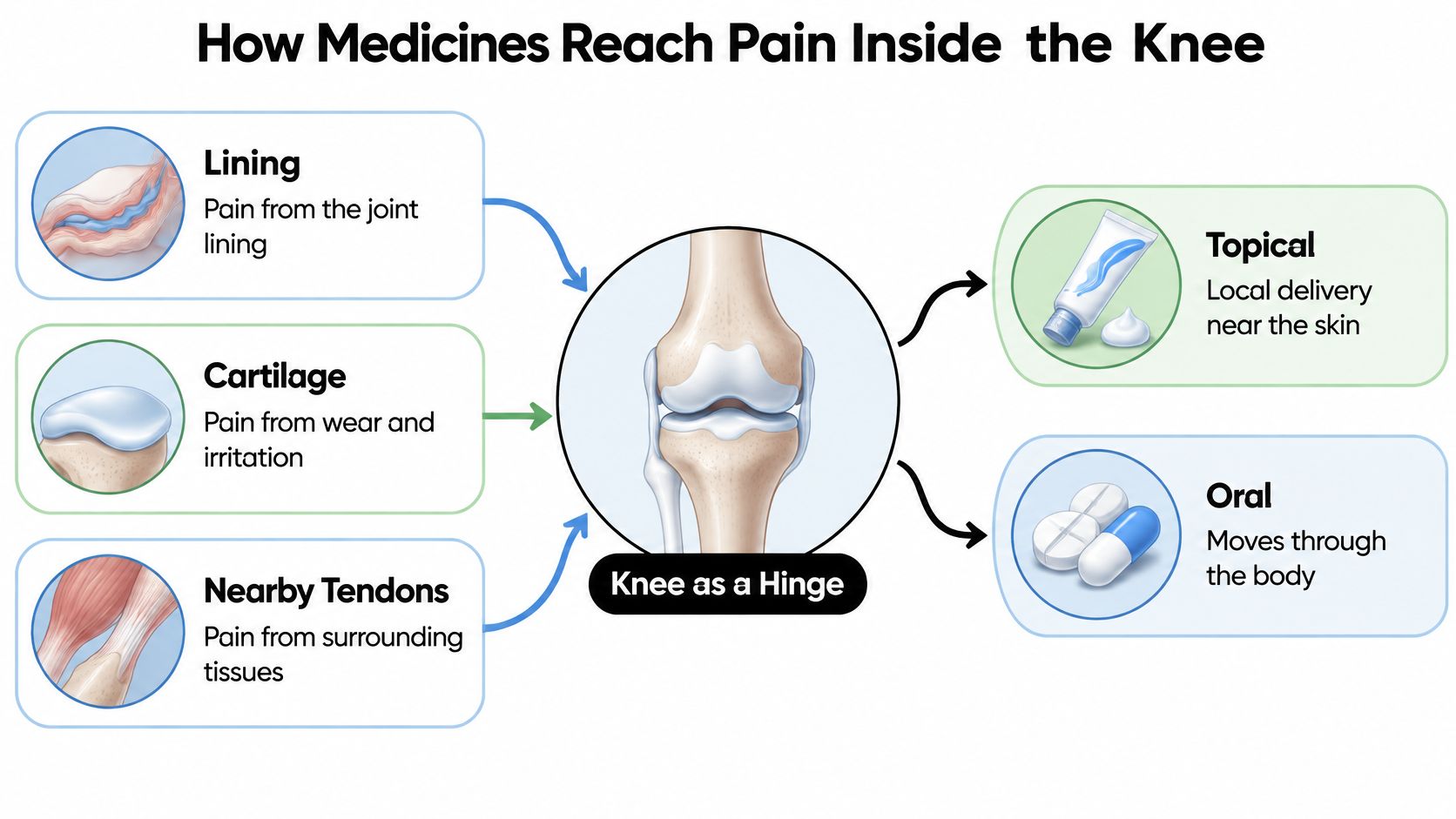
The knee is a hinge. Pain can come from the lining, from worn cartilage, or from tendons beside the joint, so the same ache does not always need the same chemistry.
A local letter or a body-wide broadcast
Picture two routes. A topical is a local letter dropped at the joint. A pill is a broadcast through the bloodstream. The letter stays nearer the sore spot. The broadcast can help pain that is wider, or pain that wakes you, because the drug is available beyond one patch of skin. It also meets stomach, kidney, and heart tissue on the way.
A 2023 evidence review reported that topical diclofenac improved pain by at least 50% within six weeks for chronic hand and knee osteoarthritis, with a number needed to treat of 5. About five patients would need that treatment for one extra person to reach that improvement compared with placebo or control. The same review reported a number needed to treat of 7 for topical ketoprofen. Those names matter only after the benchmark. Diclofenac and ketoprofen gels work mainly by blocking cyclooxygenase near the joint, which lowers prostaglandins that sensitize pain nerves, with less body-wide exposure than the same drug swallowed.
What the tingle is not
Counterirritants such as menthol, methyl salicylate, and camphor create cooling or warmth. People use them for sore muscles and joints around activity. Do not treat that sensation as the same outcome as a 50 percent pain drop. Oral NSAIDs use the prostaglandin pathway throughout the body. Acetaminophen is a separate pain reliever. It is not an anti-inflammatory.
Judge a topical NSAID by function at about six weeks, such as stairs or sleep, not by the first tingle.
If nothing has changed by then, stop that product. Do not stack a second one on top out of habit. Persistent, severe, swollen, or function-limiting pain needs a professional look rather than an endless self-trial. A plain guide to a topical NSAID is worth reading before you assume every tube on the shelf shares the same job.
What Braces Injections and Modalities Change
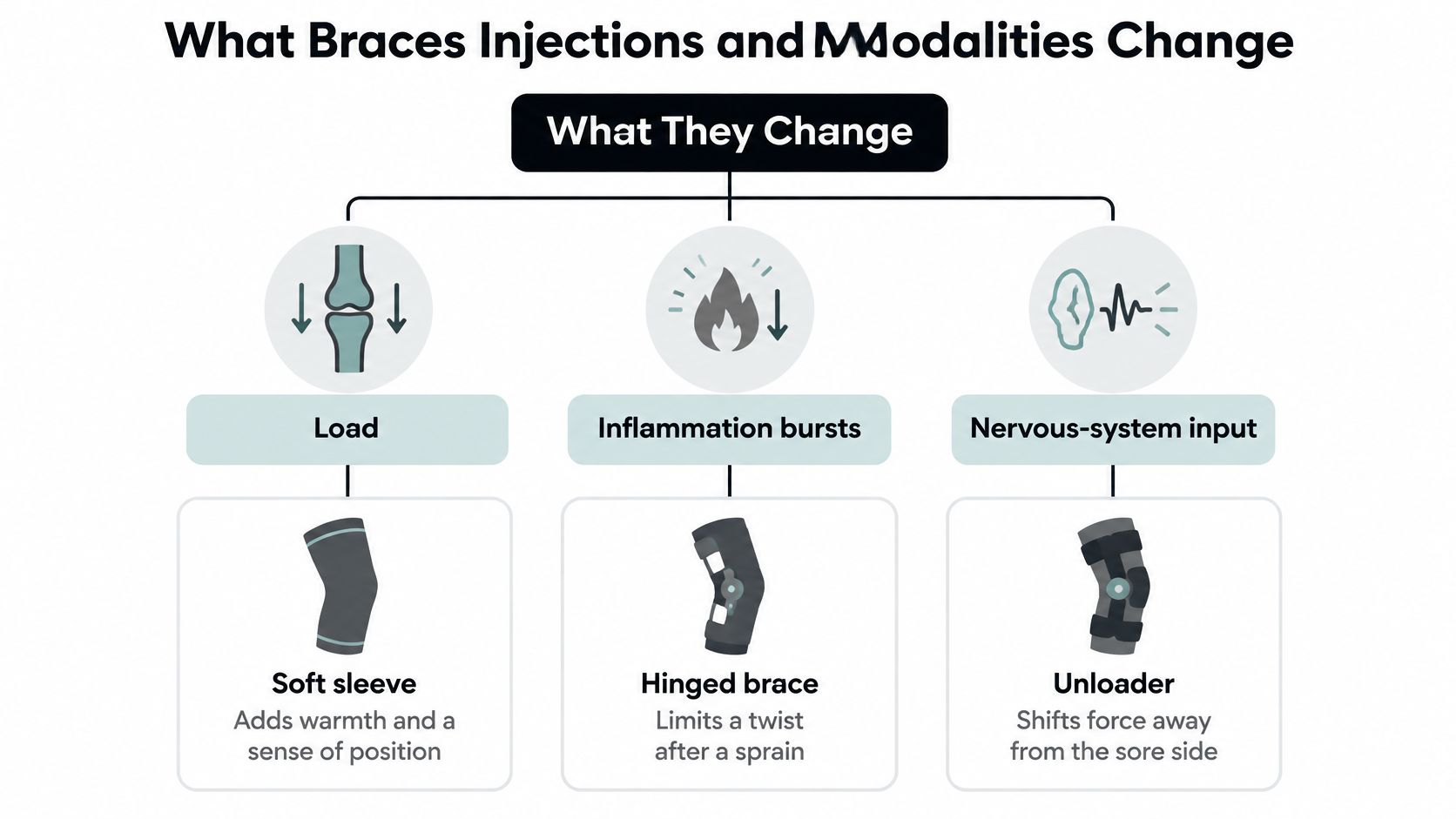
Say a warehouse shift leaves the inside of one knee hot, and the next morning the same knee feels unstable on stairs. Hardware and clinic procedures change load, a short inflammation burst, or nervous-system input. They are not stronger creams.
Three braces, three jobs
A soft sleeve adds warmth and a sense of position while you walk the aisle. It cannot regrow cartilage, and wearing it every waking hour without quad and hip strength turns it into a crutch. A hinged brace limits a twist after a sprain, which is useful for a few weeks of protected turning, not as a permanent costume. An unloader shifts force off the worn side during walking when one compartment is the problem. If both sides of the knee are worn, that shift has less to offer.
Ice, heat, and a competing signal
Ice for about 10 minutes after a new overload can calm a hot, swollen knee. Heat suits morning stiffness before a walk. TENS offers a competing signal for some people during activity. It is a session tool, not a cure, and it is the wrong tool over numb skin, open wounds, or when a pacemaker is in the picture.
When the flare outruns the cupboard
A corticosteroid injection is a clinic option when a flare blocks walking or sleep and simpler steps have not been enough. Relief is often counted in days to weeks, and repeats are limited. Hyaluronic acid is a gel-like fluid supplement given as a series when exercise and simpler pain control are already in place. Benefit is mixed, and cost is a real filter. Even when an X-ray is described as bone-on-bone, the base is still movement, strength, and weight where that applies, before anyone discusses injections or surgery.
Add a brace or a modality to the product you already chose. Do not replace a strengthening plan with hardware.
An arthritis knee pain treatment plan that skips strength work will keep asking the sleeve to do a muscle's job.
Safety Limits That Should Stop Self-Treatment
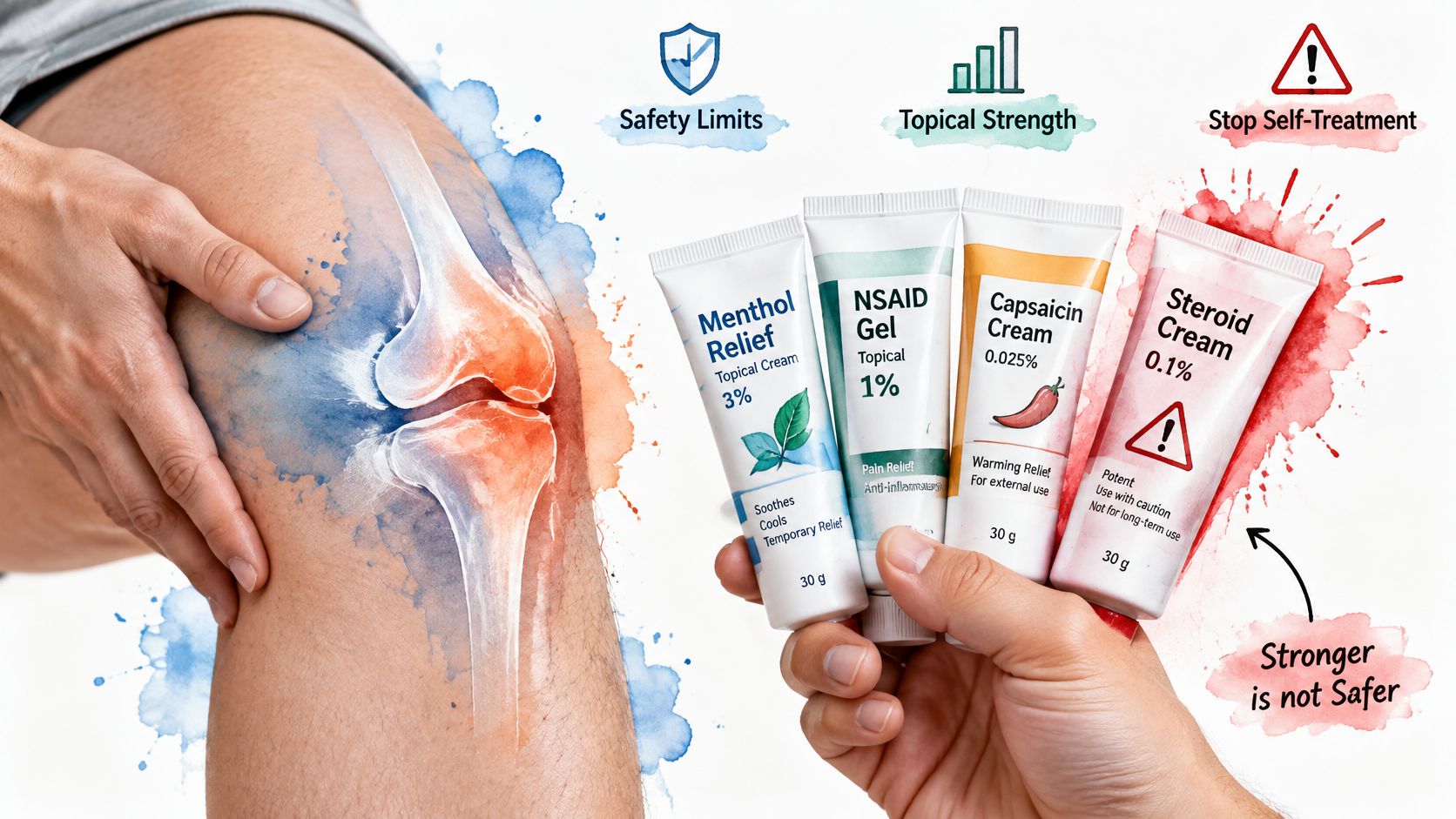
A stronger product is not a safer product. Concentration on a label is not a score for how harmless the tube is.
What still gets into the body
British Columbia practice guidance identifies topical diclofenac at 1 to 4%, ibuprofen at 5 to 10%, and ketoprofen at 1 to 5% as the formulations with the strongest supporting evidence. Estimated systemic absorption is approximately 6 to 23% of oral exposure. That cut lowers stomach, kidney, heart, and interaction risk. It does not erase them. Count every NSAID, gel plus pills. Keep product off broken skin, and do not cover the area with a tight dressing unless the label allows it. A spray or stick can reduce messy hand contact, which does not change the daily total.
Evidence is not enough to assume safety in renal failure, heart failure, or anticoagulant use. Canadian clinical guidance in CMAJ recommends reassessing response after roughly 6 to 12 weeks rather than continuing an ineffective treatment by habit.
Skin that is not "working heat"
The same British Columbia guidance notes that Health Canada warns menthol-containing topical pain relievers have been linked to rare but serious skin burns. Blistering, marked redness, severe burning, or swelling means stop and get assessed. Do not read those signs as normal therapeutic heat, and do not rub harder.
Red flags that are not a shopping problem
Pause self-treatment and book an assessment for pain after trauma, locking, giving way, marked swelling, fever, a hot joint, or symptoms that worsen quickly. Acetaminophen still needs a daily-dose ceiling, especially when cold remedies hide a second dose.
Before the next application, run this stop list:
- Add the doses: Gel plus any oral NSAID is one exposure, not two separate hobbies.
- Check the skin: Intact skin only, and no occlusive wrap unless the label says so.
- Watch the reaction: Blisters, severe burning, or swelling end the trial.
- Name the clock: No meaningful change in function after the reassessment window means stop, do not restock.
- Separate emergencies: Trauma, locking, fever, or a rapidly worse knee is care, not another format.
For a wider look at what sits on the pharmacy shelf, see over-the-counter pain relief and still apply the same limits.
Choosing by Athlete Clinic and Senior Patterns
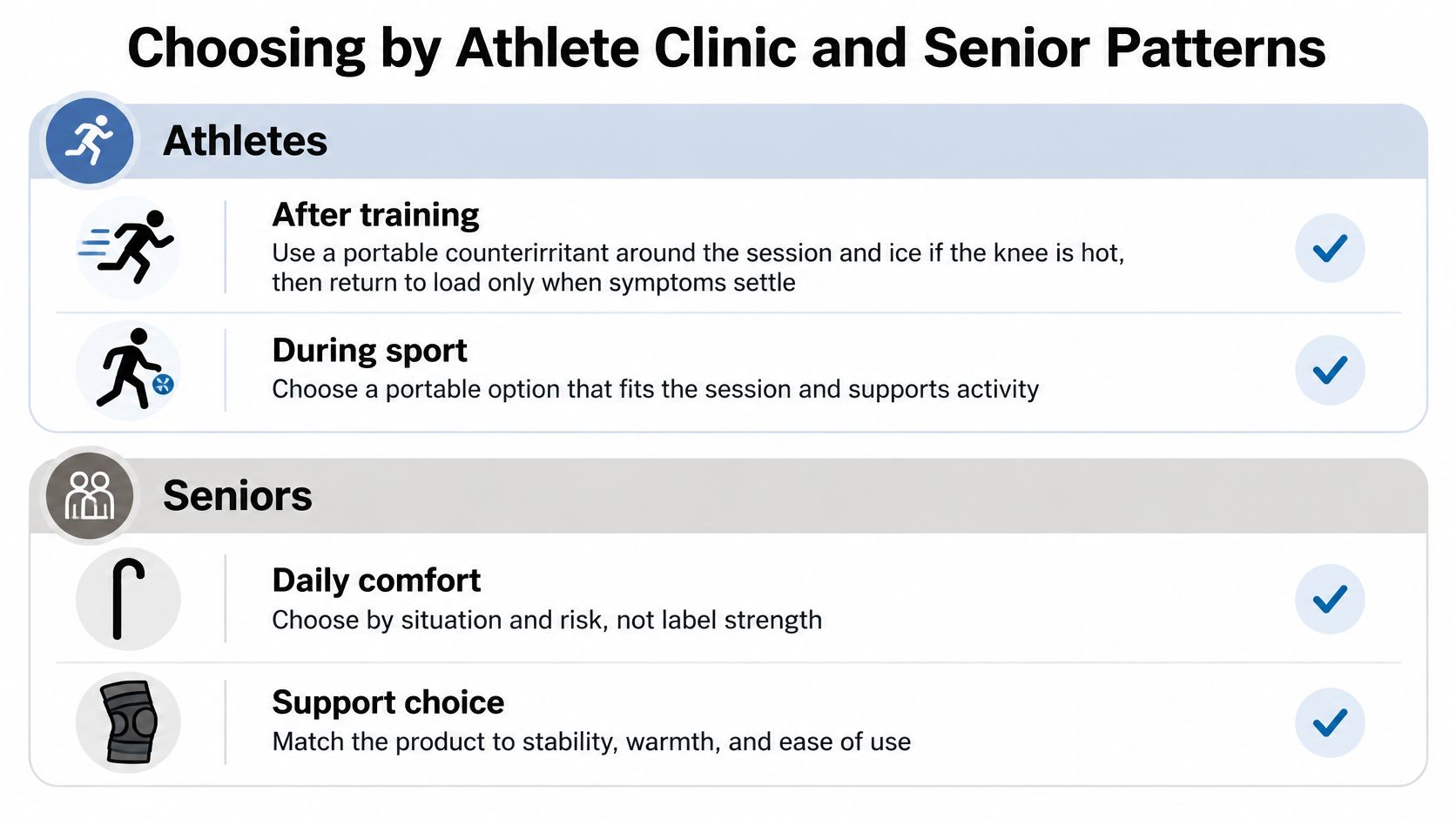
Choose by situation and by risk, not by which label sounds strongest. A sensible first step for a stiff osteoarthritic knee is not the same purchase as a knee that just gave way on a landing.
After training
A runner or court athlete can use a portable counterirritant around the session and ice if the knee is hot. Return to load only if the pain settles within about two days. If the knee gives way, do not mask it and jog through. Instability is an assessment, not a warm-up problem. The product's job is to let a planned session happen, not to hide a joint that cannot hold you.
On a demanding shift
A nurse, tradesperson, or military member often needs a non-greasy stick or spray that fits in a pocket and does not soak a uniform. Use a brace only for the hours that provoke pain, then take it off so the thigh still does the work. Occupational overuse is a load problem with a skin-care problem attached. Sweat, gloves, and repeated kneeling make broken skin more likely, which is a reason to pause topical use rather than layer more of it.
An older adult with a recurring ache
Osteoarthritis becomes more common with age and is more common among women, so a senior pattern should not be copied from a sport aisle. Heat for morning stiffness, a short walk, and one clearly labelled topical NSAID is a coherent start. Add an oral NSAID only when stomach, kidney, and heart risk is acceptable. Recheck whether stairs, sleep, or the walk changed. Pain relief that does not let you move is not a success. Ontario's 2024 osteoarthritis quality standard frames topical therapy as part of a stepped-care pathway beside education, therapeutic exercise, physical activity, weight management, and self-management, not as a standalone cure. A pain relief approach for seniors should keep that same order: movement first, one medicine trial second.
When the scenario is an injury
Trauma, locking, giving way, marked swelling, fever, or rapid worsening is an assessment. Buying a stronger tube does not sort a torn structure from a flare. Clinics can help by writing down the ingredient, the concentration, whether the skin was intact, and what function looked like at the next visit, so a product is not renewed by habit.
The appropriate product depends on the diagnosis, skin tolerance, other medicines, and whether relief lets rehabilitation happen.
Medicine use in real programmes shows the same pairing. A 2023 Halifax, Nova Scotia study, published in 2026 by researchers affiliated with Nova Scotia Health, found that 84.2% of participants with knee osteoarthritis were using medication for osteoarthritis pain management, 73.7% used NSAIDs or acetaminophen, and 26.3% used topical NSAIDs, as reported in that Halifax study. At the end of 2022, the GLA:D Canada registry included 15,193 participants, including 11,228 with knee osteoarthritis, and approximately two-thirds of knee participants used pain medication. Those adults were in an exercise programme, not a product-only plan. Relief that lets you finish the strength work is the point. Relief that replaces the strength work is a stall.
Build Your Knee Routine and When to Get Help
Turn the row you picked into one week. The point of the week is a fair test, not a bigger pile of products.
- Name today's limit. Stairs, sleep, or training. Write the one task that fails, so day seven has something to compare.
- Use one pain product. Do not put a gel on top of the same oral NSAID. Two routes with one drug family are one exposure.
- Add a short daily strength or range session, or the exercise a clinician already prescribed. Ten focused minutes beats a new gadget.
- Recheck that limit on day seven. If the task is easier, keep the plan. If it is unchanged, do not add a second class out of frustration.
Book care if the knee locks, gives way, swells hard, or is hot with fever. Book care if a topical NSAID has not changed function after the reassessment window you agreed with a clinician. A knee that still buckles is not waiting for a stronger label.
When the matching row is localized soreness on intact skin, MEDISTIK is the non-prescription topical step in our line. It is a non-prescription topical pain relief system designed to deliver fast, targeted relief directly where pain occurs, without pills, injections, or greasy creams. The Power Stick is for long-lasting, localized pain relief, the Power Spray is for fast relief over larger or hard-to-reach areas, and the Daily Defence Roll-On is for cooling relief and everyday maintenance. Match the format to the spot you can reach before work or after training. Pat B. put it this way: "So far, very pleased with my results. My knees feel better and so does my back." The test is still whether relief lets you do the planned movement. If the knee flares or buckles, see a clinician.
MEDISTIK offers non-prescription topical formats for temporary, targeted relief of sore muscles and joints, including knees, without pills, injections, or a greasy cream. If localized soreness on intact skin is the row you chose, match a stick, spray, or cooling roll-on to that job and keep your strength work in the same week. Visit MEDISTIK to compare those formats and pick the one that lets you move.


