

You’ve just pulled a muscle, and the first question that pops into your head is always the same: ice or heat? It's a classic debate, but the answer is surprisingly straightforward. For the first 24-48 hours, cold is your best friend. After that, it’s time to switch to heat.
Think of it this way: cold is like an emergency brake for the initial damage, stopping inflammation and swelling in its tracks. Heat comes in later as the repair crew, speeding up the healing process and easing any leftover stiffness.
Your Two-Step Recovery Plan: Cold First, Then Heat
Let’s imagine a fresh muscle strain is like a small fire starting in your muscle tissue. Your first priority is to put out those flames—the inflammation. This is where cold therapy, or cryotherapy, is the hero. Applying something cold makes the local blood vessels constrict, which drastically limits the amount of fluid rushing to the injured spot. This simple action helps reduce swelling, numbs the area for some much-needed pain relief, and can even prevent further damage to the surrounding tissues.
After about two days, once the "fire" is under control, the focus shifts from damage control to rebuilding. This is when heat therapy, or thermotherapy, takes over. Applying warmth does the exact opposite of cold: it encourages the blood vessels to open up (a process called vasodilation). This ramps up circulation, bringing a fresh supply of oxygen and nutrients directly to the damaged muscle fibres. It’s like calling in a construction crew to get the repair work done faster.
This cold-then-heat strategy creates a powerful two-step recovery system. The first step contains the immediate damage, while the second step actively kicks the natural healing process into high gear.
Quick Guide: When To Use Cold Vs. Heat
For a quick reference, here’s a simple breakdown of when to reach for the ice pack versus the heating pad.
| Therapy Type | When to Use | Primary Benefit | Recommended Application |
|---|---|---|---|
| Cold Therapy (Cryotherapy) | Immediately after an injury (first 24-48 hours) | Reduces swelling, inflammation, and numbs acute pain. | Apply for 15-20 minutes at a time, every 2-3 hours. |
| Heat Therapy (Thermotherapy) | After the initial 48 hours; for chronic stiffness or before activity. | Increases blood flow, relaxes muscles, and soothes soreness. | Apply for 15-20 minutes at a time, 2-3 times a day. |
Remember, this table is a guideline. The most important rule is to listen to your body and what feels right for your injury.
In this guide, we'll dive deeper into the science behind this one-two punch for muscle recovery. We’ll cover everything you need to know to use both therapies effectively and safely.
We'll explore:
- The perfect timing for making the switch from cold to heat.
- How to apply them correctly to avoid any skin issues.
- More advanced techniques like contrast therapy for that stubborn, lingering soreness.
- How easy-to-use topical products, like those from MEDISTIK, can deliver targeted cooling or warming relief right where you need it, making them a perfect fit for any pain management routine.
Getting a handle on this basic principle is the first and most important step toward taking back control of your recovery and getting back to doing what you love, pain-free.
How Cold Therapy Calms Fresh Injuries
The moment you strain a muscle, your body’s internal alarm system goes off. It immediately rushes inflammatory cells and fluids to the scene, which is what causes that all-too-familiar trio of swelling, redness, and pain. This is precisely when cold therapy, or cryotherapy, steps in as the essential first responder.
Imagine the injury site is a chaotic traffic jam that just appeared out of nowhere. Applying cold is like sending in an expert traffic controller to clear the congestion. The cold temperature makes your local blood vessels narrow down in a process called vasoconstriction.
This narrowing effect is exactly what you need in those first few critical hours. It slows down blood flow to the damaged area, limiting how much fluid can pool there. In short, it helps you get a handle on swelling and inflammation before they spiral out of control.
The main point of cold therapy isn’t to directly heal the muscle tissue itself. Instead, its job is to create the perfect conditions for your body's natural repair crew to get to work efficiently.
The Science Of Cooling Down
When you apply cold to a new strain, you get two big wins right away. First, the cold numbs the nerve endings close to the skin. This interrupts the pain signals zipping up to your brain, giving you immediate and noticeable relief.
Second, by keeping that initial inflammation in check, you prevent something called secondary tissue damage. When swelling gets excessive, it can put a squeeze on healthy surrounding cells, cutting off their oxygen supply and causing even more harm. Cold therapy acts like a shield, protecting these neighbouring tissues.
In Canada, where over 7.6 million people live with chronic pain, physiotherapists almost universally recommend ice for the first 24-48 hours after an injury. Why? Because research backs it up. Cryotherapy has been shown to suppress nerve activity, calm muscle spasms, and constrict blood vessels to reduce fluid buildup. Some studies even suggest it can slash the presence of key inflammatory cells by up to 50%.
Practical Application For Best Results
To really nail cold therapy, your timing and technique have to be on point. The idea is to cool the tissue down without accidentally causing an ice burn. Sometimes an injury needs a more targeted approach, which is why knowing the specifics for your situation is key. Our guide on how to heal a calf strain quickly, for instance, lays out a detailed recovery plan.
For safe and effective cold application, just stick to these simple rules:
- Protect Your Skin: Always wrap an ice pack in a thin towel or cloth. Never put it directly on your skin.
- Time It Right: Apply cold for 15-20 minutes at a time. Any longer and your body might try to overcompensate by widening the blood vessels, which undoes all your hard work.
- Repeat The Cycle: Let the area warm up to a normal temperature for at least an hour before you ice it again. You’ll want to repeat this cycle several times a day for the first 48-72 hours.
Following this disciplined routine helps you get all the anti-inflammatory and pain-numbing perks of cold therapy, setting you up for a much smoother and faster recovery.
Using Heat Therapy To Accelerate Muscle Recovery
Once the initial swelling from a muscle strain has settled down—usually after 48 to 72 hours—it’s time to switch gears from damage control to active repair. This is where heat therapy, also known as thermotherapy, really shines. If cold therapy was the firefighter putting out the initial blaze, think of heat as the construction crew that comes in to rebuild.
Applying warmth to the injured muscle triggers something called vasodilation, which is just a fancy way of saying your blood vessels widen. This simple action dramatically increases circulation, essentially opening up a superhighway for healing resources to reach the damaged tissue.
This fresh rush of oxygen-rich blood is packed with the nutrients your muscle fibres desperately need to mend and rebuild. At the same time, the increased blood flow acts like a cleanup crew, efficiently flushing out the metabolic waste that builds up after an injury and causes that deep, lingering soreness.
How Heat Promotes Faster Healing
The real magic of heat is its ability to supercharge your body’s own healing processes. By boosting circulation, heat therapy does more than just make you feel better; it actively helps shorten your recovery time. It’s a game-changer for those deep, nagging aches that can stick around long after the initial strain.
For anyone serious about getting back to their routine, understanding how to use heat properly is key. We dive deeper into specific strategies in our complete guide on how to speed up muscle strain recovery, which lays out a full roadmap to getting you back on your feet.
Heat therapy does more than just feel good. It creates a pro-healing environment within the muscle, accelerating tissue regeneration and restoring normal function faster than rest alone.
The Science Behind The Warmth
So, what’s happening on a physiological level? Research shows that applying heat at around 40°C can significantly raise the temperature of deep muscle tissue. This warmth ramps up your body’s metabolism and the processes responsible for clearing out damaged cells and debris. For the 7.6 million Canadians dealing with chronic pain, this means faster relief from muscle spasms and stiffness.
Better yet, using heat as part of a warm-up can increase blood flow in key muscles by up to 77%, which helps prevent future damage in the first place. You can read more about these therapeutic effects on muscle tissue in recent studies.
So, when is the best time to reach for heat?
- For Chronic Pain and Stiffness: Heat is fantastic for managing long-term muscle tightness and joint stiffness because it improves flexibility and circulation.
- Before Stretching or Activity: Applying warmth before a workout helps increase tissue elasticity, making your muscles more pliable and reducing the risk of re-injury.
- To Relieve Deep Soreness: Once the acute inflammation is gone, heat is the perfect tool for tackling that stubborn, deep-seated ache in the belly of the muscle.
By strategically using heat after the first couple of days, you’re giving your body exactly what it needs to repair itself efficiently, cut down on pain, and get you moving again.
How To Apply Heat And Cold Therapy Safely
Knowing whether to reach for an ice pack or a heating pad is only half the battle. You also need to know how to apply it safely to get all the benefits without risking skin damage like ice burns or heat scalds. Sticking to a few simple, proven rules is the key to making your home treatment effective.
When it comes to cold therapy, the gold standard is the "15-20 minutes on, one hour off" rule. This cycle gives your skin and the tissues underneath a chance to return to their normal temperature, preventing any potential damage. And always, always use a barrier—a thin towel works perfectly—between the ice pack and your skin. Direct contact is a fast track to frostbite.
Heat therapy follows a similar guideline: stick to 15-20 minute sessions. The goal is a comforting, soothing warmth, not something that feels scorching hot. It’s also incredibly important to never fall asleep with a heating pad, which is a surprisingly common cause of burns. Just like with cold packs, a protective layer between the heat source and your skin is a smart move.
Simplifying Your Routine
While ice packs and heating pads definitely work, let's be honest—they can be a bit of a hassle. They take time to prepare, can get messy, and don't always mould perfectly to the spot that's hurting. This is where modern topical analgesics really shine.
Topical products can deliver a controlled cooling sensation or a deep, penetrating warmth right where you need it, minus the risks that come with extreme temperatures. You can apply them directly to the strained muscle for targeted relief that’s both convenient and consistent. If you're curious, exploring the benefits of topical versus oral pain relievers explains why so many people are making the switch.
This diagram breaks down how heat therapy actually helps your muscles heal by improving blood flow and getting nutrients where they need to go.
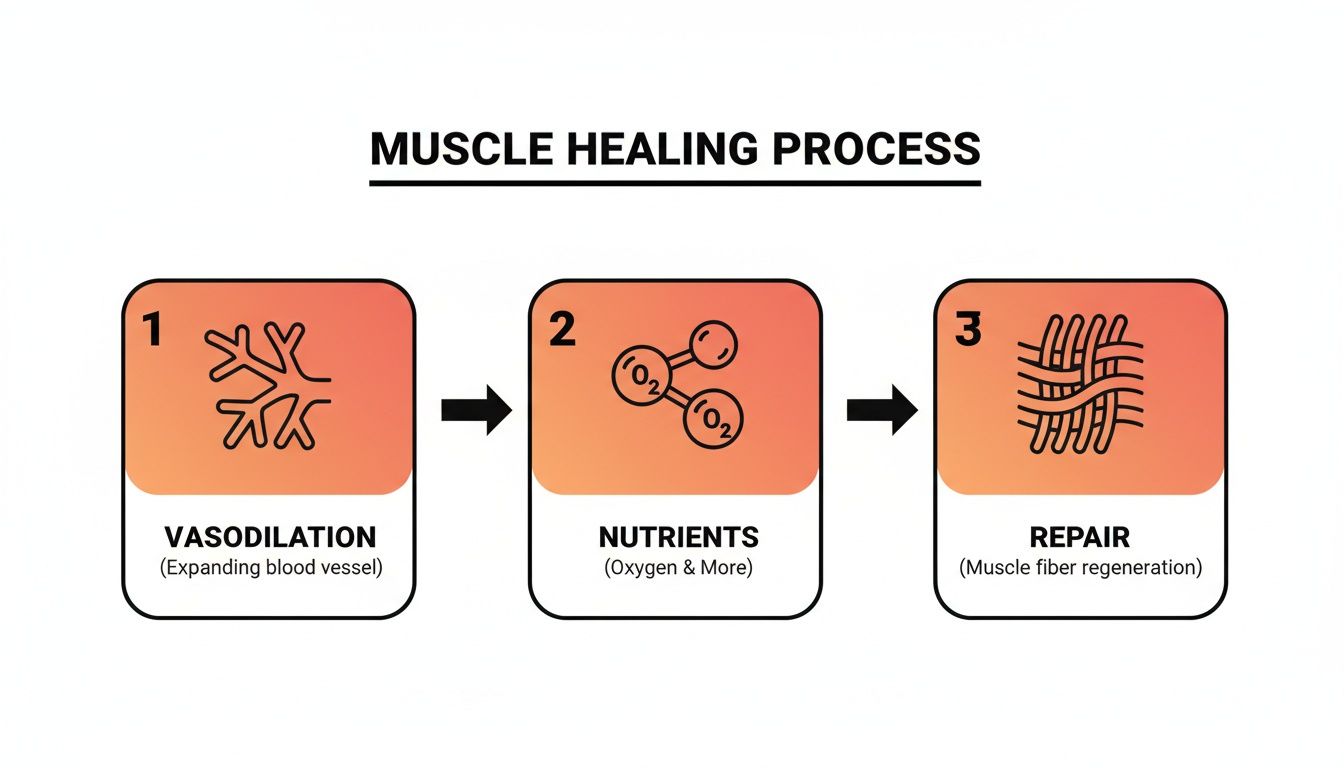
As you can see, vasodilation (the widening of blood vessels) kicks things off, speeding up the delivery of the essential building blocks your body needs to repair those muscle fibres.
Safety First: Never apply heat or cold directly to an open wound or an area with stitches. If you have any condition that affects your circulation, like diabetes, it's best to chat with a healthcare professional before starting any new therapy.
By keeping these simple guidelines in mind, you can safely and effectively take control of your muscle strain recovery. Choosing the right method and applying it correctly will help you get back to feeling like yourself again, faster and with a lot less discomfort.
Combining Therapies For Peak Performance
If you're a serious athlete or anyone who pushes their body, just picking between heat or cold is only scratching the surface of recovery. For a real edge, there's an advanced technique called contrast therapy that strategically alternates between the two to supercharge your healing.
Think of it this way: the quick switch from cold to heat creates a powerful "pumping" action deep in your muscles. Imagine your blood vessels are a series of tiny hoses. The cold clamps them down (vasoconstriction), and then the heat immediately opens them up (vasodilation).
This rapid change forces out inflammatory by-products and metabolic junk like lactic acid. At the same time, it pulls in fresh, oxygen-rich blood packed with nutrients your muscle fibres are screaming for. It’s a game-changer for tackling delayed onset muscle soreness (DOMS) or that tricky transition from a fresh injury into the longer healing phase.
Creating A Full Recovery Cycle
Once you understand what heat and cold are built for, you can create a complete cycle that primes your body for action, supports it during the grind, and helps it bounce back faster. A systematic approach like this keeps you in the game and minimizes frustrating downtime.
Here’s what a pro-level recovery cycle looks like:
-
Priming (Pre-Activity): Before you even start, apply gentle heat or a warming topical like MEDISTIK's Extra-Strength Stick. This boosts blood flow, warms up the tissues, and improves elasticity, which can help stop a strain from happening in the first place.
-
Restoring (Post-Activity): Right after your workout or as soon as you feel that tweak of a strain, go for cold therapy or a cooling roll-on. This is all about damage control—it gets the initial inflammation and swelling in check, offers immediate relief, and sets you up for a better healing process.
-
Advanced Recovery (Contrast Therapy): In the days that follow, alternate between heat and cold. This is your secret weapon for accelerating waste removal and speeding up tissue repair, especially for that deep, stubborn soreness.
The real power here is in the synergy. You're not just reacting to pain; you're proactively managing your body's physiological responses at every single stage of your activity and recovery.
The Science Of Contrast Timing
Getting the timing right is everything if you want the best results from contrast therapy. Interestingly, the research shows that while cold is crucial after the 48-hour mark for acute injuries, heat is often preferred within the first 24 hours for DOMS.
Studies show that cold’s ability to constrict blood vessels can cut swelling in half during the acute phase. On the flip side, hot water immersion helps with long-term regeneration by activating special heat shock proteins, which are proven to reduce the markers of muscle damage more effectively than just using cold water. You can dive deeper into these therapeutic findings on muscle strains here.
By thoughtfully combining therapies, you're moving beyond the simple "heat or cold" debate. You’re adopting a professional-grade strategy for peak performance and a faster, more complete recovery.
When You Should See A Healthcare Professional
While reaching for a hot or cold pack is a fantastic home-care strategy for a muscle strain, these tools are really meant for minor injuries. It's so important to recognise the signs that something more serious is going on and requires a professional eye.
Think of self-care as your first line of defence, but you also need to know when it’s time to call in the experts. Ignoring certain symptoms can drag out your recovery time or even lead to chronic issues. Pain is your body’s alarm system; sometimes it’s signaling a problem that needs more than just rest and a topical cream.
Red Flags for a More Serious Injury
If you experience any of the following, it’s best to get in touch with a doctor or physiotherapist right away:
- Severe pain that doesn't get better after a few days of taking it easy at home.
- Inability to put weight on the injured leg or arm, or you can't move the joint.
- A visible lump or weird shape in the muscle, which could mean a complete tear.
- Hearing a distinct ‘popping’ sound right when the injury happened.
- Numbness, tingling, or a loss of sensation around the injured spot.
Understanding these warning signs is key to getting the right care at the right time. Self-care tools are most powerful when you use them for the right reasons—and get professional guidance when you really need it.
For athletes trying to stay on top of their game and minimize risks, exploring resources like a coach's guide to wearable technology for injury prevention can be a huge help.
Common Questions About Treating Muscle Strains
When you're trying to figure out the rules of using heat or cold for muscle recovery, a few questions always seem to pop up. Getting clear, straightforward answers is the key to getting your recovery strategy just right and making sure you're doing what’s best for your body.
Let's dive into some of the most common questions we hear.
Can I Use A Topical Cream Instead Of An Ice Pack Or Heating Pad?
Absolutely. In fact, topical analgesics offer some major advantages over traditional ice packs and heating pads, especially when it comes to convenience and targeted application. They let you put relief exactly where it hurts, without any messy drips or bulky equipment.
Modern cooling formulas are designed to deliver the same kind of numbing, anti-inflammatory effects you’d get from an ice pack. They give you a controlled cooling sensation that helps calm down a fresh injury. On the flip side, warming formulas provide a deep, soothing heat that gets right into the muscle tissue to ease stiffness and kickstart blood flow, all without needing to be plugged in.
The biggest win for topicals is their "apply and go" nature. You get the therapeutic feeling of heat or cold while staying on the move, which makes them a perfect fit for a busy lifestyle.
Should I Use Heat Or Cold For Chronic Muscle Soreness?
That's a great question, because chronic pain is a totally different beast than a new, acute injury. For those ongoing issues—like persistent stiffness, nagging aches, or conditions like arthritis—heat is generally your best friend.
Warmth is fantastic for relaxing tight muscles, improving how flexible the tissue is, and boosting circulation to the area. This increase in blood flow brings in fresh oxygen and nutrients while helping to carry away waste products, which can really help soothe the deep discomfort that comes with chronic conditions. Cold therapy is best saved for new injuries or acute flare-ups where fresh inflammation is the main problem.
How Soon Can I Exercise After A Muscle Strain?
There’s no magic timeline that works for everyone—it honestly depends on how severe your strain is. The most important rule of thumb is to listen to your body. Trying to push through sharp pain is just asking for a re-injury, and that will only set your recovery back.
Start with a slow and steady return to activity. Focus on gentle stretching and a proper warm-up to get your muscles ready for movement. If you try an exercise and it causes pain, stop. That's your body telling you it needs more time to heal. For a deeper dive into managing post-workout aches and pains, check out this guide on how to reduce muscle soreness for faster recovery. It offers some really valuable tips for supporting your body’s healing process.
Remember, a smart, patient approach to recovery will always beat trying to rush back into your routine.
For a powerful, targeted approach to managing muscle pain, MEDISTIK offers a complete system to help you prime for activity, perform at your best, and restore your body. Explore our seriously strong, Canadian-made topical solutions at MEDISTIK.


