

You notice the change before you feel the pain. After a weekend hike, your knee looks fuller by evening, the skin feels tight, and bending the leg to sit down takes more effort than usual. Someone else may wake up with a puffy knee that has developed gradually, without one clear injury. Both experiences involve swelling, but they don't necessarily call for the same treatment.
This guide follows a practical path through knee joint pain swelling treatment. First, decide whether the knee needs same-day medical assessment. If it doesn't, use a short, sensible self-care routine, then rebuild strength and movement rather than relying on prolonged rest. The aim isn't only to make the knee look less swollen. It's to understand what the swelling may be signalling and choose care that matches the cause.
When a Swollen Knee Steals Your Day
By Monday morning, the hiker's knee may feel stiff rather than sharply painful. A retiree with gradually increasing swelling may describe a different pattern: discomfort after walking, stiffness after sitting, and less confidence on stairs. Neither person should assume that a swollen knee is automatically “just arthritis” or “just inflammation”.
Osteoarthritis is a major Canadian cause of knee pain, stiffness, and swelling. Public Health Agency of Canada surveillance estimated that approximately 3.9 million Canadians aged 20 and older, or 13.6% of the adult population, were living with diagnosed osteoarthritis in 2016–2017, with an annual incidence of 8.7 cases per 1,000 people during that period (Statistics Canada data on osteoarthritis in Canada). Yet osteoarthritis is only one possible explanation for a puffy knee.
Three decisions matter
Your first decision is practical: what should you do during the first 48 hours? A familiar, activity-related flare may settle with relative rest, cooling, compression, and gentle movement. A sudden hot knee, severe injury, or rapidly worsening swelling needs a different response.
Your second decision is about support. If symptoms are mild and improving, self-care may be reasonable. If swelling persists, returns frequently, limits walking, or changes the way you move, a physician, physiotherapist, or other qualified clinician can assess the joint rather than guessing from its appearance. It may also help to distinguish joint pain from muscle pain, because the location and behaviour of discomfort can guide the next step.
The third decision is long term. A knee that repeatedly swells needs more than occasional pain relief. It may need a plan for range of motion, strength, activity load, footwear, body-weight management where relevant, and professional review.
Practical rule: The size of the swelling doesn't tell you the cause. Heat, speed of onset, associated symptoms, injury history, and ability to bear weight matter just as much.
What Knee Swelling Actually Means
Think of the knee as a smooth hinge with a small amount of fluid inside its capsule. The fluid helps the joint surfaces glide. When tissues become irritated, the body can produce more fluid, and the capsule begins to feel tight. This is commonly called an effusion, or “water on the knee”.
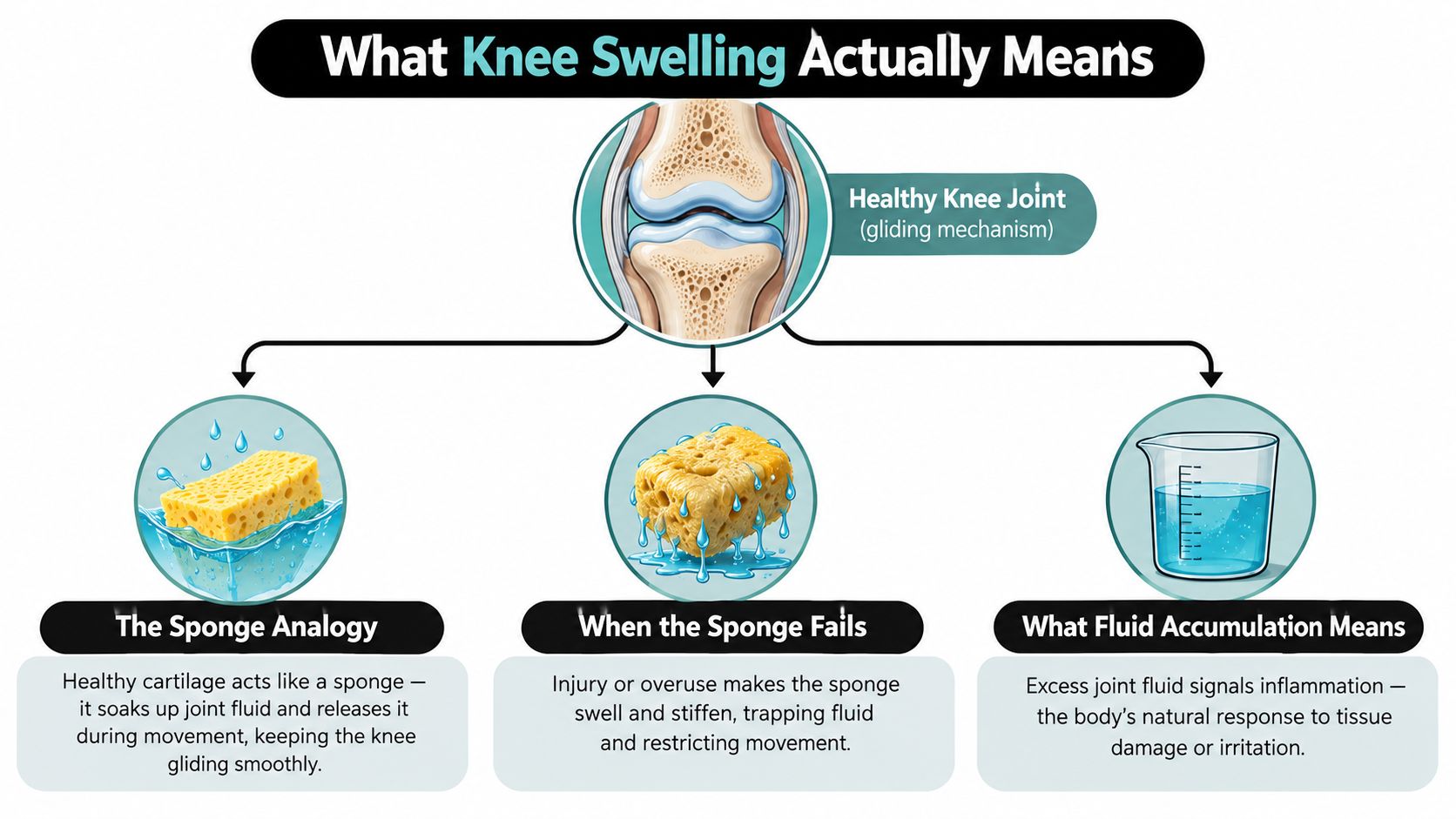
A second pattern is soft-tissue swelling, or edema, around the joint. It may follow a bruise, sprain, irritation of a bursa, or strain in nearby tissues. An effusion often makes the knee feel full from within and can limit bending. Edema may look more superficial or spread around the kneecap and upper shin. A clinician can tell the difference more reliably than a home examination.
Common causes have different fingerprints
Several conditions can produce similar-looking swelling:
- Osteoarthritis can cause activity-related pain, stiffness after rest, and recurring fluid changes.
- Meniscus tears or ligament sprains may follow a twist, fall, or awkward landing, sometimes with catching or instability.
- Overuse tendinopathy or bursitis often relates to repeated loading, kneeling, running, or changes in activity.
- Crystal arthritis, including gout, can cause a sudden, very painful inflammatory episode.
- Infection can make a joint hot, markedly swollen, and difficult to move.
- Major trauma can cause swelling alongside bruising, deformity, or an inability to bear weight.
The treatment follows the driver. Cooling may ease an inflammatory flare, but it won't repair a torn ligament. A topical product may make movement more comfortable, but it can't rule out infection. People exploring broader integrative approaches to joint pain should still begin with an appropriate assessment when swelling is new, severe, or unusual.
A useful description for a healthcare professional includes when the swelling began, what activity preceded it, whether the knee feels hot, whether you can bear weight, and whether the calf or foot has changed. Those details often matter more than saying, "My knee is swollen."
Red Flags and When to Seek Care Today
A swollen knee isn't automatically an emergency, but it shouldn't automatically be treated at home either. Canadian clinical guidance recommends same-day assessment for a rapidly painful, hot, or markedly swollen knee, even without fever, because septic arthritis can develop without obvious signs. Alberta patient guidance also advises medical review for new or worsening swelling, redness, warmth, fever, reduced movement, numbness, or cool or pale skin (Canadian knee osteoarthritis guidance).
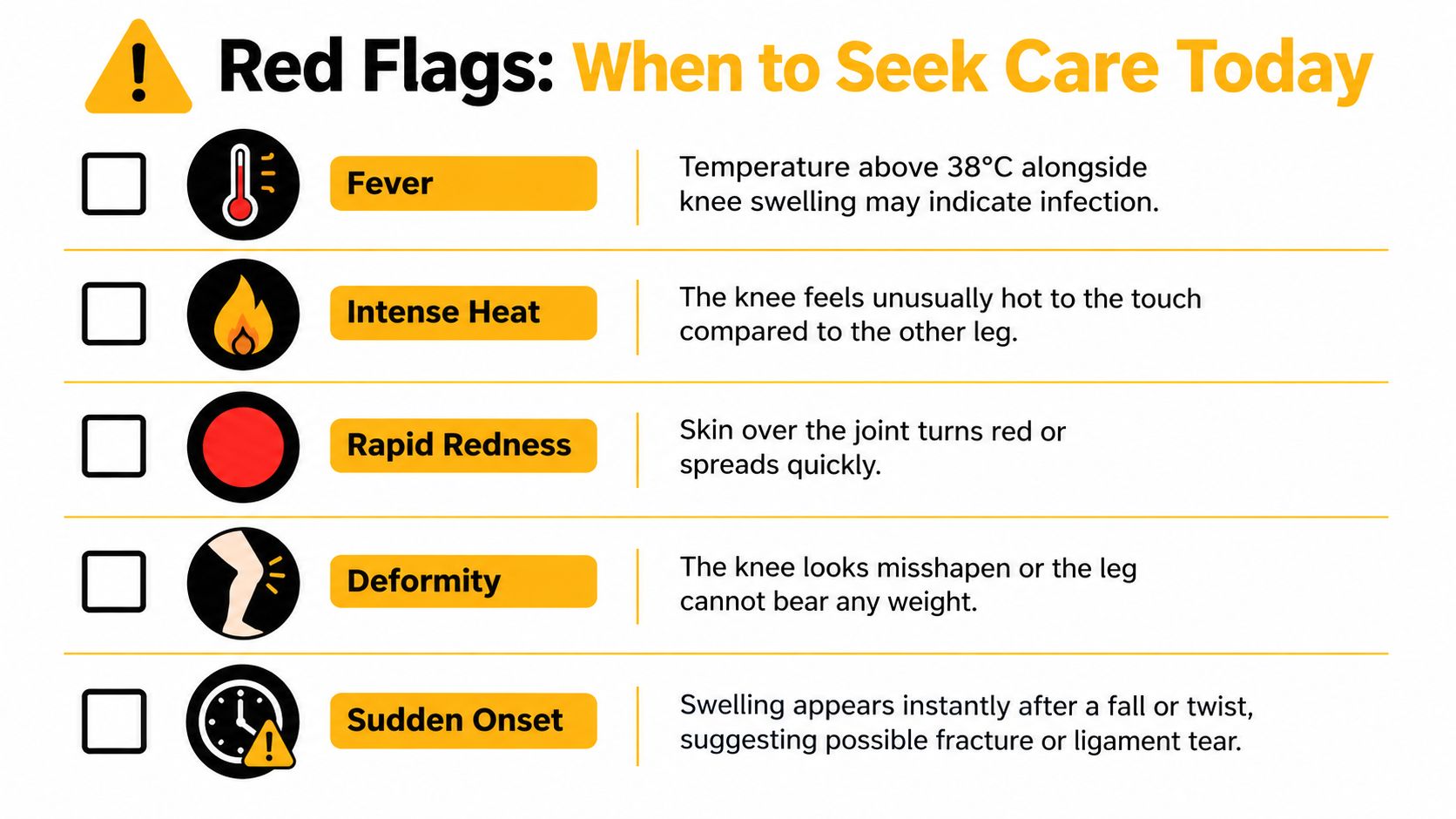
Use this triage checklist
Seek same-day medical assessment if any of these features is present:
- Sudden severe pain: Intense pain after a twist, fall, or forceful movement may indicate a significant injury.
- Heat and marked swelling: A hot, very swollen joint can signal infection or another urgent inflammatory problem, even if you don't have a fever.
- Fever or feeling unwell: Chills, unusual fatigue, or a general sense of illness raise the concern for infection.
- Inability to bear weight: If you can't safely stand or walk, don't test the knee repeatedly at home.
- Calf swelling or pain: Calf symptoms can indicate a blood clot and need prompt assessment, particularly when they develop with leg swelling or risk factors.
- Recent surgery, injection, or procedure: A new swollen knee after an intervention deserves direct clinical advice rather than routine self-care.
- Numbness or pins and needles: Altered sensation may indicate nerve or circulation involvement.
- A pale or cool foot: A foot that feels cooler or looks paler than the other side can signal compromised blood flow.
- Visible deformity or rapid change: A misshapen knee after trauma may involve a fracture or major ligament injury.
Immunosuppression, a history of joint infection, or a weakened immune response should also lower the threshold for urgent advice. Don't wait for every warning sign to appear.
If the knee is rapidly painful, hot, or substantially swollen, the same-day step is medical assessment, not ice and a topical stick.
First 48 Hours of Self-Care
If the swelling resembles a familiar activity-related flare, you can walk safely, and no red flags are present, use relative rest. That means removing the activity that provoked the symptoms while continuing comfortable daily movement. Bed rest can increase stiffness and make the return to activity harder.
Make RICE specific
- Rest: Avoid running, deep squats, kneeling, and repeated stairs if they increase pain or swelling. Short, easy walks may be acceptable if your gait remains steady.
- Ice: Use a cold pack wrapped in a cloth for 10 to 15 minutes at a time. Never place ice directly on the skin, and stop if the area becomes numb or painful.
- Compression: A sleeve should feel supportive, not constricting. Remove it if the foot becomes numb, cool, pale, or unusually tingly.
- Elevation: When sitting or lying down, raise the leg above heart level if comfortable. Support the calf rather than forcing the knee into a locked position.
For practical guidance on choosing between cooling and warming, see this explanation of swelling, heat, or ice. Gentle ankle pumps and comfortable knee bends can help prevent the leg from becoming still, provided they don't increase symptoms.
Weigh medication trade-offs
Acetaminophen may help pain but doesn't target inflammation. Ibuprofen and naproxen sodium may help both pain and inflammation, but oral NSAIDs can increase the risks of gastrointestinal bleeding, kidney injury, fluid retention, raised blood pressure, and cardiovascular problems. The risks are especially important for older adults and people taking anticoagulants or living with kidney, heart, or gastrointestinal disease (Ontario Health osteoarthritis quality standard).
Ask a pharmacist or physician before using an oral NSAID if you take regular medication or have a chronic condition. A topical analgesic may reduce local discomfort with less systemic exposure than an oral NSAID, but it still needs to be used according to its Canadian product label. Resources on non-surgical knee pain exercises can help you plan the transition from protection to movement.
A simple day might include gentle bending after waking, a brief movement break around midday, cooling after an aggravating activity, and topical application later if the product label allows it. At night, support the leg comfortably so the knee isn't hanging unsupported or forced into hyperextension.
Choosing Between Topical, Oral, and Ice
Each option earns its place for a different reason. Ice changes the immediate sensory and inflammatory experience, oral medication can affect symptoms throughout the body, and a topical analgesic focuses application on the painful area. None of these choices replaces the triage step.
| Option | Best For | Key Caution |
|---|---|---|
| Topical analgesic | Local discomfort when you want to support movement or rehabilitation | Use only on clean, intact skin and follow the Canadian product label |
| Oral NSAID | Pain with an inflammatory component when a clinician or pharmacist considers it appropriate | Can affect the stomach, kidneys, fluid balance, blood pressure, and cardiovascular system |
| Acetaminophen | Pain relief when inflammation isn't the main target | Check the label and your other medicines to avoid exceeding recommended use |
| Ice | Short-term relief after activity or during a familiar flare | Protect the skin and stop if numbness or excessive cold develops |
Topical products work by placing active ingredients across the skin over or around the painful area. Their appeal is local symptom management without the same degree of systemic exposure associated with oral NSAIDs. That doesn't mean they are risk-free, and it doesn't mean they treat the reason the knee became swollen.
Apply a topical product carefully
Use a thin layer on clean, dry, unbroken skin. Don't apply it over cuts, rashes, or open wounds, and wash your hands after use unless the product directions state otherwise. Follow the Canadian label for frequency, maximum use, and precautions rather than assuming that more product will work better.
A topical analgesic can fit between cooling sessions, before a prescribed exercise programme, or during a return to normal activity. MEDISTIK is one example of a non-prescription topical pain-relief option designed for temporary relief of sore joints and muscles. For a broader comparison of local and oral approaches, see the benefits of a topical pain reliever versus an oral pain reliever.
Relief is useful when it helps you move safely. It becomes a problem when it masks a worsening knee and delays assessment.
If swelling is substantial, increasing, or associated with heat, redness, or reduced function, stop treating the product as the main answer. Arrange an assessment.
Rebuilding Movement With Physiotherapy
Rest protects an irritable knee, but prolonged rest can become part of the problem. Once urgent causes have been excluded, rehabilitation usually works best as a graded process that respects symptoms without allowing the joint to become completely inactive.
Start with motion, then add force
During a hot or painful flare, try small, comfortable movements rather than forcing a deep bend. Seated heel slides, in which the foot glides towards the chair and back, can maintain motion. Supported quadriceps contractions, sometimes called quad sets, involve gently tightening the front thigh while the leg rests comfortably.
When irritability settles, add low-load strength work. Examples include:
- Isometric holds: Tighten the thigh or glute muscles without moving the knee.
- Sit-to-stand practice: Use a chair and control the descent rather than dropping into the seat.
- Supported step work: Begin with a low step and hold a rail if balance is uncertain.
- Calf and hip strengthening: Strong surrounding muscles help distribute load during walking and stairs.
- Balance practice: Progress from supported standing to more challenging stability work only when the knee feels reliable.
The commonly used 0 to 3 out of 10 discomfort rule can provide a rough guide during exercise, but it isn't permission to ignore swelling. If pain escalates during the session, the knee is more swollen later, or your walking pattern deteriorates, reduce the range, resistance, or repetitions and discuss the response with a physiotherapist.
A physiotherapist can examine range of motion, strength, gait, balance, and load tolerance, then adjust the programme as the knee changes. Guidance on knee pain relief exercises is most useful when matched to the cause and your current capacity. Some people also need help arranging physical therapy remote staff options when access, work, or travel makes regular appointments difficult.
Progression should be earned by response, not by the calendar. When a movement feels easier, swelling remains stable, and walking is more confident, increase one variable at a time, such as range, resistance, duration, or complexity.
When Injections and Surgery Enter the Picture
An injection may be reasonable when pain and swelling are blocking rehabilitation despite appropriate conservative care. A clinician may discuss an intra-articular corticosteroid injection as a short-term bridge that makes walking or exercise more manageable. Its effect is temporary, and repeated use isn't automatically appropriate because an injection doesn't correct every mechanical or degenerative driver.
Hyaluronic acid or platelet-rich plasma may also enter a discussion, depending on the diagnosis, local practice, cost, and patient preference. Evidence and recommendations are mixed, so ask what improvement is realistically expected, how long it might last, and what alternatives remain.
Procedures need a clear indication
Arthroscopy is often misunderstood as a way to “clean up” an arthritic knee. Canadian recommendations state that arthroscopy doesn't reduce pain or improve function in typical knee osteoarthritis. Choosing Wisely Canada also reports that needle lavage produces no measurable improvement in pain, function, walking time, stiffness, tenderness, or swelling. That doesn't mean every operation is inappropriate. A specific traumatic injury may require an orthopaedic opinion, but degenerative knee symptoms shouldn't automatically lead to a procedure.
For a fuller discussion of arthritis knee pain treatment, keep the sequence in mind: confirm the cause, build rehabilitation, manage symptoms safely, and reassess function.
Knee replacement is generally considered when disease is advanced, conservative care has been attempted or isn't suitable, and pain and functional loss substantially affect quality of life. The Canadian Institute for Health Information reports that approximately 83,700 knee replacements due to osteoarthritis are performed in Canada each year, and roughly 90% of first knee replacements for osteoarthritis are total replacements (CIHI information on knee replacements). Those figures describe the healthcare burden, not an individual prediction.
Prevention and a Long-Term Plan You Can Stick To
The most useful prevention plan isn't dramatic. It makes the knee's workload more predictable and keeps the muscles around it prepared for daily demands. Manage activity load, choose supportive footwear for the task, maintain comfortable mobility, and increase new exercise gradually rather than making a sudden jump.
A sustainable routine might look like this:
- Daily mobility: Move the knee through a comfortable range, especially after sitting.
- Regular strength work: Train the quadriceps, glutes, hamstrings, and calves with exercises you can repeat consistently.
- Planned walking: Build walking time according to the knee's response, not a rigid target.
- Smarter loading: Alternate demanding tasks with easier movement and avoid repeating the activity that reliably triggers swelling.
- A rehearsed flare plan: Know how you'll modify activity, use cooling or compression, check for red flags, and decide when to seek advice.
Save this short pathway:
- Triage first. Hot, rapidly swollen, severely painful, unstable, numb, or circulation-affected knees need same-day assessment.
- Protect without freezing. Use relative rest, careful cooling, compression, elevation, and comfortable motion.
- Choose medication by risk. Discuss oral NSAIDs when medical conditions or other medicines create concerns, and use topicals only as labelled.
- Rebuild capacity. Progress from range of motion to strength, balance, and normal activity.
- Escalate thoughtfully. Consider injections or surgical review only when the diagnosis and functional impact justify them.
- Keep the habit. Regular strength and manageable activity help the knee remain useful between flare-ups.
MEDISTIK offers non-prescription topical products for temporary relief of sore muscles and joints, including discomfort associated with stiffness and arthritis. Visit MEDISTIK to explore its topical formats and educational pain-management resources, then choose an option that complements, rather than replaces, proper assessment and rehabilitation.


