

You're standing in the pharmacy aisle after a workout, or after a long day on your feet, and your shoulder, knee, or lower back is telling you it's had enough. The shelf is full of tubes, sticks, gels, and warming rubs, and they all look like they should help. The hard part is knowing which one is an OTC anti inflammatory cream, and which one only feels active because it tingles, cools, or burns.
A real anti-inflammatory product is different from a simple sensation-based rub. It's meant to be applied where the pain is, so the ingredient can work locally instead of circulating through the whole body. That matters in Canada, where approximately 3.9 million Canadians aged 20 and older, about 13.6% of that population, were living with diagnosed osteoarthritis (Public Health Agency of Canada), a condition that keeps a lot of people looking for practical, non-prescription relief.
What an OTC Anti Inflammatory Cream Actually Is
A lot of people reach for a cream because they want relief without having to think too hard about it. The tube goes into a gym bag, a work kit, or a bathroom drawer, and it becomes the thing you grab when a joint flares up after a walk, a lift, or a long shift. That's the basic idea behind an OTC anti inflammatory cream, a topical product you apply to the skin over a sore muscle or joint to help reduce local pain and inflammation.
The key word is topical. The product is put on the skin, not swallowed, so the active ingredient is aimed at the painful area rather than the whole body. That's why a tube meant for osteoarthritis or a recent muscle strain isn't the same thing as a drink, capsule, or tablet taken for pain everywhere at once. If you want a broader overview of topical pain formats, see this topical analgesic guide.
What it is and what it isn't
An anti-inflammatory cream is not the same as a cooling gel or a warming rub that only creates a sensation. Some products use menthol or camphor to make the area feel cooler or hotter, which can distract from pain, but that isn't the same as directly treating inflammation. If your product mainly gives a cold or hot sensation and doesn't contain a topical anti-inflammatory ingredient, it may still be useful, just for a different purpose.
Practical rule: if the label names a topical anti-inflammatory ingredient, you're looking at a treatment product. If it mainly names a sensation ingredient, you're probably looking at a counterirritant.
That distinction matters because expectations change. A sensation-based rub can feel quick, while an anti-inflammatory product is trying to do more than mask discomfort. For someone with recurring joint pain, that difference is often the reason one product feels useful for a few minutes and another feels useful through the day.
People also confuse "cream" with one specific texture. In practice, OTC anti-inflammatory products can come as creams, gels, solutions, sticks, or sprays. The format affects how easily the product spreads, how fast it dries, and how it sits on the skin, but the question is still the same: what active ingredient is inside, and is it meant to reduce inflammation?
How Anti Inflammatory Ingredients Reach the Tissue
Inflammation isn't abstract when you can feel it in a knee, wrist, or back. It shows up as swelling, heat, pain, and reduced movement, and local treatment makes sense when the problem is local. If one joint is angry after overuse, there's no reason to flood the whole body with medicine when the target sits right under the skin.
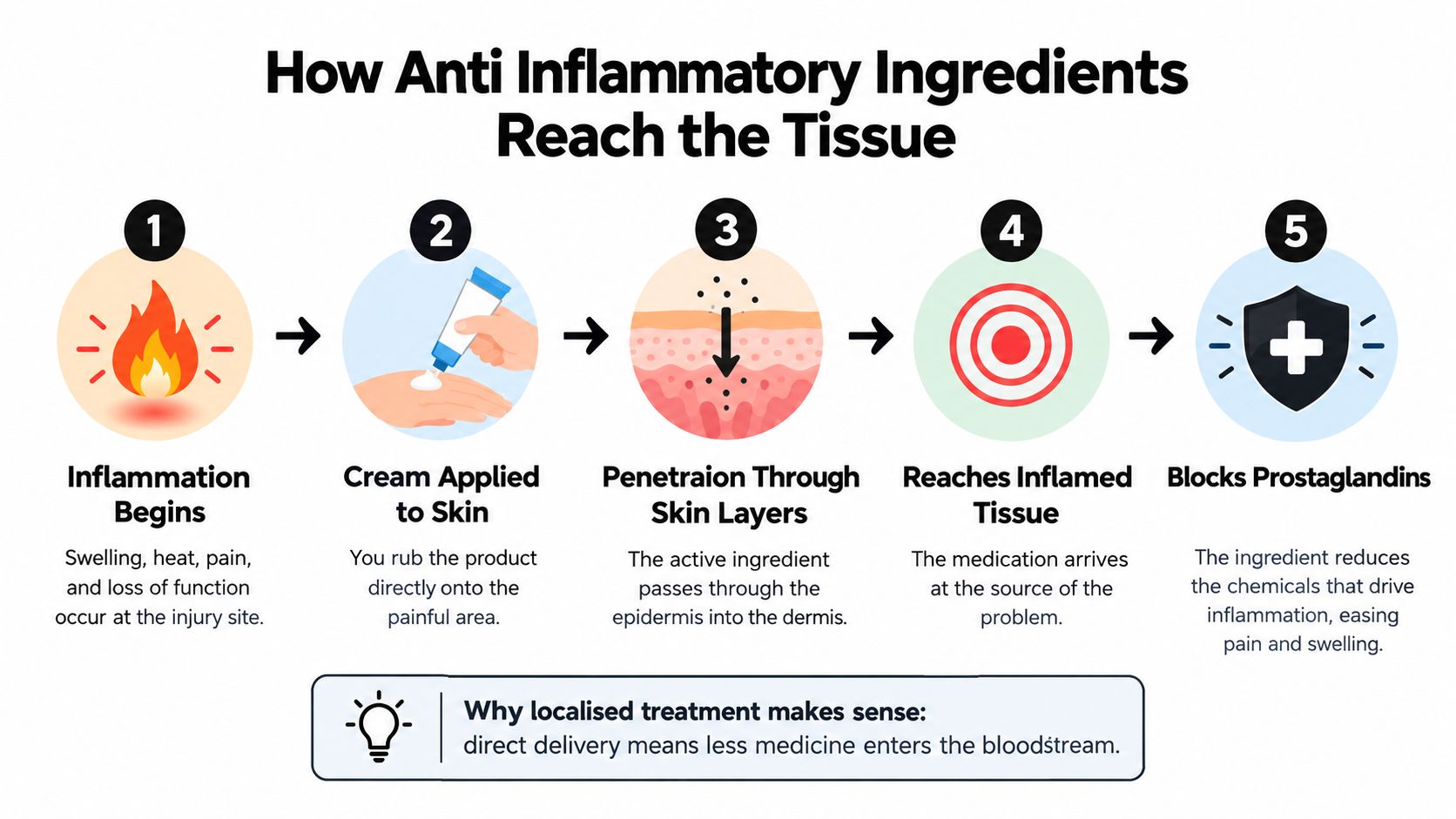
The skin is a barrier, so a topical ingredient has to cross it before it can affect tissue below. How far and how fast that happens depends on the ingredient, the strength, and the formulation. A gel, cream, stick, or spray doesn't just feel different in your hand, it can also influence how the product spreads and how much active ingredient reaches the area that hurts.
From skin surface to sore tissue
A simple way to think about it is this. You apply the product to the sore spot, it passes through the outer skin layers, and it works on the tissues underneath. In a joint problem, that may mean acting closer to the painful area than an oral product would. In a muscle strain, it means the medicine is aimed where the soreness is happening.
The formulation matters because not every topical vehicle behaves the same. A gel may feel lighter and dry faster. A cream may feel richer and stay on the skin longer. A stick can be easier to apply on the go, while a spray can be convenient when reaching a painful area is awkward. Those are practical differences, not cosmetic ones, because they affect how easily you use the product consistently.
Local treatment works best when the pain is local, because the medicine is delivered where you need it instead of travelling through the whole body first.
That's also why two products with the same general ingredient class can feel different in real life. The active ingredient matters, but so does the vehicle carrying it. A product designed for recent muscle or joint injuries isn't automatically interchangeable with one designed for knee osteoarthritis. Canadian evidence reviews make that point clearly for diclofenac, where the approved concentration, form, and treatment duration vary by indication (Canadian Agency for Drugs and Technologies in Health).
The process is usually slower than taking a pill, but that isn't a weakness. For localized pain, slower local delivery can be exactly what you want, because it keeps the effect concentrated where the discomfort lives. The important part is choosing a product built for the kind of pain you have.
Common Active Ingredients and What They Are Best For
The front of the tube tells you almost nothing. Two products can promise pain relief and still work in very different ways once you look at the active ingredient. That is why it helps to sort OTC options by ingredient class, not by brand name.
Topical treatment is already part of routine care for local joint pain. Canadian primary care data reported that 45% of NSAID prescriptions for osteoarthritis were for topical products in a study of 207,610 patients over age 30 (Canadian Medical Association Journal Open). That is a useful clue for pharmacy aisle decisions, because it shows topical products are not fringe tools.
The main ingredient families
Topical NSAIDs, especially diclofenac, are the clearest anti-inflammatory option for local musculoskeletal pain. They act like a local version of an oral anti-inflammatory, with the medicine placed where the pain is. For diclofenac products, a 1.16% diclofenac diethylamine gel is approved for recent localized muscle or joint injuries, while a 1.5% diclofenac sodium solution is approved for knee osteoarthritis and used for no more than three months (CADTH).
Ketoprofen is another topical NSAID. The Canadian comparative review found it effective for painful inflammatory conditions, but the evidence does not look exactly the same across every product and condition (CMAJ review). That detail matters because people often assume every anti-inflammatory cream is interchangeable. They are not.
Menthol and methyl salicylate belong to a different group. They are common in counterirritant products that create cooling or warming sensations, which can make soreness feel easier to ignore for a while. That can help with short-term comfort, especially if a person wants something that feels like it is working quickly. The effect is different from a topical NSAID, though.
Capsaicin is another ingredient people often ask about. It is usually used for recurring aches, where the goal is gradual desensitisation and a warming sensation rather than fast anti-inflammatory action. Some readers find that useful. Others find the initial sting too irritating to keep using.
| Ingredient Class | Typical Use | Evidence Strength | Key Caution |
|---|---|---|---|
| Topical NSAIDs, like diclofenac | Local joint and soft-tissue pain | Stronger for inflammatory pain | Match the product to the condition and formulation |
| Ketoprofen topical products | Local inflammatory pain | Supportive, but product-specific | Not all formulations behave the same |
| Menthol and methyl salicylate | Fast-feeling temporary relief | Mixed for true anti-inflammatory effect | Sensation relief is not the same as anti-inflammatory action |
| Capsaicin | Recurring aches and some chronic pain patterns | Useful for selected cases | Can sting and take patience |
| Arnica-based products | Mild aches and self-care routines | Variable | Do not assume it works like an NSAID |
For a side-by-side comparison of OTC anti-inflammatory creams by ingredient class, see this anti-inflammatory cream overview. The practical takeaway is simple. Match the ingredient class to the kind of pain you are treating, then check whether the format and concentration fit the label's intended use.
Topical vs Oral Anti Inflammatory Treatment
Both topical and oral anti-inflammatory products work through the same basic pathway. They reduce prostaglandin-driven inflammation, which is one reason pain, swelling, and stiffness can ease. The main difference is where the medicine goes, how much of the body it reaches, and which side effects become more likely.
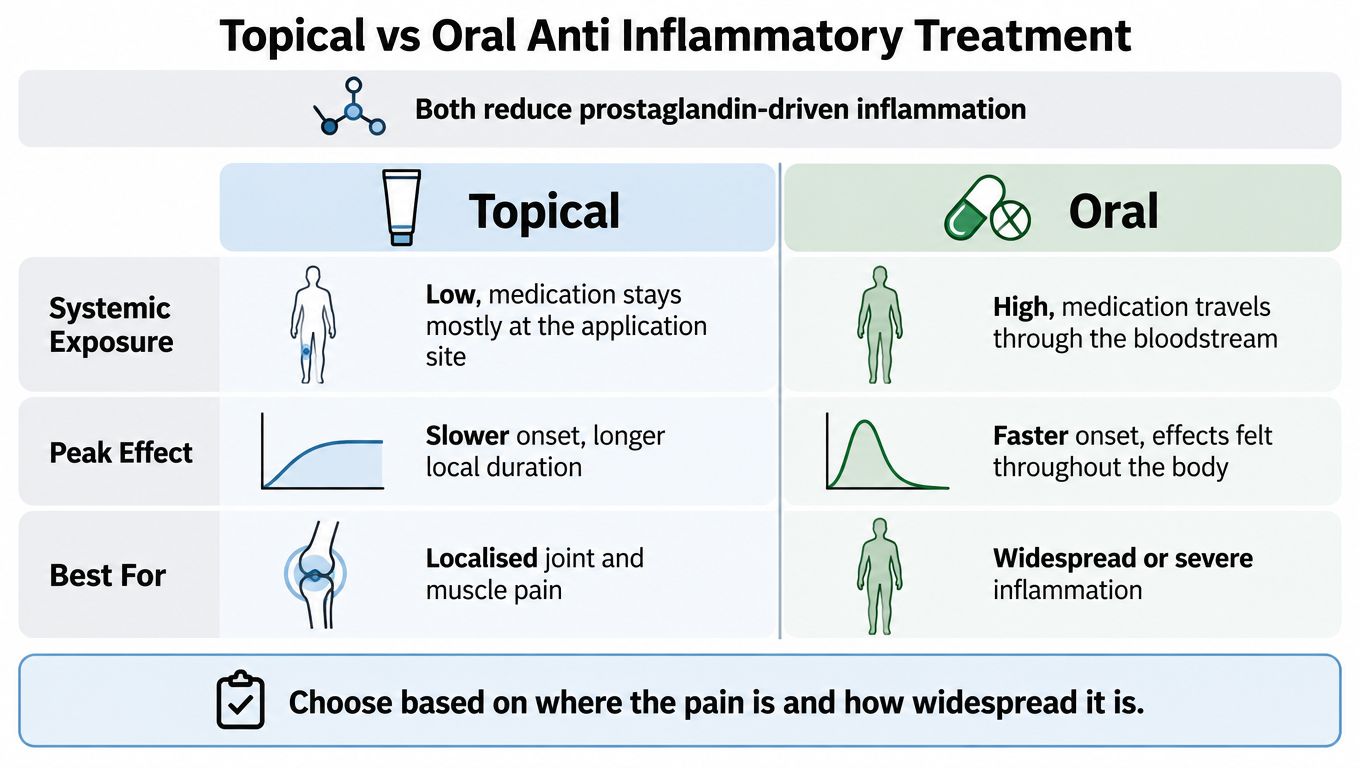
Canadian comparative evidence found that topical diclofenac produced at least 50% pain reduction within six weeks in chronic hand and knee osteoarthritis, with a number needed to treat of approximately 5, while topical ketoprofen had an NNT of 7 (CMAJ review). An NNT of 5 means about one in five people gets that level of relief who would not have with placebo. That is why topical treatment deserves attention, especially for pain that stays in one place.
Where topical treatment fits best
Topical NSAIDs make the most sense when the pain is local. A sore knee, a painful hand joint, a shoulder that flares after repeated lifting, or a small area of soft-tissue pain are the kinds of situations where a cream or gel can fit well. The goal is simple, relief at the site of the problem without loading the rest of the body with medicine it does not need.
Oral NSAIDs still have a place. If pain is widespread, severe, or affecting several areas, a tablet or capsule may be easier to use. The trade-off is that oral treatment exposes the whole body, which raises the chance of stomach, kidney, blood pressure, or cardiovascular concerns in some people.
A referenced study in the Canadian review found that severe gastrointestinal adverse events fell from 26% with oral treatment to 17% after substitution with topical therapy (CMAJ review). That does not make topical treatment risk-free, but it helps explain why many people with local pain start there.
Useful decision rule: if the pain is local and the skin is intact, topical treatment is often the more targeted first step. If the pain is widespread or the inflammation is deep and severe, oral or prescription care may be more appropriate.
For a simple side-by-side explanation, see this topical versus oral pain reliever guide. The choice is not which one is stronger in the abstract. It is which one fits the size of the problem and the person's health risks.
Safe Use, Dosing, and Technique That Actually Matter
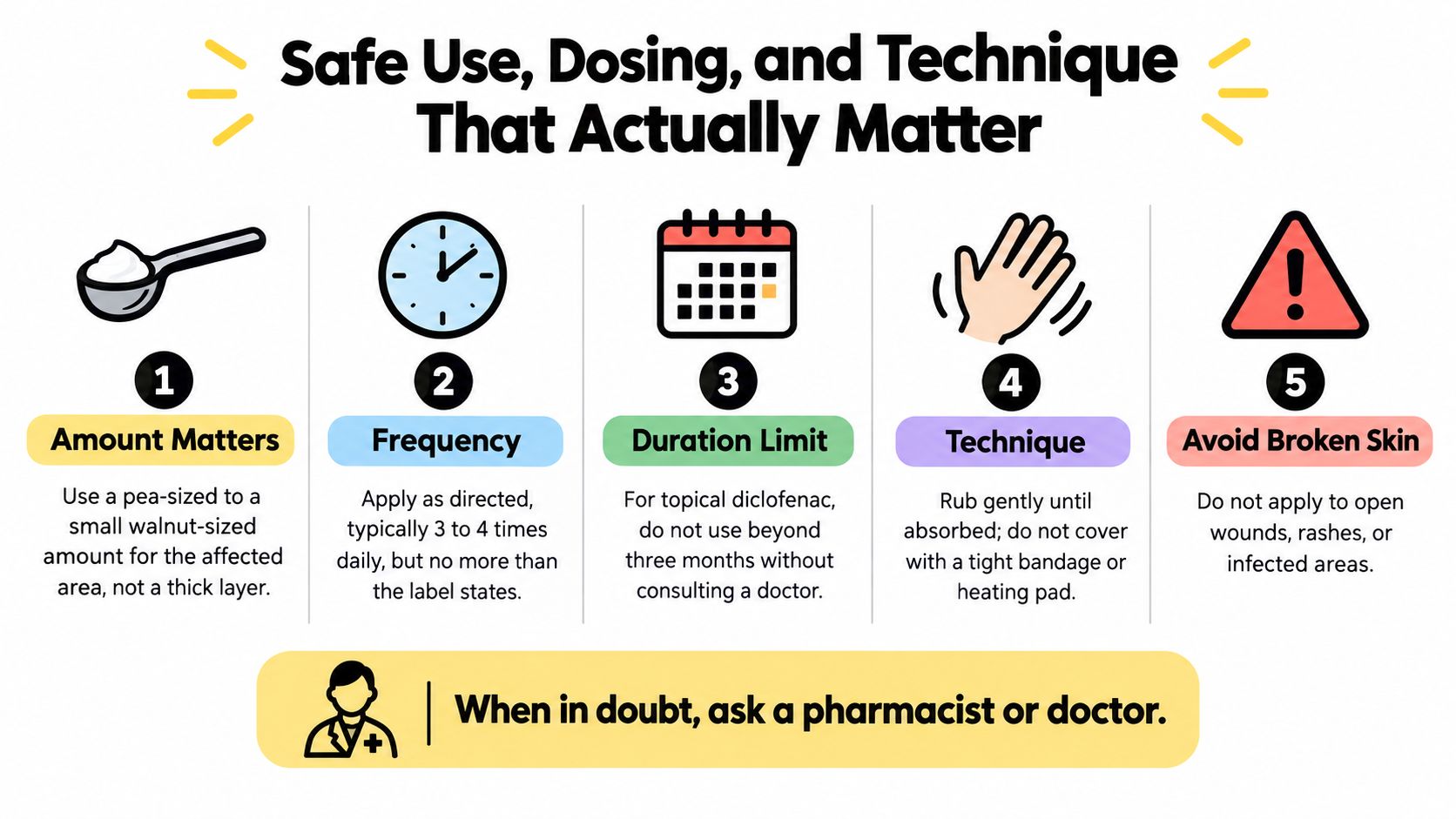
The cream in the tube matters less than the way it is used. A person can have the right product and still get stinging, irritation, or weak relief by applying it to the wrong skin or combining it with the wrong products. For diclofenac, Canadian guidance advises avoiding cuts, wounds, rashes, or eczema, and avoiding concurrent oral diclofenac or other NSAIDs unless medically directed.
The practical basics
Apply the product only to intact skin. Scraped, burned, infected, or already irritated skin has a weaker barrier, so it absorbs unpredictably and is more likely to react. Keep it away from the eyes and mucous membranes, and wash your hands after use unless the hands are the area being treated.
Some products are meant for limited use. Canadian evidence on diclofenac notes a knee osteoarthritis solution used for no more than three months. The reason is practical, not mysterious, longer-term safety was not established for that use case.
Technique matters too. Rub the product in gently until it is absorbed, and do not pile on a thick layer because the pain feels stubborn. More cream does not mean better relief, and a tight bandage or occlusive wrap is usually a poor choice unless the label or a clinician specifically says it is acceptable. For a simple reminder on how to use topical pain products safely in Canada, see this topical pain relief guide for Canada.
Practical rule: if the label says one thing and your instincts say “more is better”, follow the label.
For athletes and physically active people, timing can matter. Apply the cream before sweat and friction start, ideally with enough lead time for it to absorb, and skip compression garments over the treated area unless the product directions allow them. Heat, massage, and heavy rubbing can change how the product behaves on the skin, so keep those out of the routine unless the label supports them.
The safest approach is usually the simplest one. Use the smallest amount that matches the directions, and ask a pharmacist before combining topical treatment with oral NSAIDs or other pain products.
Building a Smart Pain Relief Routine Around Creams
An anti-inflammatory cream works best when it's part of a routine, not a panic response. For active adults, that might mean using it around training, work, or recovery. For someone with recurring arthritis or knee pain, it may sit inside a daily rhythm of movement, pacing, sleep, and sensible use of heat or ice.
A topical product can be one useful tool in that routine, but it can't explain away every pain signal. The goal is to stay functional without ignoring the body when it's asking for a closer look.
When cream fits and when it doesn't
Use the cream when pain is local and predictable, like a flare after gardening, lifting, walking, or getting up stiff in the morning. Keep an eye on what happens after you apply it. If the discomfort eases and movement feels easier, that's useful information. If nothing changes, or the pain keeps returning in the same pattern, the issue may need assessment rather than more product.
Look out for red flags:
- Persistent pain beyond two weeks that doesn't settle with usual self-care.
- Joint swelling or warmth, especially if it's new or worsening.
- Numbness or weakness, which suggests something beyond simple soreness.
- Systemic symptoms, such as fever or feeling unwell.
- Pain after a significant injury, especially if movement is limited.
For older adults, the threshold for asking for help should be lower, not higher. The Arthritis Society Canada's advice to consider topical NSAIDs before oral NSAIDs in people aged 75 and older fits a broader pattern, use the least systemically demanding option that still makes sense for the problem (Arthritis Society Canada).
If you want a broader recovery framework, see this recovery cream guide. A smart routine combines the right topical product with movement quality, recovery habits, and a willingness to stop self-treating when the pattern doesn't add up.
MEDISTIK makes non-prescription topical pain relief products designed for warm-up, performance, and recovery, with formats that fit real life in the clinic, gym, or workplace. If you're comparing topical options for sore muscles, joints, stiffness, or inflammation, visit MEDISTIK to see how topical care can fit into a practical pain management routine.


