

You're in a clinic waiting room, rubbing a knee that's been sore since weekend gardening. Nearby, an older patient is managing familiar arthritis discomfort, while someone in training gear wants something to help between workouts. All might reach for a muscle and joint cream, but they shouldn't necessarily choose the same product or use it the same way.
The useful question isn't which cream feels strongest. It's which ingredient fits the problem, what benefit you can reasonably expect, and whether self-treatment is appropriate.
What a Muscle and Joint Cream Actually Does
A muscle and joint cream is a topical product applied to the skin to relieve discomfort in a particular area. The category includes products that alter pain sensations and products with anti-inflammatory ingredients. Those aren't interchangeable approaches, even when their packaging looks similar.
Health Canada identifies menthol, methyl salicylate, and capsaicin as ingredients in Canadian non-prescription topical analgesics for temporary muscle and joint pain relief. Their counterirritant action stimulates or mildly irritates sensory nerves in the skin, helping modulate the perception of deeper discomfort, as explained in its topical pain-reliever safety review.
Relief isn't repair
Temporary relief describes a change in symptoms. It doesn't establish that cartilage has recovered, a tendon has healed, or the cause of recurring pain has resolved.
For the gardener, relief might make an ordinary evening more comfortable. For someone with arthritis, it might support a manageable daily routine. Neither outcome means the underlying condition has disappeared.
Practical rule: Judge a topical analgesic by the comfort and function it provides, not by how intensely it tingles.
Pain involves nervous-system processing, not a signal travelling unchanged from a sore joint. This explanation of how pain is processed by the brain provides useful context for understanding why changing sensations at the skin can change the experience of pain.
Decide what you're trying to accomplish
Before buying a product, separate these questions:
- Symptom relief: Are you trying to ease familiar, localised discomfort?
- Functional support: Would relief help you complete an appropriate activity more comfortably?
- Clinical assessment: Is the pain new, unexplained, worsening, or associated with a loss of function?
The distinction matters particularly during activity. Feeling less pain isn't proof that a joint or tendon can tolerate more loading. Don't use a cream to turn a painful movement into permission to keep pushing.
A reasonable treatment goal is concrete: getting through routine household tasks, tolerating prescribed rehabilitation, or settling a familiar ache. A promise to fix arthritis or repair an injury belongs in a different category, and a topical analgesic label shouldn't be read that way.
Active Ingredients and How They Work on Pain
Read the active ingredient before the product description. Cooling, extra-strength, natural, and sports describe a shopping experience more readily than they explain a treatment.
Menthol and methyl salicylate belong to the counterirritant group discussed above. Their sensory effects can be noticeable during application, but the strength of that sensation doesn't tell you how much useful relief you'll receive. The explanation of menthol in cream can help you interpret cooling-product labels without treating cold sensation as evidence of tissue healing.
Common Topical Analgesic Ingredients at a Glance
| Ingredient Family | How It Feels | Typical Onset | Best Fit |
|---|---|---|---|
| Menthol and methyl salicylate counterirritants | Cooling, warming, or tingling, depending on formulation | Sensation may be noticeable during application; relief varies | Temporary relief of familiar muscle and joint discomfort within labelled uses |
| Capsaicin counterirritants | Warming or irritating sensations can affect tolerability | Don't infer timing from warmth; follow formulation-specific directions | Labelled pain indications when skin tolerability is acceptable |
| Topical NSAIDs, including diclofenac | Sensation isn't a reliable guide to anti-inflammatory benefit | Assess benefit over the prescribed or labelled treatment period | Localised osteoarthritis and regional pain where clinically appropriate |
There's no defensible universal onset or duration for an entire ingredient family. Concentration, formulation, application site, and the condition being treated all matter. A roll-on called natural ice should still be evaluated by its medicinal ingredients and directions, not its name.
Anti-inflammatory products answer a different question
Topical non-steroidal anti-inflammatory drugs, or NSAIDs, differ from sensory counterirritants. Canadian guidance identifies localised osteoarthritis and regional pain syndromes as suitable targets, particularly when oral NSAIDs are undesirable because of gastrointestinal, renal, cardiovascular, age-related, or multiple-medication concerns. It also recommends limiting the treatment area, rather than applying the product broadly, in its guidance on topical NSAID submissions.
That makes a localised hand or knee problem a different decision from widespread aching. Evidence for a particular anti-inflammatory formulation shouldn't be transferred to a menthol cream, and evidence for one joint condition shouldn't be stretched to every muscle complaint.
For capsaicin, the practical issue is whether the labelled use fits and whether the person tolerates the skin sensation. Don't interpret irritation as a requirement to persevere regardless of severity.
The sensible comparison is appropriate ingredient plus acceptable tolerability plus useful function. Stronger sensation alone doesn't meet that standard.
Sticks, Sprays, Roll-Ons, Creams, and Gels
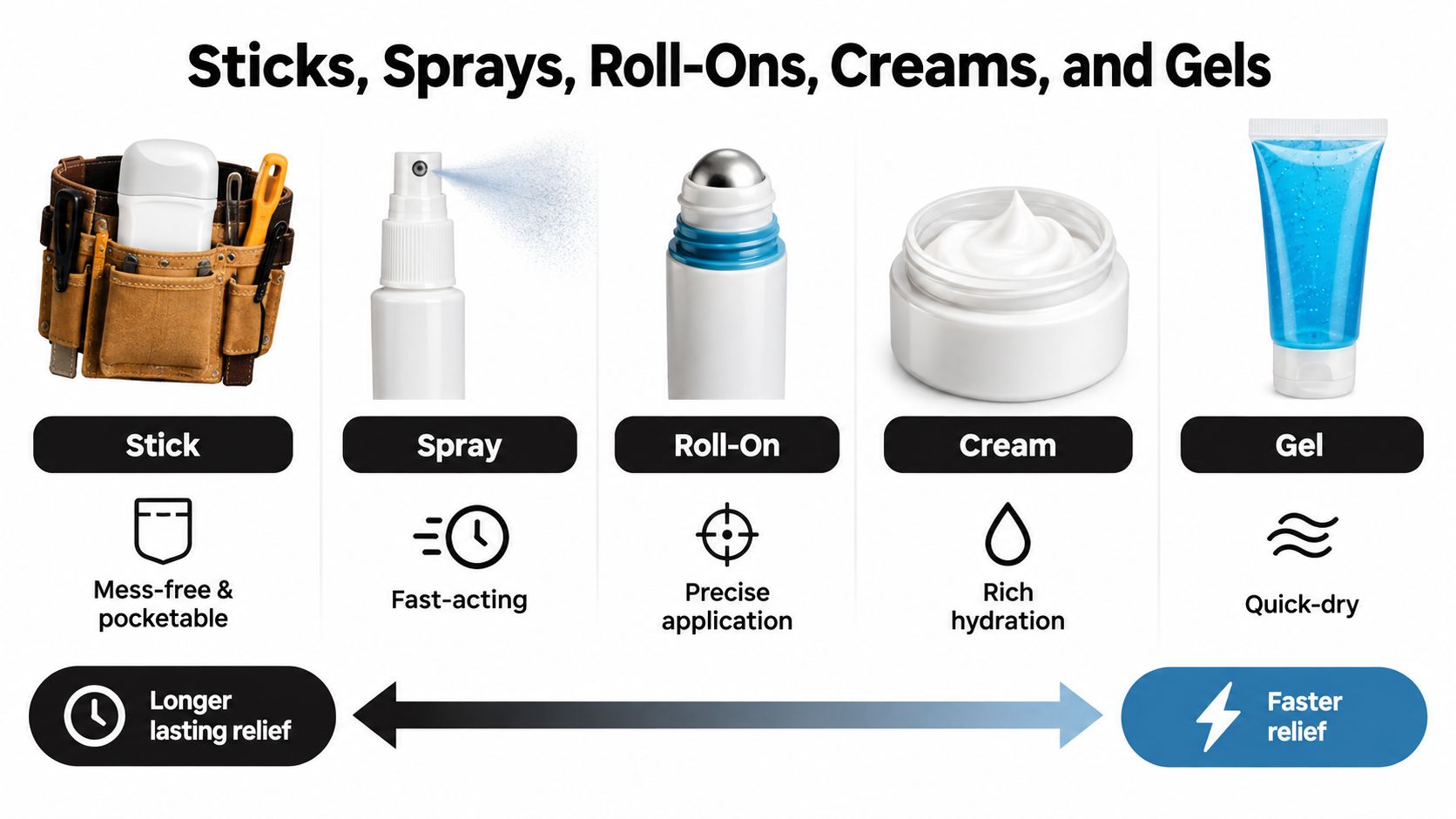
A person who can comfortably rub cream into a knee may struggle to reach their lower back. Someone with painful hands may find a rollerball easier to handle than a tube. Packaging can determine whether a reasonable treatment is practical.
This format comparison illustrates the handling differences to consider, although speed and duration still depend on the formulation.
Match the applicator to the person
A stick can suit someone who wants targeted application without spreading cream across their palms. Before recommending it to a tradesperson or runner, check whether they can reach the intended area and control the application comfortably.
A spray may be easier for a difficult-to-reach area, but convenient coverage isn't a reason to treat a larger surface than directed. The user still needs control over where the product lands, especially around the face and sensitive areas.
A roll-on offers guided application through a rollerball. Try the cap, grip, and movement before assuming it's accessible for arthritic hands. Creams and gels allow hand application where rubbing is directed, but a clinician shouldn't turn that into vigorous massage over an unexplained painful area.
A convenient applicator can improve usability. It can't make an unsuitable ingredient appropriate.
MEDISTIK offers an extra-strength stick, extra-strength spray, and natural ice roll-on as portable options alongside traditional cream and gel formats. Compare their labels rather than assuming that different applicators provide identical effects; this overview of topical pain-relief products provides additional format context.
The video below offers another way to review topical application formats.
For clinics, handling also includes hygiene and consistency. Staff need to know whether an applicator contacts skin, how the product should be managed between patients, and how application is documented. A product that's easy to carry still needs an organised clinical routine.
How to Tell a Real OTC Product From an Unproven Compounded Cream
A long medicinal ingredient list can look impressive. It can also make a cream harder to evaluate, particularly when the combination hasn't been shown to outperform established care.
Ontario's Workplace Safety and Insurance Board's 2026 review found that compounded topical analgesics containing ingredients such as amitriptyline, baclofen, gabapentin, ketamine, naproxen, or pregabalin lack Health Canada approval for topical pain treatment. It concluded that evidence for compounded products in chronic non-cancer pain is very limited and noted that trials rarely compared them with standard care in its compounded topical analgesics formulary decision.
The following checklist is a starting point for label review, not a substitute for confirming the product's regulatory record.

Verify the product, not just the ingredient names
For a Canadian OTC purchase, look for the Drug Identification Number, or DIN, or Natural Product Number, or NPN, as applicable. Confirm the identifier against the relevant Health Canada product record, or ask a pharmacist to help. Check that the record matches the product name and formulation you're holding.
Then read the medicinal ingredients and their concentrations. An ingredient's presence isn't enough to establish that the whole product is suitable for your condition. This guide to Health Canada-approved products offers context for that distinction.
Regulated status also isn't a promise that everyone will benefit. The useful information includes the authorised indication, application directions, warnings, and circumstances requiring medical attention.
Questions worth asking before purchase
- Product identity: Does the regulatory identifier match this exact formulation?
- Treatment fit: Does the labelled use match the symptoms you're trying to manage?
- Evidence fit: Was the supporting research conducted on this formulation, or merely on an ingredient?
- Safety clarity: Are application limits and stop-treatment instructions understandable?
- Comparative value: If a compounded product is proposed, why choose it over a standard option?
Compounding isn't automatically inappropriate, but it requires a clear clinical rationale and an honest discussion of uncertainty. A prescription-style ingredient list doesn't resolve that uncertainty.
More ingredients don't automatically mean stronger relief. Without useful comparative evidence, complexity may add questions rather than answer them. Be especially cautious when claims move from temporary symptom relief to curing chronic pain or repairing damaged joints.
Applying Muscle and Joint Cream Safely
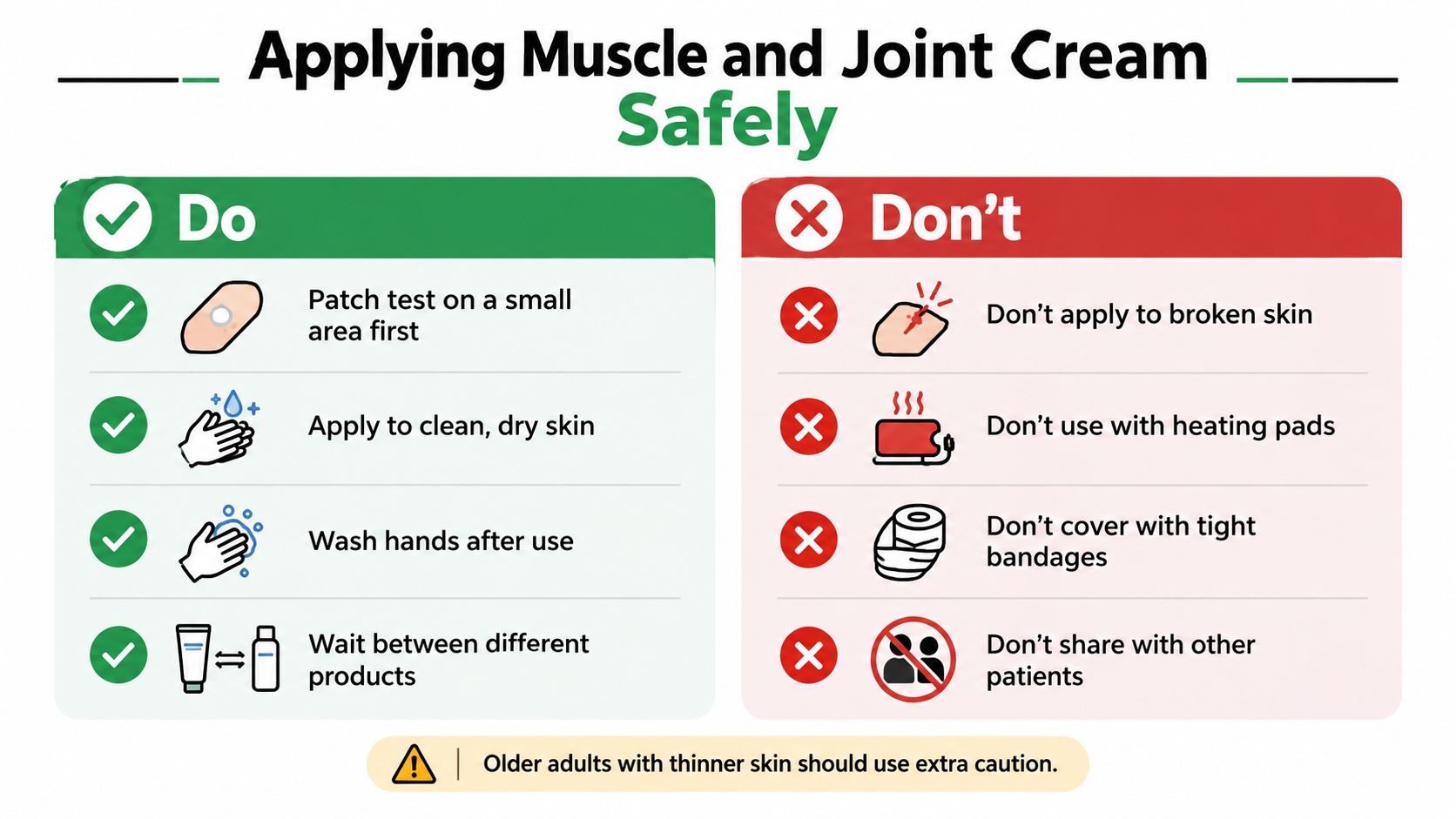
For an older adult using several treatments, the first task is to review what's already going on the skin. Include medicated creams, patches, rubs, and products applied by a therapist or family member. Don't assume that products are compatible because each is sold without a prescription.
Health Canada's safety review cited earlier documents serious skin burns associated with counterirritant analgesics. The central precautions are limited application, intact skin, and no added heat or occlusion.
Before and during application
- Check the skin: Use only an appropriate area of clean, dry, unbroken skin. Avoid cuts, rashes, irritation, and sensitive areas.
- Read the directions: Follow the product-specific amount, frequency, and application method. Apply a thin, limited layer rather than assuming more will work better.
- Keep it away from sensitive surfaces: Avoid eyes and mucous membranes. Wash hands after application unless the product's directions specify a different procedure for treating the hands.
- Review other products: Ask a pharmacist before combining topical treatments on the same area. Waiting between products doesn't automatically make a combination safe.
Older adults with fragile or sensitive skin deserve particular attention to tolerability. A small-area trial, when consistent with the label, doesn't guarantee that repeated or broader application will be tolerated.
Safety boundary: A warming cream is not an invitation to add a heating pad.
Don't combine counterirritants with heating pads, hot water bottles, hot baths, tight wraps, or occlusive dressings. Intensive exercise can also increase skin temperature and absorption, so application before activity or between sets shouldn't be treated as a universally safe routine.
When to stop
Stop using the product and seek medical assessment for pain, swelling, or blistering at the application site. Don't cover a reaction with another cream or interpret escalating burning as proof that the product is working.
For older adults, a written routine is often more useful than a collection of applicators: identify the product, body area, permitted frequency, and stop conditions. Keep the label available rather than relying on memory.
In clinic, record the application and communicate it to the patient. Otherwise, the person may unknowingly repeat treatment at home or combine it with a different product. Clear handover is part of safe use, not an administrative extra.
Who Actually Needs a Muscle and Joint Cream
Age alone doesn't determine who might benefit. The better criteria are a suitable localised complaint, an appropriate labelled indication, and a realistic reason to prefer topical treatment.
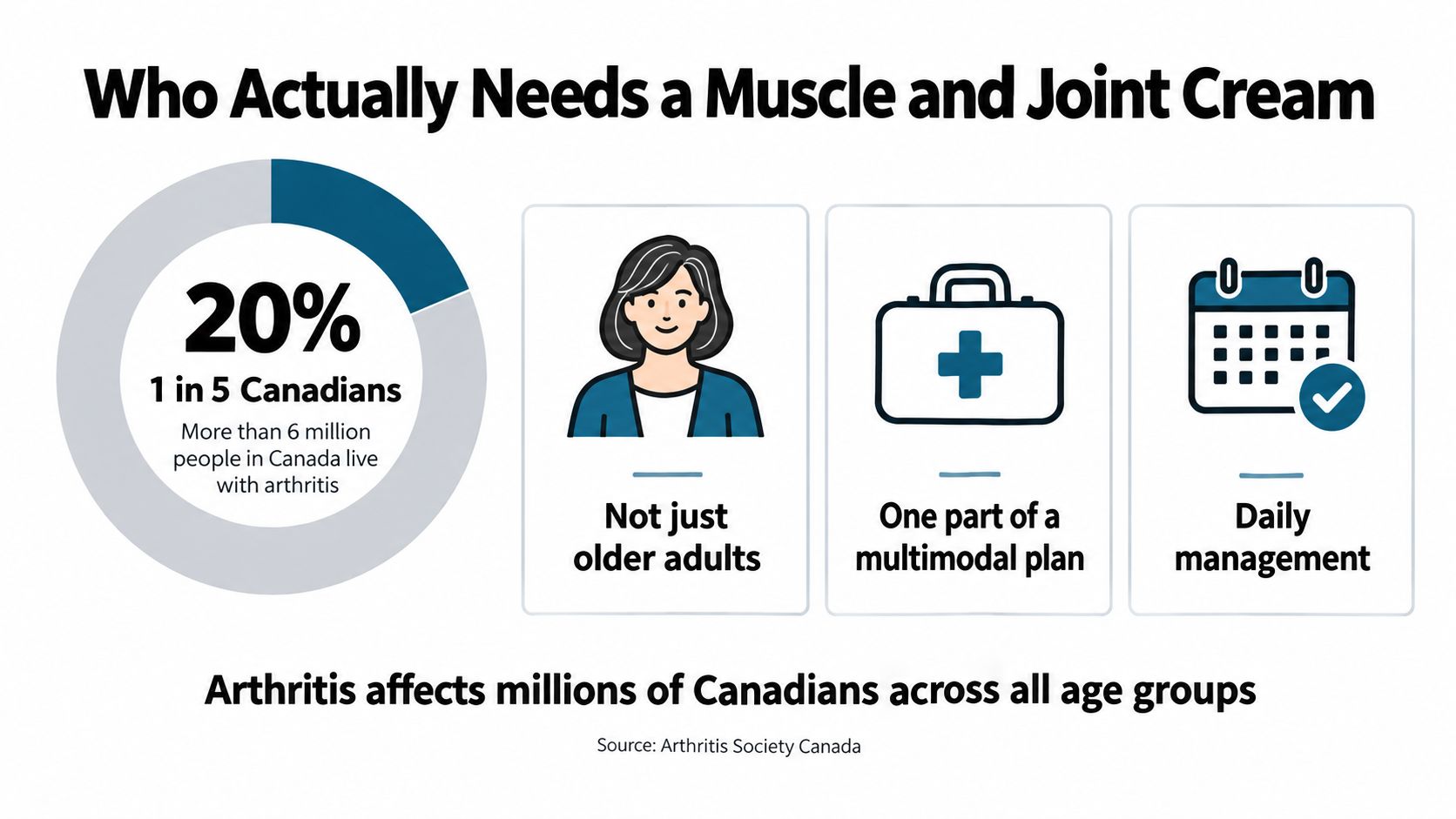
Statistics Canada reported that 19.3% of Canadians aged 15 and older, approximately 5.7 million people, reported arthritis in 2017, illustrating the scale of joint-related health needs in its Canadian arthritis report. That figure describes arthritis prevalence, not topical-product use or evidence that a particular cream treats arthritis.
The infographic provides a rounded overview of the broader arthritis burden; it shouldn't be read as a treatment recommendation.
Different users need different decisions
For active adults and physically demanding workers, a topical analgesic may be useful for familiar discomfort that has already been assessed or is suitable for self-care. If the same task repeatedly provokes pain, review the task, equipment, and workload rather than increasing applications.
For athletes, military personnel, and first responders, portability can be useful, but readiness to perform isn't established by symptom relief. Training or duty decisions should account for function and the underlying problem.
For older adults with arthritis, the priority is an understandable routine that fits skin condition, other treatments, and daily activities. The person who needs help opening a tube may also need help keeping track of applications.
Where clinicians add value
Physiotherapists, chiropractors, and massage therapists can help define the purpose of a topical product within a wider care plan. Record what success would look like, such as improved tolerance of an appropriate exercise, rather than just asking whether the cream feels strong.
Mechanical symptoms require a separate conversation. If shoulder pain is accompanied by popping, Dream Body Clinic's resource on rotator cuff popping causes is a useful discussion starting point, not a diagnosis or justification for treating every click with cream.
Nobody needs a topical product solely because they belong to a demographic group. The decision should follow the symptoms, the label, and the person's goals.
Building a Smarter Topical Pain-Management Plan
Start with a task you want to manage more comfortably, then choose treatment around that task. A useful plan might pair an appropriate topical product with prescribed movement, workload changes, or rehabilitation. It shouldn't depend on repeatedly suppressing symptoms so you can ignore them.
Make the plan testable
Write down the product, application site, and meaningful outcome before starting. Comfort matters, but function is the more useful practical test: can you complete the intended activity without exceeding the limits your clinician has set?
Discuss the benefits of a topical pain reliever versus an oral pain reliever with a pharmacist or clinician when medication risks complicate the choice. Topical treatment isn't automatically the right answer because it avoids swallowing a tablet.
Keep non-drug supports specific. That might mean changing a lifting setup, adjusting a sleep position, or following a supervised mobility programme. Heat or ice, where appropriate, needs its own instructions rather than being added directly over a medicated area.
Red Flags That Mean It's Time to See a Clinician
| Symptom | Why It Matters | What to Do |
|---|---|---|
| Sudden severe pain or marked swelling | The problem may be unsuitable for self-treatment | Stop the provoking activity and seek prompt assessment |
| Weakness, numbness, or deformity | These symptoms require evaluation beyond pain relief | Seek urgent clinical advice |
| Inability to bear weight | Function is substantially impaired | Don't push through; obtain urgent assessment |
| Persistent pain without meaningful improvement | The diagnosis or treatment plan may need review | Book reassessment rather than continuing indefinitely |
| Application-site blistering or swelling | A significant skin reaction is possible | Stop the product and seek medical care |
The body area also matters. Jaw pain isn't a reason to improvise with muscle and joint cream near the mouth; the Pain and Sleep Therapy Center TMJ guide offers condition-specific context for discussing that problem.
The smarter plan uses symptom relief to support appropriate care, not replace it. Continue only when the product is tolerated, the labelled use fits, and the benefit is worth the effort.
MEDISTIK offers muscle and joint topical products in stick, spray, and roll-on formats for different application preferences. Visit MEDISTIK to compare the options and review their directions, then ask your pharmacist or clinician which fits your symptoms and treatment routine.


