

You wake with a stiff knee, or finish a long walk with an ache that makes the stairs home feel harder than they should. A few gentle strokes around the thigh and knee may ease tension and make movement feel more comfortable. But knee joint pain massage is supportive care, not a way to repair cartilage, diagnose an injury, or replace medical assessment.
Osteoarthritis affects many Canadians. The Public Health Agency of Canada reported that approximately 3.9 million Canadians aged 20 and older, or 13.6% of that age group, were living with diagnosed osteoarthritis in 2016–2017, and the knee is the most commonly reported symptomatic joint site among Canadians with OA (Public Health Agency of Canada osteoarthritis factsheet). That makes knee discomfort familiar, but it doesn't mean every sore knee has the same cause or is suitable for massage.
The practical starting point is to notice where the discomfort sits and how it behaves. This guide shows how to work gently with surrounding muscles, when to leave the knee alone, and how massage and topical relief may fit around movement, work, and rest.
Why Knee Joint Pain Massage Is Worth Considering
Knee pain can show up as morning stiffness, an ache after standing through a shift, or soreness that follows exercise. When symptoms build gradually and there are no warning signs, gentle massage of the muscles around the knee may help ease tension and make ordinary movement more comfortable. The aim is a useful change in how the knee feels and functions, not a dramatic promise of a cure.
The distinction matters. Massage can address some soft-tissue tension around the joint, but it can't rebuild worn cartilage or repair a torn ligament or meniscus. It also can't establish why the knee hurts. A painful knee may need assessment, particularly if symptoms are persistent, severe, or accompanied by swelling, instability, trauma, or reduced function.
A practical standard: Judge massage by whether it helps you move more comfortably, not by how much pressure you can tolerate.
Evidence for massage in knee osteoarthritis is encouraging in some trials, but it doesn't justify promising that it works for everyone. In a randomized trial, adults with knee OA who received a structured Swedish massage protocol showed improvements in WOMAC global, pain, and stiffness scores after eight weeks (randomized trial published in 2006). Those results support considering massage as an adjunct, not as a substitute for diagnosis, exercise-based care, or other recommended treatment.
A sensible plan starts with a baseline: note where the pain is, what makes it worse, and how walking, stairs, or sleep are affected. Try light, comfortable work only if the knee is not hot, markedly swollen, or unstable. Stop if massage aggravates symptoms, and seek assessment when the problem persists or interferes with normal activity.
Understanding the Knee Structures You Are Actually Massaging
The knee area includes muscles and tendons that help move and support the joint. When massaging at home, you're generally working on these surrounding soft tissues, not trying to press into the joint itself. Where the pain sits can help you choose a gentler, more appropriate approach, though location alone can't diagnose the cause.
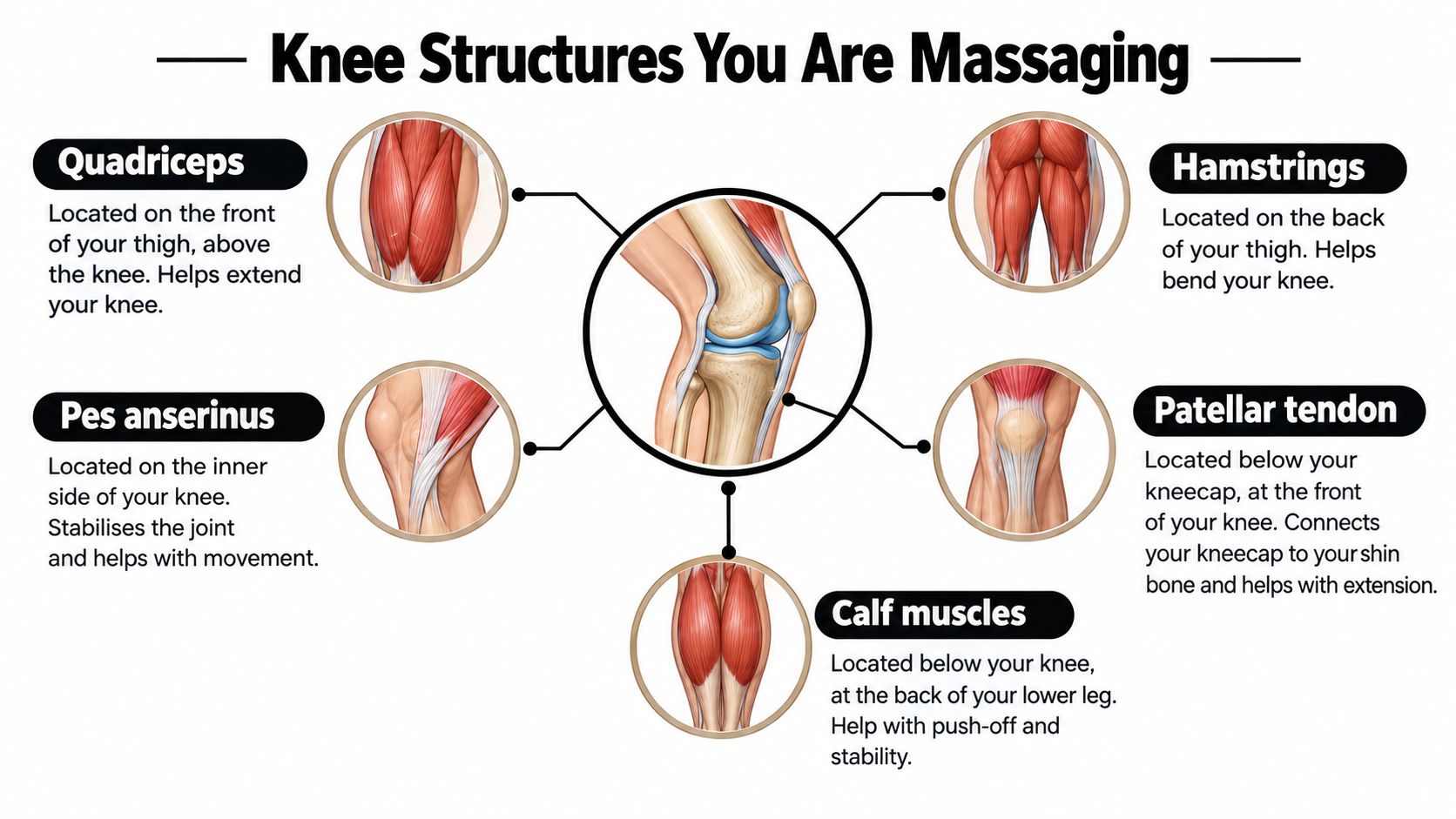
The quadriceps cover the front of the thigh and help straighten the knee. The hamstrings run along the back of the thigh, while the pes anserine tendons attach on the inner side of the knee, just below the joint line. The patellar tendon sits below the kneecap, and the calf muscles cross the back of the lower leg. The iliotibial band runs along the outer thigh; use a light glide over the surrounding area rather than trying to force the band to stretch.
Pain directly at the joint line deserves more caution than a broad feeling of tightness in the thigh or calf. A tender tendon or muscle belly may respond to light work nearby, but sharp, focal pain isn't an invitation to press harder. The back of the knee is particularly sensitive: avoid digging into the hollow behind the joint.
| Pain location | Likely tissue | Safe approach |
|---|---|---|
| Front of thigh, above the kneecap | Quadriceps muscle | Use broad, gentle strokes along the thigh. |
| Behind the knee or back of the thigh | Hamstrings or nearby tissues | Work on the thigh muscle, not the hollow behind the knee. |
| Inner knee, below the joint line | Pes anserine tendon area | Use light contact around the area; stop if it's sharply tender or swollen. |
| Below the kneecap | Patellar tendon or nearby tissues | Avoid pressing directly into a painful tendon. |
| Outer thigh or lower leg | Iliotibial-band region or calf muscles | Glide over the outer thigh; use comfortable pressure on the calf. |
The calf can influence how the knee feels during movement, so some people find it useful to consider the lower leg as part of their overall comfort routine. For more on that relationship, see this guide to calves and knee pain.
A Safe Knee Joint Pain Massage Routine You Can Do at Home
Choose a position that lets your leg relax, such as sitting with it supported or lying on your back. Keep your hand pressure comfortable, and use a small amount of lotion if your skin needs a smoother glide. This is meant to feel soothing, not sharp or bracing.
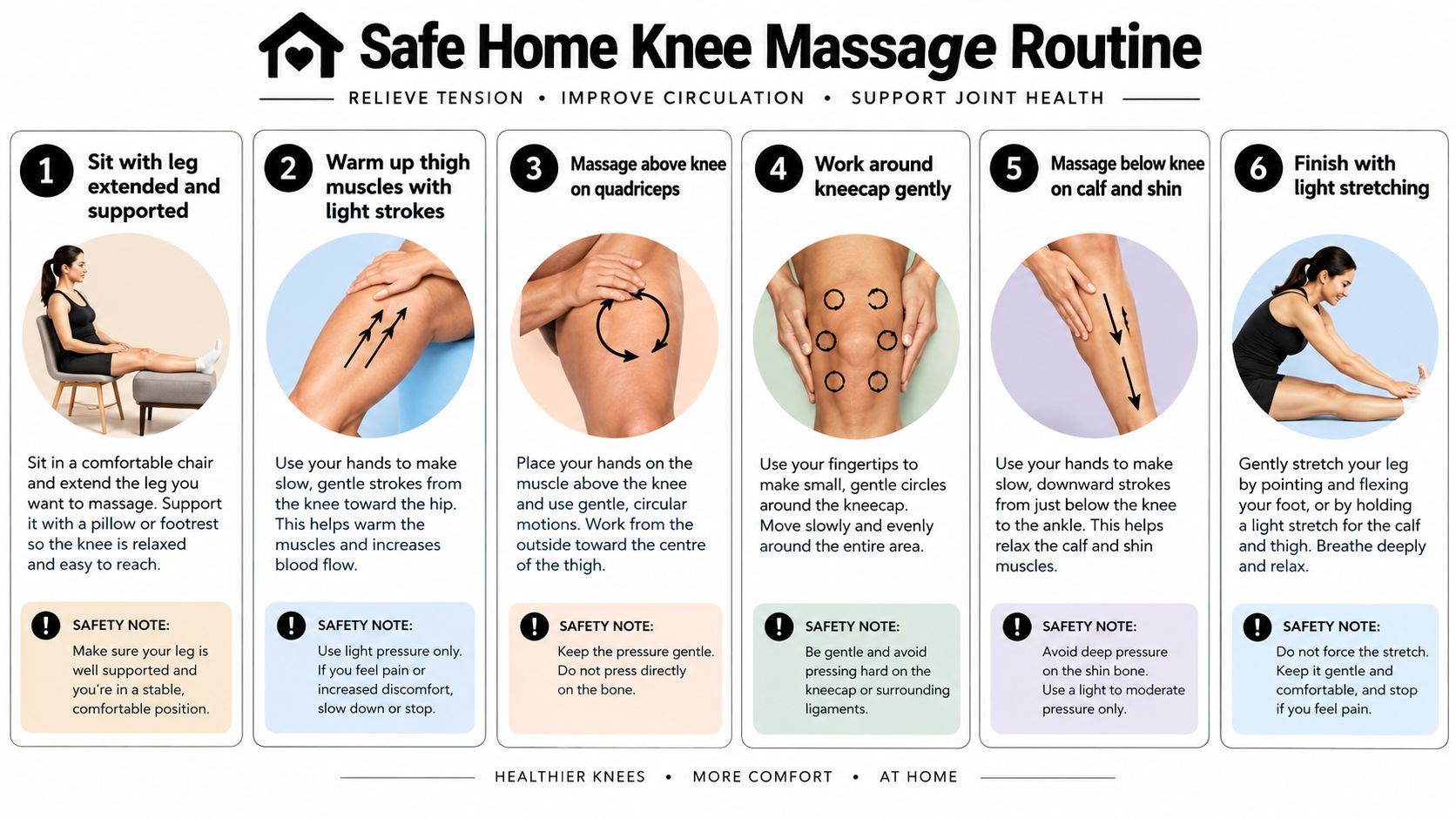
Begin with light, broad strokes over the front and sides of the thigh to warm the area. Then use slow, sweeping strokes along the quadriceps, working toward the knee without pressing on the kneecap. Spend roughly 60–90 seconds on each region, adjusting or stopping if you feel sharp pain, tingling, or a lasting increase in discomfort.
Around the kneecap, use small, gentle circles on the soft tissue beside it. Don't push the kneecap down or grind your fingertips into the joint line. At the inner knee, keep contact light around the tissues below the joint; avoid direct pressure on any sharply tender spot. On the outer thigh, use a relaxed glide rather than trying to force the iliotibial band to loosen.
Finish by working the calf with comfortable strokes down toward the ankle. Avoid pressing into the hollow at the back of the knee. Check in with the joint as you go: if it feels hot, swollen, unstable, or more painful, stop instead of trying to massage through it.
A partner or therapist can help with areas that are difficult to reach. Ask for broad, gentle strokes on the thigh and calf, and be clear that direct pressure on the kneecap, joint line, and back of the knee isn't wanted. A trained therapist can tailor the work to your comfort and symptoms. A massage gun or foam roller may also be considered for larger muscle areas, but not directly over the joint; this overview can help you find the best recovery tool.
A 2006 randomized trial of adults with radiographically confirmed knee OA found improvements in WOMAC global, pain, and stiffness scores after an eight-week Swedish massage protocol (trial details). That's evidence for a structured approach, not a reason to use more force at home.
When You Should Not Massage a Painful Knee
Don't massage a knee that's acutely injured, hot, visibly swollen, or unstable. Pressure and friction can aggravate an already irritated area, and massage won't tell you whether the problem is a sprain, fracture, infection, or another condition.
Seek prompt medical advice for fever with a hot or red joint, rapidly increasing swelling, inability to bear weight, a locked knee, or a knee that repeatedly gives way. Calf swelling or pain also needs urgent assessment because it can signal a serious problem. After significant trauma, get the injury assessed rather than using massage to see if it settles.
If a knee is suddenly very swollen, hot, or difficult to use, leave it alone and get medical advice.
For mild discomfort after activity without those warning signs, resting from aggravating movement and using a wrapped cold pack may be more appropriate than massaging. Don't put ice directly on bare skin. If symptoms are unexplained, worsening, or not settling, arrange a clinician's assessment. A guide to knee joint pain and swelling can help you think through what to watch for, but it isn't a substitute for care.
Some situations call for advice before hands-on treatment, including recent surgery, severe osteoporosis, diabetes that affects skin sensation or healing, or use of medicines that increase bleeding risk. Tell a registered massage therapist about these factors before a session, and follow your treating clinician's instructions.
Canadian guidance citing the American College of Rheumatology conditionally recommends against massage specifically to reduce knee- or hip-OA symptoms because benefits are uncertain and evidence quality is low. It also emphasises assessment for red flags before manual treatment (Canadian osteoarthritis guideline). That's a reason to keep claims modest and make safety the first decision.
Pairing Massage With Topical Relief for Warm-Up and Recovery
A topical product can be used alongside massage, but it doesn't change the safety rules or treat the underlying cause of knee pain. Choose a product intended for the area, follow its label, and don't apply it to broken or irritated skin. If you have sensitive skin or use other topical treatments, check with a pharmacist or clinician about suitability.

For a walk or exercise session, some people prefer to apply a topical analgesic before activity and use light massage around the thigh and calf as part of a comfortable warm-up. Others find it more useful after activity, when they're settling down and their legs feel tired. There isn't one timing routine that suits everyone, so follow the product instructions and judge the result by comfort and function.
MEDISTIK offers topical formats including an extra-strength stick, a fast-acting spray, and a cooling roll-on. A stick can be convenient to carry; a spray can be easier to apply to hard-to-reach areas; a roll-on offers a portable cooling sensation. These formats provide temporary relief, not a repair for damaged joint structures. If you're comparing options, read more about pain relief cream for knee joints.
The video below can serve as a visual reference for topical application. Keep any product away from your eyes and wash your hands after applying it, unless the label directs otherwise.
Avoid layering products or combining them with heat unless the label explicitly allows it. Stop using a topical product if it causes significant irritation, and ask a healthcare professional if you're unsure whether it's suitable for you.
Building Massage Into Your Week Around Exercise and Daily Life
Massage is most useful when it helps you keep moving comfortably. It shouldn't become a reason to skip strengthening or to push through worsening pain. Try a brief, gentle routine around an activity you already do, then pay attention to whether that activity feels easier.
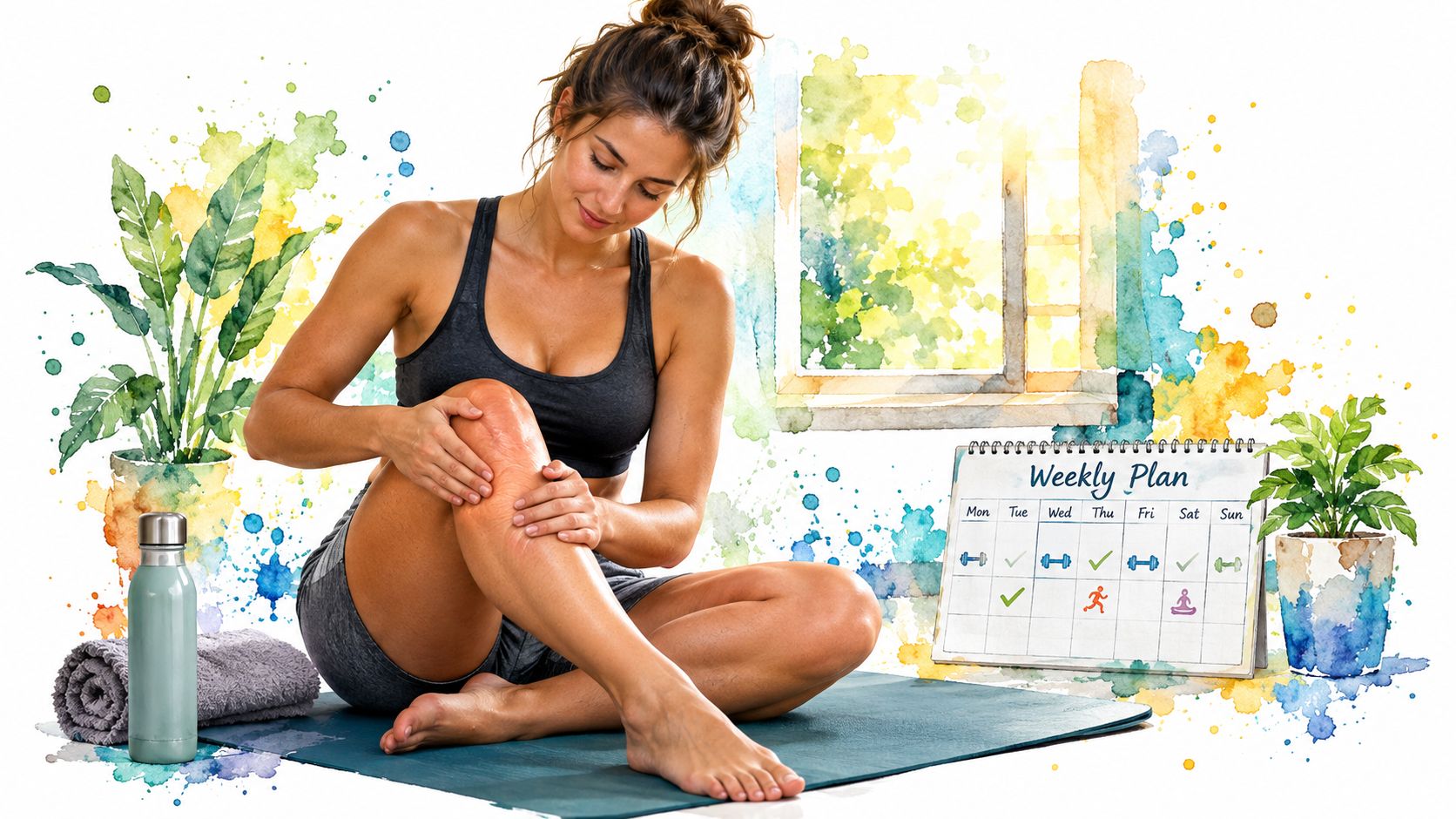
Before a walk, light strokes on the thigh and calf may help you feel ready to move. After a run or other training, gentle work on the surrounding muscles can form part of a cool-down, provided the knee isn't acutely swollen or injured. If you stand for work, a comfortable leg routine at the end of your shift may help you unwind. For bedtime stiffness, keep the pressure light and stop if it aggravates the joint.
Track practical outcomes, not just how the knee feels immediately after massage. Note whether walking, stairs, work tasks, or sleep are becoming easier. If you're trying self-care, reassess after 4–8 sessions. If function hasn't meaningfully improved, or symptoms worsen, don't keep repeating the same routine. Ask a clinician about assessment and options such as strengthening, mobility work, or other care.
Massage can support exercise, but it doesn't replace it. A physiotherapist can help tailor movement to your abilities, and a clinician can advise on broader osteoarthritis management. Explore these knee pain relief exercises for ideas to discuss with a professional. If you take part in grappling sports, this guide can also help you find foam rolling advice for grapplers, with the same reminder to avoid rolling directly over a painful joint.
Knowing When to Book a Professional Instead
Book an assessment if self-care hasn't helped after 4–8 sessions, swelling doesn't settle, or pain regularly wakes you at night. Locking, catching, instability, or persistent loss of function also deserves professional attention. A child or teenager with knee pain should be assessed rather than treated with a home massage routine.
A registered massage therapist can address surrounding soft tissue when massage is appropriate. A physiotherapist can guide exercise-based rehabilitation; a sports medicine physician or rheumatologist can assess and diagnose, and an orthopaedic surgeon may be involved when a structural problem is suspected. The right starting point depends on the symptoms and your healthcare access.
Before an appointment, jot down where the pain is, what brings it on, and what you've tried. Include whether you've noticed swelling, changes in walking, or trouble on stairs. For a broader overview of care options, see this guide to how to treat knee pain.
Keep the plan simple: avoid massage when red flags are present, use light pressure on surrounding muscles when it's safe, and judge success by whether daily movement improves. If the knee isn't improving, get it assessed rather than pressing harder.
MEDISTIK offers topical sticks, sprays, and roll-ons for temporary relief of sore muscles and joints, including a portable option to fit around activity and recovery. If you're looking for a topical product to include in a careful knee comfort routine, visit MEDISTIK.


