

A pulled muscle feels like localized pain and tightness that worsens when you use or stretch the muscle, often with tenderness or swelling depending on how serious the injury is. You might notice a sudden pulling or sharp sensation during a forceful movement, followed by aching, stiffness, weakness, or difficulty moving the area.
You may be reading this with one hand pressed against your thigh, back, shoulder, or calf after lifting a box, sprinting for a bus, or finishing an unfamiliar workout. The important question isn't only whether the pain is sharp or dull. When it started, where you feel it, and what you can still do provide a more useful guide to whether you're dealing with an uncomplicated strain or an injury that needs professional assessment.
Recognizing a Pulled Muscle
You lift a grocery bag from the floor and turn toward the counter. Halfway through the movement, one part of your back or leg suddenly tightens. The pain is specific enough that you can point to it with one finger, and reaching, bending, or contracting that muscle makes it worse.
That experience fits the common pattern of a muscle strain, the medical term for a pulled muscle. It may feel like a sudden tug, a sharp sting, or a deep tightening inside the muscle. Some people notice an immediate ache instead, particularly after a forceful movement that seemed minor at the time.

The first clues
A strain usually becomes more noticeable when you stretch, contract, or load the affected muscle. Tenderness may remain when you're still, while activity brings on sharper pain. A more substantial injury can add swelling, bruising, weakness, or difficulty moving the limb, and symptom severity varies with the extent of the injury, as explained in Alberta Health Services guidance on muscle strains.
This differs from the broad, gradually developing soreness that often follows unfamiliar exercise. Delayed soreness can affect several muscles and may not identify one precise moment of injury. A strain more often has a distinct painful area connected with overstretching or a forceful contraction, although symptoms alone can't establish the exact severity.
Practical rule: A specific painful spot that reliably hurts when you activate or stretch one muscle deserves more attention than a general ache spread across the body.
You can learn more about possible causes and patterns in this guide to muscle pain causes. Seek urgent assessment if pain is severe, the limb becomes cool, pale, or discoloured, or you develop numbness, tingling, weakness, or an inability to move. Those signs aren't typical of a straightforward mild strain and may indicate a more significant injury or impaired circulation.
The Exact Sensations of a Muscle Strain
A pulled muscle doesn't always feel like a dramatic tear. Often, the initial discomfort settles into a persistent ache that flares when you reach, bend, lift, run, or push off. The most useful pattern is focal pain that changes with the muscle's job.
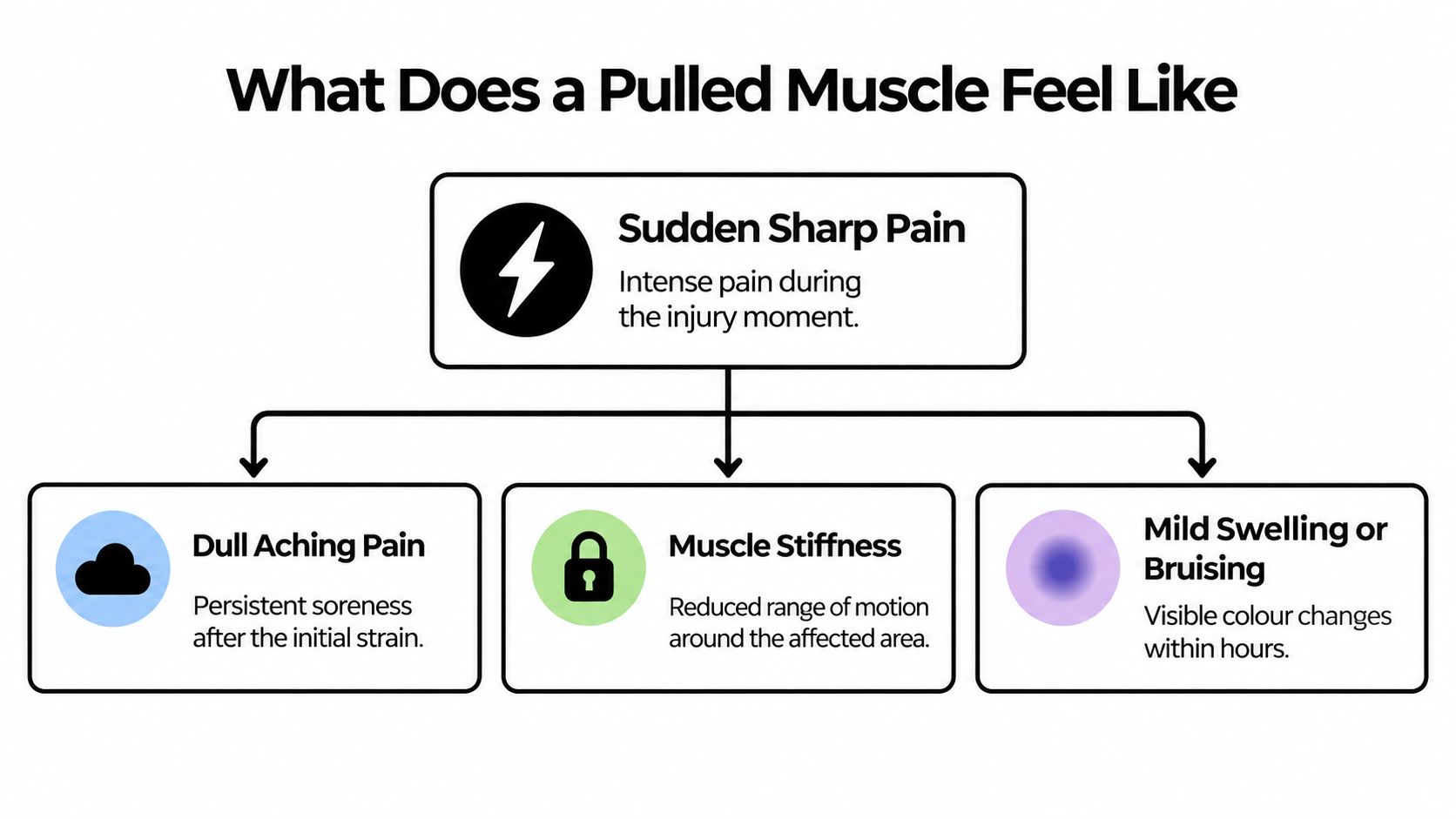
How the sensation can change
During lifting, sprinting, falling, or another forceful movement, the pain may be sudden and sharp, sometimes described as tearing. Later, inflammation and protective muscle guarding can create a dull ache, stiffness, and weakness. Guarding is the body's attempt to limit movement, so the area may feel unusually firm or “locked” when you try to use it.
A mild strain may leave movement nearly normal, though certain positions still hurt. More fibre damage can cause swelling, bruising, reduced range of motion, and difficulty generating force. A visible bulge, dip, or other deformity is more concerning because it may indicate a complete tear rather than a minor strain. Alberta Health Services describes common strain symptoms and changes in movement.
| Sensation or sign | What it often suggests |
|---|---|
| Focal tenderness | You can identify one painful area in the muscle |
| Pain with contraction | Using the muscle reproduces the discomfort |
| Pain with stretching | Lengthening the muscle provokes symptoms |
| Tightness or guarding | The muscle is protecting the area from further load |
| Swelling or bruising | The injury may involve more fibre disruption |
| Weakness or reduced movement | Function is affected and assessment may be useful |
The key test isn't whether the pain sounds sharp, dull, burning, or aching. Different injuries can use the same words. Instead, compare the painful side with the other side: can you move through a similar range, produce similar force, and complete ordinary tasks without a clear loss of function? A reproducible response to activating or stretching one muscle supports a strain pattern more than diffuse, unexplained pain. For a broader comparison, see bone pain versus muscle pain.
Strain vs. Tendon Injury vs. DOMS
Pain quality alone can mislead you. A sore muscle, an irritated tendon, and a strain may all cause tenderness, stiffness, or weakness, so use timing, location, and function as your decision framework.
Delayed-onset muscle soreness, commonly called DOMS, usually develops gradually after unfamiliar or unusually demanding exercise. It tends to feel more widespread, with stiffness across the muscles used during the activity, rather than one sharply defined spot linked to a single movement. Read more about delayed-onset muscle soreness.
A strain may start during a specific action, such as pushing off, lifting, or reaching, though symptoms can become clearer later. A tendon problem is more likely to centre near the junction between muscle and bone or around a tendon, while a strain more often feels centred in the muscle itself. These patterns overlap, so location doesn't replace an examination.
| Injury type | When it starts | Where it hurts |
|---|---|---|
| Muscle strain | Often during or after a specific forceful movement | A focused area within the muscle |
| DOMS | Gradually after unfamiliar or harder exercise | More widespread across exercised muscles |
| Tendon injury | During repeated loading or a particular movement | Near the tendon or muscle-to-bone junction |
Function settles the uncertainty
Write down what you were doing when symptoms began. Then compare the injured side with the opposite side for strength, range of motion, swelling, bruising, and tenderness. A physiotherapy assessment uses similar information, along with active movement and the injury history.
A lack of bruising doesn't rule out a strain, and delayed soreness doesn't prove that no strain occurred.
Marked weakness, worsening symptoms, or a visible divot or abnormal bump changes the decision. A substantial contour change can indicate more serious fibre disruption, and severe strains may require MRI to define the damage. Don't treat an inability to use the muscle as ordinary post-exercise soreness because the pain itself feels tolerable.
Immediate Care and Pain Management
If the pattern seems mild and you can still use the limb, protect the area from the activity that triggered the pain. Avoid testing it repeatedly with sprints, heavy lifts, deep stretches, or forceful massage. Relative rest is more useful than complete immobility, because gentle, comfortable movement can help prevent stiffness.
A sensible first response
- Reduce the load. Stop the provoking activity and keep movements within a comfortable range.
- Use cold carefully. A cold pack wrapped in fabric may help with early discomfort and swelling. Keep it brief enough to protect the skin, and don't apply ice directly.
- Add light compression. A supportive wrap can limit swelling, but loosen it if you develop numbness, tingling, increasing pain, or colour change.
- Raise the limb when practical. If the injured limb is swollen, raise it while resting.
- Recheck function. Notice whether walking, lifting, or moving becomes easier or harder over the following period.
Cold isn't automatically right for every injury, and heat may be useful at a different stage or for a different pain pattern. This guide to muscle strain heat or cold can help you think through that choice without using comfort as proof that the injury is minor.
Topical analgesics may temporarily reduce discomfort, but relief doesn't restore strength or confirm the diagnosis. If you're exploring ways to soothe sore muscles naturally, treat that as part of comfort management while you continue monitoring movement, swelling, and warning signs.
MEDISTIK offers topical pain-relief formats, including an extra-strength stick, an extra-strength spray, and a cooling ice roll-on, for temporary relief of sore muscles and joints. Use any product according to its label, and don't let reduced pain tempt you back into strenuous activity before function has returned.
When to Seek Professional Medical Help
A mild strain may be suitable for short-term self-care, but pain intensity isn't a reliable triage rule. An injury that feels manageable can still require assessment if you can't use the limb, your strength has suddenly dropped, or the shape of the muscle has changed.

Arrange prompt medical assessment after major trauma, a pop or snap with instability, rapidly increasing swelling, significant deformity, or an inability to bear weight or use the limb. Numbness, tingling, a pale or cold extremity, and sudden severe weakness also require urgent attention because nerves, circulation, or a more extensive tear may be involved.
Breathing or swallowing difficulty, fever with systemic symptoms, or dark, cola-coloured urine isn't the expected pattern of a simple pulled muscle. These symptoms need urgent assessment rather than repeated home treatment. The same applies when pain is getting worse instead of settling, or when substantial bruising and loss of function persist.
For a useful distinction between short-lived injury pain and a longer-lasting problem, review acute versus chronic pain. Pain that isn't improving after several days, or remains unresolved after about a week of home care, warrants evaluation. A clinician or physiotherapist can compare strength and movement, examine the tender area, and decide whether imaging such as MRI is appropriate.
More serious tears may show a visible contour change or pronounced weakness even when the pain isn't extreme. Don't wait for discomfort to become unbearable before seeking help. Function, progression, and neurological or circulation symptoms provide the stronger warning signals.
Moving Forward with Confidence
A pulled muscle can be alarming, especially when a normal movement suddenly changes how you walk, lift, or reach. The practical answer to what does a pulled muscle feel like is a focused pattern: pain in one area, tenderness, tightness, and symptoms that increase when the muscle contracts, stretches, or bears load.
Canadian injury surveillance shows why recognising this pattern matters. Sprains and strains accounted for 51% of injuries in a national Statistics Canada analysis, while sports or exercise were associated with 35% of injuries overall. Among working-age adults aged 20–64, sports and work were related to 47% of injuries, according to Statistics Canada's injury analysis.
Don't use those figures to diagnose yourself. Use the decision framework instead: record how the problem began, identify the exact location, compare function with the other side, and watch whether symptoms improve. If weakness is marked, swelling is substantial, the muscle's contour changes, or warning signs appear, arrange professional care. For people considering hands-on support for movement-related concerns, osteopathy for musculoskeletal pain may be one option to discuss with a qualified practitioner.
If a suspected strain is limiting your work, sport, or daily movement, explore MEDISTIK's topical pain-relief options for temporary comfort while you monitor function and follow appropriate care. Visit MEDISTIK to review the available formats and pain-management resources.


