

You notice your knee aching on the stairs, or your shoulder complaining when you reach overhead. The pain may disappear once you stop, then return the next morning or after another busy day. It's natural to wonder whether you should stretch it, rest it, use a pain-relief product, or book an appointment.
The phrase “cause joint pain” hides an important reality: joint pain isn't one problem. Mechanical strain, osteoarthritis, inflammation, injury, infection, and pain referred from elsewhere can all feel similar at first. The useful question isn't only where it hurts. It's how the pain behaves.
Why Your Joints Hurt and What to Do About It
The pain pattern gives you a useful starting point. Discomfort that builds with walking, lifting, gripping, or repeated movement often suggests a mechanical cause. Pain that is worse after rest, with swelling or warmth, or in several joints deserves closer medical attention. Sudden pain after an injury follows a different route, especially if you heard a pop, developed rapid swelling, or cannot use the joint normally.
Age does not identify the cause. More than half of Canadians living with arthritis are younger than 65, and over 90% of people with osteoarthritis report pain, stiffness, or aching, according to this Canadian osteoarthritis report summary. Joint pain can affect work, sport, caregiving, and daily tasks during the working years, not only later in life.
Use three patterns to guide your next step:
- Mechanical pain changes with load and movement. Reducing the aggravating activity, while maintaining comfortable movement, may help.
- Inflammatory pain often includes swelling, warmth, prolonged stiffness, or several painful joints. Arrange an assessment rather than treating it as simple overuse.
- Injury-related pain starts after a specific event or a clear change in activity. Rapid swelling, deformity, or inability to bear weight calls for prompt care.
- Other causes, including infection, crystal arthritis, nerve involvement, or illness elsewhere in the body, may also require medical assessment.
For help separating joint pain or muscle pain, focus on what you feel and when it appears. You are not diagnosing yourself. You are gathering clues that help you choose between temporary load adjustment, physiotherapy, a routine appointment, or urgent evaluation.
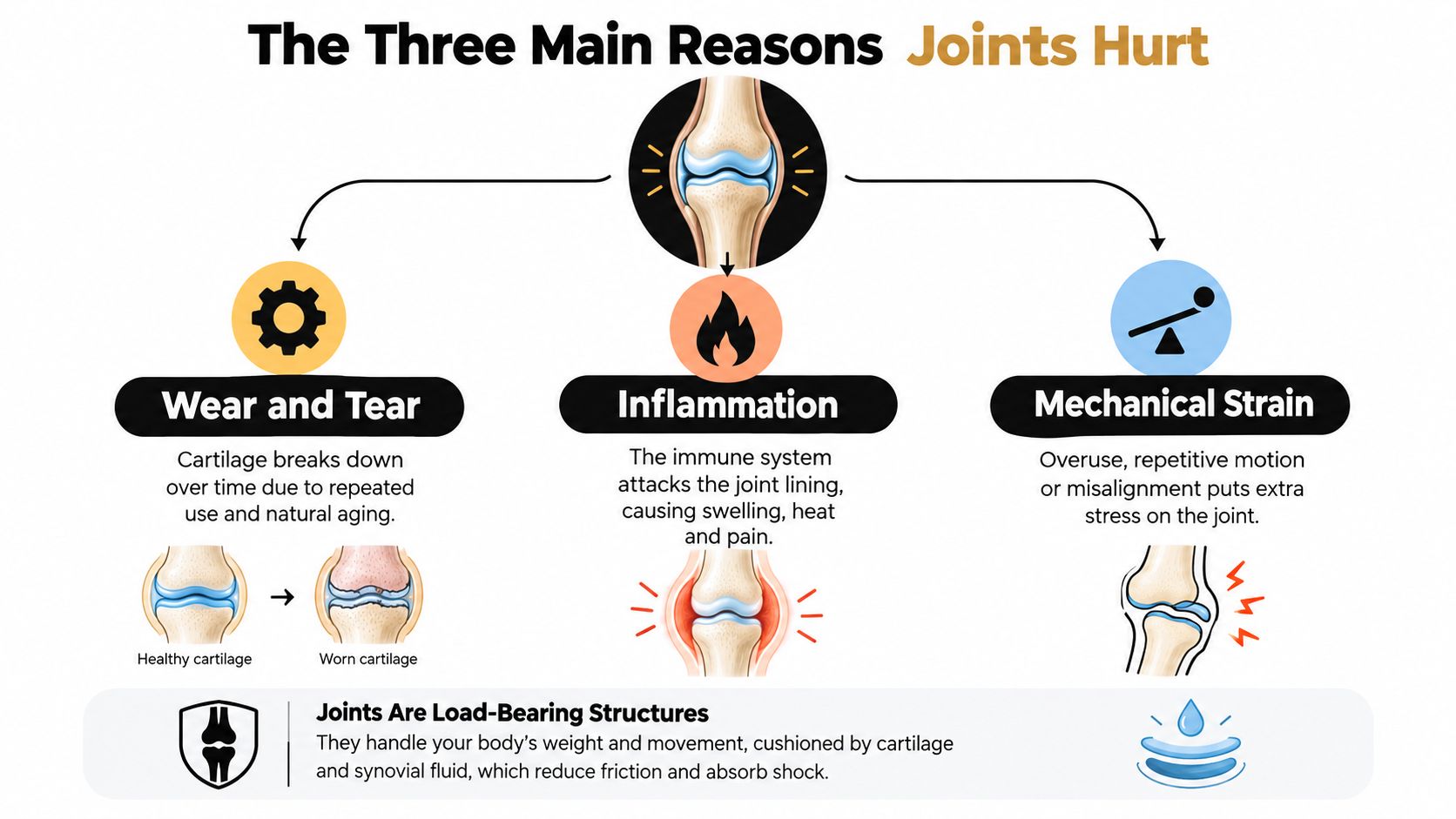
The Three Main Reasons Joints Hurt
A joint is a meeting point between bones. Cartilage helps the surfaces glide, while synovial fluid reduces friction and the surrounding muscles, tendons, ligaments, and joint capsule provide support. Pain can arise from any of these parts, not just from the cartilage itself.
Think of a door hinge. Mechanical pain is like a hinge that has gradually worn or is being forced at an awkward angle. Repeated loading, a previous injury, alignment changes, or reduced support from surrounding muscles can make movement painful. The discomfort commonly appears during a task or after the joint has worked harder than usual.
Inflammatory pain is different. It's more like a hinge that has become hot and swollen because the surrounding lining is irritated. The immune system can drive inflammation inside the joint, producing warmth, tenderness, swelling, and stiffness that may be strongest after rest. Rheumatoid arthritis is one example, but several inflammatory conditions can affect joints.
A third group includes systemic, referred, and acute causes. A joint may become painful because of infection, crystal deposits, a metabolic or autoimmune illness, or a nerve problem that sends pain into the area. A ligament sprain, tendon injury, cartilage tear, or fracture can also create sudden pain without being a chronic joint disease.
Acute and persistent pain follow different clues
Acute pain starts suddenly, often after an injury, an unusual load, an infection, or a crystal flare. Persistent pain may develop gradually and fluctuate with activity, sleep, stress, and recovery. The same knee can hurt after a sports injury in one period of life and develop osteoarthritis later, so a previous diagnosis shouldn't automatically explain every new symptom.
Osteoarthritis illustrates the scale of mechanical joint problems in Canada. Approximately 3.9 million Canadians aged 20 and older, or 13.6% of that population, were living with diagnosed osteoarthritis in 2016–2017, and about 219,000 new diagnoses were recorded that year, according to the Public Health Agency of Canada.
Practical rule: First identify whether the joint reacts mainly to load, to rest, or to a sudden event. That observation often matters more than the pain's exact location.
Common Diagnoses Behind Joint Pain
Once you understand the broad mechanisms, named conditions become easier to compare.
Osteoarthritis involves changes throughout the joint, including cartilage and the underlying bone. Pain often increases with walking, stairs, gripping, or other loading, while stiffness after waking or sitting is usually brief. The knee, hip, hand, spine, foot, and other load-bearing areas may be involved. A previous injury, repetitive work, altered alignment, and excess mechanical loading can contribute, but osteoarthritis isn't solely the result of “wearing out” from age.
Rheumatoid arthritis is an inflammatory autoimmune condition. The immune system attacks the joint lining, which can create swelling, warmth, tenderness, and stiffness that lasts well after getting out of bed. Several joints may be involved, sometimes in a similar pattern on both sides. Canadian data indicate that approximately 374,000 people aged 16 and older, or 1.2% of that age group, live with diagnosed rheumatoid arthritis. Persistent swelling, warmth, morning stiffness lasting more than 30 minutes, or unexplained weight loss should be assessed, as described by the Public Health Agency of Canada's rheumatoid arthritis guidance.
Bursitis and tendinopathy can feel like joint pain even when the irritated structure sits beside the joint. A bursa cushions pressure between tissues, while a tendon transfers muscle force to bone. Local tenderness, pain with a particular motion, and sensitivity when lying on the area can point toward these problems.
Gout and pseudogout are crystal-related forms of arthritis. They can cause a sudden, intense flare with marked tenderness, swelling, and warmth. The big toe is a familiar site for gout, but the knee and other joints can also be affected.
Sprains, strains, meniscus injuries, and fractures usually follow a distinct event or a clear increase in load. Rapid swelling, instability, locking, bruising, or an inability to bear weight makes an injury assessment more important.
| Condition | Typical pain pattern | Key clues |
|---|---|---|
| Osteoarthritis | Activity-related ache and stiffness | Gradual onset, load sensitivity, reduced motion |
| Rheumatoid arthritis | Persistent inflammatory pain | Swelling, warmth, prolonged morning stiffness, multiple joints |
| Bursitis or tendinopathy | Localized pain near a joint | Tender spot, pain with a specific movement or pressure |
| Gout or pseudogout | Sudden severe flare | Hot, swollen, extremely tender joint |
| Acute injury | Pain after a specific event | Bruising, instability, locking, rapid swelling, or reduced weight-bearing |
The distinction between the joint itself and nearby soft tissue matters. This overview of arthritis joint pain can help you organise the symptoms you notice before speaking with a clinician.
How Joint Pain Shows Up in Real Life
Joint pain often reveals its cause through its pattern. A recreational runner may feel pain at the front of the knee after adding hills, speed work, or longer sessions. Sitting may feel comfortable, while stairs, squats, or the first part of a run bring symptoms on. That behaviour points toward a load-related problem, although an examination is needed to tell whether the kneecap, tendon, cartilage, or another structure is involved.

A hairstylist may notice aching at the base of the thumb after years of gripping scissors and holding tools. Pinching, twisting, or opening containers can trigger it, while complete rest may not. Thumb osteoarthritis can follow this pattern, but irritated tendons can feel much the same. The location helps, yet the movement that provokes pain adds another useful clue.
A teacher who wakes with sudden, severe pain in the big toe may assume a minor injury caused it. If the toe is hot, swollen, and extremely tender without a clear accident, a crystal flare such as gout should be considered. Sudden onset and visible inflammation carry more diagnostic meaning here than the person's occupation.
A new mother may develop wrist and finger discomfort while lifting, feeding, and using her hands repeatedly. Mechanical overload near the wrist is one possibility. Morning stiffness, swelling, warmth, or symptoms in several joints shift the pattern toward inflammatory arthritis, so a clinician should assess it rather than treating it as routine overuse.
Track four details before an appointment:
- Timing: Did the pain begin suddenly, gradually, or after an activity change?
- Triggers: Do walking, gripping, lifting, or impact bring it on?
- Rest response: Does sitting ease it, or does stiffness build while you remain still?
- Function: Can you bear weight, make a fist, climb stairs, or reach overhead?
Joint pain can affect people during their working years, including those who work with their hands, train regularly, care for family, or spend much of the day standing. Your pattern is a map, not a diagnosis. Load-related pain may call for activity adjustment, while sudden inflammatory symptoms or loss of function deserve clinical assessment.
This short video offers another visual way to think about knee symptoms and movement:
If knee swelling accompanies pain, review this guide to knee joint pain and swelling to organise what you are experiencing, especially when symptoms continue or movement becomes harder.
Red Flags and the Path to Diagnosis
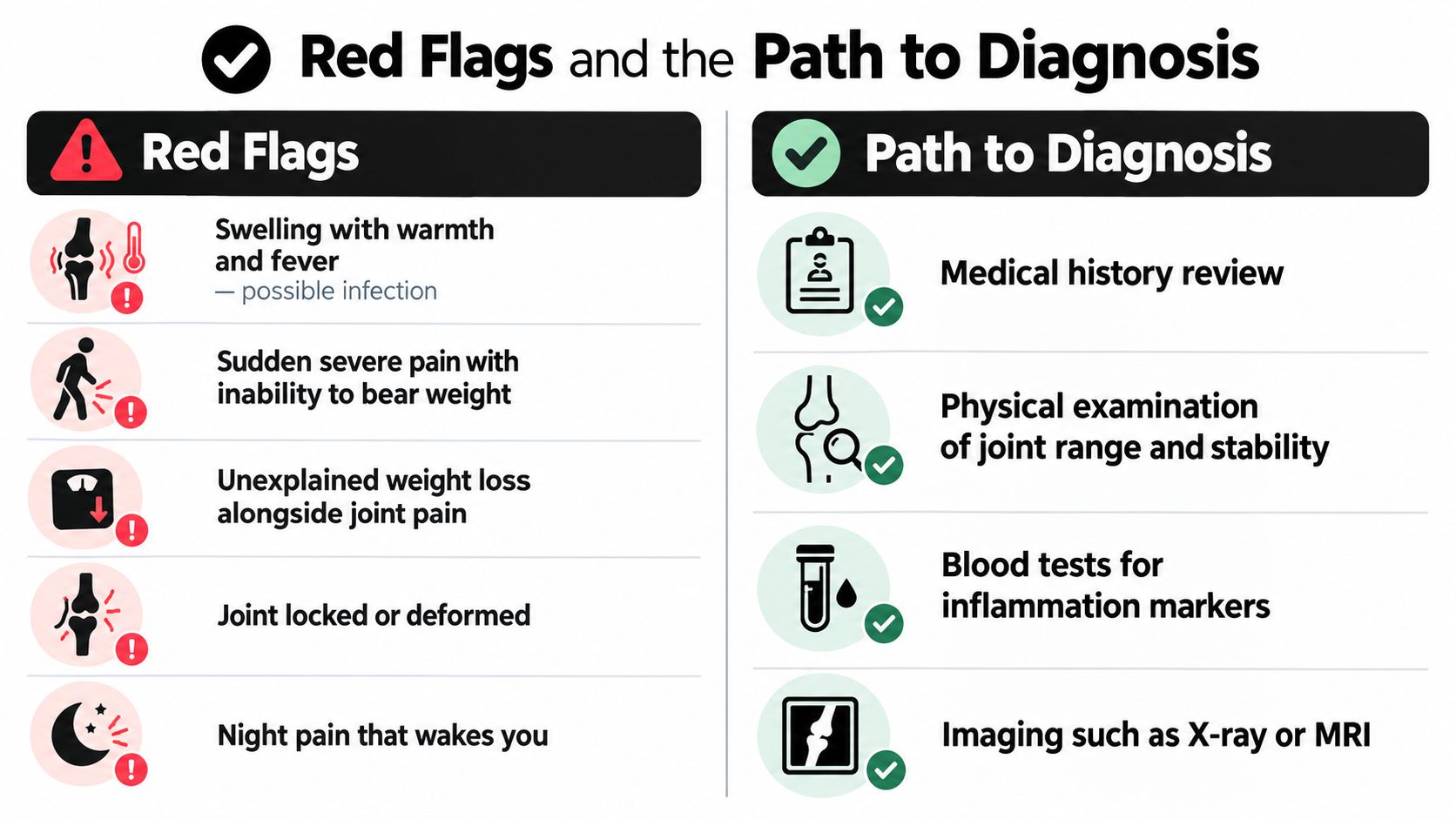
Some joint symptoms shouldn't be managed by trial and error. A hot, swollen joint with fever may indicate infection, particularly if the pain appeared quickly. Infection can damage a joint and requires urgent medical attention. Fever in someone who is immunosuppressed also raises the stakes.
Seek prompt assessment for:
- Sudden severe pain: Especially when you can't bear weight or use the limb normally.
- Rapid swelling or deformity: This can follow a fracture, major ligament injury, or another urgent problem.
- Persistent warmth and swelling: These findings can suggest inflammatory disease or infection.
- Unexplained weight loss: Joint pain combined with this symptom needs medical review.
- Numbness or weakness: These may indicate nerve involvement rather than a problem confined to the joint.
- A locked joint: Inability to fully bend or straighten the joint can follow an internal injury.
What an assessment usually involves
A clinician starts with your history. They'll ask when the pain began, what makes it better or worse, whether there was an injury, and whether other joints or general symptoms are involved. Bring a short record of swelling, morning stiffness, activity changes, medications, and how the pain affects specific tasks.
The physical examination may assess tenderness, warmth, swelling, range of motion, strength, stability, and the way you walk or use the limb. Blood tests such as ESR and CRP may help evaluate inflammation, while rheumatologic tests can be considered when an autoimmune condition is suspected. No single blood test explains every type of joint pain.
Imaging depends on the working diagnosis. An X-ray can show bone and joint changes, while ultrasound or MRI may help examine soft tissue, fluid, cartilage, or internal structures. If infection or crystal arthritis is a concern, a clinician may recommend joint aspiration, which removes a small amount of fluid for analysis.
Seek same-day care for a hot, swollen joint with fever, sudden severe pain with inability to bear weight, or rapidly worsening function. A milder mechanical pattern without red flags may be suitable for temporary load adjustment, followed by physiotherapy or a routine appointment if it doesn't improve.
Moving Well Without Making It Worse
Complete rest often feels safest, but prolonged inactivity can reduce strength and make ordinary loads feel harder. The better approach is usually symptom-guided loading, where you reduce the demand during a flare without abandoning all movement.
Use a load ladder:
- During a flare, reduce intensity and range. Replace deep squats with a smaller comfortable movement, shorten a walk, or pause impact activity. Gentle motion can help you avoid guarding the joint.
- When symptoms settle, reintroduce low-impact activity. Walking on a level surface, cycling with tolerable resistance, or controlled mobility work may be easier than running or jumping.
- Build capacity gradually. Add resistance, distance, speed, or impact one variable at a time. The joint's response later that day and the next day is more useful than how it feels during the first few minutes.
- Maintain a consistent baseline. Regular, tolerable activity supports function better than alternating between complete rest and an exhausting effort.
Your strategy should match your life. An athlete may temporarily replace impact with cycling. A tradesperson may rotate tasks, use better positioning, or divide heavy work into shorter bouts. A caregiver may change lifting technique and ask for help with the most demanding transfers. An older adult may focus on supported strength and balance rather than chasing a particular exercise style.
Arthritis Society Canada recommends gradually increasing activity toward 150 minutes of moderate-to-vigorous exercise weekly if tolerated, while Canadian osteoarthritis data identify abnormal loading, repetitive occupational use, and previous injury as relevant risks. These recommendations appear in this joint pain handout from Arthritis Society Canada. The target isn't a pass-or-fail test. It's a direction to move toward when your symptoms and health allow.
Use exercises to help with back pain as an example of why exercise selection and dosage matter. A movement can be helpful in one phase and aggravating in another, depending on range, resistance, speed, and recovery.
Track the delayed response. If a small increase in activity causes a clear flare that lasts into the following day, reduce one variable rather than abandoning movement altogether.
Treatment Options From Self-Care to Topical Relief
Treatment should match the suspected cause. Mild mechanical pain may respond to temporary load adjustment, sleep support, gradual strengthening, and physiotherapy. Inflammatory arthritis usually needs medical assessment and, when diagnosed, disease-modifying treatment rather than symptom relief alone. Acute injuries may require protection, rehabilitation, imaging, or a period of supervised recovery.
Common options include:
- Exercise and physiotherapy: Strengthening, mobility work, coordination training, and task modification can improve how the joint handles load.
- Medication: Acetaminophen and non-steroidal anti-inflammatory drugs may help some people, but NSAIDs can carry risks and aren't appropriate for everyone. A pharmacist or clinician can review interactions, stomach, kidney, heart, pregnancy, and other health considerations.
- Disease-modifying medication: Inflammatory arthritis may require prescription treatment that controls the immune process and helps prevent joint damage.
- Injections: Corticosteroid, hyaluronic acid, or platelet-rich plasma injections may be considered in selected situations, depending on the diagnosis and clinician's assessment.
- Surgery: Advanced structural damage, major injury, or persistent loss of function may lead to a surgical discussion after non-surgical options have been evaluated.
Topical analgesics can be useful when pain is localized and superficial, especially around a knee, hand, shoulder, or other accessible area. They may provide temporary support before activity, during a flare, or after a demanding day, with less whole-body exposure than an oral medicine. Follow the product directions, avoid damaged skin, and ask a pharmacist if you have allergies, skin conditions, or concerns about combining treatments.
Because medication choices depend on individual risks, this guide to non-opioid pain relief guidance can provide broader context for discussing options with a qualified professional. Topical relief should complement movement, rehabilitation, and diagnosis. It shouldn't conceal worsening swelling, fever, instability, or progressive loss of function.
For practical considerations around localized products, see this guide to topical joint pain relief.
Your Next Step Based on What Your Pain Is Telling You
Ask yourself three questions:
- Is it mechanical? If pain increases with use, improves with rest, and causes only brief stiffness, try sensible load reduction and gradual movement. Persistent symptoms or reduced function deserve physiotherapy or a routine clinical assessment.
- Is it inflammatory? Swelling, warmth, prolonged morning stiffness, several painful joints, or unexplained weight loss calls for prompt medical evaluation.
- Are there red flags? Fever with a hot swollen joint, sudden severe pain, inability to bear weight, deformity, locking, numbness, or weakness needs urgent attention.
Protect your joints by staying consistently active, addressing injuries early, adjusting repetitive tasks, and maintaining a healthy body weight when appropriate. The right response depends on the pattern, not just the pain score.
MEDISTIK provides Canadian-made, non-prescription topical pain relief for sore muscles and joints, with practical formats for work, sport, recovery, and everyday movement. Visit MEDISTIK to explore topical options and educational resources that can support your plan alongside professional care.


