

The knee feels stiff before your morning run. Your shoulder starts aching halfway through a long shift. You can keep moving, take an oral medication, or apply something directly over the uncomfortable area and see whether targeted relief helps you move more normally. That choice becomes more useful when you understand what the product contains, what it can realistically do, and when pain points to a problem that needs more than temporary relief.
Topical joint pain relief isn't a magic eraser. It can be a practical bridge between ignoring discomfort and taking medication that circulates throughout the body, particularly when pain is localised to a knee, hand, elbow, or other accessible joint. The right product may help you complete mobility work, tolerate a workday, or recover more comfortably, but it shouldn't replace diagnosis, progressive exercise, or professional care when symptoms persist.
Understanding Topical Joint Pain Relief
A runner with a stiff knee may not need the same approach as a warehouse worker with a sore shoulder. The runner may be dealing with activity-related irritation that changes during movement, while the worker may have recurring discomfort linked to repetitive loading, limited recovery, or an underlying joint condition. In both cases, a topical product can be applied over the symptomatic area instead of taken by mouth.
Topicals are designed to deliver an active compound through the skin around the application site. That local approach can reduce exposure compared with an oral medication, although it doesn't mean that no absorption into the bloodstream occurs. The practical advantage is focus: when one or two joints are bothering you, applying treatment directly over those areas may make more sense than exposing the whole body to a medication intended to address a local problem.
Relief is not the same as repair
A warming, cooling, or numbing sensation can make movement feel easier, but the sensation itself doesn't prove that inflammation has been reduced or that damaged tissue has healed. Counterirritants mainly alter how pain feels at the skin and nerve level. Topical NSAIDs take a different approach by targeting inflammatory processes, making them more relevant to some forms of osteoarthritis.
That distinction matters in practice. If pain improves enough for you to move with better control, a topical may support rehabilitation. If it allows you to ignore swelling, instability, or steadily worsening pain, it may be hiding a signal that deserves assessment.
Practical rule: Use topical relief to support sensible movement, not to justify pushing through pain that changes your mechanics.
Canada's need for accessible joint-pain strategies extends beyond retirement age. Statistics Canada reported that in 2017, 19.3% of Canadians aged 15 and older, approximately 5.7 million people, reported arthritis diagnosed by a health professional, and 58% of those reporting the condition were younger than 65 (Statistics Canada's arthritis analysis). That distribution includes people balancing sport, employment, caregiving, and physically demanding tasks.
A useful middle ground
Topical joint pain relief fits best when the discomfort is localised, the skin is intact, and the treatment goal is clear. You might use it before mobility work for a stiff knee, during a physically demanding day when a small area becomes uncomfortable, or after training when the priority is calming a sore region. You shouldn't expect a topical to correct poor training load, restore worn cartilage, or resolve pain from an undiagnosed injury.
For a plain-language overview of how topical analgesics fit into broader pain management, see this guide to topical analgesics. Then read the label, check the active ingredient, and decide whether the product matches the type of pain you're experiencing.
Active Ingredients and Mechanisms of Action
The label matters more than the product category. Two creams or sprays can both promise joint comfort while working through entirely different pathways. One may reduce local inflammatory activity, while another mainly changes the sensory input reaching the nervous system.
Topical NSAIDs
Topical nonsteroidal anti-inflammatory drugs, or NSAIDs, are the most clinically important category for localised osteoarthritis. Diclofenac and ketoprofen inhibit cyclooxygenase enzymes involved in the production of inflammatory mediators. In straightforward terms, they target part of the chemical process that contributes to pain and inflammation around an affected joint.
That makes a topical NSAID more suitable for an arthritic knee or hand than for a vague sense of whole-body fatigue. It still isn't risk-free. Some medication is absorbed systemically, and people with concerns such as renal disease, heart failure, or anticoagulant use should discuss the choice with a clinician.
Counterirritants and cooling agents
Menthol, methyl salicylate, and similar counterirritants create a competing cooling, warming, or tingling signal. Think of the effect as a busy signal for some incoming pain messages. The product doesn't necessarily correct the source of the pain, but the new sensory input can make the original discomfort feel less prominent for a period of time.
Menthol is especially useful when the goal is a noticeable cooling sensation over a sore area. That can be appealing after activity or when superficial tissues feel hot and irritated. It doesn't automatically make menthol appropriate for deep joint pain, and a strong sensation isn't a reliable measure of treatment strength.
Capsaicin also works through sensory nerves, but its experience can be quite different. It may produce warmth or irritation before the area becomes less responsive to pain signals. It requires careful application and isn't a sensible choice for broken or irritated skin.
Matching mechanism to the complaint
A localised arthritic ache with stiffness and activity-related discomfort calls for a different discussion than short-lived muscle fatigue after training. A topical NSAID may be the more evidence-based option for some osteoarthritis presentations. A counterirritant may be chosen when a person wants temporary sensory relief before or after activity.
Natural extracts can add a familiar ingredient profile, but “natural” doesn't establish effectiveness or eliminate skin-safety concerns. Judge the formulation by its active ingredients, directions, warnings, and fit with your medical history. For a clearer explanation of the sensory effect behind menthol, consult this resource on how menthol relieves pain.
Choosing the Right Format for Your Routine
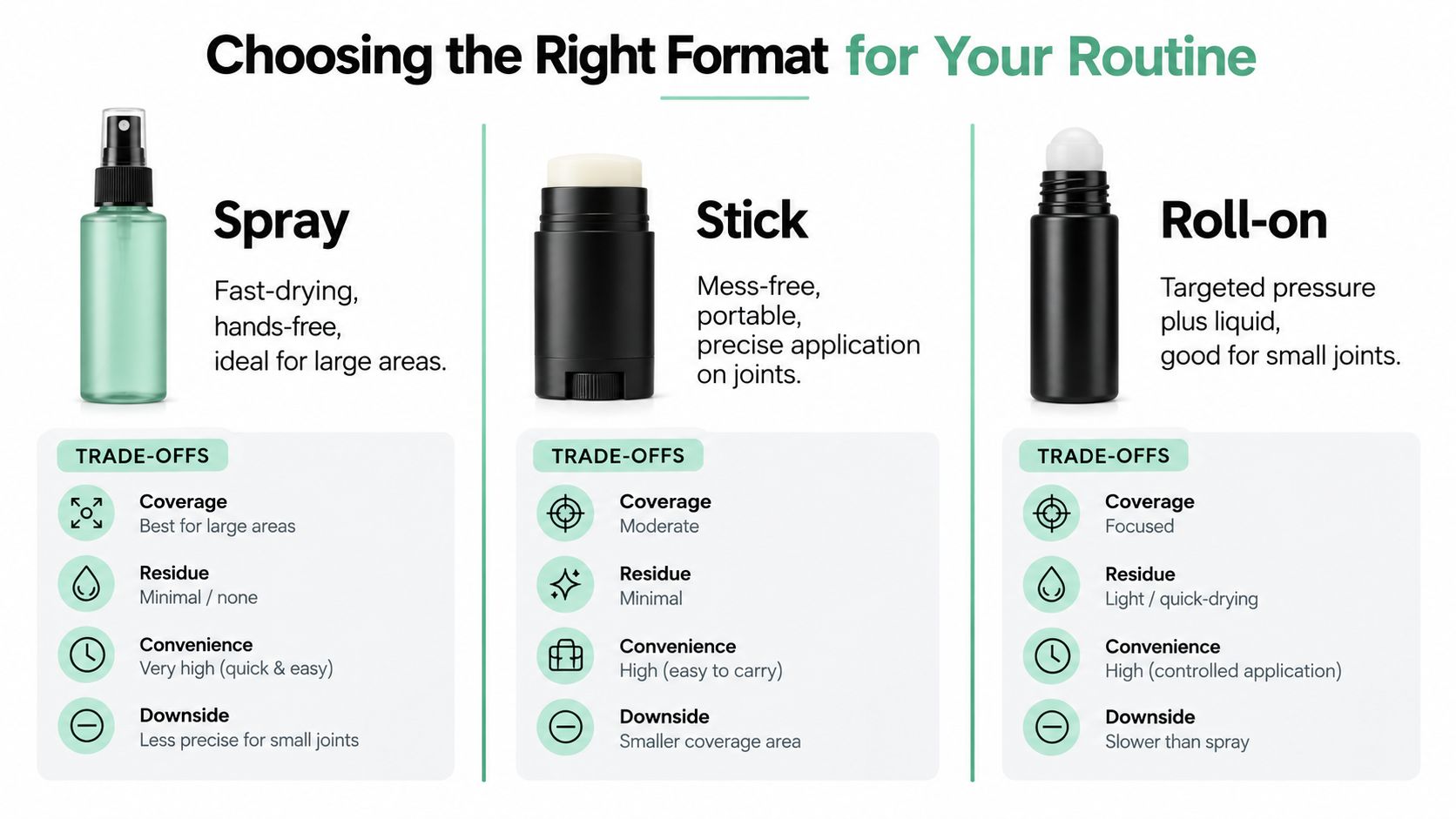
A product can have a reasonable ingredient profile and still fail in daily use if its format doesn't suit the setting. A spray that works well on a hard-to-reach back area may be frustrating beside a windy playing field. A stick that gives precise coverage around a knee may be preferable in a clinic, where clean application and control matter.
Spray
Sprays are useful when you need broad coverage, fast application, or minimal hand contact. They can suit a large muscle region, a mid-back area, or a quick application during a training session. The trade-off is control. Wind can carry the mist, nearby surfaces may collect residue, and you need to avoid the eyes, face, and other sensitive areas.
Stick
A stick offers targeted, mess-free application over a knee, elbow, wrist, or other accessible joint. It travels well in a gym bag and lets you apply a controlled layer without putting product on your palms. Direct contact can be a disadvantage when the area is difficult to reach or when several people are sharing equipment.
Roll-on
A roll-on combines liquid application with the pressure of a ball tip. That makes it useful for small joints and defined areas where you want to guide the product precisely. It can feel refreshing during recovery, but the liquid format may require a short period before clothing or equipment rubs against the area.
| Format | Strength | Trade-off | Useful setting |
|---|---|---|---|
| Spray | Fast, hands-free coverage | Less precise in wind or close quarters | Sideline, gym, large area |
| Stick | Controlled, clean application | Requires direct contact | Clinic, home, targeted joint |
| Roll-on | Precise application with light pressure | Best for smaller areas | Recovery, travel, hand or ankle |
Choose the format before the marketing claim: The best applicator is the one you can use correctly, consistently, and safely in the environment where pain appears.
For a closer look at the practical use of a liquid applicator, this roll-on pain relief resource offers useful context. A physiotherapist applying a product to a patient's knee may prioritise precision. An athlete managing a sore area between drills may value speed. A worker on a job site may care most about portability and whether the product leaves the hands clean.
The format should also match the treatment goal. Use precision when the discomfort is confined to a joint. Use broader coverage for a larger region, but don't treat a wider application area as permission to apply more product than the label directs.
Clinical Evidence and Safety Considerations
The strongest clinical case for topical joint pain relief in osteoarthritis involves topical NSAIDs, not every warming or cooling product sold for aches. A Canadian evidence review found that topical diclofenac achieved at least 50% pain reduction within six weeks, with a number needed to treat of approximately 5 for osteoarthritis, and reported pain relief comparable to oral NSAIDs (Canadian evidence review in CMAJ).
That result needs to be interpreted properly. An NNT of approximately 5 describes the treatment effect in the reviewed evidence. It doesn't promise that every person will respond, and it doesn't mean that a diclofenac product is interchangeable with a menthol spray or capsaicin cream.
Apply with discipline
Start with the product label and the condition of your skin. Apply only to intact skin over the symptomatic region, use the directed amount, and avoid contact with the eyes and mucous membranes. Wash your hands after application unless the hands are the treated area and the label says otherwise.
Do not cover the area with a tight bandage unless a healthcare professional specifically instructs you to do so. Don't combine a topical counterirritant with a heating pad, hot pack, or other external heat source.
Health Canada has received reports of serious skin burns from over-the-counter products containing menthol, methyl salicylate, or capsaicin, particularly when products were applied to damaged skin, covered with tight bandages, or combined with external heat (Health Canada's safety review). Cooling or warming is a sensory effect, not a safety certificate.
Know when to stop
Stop using the product and seek medical attention promptly if severe pain, swelling, or blistering develops. Mild temporary sensation may be expected with some formulations, but escalating burning, marked redness, or skin damage isn't a sign that the product is working better.
People considering a topical NSAID should also review medication and health risks with a clinician or pharmacist. Anticoagulant use, renal disease, and heart failure are specifically relevant concerns in the Canadian evidence review, and evidence is limited in some higher-risk groups. A non-prescription label changes how you obtain the product, not the need to use it thoughtfully.
For Canadian product guidance and safety context, consult this resource on Health Canada approved products. Keep the treatment area clean, avoid stacking multiple products with overlapping ingredients, and reassess whether the topical is improving function rather than just producing a stronger skin sensation.
Matching Topicals to Joint Profiles and Goals
A useful decision starts with four questions: Which joint hurts? What is the likely diagnosis? What risks make oral medication less suitable? What do you need to do next? The answers often narrow the choice more effectively than a shelf full of product claims.
For a localised knee or hand osteoarthritis pattern, topical NSAIDs deserve serious consideration. They are especially relevant when a person wants an anti-inflammatory option at the application site or has reasons to be cautious about oral NSAIDs. The knee and hand are also practical targets because the symptomatic region is accessible for direct application.
The Canadian osteoarthritis burden is substantial. A Public Health Agency of Canada fact sheet estimated that approximately 3.9 million Canadians aged 20 and older, or 13.6% of that population, were living with diagnosed osteoarthritis, with prevalence higher among women than men (Public Health Agency of Canada osteoarthritis fact sheet). Those figures describe the condition, not the likely response to a topical, so treatment still needs to match the individual presentation.
Use the goal to guide the product
If your goal is to reduce local inflammatory pain over a recurring arthritic joint, an evidence-supported topical NSAID may be a rational discussion with a pharmacist or clinician. If your goal is short-term sensory relief around an activity, a counterirritant or cooling formulation may be more aligned with the situation.
Neither option should be treated as a cure for osteoarthritis, inflammatory arthritis, a tendon injury, or a mechanical problem. Arthritis Society Canada describes topical diclofenac and capsaicin as reasonable alternatives in certain circumstances, while recognising that topical agents generally provide symptom relief rather than routine long-term management of the underlying disease. That distinction is covered in the Canadian guidance on the best topical pain relief for arthritis.
A simple risk profile
| Situation | More useful question |
|---|---|
| Localised knee or hand osteoarthritis | Would an evidence-supported anti-inflammatory topical fit the diagnosis and health history? |
| Short-lived activity-related soreness | Would temporary sensory relief help without changing safe movement? |
| Deep, diffuse, or multi-joint pain | Is a topical unlikely to reach the main source of symptoms? |
| Persistent swelling, weakness, or loss of function | Does this need assessment rather than repeated self-treatment? |
An athlete with a mild, familiar ache may use topical relief as one part of a planned warm-up and recovery routine. An older adult with recurring knee pain, morning stiffness, and declining walking tolerance needs a broader plan that may include strengthening, activity modification, rehabilitation, and medical review.
Integrating Topicals into Movement and Recovery
A topical works best when it supports a deliberate routine. I use a simple Prime, Perform, Restore framework to keep the product in its proper role. It isn't a substitute for load management, but it can help a person approach movement with a clearer plan.
Prime
Before exercise or a physically demanding shift, apply the chosen product according to its label to clean, intact skin. Give yourself enough time to observe how the skin and joint respond, then complete active mobility work rather than relying on the product's warming or cooling sensation as the warm-up.
For a stiff knee, that might mean controlled bends, gentle range-of-motion work, and a gradual increase in walking or running intensity. The aim is to improve movement quality. If the joint remains unstable, swollen, or sharply painful, stop and reassess instead of escalating the amount applied.
Perform
During activity, a fast, portable format can be convenient when a familiar area becomes uncomfortable. Use it only as directed and keep the application away from the eyes, broken skin, and areas that will be tightly covered by equipment or clothing.
A product should never be used to override a meaningful change in pain. If you begin limping, guarding a joint, losing strength, or changing your technique, the correct response is to reduce the load and investigate the cause.
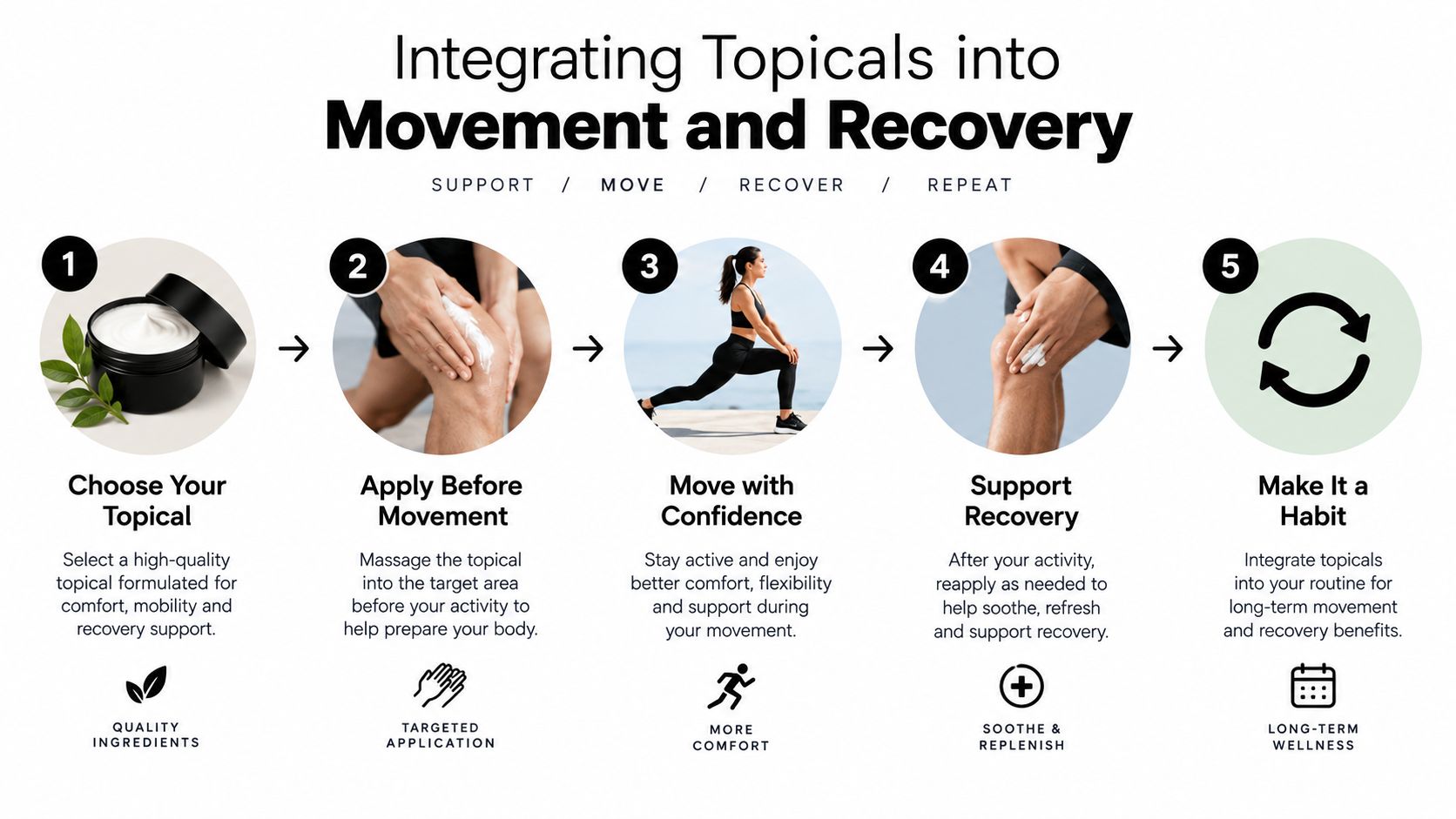
Restore
After training, use recovery time to combine appropriate topical relief with gentle movement, hydration, sleep, and a review of what provoked the symptoms. A cooling roll-on may feel useful for a superficial sore area, but it doesn't diagnose inflammation or determine whether you can train again.
Timing matters less than purpose. Prime to improve readiness, perform without ignoring warning signs, and restore by addressing the factors that produced the discomfort. Clinics can make this process more consistent by documenting the joint, product, response, and activity context. Resources for physical therapy clinics can help practices think about patient education and workflow around care delivery.
For athletes, the routine should be rehearsed before competition rather than introduced for the first time during an event. For workers, a portable product may support a break-time mobility routine, but recurring pain at the same task should trigger an ergonomic or workload review.
Beyond Temporary Relief and Next Steps
Topical relief is a tool, not a finish line. If a knee hurts every time you climb stairs, if a hand becomes progressively less useful, or if shoulder pain repeatedly interrupts sleep and work, applying another layer doesn't answer the underlying question. Persistent symptoms, increasing swelling, weakness, instability, or loss of function warrant assessment.
A complete plan may include strengthening around the joint, mobility work, changes to training volume, task modification, rehabilitation, and medical treatment when appropriate. Topicals can make those steps more tolerable, but they shouldn't become a reason to postpone them.
Listen to function: If relief changes comfort but not your ability to move safely, the treatment goal needs to be reconsidered.
Choose the ingredient according to the goal. Choose the format according to the setting. Follow the safety instructions every time, particularly with menthol, methyl salicylate, capsaicin, and external heat. Nutrition and general recovery also belong in the broader conversation, and this seed oil guide for joint health offers one way to consider dietary habits alongside movement and clinical care.
The most useful question isn't “Which topical is strongest?” It's “What does this pain require today, and what will help me address its cause over time?” A thoughtful answer protects the skin, respects the diagnosis, and keeps movement central.
MEDISTIK offers non-prescription topical options in stick, spray, and roll-on formats for temporary relief of sore muscles and joints, including support during warm-up, activity, and recovery. Visit MEDISTIK to compare formats and choose an option that fits your joint, routine, and safety needs.


