

That familiar ache you feel a day or two after a tough workout? That's Delayed Onset Muscle Soreness (DOMS), and it’s completely normal. It’s your body’s response to putting your muscles through a new or more intense challenge.
The discomfort comes from tiny, microscopic tears in your muscle fibres. Think of it less as damage and more as a renovation project—this is a sign that your body is repairing and rebuilding those fibres to be even stronger.
The Real Reason Your Muscles Ache After a Workout
If you’ve ever woken up feeling stiff and sore a day or two after trying a new fitness class or lifting heavier than usual, you know exactly what DOMS feels like. It’s a classic sign that you’ve pushed your muscles just enough to trigger an adaptation.
When you perform exercises, especially movements where you lengthen a muscle under tension (like lowering a dumbbell during a bicep curl), you create those micro-tears. Your body’s natural response is to kickstart an inflammatory repair process to patch them up. This healing cycle is precisely what makes your muscles more resilient for the next time.
Quick Guide to Post-Workout Soreness
It's easy to confuse the immediate burn you feel during a workout with the deep ache that sets in later. This quick table breaks down the key differences between acute soreness and DOMS to help you understand what your body is telling you.
| Soreness Type | When You Feel It | What It Feels Like | Primary Cause |
|---|---|---|---|
| Acute Soreness | During or immediately after exercise | A burning sensation or muscle fatigue | A temporary buildup of metabolic byproducts (like hydrogen ions) |
| DOMS | 12-72 hours after exercise | A deep, dull ache, stiffness, and tenderness | Microscopic tears in muscle fibres from intense or new exercises |
Essentially, the burn you feel during the workout is your muscles working hard in the moment. The soreness you feel days later is the sign of them getting stronger.
Debunking the Lactic Acid Myth
For years, lactic acid got a bad rap as the villain behind post-workout pain. But that’s a persistent myth we need to put to rest.
Your body produces lactic acid during intense exercise as a temporary fuel source. However, it gets cleared out of your muscles within an hour or two after you stop. DOMS, on the other hand, doesn’t even show up until much later—typically starting 6 to 8 hours post-exercise and peaking around the 48-hour mark.
Since the lactic acid is long gone by the time the real soreness kicks in, it simply can’t be the cause.
This delayed response is key. The soreness is a direct result of the body’s repair mechanism kicking in, not a leftover chemical from the workout itself. The sensation of pain is a complex signal, and understanding how your brain processes these signals can change your approach to recovery. You can learn more about how pain is processed by the brain in our detailed guide.
A Deeper Look at the Muscle Repair Process
To really get what's happening when your muscles ache after a workout, we need to zoom in and look at the fascinating repair cycle that happens on a microscopic level. It's not just any old movement that gets this process started; the main trigger is something called eccentric muscle contractions.
Think about the downward part of a bicep curl, when you're slowly lowering the weight. Or picture your quad muscles acting like brakes when you're running downhill. These are eccentric movements—they stretch your muscle fibres while they're loaded with tension, causing those tiny, microscopic tears.
It's a bit like a sturdy rope being stretched just enough for a few of its threads to fray. This isn't bad damage; it's controlled, minor stress that basically sends a signal to your body that it’s time to reinforce the area.
The Body's Repair Crew Arrives
As soon as these micro-tears happen, your body’s internal emergency response system jumps into action. It sends out a specialised clean-up crew to the "damage" site to get things sorted.
This response involves a complex inflammatory process. Your body floods the area with immune cells and fluids, which start clearing out the damaged tissue and kick off the rebuilding phase. It's this exact inflammation that causes the classic symptoms we all know as DOMS:
- Tenderness: The area gets sensitive to the touch because of all the activity from the inflammatory response.
- Swelling: You might notice some puffiness as more fluid gathers around the muscle fibres.
- Stiffness: That feeling of tightness and not being able to move as freely? That's your muscles starting to heal.
This diagram breaks down the three simple stages, from the workout itself to the recovery.

You can see how the intentional stress of exercise leads to those micro-tears, which in turn leads directly to that feeling of DOMS while the body gets to work repairing itself.
From Damage to Strength
Now, this whole biological chain reaction might sound a bit intense, but it’s actually the cornerstone of how we get stronger. The inflammation isn't a problem we need to get rid of; it's a crucial part of the solution.
This entire cycle of controlled damage and repair is precisely how your muscles adapt and grow. Your body doesn't just patch up the tears—it overcompensates, rebuilding the fibres to be thicker and more resilient than they were before to better handle future stress.
Ultimately, this is the process that builds your strength and muscle mass over time. Every bout of soreness is really a sign that your body is successfully adapting to the new demands you’ve placed on it. It's getting you ready for the next challenge. So, even though it's uncomfortable, DOMS is a productive, and even necessary, part of your fitness journey.
How to Know If Your Soreness Is Normal
Not every ache you feel after a workout is a sign of progress. While that deep, satisfying soreness from DOMS means your muscles are adapting and growing stronger, you need to know the difference between that productive feeling and the warning signs of a real injury. Figuring this out is key to making smart decisions about your recovery.
A big clue is the timeline. The normal muscle soreness you get after a workout, DOMS, doesn't hit you right away. It usually starts creeping in about 12 to 24 hours after your session. It often hits its peak intensity around the 48-hour mark before it starts to fade over the next few days.

Gauging Your Pain on a Scale
A simple way to check if your discomfort is in the normal zone is to rate it on a scale of 1 to 10. Think of 1 as barely there and 10 as severe, debilitating pain.
Productive muscle soreness should feel more like a dull, widespread ache, not a sharp pain in one specific spot. Generally, this feeling should land below a 4 out of 10. If you find your pain is consistently higher than that, it could be a sign you pushed a little too hard, too fast.
Health experts often suggest that a good level of post-exercise discomfort shouldn't go past a 3 out of 10. There's good reason for this: research shows that severe muscle micro-tears can slash your strength capacity by 50% or more, proving that too much damage actually holds back your performance. You can learn more about how pain severity impacts recovery from recent studies.
Red Flags to Watch For
While DOMS is a totally normal part of getting fit, some symptoms are not. These are your body's clear signals that it needs rest—and maybe medical attention—not another tough workout.
Keep an eye out for these warning signs:
- Sharp, Stabbing Pain: DOMS feels like a dull ache. If you’re getting a sharp, shooting, or stabbing pain, especially when you make a certain move, that could point to a strain or tear.
- Significant One-Sided Swelling: A bit of minor swelling can come with DOMS, but it should be pretty even on both sides. If one arm or leg is way more swollen than the other, that’s a red flag.
- Restricted Range of Motion: Stiffness is normal, but you should still be able to move your joints through most of their usual range. If the pain is so bad you can't, for example, fully straighten your arm or bend your knee, it's time to back off.
- Pain That Gets Worse: Normal soreness gets better after peaking around that 48-hour mark. If your pain just keeps getting worse after that point or sticks around for more than a week, it’s a good idea to get it checked out.
Think of it like this: "Good" soreness feels like your muscles are tired but satisfied. "Bad" pain feels like something is actually broken. Learning to hear these different signals is one of the most important skills you can build on your fitness journey.
Proactive Strategies to Minimize Muscle Soreness
While that post-workout ache is a normal sign that your muscles are adapting and getting stronger, you don't have to just accept days of hobbling around. The smartest way to handle muscle soreness is to get ahead of it with a few proactive strategies.
Thinking about prevention lets you control the intensity of DOMS, making your recovery feel a lot smoother and getting you back to your routine that much faster. It's all about working with your body's natural repair process, not against it.
Master the Warm-Up
Jumping straight into an intense workout without preparing your muscles is a recipe for serious soreness. A proper warm-up isn't just a suggestion; it’s non-negotiable. It gradually gets your heart rate up and boosts circulation, making sure your muscles get the oxygen-rich blood they need to perform.
A dynamic warm-up—think active movements like leg swings, arm circles, and torso twists—is way more effective than just holding a few static stretches. It fires up your nervous system and improves muscle elasticity, making those muscle fibres less likely to get the micro-tears that cause DOMS. For an extra edge, applying a product like the MEDISTIK Extra-Strength Stick during this phase can help warm the area and prime your muscles for action.
Embrace Progressive Overload
One of the biggest culprits behind severe, can't-walk-down-the-stairs DOMS is doing way too much, too soon. Your best defence against this is the principle of progressive overload. This simply means making small, gradual increases to your workout intensity over weeks and months, not all in one go.
Think of it like this: your muscles are incredible at adapting, but they need time. By slowly adding a little more weight, a few more reps, or a bit more time to your workout, you give your muscle fibres a chance to repair and strengthen without getting completely overwhelmed.
This methodical approach builds resilience and seriously reduces the shock to your system, which in turn minimizes how sore you'll feel later.
Focus on Flawless Form
Poor technique doesn't just put you at risk for injury—it’s also a direct cause of unnecessary muscle soreness. When your form is off, you often put stress on joints, tendons, and smaller stabilizing muscles that aren't designed to handle the main workload.
This misplaced stress can lead to sharp, localized pain instead of that productive, dull ache of DOMS you feel in the muscles you were actually trying to target. Taking the time to learn and practise proper form ensures you’re working the right muscle groups safely and efficiently. Quality over quantity will always give you better, less painful results.
By combining these proactive steps, you can significantly improve pain relief and recovery, allowing you to train more consistently and effectively. For a deeper dive, learn more about how to improve pain relief and recovery with targeted strategies.
Evidence-Based Methods For Relieving Sore Muscles
When you're dealing with that familiar post-workout ache, you want relief that actually works—not just old wives' tales. The good news is that science points to several solid strategies for managing the discomfort and getting you back on your feet faster. It's all about supporting your body's natural repair process.
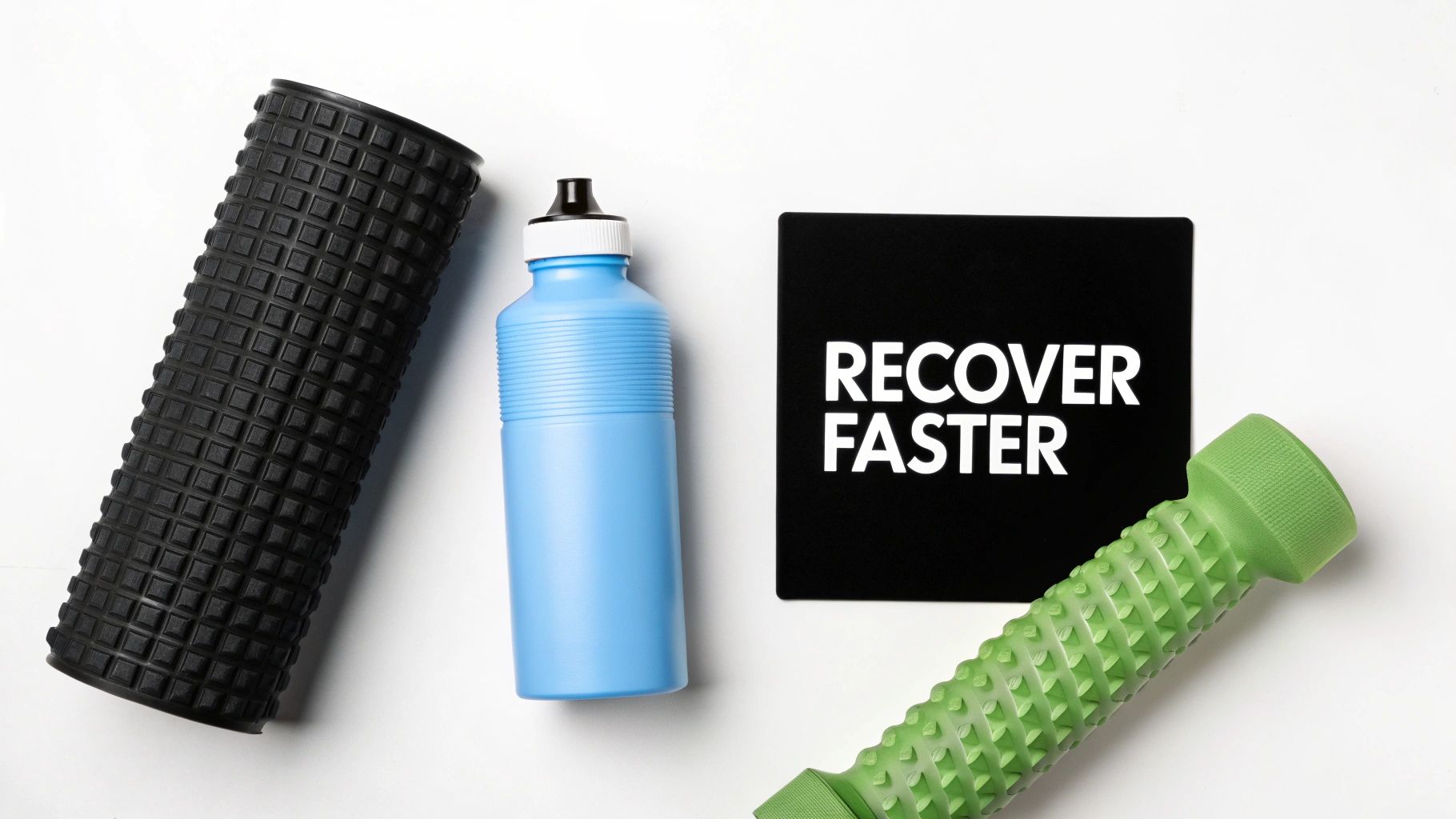
One of the most effective tools in your recovery kit is surprisingly simple: active recovery. This just means engaging in some light, gentle movement the day after a tough session. Think a brisk walk, a slow spin on a bike, or some light yoga.
This low-intensity activity boosts blood flow to your sore muscles, delivering the nutrients they need to repair while helping to flush out the waste products that build up during the healing process.
Targeted Relief And Proven Techniques
Beyond just moving a little, several hands-on techniques can bring significant relief. These methods work by physically manipulating the muscles and surrounding tissues to ease tightness and get the blood flowing.
For Canadian athletes looking to bounce back quickly, certain interventions have shown real results. Research has found that a 20-30 minute massage up to two hours after your workout can noticeably reduce DOMS over the next 24 hours. Even your post-workout snack plays a part; getting enough carbohydrates helps refuel your muscles and can minimize soreness. For a deeper dive, check out these science-backed tips to reduce muscle soreness and recover faster.
Other tried-and-true methods include:
- Foam Rolling: Think of this as a DIY massage. By rolling over those tender spots, you help break up knots and release tension in the fascia—the web of connective tissue that encases your muscles.
- Proper Hydration: Being dehydrated can make muscle soreness feel even worse and drag out your recovery. Staying hydrated is essential for helping your body flush out waste and support cellular repair.
The point of these techniques isn't to magically erase soreness, but to manage it. By improving circulation and reducing stiffness, you'll regain your range of motion and feel a whole lot more comfortable while your body does its rebuilding work.
The Role Of Topical Analgesics
For immediate, targeted relief, a topical analgesic can be a game-changer. Products like MEDISTIK are designed for that crucial 'Restore' phase of recovery, creating a cooling or heating sensation that helps distract your brain from the pain signals.
Active ingredients like menthol and methyl salicylate get to work right at the source, creating a counter-irritant effect on the skin's nerve receptors. This provides temporary relief from that deep, nagging ache of DOMS, letting you move more freely and get on with your day. It’s a powerful approach because it delivers relief exactly where you need it, without the full-body effects of oral medications. You can learn more about the benefits of a topical pain reliever versus an oral one here.
Sorting through all the recovery options out there can be confusing. To help, we've organized some of the most common methods based on the strength of scientific evidence supporting their use for DOMS.
Effective DOMS Relief Methods Ranked by Evidence
| Recovery Method | How It Helps | Level of Evidence | Best Time to Use |
|---|---|---|---|
| Massage | Reduces inflammation, improves blood flow, and alleviates stiffness. | Strong | 0-72 hours post-exercise |
| Active Recovery | Increases circulation to deliver nutrients and remove metabolic byproducts. | Strong | 24-48 hours post-exercise |
| Topical Analgesics | Creates a counter-irritant sensation to temporarily block pain signals. | Strong | As needed for immediate relief |
| Compression Garments | May reduce swelling and muscle vibration, improving perceived soreness. | Moderate | During and after exercise |
| Foam Rolling | Releases fascial tension and improves range of motion. | Moderate | Immediately after exercise or on recovery days |
| Cold Water Immersion | Constricts blood vessels to reduce swelling and inflammation. | Moderate | Within 1 hour post-exercise |
| Stretching (Static) | Can provide temporary relief from stiffness but has little effect on DOMS. | Weak | After a warm-up or workout |
Ultimately, a smart recovery plan isn't about finding one magic bullet. It’s about combining gentle movement, targeted hands-on techniques, and effective topical relief to support your body's natural healing process. This well-rounded approach is your best bet for bouncing back faster and stronger.
Your Top Questions About Muscle Soreness Answered
Let's clear up some of the biggest questions people have about that post-workout ache. Getting the right answers will help you understand what your body is telling you so you can recover smarter and keep making progress.
Must I Be Sore After Every Workout?
Not at all. While that familiar ache tells you that you’ve definitely challenged your muscles, it’s not the only—or even the best—measure of a great workout. The whole "no pain, no gain" idea is a total myth.
Real, lasting progress is built on consistency and progressive improvement over the long haul. As your body gets stronger and adapts to your training, you'll find that DOMS shows up less and less, even when you're still hitting new personal bests.
Should I Train While Still Sore?
It really comes down to how sore you are. Pushing through intense pain and trying to train the same muscles with high intensity can mess with the healing process and seriously increase your risk of getting injured. It's usually best to give those muscles a proper rest day.
That said, a little bit of gentle movement can be your best friend.
Active recovery—think a light walk, a relaxed swim, or an easy spin on a bike—can actually help ease that stiff, locked-up feeling. This kind of low-impact activity boosts blood flow to your muscles, which can speed up the healing process without causing more damage. The key is to listen to your body and choose light activity over another gruelling session.
How Long Is Too Long For Soreness?
Generally, DOMS will stick around for about three to seven days, with the worst of it usually hitting around the 48-hour mark. If your pain is debilitating, seems to be getting worse instead of better, or hangs around for more than a week, it’s a good idea to check in with a healthcare professional.
Is Ice Or Heat Better For Sore Muscles?
Both can be useful, but they do very different jobs. Timing is everything. Here’s how to think about it:
- Ice: Reach for an ice pack within the first 24-48 hours. The cold helps calm down that initial, intense inflammation and can numb the area to give you some relief from the sharpest pain.
- Heat: Once that first wave of inflammation has settled, heat becomes your go-to. A warm compress or bath is fantastic for soothing lingering stiffness and improving circulation to tight, achy muscles.
Don't let muscle soreness sideline you from what you love. For powerful, targeted relief that works with your body's natural recovery process, trust the Canadian-made solutions from MEDISTIK. Find the right product for your post-workout needs and get back to moving your best. Explore our full range at MEDISTIK.


