

You're at your desk, your shoulder has that familiar tight, annoyed feeling, and you still have half a day left. Or maybe your knee flares after a training session, but you've got to drive home, make dinner, or get through another shift. That's the moment many people start looking for something cold that doesn't require holding an ice pack in place or cleaning gel off their hands.
That's where ice cold patches make sense for some people. Not because they're automatically stronger than ice, and not because they replace every other option, but because they're easy to wear while you keep moving. A patch can sit under a shirt, stay where you put it, and give you that cooling signal without tying you to the freezer.
In Canada, these products aren't niche anymore. They sit beside gels, sprays, rubs, and heat wraps in everyday pharmacy and grocery aisles. But the practical questions usually go unanswered. When is a patch the better format? When is a gel smarter? When is plain ice still the better call?
This guide takes the mystery out of that choice. If you're sorting out recovery after sport, trying to stay comfortable during work, or helping patients think through options, it helps to look at patches as a delivery format first. If you also want broader recovery ideas, this guide on how to reduce soreness after workouts adds useful context around what cooling can and can't do.
Introduction to Ice Cold Patches and Hands Free Cooling
You feel a sore spot and still need to keep going. Maybe it is your shoulder during computer work, your low back midway through a shift, or your knee after training when the rest of the day is still waiting. In that moment, the question usually is not, “What is the strongest cold option?” It is, “What can I use without stopping everything else?”
That practical question explains why ice cold patches appeal to so many active adults. A patch is a hands-free format for cooling. You place it over the area, smooth it down, and keep typing, walking, driving, or doing chores. The advantage is often adherence, not raw intensity.
That distinction matters. A patch is not automatically stronger than an ice pack, and it does not replace every gel or spray. It works more like choosing the right container for the job. A travel mug is not stronger than a regular cup, but it is easier to carry, less messy, and more likely to get used. Patches fill that same role for people who want cooling they can wear.
Health Canada has reviewed topical pain relievers as a broad self-care category, which helps show how established these products are in Canada. Its review summary covers common medicinal ingredients such as menthol, methyl salicylate, and capsaicin used in nonprescription topical products, including patch formats (Health Canada topical pain reliever review summary).
A simple way to choose the format is to match it to the situation:
- Choose a patch when you want cooling that stays in place while you move.
- Choose ice when you want a short, direct cold application and can stop to use it.
- Choose a gel or roll-on when you want flexible coverage over a larger or awkward area.
- Choose a spray when touching the area is uncomfortable or you need a quick, no-rub option.
Skin tolerance also shapes the decision. Some people like the steady feel of a patch. Others prefer a gel because adhesives irritate their skin or because they want more control over how much product they apply. That is why it helps to treat a patch as a format choice first, not a universal upgrade.
If you want a broader look at how patch formats fit into topical options, this overview of topical pain relief patches is a helpful companion. If soreness after training is part of the bigger picture, this guide on how to reduce soreness after workouts adds useful context around what cooling can and cannot do.
How Ice Cold Patches Create a Cooling Sensation
An ice cold patch works through two experiences at the same time. One is what your skin senses. The other is what your brain interprets. That's why a patch can feel surprisingly cold even when it isn't the same as pressing a bag of ice directly on the area.
Think of your skin like a thermostat
Your skin has sensory receptors that act a bit like temperature alarms. When ingredients such as menthol contact the skin, they stimulate cold-sensitive receptors and send a message upward that says, in simple terms, “this feels cool.”
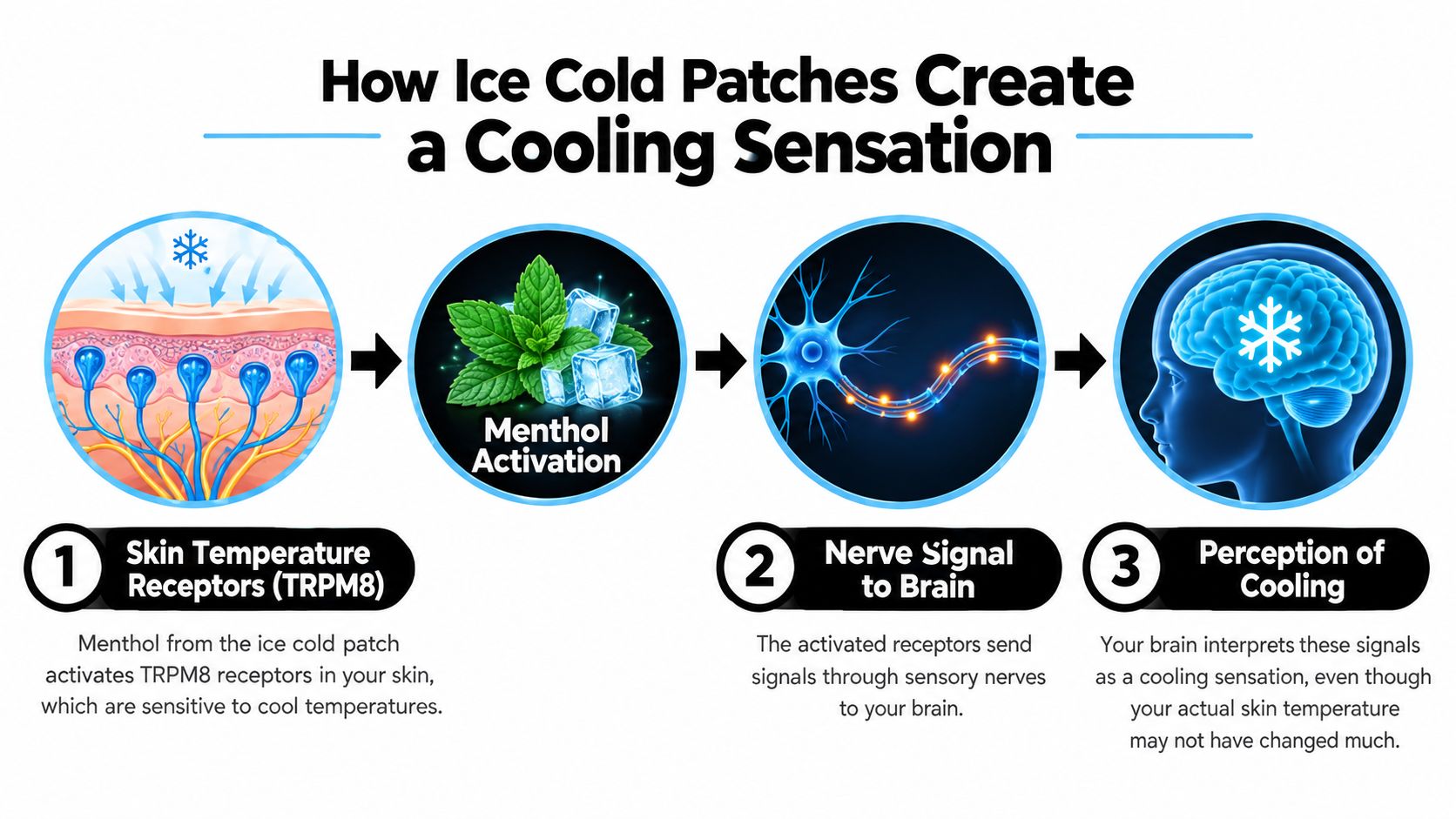
That's why menthol doesn't just smell minty. It creates a real sensory effect. If you've ever wondered why some cold products feel brisk within moments while others feel dull or wet, this is the reason. The formula is talking to the skin's cold sensors.
A good plain-language way to think about it is this:
Key concept: A cooling patch doesn't need to behave exactly like frozen ice to produce a meaningful “cold” experience. It can combine sensory signalling with local skin cooling.
What the research suggests about menthol and ice
Controlled topical-cooling research helps make that idea less abstract. In a volunteer study described in a peer-reviewed review, 20 minutes of topical menthol, crushed ice, or both reduced radial artery blood flow by about 20% to 24% with ice, 17% to 24% with menthol, and 36% to 39% with the combination. In that same summary, menthol caused significantly less discomfort than ice at 5, 10, and 20 minutes (peer-reviewed review of menthol-based cooling effects).
That matters because many people stop using plain ice sooner than intended when it feels too intense, too wet, or too awkward to hold in place. A patch or menthol-based topical may feel more tolerable, which can make consistent use easier.
If you want a deeper explanation of how this ingredient works in pain-relief products, this article on how menthol relieves pain breaks the mechanism down clearly.
Why the combination can feel stronger
Some people layer experiences mentally, even if they don't combine products. They notice that direct cold feels physically colder, while menthol feels sharper and more lingering. The research above supports the idea that combining sensory cooling with actual cooling exposure can create a stronger overall effect.
That doesn't mean “more intense” is always better. For irritated skin, a gentler cooling sensation may be the smarter choice. For a fresh post-activity flare, direct ice may still feel more appropriate.
Types of Cryotherapy Patches and How They Differ
Not every “cold patch” works the same way. In day-to-day practice, people usually lump two different tools together. One is a reusable gel-based cold pack that needs chilling. The other is a single-use adhesive cooling patch, often menthol-based, that works without a freezer.
That difference matters more than most labels suggest.
Two categories, two routines
Reusable gel packs behave more like traditional ice therapy. They store cold in advance, then release it when applied. They can feel physically colder at first, but they're bulkier, less discreet, and harder to use while walking around or getting work done.
Single-use ice cold patches are built for portability and adhesion. Canadian retail listings commonly describe them as discreet, greaseless, long-wearing, and sometimes cut-to-size. The practical appeal is obvious. You can put one on your shoulder, lower back, or calf and keep moving.
Reusable Gel Packs vs Single Use Ice Cold Patches
| Feature | Reusable Gel Pack | Single Use Ice Cold Patch |
|---|---|---|
| How it works | Chilled in freezer, then applied to skin | Adhesive patch applied directly to skin |
| Mobility | Best when resting in place | Better for walking, commuting, or working |
| Mess factor | Can drip or feel damp | Usually dry and greaseless |
| Clothing fit | Harder to keep under clothing | Easier to wear under clothing |
| Set-up | Needs freezer access | Ready to use anywhere |
| Body-area fit | Good for broad areas when seated | Good for targeted areas if the patch shape fits |
| Travel use | Less practical on the go | Easier for gym bags, work bags, and travel |
| Main advantage | Strong physical cold feel | Adherence and convenience |
The better question to ask
Instead of asking which one is stronger, ask which one you'll use properly.
If you're recovering at home and can sit still, a gel pack may suit you better. If you need cooling during a shift, on a flight, at your desk, or under sports gear between activities, a patch often wins because it removes friction from the routine.
That's the heart of the format choice. Not superiority. Adherence.
How to Apply Ice Cold Patches for Best Results
You are halfway through a workday, your upper back starts complaining, and you want cooling that stays put under a shirt instead of turning into another task to manage. That is where application matters. A patch is often chosen because it is easier to live with, so the goal is not to make it stronger. The goal is to make it stay comfortable and usable for the time you need it.
Start with the skin, not the patch.
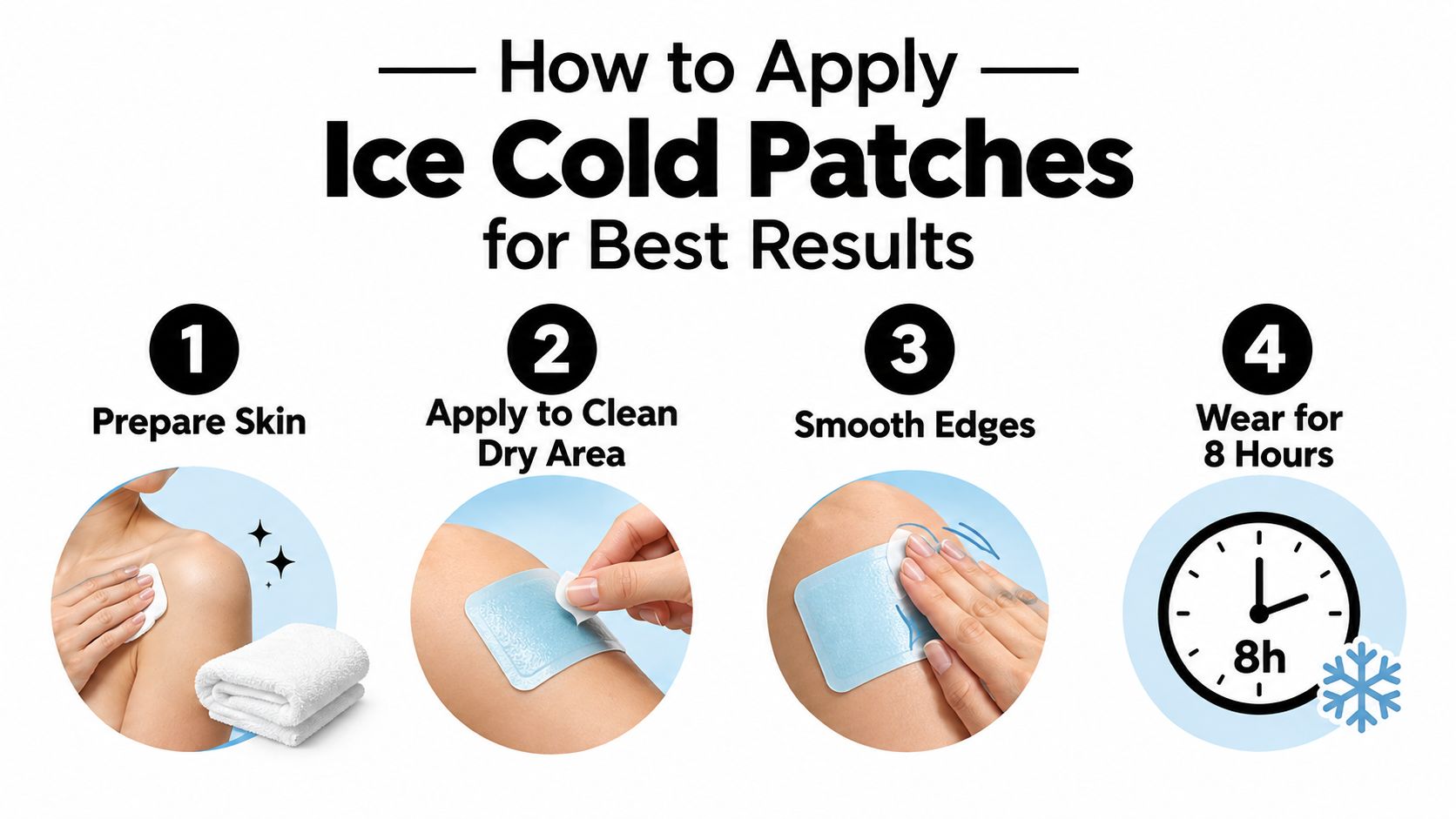
Clean, dry skin gives the adhesive a fair chance. Sweat, body oil, and leftover lotion act like dust under tape. The patch may still go on, but the grip is weaker from the start, so edges lift sooner with walking, bending, or clothing rubbing across the area.
Place the patch over the sore spot, then press from the centre outward so air pockets do not collect under the surface. If the label says the patch can be trimmed, shaping it can help on curved areas such as the upper trapezius or outer knee. If the label does not say that, leave it intact.
A useful way to choose placement is to ask one question. Will this area keep folding, twisting, or rubbing for the next few hours? Flat, lower-motion areas usually hold a patch better than skin under a waistband, over a sharply bending joint, or anywhere gear keeps scraping the edges.
Follow the label, especially for wear time
Directions differ by product, and that matters more with medicated patches than with a plain cold pack. Some labels allow only a limited number of applications per day and set age cutoffs for use. If a patch feels mild, that does not mean extra patches or longer wear are automatically safe.
The practical rule is simple. Use the product exactly as labelled, remove it if the skin becomes too reactive, and give the same spot a break before putting something else on top unless the instructions say that is allowed.
Small adjustments that improve real-world use
- Apply before heavy sweating starts. If you wait until skin is damp, adhesion often becomes the weak point.
- Choose the body position first. Put the patch on while standing or sitting the way you will spend most of the next hour, so it settles on the skin in a natural position.
- Do not keep re-sticking a peeling corner all day. Repeated tugging can irritate the skin more than the patch itself.
- Remove it early if the sensation turns sharp or stingy. Cooling should feel clear and tolerable, not alarming.
If a patch keeps failing on a moving area, that does not mean cold therapy failed. It usually means the format was a poor match for the job. For spots where adhesive never seems to cooperate, an ice roll application method for hard-to-patch areas can be easier to control.
That is the decision frame to keep in mind. Choose a patch when hands-free wear, staying mobile, and low mess matter most. Choose another cold format when the body area, wear conditions, or your skin make adhesion more trouble than help.
Ice Cold Patches Versus Traditional Ice and Cooling Roll Ons
When people ask, “Which one should I use?” they're often really asking, “Which one fits what I'm doing right now?” That's the useful comparison. Not abstract product categories, but real situations.
Start with the job you need done
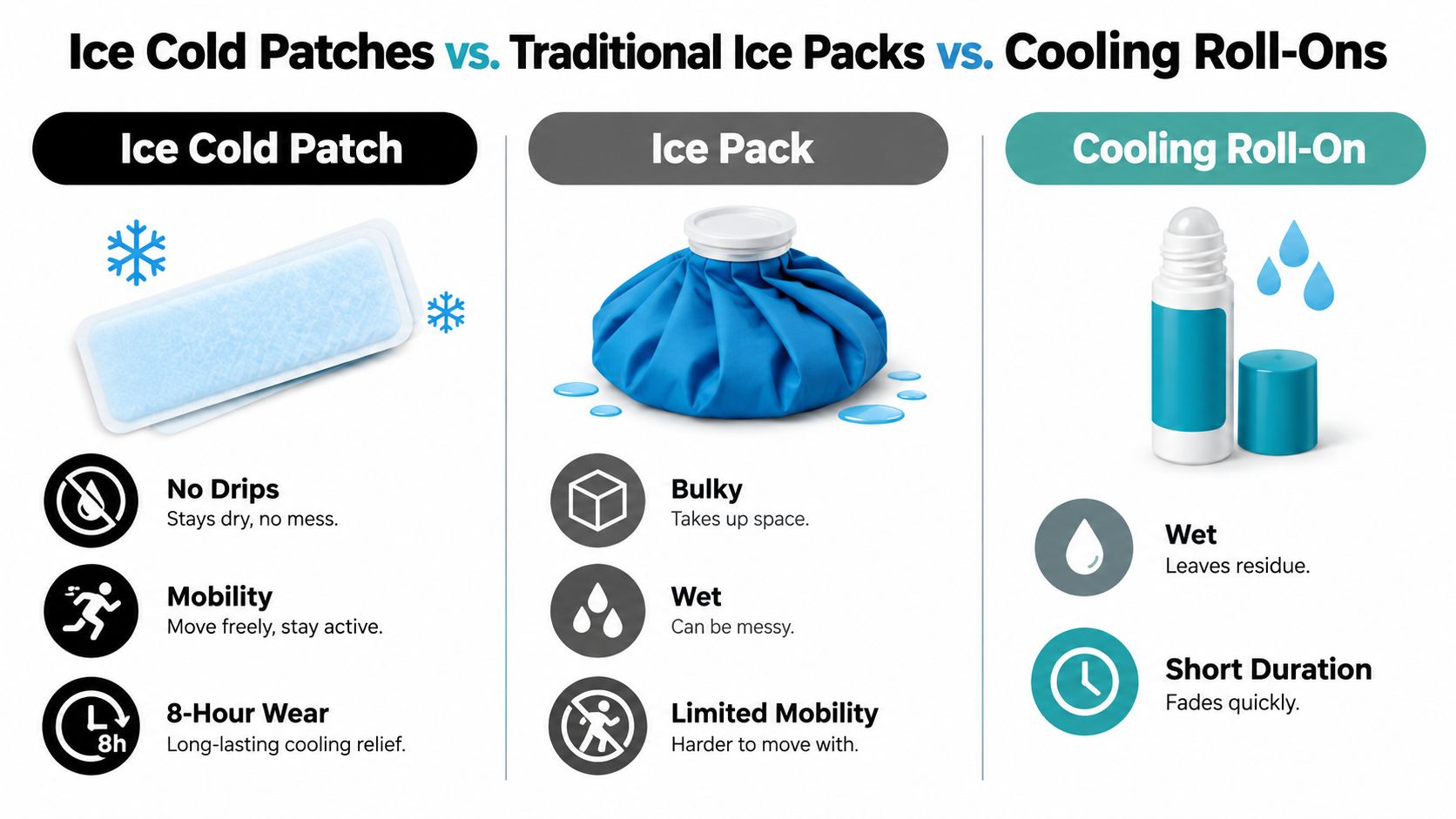
Traditional ice is still the most familiar cold tool. It gives direct physical cold and works well when you can rest, prop up the area, or stay seated. Its weaknesses are obvious too. It's bulky, wet, and not easy to use while typing, driving, commuting, or moving around the house.
Cooling roll-ons and similar liquids are fast and portable. They're handy when you want a quick cooling pass over a broad area or when you don't want adhesive on the skin. Their downside is that the sensation may fade sooner, and the product can transfer to hands or clothing if you're not careful.
Ice cold patches sit in the middle. They usually aren't as physically cold as a frozen pack, and they don't spread as flexibly as a liquid. But they're often the easiest to wear during normal life.
A decision matrix for everyday use
| Situation | Best fit | Why |
|---|---|---|
| Desk work or long meetings | Ice cold patch | Hands-free and discreet under clothing |
| Fresh post-activity recovery at home | Traditional ice | Stronger direct cold when you can sit still |
| Quick cooling before or after commuting | Roll-on | Fast to apply, no need to position a patch |
| Warehouse, retail, or active workday | Ice cold patch | Easier to keep on while moving |
| Broad area that changes location | Roll-on or gel | Easier to spread than a fixed patch |
| Sensitive skin that dislikes adhesive | Ice pack or non-adhesive cooling format | Avoids patch adhesion issues |
| Lower back under fitted clothing | Patch or roll-on | Depends on whether you prefer wear time or flexibility |
When a patch is the wrong choice
A patch is a poor fit when the sore area is too large, too hairy, too sweaty, or too mobile for the adhesive to stay settled. It may also disappoint people who expect the immediate, deep chill of a freezer-cold pack.
That's why I'd frame patches as temporary sensory relief with practical staying power, not deep tissue magic. If your question is specifically about using direct cold for the back, this guide on an ice pack for back pain helps clarify when the old-school option still makes the most sense.
Choose the format that matches the task. The “best” cooling tool is the one you can use correctly in the setting you're actually in.
Safety Considerations and Skin Tolerance for Active Adults
You finish a workout, stick on a cooling patch, pull on a compression sleeve, and head out the door. Twenty minutes later, the area feels more stingy than soothing. That situation is usually a skin tolerance problem, not a sign that the patch is “working better.”
That distinction matters. Ice cold patches are often easier to stick with because they are hands free and low maintenance, but easier use does not make them a stronger treatment. It means they can fit real life better. The tradeoff is that wear time, adhesive, sweat, and trapped heat all affect how your skin handles them.
What Health Canada's review means in plain language
Health Canada reviewed reports of serious skin burns linked to some over the counter topical pain relievers and updated labelling to reflect that risk. The products involved included ingredients such as menthol, methyl salicylate, and capsaicin. You can read the review on the Health Canada safety review page.
The practical message is simple. Serious reactions appear to be uncommon, but they are real. A cooling sensation should feel noticeable yet tolerable. Burning, sharp pain, or angry-looking skin means stop and check the area.
Who tends to need more caution
Active adults run into a few predictable skin problems because their routine adds friction, moisture, and repeat exposure.
- People with sensitive or reactive skin: Adhesive and cooling ingredients may irritate skin that already flares easily.
- Adults with thinner skin: The same patch can feel stronger and leave redness more quickly.
- Athletes wearing tight gear or braces: Compression can trap heat and increase rubbing over the patch.
- Anyone using repeated applications on the same spot: Skin can become less tolerant after several rounds, even if the first use went fine.
- People with known ingredient or adhesive allergies: Local rash or itching is more likely.
How to lower the chance of irritation
Start with intact, dry skin. Skip areas with cuts, razor burn, rash, or leftover irritation from tape or another topical.
Then consider the setting. A patch under snug clothing after a hot shower is like putting a lid on a warm pan. Heat and occlusion can make the area feel much harsher than it did during a brief test on uncovered skin.
A small trial helps. Use the patch for a shorter wear period the first time, especially on thinner or more sensitive areas such as the inner arm, side of the knee, or upper chest.
If the skin starts to feel hot, sharply painful, or unusually red rather than just cool, remove the patch.
When a patch is the safer practical choice, and when it is not
For adherence, patches often win during a work shift, errands, or travel because they stay in place without repeat application. That convenience can improve follow-through. If you know you will not reapply a gel or stop to ice an area, a patch may be the format you use correctly.
But skin tolerance sets the limit. If you sweat heavily, react to adhesives, or wear tight equipment over the area, ice or a non-adhesive cooling product may be the better choice even if it is less convenient.
A useful rule is this: choose a patch when wear time and mobility matter more than intense cold, and choose another format when your skin dislikes being covered. That keeps the decision practical, which is where patches usually help most.
Pairing Ice Cold Patches with Topical Analgesics Like MEDISTIK
The most useful way to build a routine isn't to ask one product to do everything. It's to match the format to the moment. I like the simple rhythm of prime, perform, restore because it mirrors how people move through a day.
A simple prime perform restore approach
Before activity, some people prefer a warming or non-cooling topical if the goal is to get moving comfortably. During a busy workday or while travelling, an ice cold patch may fit better because it stays put and doesn't ask for much attention.
After activity, cooling often makes more sense if the area feels irritated, hot, or overworked. If you want to combine format choice with a broader treatment plan, this article on how MEDISTIK works with treatments to reduce discomfort and improve healing speed gives a good example of how topical products can support, rather than replace, manual care and exercise-based rehab.
Where a product like MEDISTIK can fit
A product line such as MEDISTIK may fit into that routine by giving people different topical formats for different moments, such as a stick, spray, or rapid cooling roll-on. That's often more realistic than expecting one patch or one rub to handle warm-up, activity support, and recovery equally well.
The key is staying honest about the goal. Use a cooling patch when hands-free wear and sensory relief matter most. Use other topical formats when spreadability, quick reapplication, or a different feel on the skin matters more. If pain keeps returning, changes in pattern, or limits normal activity, that's a good reason to involve a healthcare professional.
If you want a practical Canadian-made option for topical pain relief, MEDISTIK offers formats that fit different moments, including cooling options that can complement the kind of decision-making described here. If you're sorting out whether a patch, roll-on, stick, or spray fits your routine best, their product and education pages can help you build a more workable plan for work, sport, and recovery.


