

You wake up, reach toward the nightstand, and discover that twisting to the right suddenly hurts. The ache sits between your shoulder blades, mostly on one side, and every deep breath or turn seems to catch it. You may wonder whether you slept badly, strained a muscle, irritated a rib, or whether the pain is coming from an organ rather than the spine.
That question matters because mid-right back pain isn't one diagnosis. The same location can reflect muscle and joint irritation, referred pain from the neck or shoulder region, or a problem involving the gallbladder or kidney. Canadian patient guidance lists poor posture, muscle or ligament injury, disc problems, fractures, and osteoarthritis among possible causes, while also identifying gallbladder and kidney referral as possibilities when other symptoms appear. MyHealth Alberta explains the difference between common back causes and warning patterns.
Most episodes are assessed first through the pain pattern, movement behaviour, associated symptoms, and physical examination. Scans aren't automatically the starting point, particularly when there are no warning signs. The sections below follow two parallel paths, mechanical causes and organ-related or urgent causes, before placing topical relief in its proper role within recovery.
What Mid Right Back Pain Usually Feels Like
You reach across a desk, turn toward the right, and feel a sharp catch beneath the shoulder blade. The discomfort may stay beside the thoracic spine, sit between the shoulder blade and spine, or curve slightly around the ribs. It can begin as a dull, nagging ache, then sharpen with rotation, overhead reaching, coughing, or a deep breath.
After an awkward night's sleep or work in the garden, pressing the area may reveal muscles that feel bruised, tight, or cord-like. Sitting still can increase stiffness, while walking or changing position may gradually ease it. Moving the right arm can also reproduce the pain because the shoulder blade, ribs, and muscles of the mid back operate as a linked unit.
A useful starting clue: Mechanical pain often changes with position, load, or movement. Organ-related pain is less consistently affected by those adjustments.
Location cannot identify the cause by itself. A focused guide to pain in the upper right of the back can help you compare the area involved. More useful clues include what worsens or eases the symptom and whether other symptoms appear alongside it.
How location guides assessment
Widespread soreness after a demanding day may fit general muscle fatigue. A small, reproducible tender spot beside the spine points more toward a local muscle, rib, or joint source. Pain that travels around the chest wall, changes with breathing, or feels deep and difficult to reproduce by touch calls for a broader assessment.
The pattern also matters over time. A brief episode after an obvious strain may settle as the irritated tissues recover. Persistent or recurring symptoms deserve review rather than repeated self-treatment without reassessing the cause.
Canadian data show why back symptoms merit thoughtful attention. One national analysis found that 20.2% of Canadian adults reported back problems lasting 6 months or more, and another study estimated chronic back disorder prevalence at 18.9% in 2007 and 17.8% in 2014. These figures are reported in the Canadian analysis of long-duration back problems.
Those findings do not make every short episode serious. They support reading the pain pattern carefully, so a right-sided ache is not automatically dismissed as a strain or treated as an emergency.
How the Mid Back Works and Why One Side Hurts
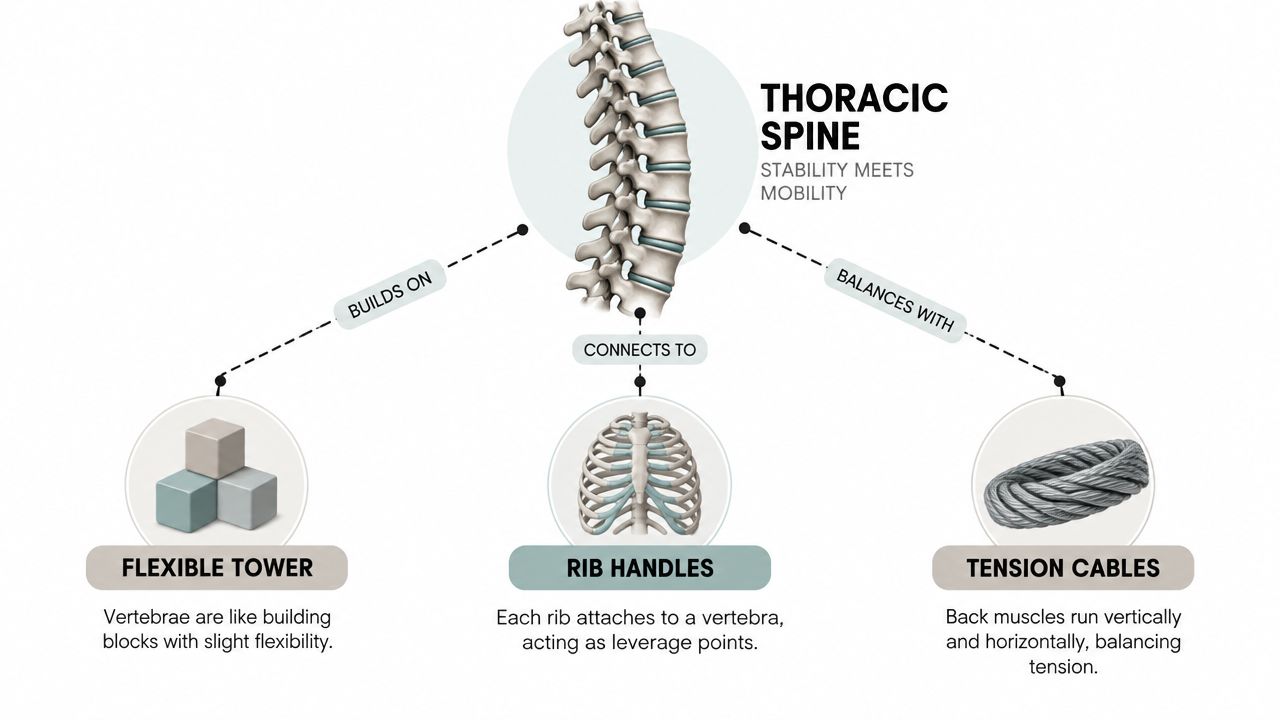
Think of the thoracic spine as a flexible tower. The vertebrae are stacked blocks that provide support while allowing controlled movement. They're less freely mobile than the neck and lower back because the rib cage surrounds them, but they still need to rotate, extend, and coordinate with the shoulders.
Each rib acts like a handle attached to the tower. When you breathe, reach, or twist, the ribs and thoracic joints move together. The muscles beside the spine and around the shoulder blades work like tension cables, constantly adjusting force to keep the tower upright against gravity.
Why stiffness often dominates
The mid-back is built for stability and controlled rotation more than large bending movements. When a muscle, rib joint, or facet joint becomes irritated, the surrounding muscles may tighten to protect the area. That protective tension can feel like stiffness, restricted rotation, or a catching sensation rather than constant severe pain.
A right-sided symptom often reflects how force travelled through the body, not a single damaged structure. You might favour your right arm while lifting, sleep repeatedly on your right side, hold a child on one hip, or drive with your right hand fixed on the wheel. Even a sudden sneeze can make you brace asymmetrically.
These habits can make the right muscles work harder or keep the right shoulder blade in a slightly different position. The result may be a tender band, a rib-area ache, or a sharper pain during rotation.
A practical movement model
Use three questions to understand the pattern:
- What was loaded? Lifting, gardening, reaching, sport, or prolonged sitting can all alter thoracic demand.
- Which movement reproduces it? Rotation, extension, arm elevation, or deep breathing may identify the dominant load.
- Does the pain settle when the load changes? Improvement with walking, repositioning, or gentle movement supports a mechanical contribution.
A resource on mid-back muscles can help you visualise how these tissues support the ribs and shoulder blades. The important point is that the right side is a directional clue. It tells you where the body may be absorbing extra tension, but it doesn't identify the exact tissue by itself.
The Three Most Common Mechanical Drivers
Mechanical pain usually comes from several overlapping structures. A clinician compares the sensation, triggers, relieving factors, and examination findings rather than relying on location alone.
| Driver | Typical Sensation | Common Trigger | Relieved By | Exam Clue |
|---|---|---|---|---|
| Muscle strain or overload | Tight, tender band or aching knot | Lifting, reaching, repetitive work, prolonged posture | Heat, gentle movement, reduced loading | Pain reproduced by pressing or contracting the muscle |
| Facet joint irritation | Sharp, localised catch, sometimes spreading around a rib | Rotation or extension | Neutral posture and reduced twisting | Pain with specific spinal movements, often with limited motion |
| Referred pain from the neck or shoulder blade | Dull ache that may feel harder to localise | Neck position, shoulder loading, sustained desk posture | Changing neck or shoulder position | Thoracic pain changes when the neck or shoulder is examined |
Muscle strain or overload
A strained or overloaded muscle often feels like a tight strip beside the spine or under the shoulder blade. Pressing the area may reproduce the familiar pain, and contracting the muscle against resistance can make it more noticeable. The pain commonly follows an increase in activity, especially lifting, reaching, gardening, sport, or repetitive work.
The muscle doesn't need to be torn for this pattern to occur. It may have been asked to maintain tension longer than it could comfortably tolerate. Reducing the aggravating load while preserving easy movement is usually more useful than complete bed rest.
Facet or rib-related irritation
Facet joints guide movement between vertebrae. When one becomes irritated, rotation or backward bending may produce a sharp, highly localised catch. Because the ribs connect with the thoracic spine, discomfort can sometimes travel around the side of the chest wall.
This pattern may feel different from a muscle ache. The person may point to a small area, report a sudden block during twisting, and show reduced movement during an examination. Similar symptoms can still come from nearby muscles or rib joints, so a physical assessment may be needed when the pain persists.
Referred pain from the neck or shoulder
Pain felt in the mid-back doesn't always start there. Irritation or overload in the neck, shoulder, or shoulder-blade region can create a dull ache that changes with neck position or arm use. If turning the neck alters the back pain more than turning the thoracic spine does, the source may be above the painful area.
Workstation changes can reduce repeated strain, especially when the chair and desk encourage slouching. For practical guidance on chairs designed for your working comfort, look for support that lets you change position easily rather than forcing you to hold one rigid posture.
These patterns overlap. Understanding muscle pain causes can help, but the aim isn't to label yourself with certainty. It's to identify the dominant behaviour so your next step, movement modification, clinical review, or urgent assessment, matches the pattern.
When the Right Side Means Something Else
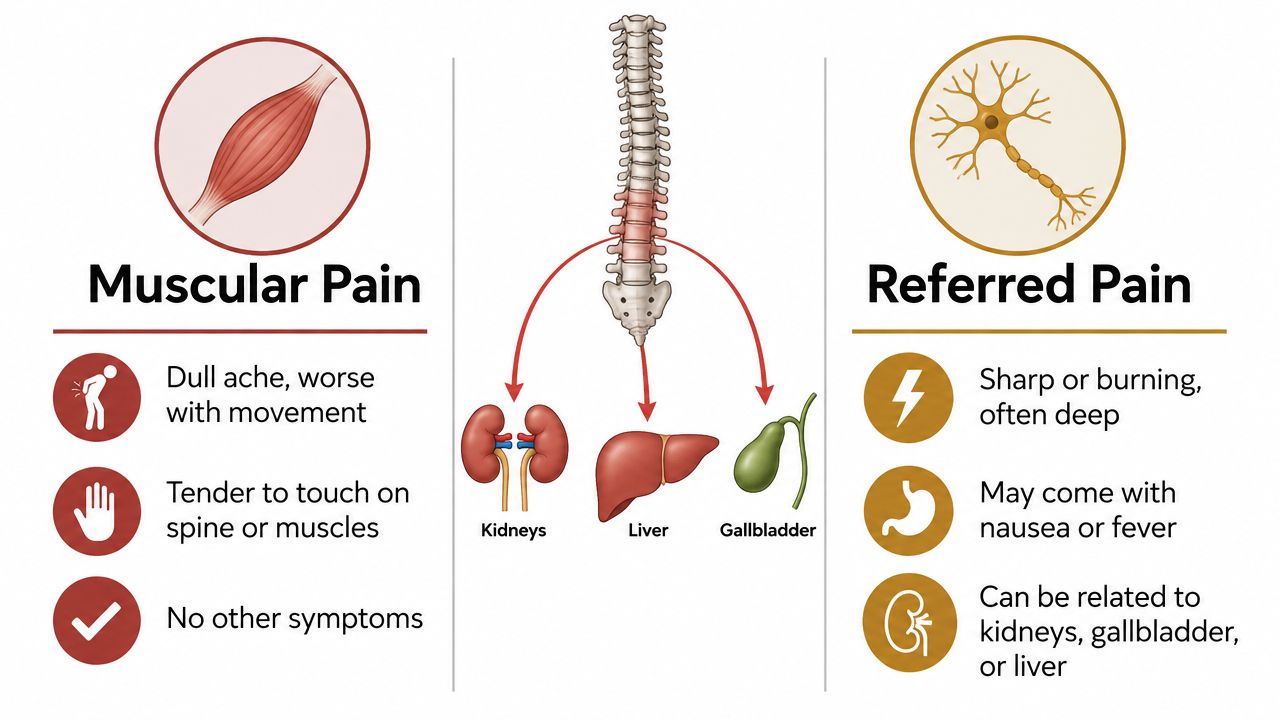
Right-sided mid-back pain needs a different line of reasoning when movement does not reliably change it. The gallbladder and right kidney can send discomfort toward the back, so organ-related pain may resemble a thoracic muscle strain at first.
Gallbladder pain may appear in the right upper abdomen or beneath the ribs. A repeated connection with eating, especially fatty meals, can point away from a simple muscle problem. The discomfort may also spread toward the right shoulder-blade area. Nausea or vomiting adds to that concern.
Kidney-related pain is often deeper and closer to the flank. Changes in urination, fever, nausea, or feeling generally unwell make a spinal muscle source less likely. The location alone cannot identify the cause, much like hearing an alarm without seeing which room triggered it.
Four questions that sharpen the pattern
Ask yourself:
- Does posture or movement control it? Pain that changes consistently with twisting, reaching, or sitting fits a mechanical source more closely.
- Is it linked to eating? A recurring connection with rich or fatty meals warrants medical attention instead of repeated self-treatment.
- Are there whole-body symptoms? Fever, nausea, urinary symptoms, abdominal pain, chest symptoms, or unusual fatigue raise the level of concern.
- Is the tenderness superficial or deep? A sore spot reproduced by light pressure behaves differently from deep, poorly localised pain.
Duration also matters. Pain that stays unchanged, worsens, repeatedly wakes you at night, or occurs with unexplained weight loss should be assessed. These features do not prove an organ problem or a serious spinal condition, but they make a simple strain an unsafe assumption.
When to seek urgent care
Canadian guidance lists bowel or bladder changes, numbness, weakness, fever, trauma, and worsening pain despite medication as reasons to seek prompt assessment. MyHealth Alberta's patient guidance outlines these warning signs and organ-related referral patterns.
Do not use topical relief to postpone assessment when these symptoms are present. The checklist is for recognising a change in risk, not for diagnosing the source. It helps separate routine mechanical self-care from pain that needs medical review.
A Stepwise Self-Care and Recovery Plan
A sensible recovery plan changes as the pain changes. It shouldn't ask you to jump from severe stiffness straight into strengthening, and it shouldn't keep you resting once gentle movement is clearly tolerated.
Phase one focuses on comfortable protection
During the early painful period, reduce the activity that provokes the pain without immobilising yourself. Reclined sitting with support behind the lower back may reduce thoracic muscle guarding. Side-lying with a pillow between the knees can keep the trunk from rotating while you sleep.
Heat may feel better when stiffness and muscle tension dominate. Cold can feel more comfortable after a recent strain. Use whichever option makes movement easier, protect the skin, and stop if the application causes burning, numbness, or irritation.
The entry criterion is a position in which the pain settles. The exit criterion is the ability to change position and walk briefly without a clear flare.
Phase two restores easy motion
Start with small, controlled movements. Diaphragmatic breathing can encourage rib movement without forcing a painful stretch. Gentle thoracic extension over a foam roller may help if bending forward has left you stiff, while pain-free rotation can restore confidence in turning.
Keep the range comfortable. A mild stretch or awareness of movement is acceptable, but sharp catching, increasing pain, or symptoms that linger after the exercise means the movement is too demanding.
Short walks can break up guarding and prolonged sitting. Guidance on back pain relief at home can complement this approach, but home care should remain within the limits set by your symptoms.
Phase three adds controlled strength
Once everyday movement is easier, introduce light endurance work for the mid-back and shoulder-blade stabilisers. Suitable examples may include:
- Wall slides: Keep the ribs relaxed while the arms move slowly upward.
- Prone Y and T movements: Lift the arms only as far as you can without shrugging or arching.
- Bird-dog variations: Begin with one limb at a time, then progress only when the trunk stays steady.
Perform each exercise slowly and stop before fatigue changes your technique. The correct dose is the amount you can recover from without a clear increase in symptoms later that day or the next morning.
For more context on professional mid back pain treatment options, a clinician can help distinguish routine muscular overload from joint, nerve, or post-traumatic problems.
Phase four prevents repeat episodes
Recovery isn't complete when the pain first fades. Change position often, bring frequently used objects closer, vary which arm carries loads, and adjust your workstation so your shoulders aren't held forward for long periods.
Build a maintenance routine around walking, thoracic mobility, shoulder-blade control, and gradual trunk strengthening. The calendar matters less than behaviour. Progress when movement remains calm, and step back when your body shows that the current load is too much.
Gentle movement demonstrations can be useful when you need to see the technique before trying it:
Where Topical Pain Relief Fits In
Topical relief can make a sore area more comfortable, but it shouldn't become the entire treatment plan. Its most useful role is often as a bridge to movement, especially when discomfort makes breathing, walking, mobility work, or early strengthening feel difficult.
Different formats serve different purposes:
| Option | Best For | Limitation |
|---|---|---|
| Heat | Stiffness, muscle guarding, and comfort before movement | May aggravate a freshly inflamed area or irritate sensitive skin |
| Cold | Recent strain and short-term numbing | Doesn't restore mobility or build capacity |
| Menthol-based topical | Temporary surface cooling and altered pain sensation | Relief is usually modest and doesn't correct loading mechanics |
| Capsaicin-based topical | Repeated local pain management under product directions | Can cause burning or skin irritation |
| Topical NSAID | Local pain where the product is appropriate | Requires attention to contraindications, instructions, and skin reactions |
Heat may help a tight muscle relax before a walk or gentle mobility session. Cold may feel better after a recent overload. Medicated topicals such as menthol, capsaicin, and topical anti-inflammatory products act mainly through local sensory or inflammatory pathways, so they may reduce symptoms without changing the irritated joint, rib, muscle capacity, or movement habit underneath.
Use relief strategically: Apply a topical only as part of a plan that still includes comfortable movement and progressive loading.
Topicals generally provide temporary relief rather than a complete solution. They may not reach a deeper joint source effectively, and they can cause redness, burning, rash, or other skin reactions. Follow the product directions, avoid damaged skin, and ask a pharmacist or clinician if you have medication, allergy, or health concerns.
For a broader explanation of topical pain relief for back pain, consider how the product fits your movement plan. MEDISTIK offers topical formats including a stick, spray, and cooling roll-on for temporary relief of sore muscles and joints. Used appropriately, one of these formats may help you move more comfortably during rehabilitation, but it won't replace assessment when red flags are present.
Putting It Together With Two Real-World Scenarios
Consider a 42-year-old office worker who spends a weekend gardening, repeatedly twisting while lifting soil and reaching to the side. The next morning, the pain sits beside the right shoulder blade, feels tender to touch, and catches during rotation. There's no fever, nausea, abdominal discomfort, urinary change, weakness, or recent trauma.
That pattern supports a mechanical problem. The person reduces aggravating activity, uses a comfortable reclined position, applies heat if it feels soothing, and begins short walks and gentle thoracic movement as symptoms settle. A topical analgesic provides comfort before mobility work, but the recovery still depends on gradually rebuilding tolerance. Within ten days, the pain has resolved in this illustrative scenario, and the person continues with workstation changes and trunk-strengthening exercises.
Now consider a 55-year-old with pain in a similar area, but this time the symptoms include right-sided abdominal discomfort, fever, and nausea. Pressing the back doesn't reproduce the pain clearly, and changing posture offers little relief. Treating this as a muscle strain would miss the more important pattern.
That person needs prompt clinical evaluation. Further assessment and imaging can identify a gallbladder problem, leading to a different treatment pathway from stretching, strengthening, and topical comfort. The scenario shows why location is only the first clue. The associated symptoms and pain behaviour determine whether self-care is reasonable or whether escalation comes first.
Canadian clinical guidance supports this cautious triage approach. Most primary-care low back pain is non-specific, and serious spine conditions represent a small minority of cases, but the presence of trauma, systemic symptoms, neurological changes, or visceral features changes the decision. The Canadian clinical guideline discusses imaging, triage, and active rehabilitation for spine pain.pdf).
A Canadian burden review estimated the current economic burden of back pain at $1.2 billion, representing 8.2% of the total burden of musculoskeletal system diseases. The same review reported lower back pain at 22.3% of chronic pain sites and upper back pain at 9.5%, placing right mid-back complaints within a larger national pattern of spinal pain. The Canadian economic review provides this burden context.
If your mid-right back pain changes with movement and is steadily settling, use a graded recovery plan rather than chasing instant relief. If it comes with fever, nausea, abdominal or urinary symptoms, weakness, numbness, bowel or bladder changes, trauma, unexplained weight loss, or worsening pain, arrange medical care promptly.
MEDISTIK provides Canadian-made topical pain relief formats that can support temporary comfort for sore muscles and joints during work, exercise, and recovery. Visit MEDISTIK to explore the available options and educational resources, then speak with a healthcare professional if your mid-right back pain doesn't fit a straightforward mechanical pattern.


