

You've finished a training session, shifted a heavy box at work, or spent hours at a desk, and now one shoulder, calf, or lower back muscle is demanding attention. You want something portable that can provide comfort quickly, without stopping to massage a cream into a tender area or carry an ice pack.
A muscle pain relief spray can be useful in that moment, but it works best when you choose it for a specific job. Warm-up, mid-activity comfort, and recovery don't always call for the same format. A spray may offer broad, touch-free application, while a stick or roll-on may provide more precise coverage and longer contact with the skin.
In Canada, Health Canada authorizes topical, non-prescription pain relievers for the temporary relief of muscle and joint pain, and recognizes spray as an acceptable dosage form alongside lotion, solution, cream, gel, liquid, ointment, and powder. That regulatory recognition supports the format, but it doesn't turn a spray into a cure or make every product interchangeable. The right choice depends on the ingredient, the label, your skin, and what you need to do next.

When a Muscle Pain Relief Spray Makes Sense
A commuter wakes with a stiff back and has to get through a physically demanding shift. An amateur runner finishes training with sore calves but still needs to drive home. A physiotherapy patient wants temporary relief over a painful shoulder without rubbing an irritated area. These are different situations, yet they share the same practical need: relief that fits around movement.
A spray makes particular sense when touching the area feels uncomfortable, when the site is difficult to reach, or when you need to cover a wider region quickly. It can suit the middle of a training session, a workplace first-aid kit, or a clinic where a practitioner wants an application method that doesn't require prolonged rubbing. The sensation may also help you feel more comfortable before mobility work, provided the underlying problem has been assessed appropriately.
The important word is temporary. A topical analgesic can reduce the experience of soreness or joint discomfort, but it doesn't repair a torn tendon, correct a fracture, resolve an infection, or diagnose why pain keeps returning. Health Canada's topical labelling standard places these products in the category of temporary relief, not definitive treatment. Read the label as carefully as you'd read instructions for an oral medicine.
Match the spray to the moment
Think of your routine as three jobs:
- Prime: Before activity, use a product only as directed and pair it with gradual movement rather than treating the spray as a substitute for warming up.
- Perform: During work or sport, a portable format can offer practical comfort over a hard-to-reach or sensitive area.
- Restore: After activity, temporary relief may make gentle stretching, mobility, rest, or a clinician-recommended recovery plan easier to tolerate.
That framework keeps expectations realistic. You're not using a spray to prove that pain has disappeared. You're using it to support safe, comfortable movement while you pay attention to the cause and pattern of the pain.
Practical rule: If pain is sudden, severe, associated with major swelling, deformity, loss of strength, numbness, or an inability to bear weight, seek professional assessment instead of repeatedly masking it with a topical product.
How Muscle Pain Relief Sprays Work on Sore Muscles
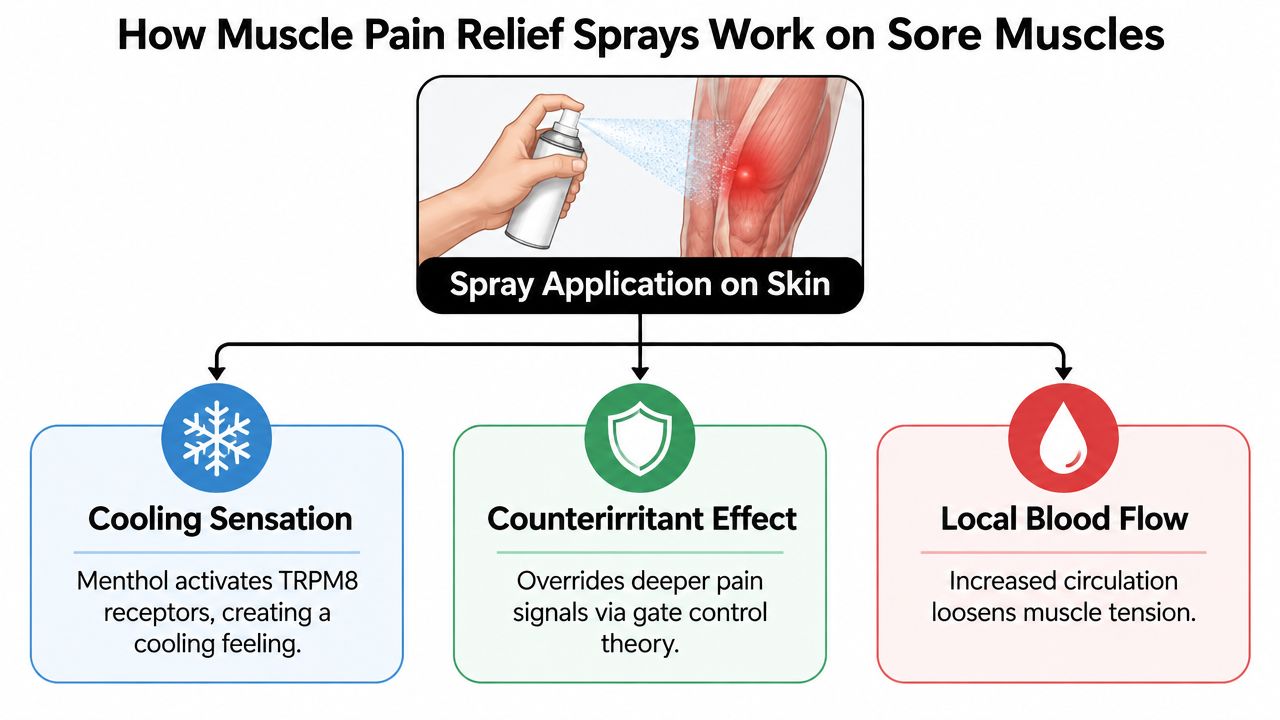
After a long run, a hard training session, or a demanding shift, a spray can make a sore area feel easier to move. Its first target is the skin. Ingredients stimulate sensory nerve endings near the surface, producing cooling, warming, tingling, or burning. The nervous system processes that strong new signal alongside the ache, so the original discomfort may seem less prominent for a while.
Menthol is a familiar example. It activates cold-sensitive receptors, making the skin feel cooler even though its temperature has not changed like it would with an ice pack. This is a sensory effect, not evidence that the spray has reached deep muscle or removed the cause of pain. For a plain-language explanation, see how menthol relieves pain.
Two different paths to comfort
Counterirritants, including menthol, methyl salicylate, and capsaicin, mainly work through sensory modulation. The added sensation can act like a competing sound in a crowded room, making pain easier to notice less. Relief may begin quickly, but a stronger cooling or warming feeling does not reliably show that inflammation has improved or function has returned.
Topical NSAIDs use a different pathway. Ingredients such as diclofenac, ibuprofen, and ketoprofen are intended to provide local anti-inflammatory pain relief. Canadian clinical discussions identify topical NSAIDs as the topical option with the strongest evidence for many musculoskeletal problems, particularly acute sprains and strains. A CMAJ review reported a number needed to treat of 2 for topical diclofenac and 3 for topical ketoprofen when the goal was a 50% reduction in pain within one week for acute sprains and strains. Those results describe the treatments and outcomes studied, not every spray sold in Canada. CMAJ's review of topical pain treatments provides the clinical context.
Application also shapes the result. A sweeping spray can cover a broad, intact area quickly, which may suit mid-activity use or a hard-to-reach spot. Uneven coverage can leave untreated patches, while a stick or roll-on may offer more controlled placement. The strongest sensation still does not prove deeper action or healing. It only shows that surface sensory receptors have been stimulated.
Use the sensation as feedback about comfort, not as a target to intensify. If the product feels sharply painful, irritates the skin, or causes persistent burning, remove it according to the label and stop using it.
Inside the Formula Key Ingredients and Safety Signals
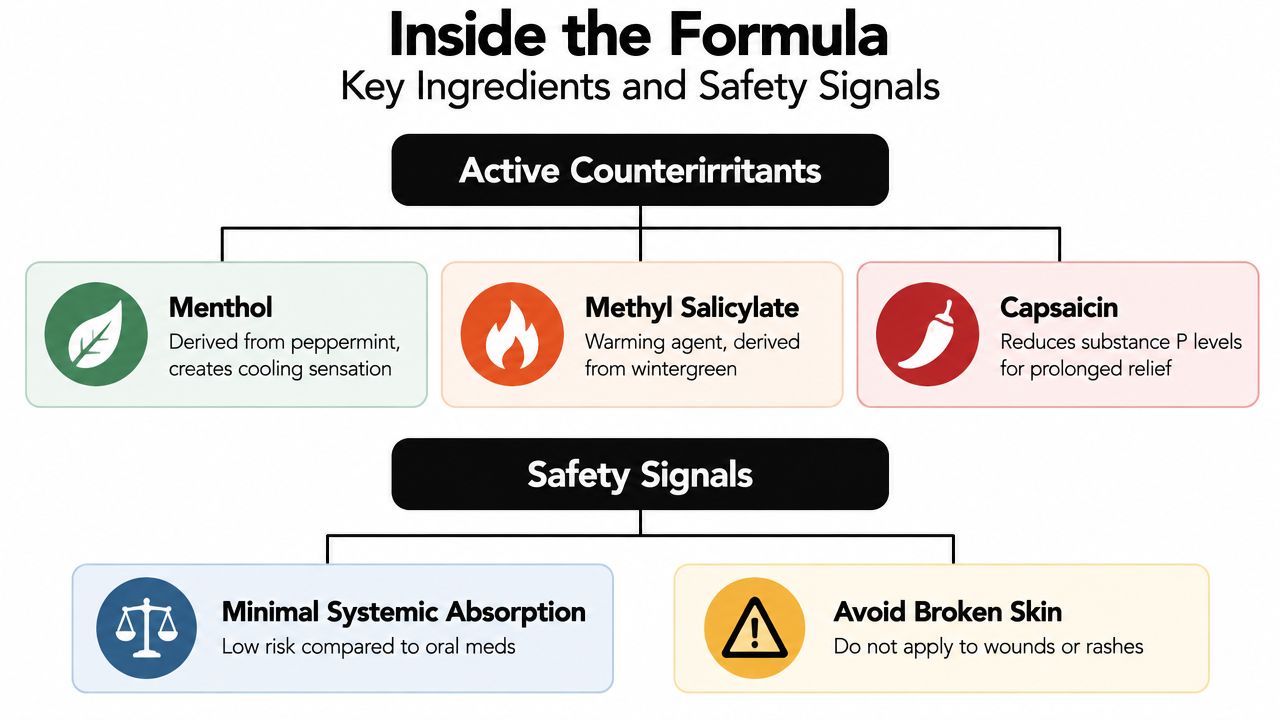
Reading the active ingredients is more useful than judging a product by its smell or how cold it feels. Canadian OTC topical pain relievers commonly include counterirritants such as menthol, methyl salicylate, or capsaicin. Some products use a topical NSAID, such as diclofenac, when local anti-inflammatory action is the intended pathway.
Menthol creates a cooling sensation. Methyl salicylate is associated with warming sensations. Capsaicin can initially feel hot or irritating and is used in topical pain products through a different sensory mechanism. These sensations can distract from discomfort, but they shouldn't be treated as a measurement of dose quality or healing.
Topical NSAIDs deserve separate attention because Canadian guidance identifies topical diclofenac, ibuprofen, and ketoprofen as having the strongest evidence among topical options for relevant musculoskeletal pain. The British Columbia primary-care guidance describes topical diclofenac in concentrations of 1% to 4%, ibuprofen in 5% to 10%, and ketoprofen in 1% to 5%. It also notes that diclofenac is available OTC in Canada at 1.16% to 2.32%. Those ranges apply to the formulations discussed in the guidance, so check the product label rather than assuming that every spray contains an NSAID. The Canadian guidance summary offers additional background.
Safety signals deserve attention
Health Canada's monitoring shows why careful application matters. A 2017 review identified 29 unique Canadian reports of serious skin burns linked to OTC topical pain relievers containing menthol, methyl salicylate, or capsaicin, and 28 reports involved products used as directed. A separate Health Canada safety summary described 21 serious adverse-event cases involving menthol-containing products with concentrations from 0.75% to 11%, with burns, swelling, or blistering sometimes appearing within 24 to 48 hours. See the Health Canada safety review of topical pain relievers.
These findings don't mean topical products are unsuitable. They mean the cooling or warming feeling isn't a safety gauge. Avoid broken or irritated skin, tight coverings, heating pads, overheating, and unnecessary reapplication. If you develop blistering, marked swelling, severe burning, or worsening irritation, stop using the product and seek medical advice.
For readers comparing topical options that may include other active ingredients, this lidocaine with aloe vera overview can help clarify why labels and intended uses matter.
Choosing Your Format Spray Stick or Roll On Compared
The best format depends on the job, not on which package looks most convenient. A spray is usually attractive when you want broad, touch-free coverage. A stick can make sense when you want a product that stays in contact with a smaller area and can be applied without getting liquid on your hands. A roll-on offers precision and a controlled glide, which can be useful around a specific muscle or joint.
Spray vs Stick vs Roll On for Muscle Pain Relief
| Criterion | Spray | Stick | Roll On |
|---|---|---|---|
| Coverage | Useful for wider areas and hard-to-reach locations | More focused coverage | Precise coverage over a defined area |
| Skin contact | May dry quickly, so application must be even | Leaves product directly on the target area | Applies product through repeated rolling |
| Hands-free use | Strong option, especially when touching hurts | Strong option | Strong option |
| Portability | Convenient for a gym bag, clinic, or workplace kit | Compact and less likely to spill | Compact and easy to control |
| Mess control | Can drift beyond the target if sprayed carelessly | Usually contained to the contact surface | Usually contained to the roller path |
| Best practical job | Fast application across broad or difficult-to-reach areas | Longer-lasting targeted application | Cooling, precise application during travel or activity |
A runner applying relief to the back of a shoulder may prefer a spray because reaching the area is awkward. Someone managing a small knee region may prefer a roll-on because precision matters more than speed. A worker applying a product before putting on protective clothing may favour a stick if avoiding airborne mist and transfer is a priority.
A gel remains useful when massage itself is part of the routine and the skin can tolerate direct contact. For a broader discussion of how gels compare as a topical option, explore this sore muscle gel guide.
MEDISTIK offers a fast-acting extra-strength spray, a long-lasting extra-strength stick, and a natural ice roll-on, so the practical distinction is built around different application jobs rather than one universal format. Before choosing, consider how much area you need to cover, whether you can touch the site, and whether you need precision at the bench, in a clinic, or on the road. The roll-on pain relief guide provides more format-specific context.
How to Use Muscle Pain Relief Spray Correctly
A safe application starts with the product label, not a guess based on how much spray seems necessary. Health Canada recognizes non-pressurized, continuous bag-on-valve, and aerosol sprays as distinct spray formats, and each product can have its own directions. Check the active ingredients, warnings, target area, and maximum frequency before the first use.
A practical application routine
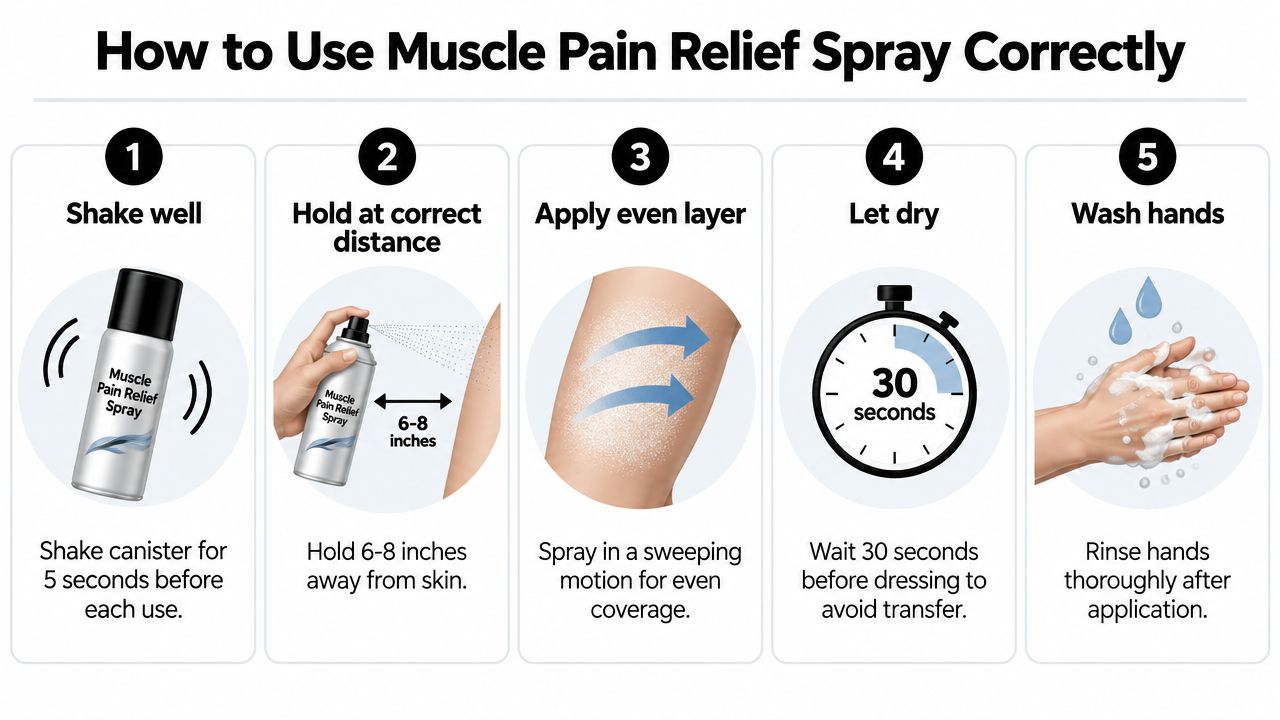
- Prepare the skin. Make sure the area is clean, dry, intact, and free from cuts, rashes, abrasions, or other irritation. Don't apply over a wound or near the eyes, mouth, nose, or other mucous membranes.
- Prepare the container. Shake the product if the label directs you to do so. Hold the container at the distance stated on its packaging. The supplied visual uses 6 to 8 inches as its application example, but the product label takes priority.
- Sweep, don't soak. Apply an even layer over the painful area using a controlled sweeping motion. Start with the label's stated amount, and don't keep spraying because a stronger sensation seems appealing.
- Let the product settle. Allow the area to dry before dressing or returning to activity. This reduces transfer to clothing and helps you notice whether the skin is reacting.
- Clean your hands. Wash your hands thoroughly after application, even if you didn't deliberately rub the product in. This prevents accidental transfer to the eyes or face.
Build it into movement carefully
Before training, use temporary comfort as support for gradual mobility, not permission to ignore a sharp or unstable symptom. During work or sport, stop if pain changes character or function deteriorates. During recovery, combine the product with clinician-approved stretching, mobility, rest, and load management.
Avoid tight bandages, plastic coverings, heating pads, hot baths directly after application, and other sources of intense heat unless a healthcare professional and the product label specifically say otherwise. Don't combine multiple topical pain products over the same area without advice, because you may unintentionally increase irritation or ingredient exposure.
For a practical label-focused refresher, read how to use pain relief spray. If symptoms worsen, skin changes appear, or pain persists beyond what you'd reasonably expect from a minor strain, stop self-treatment and contact a pharmacist, physician, physiotherapist, or other qualified healthcare professional.
What Sprays Can and Cannot Do for Pain Relief
A runner may feel a strong chill from a spray before the muscle itself has changed. “Fast-acting” usually describes how quickly cooling, warming, or numbing reaches your senses. It does not show that tissue is healing faster or that the underlying problem is better controlled. Sensory onset and therapeutic effect are related, but they are different jobs.
A very cold spray can seem more powerful than a milder formula because it stimulates skin receptors intensely. More product can increase exposure without improving comfort in proportion. Health Canada's burn reports make this distinction important for products containing menthol, methyl salicylate, or capsaicin. Follow the label rather than chasing a stronger sensation.
Relief isn't the same as repair
A spray may make a gentle walk, mobility exercise, or work task easier. That comfort does not confirm that a strain is minor, restore damaged tissue, or correct a joint problem. If temporary relief repeatedly lets you push through worsening pain, it may hide the point at which assessment is needed.
Topical NSAIDs may be worth discussing with a pharmacist or clinician when inflammation is a major part of the problem. Canadian evidence summaries found meaningful benefit for acute sprains and strains, while the cited evidence concerns topical NSAIDs rather than every cooling, warming, or numbing spray. Those findings should not automatically be applied to counterirritant products.
The product's job also changes with timing. Before activity, a spray may support a gradual warm-up. During activity, it may offer a portable comfort measure when stopping is not immediately practical. In recovery, it can complement rest, mobility, and load management, but it cannot replace them.
For persistent, widespread, or unexplained pain, a spray should sit within a proper care plan rather than stand in for one. People researching complex conditions may encounter options such as find fibromyalgia stem cell care, but proposed treatments for chronic pain require careful review with a qualified healthcare professional. Review topical pain medications guide to compare broad categories before speaking with a pharmacist or clinician. A spray is a comfort tool, not a diagnosis or complete treatment strategy.
Finding the Right Muscle Pain Relief Spray for You
Choose a format by answering five practical questions:
- What hurts? A temporary ache after activity calls for a different conversation than sudden severe pain, recurring swelling, or unexplained weakness.
- Where is it? Broad or hard-to-reach areas may favour a spray, while a small target may suit a stick or roll-on.
- When will you use it? Warm-up, mid-activity, and recovery create different needs for speed, portability, contact, and precision.
- How does your skin react? Avoid damaged or irritated skin, and stop if burning, swelling, blistering, or significant irritation develops.
- Is the product authorized for its intended use in Canada? Read the label and confirm that the product is intended for temporary topical relief of muscle or joint pain. Don't assume that a compounded formulation has the same status as an authorized commercial product.
MEDISTIK's Canadian-made range includes a fast-acting extra-strength spray, a long-lasting extra-strength stick, and a natural ice roll-on for temporary relief of sore muscles and joints. The company also describes its products as FDA and Health Canada approved, and offers educational pain-management resources and a 100% satisfaction guarantee. Use those details as part of your comparison, alongside the active ingredient, directions, warnings, and the format that matches your main job to be done.
Start with one format for one clear situation, follow the label, and observe both comfort and skin response. If the pain keeps returning, interferes with normal activity, or requires frequent self-treatment, arrange an assessment rather than switching to a stronger sensation.
Try the MEDISTIK fast-acting spray when you need portable, touch-free temporary relief for sore muscles and joints, and compare it with the brand's stick or natural ice roll-on if your routine calls for more targeted application. Visit MEDISTIK to review the formats, read the educational resources, and choose the option that fits your warm-up, activity, or recovery routine.


