

If you’re trying to figure out the best pain relief for back pain, you’re definitely not alone. The truth is, there's no single magic bullet. Real, effective relief usually comes from a smart combination of different strategies. This guide is designed to give you a clear path forward, covering everything from professional care to powerful self-management tools like topical analgesics.
Finding Lasting Relief for Your Aching Back
Back pain is so much more than a physical problem—it's a frustrating disruption to your daily life, your work, and all the activities you love. It’s an almost universal human experience, but finding a solution that actually works can feel like a lonely, confusing journey. Too often, the search for relief leads you down a rabbit hole of conflicting advice, leaving you stuck in a cycle of discomfort.
The reality is that back pain is one of Canada's biggest health challenges. An estimated 7.6 million Canadians—that's one in five people—are currently living with chronic pain. Many report that it seriously gets in the way of their daily activities. This isn't just a minor inconvenience; it's a widespread issue that shows just how badly we need clear, effective, and accessible solutions that do more than just mask the problem for a little while.

Building a Foundation for Effective Relief
Lasting relief isn't about finding one quick fix. It’s about building a solid, multi-faceted approach that combines understanding the root cause of your pain with a proactive plan to manage it. Think of it like building a sturdy house: you need a solid foundation, supportive walls, and a protective roof.
For back pain, this structure looks something like this:
- Professional Guidance: Getting a proper diagnosis from experts like physiotherapists or chiropractors who can figure out what's really going on.
- Lifestyle Adjustments: Making small but meaningful changes like improving your posture, incorporating more movement, and building a stronger core.
- Targeted Self-Care: Using effective tools like topical analgesics to manage pain right at the source, without the systemic side effects that can come with oral medications.
This guide will focus on empowering you with the knowledge to build this very structure. We'll walk through evidence-backed options and explain how targeted, non-systemic solutions like MEDISTIK can become a crucial part of your pain management toolkit.
When you understand how to prepare your muscles for activity, manage pain during movement, and support recovery afterward, you can finally stop chasing answers and start confidently choosing what’s right for you. A great place to start is by exploring this guide on exercises for core stability.
To simplify these concepts, here’s a quick breakdown of the core strategies we'll be discussing.
Key Approaches for Managing Back Pain
| Approach | Description | Best For |
|---|---|---|
| Professional Care | Working with healthcare providers (e.g., physiotherapists, chiropractors) for diagnosis and treatment plans. | Identifying root causes, severe or chronic pain, and creating a structured recovery plan. |
| Lifestyle Changes | Integrating regular movement, ergonomic adjustments, and exercises to strengthen supporting muscles. | Preventing future flare-ups, building long-term resilience, and improving overall wellness. |
| Targeted Relief | Using topical analgesics to manage pain directly at the source with minimal systemic side effects. | Immediate relief from acute pain, managing discomfort during activity, and aiding recovery. |
This table provides a high-level overview, but the real magic happens when you combine these elements into a cohesive plan that works for your body and your life.
The goal is to shift your focus from simply chasing pain to proactively managing it. This means moving with confidence, whether you're at work, playing sports, or just enjoying your day-to-day life.
Our aim here is to give you a clear roadmap. One that helps you make informed decisions that lead to lasting comfort and a better quality of life. Let's start the journey toward a healthier, more comfortable back.
Understanding What Is Causing Your Back Pain
Before you can find real relief for your back pain, you have to play detective and figure out what’s causing it in the first place. Think of your spine as the central pillar of a house. When it’s strong and aligned, everything holds up perfectly. But if any part of that foundation gets compromised—whether from a sudden shock or just years of wear and tear—the whole structure feels the pressure.
That’s a pretty good picture of what’s happening in your back. The pain you’re feeling is an alarm bell telling you something’s off, but the actual cause can be anything from simple to surprisingly complex. Nailing down the source is the single most important step toward finding relief that actually lasts.
The Most Common Culprits Behind Back Pain
For most of us, back pain isn’t from one big, dramatic event. It’s usually the result of all the little stresses our daily lives put on our bodies. These are often called “mechanical” issues, which is just a way of saying they’re about how the different parts of your back—your muscles, ligaments, and bones—are moving and working together.
The most frequent causes usually fall into one of these buckets:
- Muscle or Ligament Strains: This is, by far, the top reason for sudden back pain. It can happen from a quick, awkward twist to grab something off a shelf or from trying to lift a heavy box the wrong way. Even tiny movements can create micro-tears in the muscle fibres.
- Poor Posture: Let's be honest, we're all guilty of this. Slouching at a desk, hunching over a phone, or standing awkwardly for too long puts uneven strain on the spine. Over time, that constant pressure wears down your back muscles, leading to chronic aches and stiffness.
- Lack of Physical Conditioning: If your core and back muscles are weak, they can’t properly support your spine. This leaves you vulnerable to injury from simple, everyday tasks. When your abs are weak, your back muscles are forced to pick up the slack, which leads to them getting tired and sore.
It's also worth remembering that everything is connected. Sometimes, the root cause isn't in your back at all—it could start in your feet. For a deeper dive, check out this information on back pain related to feet to see how your body’s alignment from the ground up plays a huge role.
When the Issue Is More Structural
Sometimes, back pain goes beyond everyday strains and points to a specific condition affecting the spine itself. These problems tend to develop over a longer period and often need a more targeted game plan for management.
Your spine is an incredibly sophisticated structure of bones, discs, and nerves. When any of these components are compromised, it can create a ripple effect of pain and discomfort that impacts every part of your life.
Some of these more structural causes include:
- Bulging or Herniated Discs: The gel-like discs between your vertebrae act as shock absorbers. If one of these discs bulges out or ruptures, it can press on a nerve. This can cause a sharp, shooting pain—often called sciatica if it zings down your leg.
- Arthritis: Just like in other joints, osteoarthritis can affect the small joints in your lower back. As the protective cartilage wears down over time, it leads to pain, inflammation, and that dreaded morning stiffness.
- Spinal Stenosis: This condition is a narrowing of the canal that your spinal cord runs through. That tightening puts pressure on the cord and nerves, which can cause pain, numbness, or weakness, usually in the legs and back.
Acute Pain Versus Chronic Pain
It’s also really important to know what kind of pain you're dealing with, because acute and chronic pain need different approaches. Think of acute pain as a fire alarm—it’s loud, sudden, and warns you of immediate damage. Chronic pain is more like a constant, low buzz in the background that just won’t quit.
- Acute Pain: This is short-term pain, usually lasting a few days to a few weeks. It’s your body's normal, healthy response to an injury like a muscle strain. The goal here is to manage the discomfort, reduce inflammation, and let your body heal.
- Chronic Pain: This is the pain that sticks around for 12 weeks or longer, even after the original injury should have healed. It’s often more complex because the pain signals can get stuck in the “on” position in your nervous system. Learning how pain is processed by the brain can give you some powerful insights into managing these long-term conditions.
By figuring out if your pain is from a simple strain or a structural issue, and whether it’s acute or chronic, you can stop guessing. This knowledge lets you start choosing targeted solutions that actually address the root of your discomfort. It’s your first real step toward getting back to feeling like yourself.
Exploring Evidence-Backed Pain Relief Options
When your back is screaming, the sheer number of treatment options can feel completely overwhelming. The real goal is to cut through all that noise and find what actually works. The most effective strategies are always the ones backed by evidence, tackling the pain from multiple angles by combining professional care with powerful things you can do yourself.

This approach ensures you’re not just putting a temporary band-aid on the symptoms. Instead, you're actively working toward long-term stability and comfort. Let's walk through the spectrum of care, starting with hands-on professional help and then moving to the effective strategies you can use at home.
Professional Interventions for Structural Support
For many types of back pain, especially the chronic kind or pain stemming from a specific injury, getting a professional diagnosis is the non-negotiable first step. Think of these practitioners as expert mechanics for your body—they can pinpoint the root cause of the issue and map out a personalized repair plan.
Three of the most effective hands-on therapies include:
- Physiotherapy: A physiotherapist is focused on getting you moving again and restoring function. They use targeted exercises, specific stretches, and manual therapy to strengthen weak muscles, improve your flexibility, and correct postural imbalances that are feeding into the pain.
- Chiropractic Care: A chiropractor specializes in diagnosing and treating neuromuscular disorders, with a major focus on the spine. Through adjustments, they can help realign the spine, which relieves pressure on nerves and improves your body's overall physical function.
- Massage Therapy: This is so much more than just a relaxation tool. Therapeutic massage gets right into muscle tension, helps reduce inflammation, and boosts circulation to injured tissues. Releasing those stubborn knots and tight spots in the back muscles can provide significant and immediate relief.
These professional treatments lay the foundation for recovery by addressing the underlying structural and muscular problems. But what you do between those appointments is just as crucial for keeping up the progress and managing any flare-ups.
Powerful Self-Management and At-Home Care
Taking control of your back pain means empowering yourself with effective strategies you can use at home. These methods are the perfect complement to professional care, giving you the tools to manage discomfort day-to-day.
One of the cornerstones of self-care is movement. It might feel like the last thing you want to do when you're in pain, but gentle activity is key to preventing stiffness and keeping your supporting muscles strong. Beyond that immediate relief, building up your core and back muscles with targeted routines is your ticket to long-term stability. You might want to consider adding some of the best exercises for back muscles to your routine.
But when pain really strikes, you need a solution that works fast. This is where topical analgesics become an absolute game-changer in your search for the best pain relief for back pain.
The Science of Topical Analgesics
Topical analgesics are simply pain relievers you apply directly to the skin over a sore muscle or joint. Unlike pills that have to travel through your entire digestive system and bloodstream, topicals get the active ingredients right to the source of the pain. This targeted approach means fewer systemic side effects and, often, much faster relief.
Many of the most effective topicals work on a principle known as counter-irritation.
Counter-irritation is like creating a "sensory distraction" for your nervous system. By applying something that creates a mild sensation—like cooling or warming—you give your brain a new, non-painful signal to focus on. This new signal travels along the same nerve pathways, effectively overriding the original pain message before it can even reach your brain.
This whole process is driven by specific active ingredients that have proven their worth for decades. Let's break down the key players:
- Menthol: Derived from mint plants, menthol creates a powerful cooling sensation. When you apply it, it activates sensory receptors in the skin that tell your brain it's feeling cold. That cooling effect is immediately soothing and helps dial down your perception of pain.
- Camphor: This ingredient is interesting because it delivers a one-two punch of both cooling and warming. It first cools the nerve endings, then warms the painful area by increasing blood flow. This boost in circulation helps relax stiff muscles and can speed up the healing process.
- Methyl Salicylate: Often called oil of wintergreen, this is a potent counter-irritant that creates a deep, penetrating warmth. It works by causing the blood vessels to dilate, which ramps up blood flow to deliver more oxygen to the sore area while flushing out pain-causing substances.
By combining these ingredients, a high-quality topical analgesic can launch a multi-pronged attack on your back pain. It interrupts pain signals, reduces inflammation, and promotes healing by increasing circulation—all without you having to swallow a single pill. This makes it an incredibly safe and effective option for managing everything from acute injuries to chronic discomfort.
Why Topical Analgesics Are a Game Changer
When back pain hits, most of us instinctively reach for a bottle of pills. While oral medications can help, they have one major downside: they take the scenic route through your entire body.
Think of it like this: you want to send a package to your next-door neighbour, but instead of walking it over, you call a national delivery service. That package travels across the country and back before it finally lands on their doorstep. It's wildly inefficient, and it involves a lot of systems that have nothing to do with the simple delivery.
That's pretty much how oral pain relievers work. They have to go through your digestive system, get processed by your liver, and circulate everywhere in your bloodstream before they even get close to the source of your pain. This systemic journey can bring on a host of unwanted side effects, from an upset stomach to more serious issues with long-term use.
Topical analgesics, on the other hand, are like a dedicated special delivery service. They bring powerful, pain-relieving ingredients directly to the exact spot where you're hurting, completely bypassing your digestive system. This targeted approach means you get fast relief right where you need it, with minimal impact on the rest of your body.
The Science of Targeted Relief
So, how exactly does rubbing something on your skin manage to stop deep muscle pain? It’s not magic—it's actually some clever science that works by interrupting pain signals before they reach your brain.
When you apply a topical analgesic, its active ingredients sink through the skin and create a distinct sensation, either cooling or warming. This new feeling acts as a powerful distraction for your nervous system. Your nerves get busy processing the sudden feeling of cold or heat, which means they have less bandwidth to transmit the original pain signals.
It's a bit like turning up your favourite song to drown out an annoying noise. The noise is still there, but your brain is focused on the more immediate, dominant input from the music. This is why topicals can feel like they're giving you the best pain relief for back pain almost instantly. They aren't just masking the pain; they're actively jamming the communication lines that create it.
By applying relief directly to the source, you're not just treating the symptom—you're intercepting the pain message before it fully registers in your brain. This targeted action is what makes topicals a powerful tool for both acute flare-ups and chronic management.
The recurring nature of back pain is exactly why we need solutions we can rely on long-term. Chronic back pain in Canada often follows persistent patterns that seriously impact daily life. Research shows that 44% of people with chronic low back pain have been dealing with symptoms for five years or more, and the chances of it coming back within a year can be as high as 80%. This really highlights how crucial it is to have safe, effective options for ongoing management.
Ingredients That Get the Job Done
The power of any topical reliever boils down to its active ingredients. Most formulas combine several key compounds to launch a multi-faceted attack on pain and inflammation.
- Cooling Agents (like Menthol): These create an immediate cooling sensation that calms down irritated nerve endings and gives you that "ahhh" feeling of instant relief.
- Warming Agents (like Methyl Salicylate & Camphor): Known as counter-irritants, these ingredients generate a deep, penetrating warmth. This warmth boosts blood circulation to the area, which helps relax tight muscles and brings in oxygen-rich blood to support healing.
Once you understand the difference between how topical and oral relievers work, it becomes pretty clear why a direct approach is often the better choice. You can learn more by reading about the benefits of a topical pain reliever versus an oral one.
Convenience Meets Effectiveness
Beyond the science, the sheer convenience of modern topicals makes them a true game changer. The days of dealing with messy creams and greasy ointments are long gone. Today's innovative formats are designed for how people actually live, whether you’re at your desk, hitting the gym, or on the move.
- Sticks: These give you a mess-free, hands-free application that’s perfect for zoning in on deep, chronic aches.
- Sprays: A quick spray gives you even coverage over larger areas, making it ideal for fast relief mid-activity.
- Roll-Ons: You get the benefit of targeted application combined with a gentle massage effect, which is excellent for recovery after a workout.
This kind of versatility means you can have powerful, effective relief at your fingertips precisely when you need it. It's this combination of targeted science and practical design that makes topical analgesics an essential part of any modern back pain management plan.
How to Choose the Right Topical Product
With so many topical pain relievers on the shelf, picking the right one for your back can feel overwhelming. But it doesn't have to be complicated. The secret is matching the product to your specific situation, because not all topicals are created equal.
Think of it like a toolkit: you wouldn't grab a hammer to turn a screw. In the same way, the product that helps with nagging morning stiffness isn’t necessarily the best choice for a sharp, sudden muscle spasm during a workout.
To make it simple, we can break down pain management into three key moments: priming your body for activity, performing at your best, and restoring your muscles afterward. This Prime, Perform, and Restore framework helps you grab the perfect tool for the job, every time.
Prime Your Muscles for the Day Ahead
For that deep, chronic ache or the stubborn stiffness that greets you first thing in the morning, you need something that brings powerful, long-lasting warmth. This is the “Prime” phase. The goal here is to warm up and loosen tight, cranky muscles before you even start your day or get moving.
An extra-strength stick applicator is your best bet here. Its solid format lets you apply firm pressure as you go, massaging the active ingredients deep into the muscle tissue. It’s a hands-free way to work out those stubborn knots in your lower back or shoulders, delivering concentrated heat that preps your body for movement and helps fend off injury.
The deep heat from warming ingredients boosts blood flow to the area. This brings in more oxygen and helps flush out the chemical culprits causing your pain, making it a fantastic pre-emptive strike against predictable aches.
Perform with Confidence and Immediate Relief
What about that acute pain that strikes mid-activity? That sudden muscle tweak on a run, or that sharp twinge you feel when lifting something? That’s the “Perform” phase, and it demands a completely different approach—you need fast, on-the-spot relief that won't slow you down.
A fast-acting extra-strength spray is perfect for these moments. It gives you quick, even coverage over larger areas of your back without needing to be rubbed in. This makes it incredibly convenient to apply mid-workout, delivering an immediate cooling and warming sensation that interrupts pain signals so you can refocus and keep going.
Restore Your Body After Exertion
After any kind of physical effort—whether it’s a long day hunched over a desk or an intense session at the gym—your muscles need to recover. This is the “Restore” phase, and it’s all about tackling post-activity soreness and calming inflammation. Here, cooling is your best friend.
This decision guide helps visualize which type of relief is best for different pain scenarios.
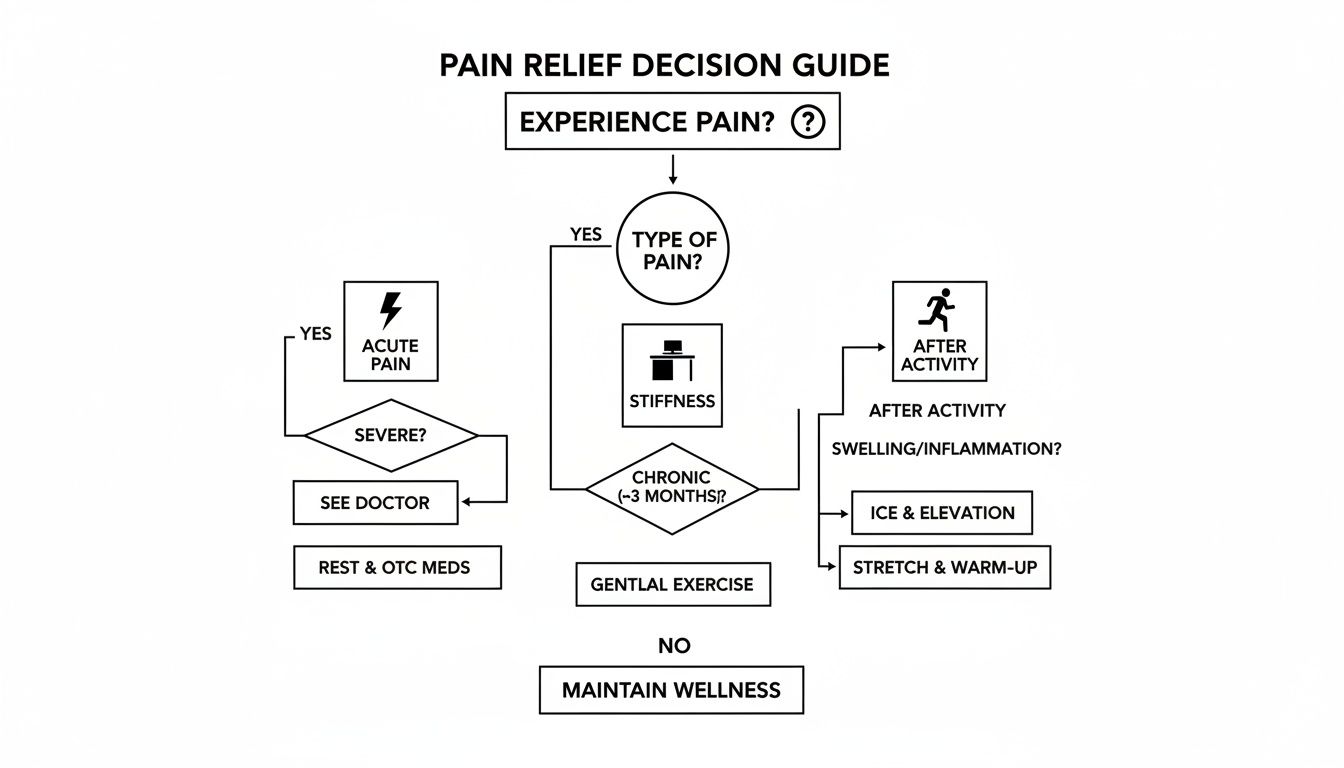
The key is simply to match the product and its formula to the specific timing and type of your pain. When you do that, you get much more effective results.
A cooling roll-on is excellent for this recovery stage. The applicator provides a gentle massage that soothes tired muscles, while the cooling formula works to calm inflammation. It’s ideal for rolling over sore spots on your back to provide targeted, cooling comfort that helps kickstart the recovery process.
By understanding how each format works, you can build a complete system for managing your back pain. This table breaks down how to choose the right MEDISTIK solution for your specific needs.
Choosing Your MEDISTIK Solution for Back Pain
| Product Format | Primary Use Case | Key Benefit | Best For... |
|---|---|---|---|
| Extra-Strength Stick | Prime | Deep, penetrating, long-lasting heat with hands-free massage application. | Chronic pain, morning stiffness, pre-workout muscle warming. |
| Extra-Strength Spray | Perform | Fast-acting, no-mess relief for large or hard-to-reach areas. | Acute pain flare-ups during activity or sports. |
| Roll-On | Restore | Targeted cooling and gentle massage to reduce inflammation and soothe soreness. | Post-workout recovery, muscle strains, general aches. |
Having the right tool on hand means you’re always prepared to tackle back pain—before, during, and after any activity.
Recognizing Red Flags for Back Pain
Knowing how to manage your back pain at home is powerful, but a huge part of self-care is understanding when you’ve hit your limit. Most of the time, back pain is muscular and gets better with some rest and targeted relief.
But sometimes, certain symptoms are your body’s way of telling you something more serious is going on. Learning to spot these “red flags” isn’t about panic; it’s about making sure you get the right help when you actually need it.
Ignoring these signals can mean a delay in diagnosing and treating an underlying condition that won’t get better on its own. By taking a responsible approach, you can confidently handle everyday aches while knowing exactly when it's time to call a doctor.
When to Seek Immediate Medical Help
If your back pain comes with any of the symptoms below, it’s critical to talk to a healthcare professional right away. These signs can point to problems like a serious infection, nerve compression, or other conditions that need more than just at-home care.
Think of these as your body’s emergency alerts:
- Fever or Chills: Pain plus a fever that you can't blame on the flu could be a sign of a spinal infection.
- Loss of Bladder or Bowel Control: This is a major red flag. It may signal severe nerve compression that needs urgent medical evaluation.
- Sudden Numbness or Weakness: If you feel unexplained weakness, tingling, or numbness in your legs, groin, or rectal area, it could mean nerve damage.
- Pain Following a Major Trauma: Back pain that starts after a bad fall, a car accident, or a direct blow needs to be checked out for fractures or other serious injuries.
The economic burden of back pain in Canada is staggering, with healthcare and related costs for low back pain treatment estimated at $6 to $12 billion annually. This highlights why both individuals and providers prioritize effective and appropriate pain management, which includes seeking timely medical care to prevent more complex and costly issues down the road. You can explore more on the financial impact of chronic pain in Canada.
At the end of the day, you know your body best. If your pain is severe, constant, and getting worse instead of better—or if something just feels wrong—trust your gut. The journey to finding the best pain relief for back pain always starts with making sure you're safe and getting the right diagnosis.
Common Questions About Back Pain Relief
When you're dealing with a sore back, you've got questions. And you deserve clear, straightforward answers to help you feel confident about getting relief. Let's tackle some of the most common questions that come up when you're looking for the best way to manage back pain.
We'll cut through the noise and give you practical, easy-to-understand info to guide you on your way back to feeling better.
How Quickly Do Topical Analgesics Work?
One of the best things about a topical analgesic is how fast it gets to work. Unlike pills that need to go through your digestive system first, topicals are applied right to the source of your pain.
How long it takes really depends on the formula. Products packed with cooling agents like menthol can deliver a soothing sensation almost instantly, giving you immediate comfort. If you're using a formula with warming counter-irritants, like methyl salicylate, you'll typically feel that deep, muscle-relaxing warmth build within 10 to 20 minutes. The magic is that the relief is concentrated exactly where you need it most.
Can I Use Topical Relief With Physiotherapy?
Absolutely—in fact, they make a fantastic team. Using topical analgesics can seriously boost the benefits you get from professional treatments like physiotherapy, chiropractic care, or massage therapy. It's all about creating a well-rounded strategy for managing pain.
Think of it like this:
- Before Your Session: Slather on a warming product to help loosen up those tight muscles. This can make your therapeutic exercises less painful and a lot more effective.
- After Your Session: A cooling product can be a lifesaver for managing any soreness or inflammation that pops up after treatment, helping you recover faster.
Just be sure to give your healthcare provider a heads-up about what you're using. That way, your self-care routine and your professional treatment plan are working together perfectly to get you the best possible results.
Partnering topical relief with professional care creates a powerful, around-the-clock approach to managing your back pain. It gives you the ability to support your body's healing process both in the clinic and at home.
Is Daily Use of Topical Pain Relievers Safe?
For most people navigating chronic back pain, using a topical analgesic every day is a safe and effective way to stay on top of the discomfort. Because the ingredients are applied locally, you get to skip the systemic side effects that can come with long-term use of oral pain medications.
That said, it's crucial to always follow the product's specific directions on how often to apply it. If your pain isn't getting better—or if it's getting worse—it's time to check in with a healthcare professional. They can help you build a safe, long-term pain management plan that's right for you.
Ready for a targeted, Canadian-made solution to manage your back pain? Explore the full range of products from MEDISTIK. Find the right format for your needs and start moving with confidence by visiting MEDISTIK.


