

You take your first step out of bed and feel a sharp pull beneath your heel. After a few minutes, it eases, only to return after a long shift or an evening walk. Another person feels the pain behind the ankle after increasing their running, while someone else notices swelling after a twist. These patterns may all be described as heel and ankle pain, but they don't point to the same tissue or require the same response.
Pain location, timing, recent activity, footwear, and work demands provide useful clues. This guide will help you recognise those clues, start sensible self-care, and understand when an assessment matters. It also explains where topical relief may fit, including the broader information in this foot and ankle pain guide, without treating any single product as a substitute for diagnosis or rehabilitation.
Introduction to Heel and Ankle Pain and What Your Pain Pattern Means
A morning first-step pattern often points toward the bottom of the heel, particularly when the pain improves after a little movement. Pain that appears behind the heel during running suggests a different structure, while pain after a sudden twist raises concern for a sprain. The word “heel” describes a region, not a diagnosis.
A useful starting point is to ask four questions:
- Where is the pain? Under the heel, behind it, along the arch, around the ankle bones, or at the side?
- When does it hurt? With first steps, during activity, after activity, at rest, or at night?
- What changed recently? Consider walking volume, running, work shifts, footwear, surfaces, or body-weight loading.
- What else is present? Swelling, bruising, weakness, numbness, redness, fever, or difficulty bearing weight changes the urgency.
Canadian population data show why this deserves attention. In a study of working adults in Quebec aged 18 to 65, 9.4% reported significant ankle or foot pain, with a higher prevalence among standing workers than sitting workers, 13.0% compared with 4.8%. The same source reported pain in 11.0% of women and 8.3% of men overall, and 17.1% of women and 10.8% of men among standing workers (Canadian foot and ankle pain data).
Those figures don't identify the cause in an individual, but they show that heel and ankle symptoms aren't unusual or trivial. A location-based approach helps you avoid two common errors, assuming every heel problem is plantar fasciitis, or assuming every ankle ache only needs more rest.
How Your Heel and Ankle Work Together Under Load
A long shift on hard flooring, a sudden increase in running, or winter footwear with less support can make the same steps feel very different. Your foot is not a rigid platform. It works more like a spring system, spreading force as you accept weight and returning energy as you push off. Several structures share that task, so irritation in one area can raise demand elsewhere.
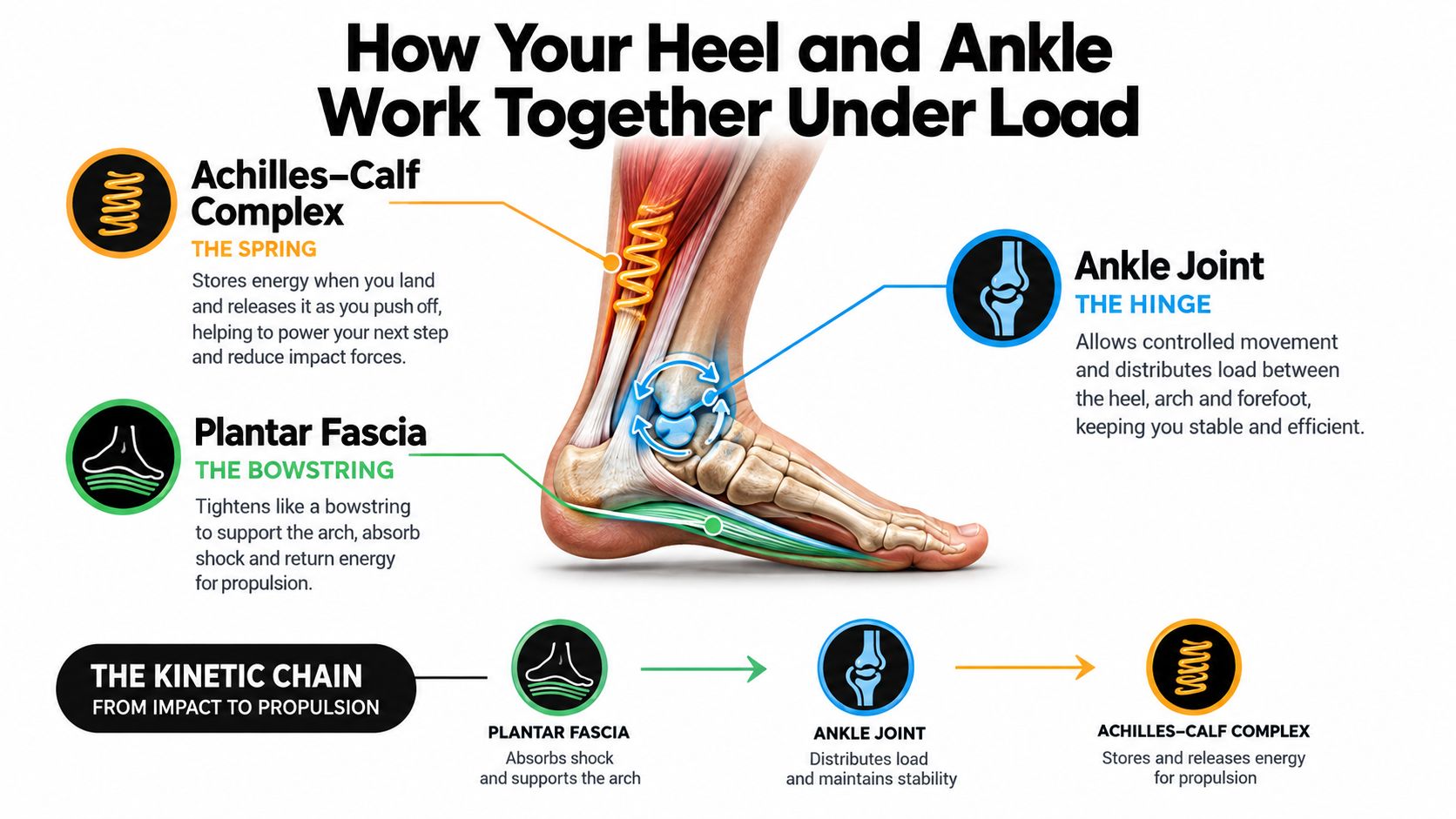
The bowstring beneath the arch
The plantar fascia is a strong band along the sole. It works like a bowstring beneath the arch, helping support the foot as the heel accepts weight, the foot rolls forward, and the toes prepare for push-off. Repeated loading can irritate the tissue near its attachment at the heel.
Foot shape changes how force travels. A high arch, flatter foot, or excessive inward rolling, called overpronation, can distribute pressure differently. None of these features guarantees pain. The same walking, running, or standing demand may challenge different tissues in different people.
The spring at the back
The calf muscles and Achilles tendon act like a spring behind the ankle. They store and release energy during walking, stair climbing, jumping, and running. If the calf is tight or activity rises abruptly, the ankle may have less movement available. The plantar fascia, Achilles tendon, or nearby tissues may then absorb more stress.
Canadian rehabilitation guidance describes plantar fasciitis as a subcalcaneal pain syndrome and lists mechanical contributors such as pes cavus, pes planus, overpronation, a tight gastrocnemius-soleus or Achilles complex, excess weight, prolonged standing, poor footwear, and sudden training increases (Canadian military and rehabilitation guidance on plantar fasciitis).
Practical rule: Pain often reflects a mismatch between what the tissues can currently tolerate and what work, sport, or daily routines demand.
The ankle acts like a hinge, allowing the lower leg to move over the foot while load shifts forward. Limited hinge movement, reduced calf flexibility, or inefficient force sharing can make symptoms appear away from the original irritation. Assessment may therefore consider the calf, knee, hip, walking pattern, footwear, work surface, seasonal activity changes, and training history.
If pain centres on the Achilles region, this guide to kinesiology tape for Achilles tendonitis explains application context. Tape may offer support during activity, but it should complement, not replace, gradual load management and rehabilitation.
Common Causes Behind Heel and Ankle Pain Explained
A warehouse shift, a new running route, or the first long hike of the season can change where pain appears. To narrow the likely cause, map three details together: exact location, timing, and trigger. Under-heel pain that is sharp during the first steps after sleep or sitting often fits plantar fasciitis. Canadian guidance describes plantar fasciitis as the most common cause of adult heel pain, with adult lifetime occurrence of about 10%, a peak presentation between 40 and 60, and bilateral symptoms in one third of cases.
A Canadian clinical review reports that plantar fasciitis accounts for up to 15% of foot injuries in the general population and 17% in the running population. It affects adults of all ages, occurs about twice as often in adult females as in males, and commonly peaks between 40 and 60 years, with bilateral involvement in about one third of cases (Canadian heel-pain clinical review).
Match the pattern before choosing treatment
| Pain Location | Likely Cause | Typical Trigger | Key Clue |
|---|---|---|---|
| Bottom or inner underside of the heel | Plantar fasciitis | Increased walking, running, standing, or unsupportive footwear | First-step pain after sleep or sitting |
| Behind the heel or along the lower calf | Achilles tendon irritation | Running, jumping, hills, or a sudden training increase | Pain with tendon loading or push-off |
| Inner ankle and arch | Posterior tibial tendon problem | Prolonged walking, standing, or repeated loading | Arch discomfort with reduced support or control |
| Around the ankle after a twist | Sprain | Uneven ground, sport, or a misstep | Swelling, bruising, tenderness, or instability |
| Broad ache in the joint or underside of the heel | Arthritis or fat-pad pain | Sustained compression, age-related change, or hard surfaces | More persistent ache, often without a classic first-step pattern |
Use the table as a sorting tool, not a diagnosis. A sprain usually follows a clear injury event, while tendon irritation can build gradually as repeated work, sport, or seasonal activity exceeds current tolerance. Arthritis may cause joint stiffness and aching. Calcaneal fat-pad pain can feel deep and bruised beneath the heel, especially when hard flooring repeatedly compresses the area.
Location changes the next step. Plantar fasciitis does not explain every complaint under the heel. Canadian guidance distinguishes under-heel fascia pain from behind-heel Achilles symptoms and arch pain linked with posterior tibial tendon problems. It also notes limited evidence for specific nonoperative treatment of calcaneal fat-pad pain, so persistent or unusual symptoms warrant individual assessment (Canadian guidance on plantar heel pain).
For practical under-heel options, review this heel pain relief resource, then compare its suggestions with your precise pain location, footwear, work surface, and recent change in walking or training load.
Symptom Patterns Diagnosis Clues and Red Flags to Watch For
Your symptom diary doesn't need to be complicated. Write down the precise location, what time of day symptoms peak, whether the pain changes with movement, and what happened during the previous day. Include work shifts, running or walking changes, new shoes, a twist or fall, and whether one or both feet are affected.
Clues that change the likely explanation
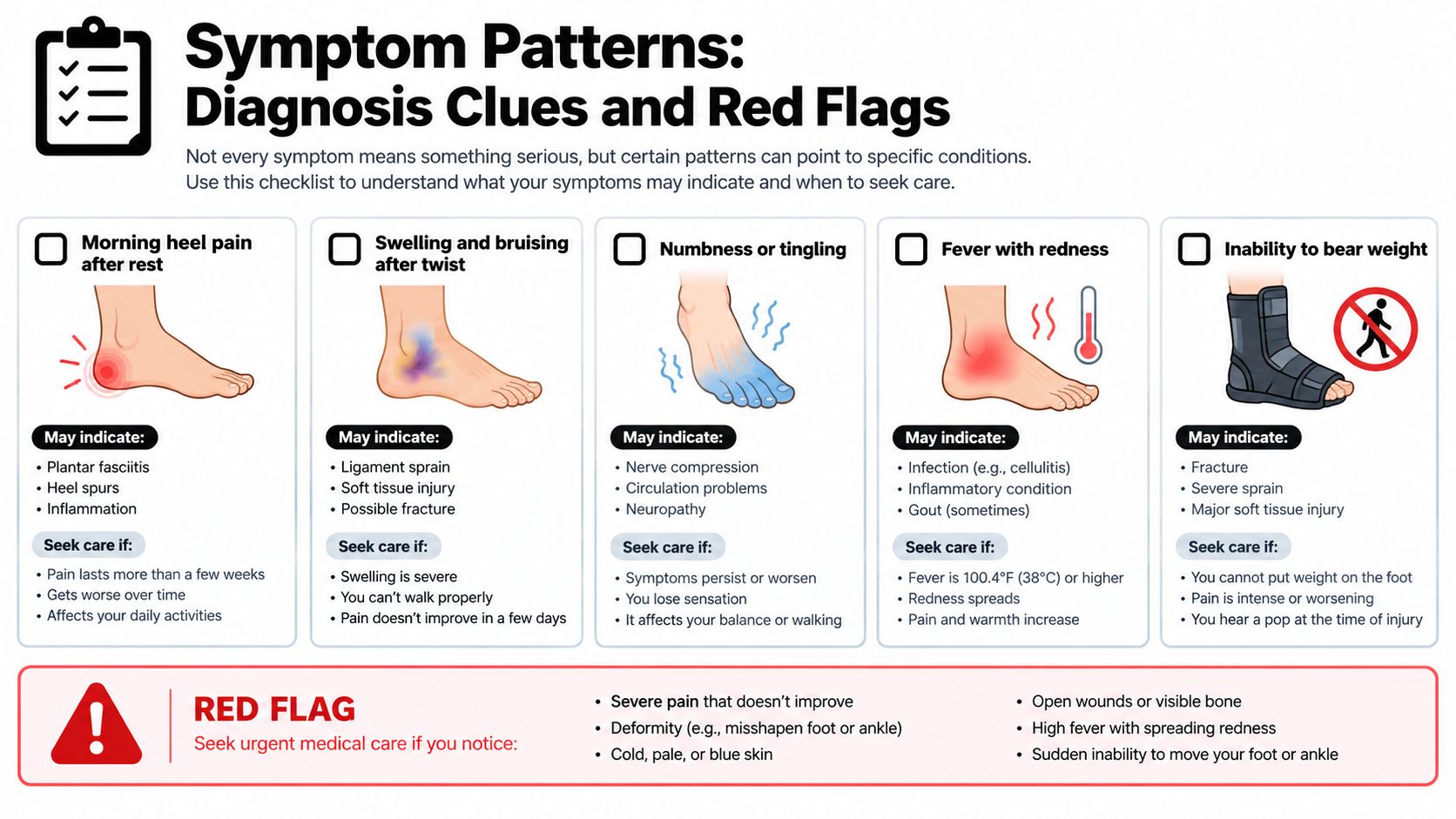
Morning pain under the heel often fits plantar heel pain, particularly when the first steps are sharp and symptoms settle somewhat with movement. Pain behind the heel during push-off shifts attention toward the Achilles tendon. Arch pain may involve the posterior tibial tendon or another part of the foot's support system.
Swelling and bruising after a twist make a sprain more likely than a gradual overuse problem. Repeated ankle “giving way” also matters because ongoing instability can keep irritating the joint and surrounding tendons. Numbness, burning, or pins-and-needles suggest possible nerve involvement and shouldn't be managed as routine plantar fasciitis without assessment.
A clinician will usually compare both sides, check tenderness and swelling, assess ankle movement and calf flexibility, observe walking, test strength and balance, and ask about work and training loads. Imaging isn't automatically required for every heel or ankle complaint, but it may be considered when the history or examination raises concern for a fracture, significant tendon injury, arthritis, or another condition.
When not to wait
Seek prompt medical care if you can't bear weight, the ankle or foot looks deformed, swelling or bruising is rapidly worsening, or severe pain began with a pop, fall, or direct injury. Fever with a hot, red, swollen area also needs urgent attention. Numbness, new weakness, or pain that is severe at rest or wakes you should be assessed rather than repeatedly treated with home remedies.
For milder, clearly load-related symptoms, a short period of measured self-care is reasonable. Arrange an appointment with a physician, physiotherapist, podiatrist, or chiropractor when pain persists, keeps returning, changes your walking pattern, or fails to improve despite consistent modifications.
Evidence Based Self Care and Rehab Steps You Can Start Today
Recovery usually works better as a progression than as complete inactivity followed by a sudden return to normal. The aim is to reduce irritating load while maintaining enough movement and strength for the tissues to adapt.
Start with mobility
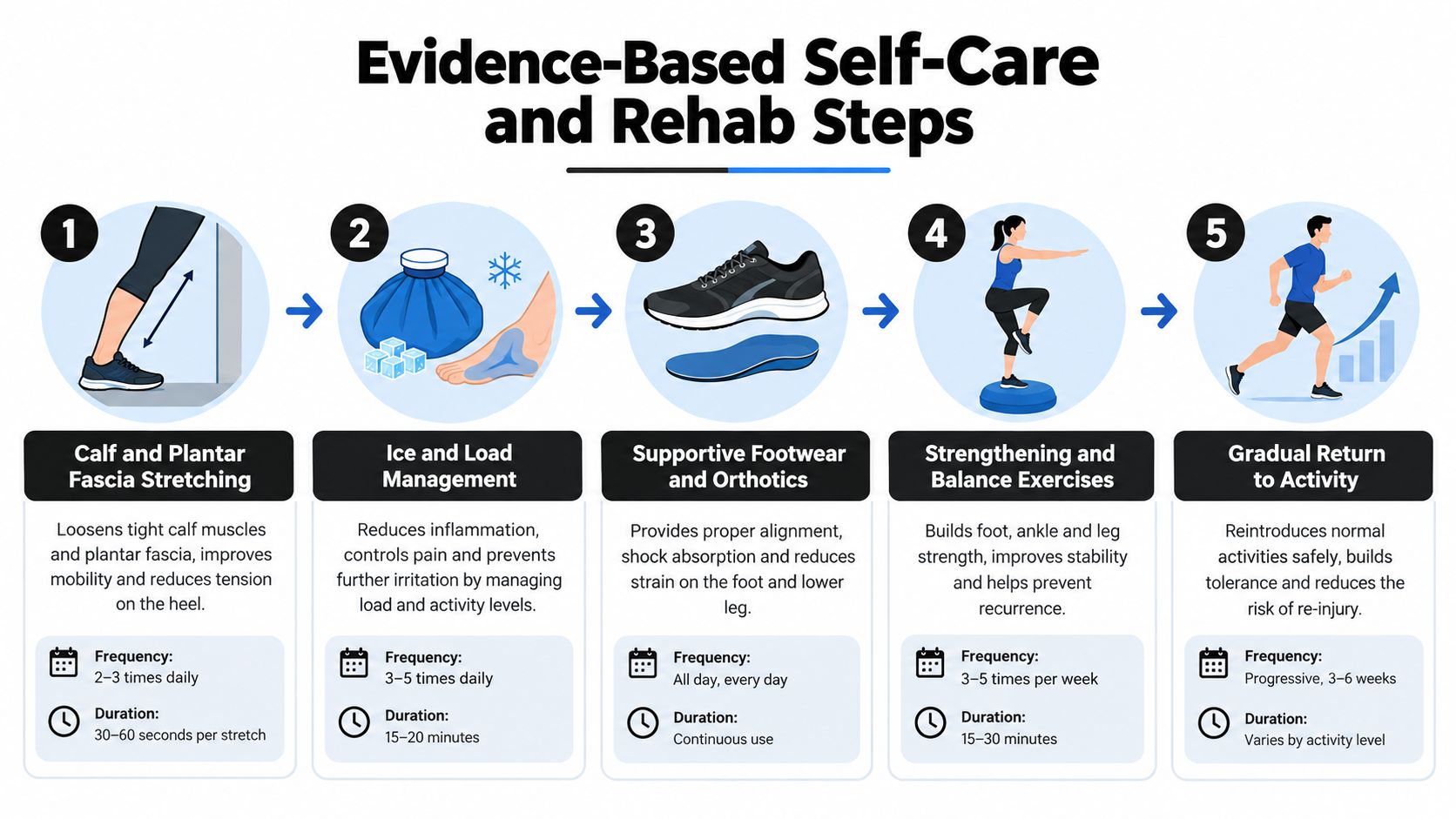
Before getting out of bed, gently move the ankle through comfortable up-and-down motions. Then use a calf stretch with the knee straight to address the gastrocnemius, followed by a bent-knee version for the deeper calf muscle. Add a plantar-fascia-specific stretch by crossing the affected foot over the opposite knee and gently drawing the toes back until you feel a mild stretch along the sole.
The sensation should be controlled, not sharp. Daily consistency matters more than forcing a dramatic range of motion. If the exercise produces a clear increase that lasts into the next day, reduce the intensity or ask a clinician to adjust the programme.
Manage the load, not every movement
Temporarily reduce the activity that clearly provokes symptoms, such as hills, sprinting, jumping, or long walks on hard surfaces. You can often maintain conditioning through a better-tolerated option, but the substitute should not reproduce the same pain pattern. Increase activity gradually once ordinary walking feels easier and your next-day response remains stable.
Ice may provide short-term comfort after activity. A wrapped cold pack or cooling roll-on can be used briefly, with a cloth barrier to protect the skin. Topical analgesics may help you move more comfortably, but they don't restore tendon capacity, correct footwear problems, or replace progressive strengthening.
Add support and strength
Wear supportive shoes with cushioning and a stable, comfortable sole during the recovery period, including at home if hard floors aggravate symptoms. An over-the-counter insole may help distribute load, while custom orthotics are more appropriate when a clinician identifies a specific mechanical need. Avoid assuming that the most rigid or expensive insert is automatically the right choice.
Once pain is settling, add controlled calf raises, foot-strengthening work, and single-leg balance as tolerated. Strength builds the capacity that stretching alone can't provide. A physiotherapist can adjust the range, repetitions, and progression for plantar fascia, Achilles, posterior tibial tendon, or ankle-sprain rehabilitation.
Use these ankle sprain home remedies only for a straightforward, mild injury without red flags. If swelling, bruising, instability, or weight-bearing difficulty is substantial, self-care shouldn't delay an examination.
A demonstration can help you check technique and understand the sequence:
Prevention Strategies for Work Sport and Everyday Life
Heel and ankle pain often follows a change in load rather than one dramatic event. A retail worker, nurse, tradesperson, runner, or older walker may face a different combination of standing, walking, hard surfaces, footwear, and recovery time. Prevention works best when those daily demands are tracked like training.
Canadian occupational evidence links longer periods of standing or walking with greater plantar fasciitis risk. One workers' compensation review reported that each additional 10% of time standing or walking was associated with a 52% higher risk (Canadian occupational review of plantar fasciitis risk). The practical lesson is to plan support and recovery before symptoms force you to stop working.
Make work less repetitive
Use brief movement breaks when your workplace permits them. Alternate standing with walking or sitting, change position before discomfort rises, and wear footwear that stays supportive through the entire shift. A cushioned surface can soften hard flooring at a workstation, but it works alongside suitable shoes, calf mobility, and sensible workload changes.
Build general strength and conditioning gradually. Canadian musculoskeletal data describe a substantial disability burden, including low back pain affecting 15.5% of Canadians and osteoarthritis affecting about 3.9 million Canadians aged 20 and older, with 219,000 new diagnoses in 2016 to 2017 (Canadian musculoskeletal and osteoarthritis data30672-7/fulltext)). Heel symptoms may therefore occur alongside broader movement or joint problems, rather than in isolation.
Plan for seasonal changes
Seasonal patterns can expose a mismatch between tissue capacity and activity. Canadian search behaviour showed statistically significant seasonality for “plantar fasciitis” and “heel pain,” with peaks in summer. Warmer weather may increase walking, running, gardening, travel, and recreational sport. Raise one demand at a time, add recovery days when needed, and do not treat a pain-free winter as proof that your feet are ready for an abrupt summer workload.
When to Consider Topical Analgesics and When to Seek Clinical Care
Topical analgesics can be useful when soreness makes ordinary movement uncomfortable, particularly before a shift, during activity preparation, or after exercise. They offer temporary symptom relief at the skin and superficial tissue level, but they won't identify whether the problem involves the plantar fascia, Achilles tendon, a sprain, arthritis, a nerve, or the heel's fat pad.
MEDISTIK offers Canadian-made topical formats, including a long-lasting extra-strength stick, a fast-acting extra-strength spray, and a cooling ice roll-on. Used as one part of a broader plan, these formats can support temporary relief while you continue appropriate footwear, load management, mobility, and strengthening. Review topical pain medication considerations and follow the product label, especially if you have sensitive skin, allergies, or other medical concerns.
Topical numbing products are a separate category, so application, ingredients, and safety instructions matter. For general background on how these products are used, consult this clinic guide to numbing cream. Don't apply a product to broken skin or use it to push through severe pain that is changing your gait.
Arrange clinical care for persistent or recurrent symptoms, bilateral pain that keeps returning, unexplained night or rest pain, or symptoms that limit work and exercise. Seek urgent attention for inability to bear weight, deformity, rapidly increasing swelling, major bruising after trauma, fever with redness, numbness, or sudden severe pain.
MEDISTIK provides portable topical relief options for sore muscles and joints, including formats suited to preparation, activity, and recovery. Visit MEDISTIK to explore the products and educational resources, then pair temporary relief with a location-specific rehabilitation plan or professional assessment when symptoms persist.


