

You've been at your desk for hours, shoulders drifting forward as you work. When you finally stand, a sharp or aching sensation sits between your shoulder blades. It may ease when you move, then return when you lift, reach, rotate, or settle back into the same position. That pattern often points to an irritated mid-back pain muscle, but the thoracic region deserves more careful attention than a simple “bad posture” explanation.
The middle back supports the ribs, shoulders, and upper body while helping you rotate and maintain an upright position. This guide explains the muscles involved, practical self-assessment, gentle exercises, symptom-relief options, prevention strategies, and the warning signs that mean you should seek medical care.
Understanding Mid Back Pain Muscle Discomfort
A person who spends most of the day seated may notice mid-back discomfort gradually rather than after one obvious injury. The first sign could be stiffness when reaching for a coffee mug, soreness after driving, or a tight band beside the spine at the end of a workday. Someone who lifts boxes, cares for children, rows, swims, or repeatedly works overhead may feel the same region become painful after a specific movement.

The thoracic spine is the middle portion of the back, between the neck and lower back. It connects with the ribs, so it's more stable and less freely mobile than the cervical and lumbar regions. That stability helps protect the chest and support the trunk, but it also means the muscles around the shoulder blades and spine may compensate when you stay still, reach awkwardly, or repeat the same task.
Mid-back pain can involve the multifidus, erector spinae, rhomboids, trapezius, intercostals, and other paravertebral muscles. These tissues help position the shoulder blades, steady the ribs, and control thoracic movement. An irritated muscle may feel sore to touch, tight during rotation, or painful when it contracts against resistance.
Why the region is easy to overlook
People often search for neck or lower-back advice because those areas are discussed more frequently. Pain between the shoulder blades can therefore be dismissed as ordinary tension, even when it affects sleep, work, exercise, or lifting. Canadian occupational data show that back-related work disorders remain clinically meaningful, although the available categories don't isolate thoracic muscle pain from other back conditions. Canadian occupational-health data provide useful context for why physically demanding work and repetitive loading deserve attention.
A useful starting point is to ask what changes the symptom. If gentle movement improves stiffness and pressing or contracting a nearby muscle reproduces the discomfort, a mechanical source becomes more plausible. For additional background on how muscles become painful, see this guide to common muscle pain causes.
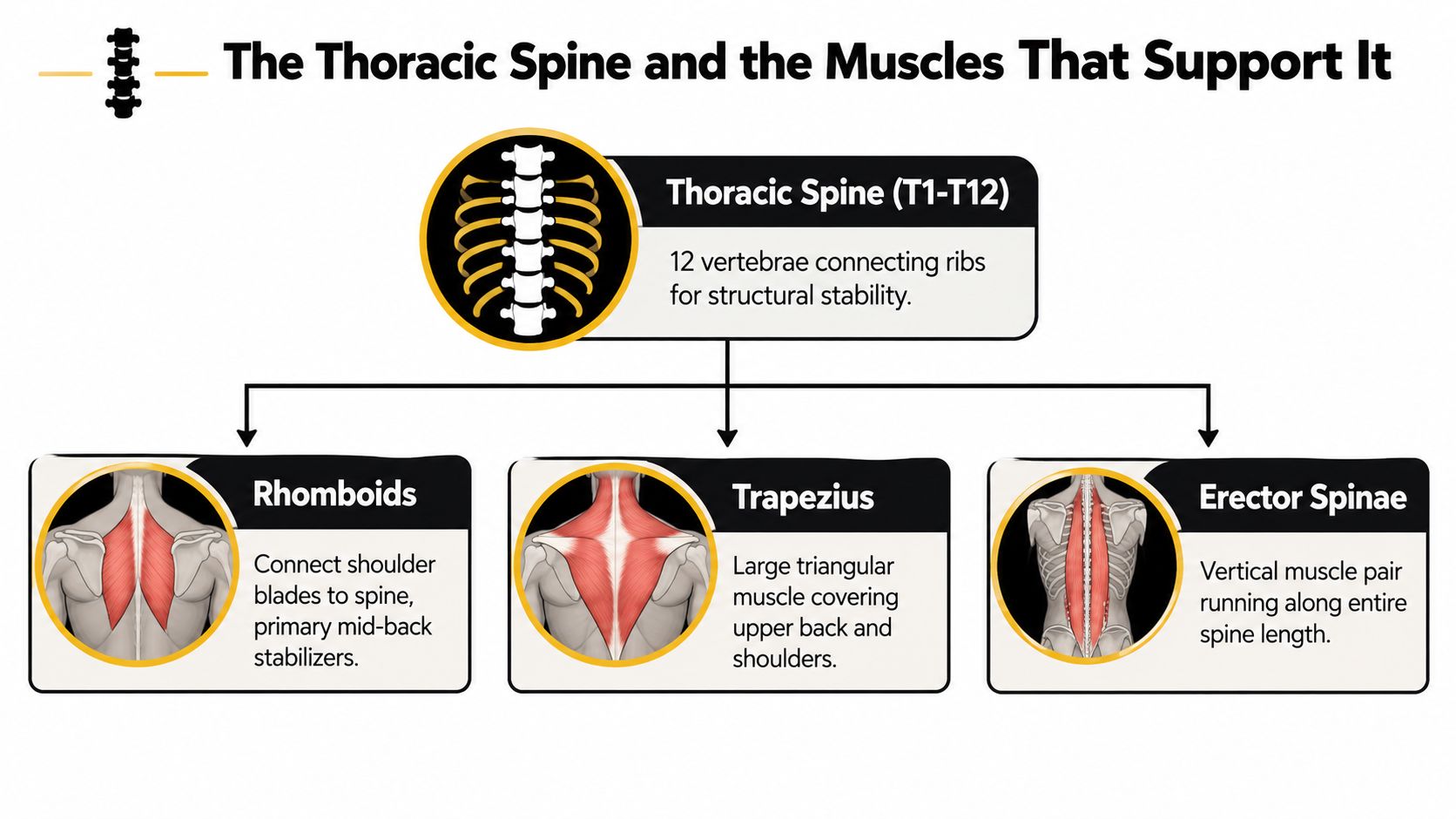
The Thoracic Spine and the Muscles That Support It
The thoracic spine acts like a rib-connected tent pole. The vertebrae provide the central frame, while surrounding muscles work like tension ropes that keep the trunk steady and guide movement. If one group stays active for too long, it can become fatigued, tender, or protective, particularly when the shoulders remain rounded or the trunk repeatedly twists.
The thoracic region contains twelve vertebrae joined to the ribs. These rib connections limit excessive motion, giving the area stability, while still allowing extension, rotation, bending, breathing, reaching, and controlled shoulder-blade movement.
The main stabilisers
- Multifidus and paravertebral muscles: These smaller muscles sit close to the spine and control movement between individual segments. Like short anchor lines on the tent, they may become tender when the trunk handles load or movement is guarded.
- Erector spinae: This vertical muscle group works like the main guy-lines, helping extend and steady the spine during lifting, upright sitting, prolonged standing, and athletic movement.
- Rhomboids: Located between the shoulder blades and spine, the rhomboids draw the shoulder blades back and support controlled scapular motion.
- Trapezius: This broad upper-back muscle helps lift, lower, rotate, and stabilise the shoulder blade through its different portions. For targeted work on this area, see these trapezius muscle pain relief exercises.
- Intercostals: These muscles fill the spaces between the ribs and assist rib movement during breathing. Irritation here may feel different from typical tension around the shoulder blades.
Clinical assessment guidance recommends checking the spinous processes and paravertebral muscles for tenderness, deformity, and spasm, then examining thoracic movement and strength. Thoracic spine assessment guidance supports a practical principle: pain reproduced by palpation, resisted trunk or scapular movement, or thoracic rotation may support a muscular or mechanical explanation. It cannot confirm that explanation by itself.
Practical rule: A muscle works within a connected system. Shoulder position, rib movement, breathing, trunk control, and workload can all change how the mid-back feels.
During strengthening, avoid chasing a hard contraction or forcing the shoulder blades together. Controlled endurance is the goal, allowing the stabilising muscles to share the workload instead of tightening defensively.
Common Causes and Self-Assessment Guidance
Mid-back muscle pain often follows a mismatch between load and capacity. A long period of slouched sitting can keep the thoracic extensors active at low intensity. Repetitive lifting, forceful reaching, sudden rotation, or unfamiliar exercise can then add a larger demand to already tired tissues.
Use movement as information
Self-assessment should be gentle. Sit or stand comfortably, then note the location and quality of the pain before trying a few controlled checks:
- Palpate beside the spine. With light pressure, compare the tender muscles on both sides. If pressing the paravertebral area reproduces a familiar, local ache, the muscle may be contributing.
- Rotate slowly. Turn the trunk to each side without forcing the range. A symptom that changes predictably with thoracic rotation suggests a mechanical component.
- Test a shoulder movement. Gently draw the shoulder blades back or perform a light resisted movement. Pain that appears with scapular loading can implicate the rhomboids, trapezius, or related stabilisers.
- Observe the pattern. Mechanical discomfort commonly changes with posture, movement, pressure, or activity. It may settle when the load is reduced.
These observations help you choose a cautious next step, but they aren't a diagnosis. A tender muscle can coexist with joint, nerve, rib, or referred pain, and symptoms can be misleading.
Consider the whole situation
Ask whether the discomfort began after a new task, a fall, a collision, a heavier workout, or a period of sustained posture. A gradual onset after repetitive work points toward a different management plan than pain after significant trauma. California labour data show that work-related back and trunk conditions can require job transfer or restriction, reinforcing the importance of taking work-limiting symptoms seriously. California workplace injury data/2023-2024Table15-PrivateIndustry.html) don't separate thoracic muscles from lumbar structures, so they shouldn't be used as a mid-back prevalence estimate.
If symptoms are persistent, progressively worsening, or interfering with normal activity, arrange an assessment with a physician or physiotherapist. Don't keep testing the painful movement repeatedly, and don't use temporary relief to push through a load that clearly aggravates the area.
Targeted Stretches and Strengthening Routines
Start with mobility that feels easy rather than intense. A mild stretch or gentle stiffness is acceptable, but stop if you develop sharp pain, spreading symptoms, dizziness, breathing difficulty, or new numbness.

Open the front before loading the back
Doorway chest stretch: Place your forearms on a doorway with elbows comfortable below shoulder height. Step forward until you feel a stretch across the chest and front of the shoulders. Keep the ribs relaxed instead of arching the lower back, breathe slowly, and hold a comfortable position before stepping back.
Seated thoracic rotation: Sit with both feet supported and hands across your chest. Rotate through the upper and middle back while keeping the pelvis mostly still. Return to centre, then rotate the other way. Move slowly and avoid pulling yourself farther with your arms.
Child's pose with side reach: From a kneeling position, sit the hips toward the heels and reach the arms forward. Walk both hands slightly to one side to lengthen the opposite side of the mid-back, then change sides. Keep the movement comfortable, particularly if kneeling or deep flexion increases symptoms.
You can use the following video as a visual reminder for controlled mobility. It shouldn't replace an individual assessment if your pain is severe or unclear.
Build endurance gradually
Once mobility feels comfortable, add low-load control work:
- Scapular retractions: Sit or stand tall and gently guide the shoulder blades back and slightly down. Don't shrug or pinch hard. Pause briefly, then release fully.
- Prone Y raises: Lie face down with arms angled overhead in a relaxed “Y.” Lift the arms only as far as you can without arching the lower back or tightening the neck. Lower with control.
- Bird-dog: From hands and knees, brace gently and extend one arm with the opposite leg. Keep the trunk level, then return slowly. Reduce the range if your back twists or your shoulder hikes toward your ear.
Begin with a small, tolerable amount of each exercise and increase only when the next day feels no worse. A physiotherapist can adjust technique, range, and loading; the Longevity Medical Institute rehab guide offers additional rehabilitation context. For related guidance, see upper-back strain relief.
Topical and Symptomatic Relief Options
Pain relief can make movement more comfortable, but comfort isn't the same as recovery. A cooling product may reduce the perception of heat or irritation, while a warming formula may feel soothing to a tight area. Neither option should be used to ignore increasing pain, resume full activity immediately, or replace assessment when symptoms don't follow a reassuring pattern.
A practical routine pairs symptom management with a manageable activity. For example, you might use a topical analgesic before gentle mobility, take a short walk instead of remaining still, then use comfortable recovery measures afterward. Follow the product label, avoid broken or irritated skin, and check with a pharmacist or clinician if you have medication, allergy, pregnancy, or skin-sensitivity concerns.

Match relief to the task
A topical stick or spray can be useful when reaching the mid-back is difficult, while a roll-on may suit smaller areas or a cooling sensation after activity. MEDISTIK offers an extra-strength stick, an extra-strength spray, and a natural ice roll-on for temporary relief of sore muscles and joints. Use any topical product as one part of a plan that also includes load modification, mobility, and progressive strengthening.
Over-the-counter pain relievers may be appropriate for some adults, but suitability depends on health history, other medicines, allergies, and the specific product. A pharmacist can help you choose safely rather than assuming an anti-inflammatory is suitable for everyone.
Nutrition doesn't replace rehabilitation, but regular meals, hydration, and adequate recovery support general activity tolerance. For broader dietary ideas, the Gym Snack nutrition blog discusses foods commonly considered in an inflammation-conscious eating pattern. You can also review practical guidance on topical pain relief for back pain.
Prevention Strategies for Different Lifestyles
Prevention works best when it fits the activity that loads your thoracic muscles. A desk worker, swimmer, warehouse employee, and caregiver may all develop pain between the shoulder blades, but they need different changes to reduce repeated strain.
For desk workers
Set the screen so you aren't constantly looking down, keep the keyboard close enough to avoid reaching, and let the chair support an upright position. Change posture frequently instead of trying to hold one perfect posture all day. Small shoulder-blade movements, standing, and brief walking breaks can interrupt sustained loading.
Don't wait for pain to become severe before adjusting the workstation. If symptoms appear near the end of each workday, treat that timing as useful information about cumulative demand.
For athletes
Warm up with controlled thoracic rotation, shoulder movement, and sport-specific patterns before high-force work. Include scapular endurance and trunk control in training, then increase volume or intensity gradually rather than combining a new exercise with a sudden increase in total workload.
A rower, tennis player, or lifter may need to examine repeated rotation, pulling, overhead work, or technique under fatigue. Recovery days should include comfortable movement, not necessarily complete inactivity.
For physically demanding workers
Use the strongest available position for lifting. Keep the load close, coordinate the legs and hips with the trunk, and avoid repeated twisting while carrying. When a task requires reaching or working overhead, alternate positions where possible and report work that repeatedly produces symptoms.
Canadian occupational data estimated that 8.9% of Canadian workers aged 16 and older developed a chronic back problem over a two-year period, representing more than one million new cases. Incidence was similar in men and women and exceeded 10% among workers aged 40 to 49, according to Statistics Canada occupational-health analysis. The figures combine back regions, but they show why prevention and early load modification matter across working life.
Red Flags and When to Seek Medical Attention
Most movement-related muscle discomfort can be approached conservatively, but mid-back symptoms shouldn't automatically be labelled muscular. Thoracic pain can be mechanical, referred from another area, or related to a non-musculoskeletal condition. Canadian clinical guidance emphasises red-flag screening, distinguishing mechanical from visceral causes, and avoiding routine imaging when red flags are absent. Clinical guidance for cervical and thoracic disorders is written for clinicians, but its safety principle is useful for self-management.
Seek prompt medical evaluation if you have:
- Night pain: Pain that repeatedly wakes you or doesn't settle in a position.
- Systemic symptoms: Fever, unexplained weight loss, or feeling unusually unwell.
- Neurological changes: New numbness, weakness, altered coordination, or other changes in the limbs.
- Significant trauma: Symptoms after a substantial fall, collision, or direct impact.
- Progressive worsening: Pain that continues to intensify despite reducing the load and trying gentle care.
- Chest or breathing symptoms: Chest discomfort, shortness of breath, or pain that doesn't behave like a local muscle problem.
If your pain is mainly local, changes with movement, and gradually improves with sensible activity modification, a physiotherapist can help confirm the movement pattern and build a progression. For symptoms focused on the right side, mid-right back pain guidance can help you identify questions to raise with a healthcare professional.
Start with the basics: notice the pattern, reduce the aggravating load, keep movement comfortable, and rebuild endurance gradually. Escalate early when the pattern is unclear, worsening, or accompanied by warning signs.
MEDISTIK offers Canadian-made topical sticks, sprays, and a cooling roll-on for temporary relief of sore muscles and joints, including discomfort around the mid-back. Visit MEDISTIK to explore options that can support comfortable movement alongside appropriate exercise, recovery, and professional care.


