

You finish a workout, climb the stairs, or get up from the garden bed, and the same thought hits you. Your back is tight, your knee is cranky, or your calf feels like it has seized around a knot. At that moment, a muscular pain relief cream looks simple, local, and fast, which is exactly why so many people reach for one first.
The catch is that not every cream works the same way, and not every sore spot needs the same ingredient. Some products mainly create a cooling or warming distraction, while others target inflammation in the tissue. If you want relief that helps you move better without guessing, the practical question is not just which tube to buy, it's what kind of pain you're trying to calm.
The Moment You Reach for a Cream
A runner rubs a calf after a hard hill session. A parent straightens up after raking leaves and feels a twinge across the lower back. A senior grips the rail on the stairs and notices the familiar ache in a knee again. In real life, people reach for a cream because they want to get back to walking, training, working, or sleeping with less friction.
A muscular pain relief cream can be useful for short-term, localised discomfort. It will not rebuild tissue, fix a torn structure, or solve every pain pattern. The goal is narrower, less pain, easier movement, and a better next hour.
Practical rule: if the pain is local and the skin is intact, a topical may be worth trying. If the pain is spreading, worsening, or linked to red-flag symptoms, the cream should not be the whole plan.
Clinicians use that same split between symptom control and treatment. A cream can help you tolerate movement while the underlying cause is assessed or settles, but it is not a diagnosis. Canada's chronic-pain burden makes that distinction matter, because pain often lasts far longer than a single strain or workout flare-up. Topical products work best with realistic expectations rather than hope alone. Health Canada's Canadian Pain Task Force report describes that broader pain context.
For readers who want a deeper primer on topical formats, this recovery cream overview is a useful companion read.
What a Muscular Pain Relief Cream Actually Does
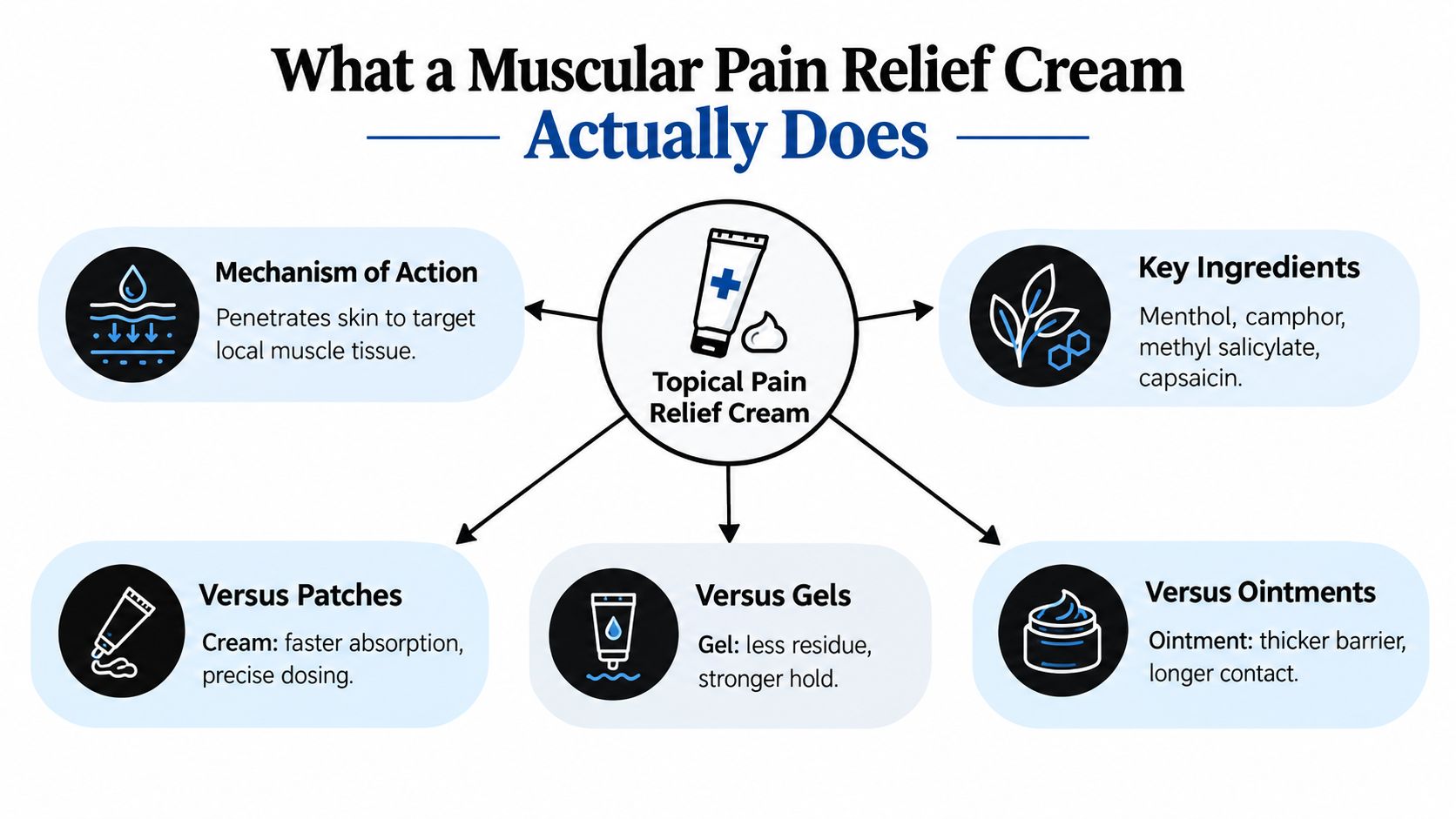
A muscular pain relief cream is a topical product designed to reduce discomfort in muscles or nearby joints when applied directly to the skin. The key detail is that “topical” doesn't mean one thing. Some products mainly change how pain feels, while others do more to reduce inflammation at the site.
Two different jobs, two different outcomes
Counterirritants such as menthol, methyl salicylate, camphor, and capsaicin work mainly through sensation. They create cooling, warming, or tingling signals that compete with deeper pain signals, which can make a sore area feel more manageable. Think of that as turning down the volume on the alarm, not fixing the wiring that triggered it.
Topical anti-inflammatories, especially diclofenac, are different. They're aimed at reducing local inflammatory activity, which is more relevant when the pain comes from sprains, strains, or osteoarthritis. The distinction matters because a strong sensation on the skin does not automatically mean stronger pain relief.
Simple test: if a product only feels intense, that's not proof it is working better. The most reliable question is whether your movement, comfort, and function actually improve.
This is why vehicle and formulation matter too. Creams spread easily over larger areas, gels may feel less greasy, and solutions or sprays can fit specific use cases. Skin condition matters as well, because broken or irritated skin changes what should and shouldn't be applied. For a clinic-friendly breakdown of topical categories, this topical analgesic guide adds helpful context.
Canadian evidence points to topical diclofenac as the best-supported option for acute localized sprains and strains, with about 2 patients needing treatment for 1 additional person to reach at least 50% pain relief within one week versus placebo, according to the Canadian Medical Association Journal. That review is the clearest reason not to treat every “muscle cream” as interchangeable.
When the search broadens beyond pain relief into athlete recovery, readers often also look at recovery supplements for athletes. That's a different category, but it sits in the same decision space for people trying to feel and move better.
Ingredients Ranked by What the Evidence Actually Shows
The ingredient list tells you more than the packaging does. If you sort products by mechanism first, the shopping decision gets much easier, because the right ingredient depends on the kind of pain, not the slogan on the front.
What tends to fit which pain pattern
Menthol is the classic cooling counterirritant. It's useful when a person wants short-term sensory relief, especially after exercise or with a fresh ache that feels better when the area is cooled and distracted.
Methyl salicylate is another counterirritant often used for temporary comfort. Its value is more about sensation and local symptom relief than treating the underlying cause.
Capsaicin has a different role. It tends to make more sense for repeated use in some chronic pain patterns, particularly when people can tolerate the initial warming or burning sensation and are looking for ongoing symptom control.
Topical NSAIDs, especially diclofenac, deserve the strongest position in this ranking for localized inflammatory pain. Canadian evidence supports them well for acute sprains and strains, and Health Canada has authorised specific diclofenac formulations for particular indications, including a 1.16% diclofenac diethylamine gel for recent acute localised muscle or joint injuries and a 1.5% diclofenac sodium solution for knee osteoarthritis with use limited to no more than three months. Health Canada's topical NSAID policy document makes that distinction clear.
Lidocaine is often discussed in topical pain care, but for muscular pain relief specifically, the most relevant Canadian evidence in this brief is stronger for topical NSAIDs than for the mixed consumer category as a whole. Herbal blends and compounded formulas may have loyal users, but the evidence base is thinner, so they should not be assumed to work as reliably as diclofenac for inflammatory pain.
A useful evidence-based habit is to ask one question before buying: what pain pattern am I treating, and what ingredient matches it? A framework like the 5-step evidence based process helps keep that question practical instead of theoretical.
| Pain Scenario | Best-Supported Ingredient | Evidence Strength |
|---|---|---|
| Acute sprain or strain | Topical diclofenac | Strongest Canadian support |
| Knee osteoarthritis | Topical diclofenac | Strong Canadian support |
| Short-term cooling comfort after exercise | Menthol | Useful for symptom relief, weaker than diclofenac for inflammatory pain |
| Surface-level warming comfort | Methyl salicylate | Symptom relief, limited evidence for deeper pain control |
| Chronic persistent pain where repeated use is tolerated | Capsaicin | Selective role, depends on the condition and consistency |
For ingredient-specific detail on one common counterirritant, this menthol guide is a practical read.
How to Apply a Muscular Pain Relief Cream Safely
Safe use matters as much as ingredient choice. The same product that helps one person move comfortably can irritate another person's skin if it's applied carelessly, layered with heat, or used on the wrong surface.
The safe-use checklist
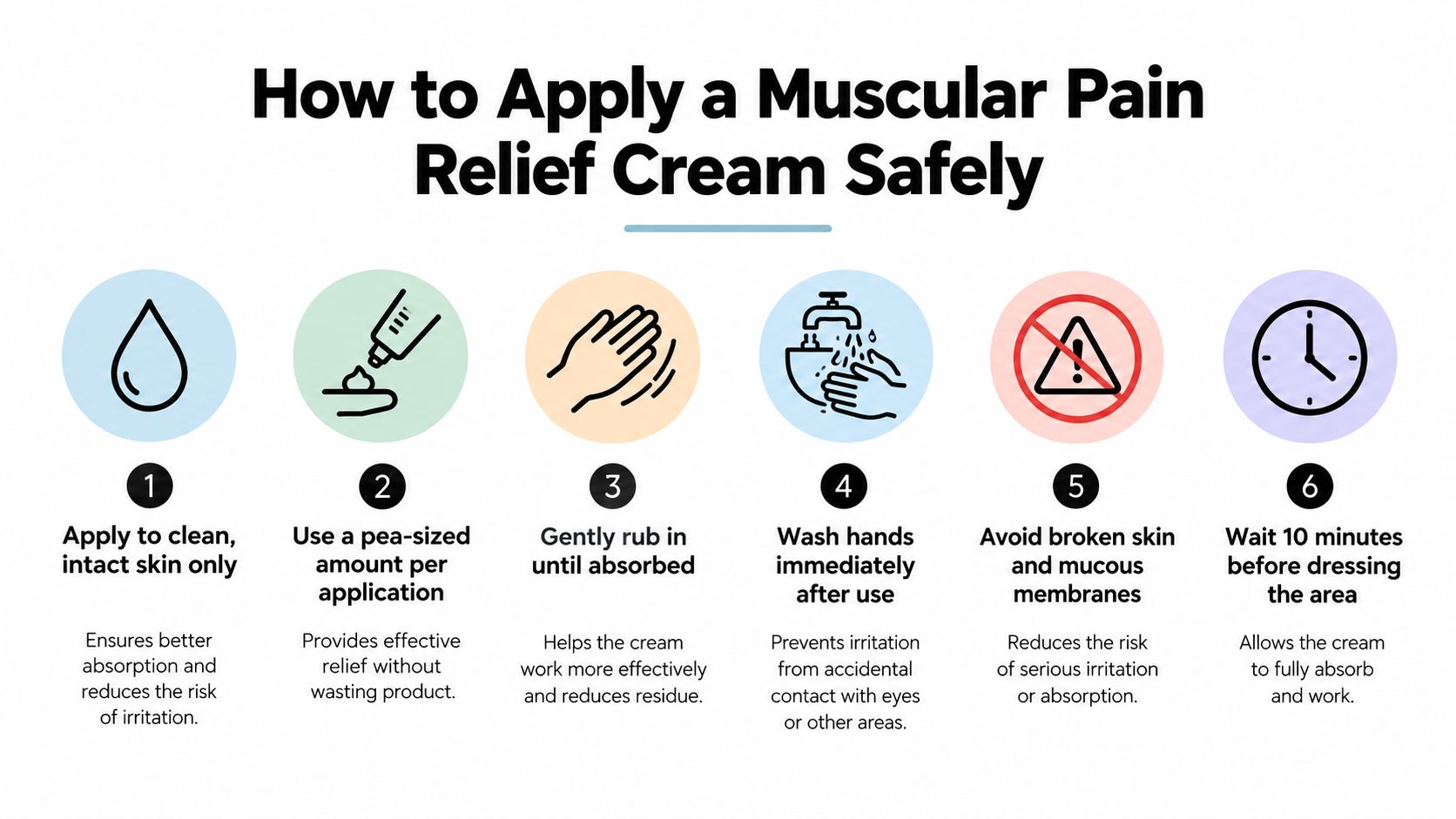
Start with clean, intact skin. That means no cuts, open scrapes, active rash, or sunburn. Broken skin can turn a tolerable product into a painful one.
Use only the amount the label calls for, then wash your hands right away unless your hands are the treatment area. That step sounds obvious, but it's the easiest way to avoid getting menthol, capsaicin, or salicylates into your eyes or onto sensitive facial skin.
Avoid pairing a topical with other products or habits that intensify absorption or irritation unless a clinician says it's fine. Heating pads, tight compression, occlusive wraps, and repeated layering can all make the skin behave differently than expected. The same caution applies if you're already taking an oral anti-inflammatory, because duplicating NSAID exposure can raise risk without adding much extra benefit.
Health Canada has warned that menthol-, methyl-salicylate-, and capsaicin-containing products can rarely cause serious skin burns, and people should stop treatment and seek medical help for severe pain, swelling, blistering, or marked skin reactions. That safety review is especially relevant for anyone using heat or working out soon after application.
If the skin is getting more painful, more swollen, or blistered, that is not a sign to apply more cream.
A mild cooling, warming, or tingling feeling is common with counterirritants. Severe pain, rash that spreads, or any blistering is not. If the pain keeps returning after a fair trial, stop guessing and get assessed.
Creams Compared to Sticks, Sprays, Roll-Ons, and Pills
The active ingredient matters, but so does the format. A cream that works well at home may be inconvenient in a treatment room, and a spray that suits the gym bag may be messy on a desk break or in a rush between patients.
Format changes the experience
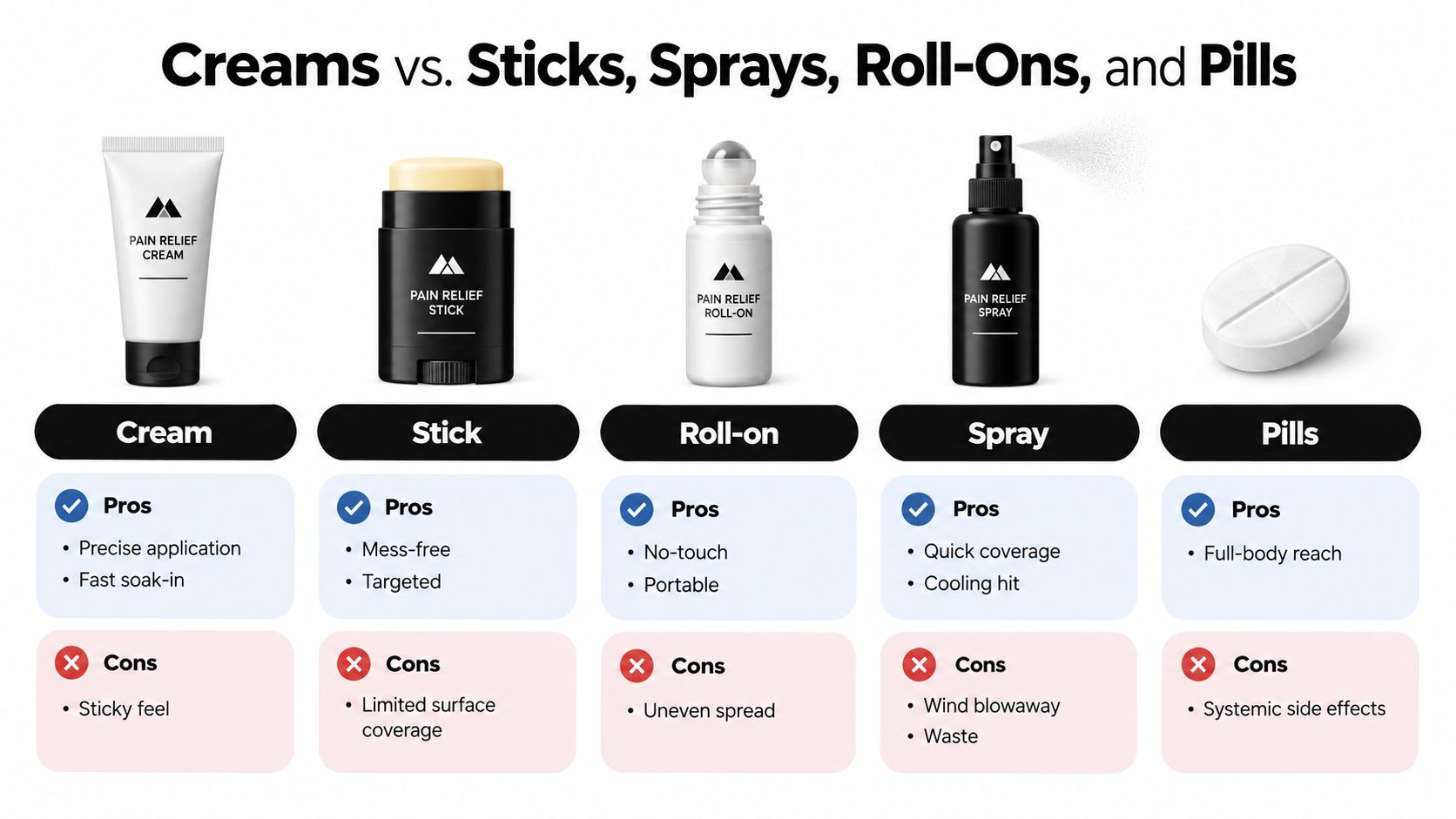
Creams spread easily over larger muscle groups and can carry a wide range of ingredients. The trade-off is residue, which can mean messier hands and transfer to clothing.
Sticks are built for cleaner, more targeted use. They're easy to keep in a bag or clinic drawer, and they suit people who want no-touch application with minimal cleanup.
Roll-ons help with direct application and are often easy to carry. They're useful when the user wants something neat and portable, though spread can be less even than with a cream.
Sprays work well for awkward places like the upper back or for quick application over a larger area. They're fast, but can be less precise and more wasteful if used carelessly.
Oral pain relievers still matter when pain is widespread, deep, or not well served by a local product. The trade-off is systemic exposure, which topicals can reduce but not always eliminate.
A topical format also changes who uses it comfortably. Someone in a training room may prefer a no-touch stick, while a person at home may prefer a cream they can work into a broader sore area. For readers comparing product styles, this topical pain relief products guide is a handy companion.
For a topical wellness option in spray form, ArtNaturals' topical spray overview is an example of how format can shape user preference, even when the intended use is different.
Matching the Right Routine to Your Reader Group
A good routine depends on who's using the product and what they need it to do. A physiotherapist, a weekend runner, a warehouse worker, and an older adult with osteoarthritis are not shopping for the same outcome, even if they all say “my muscles ache.”

Different users, different routines
Clinic teams and physiotherapists usually need a product that's easy to explain and easy to standardise. No-touch or low-mess formats often fit that workflow, especially when the goal is to pair topical relief with exercise, manual therapy, or a home plan.
Athletes tend to care most about timing. A topical can be used before activity for comfort, after training for symptom control, or between sessions when a sore area needs support, but it should not replace warm-up, load management, or active recovery.
Physically demanding workers often need portability and quick access. A product that fits a locker, lunch bag, or vehicle kit is more realistic than something that requires a long application routine in the middle of a shift.
Older adults with recurring joint pain often benefit most from a well-matched topical NSAID routine when osteoarthritis is part of the picture. The Public Health Agency of Canada reported that about 3.9 million Canadians aged 20 and older, or 13.6% of that population, were living with diagnosed osteoarthritis, and prevalence was higher among women at 16.1% than men at 11.1%. That factsheet helps explain why local, non-oral options matter so much.
For older adults in particular, this pain relief resource for seniors is worth a look.
Key Takeaways and Common Questions
A muscular pain relief cream helps most when the ingredient fits the problem and the skin is treated with care. Cooling counterirritants can make a sore area feel easier to tolerate, while topical NSAIDs, especially diclofenac, have better support for local inflammatory pain such as sprains, strains, and some osteoarthritis pain.
Quick recap
- Match the ingredient to the job. Cooling and warming products are mainly for surface symptom relief. Topical anti-inflammatories make more sense when inflammation is part of the pain.
- Check the skin first. Use only on clean, intact skin.
- Respect heat and duplication risks. Heating pads, occlusion, and using topical and oral NSAIDs together can raise risk.
- Watch the response, not the sensation. Good relief shows up as easier movement and less pain, not just a stronger tingle.
Common questions
Can I use a topical cream with an oral pain reliever? Sometimes, but not by default. If the topical contains an NSAID, ask a clinician before combining it with an oral NSAID, especially if you have kidney, heart, bleeding, or medication-related risk.
How long should I try it before deciding it's not working? Acute injuries should show meaningful change fairly soon if the product is going to help. Chronic pain, including osteoarthritis, often needs a more deliberate trial and clearer guidance.
When should I stop relying on cream and get checked? If pain follows a fall or trauma, keeps worsening, comes with numbness or tingling, or does not settle despite correct use, it needs assessment rather than another layer.
Recurring pain deserves a plan, not just another product. As noted earlier, chronic pain affects a large share of Canadians and can last for years, which is one reason a topical should fit into a broader routine rather than stand alone.
If you want a topical option built for home, clinic, and active settings, MEDISTIK offers non-prescription sprays, sticks, and roll-ons for sore muscles and joints. If you are comparing formats or building a safer routine around muscular pain relief cream, visit MEDISTIK and choose the product style that fits your day.


