

Why do you assume pain that wakes you at 2 a.m. is only a sleep problem to fix with a better pillow? When arthritis pain wakes you up at night, the timing, stiffness, and joint involved can point to inflammation, mechanical loading, or a change that needs medical review. Comfort measures still matter, but they work best after you've checked what the pattern is telling you and ruled out red flags.
Why Arthritis Pain Gets Worse After Dark
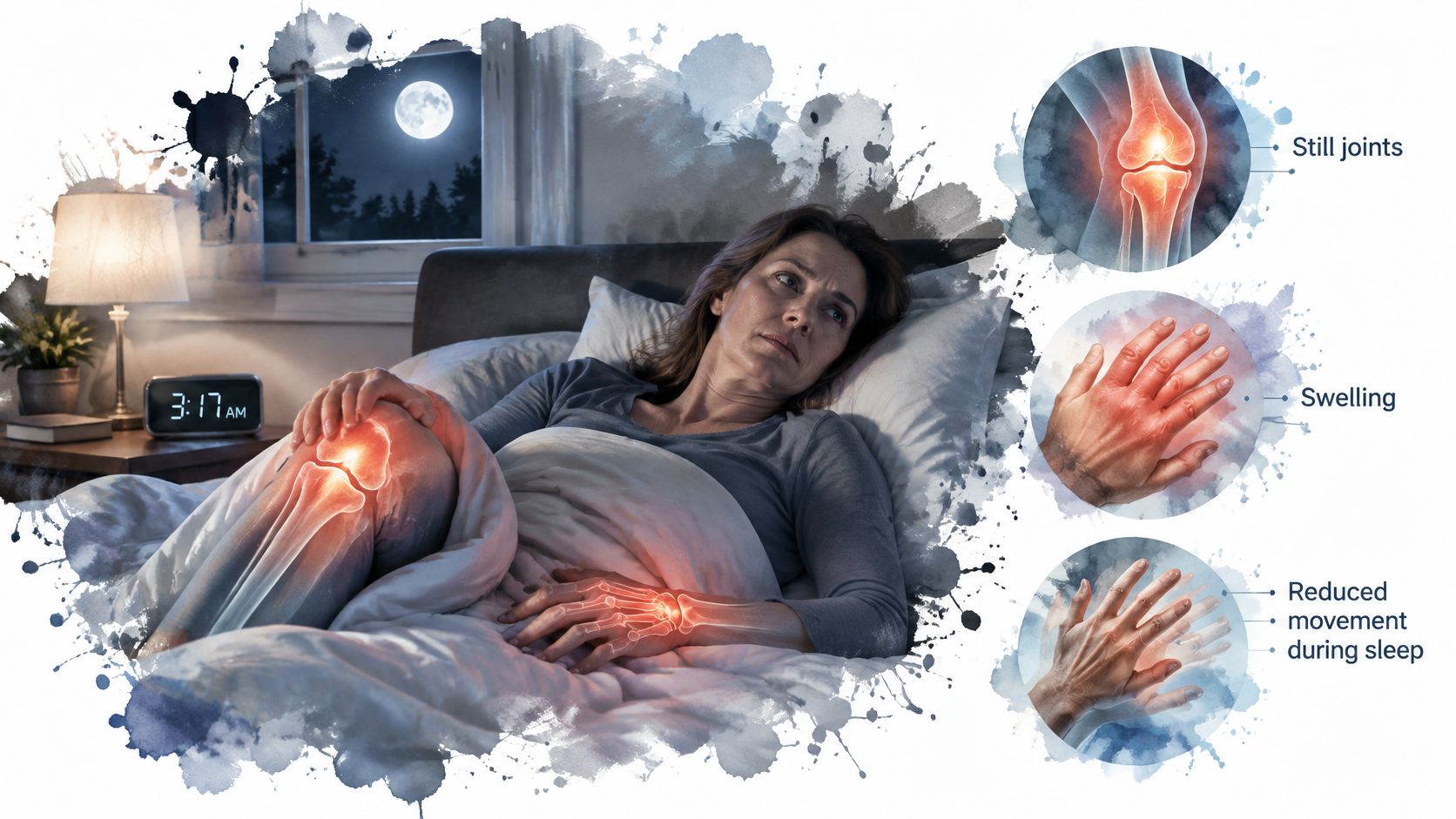
You lie down feeling manageable, then the joint seems to wake up as the room goes quiet. That's not imagination. Three overnight changes often combine, and identifying which one fits you makes the next steps clearer.
Stillness lets stiffness build
During the day, movement keeps joints lubricated and muscles warm. At night you stay still for hours, circulation slows, and tissues around a sore joint tighten. Rolling over then asks a stiff joint to move suddenly, so pain can spike even though you haven't done anything new.
Your body's natural anti-inflammatory hormone, cortisol, is at its lowest around midnight. With less cortisol dampening inflammation, inflammatory pain can climb overnight. Lying on a joint adds sustained pressure, and with fewer distractions your nervous system notices that pressure more readily.
A measurable Canadian pattern
In a nationally representative 2000–2001 Canadian Community Health Survey sample of 118,336 adults aged 18 and older, reported in a Canadian Research Data Centre Network publication, 24.8% of people with arthritis reported insomnia symptoms and 11.9% reported unrefreshing sleep. Both estimates were approximately twice as high as those among adults without arthritis. After pain was included in statistical models, the association between arthritis and insomnia symptoms fell by 53%, while the association between arthritis and unrefreshing sleep fell by 64%.
Arthritis remained associated with poor sleep even after accounting for pain, which fits what many people describe. Stiffness, fatigue, mood changes, and reduced function can also fragment the night. If you want background on joint symptoms beyond sleep, this guide to arthritis joint pain covers the basics.
Practical rule: Don't ask only how strong the pain feels. Ask whether stillness, inflammation, or sustained pressure best explains when it wakes you.
Night Pain Patterns and What They Suggest
The timing and feel of night pain can offer clues about what is driving it. Compare the pattern across several nights, rather than drawing a conclusion from one difficult night.
| Pattern | Likely driver | What to check next |
|---|---|---|
| Stiffness lasting around 30 minutes or more after waking, with night waking | Possible inflammatory arthritis | Discuss disease control with a clinician |
| Aching joints after long periods still, easing with movement | Osteoarthritis with mechanical loading | Consider joint support and gentle morning movement |
| Pain shifting between several joints over weeks | Multiple joint involvement, possibly inflammatory | Arrange a routine assessment |
| Pain waking you, followed by racing thoughts or low mood | Pain and insomnia reinforcing each other | Review sleep habits and ask about CBT for insomnia |
| Pain with restless legs or breathing pauses | Possible separate sleep disorder | Ask a clinician whether a sleep study is appropriate |
Inflammation versus mechanical loading
The first two rows describe different patterns. Arthritis Research Canada's guidance on sleep and pain explains that poorly controlled inflammation can contribute to night pain in inflammatory arthritis, while osteoarthritis pain may relate to mechanical loading and affected joints.
Mechanical pain often builds after activity or a long spell of stillness, then eases with gentle movement, a change in position, or less pressure on the joint. For example, a knee may ache after staying bent on the sofa and loosen during a short walk to the kitchen. Pain in the leg that appears while lying down can have other patterns too; this guide to pains in the leg when lying down offers related context.
Age alone cannot explain the pattern. Arthritis Research Canada reports that nearly one-third of younger adults with osteoarthritis experience severe and frequent joint pain, at rates comparable to adults aged 75 and older. Younger adults, particularly women, also report greater difficulty getting good sleep, according to Arthritis Research Canada's discussion of osteoarthritis pain and sleep.
If symptoms suggest inflammation, comfort measures alone may leave the underlying disease activity unaddressed. Track which joints hurt, when the pain starts, how long morning stiffness lasts, and whether movement changes it. That record can help a clinician assess the pattern.
When Night Pain Needs a Doctor, Not Just a Pillow
A single joint that's hot, red, and swollen, with fever or marked fatigue, is the red flag to act on first. Don't wait to see whether heat, rest, or a new pillow settles it by morning. That combination needs same-day assessment because it may signal infection rather than a routine flare.
A Canadian rheumatology-focused guide published in June 2025, Arthritis Research Canada's guide to navigating the emergency room with arthritis, identifies severe pain in a single joint as a possible infection warning, particularly when accompanied by redness, warmth, fever, or fatigue. The same guide treats sudden chest, neck, or arm pain, calf swelling, shortness of breath, seizures, or altered mental status as requiring urgent evaluation. Those symptoms don't belong in a wait-and-see plan.
Match the symptom to the timing
| Symptom | Action | Timing |
|---|---|---|
| Night waking with stiffness on most days | Routine review with a GP or rheumatologist | Within weeks |
| Pain worsening steadily over several days | Clinician review | Within a few days |
| Single joint hot, red and swollen, with fever or fatigue | Urgent assessment for infection | Same day |
| Calf swelling | Urgent assessment | Same day |
| Sudden chest, neck or arm pain, or shortness of breath | Emergency services | Immediately |
This answers the question people ask most at night. Should you wake a doctor or wait until morning? If your symptom sits in the bottom three rows, don't wait for a routine appointment. Persistent or recurring night waking without those danger signs still warrants a clinician review, just not an emergency call.
Arthritis pain at night isn't always an arthritis flare, and masking a rapidly changing symptom can be unsafe.
Keep a diary that helps triage
A short symptom diary makes that review faster and more useful. For knee joint pain with swelling and other joints, note the details a clinician will ask about first.
- Time and joint: When pain started, when it woke you, and which joint was involved
- Visible change: Swelling, redness, warmth, or a joint you can't move normally
- Morning pattern: How long stiffness lasted after you got up
- Whole-body signs: Fever, fatigue, calf swelling, breathlessness, or chest, neck, or arm pain
- Response: What helped, what didn't, and how long relief lasted
Many individuals are managing a known condition, so this isn't about alarm. The diary helps you and your clinician spot the night that doesn't fit your usual pattern. Bring it to the appointment rather than relying on memory after several broken nights.
How to Time Pain Relief Around Bedtime
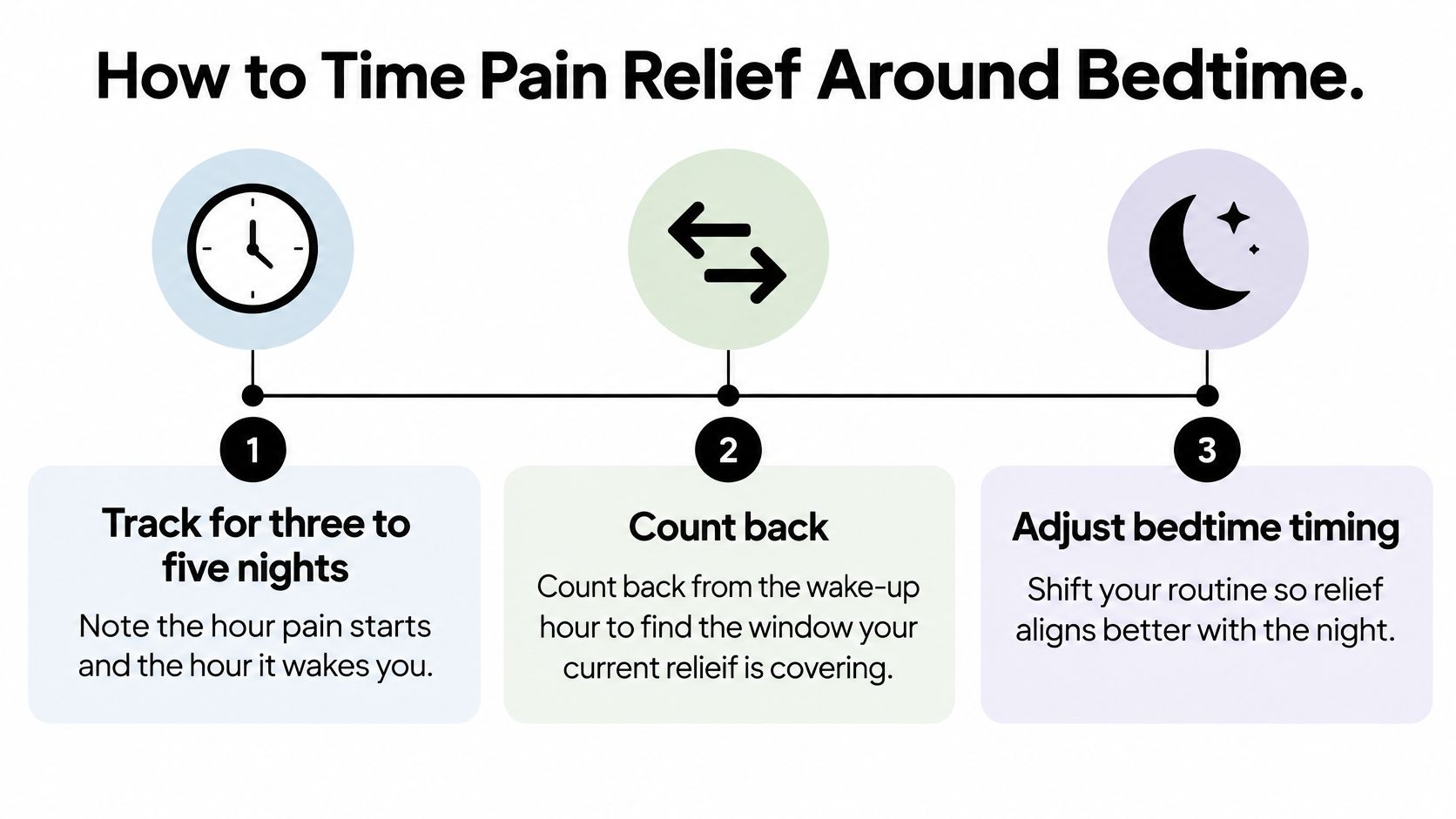
Relief that wears off at 2 a.m. won't help the waking that follows. Timing is therefore a method you can learn, not just a dose you take. Work through these steps and discuss prescribed medicines with the person who prescribed them.
Five steps to find your uncovered window
- Track for three to five nights. Note when pain starts and the hour it wakes you. You're looking for a repeatable window, not one bad night after an unusually active day.
- Count back from the wake-up hour. Compare that hour with when you last used relief and how long you expected it to last. If you wake at a similar time each night, your current timing may be missing that stretch. Background on duration, such as how long Advil Extra Strength lasts, can help you frame better questions.
- Ask about timing, don't change doses alone. Ask your prescriber or pharmacist whether analgesic or anti-inflammatory treatment can be timed to cover your usual pain window. Don't increase, split, or move prescribed doses on your own, because safety limits and other medicines matter.
- Use topicals before you're in bed. Apply a topical product to the most painful joint as its label directs, early enough that it has taken effect before lights out. For hand arthritis or muscle pain, our Power Stick should be left on for at least 10 minutes before washing hands, so build hand washing and teeth brushing around that interval.
- Log the result each morning. Record the application time, the joint treated, whether you woke, and how quickly you fell back asleep. After several nights you'll see whether a timing shift helped or moved the waking later.
What improvement looks like
Judge the change over two weeks, not one night. A good result might be fewer wakings, falling back asleep more quickly, or reaching morning with less stiffness. Say you still wake once but return to sleep within 30 minutes instead of lying awake for two hours. That's meaningful progress worth recording.
If the wake-up hour stays fixed despite careful timing, take the log back to your prescriber. A stubborn window can mean the product, the dose timing, or the underlying disease control needs review. Don't keep adding extra doses to chase the gap.
Bedtime Routine and Sleep Environment That Reduce Waking
Start with wake time, not bedtime. A consistent wake time gives your body clock a fixed anchor, which helps sleep pressure build predictably by evening. Sleeping in after a bad night feels logical, but it often makes the next night lighter and more broken.
Canadian osteoarthritis data in the Arthritis Society Canada osteoarthritis report summary indicate that 64% of people with osteoarthritis report that the condition limits their ability to obtain a good night's sleep, with a particularly notable burden among women and younger adults with osteoarthritis. The same summary links nocturnal symptoms to sustained joint loading, synovial irritation, muscle guarding, and reduced movement during sleep. Your daytime routine therefore affects the night more than many people expect.
Build the day and evening around sleep
- Avoid prolonged daytime inactivity: Break up long sitting with short, gentle movement so joints don't stiffen for hours before bed
- Use clinician-guided exercise or physiotherapy: Preserve joint range and strength without flaring the joint late in the day
- Take a warm bath or shower: Try it about an hour before bed to relax tight muscles and signal winding down
- Keep the bedroom cool: Aim for 16 to 19 degrees Celsius, with blackout curtains if street light wakes you
- Put the phone away: Set it aside 30 minutes before lights out so scrolling doesn't keep your mind alert
A routine that calms pain is different from one that only distracts you from it. Warmth, gentle stretching, and finishing topical application before bed address the joint itself. Television in bed may pass time, but it doesn't reduce stiffness and can teach your brain that bed is a place for wakefulness.
When awakenings become conditioned
After weeks of broken nights, you may start waking at the same hour even when pain is mild. Worry about another bad night then keeps you alert. Cognitive behavioural therapy for insomnia, or CBT-I, is a non-drug option for that conditioned pattern and the anxiety that grows around it.
CBT-I works on the habits and thoughts that keep insomnia going, rather than only adding a sedative. It pairs well with arthritis treatment because it addresses the sleep side while your clinician addresses inflammation or mechanical pain. Ask your GP about local or online programmes if racing thoughts are now part of every waking.
Two-week check: If you've held the routine for two weeks and you're still waking nightly, move from routine tweaks to pattern review and medical review.
Sleep Positions and Supports for Painful Joints
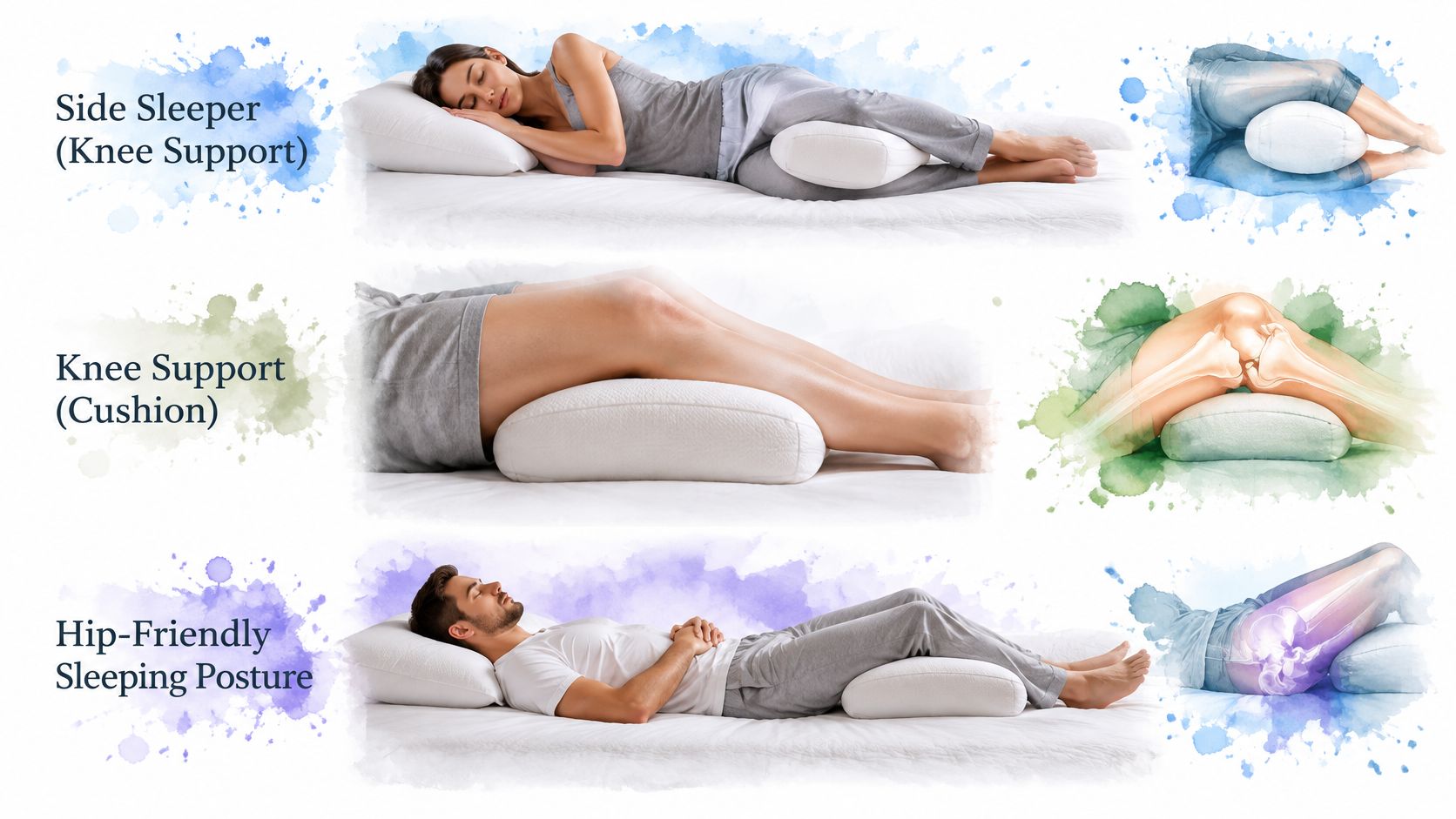
Find the joint that wakes you in this lookup table, then test the position and support for several nights.
| Painful joint | Best position | Avoid | Support |
|---|---|---|---|
| Hip or knee | Side, knees bent | Lying flat on the painful side | Pillow between the knees |
| Lower back | On the back, knees raised | Lying on the stomach | Pillow under the knees |
| Shoulder | Opposite side or back | Lying on the painful shoulder | Pillow hugged to the chest |
| Hands or wrists | Back or side, arms relaxed | Fists tucked under the pillow | Soft pillow under the forearm |
| Neck | On the back | Deep stomach sleeping | Thin, contoured pillow |
Test one change at a time
Change position gradually rather than forcing a completely new posture in one night. Notice whether the joint wakes you within the first hour, which often means pressure is still landing on the sore spot. Adjust pillow height by a few centimetres, shift the support slightly, and retest before abandoning the position.
Shoulder pain needs particular care because lying directly on it compresses already irritated tissues. If that sounds familiar, these strategies for relieving rotator cuff pain at night explain positioning in more detail. Hugging a pillow keeps the top arm from dropping across your body and pulling the shoulder forward.
Your mattress either supports these positions or fights them. If you wake with several joints aching, research on choosing a mattress for arthritis from Lucas Furniture & Mattress can help you assess firmness, pressure relief, and trial options before you buy.
A good position reduces pressure and helps you stay asleep longer. It doesn't replace treatment for the cause of pain, especially if inflammation or a red-flag change is driving it. Treat positioning as one layer alongside timed relief, routine, and medical review when needed.
Start the Two-Week Plan and Book a Review
Choose one change from each part of this approach and hold it for the next two weeks. Don't overhaul everything tonight. Four steady changes give you clear information about what helps.
- Timed relief window: A bedtime timing plan agreed with your prescriber or pharmacist
- One evening routine change: A fixed wake time, warm shower, cooler room, or phone away before bed
- One position change: The support for the joint that wakes you most often
- Symptom diary: Wake time, joint, stiffness, visible change, and what helped
Judge progress each morning by three measures. Count how many times you woke, estimate how long it took to fall back asleep, and note how long morning stiffness lasted. Small shifts across two weeks matter more than one unusually good night.
Set the review point now rather than deciding when you're exhausted. If waking persists after two weeks, or any red flag from the triage table appears sooner, book a GP or rheumatologist visit and bring the diary. Seeking review is routine care, not a sign you've failed at self-management, since 20.6% of Canadian adults reported having arthritis in 2023, according to Statistics Canada's 2025 health outcomes report.
Write down the one change you'll start tonight and add your two-week check date to your calendar. That date is your decision point. If the diary shows progress, keep building. If it doesn't, you'll arrive at the appointment with evidence a clinician can act on quickly.
We've helped over 1 million people with managing pain and inflammation, and our products are listed for muscle pain, joint pain, arthritis, injury and recovery, better sleep, headaches, chronic pain and pain prevention. If timed topical relief fits the plan you've discussed with your clinician, visit MEDISTIK to choose the format that suits the joint keeping you awake.


