

More than 4.2 million Canadians aged 15 and older reported arthritis in 2007–2008, according to the Public Health Agency of Canada. Yet that broad label doesn't tell you why a particular big toe hurts, or whether you need a different shoe, gout treatment, or urgent medical care.
A painful big toe isn't automatically gout. A joint that becomes fiercely painful overnight needs a different response from one that gradually stops bending. Even tests need context: a normal uric acid result during an attack can mislead, while an alarming X-ray doesn't necessarily explain how much a stiff toe hurts.
Tell Gout From a Stiff Big Toe
In 2023, 20.6% of Canadian adults reported having arthritis, according to Statistics Canada. For someone with pain at the base of the big toe, the useful next question isn't whether arthritis is common. It's which pattern best matches the symptoms.
The first metatarsophalangeal joint, or first MTP joint, is where the big toe meets the foot. Think of hallux rigidus as a door hinge that gradually rusts and stops lifting. Gout is more like a sudden fire alarm inside a previously quiet joint.
Big-toe pain patterns at a glance
| Clue | Gout flare | Hallux rigidus | Not routine arthritis |
|---|---|---|---|
| Onset | Hours, often overnight | Months to years | Hours, with fever, a wound, or sudden inability to walk |
| Pain | Severe; skin too sore to touch | Ache on push-off and in restrictive shoes | Rapidly worsening pain with systemic illness |
| Look | Hot, red, swollen joint | Dorsal bony bump; less obvious inflammation between painful days | Spreading redness, streaking, or drainage |
| Motion | Guarded because movement hurts | Lost upward bend of the big toe | Weight bearing may be impossible |
| Who it tends to affect | More often men; attacks can recur; becomes more common with age | Either sex; associated with repetitive load and ageing | Any age, including after trauma or illness |
| Test that helps | Joint-fluid crystals; urate interpreted over time | Examination and walking tolerance; X-ray can show spurs and joint-space changes | Same-day clinical assessment for infection |
| First step | Clinician-directed anti-inflammatory care; rest and cooling while waiting | Roomier toe box, suitable sole, activity change | Don't rely on home care |
Start with onset. A toe that was comfortable at bedtime but unbearable by morning belongs in a different column from a toe that has become harder to bend over successive seasons.
Next, consider where and when it hurts. Hallux rigidus often hurts as you push off, walk uphill, or press the top of the joint against a shoe. A gout flare can make even a bedsheet feel intolerable.
Treat the safety column differently
The final column isn't another diagnosis to choose for yourself. Fever, a wound, spreading redness, or inability to bear weight changes the urgency because infection can resemble, or coexist with, gout.
Don't force the toe upward to test it when it's acutely inflamed. Describe whether motion is blocked even on comfortable days, or whether you're avoiding movement because everything hurts.
If you're unsure whether discomfort comes from the joint or nearby soft tissue, our guide to joint pain or muscle pain can help you describe its location.
Practical rule: Match the last episode to a symptom pattern before choosing a treatment. A new hot, swollen toe needs assessment, not a confident home diagnosis.
Why Gout Strikes the Big Toe Overnight
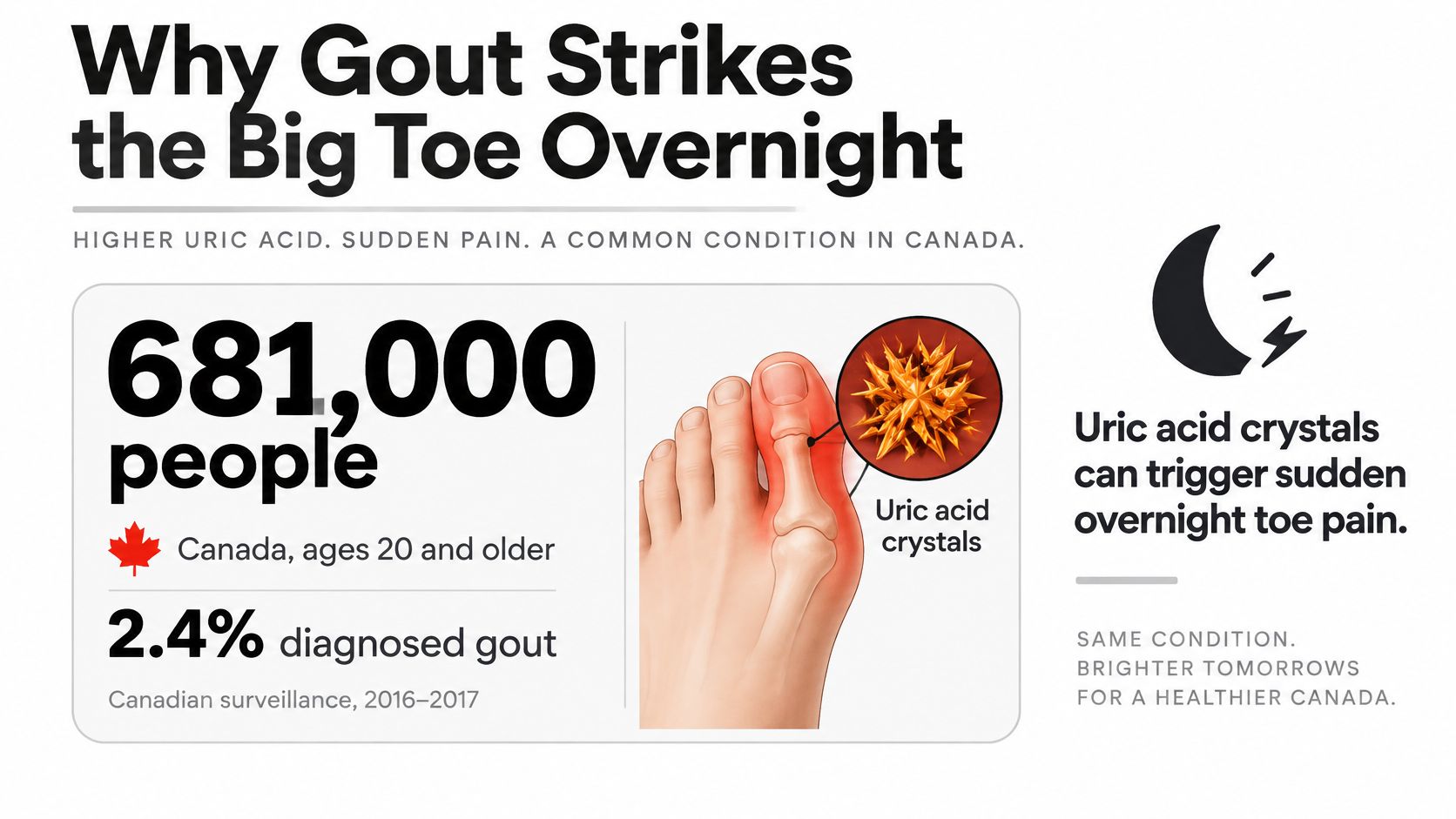
Gout begins with urate crystals, not an overworked toe. When enough urate remains dissolved in body fluids, crystals can accumulate in and around a joint. Immune cells react to those crystals, producing intense inflammation of the joint lining, called synovitis.
The big toe is a frequent site because conditions at the cooler end of the foot favour crystallisation. The analogy is sugar forming crystals as syrup cools: material that was dissolved becomes solid, and the body reacts to it.
What the Canadian numbers actually count
In 2016–2017, approximately 681,000 Canadians aged 20 and older, or 2.4% of that population, had diagnosed gout or another crystal arthropathy, according to the Public Health Agency of Canada's surveillance report; diagnosed prevalence was 3.7% among males and 1.1% among females. Those figures describe a diagnostic group, not everyone with foot pain or a high uric acid result.
The infographic summarises that surveillance context.
Gout becomes more common with age, but age and sex are clues rather than diagnostic rules. A woman can develop gout, and a man with a red toe can have something else.
The big toe is also not the only possible site. Gout can affect the ankle, knee, other parts of the foot, hand, or wrist. Repeated attacks in different joints deserve a connected medical history rather than separate explanations for every episode.
Triggers aren't the same as the underlying disease
Alcohol, dehydration, illness, some foods, and certain medicines can contribute to an attack in a susceptible person. That doesn't mean a single meal explains the entire condition or that avoiding one food removes existing crystals.
Useful observations to record include:
- Recent illness or fluid loss: Note fever, vomiting, diarrhoea, or unusually poor fluid intake.
- Alcohol and eating changes: Record unusual intake without assuming it proves the cause.
- Medicine changes: Bring the actual names, including non-prescription medicines and supplements.
Don't stop a prescribed medicine because you suspect it contributed. A clinician can weigh that possibility against why you take it.
Pain noticed on waking isn't always gout, either. Our explanation of why feet hurt when you wake up helps distinguish the timing of symptoms from their cause.
A first hot toe still needs examination. Redness describes inflammation; it doesn't identify what caused it.
How Hallux Rigidus Stiffens the Toe
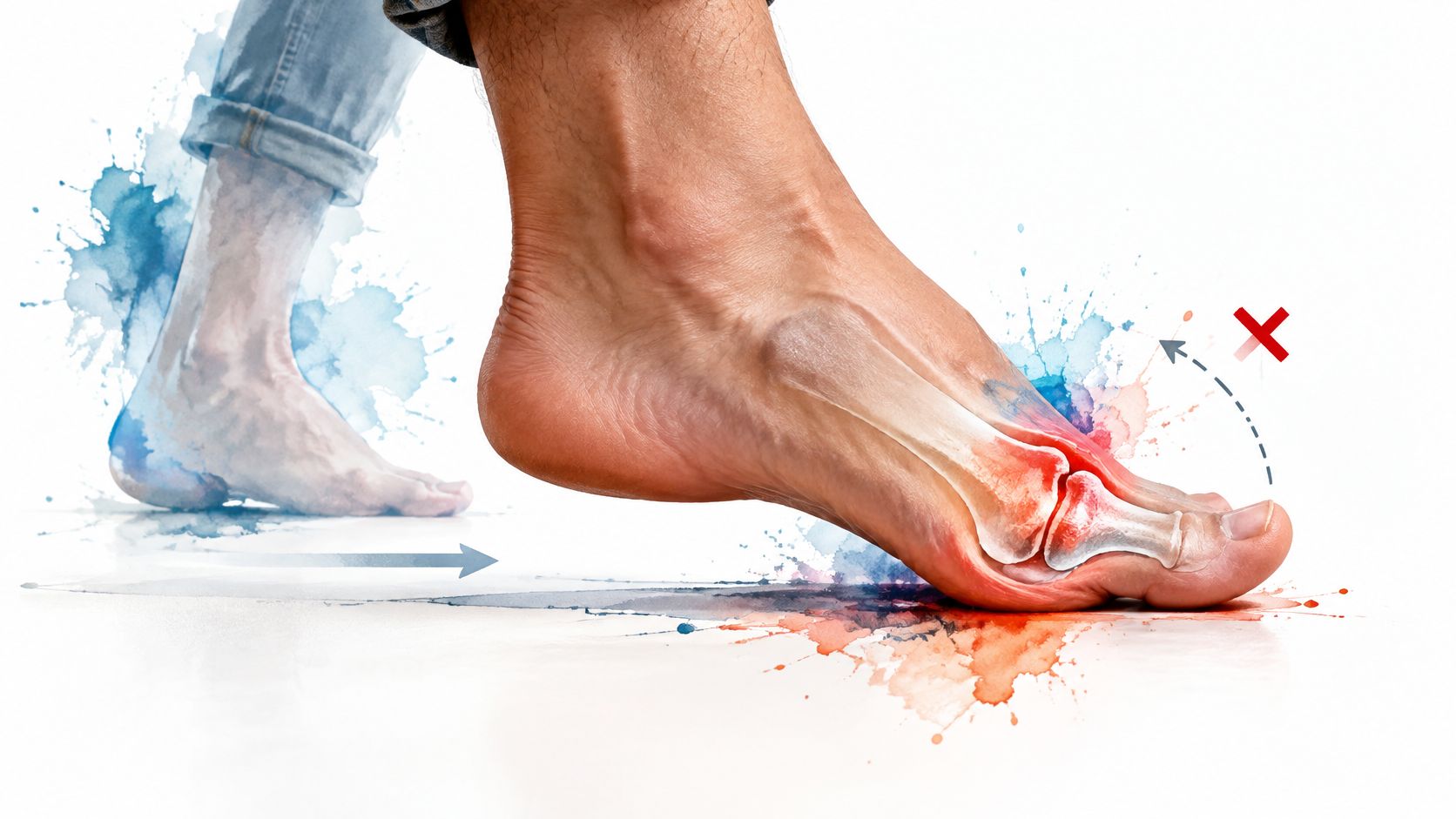
Say you're walking up a gentle slope. Your heel rises, your weight moves towards the front of the foot, and the big toe needs to bend upward so you can push off.
With hallux rigidus, that movement becomes restricted. Cartilage changes and bony growth at the top of the joint can create a painful pinch, while the shoe presses against the same prominence from outside.
This illustration locates the joint where those forces meet.
Follow the step, not just the scan
A typical history sounds mechanical: comfortable sitting, sore during push-off, and worse in shoes that press the bump. Stiffness remains noticeable even when pain settles.
A clinician checks where the pain occurs during movement, how much upward bend remains, and whether you've started rolling onto the outside of the foot. Those details connect the examination to the tasks you want to recover.
An X-ray is not a pain meter. The Canadian federal orthopaedic guidance cites a long-term survey in which 90% of surveyed patients reported no change in pain 15 years after diagnosis, despite radiographic progression.
That observation doesn't promise an individual outcome. It shows why worsening images alone shouldn't determine whether you need more aggressive treatment.
Keep treatment expectations realistic
Footwear changes and activity adjustments can make everyday movement more manageable. However, the evidence for specific inserts and injections is limited, and a device shouldn't be presented as a guaranteed correction.
The same caution applies to experimental approaches. If you encounter Pro Tec Pep's discussion of BPC-157 and TB-500 preclinical findings, keep the word preclinical in view: those findings don't establish a treatment for human big-toe osteoarthritis or replace standard assessment.
A visual explanation can help you relate joint movement to the symptoms you notice.
Nearby problems can produce overlapping pain:
- Turf toe: An injury involving the supporting tissues around the joint.
- Sesamoid pain: Discomfort beneath the big-toe joint rather than mainly above it.
- A bunion: A prominence and alignment change that can also coexist with arthritis.
The clue worth keeping is persistent loss of upward motion, especially when it interferes with push-off. It deserves an examination rather than increasingly forceful stretching.
Calm a Hot Swollen Toe in the First Days
A suddenly inflamed toe needs protection and a medical plan. Home measures can reduce discomfort while you arrange care, but they don't establish whether the cause is gout, infection, or an injury.
Use the following sequence for the acute, hot-swollen pattern, not as a routine for every stiff toe.
Protect the joint while arranging assessment
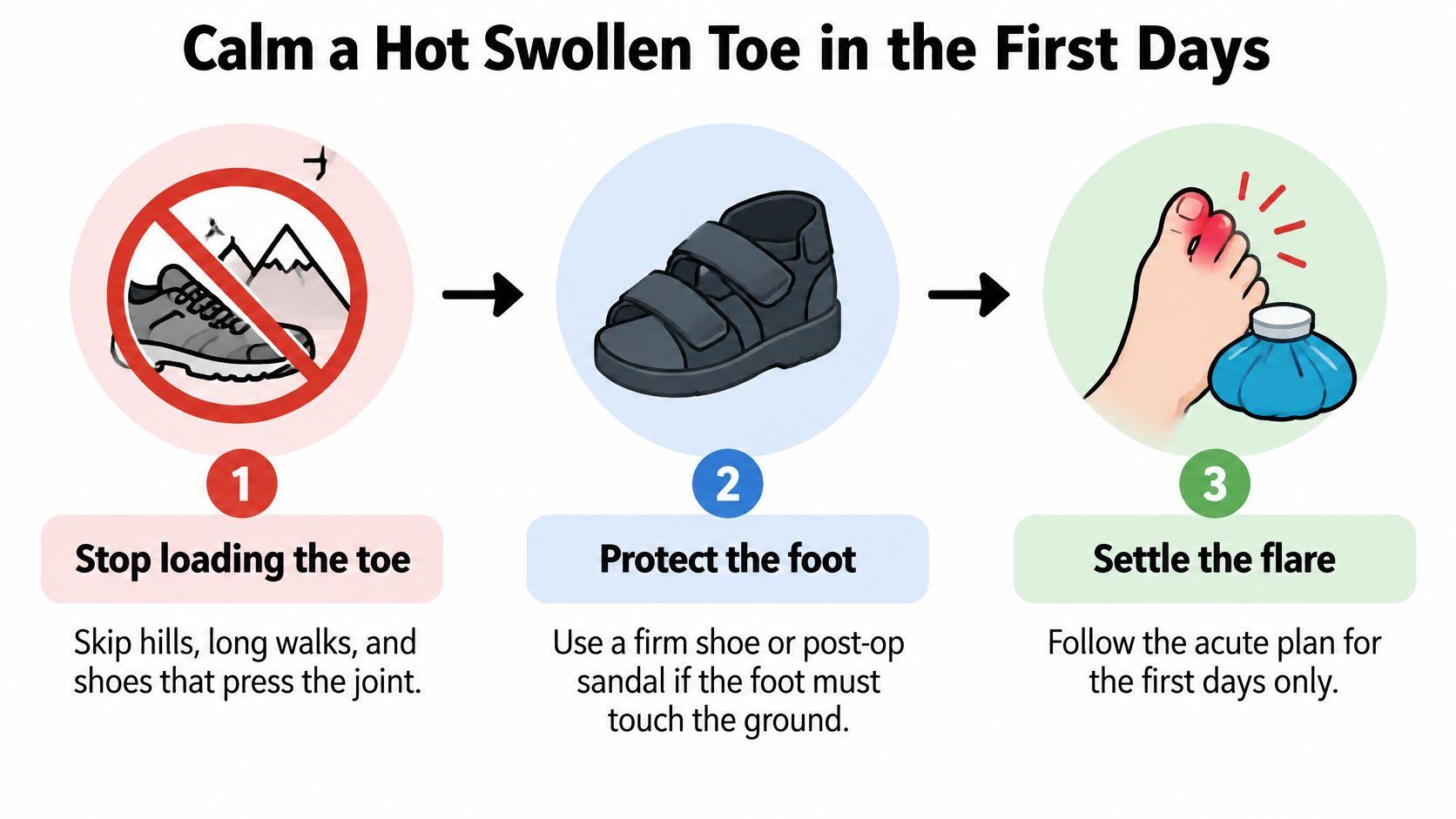
- Reduce loading immediately. Skip hills, long walks, sprint starts, and footwear that presses the joint. If you must walk, use a roomy, supportive shoe that doesn't force painful bending; a clinician may recommend a protective sandal.
- Cool it. Place a cloth between a cold pack and your skin, use brief applications, and let the skin return to its usual temperature between them. Stop if the skin becomes numb, painful, or unusually pale.
- Arrange the right level of care. A first severe episode needs prompt assessment. Fever, spreading redness, a wound, or inability to bear weight warrants same-day care rather than a trial of home treatment.
The visual below summarises the immediate protection steps.
Our guide to heat or ice for swelling explains how to choose a comfort measure. Neither approach should delay assessment of a suspicious red joint.
Separate flare treatment from crystal control
Ask the clinician which anti-inflammatory treatment suits you. Options for an active gout attack include an NSAID, colchicine, or a short corticosteroid course; kidney function, stomach risks, other illnesses, and medicine interactions influence the choice.
Don't combine leftover prescriptions or assume a medicine that helped someone else is suitable. A topical pain reliever may ease discomfort, but it doesn't remove urate crystals or replace treatment for the attack.
For established gout requiring long-term treatment, the clinical guidance available through the National Library of Medicine supports a serum urate target below 360 μmol/L (6 mg/dL) to promote crystal dissolution. This is a sustained treatment goal, not a reason to adjust medicines yourself during a painful night.
Relief tells you the toe feels better. Long-term urate control addresses why gout attacks keep returning.
Continue prescribed urate-lowering medicine unless your treating clinician tells you otherwise. Starting or adjusting that treatment is a separate prescribing decision and can sometimes be considered during a flare with appropriate anti-inflammatory cover.
Recheck if pain isn't easing, symptoms worsen, or the treatment causes side effects. Improvement should include less heat, easier footwear, and more comfortable movement, together with a follow-up plan rather than an expanding collection of unlabelled pills.
Daily Habits That Protect the Toe
Daily care works best when it matches the diagnosis. For hallux rigidus, the practical aim is to reduce painful bending and shoe pressure. For gout, it's to support the medical plan that keeps urate controlled between attacks.
Comfort matters in both situations, but comfort alone doesn't show that the underlying disease has changed.
Make walking less demanding on a stiff joint
Start with the shoes you wear to work, shop, and exercise. A deep, wide toe box should leave room above the bony bump as well as beside the toes; a shoe can be wide enough across the forefoot and still press down painfully from above.
A stiffer or rocker-style sole may reduce how much the toe must bend during push-off. Try footwear carefully on a level surface, especially if balance is a concern, and judge it by comfort and walking confidence rather than its arthritis label.
Use these practical checks:
- Check the top of the toe box: The upper shouldn't press on the prominence when you stand or walk.
- Test push-off: Walk normally rather than taking guarded steps to make an unsuitable shoe feel acceptable.
- Check stability: A sole that reduces toe movement is unhelpful if it makes you feel unsteady.
- Retire the worst pair: Narrow dress shoes and high heels can undermine changes you make elsewhere.
Don't wait until you limp to change shoes. If a particular pair reliably provokes pain, treating the resulting soreness while continuing to wear it misses the most adjustable trigger.
Change the activity before abandoning movement
A painful toe doesn't necessarily mean all exercise must stop. Cycling, pool walking, and flatter routes may be easier to tolerate than hill repeats, jumping, or fast starts.
Let the next morning help guide progression. If the toe is more painful or swollen after an activity change, reduce the demand rather than trying to push through it.
Gentle movement can help maintain the range you have, but it shouldn't become a contest with the joint. Move the toe only within a comfortable range, stopping before a sharp pinch; don't force it against a firm bony block.
Comfort check: An activity is more useful when you can repeat it without a worsening limp or a more painful morning.
Maintain a body weight you can sustain rather than pursuing a rapid change during a flare. If pain makes exercise difficult, a physiotherapist can help identify options that don't repeatedly irritate the toe.
Use symptom relief as support
Cooling after an aggravating day may make the toe more comfortable. Before applying a topical, check that the skin is intact and follow its directions, including warnings about heat, dressings, and combining products.
Our Power Stick is a non-prescription topical that provides temporary soothing relief of sore muscles and joints, including arthritic or rheumatic pain, and can be applied before activity. It doesn't rebuild cartilage, dissolve urate crystals, or replace prescribed flare treatment or urate-lowering therapy.
For broader comfort strategies, our guide to arthritis joint pain relief can help you organise symptom management around daily tasks. Reduced pain should support sensible activity, not encourage you to ignore increasing heat or swelling.
Keep gout care steady between attacks
For gout, ordinary habits matter most when they're repeatable. Drink regularly unless you have a medical fluid restriction, avoid binge drinking, and reduce sugary drinks rather than relying on a restrictive crash diet.
Keep taking clinician-prescribed treatment when the joint feels normal. An absence of pain isn't a reliable signal that the crystal burden has gone.
A useful week of action is concrete:
- Document a change: Photograph redness or swelling and note when it began.
- Remove a pressure point: Replace the shoe that consistently rubs.
- Choose a tolerable route: Use level ground and finish before you start compensating.
- Book an assessment: Arrange primary care for a new pattern instead of repeatedly treating it without a diagnosis.
- Track function: Note whether ordinary errands and push-off are becoming easier.
Success looks practical: a shoe that no longer rubs, a walk without a protective limp, and a plan you can continue. It doesn't require pretending the toe never hurts.
Signs That Need Imaging or a Surgeon
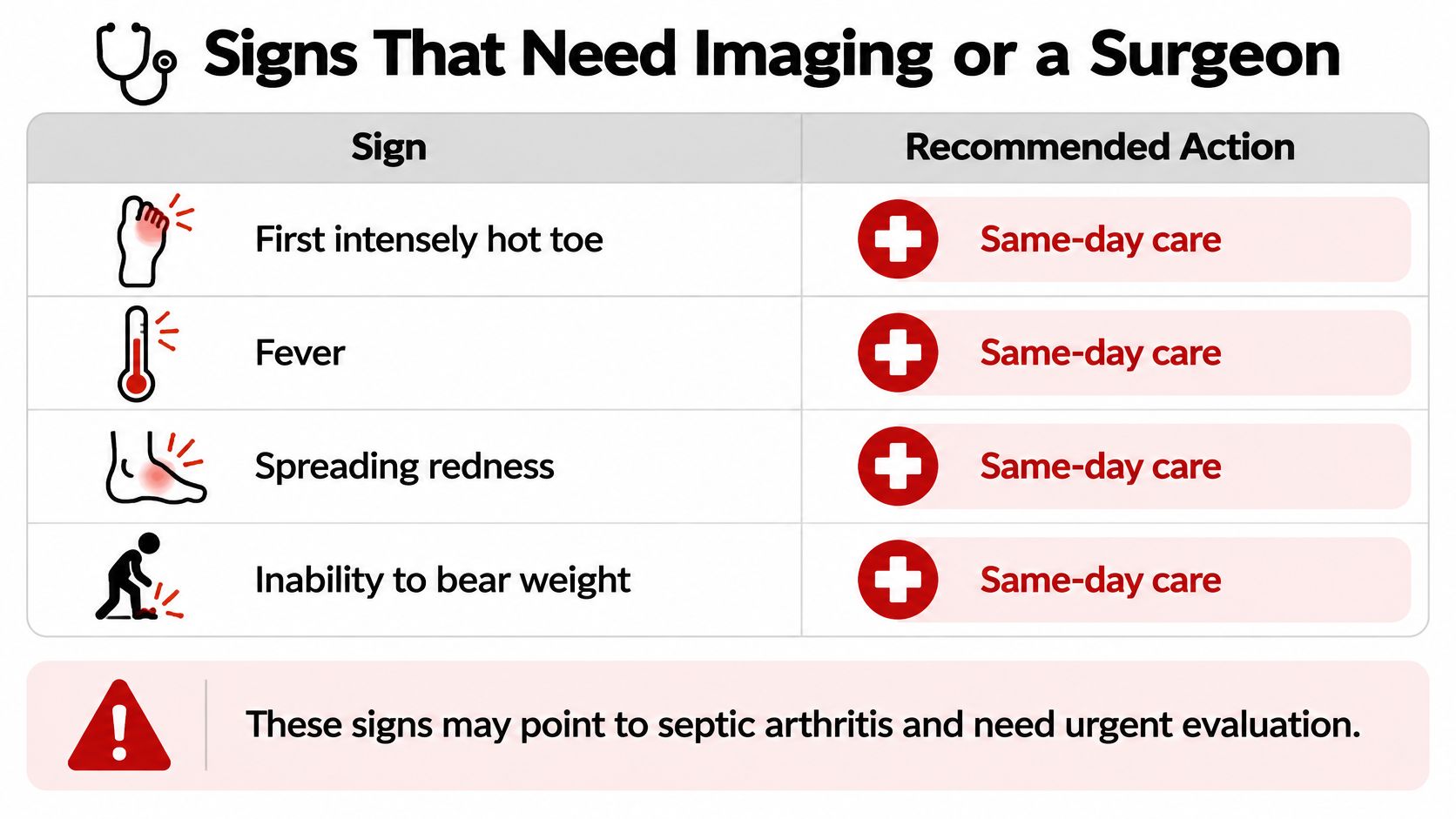
Gout and septic arthritis can coexist. A familiar history of gout therefore doesn't make fever, spreading redness, or a suddenly unusable foot safe to manage at home.
The Canadian primary-care pathway published in CMAJ identifies joint-fluid crystal analysis as the diagnostic gold standard, while recognising that aspiration may be impractical in primary care. It also explains why a normal urate result during an attack and an early X-ray cannot reliably exclude gout.
When big-toe pain should leave home care
| Sign | What it may mean | Next step |
|---|---|---|
| Fever, spreading redness, wound, or cannot bear weight | Gout, infection, or both | Same-day clinician or emergency care |
| First overnight hot red toe | Possible crystal flare; infection must also be considered | Prompt primary-care or urgent assessment |
| Normal uric acid during the attack | Doesn't rule gout out | Arrange repeat urate testing after the flare settles |
| Repeat flares, tophi, kidney disease, or joint damage | Gout that may need urate-lowering therapy | Discuss a clinician-set urate target and treatment plan |
| Months of lost upward bend and a dorsal bump | Hallux rigidus | Examination first; X-ray when function is declining or management needs clarification |
| Disabling pain or almost no upward motion after shoe changes | Advanced hallux rigidus | Podiatric or orthopaedic opinion |
These warning signs deserve urgent attention.
Make the appointment useful
Bring a photograph of the inflamed toe, your medicine list, and a brief account of recent illness, alcohol intake, or unusual meals. Describe function concretely: whether you can finish a work shift, manage stairs, or walk to the shops.
For a stiff toe, referral is about persistent disability despite reasonable conservative care, not a dramatic image. A specialist may discuss spur-removing surgery called cheilectomy or joint fusion, depending on the examination, arthritis pattern, and your goals.
For symptoms extending beyond the toe, our foot and ankle pain guide can help you describe the wider pattern. Don't postpone urgent care to gather perfect notes or try another comfort product.
MEDISTIK offers non-prescription topical pain relief for temporary comfort in sore muscles and joints, including arthritic pain. Visit MEDISTIK to explore our topical formats and pain-management resources alongside a diagnosis-specific plan for your big toe.


