

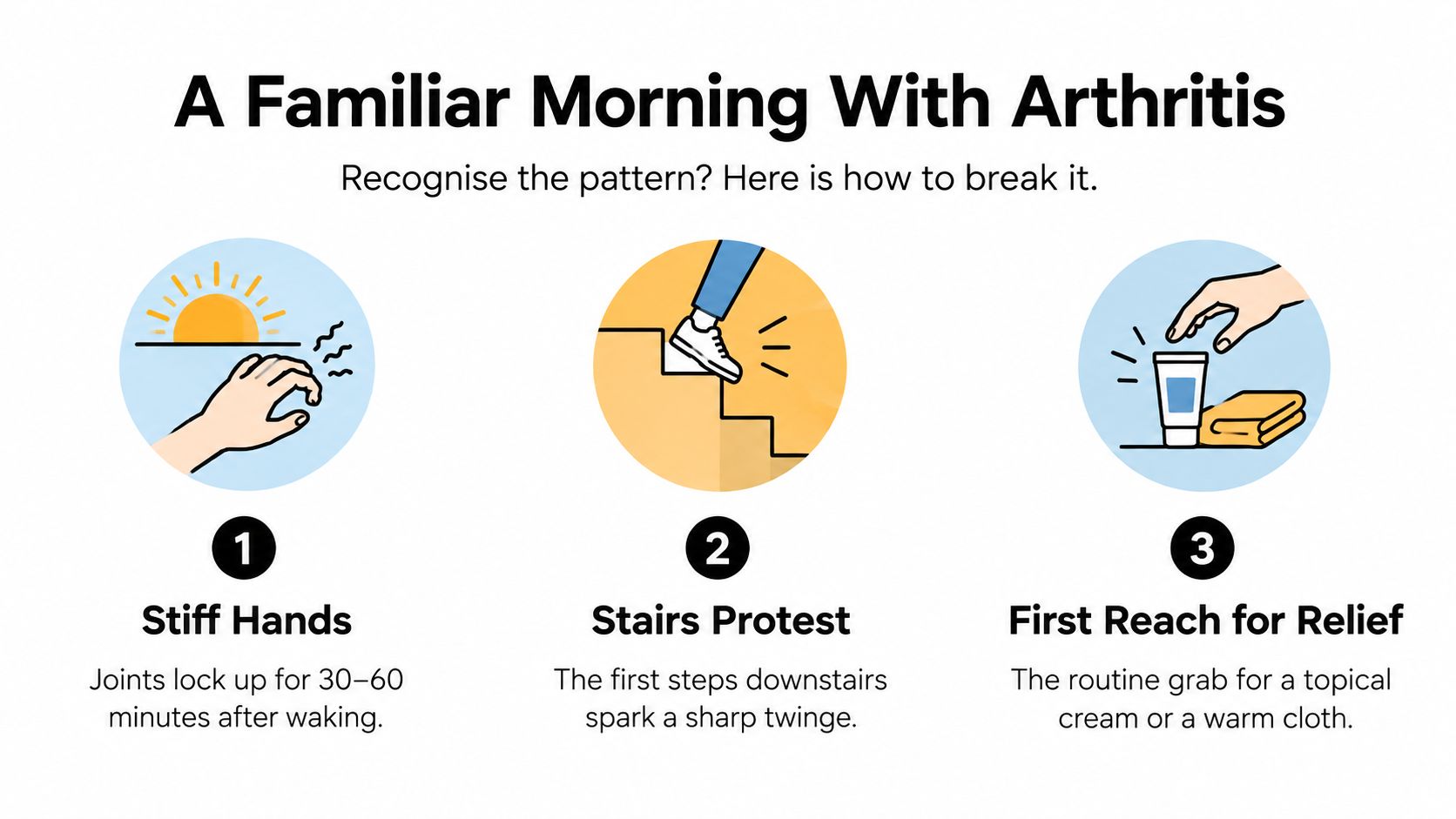
You know the moment. One hand is stiff around the coffee mug, the first steps down the stairs send a jab through the knee, and the day starts with a choice between a warm cloth, a cream, or just pushing through it. For millions of Canadians, that routine is ordinary, not dramatic, which is exactly why arthritis joint pain relief needs to be practical, matched to the right joint, and matched to the right kind of arthritis.
Canada's arthritis burden is large enough to explain why this topic matters. In 2007 to 2008, more than 4.2 million Canadians aged 15 and older, 16% of that population, reported arthritis as a long-term condition, and projections based on those data estimated 6.7 million Canadians, about 20%, by 2031 government data. The condition isn't spread evenly, either. Women were affected more often than men, and provincial prevalence varied widely across the country government data.
Practical rule: if your mornings always start with stiffness, soreness, and a “what will make this tolerable?” decision, the right answer usually depends on whether the problem is local, mechanical, inflammatory, or all three.
Knowing Which Kind of Arthritis You Have
The first question is not how strong the pain feels. It is what kind of arthritis is driving it.
Osteoarthritis usually acts like a joint under wear and load. Inflammatory arthritis involves immune-driven inflammation inside the joint, so the problem is not just mechanical strain. That difference changes the relief strategy in a practical way.
Canadian guidance notes that topical agents may help osteoarthritis symptoms, but they are not routinely used to manage inflammatory arthritis, where NSAIDs mainly ease symptoms and do not change the disease process Canadian guidance. If a joint is swollen, warm, or losing function, topical self-care should not be the only response.
What points toward osteoarthritis
Osteoarthritis often behaves like a joint that complains under load and settles once it loosens up. The knee is a common site, but the hand, back, and hip can also be involved. Canadian arthritis guidance notes that more than 90% of Canadians with OA report pain, stiffness, or aching Canadian guidance. The pattern is usually predictable. Stairs, gripping, walking, and long periods of standing tend to bring it out.
What points toward inflammatory arthritis
Inflammatory arthritis usually announces itself with more than pain alone. Swelling, warmth, and morning stiffness that lasts longer are more concerning than a joint that aches only after activity.
That is the point where local relief has limits. Topical symptom control may still make a sore area more comfortable, but it should not delay assessment or disease-modifying treatment when inflammation is driving the problem.
If the joint is hot, visibly swollen, or losing function, treat that as a clinical checkpoint, not just a pain problem.
A practical way to sort it out is to ask three questions. Is this one joint or several? Does it feel mechanical or inflamed? Does the pattern stay stable, or is it getting worse? If the answers keep pointing toward inflammation, the next step is medical review, not another layer of cream.
For a simple consumer-level overview of local symptom control, this arthritis pain resource fits the joint-specific approach used here.
How Topical Relief Reaches the Joint
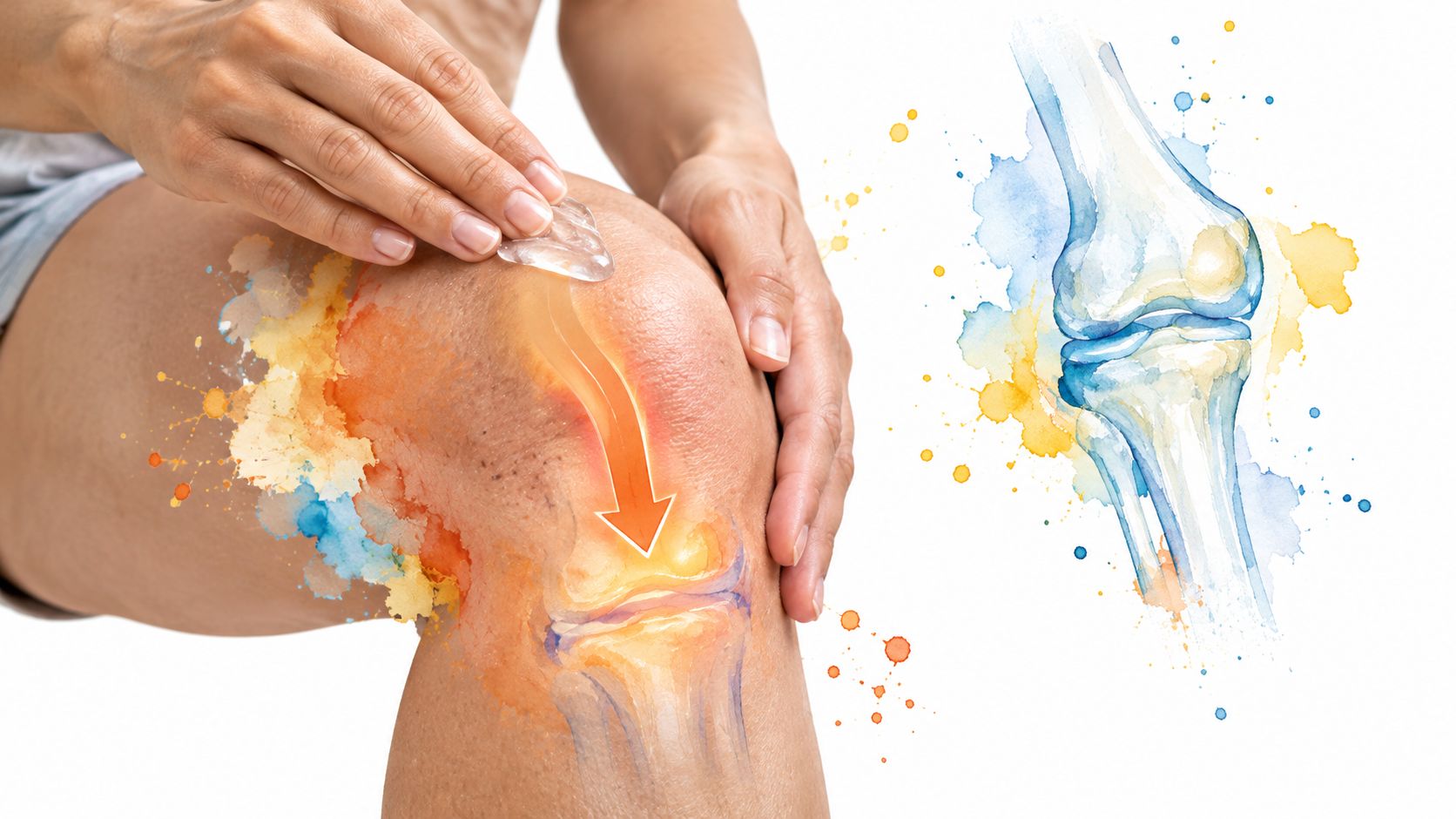
A swollen knee after a walk, a sore hand after gripping, or a localized flare in a superficial joint often calls for a treatment that stays close to the problem area. Topical analgesics fit that pattern. Canadian guidance supports topical NSAIDs for localized osteoarthritis and regional pain syndromes, especially when the goal is to reduce exposure to oral NSAIDs and their broader effects Canadian guidance. The practical advantage is simple, the medicine is placed where pain is felt, while less of it reaches the rest of the body.
The Canadian evidence summary most often cited for this approach points to topical diclofenac. It reported at least 50% pain improvement within six weeks, with an NNT of 5, while topical ketoprofen had an NNT of 7 Canadian Medical Association Journal summary. That is a meaningful response for some people, and it explains why topical diclofenac is more than a minor add-on.
Who benefits most and who should be careful
Topicals tend to work best when the joint is easy to reach and the goal is symptom control. They are also practical for people who need to be cautious with oral NSAIDs. As noted earlier, the trade-off is that the treatment may fit the skin and the joint better than it fits every risk profile. Skin sensitivity, medication interactions, and the need for medical review when symptoms look more serious still matter Canadian guidance.
The limits matter too. Canadian evidence summaries report pain relief that can be similar to oral NSAIDs for chronic OA and acute musculoskeletal pain, but the safety picture changes in people with renal failure, heart failure, anticoagulant use, or other NSAID contraindications Canadian Medical Association Journal summary. These products address symptoms; they do not alter the underlying disease process.
Clinical takeaway: if a topical product helps the joint move better and hurts less, that is useful. If the joint keeps swelling, locking, or losing function, self-treatment has reached its limit.
A practical way to use them is straightforward. Apply the product exactly as labelled, judge the response by pain and function, and reassess after about 6 to 12 weeks Canadian Medical Association Journal summary. For readers who want a closer look at this category, this topical analgesic overview fits the joint-specific approach used here.
Choosing the Right Format for Your Routine
Format matters because arthritis pain shows up in different routines, and the right relief depends on the joint, the setting, and the person using it. A hand flare in the morning, a knee that acts up at work, and an aching shoulder after the gym do not call for the same delivery method. Sticks, sprays, roll-ons, creams, gels, and oral options serve different purposes depending on context.
A stick or roll-on is easy to keep nearby and works well for quick touch-ups. A spray covers a wider area with less effort, which helps when bending or reaching is difficult. Creams and gels suit more deliberate use at home, where you can apply them carefully and wait for them to absorb. Oral options are simpler to take, but they carry the broader NSAID risk profile discussed earlier.
What the common formats feel like
The feel of a product affects whether people keep using it. Menthol-based products usually create a cooling or counterirritant sensation. Capsaicin-based products often feel warm and can tingle after repeated use. Salicylate products tend to fall somewhere in between, depending on the formula. If the sensation is too strong or unpleasant, adherence drops fast.
| Topical Format Comparison for Arthritis Joint Pain Relief | Best For | Onset | Portability |
|---|---|---|---|
| Stick | Quick application on a discrete joint | Fast enough for routine use | High |
| Spray | Larger areas or hard-to-reach spots | Fast | High |
| Roll-on | On-the-go touch-ups, clinic bags, work bags | Fast | High |
| Cream or gel | Measured use at home | Moderate | Lower |
| Oral option | Widespread symptoms when appropriate and safe | Varies | High |
For readers comparing product types, this topical pain relief products overview gives a practical starting point before choosing a format that fits the day.
The right choice is rarely the one that looks strongest on the box. It comes down to whether you can apply it reliably, tolerate it, and use it at the right time. If you will not carry a tube, jar, or bottle with you, that option is a poor fit no matter how well it works in theory.
Combining Heat, Cold, and Movement Wisely
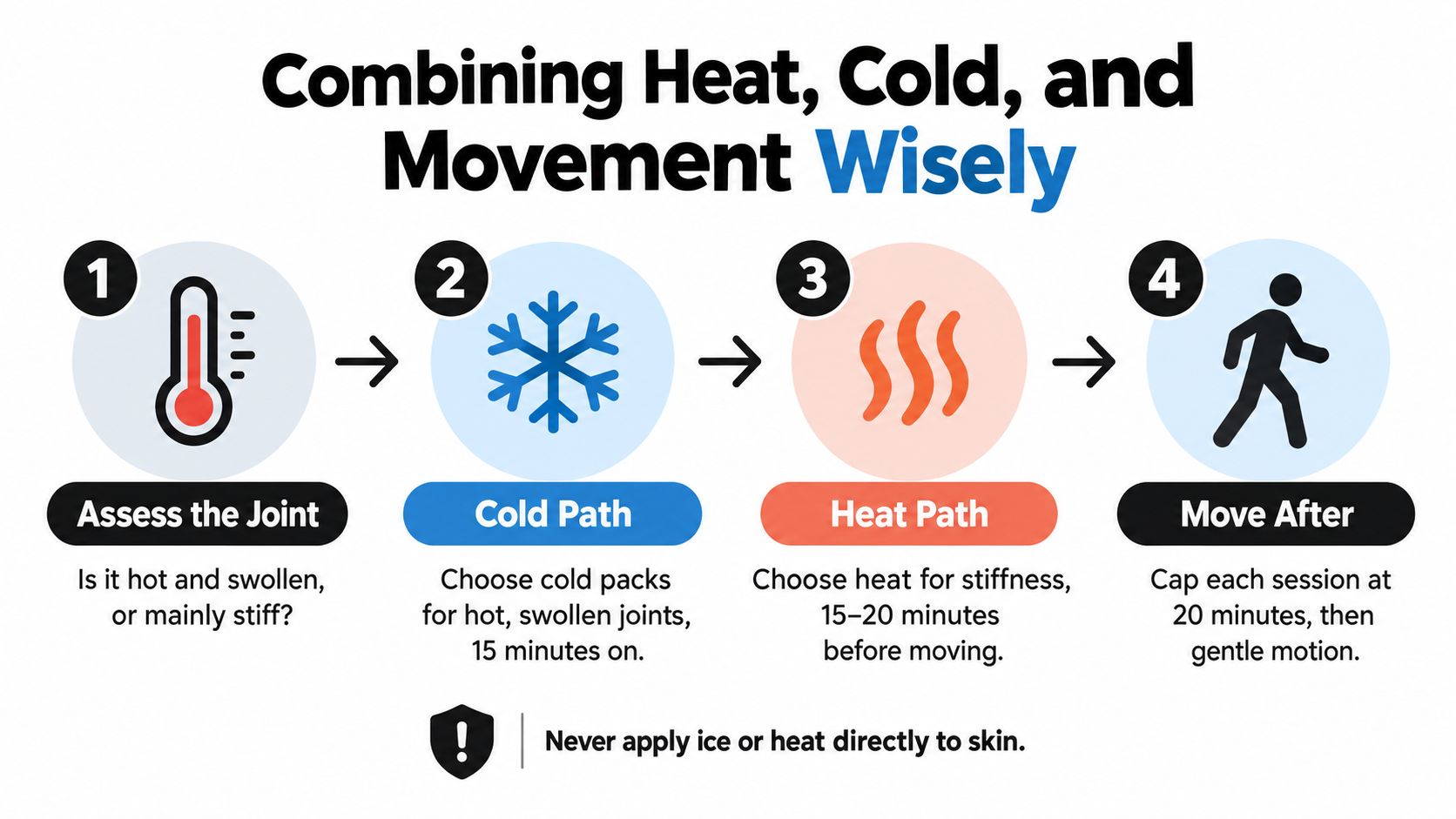
Canadian guidance gives a clear starting point. Use heat for stiffness, muscle tightness, spasms, and reduced range of motion. Use cold for swelling and inflammation. Keep each session to 15 minutes, and place a cloth barrier between the skin and the source Canadian guidance.
Heat should not go over medication patches, because absorption can increase and side effects can follow Canadian guidance.
A practical sequence that works
Look at the joint before you decide what to do. Puffy, warm, irritated joints usually do better with cold first. Stiff, tight joints usually respond better to heat first. After that, move the joint gently within tolerance instead of leaving it still for hours.
Sequence it this way: assess the joint, use the right temperature, then do tolerable movement rather than prolonged rest.
Timing matters. Canadian guidance recommends waiting 10 to 15 minutes after cold before exercise Canadian guidance. That pause helps avoid starting movement while the joint is still numb.
For a quick refresher on choosing between temperature-based relief options, see this ice or heat for inflammation guidance.
The best daily routine is often topical relief first, then heat or cold if needed, then a short round of range-of-motion work or a brief walk. The aim is not to erase every sensation. The aim is to get enough movement back that the day stays workable.
Exercise That Helps Without Wrecking the Joint
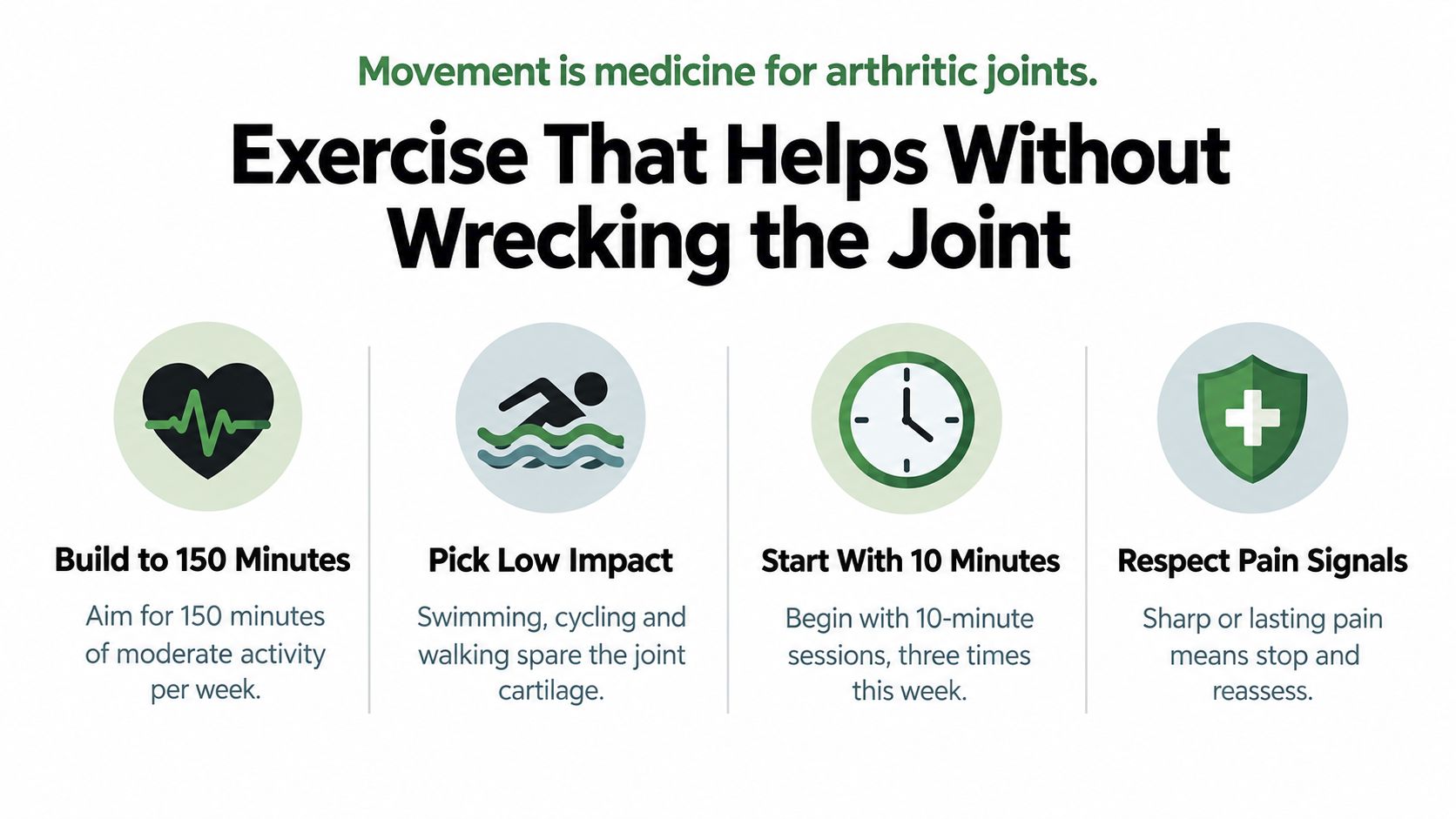
Movement is one of the few tools that helps pain, stiffness, and function at the same time, as long as it is dosed sensibly. Canadian guidance supports 150 minutes of moderate-to-vigorous activity weekly if tolerated, and that target works best when people build toward it rather than trying to jump there on day one Canadian guidance.
Start with what the joint tolerates
Walking, cycling, yoga, and water exercise are the kinds of options that fit many arthritic joints because they load the body without the same pounding as repetitive impact. Canadian arthritis guidance also frames activity during a flare more carefully, gentle range-of-motion work still belongs in the picture, especially when the joint isn't locked up with swelling Canadian guidance.
A simple rule keeps people honest. Pain that settles within an hour after exercise is usually part of normal loading. Pain that worsens the next day, or that feels sharp enough to change your gait, means the dose was too much.
Build a week that's realistic
A cautious start can be as small as 10-minute sessions, three times this week, then a gradual increase as the joint responds. That structure is often easier to keep if you use an adaptive workout planning app to map activity around flare days, work shifts, and recovery time. The point is not to train harder. It's to keep moving without paying for it later.
If the knee is the sore joint, the smartest loading options are often pool work, level walking, and controlled strengthening before stairs or repeated jumping. Best exercises for knee arthritis offers a more joint-specific version of that approach.
Good sign: the joint feels warm, looser, and more usable after movement.
Bad sign: the pain spreads, sharpens, or leaves you worse off the next day.
Topical relief can help here too. Used before a warm-up, it can make the first few minutes more tolerable, which makes people more likely to finish the session instead of quitting at the door.
Habits and Misconceptions That Make Pain Worse
A patient with a hot, swollen knee who reaches for a heating pad before work is a common scenario in clinic. The pad may feel soothing for a few minutes, then the joint stays puffy and harder to settle. Canadian guidance separates these responses: heat helps stiffness, while cold is a better fit for swelling and inflammation.
Another mistake is treating early relief as a signal to keep piling on more medication. More NSAID exposure is not automatically better, and the safer approach is to use the lowest effective dose for the shortest duration, especially when cardiovascular disease, diabetes, smoking, obesity, or other risk factors are in the picture Canadian guidance. A product should earn its place by helping enough to justify its trade-offs.
Small swaps that change the day
- Stop using heat on a visibly swollen joint. Switch to cold and see whether the swelling eases.
- Do not treat every painful joint the same way. If the joint is warm, stiff for a long time, or losing function, it deserves an examination.
- Keep moving during a flare, but reduce the load. Gentle range-of-motion work usually beats complete shutdown.
- Check footwear and work setup. Poor support, awkward desks, and repeated stair stress make knee and hip pain harder to calm.
Rest can also become a trap. Full immobilisation often leaves the joint more guarded and less willing to move later. Short, tolerable movement usually does more good than waiting for pain to disappear on its own.
The goal is not perfect symptom control. The goal is a pattern that keeps the joint working while the cause is being addressed.
Context matters more than brand loyalty. A topical option that helps a hand joint may not be enough for a knee that is loaded all day at work. Relief should follow the joint involved, the task it has to handle, and the patient's risk profile, not a habit carried over from last month's flare.
Knowing When Home Relief Is No Longer Enough
A home routine has a limit. If pain keeps climbing after a reasonable trial of topical relief, the next step is assessment, not more guessing. Canadian guidance uses a 6 to 12 week review window for topical NSAIDs, but I move sooner when pain is worsening, sleep is being disrupted, or the joint is starting to lose function.
Some signs should shorten the timeline right away. Sudden swelling, warmth, redness, locking, numbness, tingling, or a clear drop in movement can point to inflammatory disease, structural injury, or nerve involvement. Those are not ordinary stiffness symptoms, and they deserve a clinician's exam.
What a clinician may do next
The first step is usually a careful history, then a physical exam of the joint. From there, a clinician decides whether imaging, bloodwork, or referral makes sense. If inflammatory arthritis is on the table, earlier specialist review matters more than trying yet another round of self-directed relief.
A short check-in list helps keep the decision practical. Ask whether the pain pattern is still matching the likely arthritis type, whether the format still fits the joint and your risk profile, whether swelling is taking priority over stiffness, and whether the joint is functioning better or worse than it was at the last review. If the answer is no, or the joint is escalating, it is time to get it examined.
If the pattern is clear and the relief is real, keep using what works. If the joint keeps worsening, waiting usually makes the problem harder to calm.


