

Many people use an ice roller like it's a beauty prop. In a rehab setting, that's the wrong mental model. A cold roller is a local dosing tool, and if you use too much pressure, too much time, or the wrong target, it can irritate tissue instead of settling it.
Understanding the Clinical Role of an Ice Roller
An ice roller belongs in the same family as local cold applications, but its role is narrower than online claims suggest. It is built for brief, targeted cooling. That can settle superficial pain, make an irritated area feel less hot, and reduce the discomfort that comes with a fresh flare-up. Used properly, it works more like controlled ice massage than a whole-body recovery method.
Local cold is not whole-body cryotherapy
That distinction matters. CBC reported that cryotherapy spread through Europe during the 1990s and reached North America around 2011, largely through high-performance athletes and professional sports teams CBC coverage of cryotherapy's spread and Canadian context. An ice roller does not expose the entire body, and it should never be treated as a systemic recovery treatment.
Practical rule: if the goal is local comfort around a joint, tendon, or small muscle group, a roller can be useful. If the goal is broader recovery, it is the wrong tool.
The clinical question is simple. Use the roller for surface cooling and light massage when the problem is small, recent, and easy to localize. If the pain is severe, spreading, or linked to loss of function, the roller should not be the main response.
That is also why cold therapy needs timing and restraint. Cold can calm a reactive area, but over-icing can leave tissue numb without changing the underlying problem, which is why I prefer to pair it with clear use cases and, when appropriate, practical adjuncts such as ice or heat for inflammation. In real rehab work, the roller is a portable, targeted cooling aid, not a substitute for assessment or a plan when symptoms are persistent or unexplained.
Selecting the Right Tool for Musculoskeletal Recovery
A roller that feels fine on the face can be awkward on a swollen knee or a tight calf. Recovery work asks for a different build. You need a tool that stays cold enough to be useful, fits the body part you're treating, and lets you keep the contact light and moving.
Build, grip, and contact shape
A gel core usually makes more sense for recovery than a water-filled one because it tends to stay pliable and conform more easily to curved anatomy. That matters around an ankle, elbow, or shoulder, where a rigid head can feel clumsy and create uneven pressure. A water-filled design may be perfectly acceptable for cosmetic use, but it's not automatically the better recovery choice.
Handle ergonomics matter just as much. If your wrist tires after a minute, you'll start pressing too hard or moving too slowly, and both are common mistakes. The roller should let you guide it with a relaxed grip, not force you to brace your forearm through the whole session.
Choosing head size for the tissue you're treating
Broad muscle groups need broader contact. Narrower joints need precision. A larger head can cover quadriceps, hamstrings, or the side of the thigh efficiently, while a smaller head is easier to control around the elbow, forearm, or jawline.
| Ice Roller Selection Criteria | Best for Recovery | Avoid |
|---|---|---|
| Core type | Pliable gel that conforms to joint contours | Rigid construction that feels harsh on bony areas |
| Handle design | Stable, ergonomic grip that keeps pressure light | Slippery or awkward handles that make you over-squeeze |
| Head size | Larger head for muscle groups, smaller head for joints | One-size-fits-all design that misses narrow areas |
| Contact feel | Smooth glide with steady control | Rough edges, sticking, or unstable rolling |
If you're looking for a complementary local tool for recovery work, prevent foot injuries for athletes is a useful reminder that the best device is usually the one matched to the region, not the trend.
Safe Application Techniques for Acute Swelling
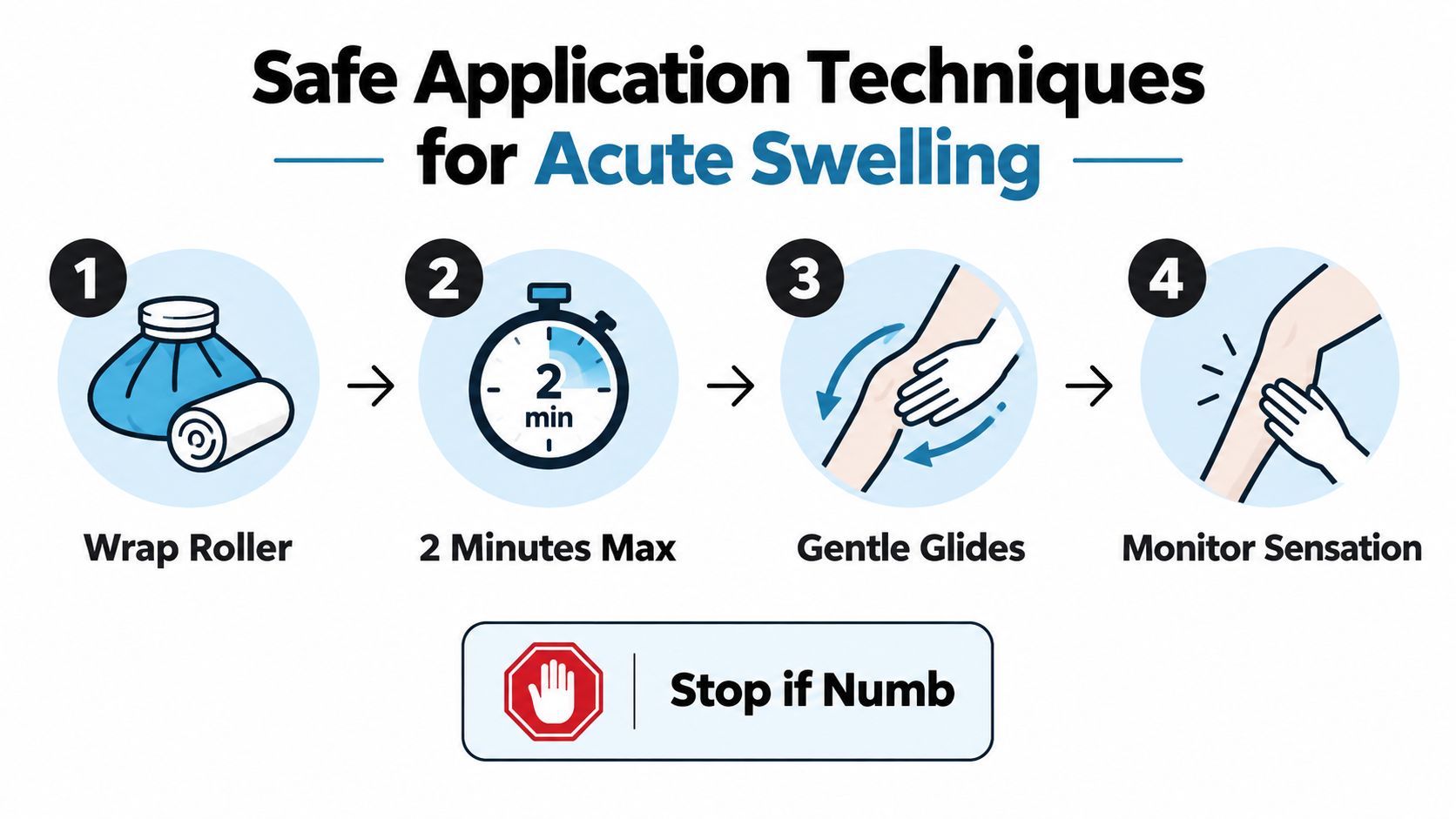
Cold works best when you treat it like a dose, not a reflex. On superficial tissue, the difference between helping and irritating the area can come down to a few quiet minutes, too much pressure, or letting the roller linger in one spot.
The basic protocol
Start on intact skin with light contact. A practical first pass is about 5 minutes for pain reduction, then reassess the skin and sensation before deciding whether to continue toward 5 to 10 minutes. UBC's evidence-informed cryotherapy guidance notes that smaller, superficial areas need shorter exposure than larger, deeper tissues, and that pain reduction may only require about 5 minutes UBC cryotherapy guidance.
Keep the roller moving. If it is parked in one spot, you are no longer using massage, you are concentrating cold in one area.
Use continuous, gliding strokes over a small target area. Avoid sustained pressure over superficial nerves, especially around the outer knee or the inside of the elbow. A roller should follow the body's contour, not pin a nerve against it.
Where technique goes wrong
The common mistakes are straightforward. People press harder because they assume the cold needs help reaching deeper tissue. They leave the roller in one place because the area feels sore. They also chase numbness, as if the strongest cooling effect were the goal.
It is not. Light pressure, movement, and repeated skin checks keep the session useful. Visual checks during cold application matter because the skin can turn pale, mottled, or overly numb before the user notices a problem. The same caution applies to any stronger cold source, which is why conservative dosing is the safer default.
If the skin turns persistently pale, mottled, or painfully numb, stop. If the area starts burning, stinging, or developing wheals, stop. For an acute flare, cold should feel controlled and tolerable, not dramatic.
For a practical comparison of cold and heat in swelling care, see swelling, heat or ice.
Integrating Cold Therapy with Topical Analgesics
Cold therapy is strongest when you use it for what it does well, not for everything you wish it did. It can blunt sharp discomfort and calm an irritated area, but it doesn't replace a more complete pain-management routine once the skin has re-warmed.

Sequence matters more than people think
Cold first, topical analgesic second is the cleaner sequence in a real-world recovery routine. The roller helps manage the immediate sensation of swelling and discomfort. Once the skin has returned to a normal baseline temperature, a topical product can be applied without trapping excessive cold against the skin or making the area feel overstimulated.
A product such as MEDISTIK's ICE Natural Fast Acting Roll-On fits that sequence because it's designed for external topical cooling relief. I'd use that kind of option after a short roller session when the skin feels settled, not while I'm still actively chilling the area.
Why the transition should be deliberate
Don't go from freezer-cold rolling straight into heavy layering of products. Let the skin normalise first. That simple pause helps you judge whether the pain is easing, whether the swelling is local, and whether the area is still safe to treat.
The goal isn't to create the coldest sensation possible. The goal is to reduce symptoms enough that movement, rest, and the rest of your recovery plan become easier to carry out.
That's where a roller and a topical analgesic can complement each other. The roller handles the immediate local cooling. A topical formula can then fit into the session as a separate step for temporary relief of sore muscles and joints, which is a much more practical sequence than trying to make one tool do everything.
Contraindications and Warning Signs to Monitor
Colder and longer is not better. That approach can create avoidable problems, especially for people whose circulation, sensation, or skin reactivity is already compromised. If tolerance is uncertain, stop early and reassess.
Who should avoid it
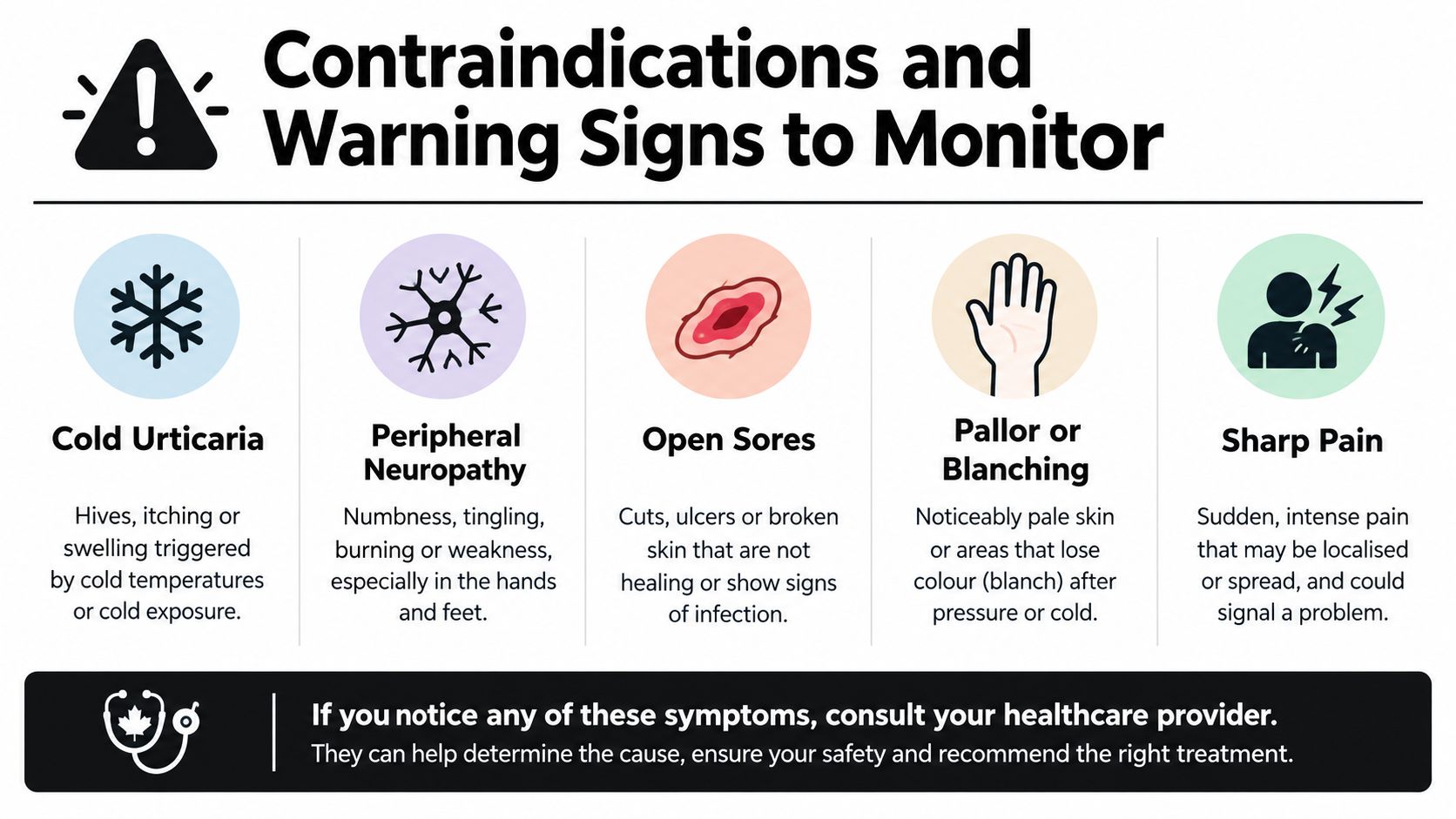
People with Raynaud's disease, cold urticaria or hypersensitivity, impaired circulation, impaired sensation, open or infected wounds, acute dermatitis, or an inability to communicate discomfort should avoid ice rolling. These are not minor cautions. They are situations where a simple recovery tool can cause more harm than relief.
Cold injury is real, even though environmental exposure data are not the same as a handheld roller. The Government of Canada recorded 1,678 cold-related deaths between 2011 and 2023, averaging 129 deaths annually, and 9,425 cold-related hospitalizations over the same fiscal period, excluding Quebec Government of Canada cold-related injury data. That does not mean a roller causes those outcomes. It does mean cold exposure deserves respect, and tissue response matters.
What to watch for during a session
Stop immediately if you see or feel any of the following:
- Persistent pallor or blanching that does not settle quickly
- Mottling or unusual colour change across the treated area
- Wheals or hive-like reaction on the skin
- Sharp pain, burning, or escalating discomfort
- Excessive numbness or loss of normal sensation
Cold therapy also has practical trade-offs with other recovery methods. For example, ice or heat for ligament injury depends on the tissue state, because the wrong temperature can irritate an already sensitive area. Health Canada has also warned that unlicensed cryotherapy equipment can cause cold burns, frostbite, tissue damage, and circulation-related problems. That warning belongs in the background whenever anyone is tempted to overdo cold exposure.
Cleaning and Maintenance for Clinical Hygiene
A roller that touches sweaty skin, post-training skin, or shared treatment spaces needs basic hygiene. If you skip that part, you're carrying bacteria from one session to the next and shortening the life of the tool at the same time.
Simple care routine
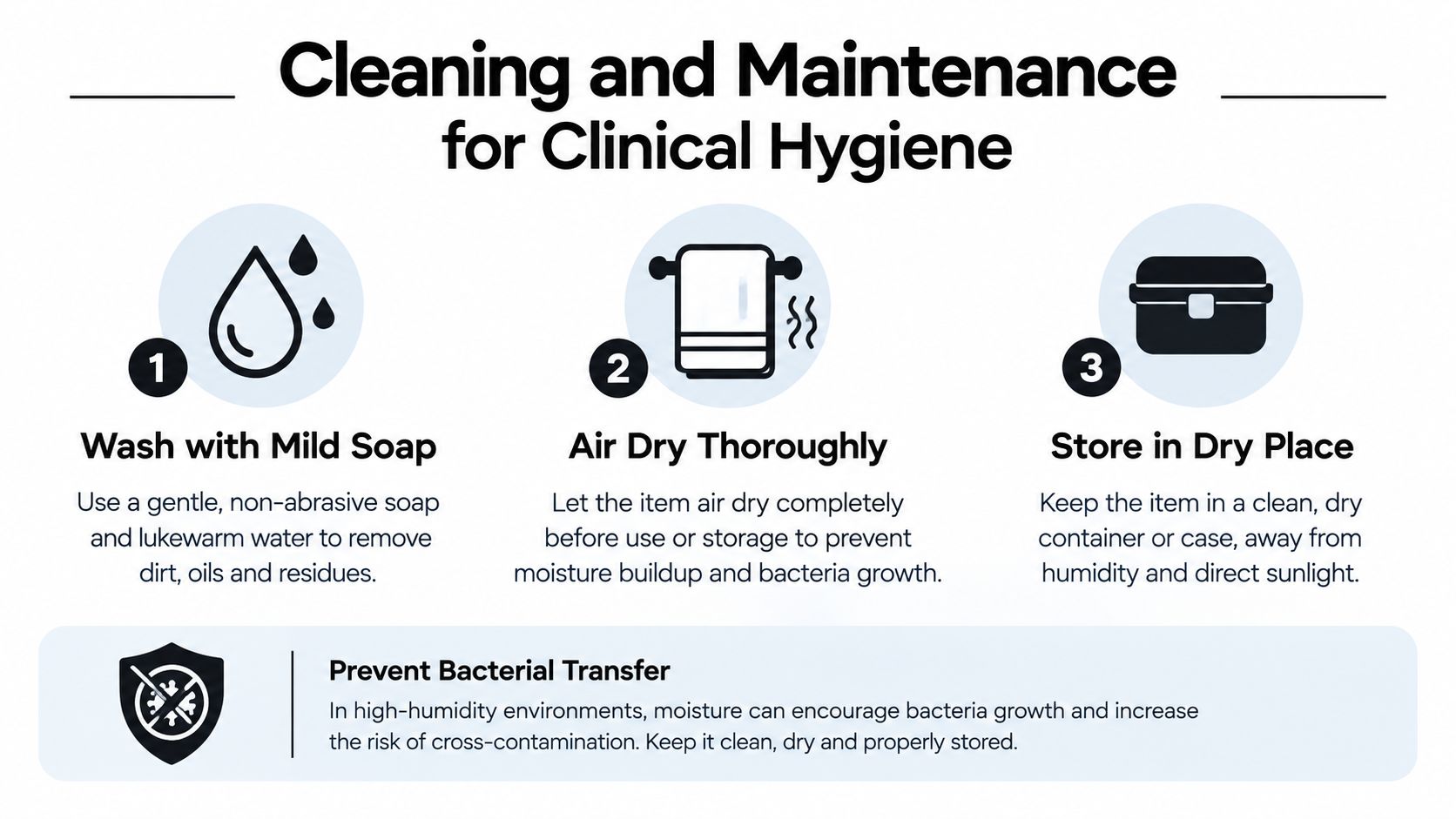
Wash the roller with mild soap and water after use, then dry it thoroughly before it goes back into storage. That keeps residue from building up on the shell and helps prevent bacterial transfer in humid spaces. Harsh chemical disinfectants can be overkill for consumer tools and may degrade the casing or core over time.
Store it in a dry place, ideally in a sealed bag or case if it lives in a freezer with food. That limits odour transfer and helps protect it from freezer burn. It also keeps the roller ready for immediate use when you need a short, controlled session.
Clinical common sense
Don't put a damp roller straight back into a crowded freezer shelf. Moisture, crumbs, and food odours aren't just unpleasant, they're avoidable contamination points in a busy home or clinic. Dry storage is a small habit, but it preserves both hygiene and structure.
If the roller is part of a rehab room or sports bag, check it regularly for cracks, soft spots, or loose seals. Once the core or casing starts breaking down, the tool stops behaving predictably, and predictability is the whole point of using it in the first place.
MEDISTIK offers Canadian-made topical pain relief designed for warm-up, performance, and recovery, including an extra-strength stick, a fast-acting spray, and a cooling roll-on that fits well after a short ice-roller session. If you want a practical routine that combines controlled cold with topical relief, visit MEDISTIK and look for the format that matches your training, clinic, or day-to-day recovery needs.


