

That nagging ache you feel right between your shoulder blades? It’s more than just a simple annoyance. Think of it as a signal your body is sending to let you know something is out of balance.
This specific kind of discomfort, often called interscapular pain, usually points back to muscle strain, poor posture (hello, "tech neck"), or even underlying issues with your joints. Figuring out how to get relief really starts with getting to the bottom of what’s causing it in the first place.
Why That Nagging Pain Between Your Shoulder Blades Won't Quit
Whether it's a sharp twinge or a dull, constant ache, that feeling is your body trying to tell you something. The area between your shoulder blades is part of your thoracic spine, and it’s a seriously complex hub of muscles, nerves, and bones. It’s built to be stable yet mobile, but our modern lives often push it way past its limits.
Picture your upper back muscles as a dedicated crew, working all day to hold up your head and support every move your arms make. When you spend hours slouching over a desk or staring down at your phone, you’re basically forcing key muscles—like your rhomboids and middle trapezius—into a stretched-out, strained position for way too long. At the same time, your chest muscles get tight, which only pulls your shoulders forward and makes the whole imbalance worse.
The Most Common Triggers
This kind of pain rarely pops up because of one single thing. Instead, it’s usually the result of daily habits that stack up over time, eventually leading to that chronic soreness you can’t seem to shake.
- Poor Posture: This is the big one. "Tech neck" from staring at screens and just general slouching puts a ton of constant tension on the muscles and ligaments in your upper back.
- Muscle Strain: Did you just start a new workout, lift something the wrong way at the gym, or spend the weekend doing heavy yard work? Overdoing it can cause tiny tears and inflammation in the muscles.
- Repetitive Motions: If your job or a hobby involves doing the same arm and shoulder movements over and over, you can wear out those muscles, leading to a deep, nagging ache.
The pain you're feeling is often a sign that your main postural muscles are overworked. When the big support muscles get tired or weak, smaller muscles have to jump in and compensate. This leads to inflammation and trigger points—what most of us know as those tight, painful knots.
It's Not Always Just Muscle Aches
While muscle strain is definitely a common culprit, it’s not the only possible reason for your discomfort. Sometimes, the problem actually starts in the spine itself.
For example, a herniated disc in your neck or upper back can press on a nerve, sending pain signals out to the area between your shoulder blades. In a similar way, osteoarthritis can cause joint inflammation that radiates into the muscles nearby. Learning to spot these different patterns is the first real step toward finding a solution that gives you lasting relief.
What Causes Soreness Between the Shoulder Blades?
Think of your upper back muscles as the unsung heroes holding up your head and arms all day. They work tirelessly to keep your posture stable and allow you to move freely, but understanding their basic anatomy helps explain why that spot right between your shoulder blades gets so sore.
The two main players here are the rhomboid muscles, which act like ropes pulling your shoulder blades toward your spine, and the large, blanket-like trapezius muscle that spans your neck and shoulders. When you spend hours slouching over a desk or hunched over your phone, these muscles get overstretched, tired, and inflamed. The result? That nagging, persistent tension right between your shoulders.
Key Muscles Involved
The rhomboids are located deep under the trapezius, connecting your spine to the inside edge of your shoulder blades. When they get tight, it can feel like a deep, pulling sensation that makes it hard to move your shoulders properly.
Your trapezius, on the other hand, is a big, diamond-shaped muscle running from your neck down to your mid-back. It works with a team of smaller stabilizer muscles to hold you upright.
A few common culprits that put these muscles to the test include:
- Slouching at a desk all day, which constantly overstretches your rhomboids.
- Lifting heavy boxes without proper form, putting immense strain on your traps.
- Repetitive movements in sports, like swimming laps, which can easily overwork the entire upper back.
- Chronic stress, which keeps your neck and shoulder muscles in a constant state of tension.
How Everyday Habits Overstretch These Muscles
Imagine your rhomboids and trapezius are like a rubber band. When you hold a forward-head posture for hours on end, that "band" gets stretched far beyond its comfortable resting length.
Things like texting for an entire evening, lugging around a heavy backpack, or leaning over the counter to cook can all stretch those muscular bands. Over time, this constant tension creates tiny micro-tears and inflammation in the muscle fibres.
Here’s how quickly it can happen:
- Looking down at your phone for just 30 minutes without a break can create up to a 60° forward head tilt, dramatically increasing strain on your rhomboids.
- Carrying a single-strap bag forces the traps on one side of your body to overcompensate for the unbalanced load.
- Bending over to prep dinner without any back support forces your muscles into a lengthened, weakened position for long enough to cause fatigue.
Other Triggers to Keep in Mind
Improper lifting doesn’t just strain the traps; it also forces neighbouring muscles like the erector spinae to jump in and stabilize your torso. It’s like trying to carry a heavy box while your body is wearing unbalanced weights—something is bound to give.
Repetitive motions from work or sports, like painting a ceiling or swimming, can wear down specific muscle fibres much like overuse frays the bristles of a paintbrush. On top of that, chronic stress makes everything worse by keeping your muscles locked in a constant state of high alert.
The Clear Link Between Posture and Pain
Your posture is basically a roadmap showing where stress accumulates in your upper back. As soon as you start to slump, that stress zeroes in on the area between your shoulder blades. Before you know it, small, seemingly harmless habits can snowball into persistent soreness.
Think of a slumping posture like a leaning tower—even small misalignments at the base will eventually cause the entire structure to wobble under pressure.
The concept map below shows exactly how common issues like poor posture and muscle strain come together to create that all-too-familiar soreness between the shoulder blades.
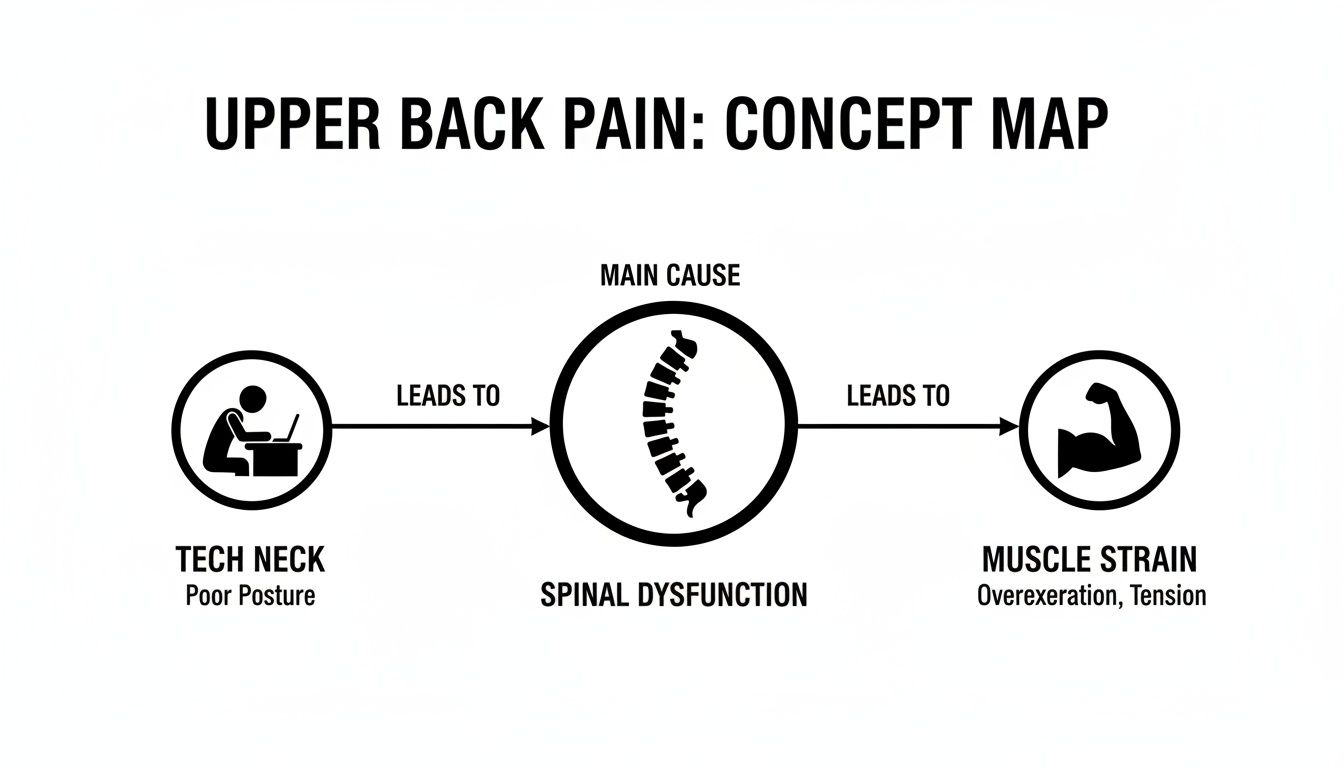
As you can see, things like tech neck and improper lifting directly lead to spinal misalignment and muscle fatigue.
A Look at the Numbers in Canada
In Canada, soreness between the shoulder blades is often part of the larger issue of chronic pain, which affects about 18.9% of adults nationwide. Looking closer, regional rates show 21.8% in British Columbia, 20.6% in Alberta, and 19.6% in the Prairies are dealing with chronic pain.
To help you connect the dots, here’s a quick breakdown of the most common triggers for this type of pain and the specific muscles involved.
Common Causes of Soreness Between Shoulder Blades
| Cause | Primary Muscles Affected | Typical Activities |
|---|---|---|
| Tech Neck or Poor Posture | Rhomboids, Trapezius | Desk work, prolonged smartphone use, reading |
| Improper Lifting Technique | Trapezius, Erector Spinae | Manual labour, moving furniture, lifting children |
| Repetitive Motions | Multiple upper back muscles | Swimming, painting, assembly line tasks, rowing |
This table shows just how easy it is for daily activities to contribute to discomfort if we're not careful.
For a deeper dive into managing this specific type of injury, check out our detailed guide on upper back muscle strain.
Now that you have a better grasp of the "why," we can move on to figuring out the right relief methods for you.
Actionable Self-Care For Immediate Relief
When that ache between your shoulder blades flares up, you want relief, and you want it now. Waiting for it to go away on its own isn't always practical. Here are some actionable, at-home methods you can use to manage the discomfort and kick-start the healing process right away.
The age-old debate always comes up first: ice or heat? The right answer really just depends on what kind of pain you're dealing with. A simple way to think about it is that ice is for injuries, and heat is for muscle stiffness.
Mastering Cold and Heat Therapy
If you're dealing with fresh, acute pain—maybe you overdid it at the gym or lifted something the wrong way—cold therapy is your go-to for the first 48 hours. Grab an ice pack, wrap it in a towel, and apply it for 15-20 minutes. The cold helps constrict blood vessels, which reduces inflammation and swelling. It also has a nice numbing effect that provides immediate, localized relief.
On the flip side, for that chronic, nagging stiffness that's been hanging around for a while, heat is what you need. A heating pad or a warm compress for 15-20 minutes helps dilate the blood vessels, boosting blood flow. This brings more oxygen and nutrients to the area, helping to relax those tight, tense muscles and soothe the ache. Knowing when to use which is a game-changer for effective relief.
Key Takeaway: Use ice for new pain and inflammation within the first two days to calm things down. Use heat for older, lingering stiffness and muscle tightness to promote circulation and relaxation.
If you'd like to dive deeper, you can learn more about when to use heat or cold for a muscle strain in our detailed article.
Gentle Stretches To Release Tension
A major cause of soreness between the shoulder blades is simply tight muscles. Gentle, targeted stretching can do wonders to release that built-up tension, improve your flexibility, and bring some much-needed relief. The key here is to move slowly and never push into any sharp pain.
Here are three simple but powerful stretches you can do just about anywhere:
- Cat-Cow Stretch: Get on your hands and knees with a neutral spine. On your inhale, let your belly drop as you look up, arching your back (Cow Pose). As you exhale, round your spine up towards the ceiling and tuck your chin to your chest (Cat Pose). Flow between these two positions 10-15 times to gently get your upper back moving.
- Cross-Body Arm Stretch: Whether you're standing or sitting, bring one arm across your chest. Use your other arm to gently pull it a little closer to your body until you feel a good stretch between your shoulder blades. Hold for 20-30 seconds, then switch sides.
- Doorway Stretch: Find a doorway and place your forearms on the frame, with your elbows bent at a 90-degree angle and just below shoulder height. Step forward with one foot until you feel a gentle stretch opening up your chest and the area between your shoulder blades. This is a fantastic counter-stretch for all the slouching we do.
Remember, these movements are meant to be restorative, not strenuous. Always listen to your body and focus on breathing deeply and steadily as you stretch.
The Role of Topical Analgesics for Targeted Relief
When you need to hit the pain right where it hurts, a topical analgesic offers a powerful solution without affecting your whole body like oral medications. You apply it exactly where you need it, and it goes to work.
Products with active ingredients like menthol and camphor are especially good for that soreness between the shoulder blades. They work on something called the "gate control theory" of pain. Think of it like this: pain signals are messages trying to get through a series of "gates" to your brain.
The strong cooling or warming sensations from menthol and camphor essentially rush the gate, blocking the pain signals from getting through. This process, known as counter-irritation, overrides the ache in your muscles and provides fast, targeted relief—no pills required. This makes them a fantastic option for managing localized muscle pain and getting you back to your day more comfortably.
Building a Stronger Back to Prevent Future Pain
Getting rid of that nagging soreness between your shoulder blades isn’t just about dealing with flare-ups when they happen. The real secret to lasting comfort is building a resilient, stronger back that's less likely to get injured in the first place. It’s a shift from putting out fires to preventing them altogether.
Think of it this way: your postural muscles are the foundation of your upper body. If that foundation is weak, things start to crumble under pressure. But when you strengthen the muscles that support good posture, the whole structure becomes more stable.
Strong rhomboids and trapezius muscles basically act like a built-in support system. They hold your shoulder blades where they're supposed to be, stopping that all-too-common forward slump that kicks off the pain cycle. It's about taking control and moving from being reactive to proactive about your back health.
Essential Strengthening Exercises
You don't need to become a bodybuilder to see a huge difference. Just a few targeted exercises can wake up and strengthen those dormant postural muscles. Honestly, consistency beats intensity every single time.
Just be sure to focus on good form to get all the benefits without causing more strain. Start with a light weight or resistance that feels comfortable, and you can always build up as you get stronger.
Here are three of my go-to exercises for clients:
-
Scapular Squeezes: This is the absolute best starting point for activating your rhomboid muscles. Sit or stand up straight with your arms by your sides. Without letting your shoulders creep up toward your ears, gently pull your shoulder blades together like you’re trying to pinch a pencil between them. Hold that squeeze for 5 seconds, then relax. Aim for 2-3 sets of 10-15 reps.
-
Resistance Band Rows: This exercise is fantastic for targeting the muscles that pull your shoulders back into alignment. Secure a resistance band to something sturdy at about chest height. Grab the ends with your arms stretched out in front of you. Pull the band back towards your chest, keeping your elbows tucked in and squeezing your shoulder blades. Go slow and controlled on the way back out. Try to complete 2-3 sets of 10-15 repetitions.
-
Wall Angels: This one is a game-changer for thoracic spine mobility and getting your shoulder blades moving correctly. Stand with your back flat against a wall, making sure your head, shoulders, and hips are touching it. Bend your elbows to a 90-degree angle and raise your arms to the side, like you're making a goalpost shape. Slowly slide your arms up the wall as far as you can without your back arching or your arms popping off. Then, slide them back down. Do about 10-12 repetitions.
Creating a Consistent Routine
Building strength takes time, so the trick is to weave these exercises into a routine you can actually stick with. You don’t need to block off hours at the gym. Even 10-15 minutes, three or four times a week, can make a world of difference.
A strong back is built through consistent, mindful movements, not occasional, intense efforts. Think of it as daily maintenance for your posture, preventing small issues from becoming chronic problems.
The easiest way to make it a habit? Link it to something you already do. Maybe you do your scapular squeezes and band rows while your morning coffee brews, or a set of wall angels during a work break. If it's convenient, you're far more likely to do it.
Balancing Strength with Flexibility
While strengthening your back is key, you can't forget about flexibility. Tight chest muscles (your pecs) are a huge culprit behind upper back pain. They pull your shoulders forward, putting your back muscles under constant strain.
You need to counteract that pull by opening up the front of your body. A simple doorway stretch is perfect for this. Just place your forearms on either side of a door frame and take a gentle step forward until you feel a stretch across your chest. When you combine this kind of stretching with your strengthening exercises, you create a much more balanced and functional upper body.
This two-pronged approach not only helps prevent future soreness between the shoulder blades but also boosts your overall core stability and posture. For a deeper dive into why a strong core is so important, check out our guide on exercises for core stability. By building this solid foundation, you’ll be able to move through your day with more confidence and a lot less pain.
Optimizing Your Environment for Lasting Comfort
While exercises and stretches are fantastic for building a stronger, more resilient back, the environment you live and work in can either supercharge your progress or silently sabotage it. Finding lasting relief from that nagging soreness between your shoulder blades often boils down to making small, conscious adjustments to your surroundings.
Think of it this way: you can have the best exercise routine in the world, but if you spend eight hours a day hunched over a laptop, you're constantly fighting an uphill battle. By pinpointing and neutralizing these hidden stressors in your daily life, you take a massive step toward preventing the pain before it even starts.
Fine-Tuning Your Workspace for Spinal Health
For so many of us, the desk is where the damage begins. Hours spent slouched over a screen put a relentless strain on the muscles between your shoulder blades. An ergonomic setup isn't a perk; it's a non-negotiable for anyone serious about their back health.
Here’s a simple checklist to turn your workspace from a source of strain into a zone of support:
- Monitor at Eye Level: Your screen needs to be directly in front of you, with the very top of the monitor positioned at or just below your eye level. This simple trick helps stop that forward head tilt often called "tech neck."
- Supportive Seating: Your chair should support the natural curve of your lower back. Make sure your feet can rest flat on the floor with your knees bent at roughly a 90-degree angle.
- Armrests for Alignment: Adjust your armrests so your shoulders can completely relax, not hunch up toward your ears. Your elbows should also be comfortably bent at about a 90-degree angle.
These tweaks might seem small, but their cumulative effect is huge. They help you maintain a neutral spine, dramatically reducing the constant load on your rhomboid and trapezius muscles throughout the workday.
Beyond the Desk: Daily Habits That Matter
Your environment is so much more than your office chair. Everyday activities, from lifting groceries to how you sleep, play a crucial part in either managing or worsening upper back soreness.
Back problems are incredibly common, affecting four out of five Canadian adults at some point. In fact, data from Statistics Canada shows that newly diagnosed chronic back issues hit 9% of workers—that’s over one million new cases in just two years—with middle-aged adults being especially vulnerable. A huge chunk of this discomfort, including soreness between the shoulder blades, can be traced back to the daily grind of poor ergonomics.
Your daily movements are a series of opportunities to either reinforce good posture or contribute to pain. The goal is to make supportive habits so automatic that you don't even have to think about them.
Here are a few key areas to focus on right away:
- Lifting Mechanics: When you lift anything—heavy or light—bend at your knees, not your waist. Keep the object close to your body and tighten your core muscles to protect your entire spine.
- Backpack Use: If you carry a backpack, always use both straps to distribute the weight evenly across your back. Slingshotting a heavy bag over one shoulder is a recipe for disaster, forcing one side of your back to do all the work.
- Sleeping Positions: Your eight hours of sleep should be restorative, not a source of strain. A critical part of optimizing your environment is ensuring your sleep surface offers proper support. If you suspect your bed is part of the problem, check out this guide on finding the best mattress for back pain relief. Generally, sleeping on your back or side with supportive pillows is your best bet for keeping your spine aligned all night long.
Knowing When to Seek Professional Help
Self-care is often your best first move for tackling that nagging soreness between your shoulder blades. But it's just as important to know when that pain is trying to tell you something more serious is going on. Ignoring symptoms that don't get better can mean a longer, tougher road to recovery.
Think of your body’s pain signals like the check engine light in your car. Sometimes it's a simple fix you can handle yourself, but other times it’s a warning that you need a professional to look under the hood. If you've been consistent with self-care and aren't seeing results, that's your cue to get an expert opinion.
Red Flags You Should Not Ignore
There are a few clear signs that you should stop the self-treatment and book an appointment with a professional. These "red flags" suggest the root cause might be more than just a simple muscle knot.
- Pain that lasts over two weeks: If you’ve been stretching and doing all the right things without any real improvement, it’s time for an expert to take a look.
- Pain following a traumatic injury: Any soreness that pops up after a fall, car accident, or other major impact needs immediate medical attention.
- Radiating symptoms: If you feel numbness, tingling, or weakness travelling from your back down into your arms or hands, this could point to nerve involvement.
- Pain accompanied by other symptoms: Back soreness that shows up alongside chest pain, shortness of breath, fever, or sudden weight loss is a sign to seek medical care right away.
Who Can Help with Upper Back Soreness
Figuring out who to call can feel overwhelming, but different specialists bring unique skills to the table for diagnosing and treating your pain.
Choosing the right healthcare professional isn’t about finding the single “best” one. It’s about matching their expertise to your specific symptoms to get you on the fast track to recovery.
This is especially true for demanding jobs. For instance, public safety personnel in Canada experience shockingly high rates of chronic pain, between 35.3% to 45.4%. While low back pain gets a lot of attention, that ache between the shoulder blades is a common complaint, often tied to wearing heavy gear and maintaining stressful postures—problems that demand specialised care. You can read more on the pain rates among first responders.
Here are the key professionals who can help you out:
- Physiotherapists: These pros are all about restoring movement and function. They’ll use targeted exercises, hands-on therapy, and education to teach you proper body mechanics.
- Chiropractors: A chiropractor’s focus is on the musculoskeletal system, especially the spine. They use adjustments to improve alignment and take pressure off irritated nerves.
- Massage Therapists: Experts in soft tissue work, they can help relieve muscle tension, break up painful knots (also known as trigger points), and boost circulation to the area.
- Medical Doctors: Your family doctor is your best first stop, especially if you think something more serious is going on. They can help get a clear diagnosis, rule out other conditions, and give you a referral to a specialist if needed.
Still Have Questions About That Soreness In Your Upper Back?
Even after digging into the causes and fixes, you probably still have a few questions about that nagging soreness between your shoulder blades. Let's clear up some of the most common ones so you can feel more confident in managing the discomfort.
A lot of people ask if their day-to-day habits are really enough to cause this kind of persistent pain. The answer is almost always a big yes, but knowing the "why" behind it is key.
Can Stress Alone Cause This Pain?
You bet it can. When you're stressed out, your body flips into "fight-or-flight" mode. This floods your system with hormones that cause your muscles to tense up, especially around your neck, shoulders, and upper back.
This constant clenching in the trapezius muscles is a recipe for painful knots and trigger points. It's what leads directly to that deep, burning ache you feel between your shoulder blades. It's a very real physical reaction to what's going on in your head.
How Long Should I Wait Before Seeing a Doctor?
Here's a good rule of thumb: if you’ve been diligent with self-care for one to two weeks and nothing's changing, it’s time to call a professional.
But don't wait that long if the pain is severe, happened because of an injury, or comes with other red flags like chest pain, shortness of breath, fever, or numbness shooting down your arms. Those could be signs of something more serious that needs a proper diagnosis right away.
It's always better to play it safe. Upper back soreness between your shoulder blades that just won't quit needs a professional look to rule out other problems and get you on the right track.
Could My Sleeping Position Be the Cause?
Absolutely. Your sleeping position can be a huge piece of the puzzle. If you're a stomach sleeper, you're forcing your head to be cranked to one side all night, putting a ton of strain on your neck and upper back.
An old, unsupportive pillow is another common culprit. If it's too high or too flat, it throws your spine out of alignment and creates tension while you sleep. The best bet is usually sleeping on your back with a pillow under your head and knees, or on your side with a pillow tucked between your knees to keep your spine happy.
For targeted, non-prescription relief that fits any lifestyle, explore the range of solutions from MEDISTIK. Whether you need the deep pressure of a stick, the convenience of a spray, or the cooling comfort of a roll-on, find your ideal format at MEDISTIK.


