

After a workout, your shoulder feels tight when you reach for a mug, or your knee aches as you climb the stairs. You spot a muscle pain reliever cream in the cupboard and wonder whether it's the right choice, how soon it might help, and whether that cooling or warming feeling means it's working.
Topical pain relievers can offer temporary relief for some muscle and joint discomfort, but they don't all work in the same way, and they aren't suited to every cause of pain. The useful starting point is to match the product to the problem, then use it according to its label and know when self-treatment isn't enough.
What Muscle Pain Reliever Creams Are
After a long training session, Sam notices a sore patch in their calf. A cream or gel seems appealing because Sam can apply it directly to the area, rather than taking a medicine intended to act throughout the body. The product may create a cooling or warming sensation, or contain an ingredient intended to relieve pain through another local mechanism. Its purpose is temporary symptom relief, not to identify or repair the cause of the soreness.
“Muscle pain reliever cream” is often used as a catch-all phrase. The wider category includes creams, gels, ointments, lotions, roll-ons, sticks and sprays. These are topical analgesics, meaning products applied to the skin to relieve pain. A format that's easy to spread over a larger area may suit one person, while a roll-on or stick may be simpler for reaching a small spot without getting product on the hands.
Topical products aren't interchangeable with oral pain medicines, and “applied to the skin” doesn't mean “no absorption.” Depending on the ingredient and product, some active ingredients act locally, while others can be absorbed through the skin. Follow the product's directions, and don't assume that a cream will work for pain caused by every condition. Temporary relief can make movement more comfortable, but it doesn't necessarily treat an injury, joint disease or another underlying cause.
Checking a Canadian product label
In Canada, an authorized topical pain-relief product should follow the applicable Health Canada pathway. Depending on its ingredients and classification, it may carry a Drug Identification Number (DIN) or a Natural Product Number (NPN). A DIN is an eight-digit number assigned to an authorized drug product. Checking the label for the appropriate number helps distinguish an authorized health product from a cosmetic or an unsupported marketing claim.
Health Canada adopted its topical anaesthetic, analgesic and antipruritic labelling standard on July 9, 2015, and it took effect on July 31, 2015. The standard sets requirements for products seeking Canadian marketing authorization, including a DIN or NPN as appropriate (Health Canada's labelling-standard context).
Non-prescription options can be useful for people managing recurring musculoskeletal discomfort alongside professional care. A federal review of Canadian population surveys found that approximately one in five Canadians lives with chronic pain (Canadian chronic-pain population review). That describes the scale of need, not proof that any particular cream treats chronic pain. Keep product claims and expectations to the temporary-relief indications on the authorized label.
How Topical Analgesics Work
Pain is a message carried by the nervous system, not a direct measure of how much damage is present. A useful way to think about pain signalling is as a volume dial: sensory information from an area travels towards the brain, where the experience of pain is interpreted. Some topical ingredients change the activity of sensory nerves in the skin, which can alter how strongly discomfort is perceived. That doesn't mean the cream has switched off the cause of the pain.
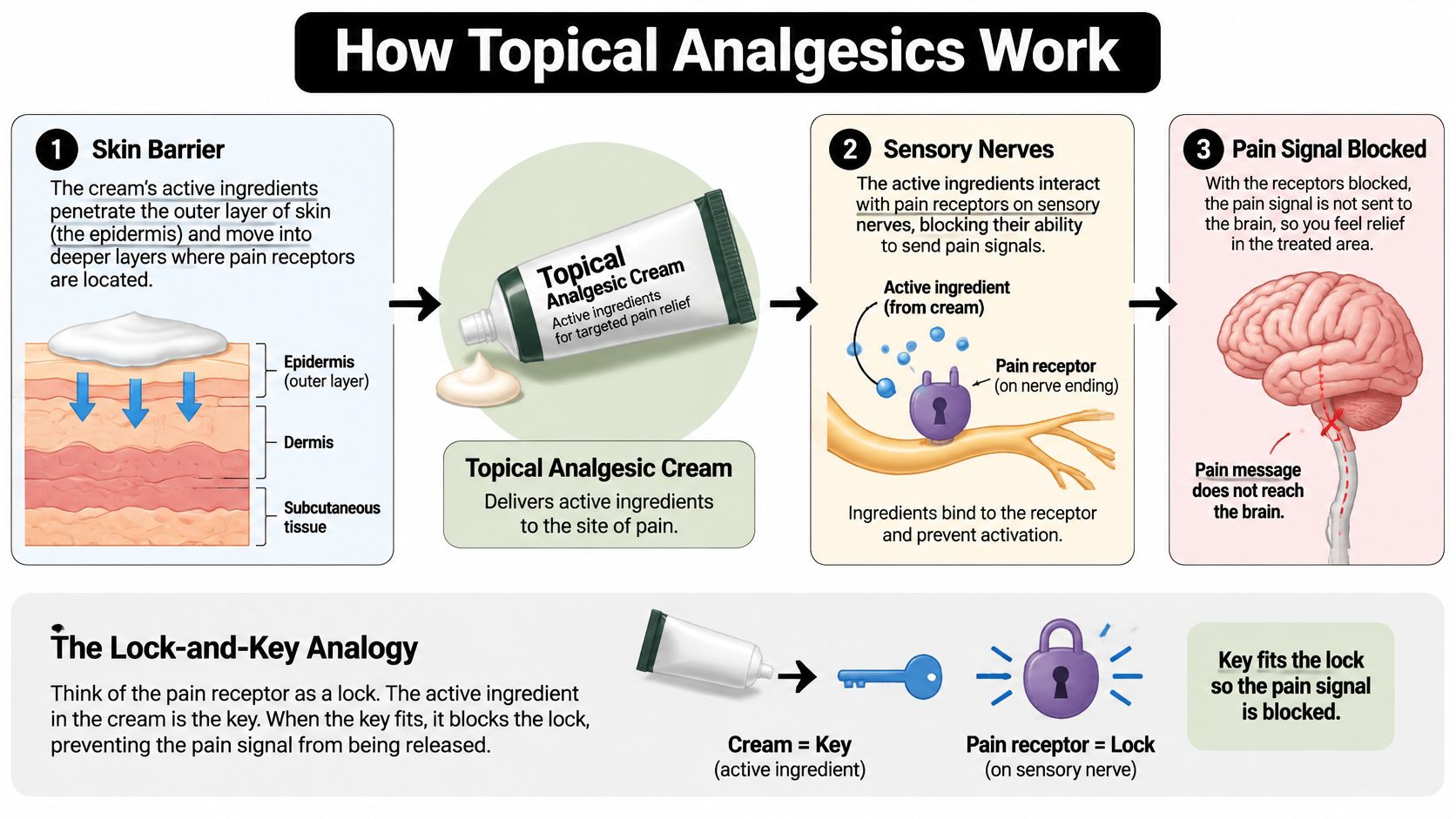
From application to sensation
First, the product's active ingredients meet the skin. Some can pass through the outer skin layers and interact with sensory nerves. How much reaches the skin or underlying tissues depends on the ingredient, the formulation, and how the product is used. That's one reason to follow the label rather than applying extra or covering the area to try to make it work faster.
With counter-irritants such as menthol, the product produces a noticeable sensation that competes with other sensory messages. Cooling or warming input can shift attention and change the way discomfort is perceived, much like turning down one sound while another becomes more noticeable. The cream isn't blocking every pain signal, and the sensation itself doesn't tell you whether the underlying tissue is healing.
Different classes of topical medicines work differently. A counter-irritant's sensory effect isn't the same as a topical anti-inflammatory medicine's action. For example, topical diclofenac is an NSAID, a type of medicine used to reduce inflammation; it should not be treated as equivalent to a menthol product. Nor should readers assume that all topical products work only at the skin surface or avoid absorption into the body.
A practical distinction: Cooling or warmth is a sensation. It may change how pain feels, but it isn't a reliable measure of injury severity or recovery.
This basic model also explains why results vary. A product designed for temporary relief of localized muscle or joint discomfort may not address nerve-related pain, an inflammatory condition or an injury that needs assessment. For a plain-language look at how sensory input can influence pain, see this explanation of the gate control theory of pain.
The following video offers another overview of topical relief:
Common Active Ingredients Explained
The ingredient list is more useful than the product's scent, packaging or promise of a strong sensation. Start by identifying the active ingredient, then check what the label says it's intended to relieve and how often it can be applied. A familiar format doesn't guarantee that two products contain the same medicine or have the same precautions.
- Menthol is a counter-irritant that can produce a cooling sensation. People may choose it for temporary relief of localized aches, but cooling doesn't show that an injury is resolving. Menthol-containing products also require care because serious skin burns have been linked to them in Health Canada's safety review, discussed below.
- Methyl salicylate is a salicylate ingredient used in some topical pain-relief products. Don't assume that applying it to skin eliminates absorption: Canadian government assessment material reports that it's readily absorbed after topical application, and repeated exposure can increase absorption and cause irritation, including itching, redness and stinging.
- Capsaicin is another ingredient found in topical analgesics. Canadian arthritis guidance identifies it as a possible option for osteoarthritis, but suitability depends on the pain condition and the product's own directions. Sensations and precautions can differ between formulations, so read the label rather than judging by a product's name.
- Triethanolamine salicylate is recognised in Health Canada's labelling standard for products such as creams, gels, ointments, lotions, roll-ons and sticks. Its labelled temporary-relief uses include muscle and joint aches associated with strains, sprains, backache and arthritis (Health Canada's triethanolamine salicylate guidance).
Read beyond the front label
Look for the product's medicinal ingredients, directions, warnings and DIN or NPN. That gives you more useful information than a general claim such as “extra strength.” If you have a known allergy to salicylates, take anticoagulant medication, or have questions about how a topical product fits with your medicines, ask a pharmacist or clinician before using it. This is particularly important for salicylate-containing products because absorption and irritation can increase with repeated exposure.
A product marketed for massage or skin care may not be an authorized analgesic. If you're comparing topical products with magnesium-focused items, a raw muscle magnesium in mango product is one example of a differently positioned topical resource. Check its own label and claims rather than assuming that a massage or magnesium product is equivalent to a topical analgesic.
For a closer look at the cooling sensation some people associate with menthol, read this overview of menthol and pain relief. The key is to choose according to the condition and the authorised use, not the sensation you prefer.
Safety and Side Effects to Know
Topical products deserve the same careful attention as other medicines. A cream may be applied to one sore area, but ingredients can still irritate skin, and some products carry a risk of serious reactions. The safest approach is to use the labelled amount and frequency, apply only to intact skin, and stop if the area reacts badly.
Health Canada's safety review identified 29 unique Canadian reports of serious skin burns associated with over-the-counter topical pain relievers containing menthol, methyl salicylate or capsaicin. The review established a link with menthol-containing products, while finding no serious-burn cases linked to methyl salicylate or capsaicin alone (Health Canada's review of serious skin burns). That distinction matters: the finding should not be misrepresented as proof that every ingredient in the review caused burns.
Reduce avoidable exposure
Before applying a topical analgesic, check the label and consider whether you've used the product before without a reaction. Apply it only to intact skin, and avoid using it under tight or occlusive bandages. Don't add external heat, such as a heating pad, over a treated area. Heat and coverage can increase risk, so don't try to intensify the product's effect this way.
Stop using the product immediately if you develop pain, swelling, blistering or marked irritation. If a reaction is severe or doesn't settle, contact a health professional. Salicylate-containing products need particular care if you have a salicylate allergy, use anticoagulants or are applying the product repeatedly or over a large area. Ask a pharmacist or clinician for advice if you're unsure whether a product is suitable with your health history or medicines.
Don't wait for a stronger sensation to mean stronger relief. Burning, swelling and blistering are warning signs, not a reason to apply more.
For dancers, avoiding a product reaction is only one part of staying active. Practical advice on preventing dance injuries can help put pain management in the wider context of movement and injury prevention. For more information on topical products available in the country, consult this guide to topical pain relief in Canada.
How to Apply Muscle Pain Creams Correctly
Good application starts with the product label, not a universal rule about how much to use. Directions can vary by active ingredient and format, so don't rely on a routine that worked for another cream. Use the amount and frequency listed on your product, and don't apply it more often in the hope of getting faster relief.
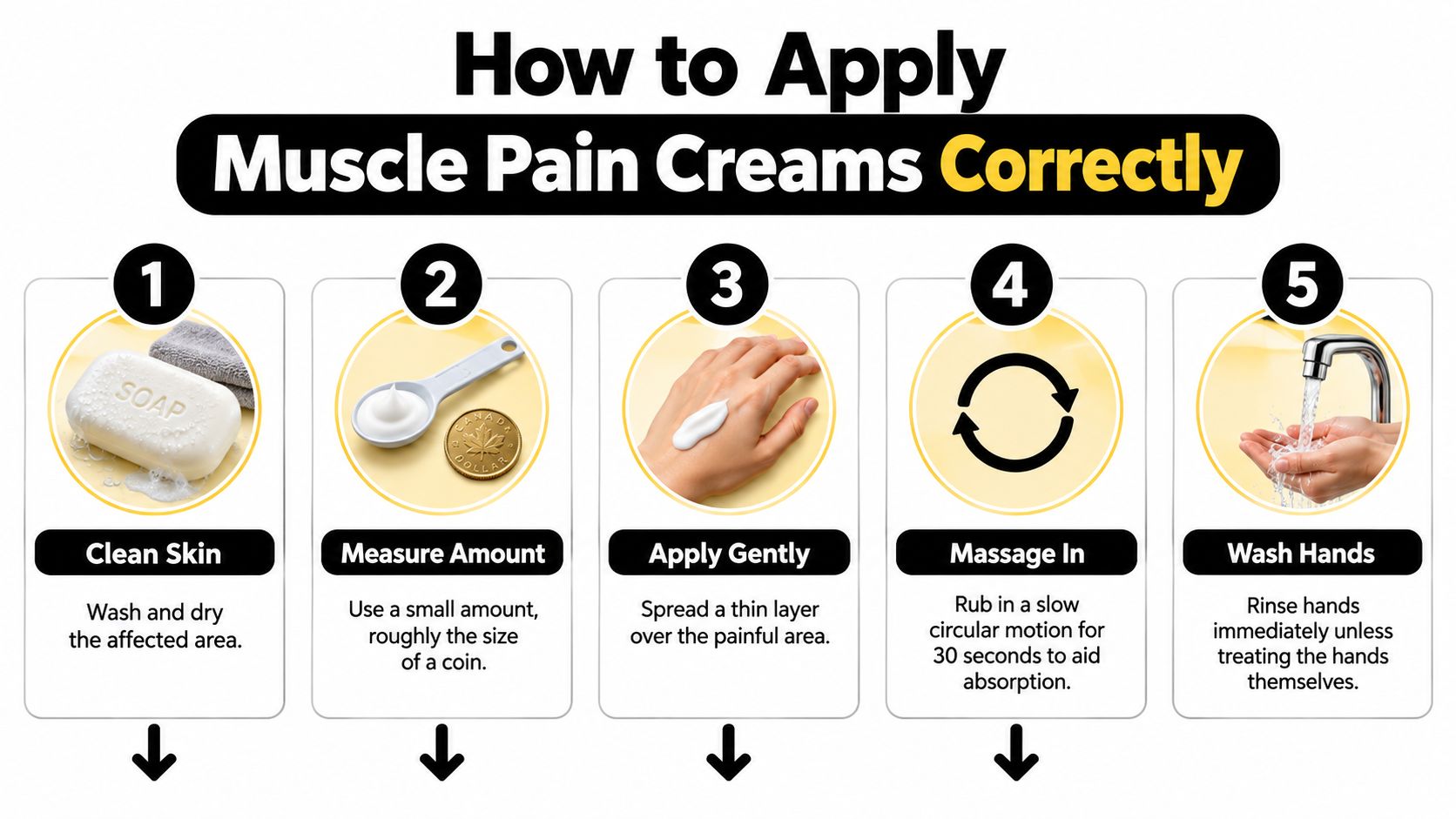
A simple application routine
- Check the skin. Don't apply the product to cuts, rashes or otherwise damaged skin. If the area is already irritated, ask a pharmacist or clinician whether the product is appropriate.
- Read the directions. Confirm where the product can be used, how much to apply and how often. Don't substitute an amount shown in a generic online diagram for the label's instructions.
- Apply to the intended area. Spread or dispense the product as directed for its format. A tube or jar allows direct application, while a roll-on, stick or spray may make it easier to target a spot or reach an area without using fingers. Each format still needs to be used as its label directs.
- Avoid adding heat or coverage. Don't wrap the area tightly or use a heating pad over the treated skin.
- Wash your hands after applying, unless you're treating your hands. This reduces the chance of transferring the product to your eyes or other sensitive areas.
If you develop marked irritation, pain, swelling or blistering, stop using the product. Don't apply another layer to mask the reaction. Some formulas leave residue on skin or clothing, so give the label's instructions priority and take care not to transfer the product to another person or an unintended area.
Applying more is not a shortcut. Repeated use of salicylate-containing products can increase absorption and may contribute to skin irritation. If your discomfort persists, worsens or keeps returning, pause self-treatment and consider a clinical assessment rather than changing the amount or frequency on your own.
Choosing the Right Cream for Your Pain
Match the product to the likely source of discomfort, not just the body part. A sore calf after a workout, an aching knee with osteoarthritis and pain from an unexplained recurring problem may all be described as “muscle pain,” but they don't call for the same assumptions. Topical products can provide temporary relief, yet the right choice depends on the condition, the ingredient and your safety considerations.
| Pain condition | Ingredient to discuss or consider | Expected time to benefit |
|---|---|---|
| Recent sprain or strain | Topical diclofenac may be an option if appropriate and available for the intended use | Canadian medical guidance reports meaningful improvement within a week in the cited evidence; follow the product directions |
| Hand or knee osteoarthritis | Topical diclofenac or capsaicin may be reasonable options | Relief may take longer than for acute sprain or strain; follow the label and discuss persistent pain with a clinician |
| Inflammatory arthritis | Don't assume a counter-irritant is enough; ask a clinician about condition-specific care | Depends on the diagnosis and treatment plan |
| Nerve-related pain | Don't treat it as ordinary muscle soreness without advice | Seek guidance if pain is persistent, unusual or accompanied by other symptoms |
| Unexplained recurring pain | Avoid repeatedly masking it without understanding the cause | Arrange an assessment if it persists, returns or interferes with daily activities |
Canadian arthritis guidance says topical diclofenac and capsaicin may be reasonable options for osteoarthritis, while evidence for topical salicylate, camphor and menthol for osteoarthritis is limited. Independent Canadian medical guidance reports that topical diclofenac improved acute sprain and strain pain by 50% within one week, with a number needed to treat of 2; chronic hand or knee osteoarthritis required longer treatment and had a number needed to treat of 5 (Canadian arthritis medication guidance). These findings describe specific evidence, not a guarantee that an individual will respond on the same schedule.
Set expectations and referral points
For a recent, local strain or sprain, a topical product may be one part of symptom management. Osteoarthritis is a different problem and may require longer-term care; inflammatory arthritis, nerve-related pain and unexplained recurring pain need their own assessment rather than a generic muscle cream. If you don't know what's causing the discomfort, or it persists despite following the label, ask a health professional what to do next.
Topical NSAIDs can reduce severe gastrointestinal adverse events compared with oral NSAIDs, but that doesn't mean they're appropriate for everyone. Canadian clinical guidance notes limits to recommendations for people with heart failure, anticoagulant use or renal failure. If you have one of these concerns, check with a clinician or pharmacist before choosing a topical NSAID. For a broader comparison of topical and oral options, see this overview of the differences between topical and oral pain relievers.
Using Creams for Warm-Up, Performance, and Recovery
A warehouse worker starts a shift with a stiff shoulder. A runner finishes a session with a sore calf. A physiotherapy patient wants to settle a local ache while following an exercise plan. Each situation calls for something slightly different, and the product's role in all three is temporary relief. It does not replace preparation, sensible activity, rehabilitation, or a diagnosis when one is needed.
Before activity, treat the warming or cooling sensation like a dashboard light: it tells you the cream is on your skin, not that the muscle underneath is ready for harder work. A sensation can mask how a joint or muscle feels, which is why a proper warm-up still matters. Follow the label directions and give the product time to take effect rather than applying and starting immediately.
During activity, a portable format such as a stick, spray or roll-on may be convenient. Discomfort that changes how you move is a reason to reassess the activity itself, because masking pain while continuing to load the tissue can turn a minor strain into a longer layoff.
Recovery is often the most suitable time to consider a topical product for temporary post-exercise soreness. Apply it as directed after activity, and pair it with rest and a gradual return to training rather than using it to shorten recovery. Soreness that peaks a day or two after exercise is common and usually settles on its own; soreness that lingers or sharpens deserves a closer look. For more on managing that window, see Maximum Health Products on soreness and this guide to muscle recovery after a workout. If pain is recurring, unexplained or worsening, arrange an assessment instead of relying on repeated applications.
MEDISTIK offers topical pain-relief products in stick, spray and roll-on formats for temporary relief of sore muscles and joints. Compare the formats and their directions, then visit MEDISTIK to explore which option may suit your routine.


