

You've probably had the moment already. Your neck locks up after a long drive, or your quads complain the morning after a hard session, and you want something that feels quick, local, and simple. Menthol pain relief is built for that exact kind of problem, but the useful part isn't just the cold tingle you notice on the skin. It's a regulated topical analgesic with a real pharmacologic role, meant for temporary relief of localized muscle and joint discomfort, not for fixing the injury underneath.
That distinction matters because menthol is easy to misunderstand. Some people treat it like a scent, some like a distraction, and some expect it to behave like a deep tissue remedy. More practically, menthol can be a sensible option for sore muscles, minor backache, strains, arthritis-related joint aches, and similar short-term complaints, as long as you understand what it does, what it doesn't do, and when to stop using it.
What Menthol Pain Relief Actually Means
A stiff lower back after gardening feels very different from a sore shoulder after lifting, but the question people ask is usually the same. What can I put on this that helps right away without making things worse? Menthol pain relief is one of the most common answers because it sits in a familiar middle ground, it's available in many topical formats, and it gives a sensation nearly everyone can feel within moments.
A cooling feeling and a pain-relief tool
The first thing to understand is that menthol is not just a cosmetic cooling agent. Historical reviews describe mint-based pain applications going back to accounts associated with Hippocrates and Galen, while modern work identified TRPM8 as a key menthol-sensitive cold receptor, which is why the sensation feels so specific and immediate. In other words, the cooling effect is real, but it's also tied to a known biological mechanism, not just marketing language. The brain's role in pain processing helps explain why a skin-level sensation can change how discomfort is perceived.
That makes menthol a temporary local aid, not a cure. It's commonly used for sore muscles, minor backache, strains, joint aches, and similar everyday problems where the goal is to take the edge off so you can move, sleep, or get through the day. If the pain is persistent, worsening, swollen, numb, or function-limiting, that's not a cue to keep layering on more product.
Practical rule: judge menthol by what it lets you do, not by how strong the cold feels on application.
For people trying to decide whether a topical fits their situation, a clinician-style question helps. Does the product make movement easier, or does it only feel intense for a short time? That answer is more useful than chasing a stronger chill.
How Menthol Works on Your Nerves
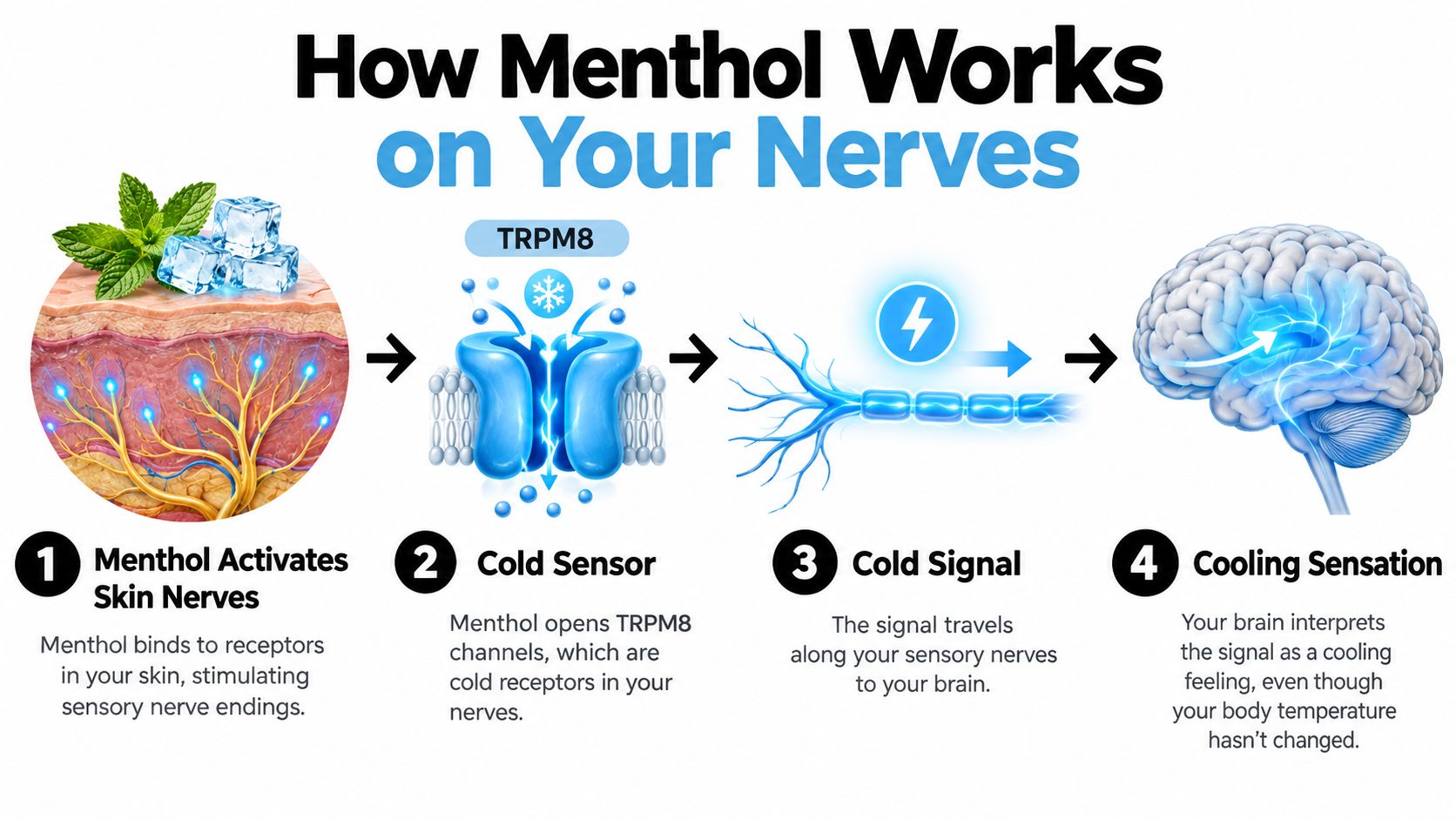
Menthol's effect starts at the skin, but the message doesn't stay there. Tiny sensory nerve endings in the skin detect the compound and send signals upward, and one of the main players is TRPM8, often described as a kind of cold sensor. When menthol activates that channel, the brain registers cooling even if the skin itself hasn't changed temperature in any meaningful way.
Why a cold signal can reduce pain
That cooling signal matters because it competes with deeper discomfort coming from muscles and joints. Menthol works mainly as a counterirritant, which means it creates a mild competing sensation that can reduce how loudly pain is perceived from the source underneath. The result is not numbness in the same way a local anaesthetic works, it's more like a sensory nudge that makes the painful signal less dominant.
Here the old and the new meet. Mint preparations were used long before the mechanism was known, but the modern explanation is cleaner and more useful for readers. The skin sensation is the visible part. The nerve signalling is the reason it can feel helpful.
Dose changes the experience
The other key point is that menthol is dose-dependent. Contemporary topical products commonly sit between 5% and 16% menthol, which in the reviewed literature is roughly 320 to 1,024 millimolar (PMC review on menthol and pain). Experimental human research found that topical l-menthol in that range reduced heat-pain sensitivity, and the highest tested concentration also produced antinociceptive effects against cold pain. That doesn't mean stronger is always better, it means the sensory result changes as the dose changes.
Lower doses tend to feel cooling. Higher doses can shift into burning, irritation, or outright pain. That is why two products can both contain menthol and still feel very different on the skin. Concentration matters, and so does the full formula around it.
If you're comparing topical options, how facial pain is diagnosed is a useful reminder that clinicians don't rely on sensation alone. They look at pattern, source, and persistence, and menthol should be judged the same way.
What the Evidence Actually Shows
The clinical picture is broader than many product labels suggest. Menthol has been studied for muscle strain, back pain, joint and arthritis-related pain, sports injuries, neuropathic pain, and migraine, but the strength of evidence varies by condition. That variability matters, because a product that helps one person's sore neck may not do much for another person's knee pain.
What it's reasonable to expect
Health Canada recognises menthol-containing over-the-counter topical analgesics for temporary relief of muscle and joint pain, including simple backache, strains, sprains, and arthritis (Health Canada labelling standard). That wording is careful for a reason. It places menthol in the role of a short-term adjunct, not a structural repair tool.
For readers trying to judge a product, that framing is more helpful than vague promises. The question is not whether the skin feels cold. The question is whether you can move more comfortably, rest more easily, or work with less distraction. A realistic trial of menthol should be judged on mobility, sleep, and daily function, not on sensation alone.
Don't confuse effect with intensity
A stronger cooling feel doesn't automatically mean deeper anti-inflammatory action. It may mean the product is more stimulating to the skin. That's why menthol guides that stop at “it feels cold” miss the point. The useful outcome is whether the discomfort becomes manageable enough for ordinary movement.
Clinical shorthand: if it helps you walk, lift, sleep, or train with less guarding, it's doing something useful, even if the sensation itself is mild.
For readers who like to evaluate products with the same discipline they'd use for any other health topic, the REVETIX guide to smarter reading is a good reminder to focus on the claim, the condition, and the outcome being measured. That habit is especially useful with topicals, where sensation can be mistaken for efficacy.
An internal comparison of product categories is also helpful, and topical pain medications are best understood as tools with different jobs, not interchangeable versions of the same thing.
Menthol vs Other Topical Analgesics
Menthol is often the first topical people try because it feels immediate. That doesn't make it the right answer for every kind of pain. Some products are meant to distract with cooling, others to build up over time, and others to numb a very specific spot.
| Active | Typical Sensation | Onset | Best Fit |
|---|---|---|---|
| Menthol | Cooling, sometimes tingling | Fast | Short-term comfort, exercise prep, sore muscles, joint aches |
| Capsaicin | Warmth, heat, initial sting | Slower with repeated use | Ongoing nerve-driven discomfort |
| Salicylates | Mild warming or rubbing sensation | Moderate | Some aching joints and general soreness |
| Lidocaine | Numbing or reduced sensation | Localised, often steady | Targeted nerve pain or specific sore spots |
Picking by problem, not by brand
Menthol's main strength is rapid sensory feedback. That makes it useful when you want something easy to apply before activity, after a workout, or during a busy day when you don't want a greasy product that takes time to settle. Capsaicin works differently, because it usually needs repeated use and is better thought of as a build-up product. Salicylates and lidocaine sit in their own lanes, with different sensations and different use cases.
The important part is not which one sounds strongest on the label. It's which one matches the kind of pain you have. A cooling product can be a good fit for movement-related discomfort, while a numbing product makes more sense for a very localised spot.
If you want a broader comparison of topical and oral approaches, benefits of a topical pain reliever versus an oral pain reliever is worth reading in the context of real-life convenience, not just theory. Different formats solve different problems, and that's the point.
A product that feels dramatic isn't automatically more useful. The better product is the one that fits the pain pattern and the day you're trying to get through.
Safety and How to Use Menthol Products Properly
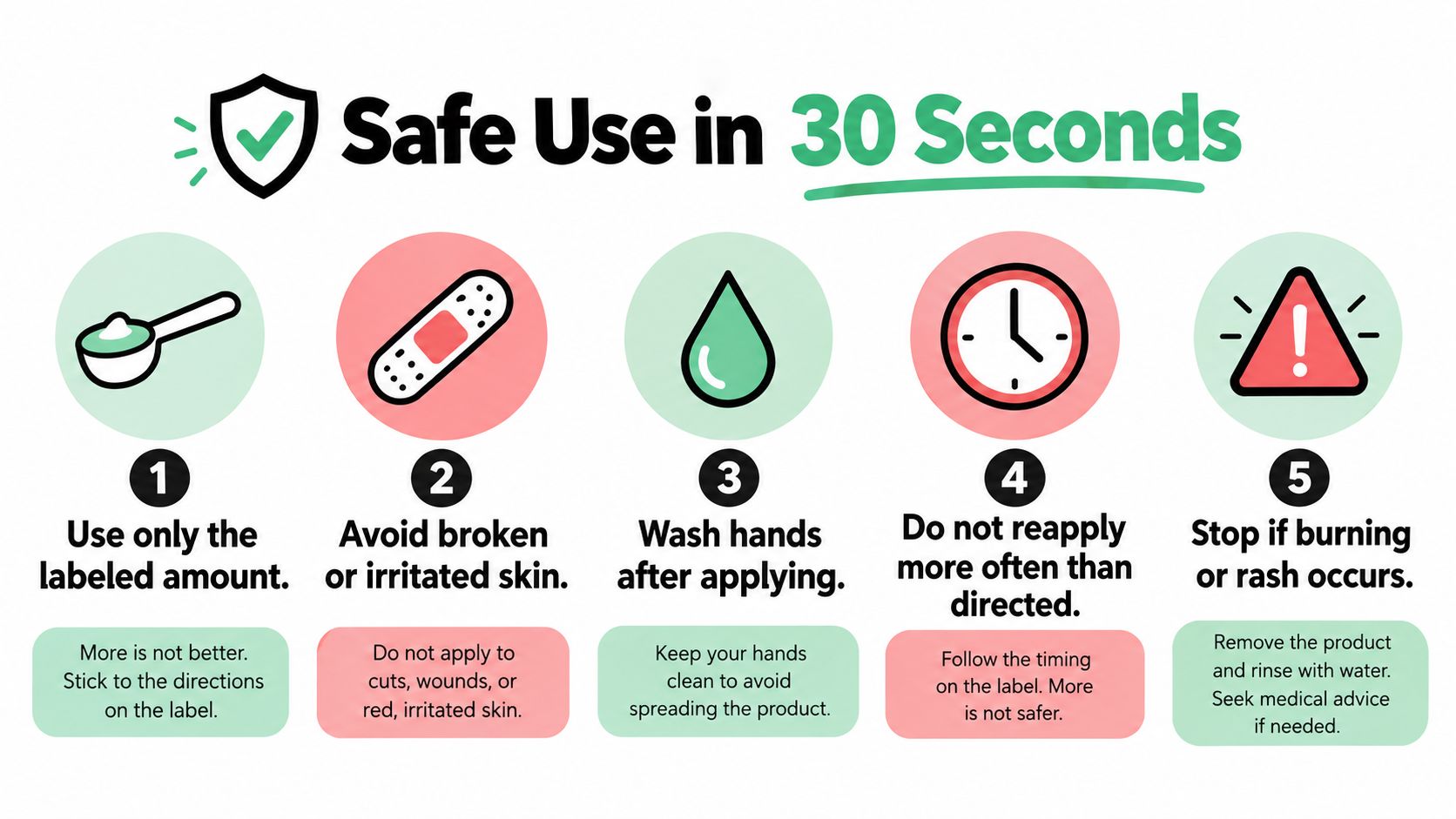
Menthol is common, but that doesn't mean it's risk-free. The safest way to use it is the simplest way: apply only what the label directs, keep it off broken or irritated skin, wash your hands after use, and don't stack multiple topical analgesics on the same area unless a clinician tells you to.
The rule that matters most
Canadian safety surveillance found 29 unique Canadian reports of serious skin burns linked to over-the-counter topical pain relievers containing menthol, alone or with other active ingredients, and Health Canada responded with labelling updates (Health Canada safety review). The practical warning is direct, external heat such as heating pads can raise the risk of skin injury. Occlusive coverings and repeated layering can also trap heat and irritate the skin.
If the skin starts to burn badly, swell, or blister, wash the product off and get medical advice. That's not a situation to push through. It's a stop signal.
Use format-specific care
Sprays, roll-ons, sticks, and gels all make application easier, but they can also make people over-apply if they're not paying attention. A roll-on can accidentally coat more skin than intended. A spray can be used too close or too often. A stick can tempt people to keep going because the hands stay clean.
- Stick products: apply a thin layer and stop when the area is covered.
- Sprays: keep them away from irritated skin and avoid repeated passes.
- Roll-ons: don't share them, and don't reuse on skin that's already red.
- Gels and creams: use the smallest amount needed while still covering the area.
The how to use pain relief spray guide is useful for people who want a format-specific reminder without overcomplicating the process.
Matching Menthol to Your Situation
A physiotherapy patient, an athlete, and a retired gardener may all reach for menthol, but they're not using it for the same reason. The right match depends on whether the goal is to get through a treatment gap, support movement during work or sport, or reduce flare-up discomfort during daily routines.

Three common use patterns
For a clinic or physiotherapy patient, menthol can sit between appointments as a comfort tool. It shouldn't replace the treatment plan, but it can make the hours between sessions easier to manage, especially when the goal is to reduce guarding and stay mobile.
For an athlete or physically demanding worker, the rhythm is usually different. A fast-acting spray or roll-on can fit a warm-up or mid-shift routine, while a longer-lasting stick may be more useful after activity when the body is settling down. The key is to avoid masking a real injury signal just because the area feels cooler.
For an older adult managing recurring joint or back pain, menthol is often a low-friction option for flare-ups during errands, housework, or short walks. It can be useful when the question is, “Can I move more comfortably today?” rather than “Can I fix this problem myself?”
MEDISTIK's topical line includes a 10% menthol roll-on, a 15% menthol stick, and a spray format designed for temporary relief of sore muscles and joints, which makes it one example of how menthol products are packaged for different routines. For readers comparing routines and recovery tools, the Thermo Recovery Wear product comparison can also help frame the broader topical picture.
What to watch for
Persistent pain deserves a closer look, especially if it's getting worse, swelling is increasing, or function is dropping. Menthol can help with comfort, but it can't diagnose the cause of pain, and it won't repair tissue.
The best outcome metric is simple. Can you sleep better, move more freely, and keep up with daily life with less effort? If not, the problem probably needs more than another application.
Choosing a Menthol Product Without Getting Misled
A stronger cooling sensation is not the same as stronger relief. That's the part many shoppers miss. The best product is the one that matches the pain pattern, the setting, and the level of irritation your skin can tolerate.
A short decision framework
Check the labelled menthol concentration first, because dose affects the sensation and can change the experience from cooling to burning. Then match the format to the moment, a stick for more sustained coverage, a spray for fast reapplication, or a roll-on for mess-free use on the go. If a product promises “deep” or “penetrating” healing, treat that as marketing until the actual ingredients and use directions make sense.
Look for products that are clearly approved or authorised in your jurisdiction, and avoid anything that suggests you should pair it with a heating pad. That combination raises the risk of irritation and skin injury, which is exactly the kind of problem that turns a simple topical into an avoidable complication. The same caution applies if you're tempted to layer multiple products over one area.
If you want a practical reference point for products that are positioned for temporary relief of sore muscles and joints, Health Canada approved products is a useful starting point for checking format and category.
Judge it by outcomes
Give any product a fair trial, then ask whether it improved mobility, sleep, or work capacity over the course of a week. That's a better test than asking whether the skin felt cold for a few minutes. If the pain is persistent, worsening, swollen, numb, or limits function, don't escalate topical use. Get assessed.
Menthol works best as a tool, not a promise. Use it that way, and it can fit neatly into a real-world pain plan without stealing attention from the problem underneath.
If you want help choosing a topical that fits your routine, explore the MEDISTIK range for spray, stick, and roll-on options designed for temporary relief of sore muscles and joints. Visit MEDISTIK to compare formats and find the one that matches how you move, work, and recover.


