

Your knee aches when you stand after a long drive, and there's a tube of pain-relief gel in the cupboard. You're tempted to rub some on and get moving, but the label raises questions: is this an anti-inflammatory, a cooling rub, or something else? Choosing a topical anti-inflammatory over the counter starts with understanding that distinction, not choosing the strongest-looking package.
When Reaching for a Cream Actually Makes Sense
A sore area you can point to is a reasonable starting point for thinking about topical treatment. Perhaps you've strained something doing yard work, or you have a familiar knee ache that makes stairs uncomfortable. Applying medication locally may make sense, provided the product's Canadian label matches the problem.
The important distinction is between recognising a symptom and diagnosing its cause. A shoulder twinge after lifting isn't automatically inflammation, and recurring joint pain isn't necessarily a minor strain. A cream can be part of symptom management without answering why the pain keeps returning.
Start with the pain pattern
Before choosing a product, ask yourself:
- Location: Can you identify a specific sore muscle or joint, or is the discomfort widespread?
- Context: Did it follow a recognisable activity, or did it appear without explanation?
- Course: Is it improving, staying unchanged, or interfering more with normal movement?
- Skin condition: Is the application area healthy and intact?
For example, someone with a recent, localised muscle injury has a different decision to make from someone whose unexplained joint swelling keeps recurring. The first person might find an appropriate label-directed option; the second needs help identifying the cause rather than another product.
Practical rule: Choose a topical for a defined symptom and a defined trial of treatment, not as an open-ended response to every ache.
Canadian labelling distinguishes temporary pain relief from broader treatment claims. That matters because feeling more comfortable doesn't establish that an injury has healed or that an underlying joint condition has been addressed. The useful question isn't whether a cream feels soothing, but whether its ingredient, indication, and permitted duration fit your situation.
How Topical Anti-Inflammatories Work on the Skin and Underneath
Topical describes where you apply a product. Anti-inflammatory describes what its active ingredient does. Those terms aren't interchangeable: a product applied to the skin can relieve pain without working like an anti-inflammatory medicine.
True topical nonsteroidal anti-inflammatory drugs, usually shortened to NSAIDs, include diclofenac and ketoprofen. These medicines interfere with cyclooxygenase activity, reducing production of prostaglandins involved in local pain and inflammation.
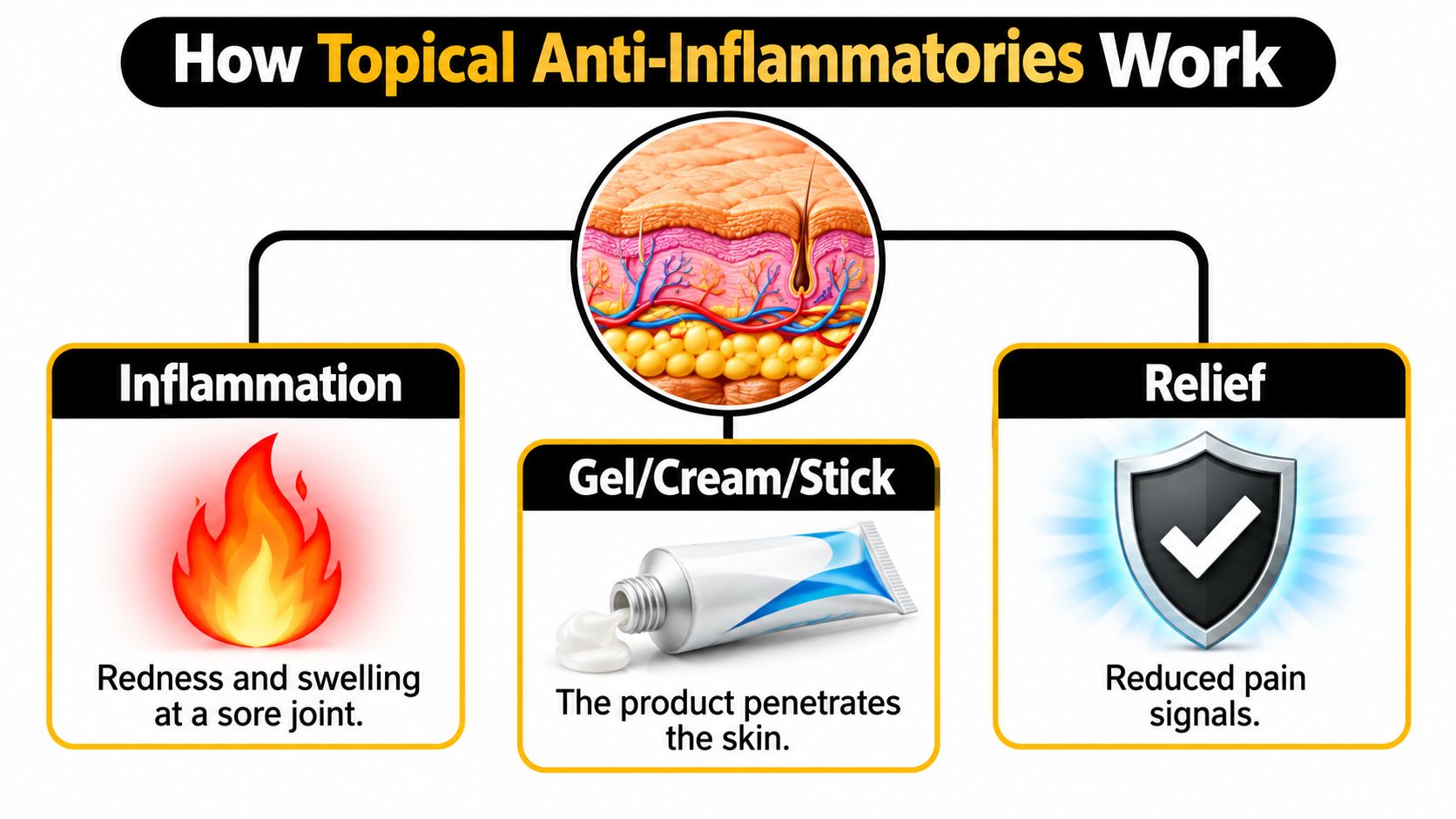
The illustration shows the basic route from skin application to local action.
Local action doesn't mean skin-only action
The medicine must move through the skin to reach relevant underlying tissue. Think of it as reducing traffic on neighbourhood roads rather than changing traffic across an entire highway network. The intention is a local effect, although some medicine can still enter the bloodstream.
That distinction explains why a topical NSAID may be considered when the treatment target is superficial or localised. It also explains why spreading a gel over the surface isn't a reliable solution for every deep or widespread pain problem.
- The active ingredient matters: It determines the medicine's intended action.
- The formulation matters: A gel, solution, stick, and spray aren't automatically equivalent.
- The treatment site matters: Evidence for a particular joint or injury shouldn't be extended to every painful area.
The broader term topical analgesic means a pain reliever applied to the skin. That category includes products with different mechanisms, so a cooling sensation alone doesn't tell you whether a medicine is suppressing prostaglandin production.
You also can't judge effectiveness by how strongly something tingles. Sensation is something you notice immediately; therapeutic benefit is something you assess through changes in pain and useful movement. They're different measurements, and the label remains more informative than the sensation.
The Two Real Categories of OTC Topical Anti-Inflammatories
Pharmacy shelves often place anti-inflammatory gels beside warming rubs and natural-format roll-ons. For practical decision-making, separate true topical NSAIDs from other topical analgesics and adjuncts. The second group isn't a single drug class, even when the packaging looks similar.
Diclofenac and ketoprofen belong to the NSAID group. However, naming an ingredient doesn't establish that every formulation containing it is available without a prescription in Canada. Check the actual Canadian product and its authorised indication.
Read the ingredient before the format
Menthol, camphor, methyl salicylate, and capsaicin shouldn't be treated as interchangeable with diclofenac. Nor should every non-NSAID ingredient be assumed to work identically. A roll-on format tells you how a product is applied, not how its medicine works.
OTC Topical Anti-Inflammatory Ingredients at a Glance
| Active Ingredient | Typical Concentration | How It Works | Best For |
|---|---|---|---|
| Diclofenac diethylamine | Canadian gel strengths vary by indication; check the exact label | NSAID action that reduces prostaglandin production | The localised injury or joint-pain indication on that product |
| Diclofenac sodium | Formulation-specific; don't substitute a gel's directions | Topical NSAID action | The authorised indication for the solution |
| Ketoprofen | Confirm Canadian availability and product-specific strength | Topical NSAID action | An appropriately assessed localised musculoskeletal problem |
| Menthol, camphor, or methyl salicylate | Product-dependent; no universal range applies | Other topical analgesic approaches, not interchangeable with diclofenac | Labelled temporary symptom relief |
| Capsaicin | Check the individual product | A distinct analgesic approach rather than diclofenac-style NSAID action | Its specific labelled use |
| Arnica or other natural-format ingredients | Preparation-dependent | Don't assume equivalence to an approved NSAID | No NSAID-equivalent recommendation can be made from the evidence discussed here |
A concentration table can look reassuringly precise while encouraging the wrong comparison. Percentages across different ingredients don't measure relative strength: a larger number on one product doesn't establish greater benefit than a smaller number on another.
Label-reading checkpoint: Compare products within their actual drug class, indication, and formulation, not by percentage alone.
Where natural-format products fit
“Natural” doesn't establish effectiveness for a particular injury or make a preparation equivalent to a topical NSAID. Ask what the product is authorised to do and whether its evidence matches your symptom.
For another example of this distinction, Pumpernickel Health Foods provides a page where readers can buy MSM silver solution. Treat that as information about a separate topical product, not evidence that it shares diclofenac's Canadian indications or demonstrated outcomes.
Topical vs Oral Anti-Inflammatories and Other Pain Relief Options
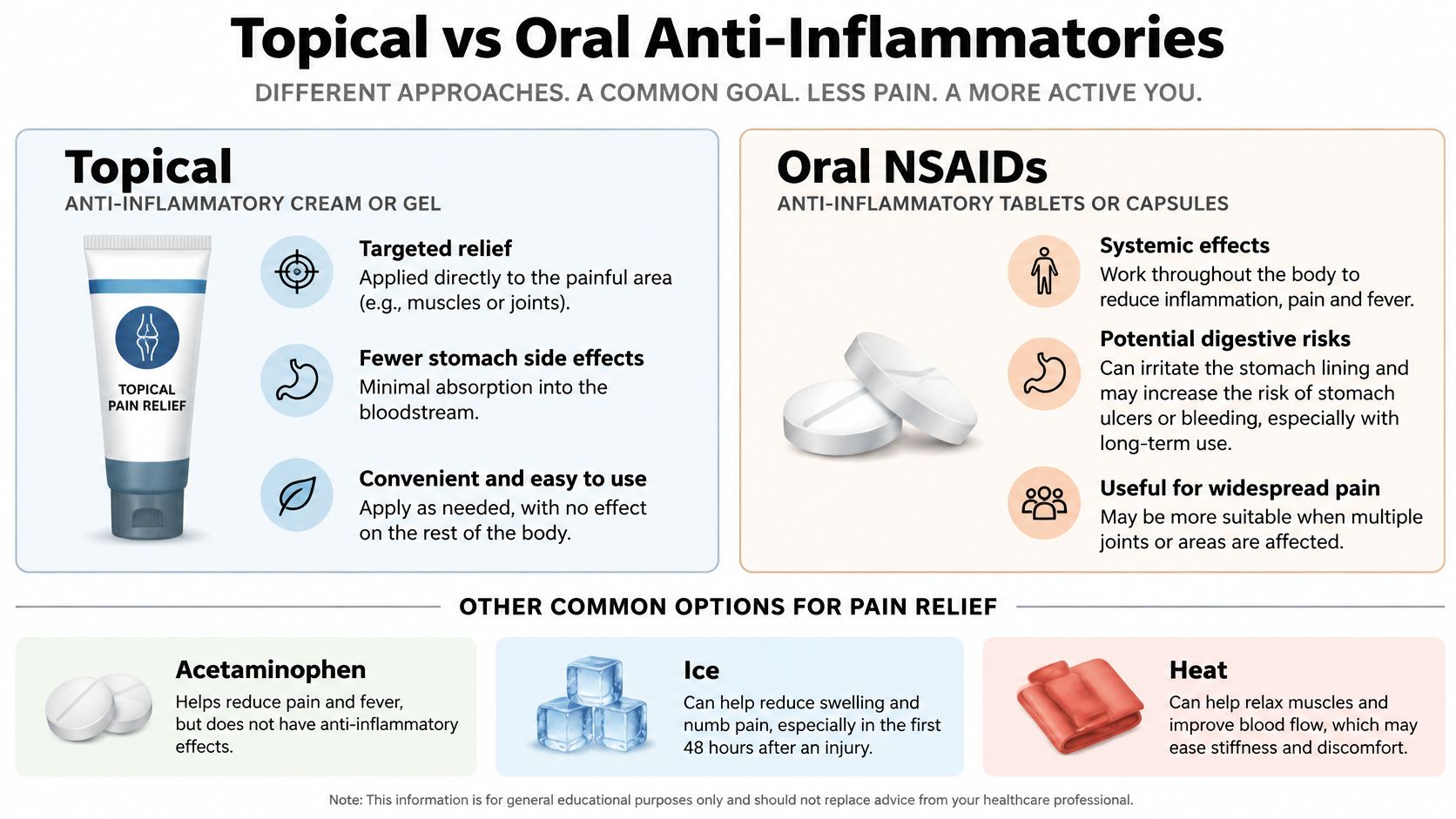
The sensible comparison isn't “cream or tablet?” in isolation. It's whether you need local symptom relief, broader medical assessment, or help restoring movement and managing activity. Different tools answer different questions.
A topical NSAID may suit a defined local problem, while oral treatment requires its own assessment of benefits and risks. Neither route should be selected because it seems stronger or more convenient.
This comparison highlights the distinction between local application and medication taken by mouth.
Compare the decision, not just the delivery route
| Option | Useful question to ask | Important limitation |
|---|---|---|
| Topical NSAID | Does this product match a specific localised problem? | The application site and indication matter |
| Oral NSAID | Is this appropriate given my symptoms, health history, and other medicines? | It isn't automatically the next step when a gel disappoints |
| Acetaminophen | Is a different pain-relief approach appropriate? | Don't assume it has the same action as an NSAID |
| Ice or heat | Could a non-drug comfort measure fit this situation? | Don't improvise combinations with a medicated application |
| Bracing or physiotherapy | Do I need support, rehabilitation, or assessment of movement? | A pain-relief product doesn't answer those questions |
Onset is another common source of confusion. A noticeable cooling or warming feeling isn't proof that one treatment has achieved better clinical pain relief. The evidence discussed later measures meaningful pain reduction over a treatment period, not a contest to see which product produces a sensation first.
Convenience also needs context. A portable applicator might be useful at work, but a format you can carry easily still needs to fit the treatment site and directions. If your symptoms require repeated interruptions, escalating applications, or several medicines to get through a shift, reassessment is more useful than choosing a smaller package.
The practical questions in this topical-versus-oral pain-reliever comparison can help frame a pharmacist discussion. Don't assume that broader or deeper pain automatically means an oral NSAID is appropriate.
How to Apply a Topical Anti-Inflammatory for Best Results
Start with the tube or bottle in your hand, not directions remembered from another product. The active ingredient, formulation, and Canadian label determine the routine.
Use the image as an application illustration, not a dosing guide. A pictured pea-sized amount isn't a substitute for a measured, label-directed dose.
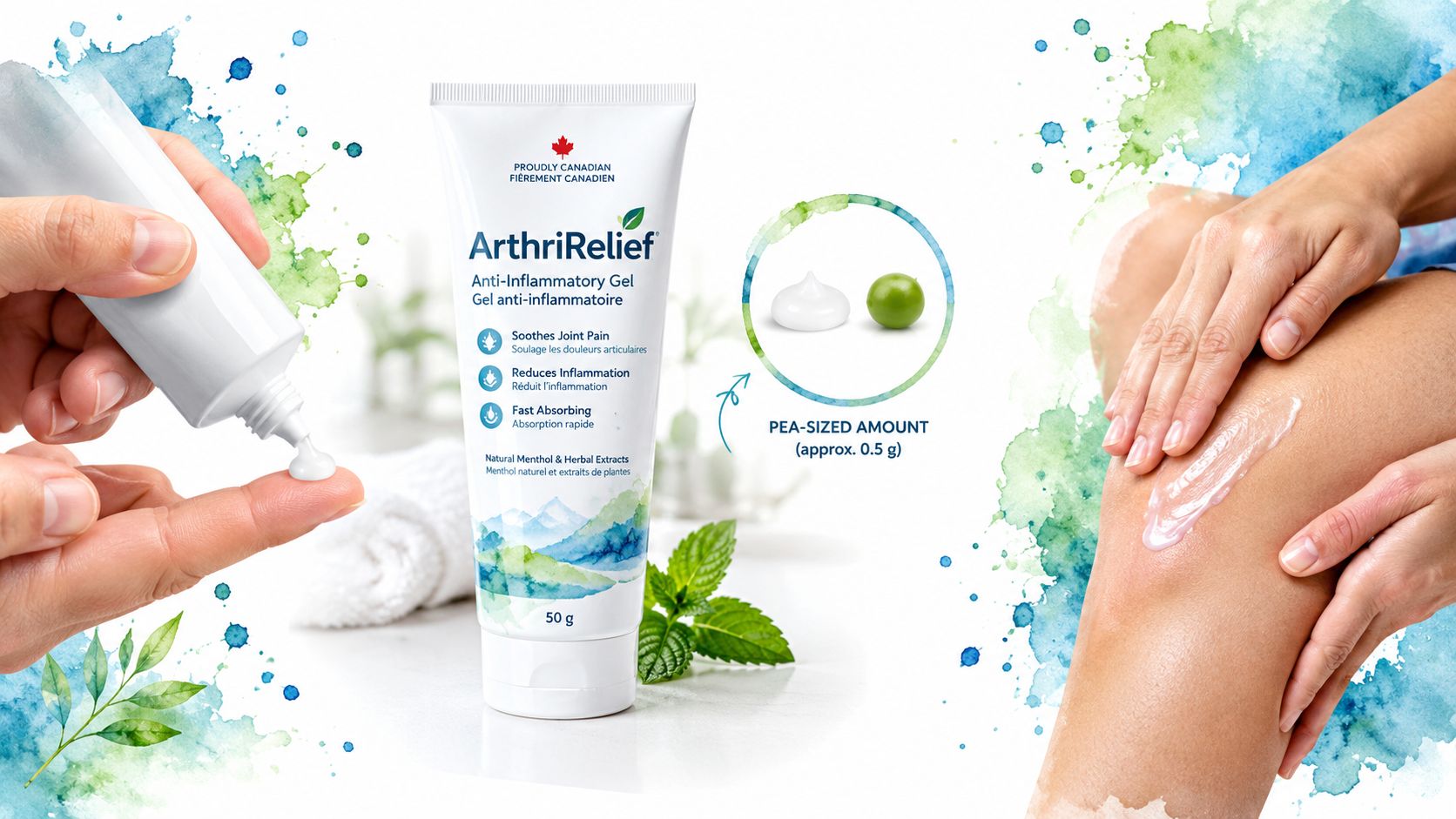
Build a repeatable routine
- Confirm the product: Read the active ingredient, permitted application area, frequency, and maximum duration.
- Inspect the skin: Apply only where the skin meets the label's requirements.
- Measure rather than estimate: Use the product's dosing instructions or ask a pharmacist to demonstrate.
- Keep a record: Note applications if you're treating more than one area, so you don't unintentionally exceed the total.
- Follow handling instructions: Check directions about washing your hands, drying, clothing, and contact with other surfaces.
For the diclofenac diethylamine 2.32% gel described in Health Canada's product monograph, the regimen is 2 g morning and evening, with a maximum of 4 g daily across all affected areas, applied only to intact skin without occlusive dressings.
Those directions belong to that formulation. They aren't a general diclofenac rule, and the daily maximum isn't an allowance for each separate painful joint.
Don't improvise layers or coverings
An occlusive dressing is a covering that seals the treated area. Don't assume that adding a tight wrap improves treatment. If you need a brace, ice, or heat, ask how to coordinate it with the specific medicine rather than placing everything over the fresh application.
Application demonstrations can help you prepare questions, but your own product label takes priority.
A tube, stick, roll-on, or spray may suit different practical preferences. For spray-specific handling, consult these pain-relief spray application considerations, then follow the instructions supplied with your product rather than transferring gel directions to a spray.
What the Evidence Says About Effectiveness
The clearest evidence discussed here concerns acute sprains and strains and localised hand or knee osteoarthritis. It doesn't establish that topical NSAIDs work equally well for unexplained deep pain or generalised inflammatory disease.
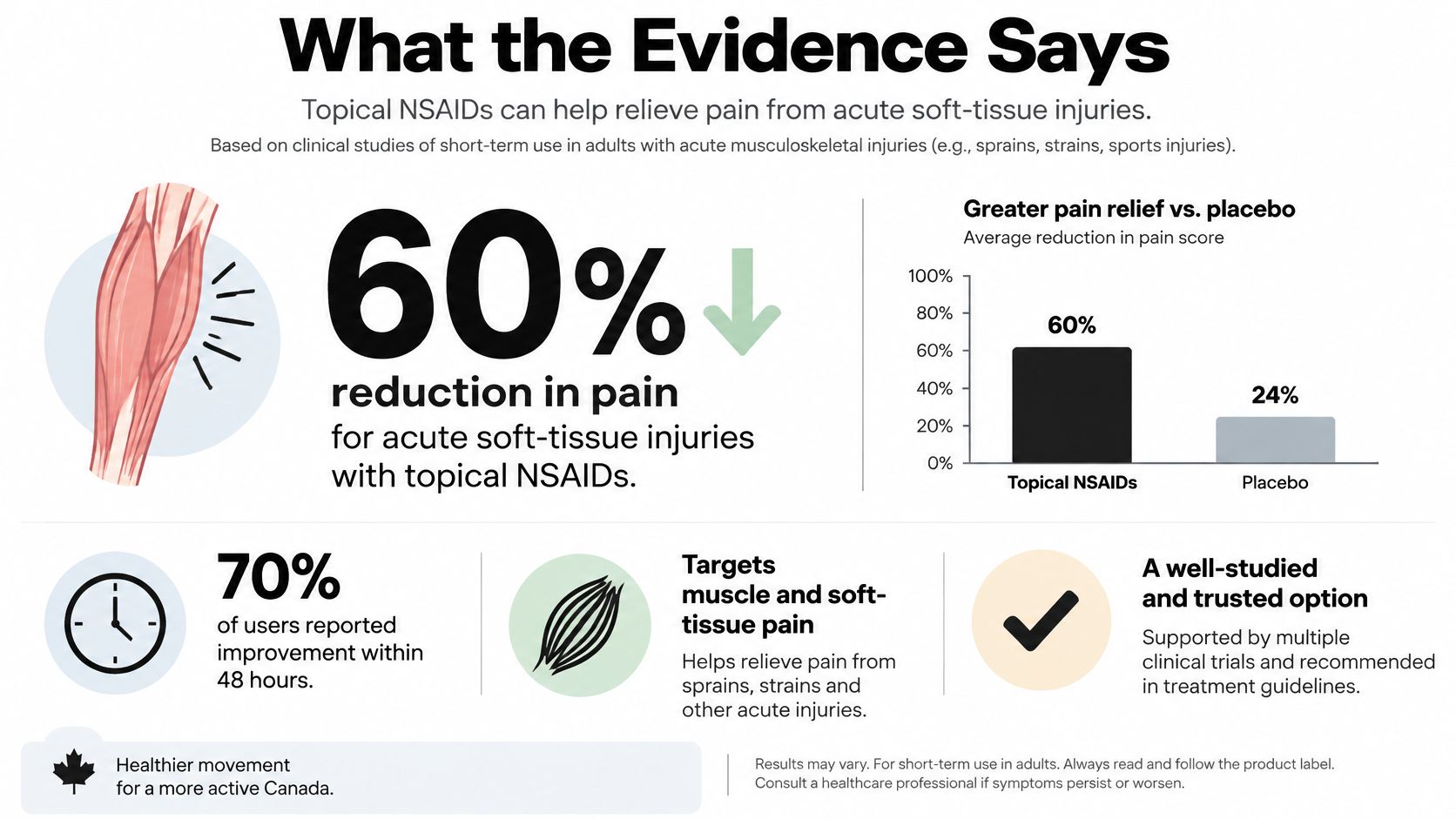
The Canadian Medical Association Journal summary reports systemic uptake at approximately 5% of oral exposure; for acute sprains and strains, topical diclofenac achieved at least 50% pain reduction within one week, with a number needed to treat of about 2, while the number needed to treat for chronic hand or knee osteoarthritis was approximately 5 over six weeks.
What those results mean for you
Number needed to treat, or NNT, describes how many people need treatment for an additional person to achieve the specified benefit compared with the control. It isn't a guarantee that a particular person will respond, and it doesn't describe complete recovery.
Consider someone with an assessed recent strain versus someone managing established knee osteoarthritis. Both may have a reason to discuss topical NSAID treatment, but their diagnoses, product indications, and follow-up plans differ. Neither should treat a trial result as permission to continue any product indefinitely.
A treatment can have good evidence and still be the wrong choice for your particular pain.
The following graphic contains percentage and rapid-response claims that aren't established by the evidence cited here. Use the clinical results above, not those graphic claims, when judging effectiveness.
Approval and treatment duration are separate checks
An approved commercial preparation and an individually compounded mixture aren't interchangeable evidence packages. Don't assume that combining familiar ingredients establishes the mixture's safety, effectiveness, or authorised indication; this overview of topical pain medications can help organise questions for your pharmacist.
Likewise, a clinician's reassessment period for persistent symptoms isn't an OTC self-treatment allowance. Follow the shorter, product-specific label limit unless a clinician directs otherwise.
Safety, Side Effects, and When to See a Clinician
Lower systemic exposure doesn't mean no risk. Pay attention both to the treated skin and to the wider medication picture. A topical belongs on your medicine list even if you think of it as “just a rub”.
Possible local reactions include dryness, itching, redness, dermatitis, and photosensitivity. If the area becomes irritated, stop and seek advice rather than applying more to overcome the discomfort.
Ask before combining treatments
Bring the actual product, or a clear photograph of its label, to your pharmacist. Mention:
- Other medicines: Include oral anti-inflammatories, anticoagulants, other topical treatments, and non-prescription products.
- Pregnancy or pregnancy planning: Ask whether the particular ingredient and formulation are suitable.
- Previous reactions: Explain any history of reactions to pain medicines or skin products.
- Your treatment pattern: Describe how often symptoms return and what you've already tried.
Keep the product away from eyes and mucous membranes. Don't use it on open, infected, burned, or eczematous skin, and don't treat a warning on one formulation as irrelevant to another without checking.
Canadian prescription-list wording allows topical diclofenac to be non-prescription at concentrations up to 2% only when used for no more than 7 days under the stated qualifier, according to Health Canada's diclofenac notice. That wording shouldn't replace your specific product's authorised directions.
Know when self-treatment should stop
Seek prompt assessment for unexplained swelling, weakness, numbness, fever, suspected infection, or concerning injury symptoms. Pain that persists beyond the labelled treatment period, repeatedly returns, or increasingly limits normal activity also deserves review.
Checking Health Canada-approved products is part of choosing responsibly. Approval still doesn't establish that a product is suitable for every person, symptom, or combination of medicines.
Choosing the Right OTC Topical and Knowing When to Move On
Localised joint pain is a substantial Canadian concern: approximately 3.9 million adults aged 20 and older were living with diagnosed osteoarthritis in 2016–2017, according to the Public Health Agency of Canada's osteoarthritis report. That helps explain the need for clear choices, but it doesn't make every recurring ache an osteoarthritis diagnosis.
The useful decision is which treatment fits this symptom now, not which package promises the strongest sensation. Health Canada's topical analgesic labelling standard frames these products around temporary pain relief.
Keep this checklist on your phone
- Identify: Know the active ingredient and whether it's a true topical NSAID or another analgesic.
- Match: Check that the Canadian indication fits your symptom.
- Limit: Follow the amount, frequency, and duration on that product.
- Evaluate: Look for useful improvement in everyday movement, not just a skin sensation.
- Escalate: Ask for assessment when symptoms persist, change, or require increasingly frequent treatment.
Stronger concentration isn't a substitute for a better diagnosis. If relief is incomplete, bring your product and symptom history to a pharmacist or clinician rather than repeatedly changing creams.
MEDISTIK offers Canadian-made, non-prescription topical pain-relief options in stick, spray, and roll-on formats, alongside pain-management educational resources. Visit to review the ingredients and directions for each format, and ask your pharmacist which option fits your symptoms and current medicines.


