

When muscle pain suddenly shows up, your first response can make all the difference. The key is to take smart, immediate action to manage the initial fallout. For acute soreness or a new injury, the go-to protocol has long been the R.I.C.E. method—Rest, Ice, Compression, and Elevation. It’s a trusted first-aid strategy designed to control inflammation and prevent things from getting worse.
Immediate Steps for Soothing Sore Muscles
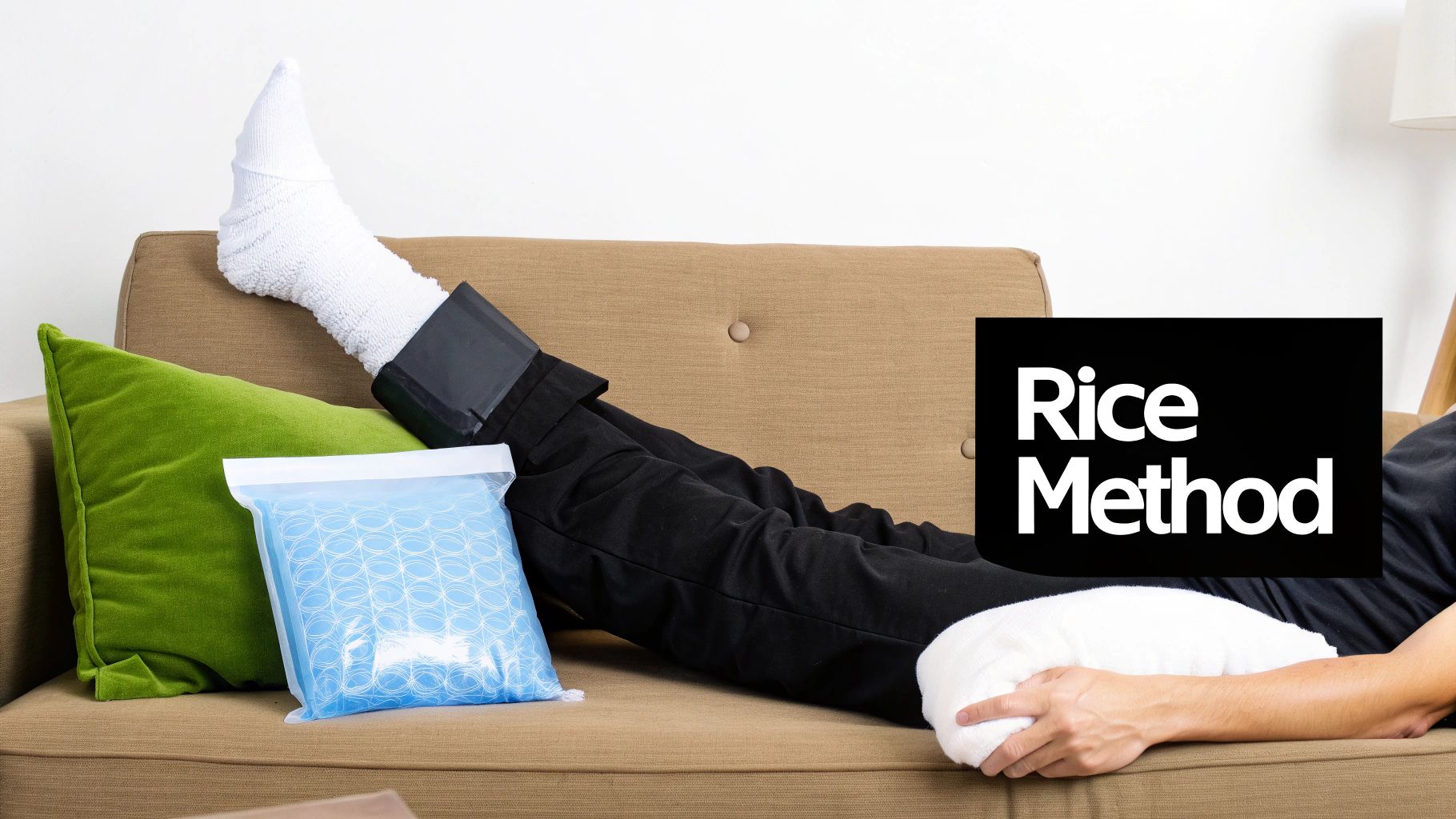
When you’re hit with sudden muscle pain, your body is sending a clear signal to pay attention. Whether it’s from pushing it too hard at the gym, an awkward twist, or a weekend spent gardening, that initial response sets the stage for your recovery. Think of this phase as muscular first aid.
The most widely recognized strategy for this is the R.I.C.E. method, a simple yet powerful four-step process. Each part of the acronym plays a specific role in calming down your body's immediate inflammatory reaction.
Understanding the R.I.C.E. Method
This protocol is your best friend for the first 24 to 48 hours after an acute muscle strain or injury. The goal is to minimize pain and swelling, creating a better environment for your body to start healing.
- Rest: This one seems obvious, but it's crucial. Stop doing whatever caused the pain. This protects the muscle from more stress and damage. It doesn't mean you have to be completely motionless, just avoid putting any strain on that sore spot.
- Ice: Applying a cold pack is key to reducing inflammation. The cold constricts blood vessels, which limits swelling and can help numb the area for some welcome pain relief. Try it for 15-20 minutes every few hours.
- Compression: Gently wrapping the area with an elastic bandage helps control swelling by preventing fluid from pooling there. The trick is to apply firm but not tight pressure—you never want to cut off circulation.
- Elevation: Use gravity to your advantage. Propping up the injured limb above the level of your heart helps drain excess fluid away from the site of the injury, which further reduces swelling and discomfort.
Following the R.I.C.E. protocol is about more than just feeling better in the moment. You're actively managing the initial inflammatory response, which helps set the stage for a faster, smoother recovery.
The Role of Active Recovery
While R.I.C.E. is perfect for the initial shock of a fresh injury, staying totally still isn't always the best plan for general soreness, like the kind you get after a good workout. That’s where active recovery comes into play.
Active recovery is all about gentle, low-impact movement. The goal is to get your blood flowing without putting more stress on those tired muscles. Better circulation delivers fresh oxygen and nutrients to damaged muscle fibres and helps flush out the metabolic waste that contributes to soreness.
Think of it like this: a stagnant pond gets murky, but a flowing stream stays clear. Gentle movement keeps your circulation moving, helping your muscles clean up and repair themselves.
A quick-reference guide can help you decide which approach is right for your situation.
First Actions for Muscle Pain Relief
| Action | Primary Benefit | Best For |
|---|---|---|
| R.I.C.E. Method | Reduces acute swelling and inflammation. | New injuries, sprains, or sudden, sharp muscle pain. |
| Active Recovery | Increases blood flow to aid repair. | General post-workout soreness and muscle stiffness. |
Simple active recovery could be a slow walk, a gentle swim, or some light stretching. The main thing is to keep moving without causing more pain. You have to listen to your body—if something hurts, back off. Getting this initial response right prepares you for more targeted treatments and helps you get back to full strength sooner.
Uncovering the Source of Your Muscle Pain
To get real, lasting muscle pain relief, you have to put on your detective hat. Figuring out why a muscle hurts is the absolute first step toward helping it heal. Think of your body as a high-performance machine—pain is just the check engine light flashing, telling you something needs attention.
The root of muscle pain isn’t always some dramatic, sudden injury. More often than not, it comes from a few common culprits that either build up slowly over time or pop up after you’ve tried a new physical challenge. Pinpointing the cause is what lets you move past temporary fixes and find a solution that actually works.
Decoding Delayed Onset Muscle Soreness (DOMS)
One of the most common characters in the muscle pain story is Delayed Onset Muscle Soreness, or DOMS. This is that classic, can’t-get-off-the-couch ache that shows up 12 to 48 hours after you’ve pushed your body in a new way. It could be from a killer workout, a long hike, or even just helping a friend move boxes all weekend.
That soreness happens because the effort created tiny, microscopic tears in your muscle fibres. While "tears" might sound scary, it’s a totally normal, even positive, part of your muscles getting stronger. Your body rushes fluid and nutrients to the area to repair and rebuild the tissue, which leads to the temporary inflammation and discomfort you feel. It's a clear sign your body is adapting and building back stronger.
Overuse, Strains, and Lifestyle Factors
Not all muscle pain is from a single event. Sometimes, the problem is more gradual, stemming from repetitive actions or constant tension that eventually leads to a strain.
- Overuse Injuries: These sneak up on you when you repeatedly stress the same muscles without giving them enough time to recover. This is a classic issue for people with physically repetitive jobs or in sports like running and tennis.
- Acute Strains: This is the opposite—it happens all at once when a muscle is stretched too far or torn suddenly. It's that sharp, immediate pain you feel when you lift something way too heavy or twist in an awkward way.
- Poor Posture: We're all guilty of this one. Spending hours hunched over a desk or staring down at a phone puts a relentless strain on the muscles in your neck, shoulders, and back, causing chronic tightness and aches.
- Stress and Tension: Never underestimate the mind-body connection. When you’re stressed, your body physically tenses up. Over time, this constant clenching leaves muscles—especially in the neck and shoulders—tight, knotted, and painful.
Identifying your pain trigger is like getting a map for your recovery. Whether your pain is from a sudden strain or the slow burn of daily habits, knowing the 'why' allows you to choose the right tools for relief.
The Impact of Chronic Conditions
Sometimes, muscle pain is a messenger for a bigger, underlying chronic condition. Health issues like fibromyalgia or certain autoimmune diseases can cause widespread, persistent muscle aches that need a very specific management plan. In the same way, arthritis can cause secondary muscle pain as the body tries to compensate for sore, stiff joints.
Recognizing these patterns is crucial. If your pain is constant, affects multiple areas, and isn’t clearly tied to a specific activity, it might be connected to a broader health issue. To get a better handle on this, it helps to understand how pain signals work in the first place. You can learn more about how pain is processed by the brain and why our bodies react the way they do.
When muscle pain comes from a sports injury, the mental game is just as important as the physical one. Understanding the full picture, including the psychology of sport injury, is vital for a complete recovery. By figuring out if your pain is from a workout, a lifestyle habit, or a deeper issue, you can stop guessing and start targeting your relief strategy where it counts.
Choosing the Right Muscle Pain Relief Treatment
Walking into a pharmacy to find muscle pain relief can feel overwhelming. You’re faced with a wall of options—pills, creams, sprays, and patches—all promising to get you back on your feet. To make the right choice, you need to understand what you’re dealing with and how these different treatments actually work.
Most people’s first instinct is to grab a bottle of oral anti-inflammatories. These pills work systemically, which means they travel through your entire bloodstream to reduce inflammation and quiet pain signals. They can be effective, especially for widespread aches, but they come with a big catch: the medicine goes everywhere, not just the sore spot.
Think of it like using a sprinkler to water a single potted plant. Sure, the plant gets watered, but so does the entire lawn, the driveway, and everything else in its path. For targeted relief, there are much more direct and efficient methods.
Localized Versus Systemic Treatments
When you’re dealing with a specific sore muscle or a single aching joint, a localized treatment just makes more sense. This is where options like hands-on therapies and topical analgesics really come into their own, as they focus all their power directly on the source of the problem.
- Physical Therapies: Treatments like massage, physiotherapy, or dry needling involve a practitioner physically manipulating the sore muscle tissue. A good therapist can zero in on knots, boost blood flow, and release tension right where it’s trapped.
- Topical Analgesics: These are the creams, sticks, and sprays you apply directly to the skin over the painful area. They deliver their active ingredients locally, helping to soothe the discomfort without sending medication on a tour through your entire body.
For those stubborn, persistent muscle knots, more intensive treatments like trigger point injections can offer highly focused relief by getting right to the source. It all comes back to the value of treating the problem where it lives.
Choosing a localized treatment is all about precision. By targeting the exact source of your pain, you get effective muscle pain relief with minimal impact on the rest of your body—a much smarter way to manage your recovery.
The Science of Topical Analgesics
Topical treatments are becoming incredibly popular, and for good reason. They operate on a cool principle known as the "gate control theory" of pain. Imagine your nerves have little gateways that open and close to let pain messages travel to your brain.
Ingredients in topical products known as counterirritants—like the cooling sensation from menthol or the warming feeling from camphor—create a new sensation on your skin. This new feeling essentially rushes the "gate," blocking the original pain signals from getting through. It's like turning up the car radio to drown out a weird engine noise; the noise might still be there, but your brain is too busy processing the music to notice it.
This process provides fast, temporary relief, which gives your muscle a chance to relax and start its own natural healing process without being constantly bombarded by pain signals. You can dive deeper into the benefits of a topical pain reliever versus an oral one to learn more.
Why Targeted Relief Matters
The shift toward effective, localized solutions isn't just a hunch; the numbers back it up. North America dominates the global market with a 39.7% share, and the topical pain relief sector is a huge part of that. Here in Canada, the demand is fueled by the 24.4% of North American adults living with chronic pain, plus a highly active population that’s no stranger to musculoskeletal issues.
With pharmacies making up 41.3% of the distribution and sports recovery driving 32% of the demand, it's clear people are looking for better solutions. This is where products like MEDISTIK fit in perfectly. They offer Health Canada-approved formulas designed to support athletes and active people through every stage—warm-up, performance, and recovery—meeting a very real need in a growing market.
In the end, choosing the right treatment is personal. A pulled muscle in your back might be best served by a no-mess topical stick. General stiffness after a hard workout might call for a good massage. By understanding the different ways to tackle pain, you can create a smart, effective relief strategy that’s perfectly suited to your body and your life.
Integrating Topical Relief Into Your Active Life
Knowing how to use topical solutions effectively can turn them from a simple fix into a game-changing tool for better performance and faster recovery. It’s not just about slapping something on when you’re already hurting; it’s about making it a core part of your active routine to head off pain before it starts and manage it smartly when it does. This proactive mindset is what keeps you ahead of soreness and moving with confidence.
The best approach is to think of muscle care as a complete cycle: prepping your body for action, supporting it during the main event, and helping it recover afterwards. This system lets you match the right tool to the right moment, maximizing the benefits whether you're hitting the gym, the trails, or just getting through a physically demanding day.
The Prime, Perform, Restore System
Every part of your active routine has different needs. A professional-grade topical system like MEDISTIK is built to support you through each phase, making sure your muscles are always primed for whatever you throw at them.
- Prime (Warm-Up): Before you even think about starting, your muscles need to be warm and ready to go. Applying the extra-strength MEDISTIK Stick during your warm-up helps boost blood flow to key areas, getting them ready for the work ahead and lowering your risk of strains.
- Perform (During Activity): It happens. Pain or stiffness can flare up mid-activity. A fast-acting spray offers quick, on-the-go relief without any mess, letting you tackle the discomfort right away and get back to performing your best.
- Restore (Cool-Down): After you’ve pushed your limits, the focus switches to recovery. Using a cooling roll-on can help calm inflammation and soothe tired muscles, kick-starting the healing process immediately.
When you align your pain relief strategy with your activity cycle, you're no longer just reacting to pain—you're proactively managing what your body needs. This system transforms topical analgesics into an essential piece of your performance and recovery toolkit.
Application Tips for Maximum Benefit
How you apply a topical solution is just as important as when. To get real, effective relief, you need to make sure the active ingredients can get where they need to go and do their job. A clean, no-mess application makes the whole process easy.
This flowchart breaks down the typical journey of treating muscle pain, showing exactly where different strategies fit in.
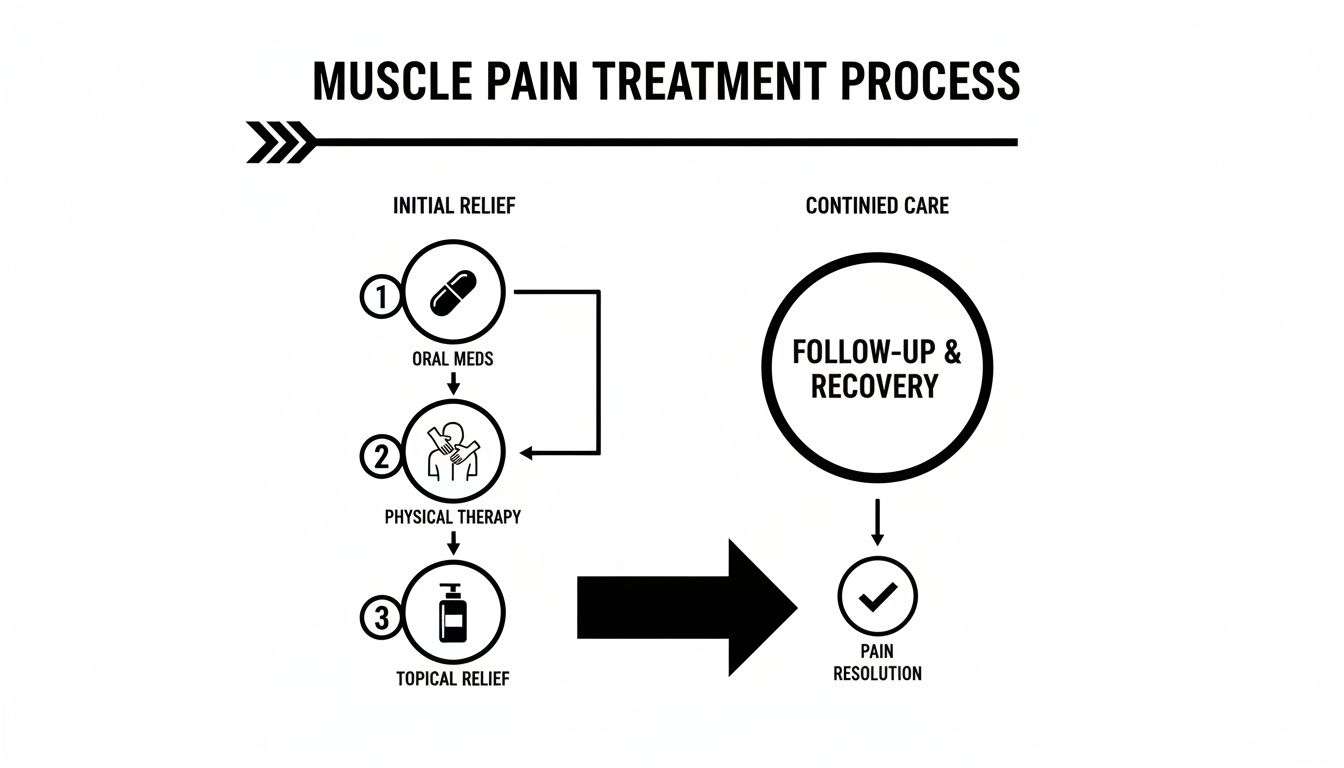
As you can see, topical relief is often the most accessible and effective first step, used either on its own or alongside other treatments like physiotherapy. For example, the stick format is perfect for covering large muscle groups like your quads or back—just apply firm pressure to work it in. For smaller joints or more targeted spots, a roll-on gives you much more precise control.
And for those days when you need an extra kick, layering products can be incredibly effective. You can learn more about combining the stick and spray to create a powerful one-two punch against stubborn pain.
A Growing Need for Effective Solutions
The demand for accessible, powerful muscle pain relief is on the rise, especially here in Canada. An aging population and an increase in sports-related injuries are major drivers. With reports showing that chronic pain affects up to 20% of Canadian adults, the need for reliable, non-prescription options has never been clearer.
This is why a Canadian-made solution like MEDISTIK, trusted by over one million customers and 10,000+ clinics, has become so indispensable. Considering that North America holds 42.8% of the muscle relaxant market share, proven topicals offer a vital, targeted alternative for everyone from elite athletes to weekend warriors.
By bringing the Prime, Perform, Restore system into your routine, you can shift from just reacting to pain to truly mastering your body's recovery. It’s an approach that helps active people stay in the game, hit their goals, and spend less time on the sidelines.
Tailored Pain Relief for Every Lifestyle
When it comes to muscle pain, there’s no such thing as a one-size-fits-all solution. A weekend gardener nursing a sore back has very different needs from a competitive athlete pushing their body to the limit. That's why a versatile approach to topical pain relief is so important—it can be adapted to fit anyone's lifestyle, ensuring you get the targeted support you need, right when you need it.
This is all about matching the right tool to the right person. Whether you’re a clinician looking to enhance patient care, an athlete chasing a new personal best, or just trying to manage daily aches and pains, the goal is the same: effective, reliable relief.
For Clinicians and Healthcare Professionals
Physiotherapists, chiropractors, and massage therapists are on the front lines, helping people manage their pain every single day. Adding a professional-grade topical like MEDISTIK into your treatment plans can make a real difference, offering patients immediate, tangible relief both during and after their sessions.
- During Treatment: Using a warming product before manual therapy helps relax tight muscles. This makes them more pliable and easier to work on, which can reduce a patient's discomfort right there on the table.
- Post-Treatment: When you send patients home with a recommendation for a topical analgesic, you’re giving them a tool to manage flare-ups between appointments. This helps them stick to their care plan and feel more in control of their recovery.
By bringing topicals into your practice, you extend the benefits of your hands-on work long after the appointment ends. It’s a simple addition that helps patients feel better faster and stay on track with their recovery goals.
For healthcare professionals, a trusted topical analgesic is more than just a product—it's an extension of their clinical care. It provides patients with an effective tool for self-management, reinforcing the clinic's commitment to comprehensive, patient-centred recovery.
For Athletes and Fitness Enthusiasts
If you’re an athlete, you know that managing the physical toll of intense training is non-negotiable. Muscle pain isn't just an inconvenience; it's a roadblock to your performance. A structured approach using topical analgesics can help you train harder, recover faster, and stay in the game.
Having clear protocols is key here. A warming stick used during warm-ups can help prime your muscles for explosive action. A fast-acting spray can be a lifesaver for cramps or strains that pop up mid-competition. Afterwards, a cooling roll-on helps dial down post-exercise inflammation, speeding up your recovery so you're ready for the next session.
When used this way, topical muscle pain relief becomes more than just a quick fix—it becomes a strategic part of your performance toolkit.
For Active Adults and Seniors
For many active adults and seniors, managing daily discomfort from chronic conditions like arthritis or a recurring bad back is essential for staying mobile and enjoying life. A reliable topical solution offers a way to maintain an independent, vibrant lifestyle without having to rely solely on oral medications.
The key is consistent, daily relief. An easy-to-apply stick can soothe a stiff lower back first thing in the morning, while a roll-on can target sore knee or hand joints as needed throughout the day. Its accessibility makes it a practical choice for handling those persistent aches, helping you stay active and do the things you love.
This kind of approach is becoming more and more important. In Canada, the pain management market is set to expand significantly, largely because of the high number of people dealing with musculoskeletal issues across all age groups. This trend really highlights the growing need for effective topical options that offer targeted, temporary relief. You can learn more about Canada's growing pain management market and see just how big the demand is for these solutions.
Knowing When to See a Medical Professional

While self-care and topical solutions are fantastic for handling everyday strains and soreness, they aren't a cure-all. A huge part of smart recovery is knowing the difference between something you can manage at home and a problem that needs a professional’s eyes on it. Listening to your body is everything—it's your best defence against turning a small issue into a big one.
Think of it like this: your body sends signals when something’s not right. A dull ache after a big workout is just a whisper, but sharp, unrelenting pain is a shout. It’s critical to know when to stop and listen to that shout instead of trying to push through.
Red Flags to Watch For
If you experience any of the following, it’s time to put the foam roller down and pick up the phone. Book an appointment with your doctor or physiotherapist, because these symptoms are not your typical post-exercise soreness and could signal a more serious injury.
- Severe, Unbearable Pain: If the pain is so bad you can't put weight on a limb or it's waking you up at night, it’s time for a professional assessment.
- Worsening Pain: A regular muscle ache should slowly get better. If your pain is actually getting worse after 48-72 hours of home care, that’s a clear sign something else is going on.
- Visible Deformity or Swelling: Any obvious changes in the shape of a joint or limb, or sudden, major swelling, are red flags for a significant injury.
- Numbness, Tingling, or Weakness: That "pins and needles" feeling or a sudden loss of strength can point to nerve involvement, which needs immediate attention.
Self-treatment is an incredibly valuable tool for recovery, but it has its limits. The single most important step you can take for your long-term health is recognizing when your pain is signalling a need for a professional diagnosis.
Sometimes, muscle pain comes with other symptoms that you should never ignore. Be on high alert if your soreness is paired with a fever, chills, or unexplained weight loss. These can be signs of an infection or another underlying medical issue that needs a prompt diagnosis. By understanding these boundaries, you can use self-care confidently for the small stuff while making sure you get expert help when it truly matters.
Common Questions About Muscle Pain Relief
When you're dealing with muscle pain, you want clear, straightforward answers. Navigating the world of pain relief can feel a bit overwhelming, so let's tackle some of the most common questions people have.
How Often Can I Apply a Topical Pain Reliever?
For most topical analgesics, including MEDISTIK, a good rule of thumb is to apply a thin layer to the sore area up to 3-4 times per day. That said, you should always check the product label for the most accurate directions.
It's also important to only apply it to intact skin—never on broken, irritated, or sensitive areas. If your pain isn't getting any better after about seven days of consistent use, it's time to check in with a healthcare professional to make sure something more serious isn't going on.
Is Heat or Ice Better for Muscle Pain?
This is the classic debate, and the answer really comes down to timing and the type of pain you’re feeling. Each one plays a very different role in the healing process.
- Ice: Your go-to for new injuries, especially within the first 48 hours. The cold constricts blood vessels, which helps dial down swelling and inflammation while giving you a bit of a numbing effect.
- Heat: Perfect for chronic muscle stiffness and soreness where there isn't a lot of swelling. Heat helps tight muscles relax and boosts blood flow to the area, which can speed up healing.
Here's an easy way to remember it: ice is for putting out the fire of a fresh injury, while heat is for soothing that stubborn, lingering stiffness. It's why you'll see some topical products designed to give you a specific cooling or warming sensation to match these needs.
Can Topical Analgesics Help With Arthritis Pain?
Absolutely. Many topical analgesics are specifically designed to offer temporary relief from the muscle and joint pain that comes with arthritis. The active ingredients get to work right where you apply them, targeting pain and inflammation at the source.
This direct, localized approach is what makes them such a great option for managing the daily aches and pains of chronic conditions like arthritis. You get relief that can improve your mobility and quality of life, often without the systemic side effects that can come with oral medications.
Ready to take control of your recovery? MEDISTIK offers a complete system of professional-grade topical solutions to help you prime, perform, and restore. Find the right product for your active life at MEDISTIK.


